World War I 
1914-1918 
USA entry- 1917
Nationalism in Europe
Deep attachments to one’s 
own nation helped unify the 
people and helped create 
competition 
Nationalism
Nations seeking economic 
growth and expansion 
Establish and expand global 
empires 
Imperialism
Build-up of military forces 
among nations 
Strong military competition 
Militarism
Hardening of alliance systems 
Triple Alliance— 
Triple Entente— 
Russia was traditionally 
Serbia’s protector 
Alliances
Building Global Empires and Military Alliances
Triple Alliance 
Germany 
Italy 
Austria-Hungary 
Triple Entente 
Great Britain 
Russia 
France
Austria-Hungary Declares war on Serbia
Archduke Franz Ferdinand, heir to 
Austro-Hungarian throne, and wife, 
Killed June 28, 1914 in 
Sarajevo by Serbian Black Hand 
member, Gavrilo Princip 
Assassination
Summer of 1914 
Franz Ferdinand assassinated June 28 
Austria issued ultimatum to Serbia; 
Serbia partially agreed July 25 
Austria declared war on Serbia July 28
Germany pledged to support Austria 
Russia mobilized to help Serbia July 30 
Germany declared war on Russia Aug 1 
France allied with Russia
Germany declared war on France Aug 3 
Germany invaded Belgium Aug 3 
Britain declared war on Germany Aug 4 
World War I Begins………..
Central Powers 
Germany, Austria-Hungary, 
Bulgaria, Ottoman Empire
Allied 
Powers 
Great Britain, France, 
Russia, Serbia, Belgium, 
US, Japan, 
Montenegro, 
Italy
The Battles Begin 
 Schlieffen Plan—Germany’s war plan 
 drawn up in 1905 
 called for invasion of neutral Belgium 
 assumed slow Russian mobilization 
 allow for quick defeat of French
Problems with Schlieffen Plan 
 Invaded heavily fortified area of Belgium 
 Great Britain involved after invasion 
 Encountered strong resistance 
 Russian army mobilized quickly 
 Split Germany forces in East
Downfall of Schlieffen Plan 
 France attacked Germans in Alsace- 
Lorraine 
 Caused delay in German advance 
 Battle of Marne caused German retreat 
 Signaled abandonment of Schlieffen Plan 
 Realized war would not end quickly 
America now starts to come into the picture…
Germany’s 
unrestricted 
submarine 
warfare 
(Sinking of the 
Lusitania) 
Zimmerman 
Telegram 
Sinking of 4 
US merchant 
ships 
US declares 
war on 
Germany 
April 6, 1917 
US entry into World War I
America_Joins_the_Ranks 4:17
Modern War 
 Submarine warfare 
 Use to get around blockades and attack enemy shipping 
 Rapid fire machine guns 
 Led to trench warfare 
 “Trench warfare” 
 Thousands of miles of ditches for protection 
 6,250 miles of Trenches 
 In-between was “no man’s land” 
 Lines never moved resulting in “Stalemate” 
 Tanks 
 Designed to break through barbed wire 
 Airplanes 
 Primary function—to observe enemy activities 
 Poison gas 
 Introduced by Germans to help break stalemates
Realities_of_War_the_Trenches_Weapons_and_Death 3:34
John 
"Black Jack" 
Pershing 
Named Commander of 
American Expeditionary Force 
(AEF) during WWI by Woodrow 
Wilson 
 Insisted that U.S. soldiers fight as a 
unit and not be spread throughout 
French forces 
 Led forces at Battle of Argonne Forest
The Home Front 
Selective Service – 2.8 million 
drafted 
War Industries Board/CREEL 
Committee– coordinate production 
of war materials 
Daylight savings time 
Bonds – Liberty and Victory 
 WWI Propaganda posters! Click here 
Scheck vs. United States
Espionage Act of 1918
 Committee on Public Information – selling the war to the public
Women’s Roles 
Women 
 Fill jobs in factories 
 Military service 
• Allowed to enlist in Navy 
• Fill temporary jobs in Army 
• Army nurses were only military 
women allowed to go overseas
African Americans 
Served in segregated 
units in military 
 “Harlem Hell-Fighters” 
• 369th Infantry Unit 
“Great Migration” 
Movement from 
South to North to 
fill factory jobs
1917 Russia pulls out of the War 
• Closing Eastern front allowing the 
German’s to focus on Western Front 
• American troops arrive in 1917
Battle of Argonne Forest 
 1918 
 Allies launch Meuse- 
Argonne Offensive 
• Final assault 
• General Pershing 
assembled over 
600,000 American 
troops with 40,000 tons 
of supplies and 4,000 
artillery pieces at hand. 
• The Americans had 
heavy losses but 
opened a hole into the 
German lines. 
 Kaiser Wilhelm II 
abdicates 
 Germany surrenders
1918_America_Arrives_Just_in_Time 2:00
War ends 11th Hour of 11th 
Day of 11th Month 1918 
Now what we know as “Veterans Day”
Treaty of Versailles 
 “Big Four” : United States, Great Britain, 
France, Italy 
Wilson’s Fourteen Points 
 Plan for peace after war 
 League of Nations (UN) 
•General association of nations 
 Help preserve peace 
 Help prevent future wars
Treaty of Versailles….cont’d 
Congress never signed Treaty of 
Versailles 
 US never member of League of Nations 
• Henry Cabot Lodge was chief opponent of Wilson 
• Senate saw the League as a “conflict of interest” that could pull us 
into another war- saw it as an “Alliance” 
 Germany’s punishment 
 Accept blame for causing war 
 Reduce military 
 Pay war reparations $$$$
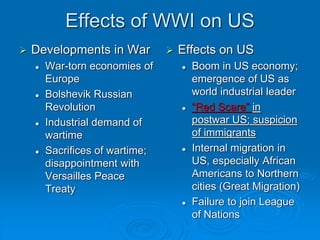
Effects of WWI on US 
 Developments in War 
 War-torn economies of 
Europe 
 Bolshevik Russian 
Revolution 
 Industrial demand of 
wartime 
 Sacrifices of wartime; 
disappointment with 
Versailles Peace 
Treaty 
 Effects on US 
 Boom in US economy; 
emergence of US as 
world industrial leader 
 “Red Scare” in 
postwar US; suspicion 
of immigrants 
 Internal migration in 
US, especially African 
Americans to Northern 
cities (Great Migration) 
 Failure to join League 
of Nations
Peace_Diplomacy_and_Reparation 6:50

14 world war i

  • 1.
    World War I 1914-1918 USA entry- 1917
  • 2.
  • 3.
    Deep attachments toone’s own nation helped unify the people and helped create competition Nationalism
  • 4.
    Nations seeking economic growth and expansion Establish and expand global empires Imperialism
  • 5.
    Build-up of militaryforces among nations Strong military competition Militarism
  • 6.
    Hardening of alliancesystems Triple Alliance— Triple Entente— Russia was traditionally Serbia’s protector Alliances
  • 7.
    Building Global Empiresand Military Alliances
  • 8.
    Triple Alliance Germany Italy Austria-Hungary Triple Entente Great Britain Russia France
  • 9.
  • 10.
    Archduke Franz Ferdinand,heir to Austro-Hungarian throne, and wife, Killed June 28, 1914 in Sarajevo by Serbian Black Hand member, Gavrilo Princip Assassination
  • 11.
    Summer of 1914 Franz Ferdinand assassinated June 28 Austria issued ultimatum to Serbia; Serbia partially agreed July 25 Austria declared war on Serbia July 28
  • 12.
    Germany pledged tosupport Austria Russia mobilized to help Serbia July 30 Germany declared war on Russia Aug 1 France allied with Russia
  • 13.
    Germany declared waron France Aug 3 Germany invaded Belgium Aug 3 Britain declared war on Germany Aug 4 World War I Begins………..
  • 14.
    Central Powers Germany,Austria-Hungary, Bulgaria, Ottoman Empire
  • 15.
    Allied Powers GreatBritain, France, Russia, Serbia, Belgium, US, Japan, Montenegro, Italy
  • 16.
    The Battles Begin  Schlieffen Plan—Germany’s war plan  drawn up in 1905  called for invasion of neutral Belgium  assumed slow Russian mobilization  allow for quick defeat of French
  • 17.
    Problems with SchlieffenPlan  Invaded heavily fortified area of Belgium  Great Britain involved after invasion  Encountered strong resistance  Russian army mobilized quickly  Split Germany forces in East
  • 18.
    Downfall of SchlieffenPlan  France attacked Germans in Alsace- Lorraine  Caused delay in German advance  Battle of Marne caused German retreat  Signaled abandonment of Schlieffen Plan  Realized war would not end quickly America now starts to come into the picture…
  • 19.
    Germany’s unrestricted submarine warfare (Sinking of the Lusitania) Zimmerman Telegram Sinking of 4 US merchant ships US declares war on Germany April 6, 1917 US entry into World War I
  • 20.
  • 23.
    Modern War Submarine warfare  Use to get around blockades and attack enemy shipping  Rapid fire machine guns  Led to trench warfare  “Trench warfare”  Thousands of miles of ditches for protection  6,250 miles of Trenches  In-between was “no man’s land”  Lines never moved resulting in “Stalemate”  Tanks  Designed to break through barbed wire  Airplanes  Primary function—to observe enemy activities  Poison gas  Introduced by Germans to help break stalemates
  • 27.
  • 29.
    John "Black Jack" Pershing Named Commander of American Expeditionary Force (AEF) during WWI by Woodrow Wilson  Insisted that U.S. soldiers fight as a unit and not be spread throughout French forces  Led forces at Battle of Argonne Forest
  • 31.
    The Home Front Selective Service – 2.8 million drafted War Industries Board/CREEL Committee– coordinate production of war materials Daylight savings time Bonds – Liberty and Victory  WWI Propaganda posters! Click here 
  • 33.
  • 34.
  • 35.
     Committee onPublic Information – selling the war to the public
  • 38.
    Women’s Roles Women  Fill jobs in factories  Military service • Allowed to enlist in Navy • Fill temporary jobs in Army • Army nurses were only military women allowed to go overseas
  • 39.
    African Americans Servedin segregated units in military  “Harlem Hell-Fighters” • 369th Infantry Unit “Great Migration” Movement from South to North to fill factory jobs
  • 40.
    1917 Russia pullsout of the War • Closing Eastern front allowing the German’s to focus on Western Front • American troops arrive in 1917
  • 41.
    Battle of ArgonneForest  1918  Allies launch Meuse- Argonne Offensive • Final assault • General Pershing assembled over 600,000 American troops with 40,000 tons of supplies and 4,000 artillery pieces at hand. • The Americans had heavy losses but opened a hole into the German lines.  Kaiser Wilhelm II abdicates  Germany surrenders
  • 42.
  • 43.
    War ends 11thHour of 11th Day of 11th Month 1918 Now what we know as “Veterans Day”
  • 44.
    Treaty of Versailles  “Big Four” : United States, Great Britain, France, Italy Wilson’s Fourteen Points  Plan for peace after war  League of Nations (UN) •General association of nations  Help preserve peace  Help prevent future wars
  • 45.
    Treaty of Versailles….cont’d Congress never signed Treaty of Versailles  US never member of League of Nations • Henry Cabot Lodge was chief opponent of Wilson • Senate saw the League as a “conflict of interest” that could pull us into another war- saw it as an “Alliance”  Germany’s punishment  Accept blame for causing war  Reduce military  Pay war reparations $$$$
  • 46.
    Effects of WWIon US  Developments in War  War-torn economies of Europe  Bolshevik Russian Revolution  Industrial demand of wartime  Sacrifices of wartime; disappointment with Versailles Peace Treaty  Effects on US  Boom in US economy; emergence of US as world industrial leader  “Red Scare” in postwar US; suspicion of immigrants  Internal migration in US, especially African Americans to Northern cities (Great Migration)  Failure to join League of Nations
  • 47.