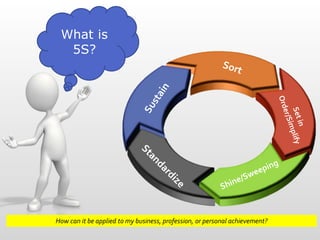
What is
5S?
How can it be applied to my business, profession, or personal achievement?
5S Background
The 5S methodology (originally Total Production System-TPS) was developed after World War
II. This methodology was developed by SakichiToyoda, son of Kiichiro, and Taiichi Ohno, a
Toyota engineer.
These threeToyota representatives looked at Ford Motor Company assembly lines and the
inventory process at the supermarket PigglyWiggly. Through the analysis at Ford, they noticed
waste along with workers who had to wait for one step to be completed which resulted in layoffs
and rehiring.
At Piggly Wiggly supermarkets, their inventory system of ordering only what was needed based
on demand helped them understand and implement the Just-In-Time or JIT process into the 5S
methodology.
How to organize a work space for efficiency and effectiveness by identifying and storing the
items used, maintaining the area and items, and sustaining the new order. The decision-making
process usually comes from a dialogue about standardization.
Sort
• Make work easier by eliminating obstacles.
• Reduce chances of being disturbed with
unnecessary items.
• Evaluate necessary items with regard to cost or
other factors.
• Remove all parts or tools that are not in use.
• Segregate unwanted material from the
workplace.
• Need fully skilled supervisor for checking on a
regular basis.
• Waste removal.
• Make clear all working floor except using
material.
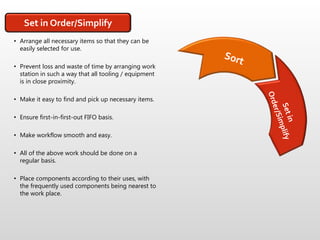
Set in Order/Simplify
• Arrange all necessary items so that they can be
easily selected for use.
• Prevent loss and waste of time by arranging work
station in such a way that all tooling / equipment
is in close proximity.
• Make it easy to find and pick up necessary items.
• Ensure first-in-first-out FIFO basis.
• Make workflow smooth and easy.
• All of the above work should be done on a
regular basis.
• Place components according to their uses, with
the frequently used components being nearest to
the work place.
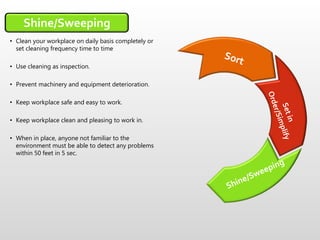
Shine/Sweeping
• Clean your workplace on daily basis completely or
set cleaning frequency time to time
• Use cleaning as inspection.
• Prevent machinery and equipment deterioration.
• Keep workplace safe and easy to work.
• Keep workplace clean and pleasing to work in.
• When in place, anyone not familiar to the
environment must be able to detect any problems
within 50 feet in 5 sec.
Shine/Sweeping
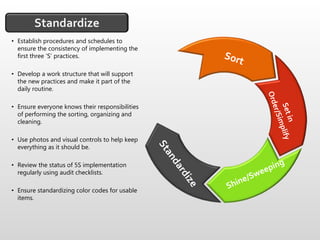
Standardize
• Establish procedures and schedules to
ensure the consistency of implementing the
first three ‘S’ practices.
• Develop a work structure that will support
the new practices and make it part of the
daily routine.
• Ensure everyone knows their responsibilities
of performing the sorting, organizing and
cleaning.
• Use photos and visual controls to help keep
everything as it should be.
• Review the status of 5S implementation
regularly using audit checklists.
• Ensure standardizing color codes for usable
items.
Sustain
• Also translates as "do without being told".
• Perform regular audits.
• Training and discipline.
• Training is goal-oriented process. Resulting
feedback is necessary on a regular routine
basis.
• Self-discipline
• To maintain proper order, ensure all defined
standards are being implemented and heard.
• Follow the process, but also be open to
improvement
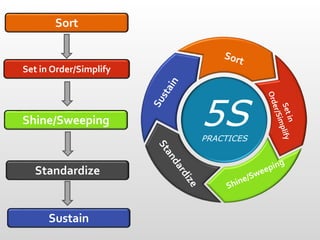
5SPRACTICES
Sort
Sustain
Standardize
Shine/Sweeping
Set in Order/Simplify
5S Methodology
The 5S Methodology was
originally developed for a
production environment.
However, these 5 principles can be
applied to every position in a
company.
Try it and see how you can
become more efficient and
improve your output.
5SPRACTICES
5S Methodology
If this Slide Presentation was helpful, please Like It
and Share It with your Community.

5S Methodology

  • 1.
    What is 5S? How canit be applied to my business, profession, or personal achievement?
  • 2.
    5S Background The 5Smethodology (originally Total Production System-TPS) was developed after World War II. This methodology was developed by SakichiToyoda, son of Kiichiro, and Taiichi Ohno, a Toyota engineer. These threeToyota representatives looked at Ford Motor Company assembly lines and the inventory process at the supermarket PigglyWiggly. Through the analysis at Ford, they noticed waste along with workers who had to wait for one step to be completed which resulted in layoffs and rehiring. At Piggly Wiggly supermarkets, their inventory system of ordering only what was needed based on demand helped them understand and implement the Just-In-Time or JIT process into the 5S methodology. How to organize a work space for efficiency and effectiveness by identifying and storing the items used, maintaining the area and items, and sustaining the new order. The decision-making process usually comes from a dialogue about standardization.
  • 3.
    Sort • Make workeasier by eliminating obstacles. • Reduce chances of being disturbed with unnecessary items. • Evaluate necessary items with regard to cost or other factors. • Remove all parts or tools that are not in use. • Segregate unwanted material from the workplace. • Need fully skilled supervisor for checking on a regular basis. • Waste removal. • Make clear all working floor except using material.
  • 4.
    Set in Order/Simplify •Arrange all necessary items so that they can be easily selected for use. • Prevent loss and waste of time by arranging work station in such a way that all tooling / equipment is in close proximity. • Make it easy to find and pick up necessary items. • Ensure first-in-first-out FIFO basis. • Make workflow smooth and easy. • All of the above work should be done on a regular basis. • Place components according to their uses, with the frequently used components being nearest to the work place.
  • 5.
    Shine/Sweeping • Clean yourworkplace on daily basis completely or set cleaning frequency time to time • Use cleaning as inspection. • Prevent machinery and equipment deterioration. • Keep workplace safe and easy to work. • Keep workplace clean and pleasing to work in. • When in place, anyone not familiar to the environment must be able to detect any problems within 50 feet in 5 sec. Shine/Sweeping
  • 6.
    Standardize • Establish proceduresand schedules to ensure the consistency of implementing the first three ‘S’ practices. • Develop a work structure that will support the new practices and make it part of the daily routine. • Ensure everyone knows their responsibilities of performing the sorting, organizing and cleaning. • Use photos and visual controls to help keep everything as it should be. • Review the status of 5S implementation regularly using audit checklists. • Ensure standardizing color codes for usable items.
  • 7.
    Sustain • Also translatesas "do without being told". • Perform regular audits. • Training and discipline. • Training is goal-oriented process. Resulting feedback is necessary on a regular routine basis. • Self-discipline • To maintain proper order, ensure all defined standards are being implemented and heard. • Follow the process, but also be open to improvement
  • 8.
  • 9.
    5S Methodology The 5SMethodology was originally developed for a production environment. However, these 5 principles can be applied to every position in a company. Try it and see how you can become more efficient and improve your output. 5SPRACTICES
  • 10.
    5S Methodology If thisSlide Presentation was helpful, please Like It and Share It with your Community.