Lean
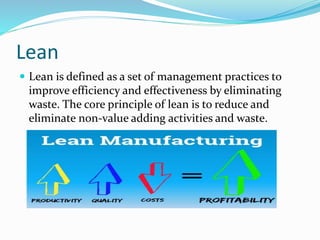
 Lean is defined as a set of management practices to
improve efficiency and effectiveness by eliminating
waste. The core principle of lean is to reduce and
eliminate non-value adding activities and waste.
The origins of 5S
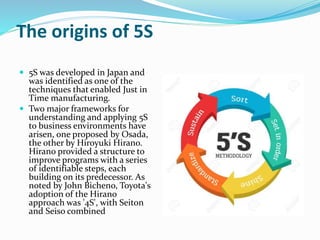
 5S was developed in Japan and
was identified as one of the
techniques that enabled Just in
Time manufacturing.
 Two major frameworks for
understanding and applying 5S
to business environments have
arisen, one proposed by Osada,
the other by Hiroyuki Hirano.
Hirano provided a structure to
improve programs with a series
of identifiable steps, each
building on its predecessor. As
noted by John Bicheno, Toyota's
adoption of the Hirano
approach was '4S', with Seiton
and Seiso combined
What is mean by 5S?
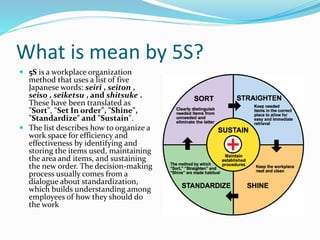
 5S is a workplace organization
method that uses a list of five
Japanese words: seiri , seiton ,
seiso , seiketsu , and shitsuke .
These have been translated as
"Sort", "Set In order", "Shine",
"Standardize" and "Sustain".
 The list describes how to organize a
work space for efficiency and
effectiveness by identifying and
storing the items used, maintaining
the area and items, and sustaining
the new order. The decision-making
process usually comes from a
dialogue about standardization,
which builds understanding among
employees of how they should do
the work
Sort (Seiri)
 Sort (Seiri)
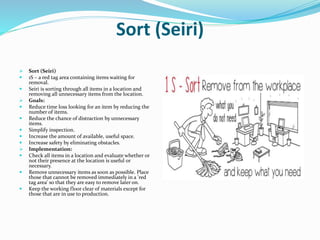
 1S – a red tag area containing items waiting for
removal.
 Seiri is sorting through all items in a location and
removing all unnecessary items from the location.
 Goals:
 Reduce time loss looking for an item by reducing the
number of items.
 Reduce the chance of distraction by unnecessary
items.
 Simplify inspection.
 Increase the amount of available, useful space.
 Increase safety by eliminating obstacles.
 Implementation:
 Check all items in a location and evaluate whether or
not their presence at the location is useful or
necessary.
 Remove unnecessary items as soon as possible. Place
those that cannot be removed immediately in a 'red
tag area' so that they are easy to remove later on.
 Keep the working floor clear of materials except for
those that are in use to production.
Set In Order (Seiton)
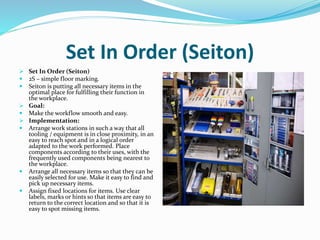
 Set In Order (Seiton)
 2S – simple floor marking.
 Seiton is putting all necessary items in the
optimal place for fulfilling their function in
the workplace.
 Goal:
 Make the workflow smooth and easy.
 Implementation:
 Arrange work stations in such a way that all
tooling / equipment is in close proximity, in an
easy to reach spot and in a logical order
adapted to the work performed. Place
components according to their uses, with the
frequently used components being nearest to
the workplace.
 Arrange all necessary items so that they can be
easily selected for use. Make it easy to find and
pick up necessary items.
 Assign fixed locations for items. Use clear
labels, marks or hints so that items are easy to
return to the correct location and so that it is
easy to spot missing items.
Shine(Seiso)
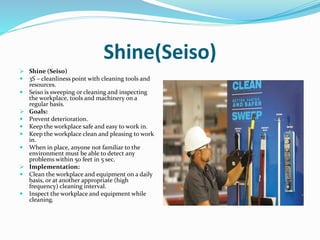
 Shine (Seiso)
 3S – cleanliness point with cleaning tools and
resources.
 Seiso is sweeping or cleaning and inspecting
the workplace, tools and machinery on a
regular basis.
 Goals:
 Prevent deterioration.
 Keep the workplace safe and easy to work in.
 Keep the workplace clean and pleasing to work
in.
 When in place, anyone not familiar to the
environment must be able to detect any
problems within 50 feet in 5 sec.
 Implementation:
 Clean the workplace and equipment on a daily
basis, or at another appropriate (high
frequency) cleaning interval.
 Inspect the workplace and equipment while
cleaning.
Standardize (Seiketsu)
 Standardize (Seiketsu)
 Seiketsu is to standardize the processes
used to sort, order and clean the
workplace.
 Goal:
 Establish procedures and schedules to
ensure the repetition of the first three ‘S’
practices.
 Implementation:
 Develop a work structure that will
support the new practices and make it
part of the daily routine.
 Ensure everyone knows their
responsibilities of performing the
sorting, organizing and cleaning.
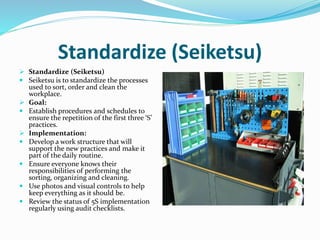
 Use photos and visual controls to help
keep everything as it should be.
 Review the status of 5S implementation
regularly using audit checklists.
Sustain/Self-discipline (Shitsuke)
 Sustain/Self-discipline (Shitsuke)
 Shitsuke or sustain the developed
processes by self-discipline of the
workers. Also translates as "do without
being told".
 Goal:
 Ensure that the 5S approach is followed.
 Implementation:
 Organize training sessions.
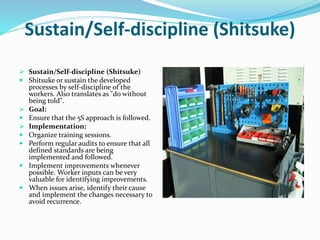
 Perform regular audits to ensure that all
defined standards are being
implemented and followed.
 Implement improvements whenever
possible. Worker inputs can be very
valuable for identifying improvements.
 When issues arise, identify their cause
and implement the changes necessary to
avoid recurrence.
Variety of 5S applications
 5S methodology has expanded from
manufacturing and is now being
applied to a wide variety of
industries including health care,
education, and government.
 Visual management and 5S can be
particularly beneficial in health care
because a frantic search for supplies
to treat an in-trouble patient (a
chronic problem in health care) can
have dire consequences.[
 Although the origins of the 5S
methodology are in manufacturing ,
it can also be applied to knowledge
economy work, with information,
software, or media in the place of
physical product

5s lean manufacturing tool

  • 2.
    Lean  Lean isdefined as a set of management practices to improve efficiency and effectiveness by eliminating waste. The core principle of lean is to reduce and eliminate non-value adding activities and waste.
  • 3.
    The origins of5S  5S was developed in Japan and was identified as one of the techniques that enabled Just in Time manufacturing.  Two major frameworks for understanding and applying 5S to business environments have arisen, one proposed by Osada, the other by Hiroyuki Hirano. Hirano provided a structure to improve programs with a series of identifiable steps, each building on its predecessor. As noted by John Bicheno, Toyota's adoption of the Hirano approach was '4S', with Seiton and Seiso combined
  • 4.
    What is meanby 5S?  5S is a workplace organization method that uses a list of five Japanese words: seiri , seiton , seiso , seiketsu , and shitsuke . These have been translated as "Sort", "Set In order", "Shine", "Standardize" and "Sustain".  The list describes how to organize a work space for efficiency and effectiveness by identifying and storing the items used, maintaining the area and items, and sustaining the new order. The decision-making process usually comes from a dialogue about standardization, which builds understanding among employees of how they should do the work
  • 5.
    Sort (Seiri)  Sort(Seiri)  1S – a red tag area containing items waiting for removal.  Seiri is sorting through all items in a location and removing all unnecessary items from the location.  Goals:  Reduce time loss looking for an item by reducing the number of items.  Reduce the chance of distraction by unnecessary items.  Simplify inspection.  Increase the amount of available, useful space.  Increase safety by eliminating obstacles.  Implementation:  Check all items in a location and evaluate whether or not their presence at the location is useful or necessary.  Remove unnecessary items as soon as possible. Place those that cannot be removed immediately in a 'red tag area' so that they are easy to remove later on.  Keep the working floor clear of materials except for those that are in use to production.
  • 6.
    Set In Order(Seiton)  Set In Order (Seiton)  2S – simple floor marking.  Seiton is putting all necessary items in the optimal place for fulfilling their function in the workplace.  Goal:  Make the workflow smooth and easy.  Implementation:  Arrange work stations in such a way that all tooling / equipment is in close proximity, in an easy to reach spot and in a logical order adapted to the work performed. Place components according to their uses, with the frequently used components being nearest to the workplace.  Arrange all necessary items so that they can be easily selected for use. Make it easy to find and pick up necessary items.  Assign fixed locations for items. Use clear labels, marks or hints so that items are easy to return to the correct location and so that it is easy to spot missing items.
  • 7.
    Shine(Seiso)  Shine (Seiso) 3S – cleanliness point with cleaning tools and resources.  Seiso is sweeping or cleaning and inspecting the workplace, tools and machinery on a regular basis.  Goals:  Prevent deterioration.  Keep the workplace safe and easy to work in.  Keep the workplace clean and pleasing to work in.  When in place, anyone not familiar to the environment must be able to detect any problems within 50 feet in 5 sec.  Implementation:  Clean the workplace and equipment on a daily basis, or at another appropriate (high frequency) cleaning interval.  Inspect the workplace and equipment while cleaning.
  • 8.
    Standardize (Seiketsu)  Standardize(Seiketsu)  Seiketsu is to standardize the processes used to sort, order and clean the workplace.  Goal:  Establish procedures and schedules to ensure the repetition of the first three ‘S’ practices.  Implementation:  Develop a work structure that will support the new practices and make it part of the daily routine.  Ensure everyone knows their responsibilities of performing the sorting, organizing and cleaning.  Use photos and visual controls to help keep everything as it should be.  Review the status of 5S implementation regularly using audit checklists.
  • 9.
    Sustain/Self-discipline (Shitsuke)  Sustain/Self-discipline(Shitsuke)  Shitsuke or sustain the developed processes by self-discipline of the workers. Also translates as "do without being told".  Goal:  Ensure that the 5S approach is followed.  Implementation:  Organize training sessions.  Perform regular audits to ensure that all defined standards are being implemented and followed.  Implement improvements whenever possible. Worker inputs can be very valuable for identifying improvements.  When issues arise, identify their cause and implement the changes necessary to avoid recurrence.
  • 10.
    Variety of 5Sapplications  5S methodology has expanded from manufacturing and is now being applied to a wide variety of industries including health care, education, and government.  Visual management and 5S can be particularly beneficial in health care because a frantic search for supplies to treat an in-trouble patient (a chronic problem in health care) can have dire consequences.[  Although the origins of the 5S methodology are in manufacturing , it can also be applied to knowledge economy work, with information, software, or media in the place of physical product