By: Carlos Sanchez
 TOPIC Slides
 5S History & Benefits 03
 What are the 5S? 04-19
 How to implement 5S 20-21
 5S Audits 22-23
6STraining
2
 Born in Toyota (No kidding!)
 Why?
◦ To create a sense of ownership and responsibility to
the workers for their workplace
 What are the Benefits of 5S?
◦ High Quality products & Services
◦ Little or no Waste
◦ High productivity
◦ Better controlled inventories
◦ Better work culture
◦ Less accidents & Absenteeism
3
6STraining
 S1. Sorting
 S2. Straighten
 S3. Shine
 S4. Standardize
 S5. Sustain
 S6. Safety (New S)
4
5STraining
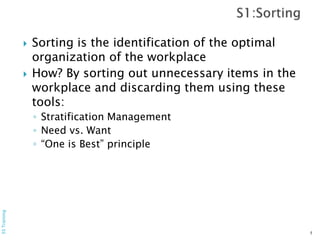
 Sorting is the identification of the optimal
organization of the workplace
 How? By sorting out unnecessary items in the
workplace and discarding them using these
tools:
◦ Stratification Management
◦ Need vs. Want
◦ “One is Best” principle
5
5STraining
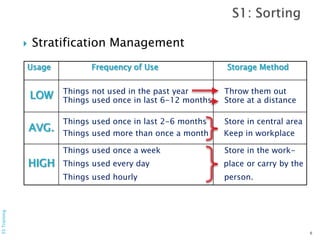
 Stratification Management
6
Usage Frequency of Use Storage Method
Things not used in the past year Throw them out
Things used once in last 6-12 months Store at a distance
Things used once in last 2-6 months Store in central area
Things used more than once a month Keep in workplace
Things used once a week Store in the work-
Things used every day place or carry by the
Things used hourly person.
LOW
HIGH
AVG.
5STraining
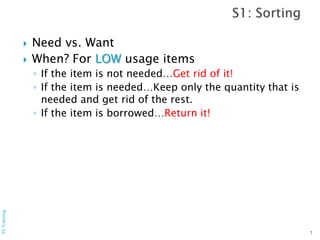
 Need vs. Want
 When? For LOW usage items
◦ If the item is not needed…Get rid of it!
◦ If the item is needed…Keep only the quantity that is
needed and get rid of the rest.
◦ If the item is borrowed…Return it!
7
5STraining
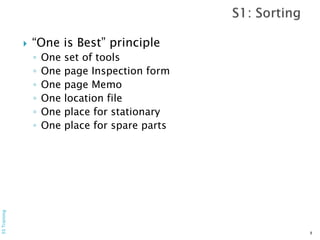
 “One is Best” principle
◦ One set of tools
◦ One page Inspection form
◦ One page Memo
◦ One location file
◦ One place for stationary
◦ One place for spare parts
8
5STraining
 Straighten is the process by which the
optimal organization identified in S1 is put to
use.
 How?
◦ Arrange things so they can be accessible
◦ All things have a defined name & place
◦ Decide how things should be put away
◦ Define put away rules for things…and follow them!
9
5STraining
 Arrange Things so they can be accessible
 How?
◦ Analyze how people get things out and put them
away, and measure the time. The goal is to reduce
this time to the minimal.
 Typical reasons for excessive time delays:
◦ Not sure where things are kept
◦ Not sure of what things are called (No labelling)
◦ Storage site is too far
◦ Several storage sites
◦ Unclear if things are in stock
◦ Things are too big/heavy to move around
10
5STraining
 All Things have a defined name & place (Visual
Factory)
 How?
◦ Develop criteria for deciding where Things belong
◦ If a Thing has several know names; choose only one!
◦ Identify similar Things with unique name or code
◦ Make a diagram of the area, locating each Thing
◦ Take pictures of how the area should look like and
each Thing in its place
11
6STraining
 Decide how things should be put away
 How?
◦ Think of storage of Things with retrieval in mind
◦ Label each storage location with the Thing’s name
◦ Each Thing must have a location associated with it
◦ Frequently used Things need to be retrieved easily
◦ All heavy Things should be stored near the floor
◦ Make it comfortable for the person (Ergonomics)
12
5STraining
 Define put away rules for things
 How?
◦ Always put things back where they belong (really?)
◦ Manage inventories to avoid stock out
◦ Have an indication of who is using the thing and
when it’s expected back
◦ Make it obvious that the thing is missing (Shadow
outlines)
◦ Take a picture of the area with all its things in place
for visual reference (Poster)
13
6STraining
 Shine is about cleanliness
 How?
◦ Identify each area of the company and assign
responsibilities to keep it clean.
◦ Everyone is responsible for S3
 Why is it so important?
◦ Lack of cleanliness could cause
 Things falling of carts and getting damaged
 Dust and grime contaminating key processes
 Dust getting into electrical contacts causing shorts
 Garbage accumulating near electrical equipment
causing fires
 Computer malfunction due to dust accumulation
14
5STraining
 Standardize is the system we put in place to
maintain the first three S’s Sorting, Straighten,
& Shine
 How?
◦ Set a high standard of workplace housekeeping
◦ “Visually Manage” the workplace
◦ React quickly when any of the S’s are not followed
◦ Create color coding and label areas and things
 Some tools:
◦ Labels, Tags & Marking
◦ Transparent Windowing
◦ Visualizing Conditions
◦ Trouble Maps
◦ Measure & Show 15
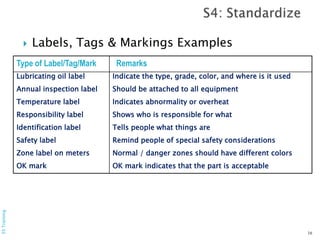
 Labels, Tags & Markings Examples
16
Type of Label/Tag/Mark Remarks
Lubricating oil label Indicate the type, grade, color, and where is it used
Annual inspection label Should be attached to all equipment
Temperature label Indicates abnormality or overheat
Responsibility label Shows who is responsible for what
Identification label Tells people what things are
Safety label Remind people of special safety considerations
Zone label on meters Normal / danger zones should have different colors
OK mark OK mark indicates that the part is acceptable
5STraining
 Transparent Windowing
◦ Make covers transparent or take them off. Let
everyone see what is stored and how good or bad
things look. Avoid the “Out of sight-Out of mind”
 Visualizing Conditions
◦ Highlight the condition of a process, like:
 Put windows in drainpipes so people can see effluent
flowing
 Tie ribbons to fans so people can “see” the breeze
 Trouble Maps
◦ Show emergency exits, fire fighting equipment on a
map of the workplace and post it everywhere.
 Measure & Show
◦ Measure the process and display the statistical
analysis, identify the limits and mark deviations 17
5STraining
 Sustain is the strategy used to keep everyone
engaged with the practices of the previous 4
S’s
 How?
◦ Discipline, Discipline, and more Discipline
◦ Make it a habit
◦ Walk the talk
◦ Audit the workplace and make it visible which areas
are Great, which are Good, and which are Not so
Good
◦ Don’t punish…re-train and follow up
◦ It never ends
18
 Safety must precede everything we do, it’s no
use to have an organized workplace if it’s not
safe for the people working on it
 How?
◦ Identify all required Personal Protective Equipment
(PPE) in all the visual documentation
◦ Perform risk assessments to processes and
establish controls to assure the safety of the person
◦ Post visual alerts to potential work hazards
(Temperature, Speed, Safe distances, etc.)
◦ Include safety in the workplace audits of 6S, and
react immediately to any unsafe conditions
identified.
6STraining
19
 5S requires commitment from Everyone in the
plant.
 5S requires a person to lead the
implementation process, typically its called
the 5S Champion or 5S Leader
 Steps:
◦ Implementation Plan
◦ 5S Awareness training for Everyone in the plant
◦ Promote the plan when ever possible
◦ Choose pilot area to start
◦ Showcase the results with the rest of the plant
◦ Replicate the process
◦ Audit, Audit, and keep auditing
◦ Take Before-After pictures 20
5STraining
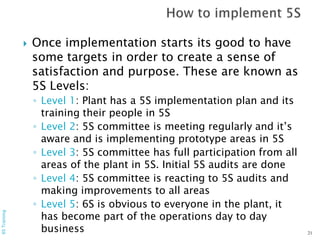
 Once implementation starts its good to have
some targets in order to create a sense of
satisfaction and purpose. These are known as
5S Levels:
◦ Level 1: Plant has a 5S implementation plan and its
training their people in 5S
◦ Level 2: 5S committee is meeting regularly and it’s
aware and is implementing prototype areas in 5S
◦ Level 3: 5S committee has full participation from all
areas of the plant in 5S. Initial 5S audits are done
◦ Level 4: 5S committee is reacting to 5S audits and
making improvements to all areas
◦ Level 5: 6S is obvious to everyone in the plant, it
has become part of the operations day to day
business
6STraining
21
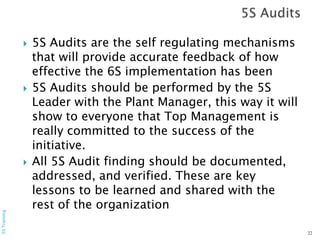
 5S Audits are the self regulating mechanisms
that will provide accurate feedback of how
effective the 6S implementation has been
 5S Audits should be performed by the 5S
Leader with the Plant Manager, this way it will
show to everyone that Top Management is
really committed to the success of the
initiative.
 All 5S Audit finding should be documented,
addressed, and verified. These are key
lessons to be learned and shared with the
rest of the organization
22
5STraining
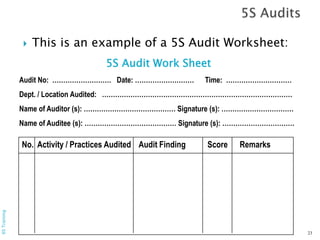
 This is an example of a 5S Audit Worksheet:
6STraining
23
Audit No: ……………………… Date: ……………………… Time: …………………………
Dept. / Location Audited: ……………………………………………………………………………
Name of Auditor (s): …………………………………… Signature (s): ……………………………
Name of Auditee (s): …………………………………… Signature (s): ……………………………
No. Activity / Practices Audited Audit Finding Score Remarks
5S Audit Work Sheet

5S Basic Training, V1 By Carlos Sanchez

  • 1.
  • 2.
     TOPIC Slides 5S History & Benefits 03  What are the 5S? 04-19  How to implement 5S 20-21  5S Audits 22-23 6STraining 2
  • 3.
     Born inToyota (No kidding!)  Why? ◦ To create a sense of ownership and responsibility to the workers for their workplace  What are the Benefits of 5S? ◦ High Quality products & Services ◦ Little or no Waste ◦ High productivity ◦ Better controlled inventories ◦ Better work culture ◦ Less accidents & Absenteeism 3 6STraining
  • 4.
     S1. Sorting S2. Straighten  S3. Shine  S4. Standardize  S5. Sustain  S6. Safety (New S) 4 5STraining
  • 5.
     Sorting isthe identification of the optimal organization of the workplace  How? By sorting out unnecessary items in the workplace and discarding them using these tools: ◦ Stratification Management ◦ Need vs. Want ◦ “One is Best” principle 5 5STraining
  • 6.
     Stratification Management 6 UsageFrequency of Use Storage Method Things not used in the past year Throw them out Things used once in last 6-12 months Store at a distance Things used once in last 2-6 months Store in central area Things used more than once a month Keep in workplace Things used once a week Store in the work- Things used every day place or carry by the Things used hourly person. LOW HIGH AVG. 5STraining
  • 7.
     Need vs.Want  When? For LOW usage items ◦ If the item is not needed…Get rid of it! ◦ If the item is needed…Keep only the quantity that is needed and get rid of the rest. ◦ If the item is borrowed…Return it! 7 5STraining
  • 8.
     “One isBest” principle ◦ One set of tools ◦ One page Inspection form ◦ One page Memo ◦ One location file ◦ One place for stationary ◦ One place for spare parts 8 5STraining
  • 9.
     Straighten isthe process by which the optimal organization identified in S1 is put to use.  How? ◦ Arrange things so they can be accessible ◦ All things have a defined name & place ◦ Decide how things should be put away ◦ Define put away rules for things…and follow them! 9 5STraining
  • 10.
     Arrange Thingsso they can be accessible  How? ◦ Analyze how people get things out and put them away, and measure the time. The goal is to reduce this time to the minimal.  Typical reasons for excessive time delays: ◦ Not sure where things are kept ◦ Not sure of what things are called (No labelling) ◦ Storage site is too far ◦ Several storage sites ◦ Unclear if things are in stock ◦ Things are too big/heavy to move around 10 5STraining
  • 11.
     All Thingshave a defined name & place (Visual Factory)  How? ◦ Develop criteria for deciding where Things belong ◦ If a Thing has several know names; choose only one! ◦ Identify similar Things with unique name or code ◦ Make a diagram of the area, locating each Thing ◦ Take pictures of how the area should look like and each Thing in its place 11 6STraining
  • 12.
     Decide howthings should be put away  How? ◦ Think of storage of Things with retrieval in mind ◦ Label each storage location with the Thing’s name ◦ Each Thing must have a location associated with it ◦ Frequently used Things need to be retrieved easily ◦ All heavy Things should be stored near the floor ◦ Make it comfortable for the person (Ergonomics) 12 5STraining
  • 13.
     Define putaway rules for things  How? ◦ Always put things back where they belong (really?) ◦ Manage inventories to avoid stock out ◦ Have an indication of who is using the thing and when it’s expected back ◦ Make it obvious that the thing is missing (Shadow outlines) ◦ Take a picture of the area with all its things in place for visual reference (Poster) 13 6STraining
  • 14.
     Shine isabout cleanliness  How? ◦ Identify each area of the company and assign responsibilities to keep it clean. ◦ Everyone is responsible for S3  Why is it so important? ◦ Lack of cleanliness could cause  Things falling of carts and getting damaged  Dust and grime contaminating key processes  Dust getting into electrical contacts causing shorts  Garbage accumulating near electrical equipment causing fires  Computer malfunction due to dust accumulation 14 5STraining
  • 15.
     Standardize isthe system we put in place to maintain the first three S’s Sorting, Straighten, & Shine  How? ◦ Set a high standard of workplace housekeeping ◦ “Visually Manage” the workplace ◦ React quickly when any of the S’s are not followed ◦ Create color coding and label areas and things  Some tools: ◦ Labels, Tags & Marking ◦ Transparent Windowing ◦ Visualizing Conditions ◦ Trouble Maps ◦ Measure & Show 15
  • 16.
     Labels, Tags& Markings Examples 16 Type of Label/Tag/Mark Remarks Lubricating oil label Indicate the type, grade, color, and where is it used Annual inspection label Should be attached to all equipment Temperature label Indicates abnormality or overheat Responsibility label Shows who is responsible for what Identification label Tells people what things are Safety label Remind people of special safety considerations Zone label on meters Normal / danger zones should have different colors OK mark OK mark indicates that the part is acceptable 5STraining
  • 17.
     Transparent Windowing ◦Make covers transparent or take them off. Let everyone see what is stored and how good or bad things look. Avoid the “Out of sight-Out of mind”  Visualizing Conditions ◦ Highlight the condition of a process, like:  Put windows in drainpipes so people can see effluent flowing  Tie ribbons to fans so people can “see” the breeze  Trouble Maps ◦ Show emergency exits, fire fighting equipment on a map of the workplace and post it everywhere.  Measure & Show ◦ Measure the process and display the statistical analysis, identify the limits and mark deviations 17 5STraining
  • 18.
     Sustain isthe strategy used to keep everyone engaged with the practices of the previous 4 S’s  How? ◦ Discipline, Discipline, and more Discipline ◦ Make it a habit ◦ Walk the talk ◦ Audit the workplace and make it visible which areas are Great, which are Good, and which are Not so Good ◦ Don’t punish…re-train and follow up ◦ It never ends 18
  • 19.
     Safety mustprecede everything we do, it’s no use to have an organized workplace if it’s not safe for the people working on it  How? ◦ Identify all required Personal Protective Equipment (PPE) in all the visual documentation ◦ Perform risk assessments to processes and establish controls to assure the safety of the person ◦ Post visual alerts to potential work hazards (Temperature, Speed, Safe distances, etc.) ◦ Include safety in the workplace audits of 6S, and react immediately to any unsafe conditions identified. 6STraining 19
  • 20.
     5S requirescommitment from Everyone in the plant.  5S requires a person to lead the implementation process, typically its called the 5S Champion or 5S Leader  Steps: ◦ Implementation Plan ◦ 5S Awareness training for Everyone in the plant ◦ Promote the plan when ever possible ◦ Choose pilot area to start ◦ Showcase the results with the rest of the plant ◦ Replicate the process ◦ Audit, Audit, and keep auditing ◦ Take Before-After pictures 20 5STraining
  • 21.
     Once implementationstarts its good to have some targets in order to create a sense of satisfaction and purpose. These are known as 5S Levels: ◦ Level 1: Plant has a 5S implementation plan and its training their people in 5S ◦ Level 2: 5S committee is meeting regularly and it’s aware and is implementing prototype areas in 5S ◦ Level 3: 5S committee has full participation from all areas of the plant in 5S. Initial 5S audits are done ◦ Level 4: 5S committee is reacting to 5S audits and making improvements to all areas ◦ Level 5: 6S is obvious to everyone in the plant, it has become part of the operations day to day business 6STraining 21
  • 22.
     5S Auditsare the self regulating mechanisms that will provide accurate feedback of how effective the 6S implementation has been  5S Audits should be performed by the 5S Leader with the Plant Manager, this way it will show to everyone that Top Management is really committed to the success of the initiative.  All 5S Audit finding should be documented, addressed, and verified. These are key lessons to be learned and shared with the rest of the organization 22 5STraining
  • 23.
     This isan example of a 5S Audit Worksheet: 6STraining 23 Audit No: ……………………… Date: ……………………… Time: ………………………… Dept. / Location Audited: …………………………………………………………………………… Name of Auditor (s): …………………………………… Signature (s): …………………………… Name of Auditee (s): …………………………………… Signature (s): …………………………… No. Activity / Practices Audited Audit Finding Score Remarks 5S Audit Work Sheet