S.M.A.R.T.
The S.M.A.R.T. principle is an organized
guideline in how to proceed with project
goals.
Let’s look at the 5 segments of this principle.
SSpecific – simple – sensible – significant
Answer the 5 “W” questions:
What do I want to accomplish?
Why is this important?
Who is involved?
Where is it located?
Which resources or limits are involved?
If we can’t answer these questions, we need to drop it and move on.
MMeasurable
As a DataAnalysts I believe there are measurable events
everywhere. Develop significant Key Performance Indicators (KPI’s)
and Dashboards to show progress.
The measurement should answer the following:
How much?
How many?
How do I know success?
AAchievable
To be successful your goal must be realistic and attainable.
Unrealistic goals will cause dissatisfaction in turn will initiate an “I
give up attitude”.
An achievable goal will usually answer the questions:
How can I accomplish this goal?
How realistic is the goal, based on constraints.
RRelevant
Does the goal matter to you? Will the results of the program have a
positive impact? Define the relevance of the project and goal.
A relevant goal should answer yes to these questions:
Does this seem worthwhile?
Is this the right time?
Does this match our other efforts/goals?
Am I right person to reach this goal?
Is it applicable in the current environment?
TTime-Bound
In projects and processes you should have a target or end date.
Providing a target date initiates imperative.
Time-bound should answer:
When is the deadline?
What are the intermediate time frame?
Let’s look at this principle in action.
I had just started at a new company. When I started the staff
provided several major concerns with inventory. There were eight
major concerns. After defining the issues, I ranked them in terms of
importance. I know everything could not be accomplished
immediately so I took highest impact issues first.
The top priority was:
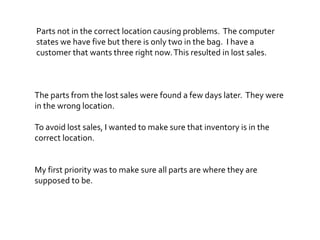
The parts from the lost sales were found a few days later. They were
in the wrong location.
Parts not in the correct location causing problems. The computer
states we have five but there is only two in the bag. I have a
customer that wants three right now.This resulted in lost sales.
To avoid lost sales, I wanted to make sure that inventory is in the
correct location.
My first priority was to make sure all parts are where they are
supposed to be.
S Specific, simple, sensible,
significant
Answer the 5 “W” questions:
What do I want to accomplish? I want to make sure all parts
are slotted properly.
Why is this important? The salesmen rely on the computer
inventory to avoid lost sales.
Who is involved? Inventory Clerk
Where is it located? Warehouse and ERP System.
Which resources or limits are involved? Resources-ERP
System; Limits-Must be conducted in free time.
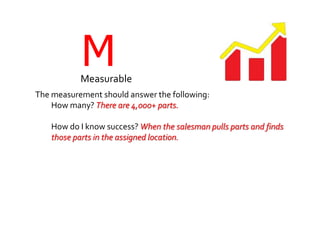
MMeasurable
The measurement should answer the following:
How many? There are 4,000+ parts.
How do I know success? When the salesman pulls parts and finds
those parts in the assigned location.
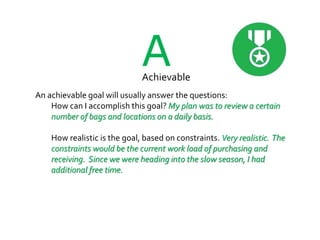
AAchievable
An achievable goal will usually answer the questions:
How can I accomplish this goal? My plan was to review a certain
number of bags and locations on a daily basis.
How realistic is the goal, based on constraints. Very realistic. The
constraints would be the current work load of purchasing and
receiving. Since we were heading into the slow season, I had
additional free time.
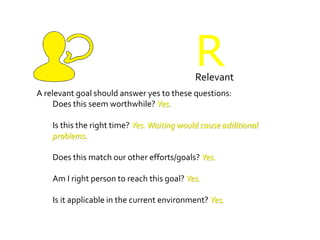
RRelevant
A relevant goal should answer yes to these questions:
Does this seem worthwhile? Yes.
Is this the right time? Yes.Waiting would cause additional
problems.
Does this match our other efforts/goals? Yes.
Am I right person to reach this goal? Yes.
Is it applicable in the current environment? Yes.
TTime-Bound
Time-bound should answer:
When is the deadline? The start time was end of August. I
wanted to have this completed no later than November 30th.
Why this time frame? Year-End Inventory would be the last week
of December.
What are the intermediate time frame? Every time a location
was complete, I would mark it off my list. I would review the list
weekly to see my progress.
Was the goals of this project met? Yes.
How were the goals met? Using the S.M.A.R.T principle.
People need that satisfaction or to see that a project is moving
forward or they will dismiss it. Breaking down long-term objectives
into short-term defined successes will assist most people to stay on
the right track.
As a planner, I develop a plan based on the ideas and goals for the
project. Based on long-term objectives, the plan can be developed
into short-term achievements.
In your next project (personal or business) try applying
the S.M.A.R.T. principle.
This organizing principle will provide a higher success
rate.
If this Slide Presentation was
helpful, please Like It
and please Share It with your
Community.

SMART - The organizing principle

  • 1.
    S.M.A.R.T. The S.M.A.R.T. principleis an organized guideline in how to proceed with project goals. Let’s look at the 5 segments of this principle.
  • 2.
    SSpecific – simple– sensible – significant Answer the 5 “W” questions: What do I want to accomplish? Why is this important? Who is involved? Where is it located? Which resources or limits are involved? If we can’t answer these questions, we need to drop it and move on.
  • 3.
    MMeasurable As a DataAnalystsI believe there are measurable events everywhere. Develop significant Key Performance Indicators (KPI’s) and Dashboards to show progress. The measurement should answer the following: How much? How many? How do I know success?
  • 4.
    AAchievable To be successfulyour goal must be realistic and attainable. Unrealistic goals will cause dissatisfaction in turn will initiate an “I give up attitude”. An achievable goal will usually answer the questions: How can I accomplish this goal? How realistic is the goal, based on constraints.
  • 5.
    RRelevant Does the goalmatter to you? Will the results of the program have a positive impact? Define the relevance of the project and goal. A relevant goal should answer yes to these questions: Does this seem worthwhile? Is this the right time? Does this match our other efforts/goals? Am I right person to reach this goal? Is it applicable in the current environment?
  • 6.
    TTime-Bound In projects andprocesses you should have a target or end date. Providing a target date initiates imperative. Time-bound should answer: When is the deadline? What are the intermediate time frame?
  • 7.
    Let’s look atthis principle in action. I had just started at a new company. When I started the staff provided several major concerns with inventory. There were eight major concerns. After defining the issues, I ranked them in terms of importance. I know everything could not be accomplished immediately so I took highest impact issues first. The top priority was:
  • 8.
    The parts fromthe lost sales were found a few days later. They were in the wrong location. Parts not in the correct location causing problems. The computer states we have five but there is only two in the bag. I have a customer that wants three right now.This resulted in lost sales. To avoid lost sales, I wanted to make sure that inventory is in the correct location. My first priority was to make sure all parts are where they are supposed to be.
  • 9.
    S Specific, simple,sensible, significant Answer the 5 “W” questions: What do I want to accomplish? I want to make sure all parts are slotted properly. Why is this important? The salesmen rely on the computer inventory to avoid lost sales. Who is involved? Inventory Clerk Where is it located? Warehouse and ERP System. Which resources or limits are involved? Resources-ERP System; Limits-Must be conducted in free time.
  • 10.
    MMeasurable The measurement shouldanswer the following: How many? There are 4,000+ parts. How do I know success? When the salesman pulls parts and finds those parts in the assigned location.
  • 11.
    AAchievable An achievable goalwill usually answer the questions: How can I accomplish this goal? My plan was to review a certain number of bags and locations on a daily basis. How realistic is the goal, based on constraints. Very realistic. The constraints would be the current work load of purchasing and receiving. Since we were heading into the slow season, I had additional free time.
  • 12.
    RRelevant A relevant goalshould answer yes to these questions: Does this seem worthwhile? Yes. Is this the right time? Yes.Waiting would cause additional problems. Does this match our other efforts/goals? Yes. Am I right person to reach this goal? Yes. Is it applicable in the current environment? Yes.
  • 13.
    TTime-Bound Time-bound should answer: Whenis the deadline? The start time was end of August. I wanted to have this completed no later than November 30th. Why this time frame? Year-End Inventory would be the last week of December. What are the intermediate time frame? Every time a location was complete, I would mark it off my list. I would review the list weekly to see my progress.
  • 14.
    Was the goalsof this project met? Yes. How were the goals met? Using the S.M.A.R.T principle. People need that satisfaction or to see that a project is moving forward or they will dismiss it. Breaking down long-term objectives into short-term defined successes will assist most people to stay on the right track. As a planner, I develop a plan based on the ideas and goals for the project. Based on long-term objectives, the plan can be developed into short-term achievements.
  • 15.
    In your nextproject (personal or business) try applying the S.M.A.R.T. principle. This organizing principle will provide a higher success rate. If this Slide Presentation was helpful, please Like It and please Share It with your Community.