What is 5S?
By
RPS Kalsi
An Introduction-
5S-
creates the foundation for
a visual work place
2
What Is 5S?
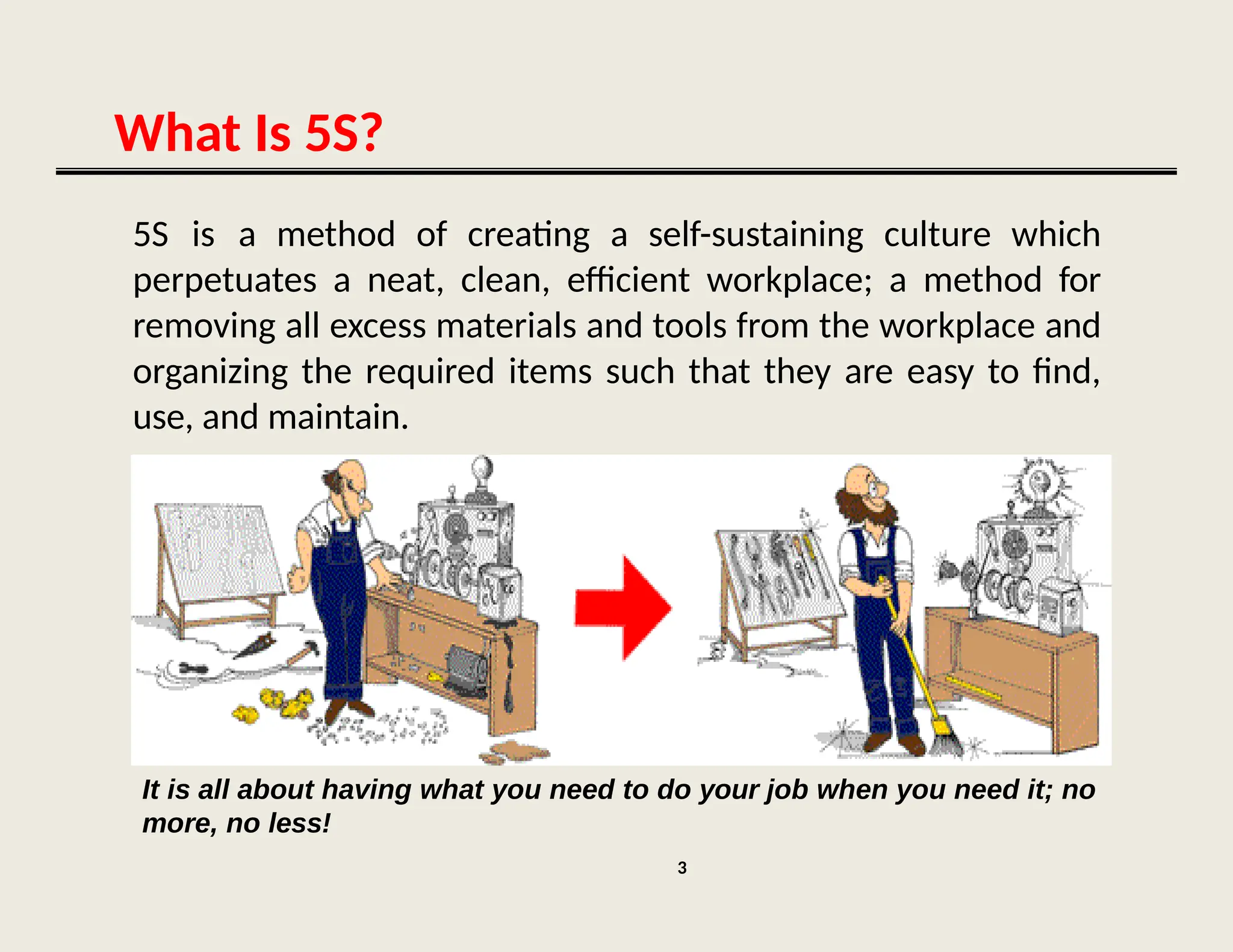
5S is a method of creating a self-sustaining culture which
perpetuates a neat, clean, efficient workplace; a method for
removing all excess materials and tools from the workplace and
organizing the required items such that they are easy to find,
use, and maintain.
3
It is all about having what you need to do your job when you need it; no
more, no less!
5S
• Improves safety
and ergonomics
• Promotes flow
• Reduces searching
• Reduces unplanned
downtime
• Improve quality
• Encourages visual
control
• Enhances
teamwork
• Improves productivity
• Eliminates distractions
• Reduces inventory and space
• Instills the discipline to follow
standard work
• Exposes problems
• Tackles waste
• Enhances self-management
4
Why implement 5S?
The 5Ss
 Sort (Seiri)
 No unnecessary items at the workplace: “When in doubt, throw it out!”
 Set in Order (Seiton)
 Anyone can instantly find, take, and return any needed item: “A place for
everything, and everything in its place”
 Shine (Seiso)
 Deviations become visual by cleaning: “Cleaning = inspection; Cleaning with
meaning”
 Standardize (Seiketsu)
 Visualize the 5S standards in the workplace: “Make the best way the easiest
way”
 Sustain (Shitsuke)
 Everybody follows the standard until we have a better one:“Stick to it!”
5
Agenda
5S
What Is 5S?
Sort
Set in Order
Shine
Standardize
Sustain
5S Summary
6
Definition of Sort
 Sort means that you remove all items from the workplace that are not
needed for current production or transactional operations
 It does not mean that you only remove the items that you
know you may never need
 It does not mean that you simply arrange things in a neater
fashion
ASK YOURSELF:
Is this item necessary to do this job? Do we
really need these items?
7
Examples of Sort
 Defective or excess unneeded items that
accumulate
 Outdated or broken jigs and dies
 Worn-out bits, inserts
 Outdated or broken tools or inspection equipment
 Old rags and other cleaning supplies
 Electrical tools/equipment with broken cords
 Outdated posters, signs, notices, and memos
When you sort, you only leave the bare
essentials: “When in doubt, move it
out.”
8
Red Tag Method
A method of identifying and removing all unneeded items from the
workplace through the use of red tags as a visual control.
• Attach a red tag to each item that is unneeded or does not belong in the area.
• Attach a red tag to each item that belongs in the area but DOES NOT have an
identified storage area.
• Fill out each tag to describe what each item is and why it was tagged.
• Record all the tags and their description in the “5S Tag Log.”
Do not tag the trash! Just throw it away!
9
Red Tag Method
10
Red Tag Method
11
Agenda
 5S
 What Is 5S?
 Sort
 Set in Order
 Shine
 Standardize
 Sustain
 5S Summary
12
Set in Order...Simplify
Tools at hand on every machine
13
Definition of Set in Order… Simplify
 Set in order means that you arrange the items that are
needed in the area and identify them or label them
so that ANYONE can find them or put them away
 “A place for everything, and everything in its place”
 ASK YOURSELF:
 Would a new person in this work
area know where this item
belongs?
14
Benefits of Set in Order… Simplify
 Person sent to find something, finds it easily
 Time spent looking for things is reduced
 Wrong parts are not retrieved in error
 Adequate space is allocated for storage of items
 Items have “their place” and not not left in walkways,
etc.
Think of a pit crew at a NASCAR race--every item is positioned to error-
proof and speed the process and to eliminate all wasted motion:
17 seconds to change 4 tires, fill the gas tank, wash the
windows, and give the driver a drink.
15
Implementing Set in Order…
Simplify
 Store items together if they are used together, and
store them in the sequence they are used.
 If tools are being set in order, design a system that
keeps the tools in their location.
 Store infrequently used items away from the point of
use.
THE KEY:
Look at the area as if you were brought into the area to help
out. Would you be able to find & put things away immediately?
16
5S COLOR CODE
Raw Material
WIP
Finished Good
Fire Protection
Production Support
Equipment/Trash Cans/
Toolboxes
Do Not Place
Anything Here
Example of Set in Order
17
Example of Set in Order
18
Example of Set in Order (cont.)
Before
After
19
Set in Order Lab
Befor
e
Afte
r
After: Organized and labeled
space
Before: Chemical laboratory
20
Agenda
 5S
 What Is 5S?
 Sort
 Set in Order
 Shine
 Standardize
 Sustain
 5S Summary
21
Definition of Shine
 Shine emphasizes removing the dirt, grime, and
dust from the work area
 This is a program of keeping the work area swept
and clean of debris
 Floors are swept, machinery is clean and wiped off
and everything in the work area is kept clean
ASK YOURSELF:
Are there items in the area that need to be cleaned?
22
Benefits of Shine
 Defects are easier to see in a well-lit and clean environment
 A work area clean of debris is less likely to cause a tripping hazard
 Machines that are clean and maintained work more efficiently and
break down less often
 A clean work area promotes improved morale and instills pride
in the team members
The best time to find defects, dents, and scratches on your
automobile is when you are hand washing it. Likewise, the best
time to find defects and safety problems is when you are
cleaning your work area.
23
Implementing Shine
 Determine the shine targets: what are we going to clean?
 Set a schedule and assign individuals
 Create procedures for continued daily shine processes
 Set periodic machine inspection and maintenance targets
 THE KEY:
 Do activities take place to prevent dirt, grime,
and contamination from occurring?
24
Agenda
 5S
 What Is 5S?
 Sort
 Set in Order
 Shine
 Standardize
 Sustain
 5S Summary
25
Definition of Standardize
 Creating a consistent way of implementing the tasks
that are performed on a daily basis including “Sort,”
“Set in Order,” and “Shine”
 “Do the right things the right way, every time!”
 ASK YOURSELF:
 Are the methods/processes in place to keep the first three
Ss maintained and ongoing?
 Is 5S practiced throughout the day?
26
Benefits of Standardization
 Easier to train new employees
 Less room for errors and scrap
 Work area is more organized
 Work area is safer
 Just like in our personal lives, if the rules are in
writing and right in front of us, we are much more
likely to understand and follow them, especially if
they have our signature on them!
27
Implementing Standardization
 Integrate the benefits found through Sort, Set in Order, and
Shine into the everyday work activity
 Make it a way of life
 It should be easily noticed when items are not in their place
 Keep it “visual”
 All 5S activities should be scheduled at the frequency rate
necessary to maintain a clean, orderly, and safe work
environment
 THE KEY:
 Documentation exists to show how, where,
and when 5S activities take place.
28
Agenda
 5S
 What Is 5S?
 Sort
 Set in Order
 Shine
 Standardize
 Sustain
 5S Summary
29
Definition of Sustain
 Sustain means that the 5S mentality is ingrained
in everyday work life and procedures
 Sustain means that the 5S program has a discipline
that ensures its continued success
 Sustain involves making a habit of maintaining
correct procedures
 Do not let 5S become another “flavor of the day”
ASK YOURSELF:
Are things reverting back to the unorganized way
they were?
30
Benefits of Sustain
 Cleaner, safer, working environment
 Detailed tasks are documented to make processes
more efficient
 Work place is maintained in an organized fashion
without clutter
 Tools and materials are easier to find
 Higher employee morale
31
Implementing Sustain
 Keep everyone aware of 5S and its benefits
 Make time each day to perform daily tasks
 Make it structured
 Give recognition where it is due
 Establish audit for 5S review
THE KEY:
The first four Ss are solidly in place and being practiced
daily. Every day we do some 5S.
32
Perform 5S Audit
Five S Routine Checklist
Work Area: Date:
Performed
by:
No. Description
55 Level
Comments
1 2 3 4 5
1 Are there unneeded materials or supplies?
2 Are there unneeded machines or other equipment?
3 Have unneeded items been marked for removal?
4 Have rules been established and posted regarding unneeded items?
5 Are locations outlined for equipment and supplies?
6 Are display boards well organized?
7 Are there performance range indicators for equipment?
8 Are there maximum and minimum indicators for eq~ and SLpPIies?
9 Are safety areas and items clearly marked?
10 Are aisles marked and free of obsruction?
11 Are equipment and supplies returned to their designated location?
12 Are floors clean and free of debris?
13 Is equipment free of leaks and messes?
14 Are cleaning checklists established for the area?
15 Have specific cleaning tasks been assigned?
16 Are trash bins, scrap containers, recycle containers emptied on a reguar basis? Is
frequency visible?
17 Have Improvements been made to maintain cleanliness?
18 Have rules and procedures been estabiished to maintain the firstthree SSs?
19 Are people punctual about their start, break, meeting, and clean -up times?
20 Do workers understand shop procedures and safety rules?
21 Are display boards curren
22 Are 5S routine checks performed regularly?
Perform 5S Audit
Note: Forms are included in the 5S forms.pdf file
35
5S Example: Before
36
5S Example: After
37
Agenda
 5S
 What Is 5S?
 Sort
 Set in Order
 Shine
 Standardize
 Sustain
 5S Summary
38
5S Summary
 5S is a process and method for creating and maintaining an
organized, clean, and high performance workplace.
 5S enables anyone to distinguish between normal and
abnormal conditions at a glance.
 5S is the foundation for continuous improvement, zero
defects, cost reduction, and a safe work area.
 5S is a systematic way to improve the workplace, our processes,
and our products through production line employee involvement.
39
5S Summary (cont.)
 5S is accomplished by following all of the steps. DO NOT
SKIP A STEP.
 5S must become part of everyone's job.
 5S is a team-oriented process between the members of the
work area.
 To review, some of the benefits of 5S include:
 Improved safety
 A clean, orderly workplace
 Improved efficiency
 Increased employee morale
 Standardized work methods
40

5S detailed slides for better understanding

  • 1.
  • 2.
    An Introduction- 5S- creates thefoundation for a visual work place 2
  • 3.
    What Is 5S? 5Sis a method of creating a self-sustaining culture which perpetuates a neat, clean, efficient workplace; a method for removing all excess materials and tools from the workplace and organizing the required items such that they are easy to find, use, and maintain. 3 It is all about having what you need to do your job when you need it; no more, no less!
  • 4.
    5S • Improves safety andergonomics • Promotes flow • Reduces searching • Reduces unplanned downtime • Improve quality • Encourages visual control • Enhances teamwork • Improves productivity • Eliminates distractions • Reduces inventory and space • Instills the discipline to follow standard work • Exposes problems • Tackles waste • Enhances self-management 4 Why implement 5S?
  • 5.
    The 5Ss  Sort(Seiri)  No unnecessary items at the workplace: “When in doubt, throw it out!”  Set in Order (Seiton)  Anyone can instantly find, take, and return any needed item: “A place for everything, and everything in its place”  Shine (Seiso)  Deviations become visual by cleaning: “Cleaning = inspection; Cleaning with meaning”  Standardize (Seiketsu)  Visualize the 5S standards in the workplace: “Make the best way the easiest way”  Sustain (Shitsuke)  Everybody follows the standard until we have a better one:“Stick to it!” 5
  • 6.
    Agenda 5S What Is 5S? Sort Setin Order Shine Standardize Sustain 5S Summary 6
  • 7.
    Definition of Sort Sort means that you remove all items from the workplace that are not needed for current production or transactional operations  It does not mean that you only remove the items that you know you may never need  It does not mean that you simply arrange things in a neater fashion ASK YOURSELF: Is this item necessary to do this job? Do we really need these items? 7
  • 8.
    Examples of Sort Defective or excess unneeded items that accumulate  Outdated or broken jigs and dies  Worn-out bits, inserts  Outdated or broken tools or inspection equipment  Old rags and other cleaning supplies  Electrical tools/equipment with broken cords  Outdated posters, signs, notices, and memos When you sort, you only leave the bare essentials: “When in doubt, move it out.” 8
  • 9.
    Red Tag Method Amethod of identifying and removing all unneeded items from the workplace through the use of red tags as a visual control. • Attach a red tag to each item that is unneeded or does not belong in the area. • Attach a red tag to each item that belongs in the area but DOES NOT have an identified storage area. • Fill out each tag to describe what each item is and why it was tagged. • Record all the tags and their description in the “5S Tag Log.” Do not tag the trash! Just throw it away! 9
  • 10.
  • 11.
  • 12.
    Agenda  5S  WhatIs 5S?  Sort  Set in Order  Shine  Standardize  Sustain  5S Summary 12
  • 13.
    Set in Order...Simplify Toolsat hand on every machine 13
  • 14.
    Definition of Setin Order… Simplify  Set in order means that you arrange the items that are needed in the area and identify them or label them so that ANYONE can find them or put them away  “A place for everything, and everything in its place”  ASK YOURSELF:  Would a new person in this work area know where this item belongs? 14
  • 15.
    Benefits of Setin Order… Simplify  Person sent to find something, finds it easily  Time spent looking for things is reduced  Wrong parts are not retrieved in error  Adequate space is allocated for storage of items  Items have “their place” and not not left in walkways, etc. Think of a pit crew at a NASCAR race--every item is positioned to error- proof and speed the process and to eliminate all wasted motion: 17 seconds to change 4 tires, fill the gas tank, wash the windows, and give the driver a drink. 15
  • 16.
    Implementing Set inOrder… Simplify  Store items together if they are used together, and store them in the sequence they are used.  If tools are being set in order, design a system that keeps the tools in their location.  Store infrequently used items away from the point of use. THE KEY: Look at the area as if you were brought into the area to help out. Would you be able to find & put things away immediately? 16
  • 17.
    5S COLOR CODE RawMaterial WIP Finished Good Fire Protection Production Support Equipment/Trash Cans/ Toolboxes Do Not Place Anything Here Example of Set in Order 17
  • 18.
    Example of Setin Order 18
  • 19.
    Example of Setin Order (cont.) Before After 19
  • 20.
    Set in OrderLab Befor e Afte r After: Organized and labeled space Before: Chemical laboratory 20
  • 21.
    Agenda  5S  WhatIs 5S?  Sort  Set in Order  Shine  Standardize  Sustain  5S Summary 21
  • 22.
    Definition of Shine Shine emphasizes removing the dirt, grime, and dust from the work area  This is a program of keeping the work area swept and clean of debris  Floors are swept, machinery is clean and wiped off and everything in the work area is kept clean ASK YOURSELF: Are there items in the area that need to be cleaned? 22
  • 23.
    Benefits of Shine Defects are easier to see in a well-lit and clean environment  A work area clean of debris is less likely to cause a tripping hazard  Machines that are clean and maintained work more efficiently and break down less often  A clean work area promotes improved morale and instills pride in the team members The best time to find defects, dents, and scratches on your automobile is when you are hand washing it. Likewise, the best time to find defects and safety problems is when you are cleaning your work area. 23
  • 24.
    Implementing Shine  Determinethe shine targets: what are we going to clean?  Set a schedule and assign individuals  Create procedures for continued daily shine processes  Set periodic machine inspection and maintenance targets  THE KEY:  Do activities take place to prevent dirt, grime, and contamination from occurring? 24
  • 25.
    Agenda  5S  WhatIs 5S?  Sort  Set in Order  Shine  Standardize  Sustain  5S Summary 25
  • 26.
    Definition of Standardize Creating a consistent way of implementing the tasks that are performed on a daily basis including “Sort,” “Set in Order,” and “Shine”  “Do the right things the right way, every time!”  ASK YOURSELF:  Are the methods/processes in place to keep the first three Ss maintained and ongoing?  Is 5S practiced throughout the day? 26
  • 27.
    Benefits of Standardization Easier to train new employees  Less room for errors and scrap  Work area is more organized  Work area is safer  Just like in our personal lives, if the rules are in writing and right in front of us, we are much more likely to understand and follow them, especially if they have our signature on them! 27
  • 28.
    Implementing Standardization  Integratethe benefits found through Sort, Set in Order, and Shine into the everyday work activity  Make it a way of life  It should be easily noticed when items are not in their place  Keep it “visual”  All 5S activities should be scheduled at the frequency rate necessary to maintain a clean, orderly, and safe work environment  THE KEY:  Documentation exists to show how, where, and when 5S activities take place. 28
  • 29.
    Agenda  5S  WhatIs 5S?  Sort  Set in Order  Shine  Standardize  Sustain  5S Summary 29
  • 30.
    Definition of Sustain Sustain means that the 5S mentality is ingrained in everyday work life and procedures  Sustain means that the 5S program has a discipline that ensures its continued success  Sustain involves making a habit of maintaining correct procedures  Do not let 5S become another “flavor of the day” ASK YOURSELF: Are things reverting back to the unorganized way they were? 30
  • 31.
    Benefits of Sustain Cleaner, safer, working environment  Detailed tasks are documented to make processes more efficient  Work place is maintained in an organized fashion without clutter  Tools and materials are easier to find  Higher employee morale 31
  • 32.
    Implementing Sustain  Keepeveryone aware of 5S and its benefits  Make time each day to perform daily tasks  Make it structured  Give recognition where it is due  Establish audit for 5S review THE KEY: The first four Ss are solidly in place and being practiced daily. Every day we do some 5S. 32
  • 33.
  • 34.
    Five S RoutineChecklist Work Area: Date: Performed by: No. Description 55 Level Comments 1 2 3 4 5 1 Are there unneeded materials or supplies? 2 Are there unneeded machines or other equipment? 3 Have unneeded items been marked for removal? 4 Have rules been established and posted regarding unneeded items? 5 Are locations outlined for equipment and supplies? 6 Are display boards well organized? 7 Are there performance range indicators for equipment? 8 Are there maximum and minimum indicators for eq~ and SLpPIies? 9 Are safety areas and items clearly marked? 10 Are aisles marked and free of obsruction? 11 Are equipment and supplies returned to their designated location? 12 Are floors clean and free of debris? 13 Is equipment free of leaks and messes? 14 Are cleaning checklists established for the area? 15 Have specific cleaning tasks been assigned? 16 Are trash bins, scrap containers, recycle containers emptied on a reguar basis? Is frequency visible? 17 Have Improvements been made to maintain cleanliness? 18 Have rules and procedures been estabiished to maintain the firstthree SSs? 19 Are people punctual about their start, break, meeting, and clean -up times? 20 Do workers understand shop procedures and safety rules? 21 Are display boards curren 22 Are 5S routine checks performed regularly?
  • 35.
    Perform 5S Audit Note:Forms are included in the 5S forms.pdf file 35
  • 36.
  • 37.
  • 38.
    Agenda  5S  WhatIs 5S?  Sort  Set in Order  Shine  Standardize  Sustain  5S Summary 38
  • 39.
    5S Summary  5Sis a process and method for creating and maintaining an organized, clean, and high performance workplace.  5S enables anyone to distinguish between normal and abnormal conditions at a glance.  5S is the foundation for continuous improvement, zero defects, cost reduction, and a safe work area.  5S is a systematic way to improve the workplace, our processes, and our products through production line employee involvement. 39
  • 40.
    5S Summary (cont.) 5S is accomplished by following all of the steps. DO NOT SKIP A STEP.  5S must become part of everyone's job.  5S is a team-oriented process between the members of the work area.  To review, some of the benefits of 5S include:  Improved safety  A clean, orderly workplace  Improved efficiency  Increased employee morale  Standardized work methods 40