Guidelines for Units 10-13 of syllabus
Nomenclature : 2 marks
Reasoning : 6 marks
Name reactions : 2 marks
Reaction Mechanism : 2 marks
Word problems (conversions) covering
Properties and reactions of functional groups
: 5 marks
• The monohalogen derivatives of alkanes are
called alkyl halides. Their names are
derived by naming the attached alkyl group
to halogen and adding the name of the
halide. For example
IUPAC Naming :
• Here, the monohalogen derivatives of
alkanes are named as haloalkanes.
The position of the halogen atom and
other substituents (alkyl groups) are
indicated by suitable numbers i.e.,
1,2,3.....etc.
Common naming : Alkyl halide
Haloarenes or aryl halides are named
by adding the prefix 'halo' (fluoro,
chloro, bromo, iodo) before the name
of the aromatic hydrocarbon. In case of
di-substituted compounds, the relative
positions of the substituents 1,2; 1,3
and 1,4 are indicated by the prefixes
ortho (o-), meta (m-) and para (p-)
respectively
Haloarenes
Nature of C-X Bond
Most of the reactions of halides involve the
cleavage of C-X bond. Larger the bond
dissociation energy of the C-X bond, smaller is
the reactivity. The bond dissociation energy
decreases with the increase in the size of
halogen atom, i.e.,
C-Cl > C-Br > C-I.
Methods of preparation of haloalkanes
From hydrocarbons:
When pure components are
needed, they can be obtained by
fractional distillation.
From alkenes
2.By the action of phosphorus
halides
Bromoalkanes and iodoalkanes are prepared by the
action of PBr3 and PI3respectively on alcohols. As
PBr3 and PI3, are not very stable compounds, they
are prepared in situ by the action of red
phosphorus on Br2, or I2.
3.with thionyl chloride:
This method is preferred than other
methods because both the products of
the reaction (SO2 and HCl) are gases
and can easily escape leaving behind
pure alkyl halide.
By halide exchange
Finkelstein reaction.
From silver salts of acids
Borodine Hundsdiecker reaction
Chloroalkanes can also be obtained
by this method by using Cl2 instead
of Br2, but, the yield of hloroalkanes
is very poor.
Preparative methods of
haloarenes
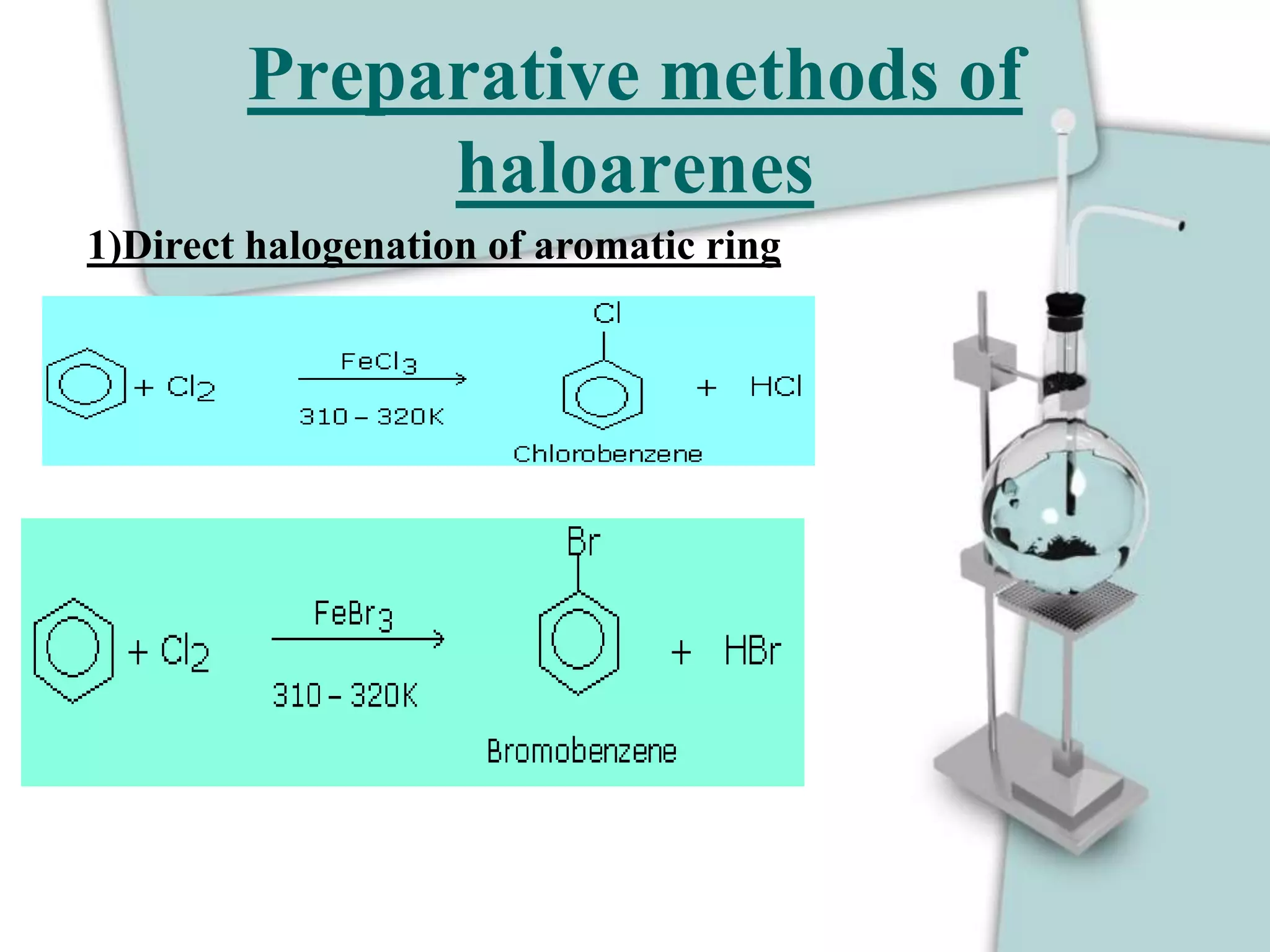
1)Direct halogenation of aromatic ring
4.Balz-Schiemann reaction
fluoroboric acid
Haloalkanes & arenes part 1

Haloalkanes & arenes part 1

  • 2.
    Guidelines for Units10-13 of syllabus Nomenclature : 2 marks Reasoning : 6 marks Name reactions : 2 marks Reaction Mechanism : 2 marks Word problems (conversions) covering Properties and reactions of functional groups : 5 marks
  • 3.
    • The monohalogenderivatives of alkanes are called alkyl halides. Their names are derived by naming the attached alkyl group to halogen and adding the name of the halide. For example
  • 4.
    IUPAC Naming : •Here, the monohalogen derivatives of alkanes are named as haloalkanes. The position of the halogen atom and other substituents (alkyl groups) are indicated by suitable numbers i.e., 1,2,3.....etc.
  • 6.
    Common naming :Alkyl halide
  • 8.
    Haloarenes or arylhalides are named by adding the prefix 'halo' (fluoro, chloro, bromo, iodo) before the name of the aromatic hydrocarbon. In case of di-substituted compounds, the relative positions of the substituents 1,2; 1,3 and 1,4 are indicated by the prefixes ortho (o-), meta (m-) and para (p-) respectively Haloarenes
  • 10.
    Nature of C-XBond Most of the reactions of halides involve the cleavage of C-X bond. Larger the bond dissociation energy of the C-X bond, smaller is the reactivity. The bond dissociation energy decreases with the increase in the size of halogen atom, i.e., C-Cl > C-Br > C-I.
  • 12.
    Methods of preparationof haloalkanes From hydrocarbons:
  • 13.
    When pure componentsare needed, they can be obtained by fractional distillation.
  • 14.
  • 21.
    2.By the actionof phosphorus halides Bromoalkanes and iodoalkanes are prepared by the action of PBr3 and PI3respectively on alcohols. As PBr3 and PI3, are not very stable compounds, they are prepared in situ by the action of red phosphorus on Br2, or I2.
  • 22.
    3.with thionyl chloride: Thismethod is preferred than other methods because both the products of the reaction (SO2 and HCl) are gases and can easily escape leaving behind pure alkyl halide.
  • 23.
  • 25.
    From silver saltsof acids Borodine Hundsdiecker reaction Chloroalkanes can also be obtained by this method by using Cl2 instead of Br2, but, the yield of hloroalkanes is very poor.
  • 26.
    Preparative methods of haloarenes 1)Directhalogenation of aromatic ring
  • 33.