FORAGING
BEHAVIOUR
Submitted by
Saharshan P M
1st Year MSc Zoology
Nirmala College,
Muvattupuzha
ForagingBEHAVIOUR
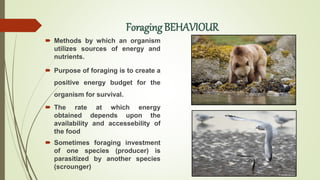
 Methods by which an organism
utilizes sources of energy and
nutrients.
 Purpose of foraging is to create a
positive energy budget for the
organism for survival.
 The rate at which energy
obtained depends upon the
availability and accessebility of
the food
 Sometimes foraging investment
of one species (producer) is
parasitized by another species
(scrounger)
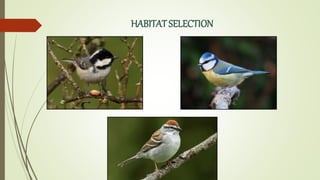
HABITATSELECTION
 Habitat is the place where an organism lives(Address).
 Place occupied by entire community.
 Plants depends on natural agents for dispersal.
 Animals have well developed locomotive abilities and they play an active role in finding
their habitats. But the choice is not necessarily a concious one.
 Habitat selection is mostly an autonomic reaction.
 Determinants of habitat selection :-
I. Genes
II. Habitat Imprinting
III. Tradition
HABITAT SELECTION
HABITAT SELECTION
 Theories of Habitat selection
I. Optimal Foraging Model:- Enable us to predict which habitat an animal
should select and when it should leave one habitat to another so as to get
greatest benefits.
II. Ideal free distribution:- This model predicts how individuals distribute
themselves so as to have highest possible fitness.
OPTIMAL FORAGING
 An organism will optimize it’s energy budget by maximizing energy intake and
minimizing energy expenditure.
 Organisms will choose food with greatest energy per unit.
 Evolutionary stable strategy used by all members of a population
 Optimal model projects which decision an animal should make in order to maximize
it’s inclusive fitness.
 According to Stephens and Krebs, optimality model have 3 parts:-
1. Decisions
2. Currency
3. Constraints
 Optimality model helps to make a quantitative and precise prediction.
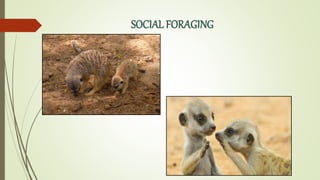
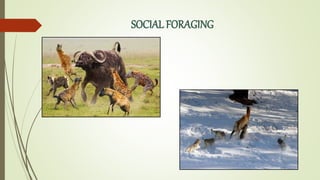
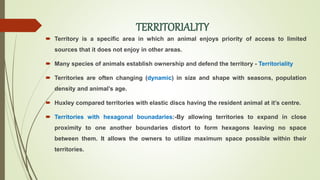
SOCIAL FORAGING
 Individuals of a species may group into flocks or herds and they collectively forage.
 Animals tend to monitor the area around them for other foragers that have found
food.
 Foraging will be more efficient because each individual spend less time scanning for
predators.
 Some individuals in a group may specialize in stealing food from others.
 This is done by:-
I. Sharing Information:- Foragers may get information concerning food sources from
one another.
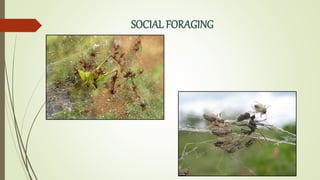
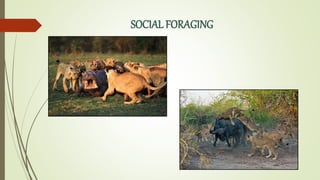
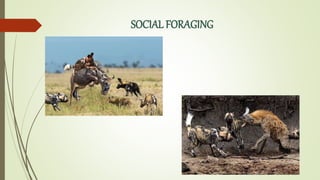
II. Co-operative Hunting:- Some animals can take down larger or more dangerous prey
when they hunt as a group. Examples include cooperative hunting by spiders, ants,
lions, African wild dogs…etc
SOCIAL FORAGING
SOCIAL FORAGING
SOCIAL FORAGING
SOCIAL FORAGING
SOCIAL FORAGING
TERRITORIALITY
 Territory is a specific area in which an animal enjoys priority of access to limited
sources that it does not enjoy in other areas.
 Many species of animals establish ownership and defend the territory - Territoriality
 Territories are often changing (dynamic) in size and shape with seasons, population
density and animal’s age.
 Huxley compared territories with elastic discs having the resident animal at it’s centre.
 Territories with hexagonal bounadaries:-By allowing territories to expand in close
proximity to one another boundaries distort to form hexagons leaving no space
between them. It allows the owners to utilize maximum space possible within their
territories.
FUNCTIONS OF TERRITORIALITY
 Economic defendibility:-
 Benefits gained from the territoriality
should be set against the costs of
defending.
 Animals should only defend the territory
if the resource they were defending is
worthwhile.
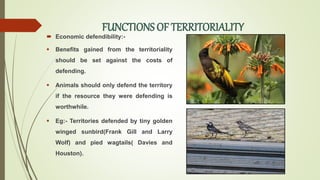
 Eg:- Territories defended by tiny golden
winged sunbird(Frank Gill and Larry
Wolf) and pied wagtails( Davies and
Houston).
FUNCTIONS OF TERRITORIALITY
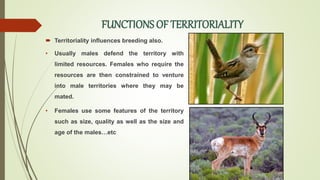
 Territoriality influences breeding also.
• Usually males defend the territory with
limited resources. Females who require the
resources are then constrained to venture
into male territories where they may be
mated.
• Females use some features of the territory
such as size, quality as well as the size and
age of the males…etc
FUNCTIONS OF TERRITORIALITY
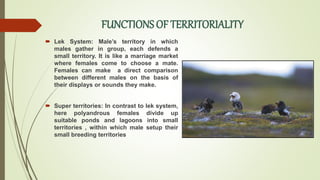
 Lek System: Male’s territory in which
males gather in group, each defends a
small territory. It is like a marriage market
where females come to choose a mate.
Females can make a direct comparison
between different males on the basis of
their displays or sounds they make.
 Super territories: In contrast to lek system,
here polyandrous females divide up
suitable ponds and lagoons into small
territories , within which male setup their
small breeding territories
FUNCTIONS OF TERRITORIALITY
 Territoriality is a nature’s contest which ensures population regulation
 Increased survivorship and reproductive potential.
 Animals become familiar with their home range and thus be able to escape predators.
 Reduction in spread of parasite and diseases between individuals since spacing
reduces the amount of physical contact between animals.
 Males could maintain established pair bonds.
THANK YOU

Foraging behaviour

  • 1.
    FORAGING BEHAVIOUR Submitted by Saharshan PM 1st Year MSc Zoology Nirmala College, Muvattupuzha
  • 2.
    ForagingBEHAVIOUR  Methods bywhich an organism utilizes sources of energy and nutrients.  Purpose of foraging is to create a positive energy budget for the organism for survival.  The rate at which energy obtained depends upon the availability and accessebility of the food  Sometimes foraging investment of one species (producer) is parasitized by another species (scrounger)
  • 3.
    HABITATSELECTION  Habitat isthe place where an organism lives(Address).  Place occupied by entire community.  Plants depends on natural agents for dispersal.  Animals have well developed locomotive abilities and they play an active role in finding their habitats. But the choice is not necessarily a concious one.  Habitat selection is mostly an autonomic reaction.  Determinants of habitat selection :- I. Genes II. Habitat Imprinting III. Tradition
  • 4.
  • 5.
    HABITAT SELECTION  Theoriesof Habitat selection I. Optimal Foraging Model:- Enable us to predict which habitat an animal should select and when it should leave one habitat to another so as to get greatest benefits. II. Ideal free distribution:- This model predicts how individuals distribute themselves so as to have highest possible fitness.
  • 6.
    OPTIMAL FORAGING  Anorganism will optimize it’s energy budget by maximizing energy intake and minimizing energy expenditure.  Organisms will choose food with greatest energy per unit.  Evolutionary stable strategy used by all members of a population  Optimal model projects which decision an animal should make in order to maximize it’s inclusive fitness.  According to Stephens and Krebs, optimality model have 3 parts:- 1. Decisions 2. Currency 3. Constraints  Optimality model helps to make a quantitative and precise prediction.
  • 7.
    SOCIAL FORAGING  Individualsof a species may group into flocks or herds and they collectively forage.  Animals tend to monitor the area around them for other foragers that have found food.  Foraging will be more efficient because each individual spend less time scanning for predators.  Some individuals in a group may specialize in stealing food from others.  This is done by:- I. Sharing Information:- Foragers may get information concerning food sources from one another. II. Co-operative Hunting:- Some animals can take down larger or more dangerous prey when they hunt as a group. Examples include cooperative hunting by spiders, ants, lions, African wild dogs…etc
  • 8.
  • 9.
  • 10.
  • 11.
  • 12.
  • 13.
    TERRITORIALITY  Territory isa specific area in which an animal enjoys priority of access to limited sources that it does not enjoy in other areas.  Many species of animals establish ownership and defend the territory - Territoriality  Territories are often changing (dynamic) in size and shape with seasons, population density and animal’s age.  Huxley compared territories with elastic discs having the resident animal at it’s centre.  Territories with hexagonal bounadaries:-By allowing territories to expand in close proximity to one another boundaries distort to form hexagons leaving no space between them. It allows the owners to utilize maximum space possible within their territories.
  • 14.
    FUNCTIONS OF TERRITORIALITY Economic defendibility:-  Benefits gained from the territoriality should be set against the costs of defending.  Animals should only defend the territory if the resource they were defending is worthwhile.  Eg:- Territories defended by tiny golden winged sunbird(Frank Gill and Larry Wolf) and pied wagtails( Davies and Houston).
  • 15.
    FUNCTIONS OF TERRITORIALITY Territoriality influences breeding also. • Usually males defend the territory with limited resources. Females who require the resources are then constrained to venture into male territories where they may be mated. • Females use some features of the territory such as size, quality as well as the size and age of the males…etc
  • 16.
    FUNCTIONS OF TERRITORIALITY Lek System: Male’s territory in which males gather in group, each defends a small territory. It is like a marriage market where females come to choose a mate. Females can make a direct comparison between different males on the basis of their displays or sounds they make.  Super territories: In contrast to lek system, here polyandrous females divide up suitable ponds and lagoons into small territories , within which male setup their small breeding territories
  • 17.
    FUNCTIONS OF TERRITORIALITY Territoriality is a nature’s contest which ensures population regulation  Increased survivorship and reproductive potential.  Animals become familiar with their home range and thus be able to escape predators.  Reduction in spread of parasite and diseases between individuals since spacing reduces the amount of physical contact between animals.  Males could maintain established pair bonds.
  • 18.