Slide
The family tree of genetics
Pedigree charts
1
Overview
I. What is a
pedigree?
a. Definition
b. Uses
II. Constructing a
pedigree
a. Symbols
b. Connecting the symbols
III. Interpreting a
pedigree
2
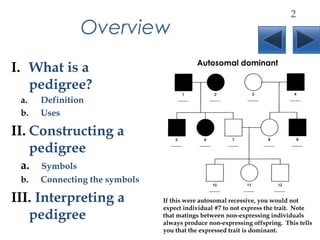
Autosomal dominant
If this were autosomal recessive, you would not
expect individual #7 to not express the trait. Note
that matings between non-expressing individuals
always produce non-expressing offspring. This tells
you that the expressed trait is dominant.
What is a pedigree?
•A graphic representation of how a
trait is passed from parents to
offspring.
•A chart of the genetic history of
family over several generations.
•A genetic counselor would find out
about your family history and make
this chart to analyze.
3
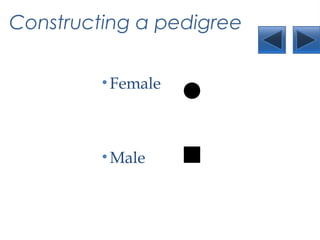
Constructing a pedigree
•Male
•Female
Connecting pedigree
symbols
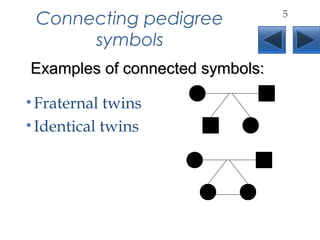
•Fraternal twins
•Identical twins
Examples of connected symbols:Examples of connected symbols:
5
Connecting pedigree
symbols
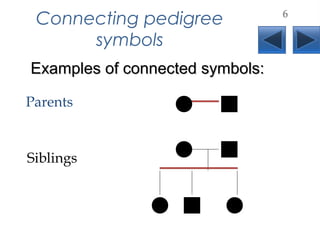
Parents
Examples of connected symbols:Examples of connected symbols:
6
Siblings
Example
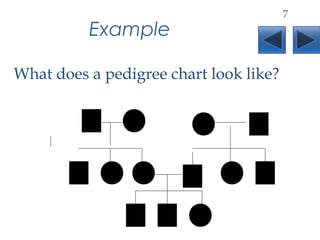
What does a pedigree chart look like?
7
Pedigree Chart
Symbols
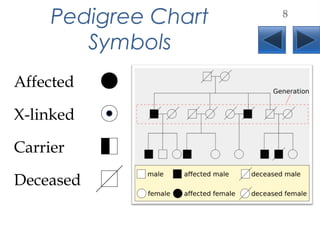
Deceased
8
Affected
Carrier
X-linked
Interpreting a pedigree
chart
Determine if the pedigree chart shows an
autosomal or X-linked disease.
• If most of the males in the pedigree are
affected the disorder is X-linked
• If it is a 50:50 ratio between men and
women the disorder is autosomal*.
* autosomal is a chromosome which is not a sex
chromosome. 
9
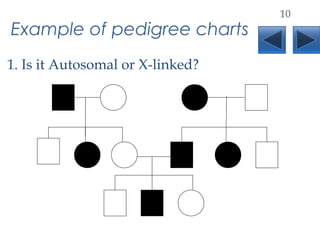
Example of pedigree charts
1. Is it Autosomal or X-linked?
10
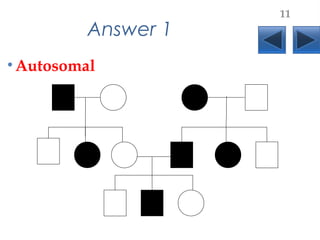
Answer 1
•Autosomal
11
Interpreting a pedigree
chart
Determine whether the disorder is
dominant or recessive.
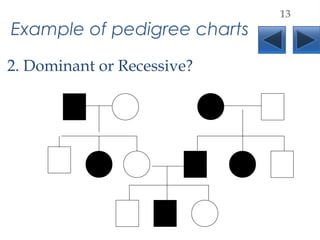
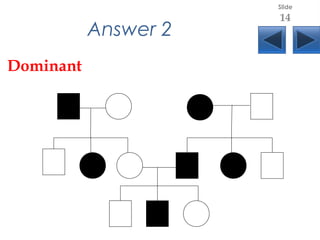
• If the disorder is dominant, one of the
parents must have the disorder.
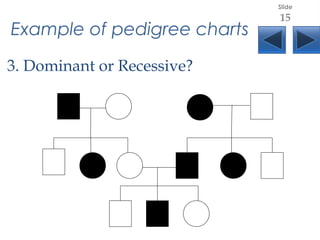
• If the disorder is recessive, neither parent
has to have the disorder because they can
be heterozygous.
12
Example of pedigree charts
2. Dominant or Recessive?
13
Answer 2
Dominant
Slide
14
Example of pedigree charts
3. Dominant or Recessive?
Slide
15
Answer 3
•Recessive
Slide
16
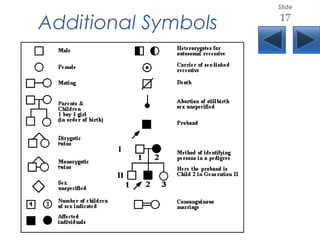
Additional Symbols
Slide
17
Queen Victoria
Descendants & Hemophilia
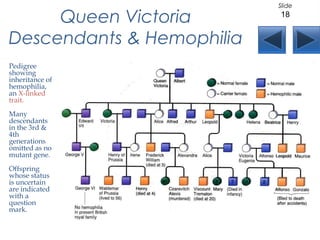
Pedigree
showing
inheritance of
hemophilia,
an X-linked
trait.
Many
descendants
in the 3rd &
4th
generations
omitted as no
mutant gene.
Offspring
whose status
is uncertain
are indicated
with a
question
mark.
Slide
18
Problem 1
• In humans, albinism is a recessive trait.
• The disorder causes a lack of pigment
in the skin and hair.
• This results in an albino appearing very
pale with white hair and pale blue eyes.
• This disorder also occurs in animals, a
common albino found in a laboratory is
the white rat.
• The pedigrees below trace the
inheritance of the allele that causes
albinism
Slide
19
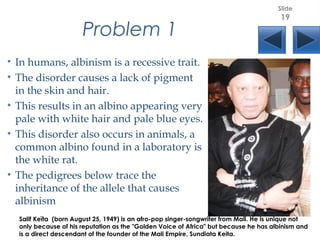
Salif Keïta  (born August 25, 1949) is an afro-pop singer-songwriter from Mali. He is unique not
only because of his reputation as the "Golden Voice of Africa" but because he has albinism and
is a direct descendant of the founder of the Mali Empire, Sundiata Keita. 
Problems
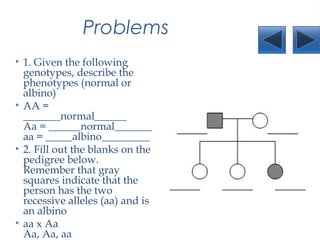
• 1. Given the following
genotypes, describe the
phenotypes (normal or
albino)
• AA =
_______normal______
Aa = ______normal_______
aa = _____albino_________
• 2. Fill out the blanks on the
pedigree below.
Remember that gray
squares indicate that the
person has the two
recessive alleles (aa) and is
an albino
• aa x Aa
Aa, Aa, aa 
Answers
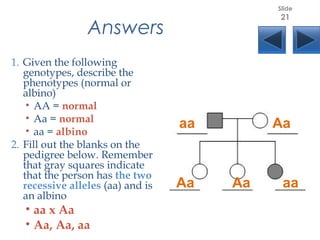
1. Given the following
genotypes, describe the
phenotypes (normal or
albino)
• AA = normal
• Aa = normal
• aa = albino
2. Fill out the blanks on the
pedigree below. Remember
that gray squares indicate
that the person has the two
recessive alleles (aa) and is
an albino
• aa x Aa
• Aa, Aa, aa 
aa Aa
Aa aaAa
Slide
21
Problems
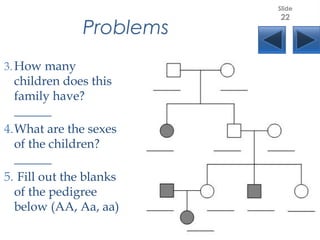
3.How many
children does this
family have?
______
4.What are the sexes
of the children?
______
5. Fill out the blanks
of the pedigree
below (AA, Aa, aa)
Slide
22
Answers
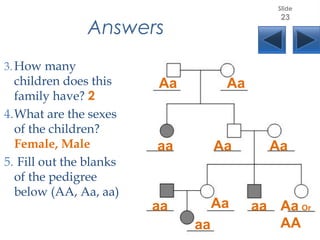
3.How many
children does this
family have? 2
4.What are the sexes
of the children?
Female, Male
5. Fill out the blanks
of the pedigree
below (AA, Aa, aa)
Aa Aa
Aaaa
Aa
Slide
23
Aa
aa aa
aa
Aa Or
AA
Problems
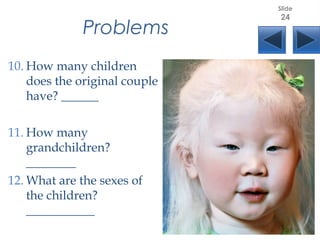
10. How many children
does the original couple
have? ______
11. How many
grandchildren?
________
12. What are the sexes of
the children?
___________
Slide
24
Problems
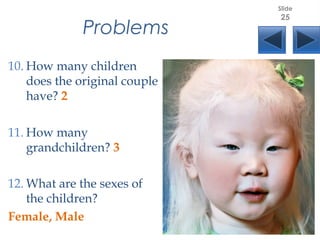
10. How many children
does the original couple
have? 2
11. How many
grandchildren? 3
12. What are the sexes of
the children?
Female, Male
Slide
25
Summary
• Pedigrees are family trees explaining your
genetic history.
• Pedigrees are used to find out the probability
of a child having a disorder in a particular
family.
• To begin to interpret a pedigree, determine if
the disease or condition is autosomal or X-
linked and dominant or recessive.
Slide
26
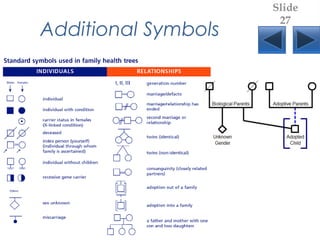
Additional Symbols
Slide
27
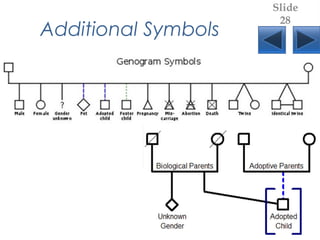
Additional Symbols
Slide
28
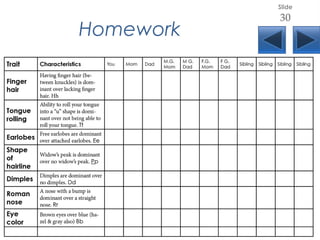
Homework
•Find out which family members (as many
as you can; siblings, parents,
grandparents, aunts, uncles, cousins,
great-grand parents, etc.) with listed
traits.
Slide
29
Homework
Slide
30

Pedigrees Lecture

  • 1.
    Slide The family treeof genetics Pedigree charts 1
  • 2.
    Overview I. What isa pedigree? a. Definition b. Uses II. Constructing a pedigree a. Symbols b. Connecting the symbols III. Interpreting a pedigree 2 Autosomal dominant If this were autosomal recessive, you would not expect individual #7 to not express the trait. Note that matings between non-expressing individuals always produce non-expressing offspring. This tells you that the expressed trait is dominant.
  • 3.
    What is apedigree? •A graphic representation of how a trait is passed from parents to offspring. •A chart of the genetic history of family over several generations. •A genetic counselor would find out about your family history and make this chart to analyze. 3
  • 4.
  • 5.
    Connecting pedigree symbols •Fraternal twins •Identicaltwins Examples of connected symbols:Examples of connected symbols: 5
  • 6.
    Connecting pedigree symbols Parents Examples ofconnected symbols:Examples of connected symbols: 6 Siblings
  • 7.
    Example What does apedigree chart look like? 7
  • 8.
  • 9.
    Interpreting a pedigree chart Determineif the pedigree chart shows an autosomal or X-linked disease. • If most of the males in the pedigree are affected the disorder is X-linked • If it is a 50:50 ratio between men and women the disorder is autosomal*. * autosomal is a chromosome which is not a sex chromosome.  9
  • 10.
    Example of pedigreecharts 1. Is it Autosomal or X-linked? 10
  • 11.
  • 12.
    Interpreting a pedigree chart Determinewhether the disorder is dominant or recessive. • If the disorder is dominant, one of the parents must have the disorder. • If the disorder is recessive, neither parent has to have the disorder because they can be heterozygous. 12
  • 13.
    Example of pedigreecharts 2. Dominant or Recessive? 13
  • 14.
  • 15.
    Example of pedigreecharts 3. Dominant or Recessive? Slide 15
  • 16.
  • 17.
  • 18.
    Queen Victoria Descendants &Hemophilia Pedigree showing inheritance of hemophilia, an X-linked trait. Many descendants in the 3rd & 4th generations omitted as no mutant gene. Offspring whose status is uncertain are indicated with a question mark. Slide 18
  • 19.
    Problem 1 • Inhumans, albinism is a recessive trait. • The disorder causes a lack of pigment in the skin and hair. • This results in an albino appearing very pale with white hair and pale blue eyes. • This disorder also occurs in animals, a common albino found in a laboratory is the white rat. • The pedigrees below trace the inheritance of the allele that causes albinism Slide 19 Salif Keïta  (born August 25, 1949) is an afro-pop singer-songwriter from Mali. He is unique not only because of his reputation as the "Golden Voice of Africa" but because he has albinism and is a direct descendant of the founder of the Mali Empire, Sundiata Keita. 
  • 20.
    Problems • 1. Giventhe following genotypes, describe the phenotypes (normal or albino) • AA = _______normal______ Aa = ______normal_______ aa = _____albino_________ • 2. Fill out the blanks on the pedigree below. Remember that gray squares indicate that the person has the two recessive alleles (aa) and is an albino • aa x Aa Aa, Aa, aa 
  • 21.
    Answers 1. Given thefollowing genotypes, describe the phenotypes (normal or albino) • AA = normal • Aa = normal • aa = albino 2. Fill out the blanks on the pedigree below. Remember that gray squares indicate that the person has the two recessive alleles (aa) and is an albino • aa x Aa • Aa, Aa, aa  aa Aa Aa aaAa Slide 21
  • 22.
    Problems 3.How many children doesthis family have? ______ 4.What are the sexes of the children? ______ 5. Fill out the blanks of the pedigree below (AA, Aa, aa) Slide 22
  • 23.
    Answers 3.How many children doesthis family have? 2 4.What are the sexes of the children? Female, Male 5. Fill out the blanks of the pedigree below (AA, Aa, aa) Aa Aa Aaaa Aa Slide 23 Aa aa aa aa Aa Or AA
  • 24.
    Problems 10. How manychildren does the original couple have? ______ 11. How many grandchildren? ________ 12. What are the sexes of the children? ___________ Slide 24
  • 25.
    Problems 10. How manychildren does the original couple have? 2 11. How many grandchildren? 3 12. What are the sexes of the children? Female, Male Slide 25
  • 26.
    Summary • Pedigrees arefamily trees explaining your genetic history. • Pedigrees are used to find out the probability of a child having a disorder in a particular family. • To begin to interpret a pedigree, determine if the disease or condition is autosomal or X- linked and dominant or recessive. Slide 26
  • 27.
  • 28.
  • 29.
    Homework •Find out whichfamily members (as many as you can; siblings, parents, grandparents, aunts, uncles, cousins, great-grand parents, etc.) with listed traits. Slide 29
  • 30.

Editor's Notes

  • #2 A quick refresher for the teacher on important terms: Autosomal gene- a gene found on any chromosome except for the sex chromosome. These are chromosomes numbered 1-22. X-linked gene- a gene found on a chromosome designated as a sex chromosome (X or Y). Dominant- Refers to an allele that is expressed phenotypically and masks any recessive counterpart. Recessive- An allele that is not phenotypically expressed when its counterpart is dominant.
  • #3 The purpose of this presentation is for the students to become familiar with how to use and interpret the pedigree chart. This presentation will illustrate several characteristics of the pedigree chart. Muscular dystrophy will be used as an example throughout this presentation. Autosomal dominant If this were autosomal recessive, you would not expect individual #7 to not express the trait. Note that matings between non-expressing individuals always produce non-expressing offspring. This tells you that the expressed trait is dominant.
  • #4 A pedigree is a chart of the genetic history of family over several generations. Scientists or a genetic counselor would find out about your family history and make this chart to analyze it. For example, a couple might like to know their chances of having a child that has muscular dystrophy. So the scientists or a genetic counselor would find out who had muscular dystrophy in the mother’s and/or father’s families. This information would be used to and then calculate the probability of the couple having a child with MD.
  • #5 You must learn the symbols of the pedigree charts before you can start to learn how to interpret it. These are the symbols that represent a male and a female.
  • #6 Here are examples of symbols that represent relationships between people.
  • #7 These symbols also represent relationships between people. some may have to each other.
  • #8 This is just an example of a pedigree and there can be many more different types.
  • #9 These are examples of different types of symbols. These symbols would be the same for males or for females, A carrier is only half filled. So an affected male would be a square that is filled in completely. A deceased female would be a circle with a diagonal slash.
  • #10 When interpreting a pedigree chart of a family with a disease like muscular dystrophy, it is important to consider two steps. The first is to determine if the disorder is autosomal or X-linked. If the disorder is X-linked most of the males will have the disorder because the Y-chromosome cannot mask the affects of an affected X-chromosome. A female can have the disorder, but it would be a very low percentage. For a female to be affected, she would have had to receive an affected gene from the mother and the father. This means that the father would have the disorder and the mother was a carrier. In an autosomal disorder, the disorder is not found on the X or Y chromosome. It is found on the other 22 chromosomes in the human body. This means that men and women have an equal chance of having the disorder. The mother and father can be homozygous dominant, heterozygous, and homozygous recessive. If a person is homozygous dominant, the person has two of the same dominant genes. For example if someone is homozygous dominant for being tall it may be represented as TT. Capital letter always represent a dominant gene. If a person is heterozygous, this person would have a dominant trait and a recessive trait. It may be represent as Tt. The dominant gene will mask the recessive gene, so the person is still tall. If a person is homozygous recessive, the person has two of the same recessive genes. For example if someone is homozygous recessive for height, it may be represented as tt. The tt would mean the person is short.
  • #11 Take a minute and try to decide if this slide is autosomal or X-linked.
  • #12 It is autosomal because it is 50/50 men to women with the disorder, if it was X-linked most of the men in the diagram would have the disorder. Make sure you count the number of men with the disorder and the number of women with the disorder. In this pedigree, 3 men and 3 women have the disorder.
  • #13 The second step is to determine if the disorder is dominant or recessive. It is important to find out if a disorder is dominant or recessive. For example, Huntington’s disease is a dominant disorder. If you have only one dominant gene you will have Huntington’s disease, which is a lethal disorder. The disorder does not show up until a person is in their middle ages such as 45. It will quickly decrease their motor skills and the brain will begin to deteriorate. If a disorder is dominant, one parent must have the disorder (either homozygous dominant (TT) or heterozygous recessive (Tt). Both parents do not have to have the disorder. One parent might not have the disorder or be a carrier. If a disease is dominant, it does not skip a generation unless one parent is heterozygous dominant (Tt) and the other parent is homozygous recessive (tt). In this case the child has a chance of not receiving the dominant gene. If the disorder is recessive, a parent does not have to have the disorder, but could still pass it to their offspring. This would happen when a parent is heterozygous recessive (Tt) and passes on the recessive (t) gene. This means this disorder can skip generations. An example of a recessive disorder would be sickle cell anemia.
  • #14 Is this pedigree dominant or recessive?
  • #15 It is dominant because a parent in every generation have the disorder. Remember if a parent in every generation has the disorder, the disorder has not skipped a generation. If the disorder has not skipped a generation the disorder is dominant.
  • #16 Is this pedigree dominant or recessive?
  • #17 It is recessive because a parent in every generation does not have the disorder. Remember the disorder can skipped a generation if the disorder is recessive. The parents can be heterozygous and be carriers of the disorder but not have the symptoms of the disorder.
  • #27 This summary will help reiterate the important parts of this lesson. [Created by Lauren Almaguer, CDC Science Ambassador, 2004.]