-Created by
Asst.Prof.Dnyaneshwari Joshi
Department of Biotechnology
NACS college.
CLEAVAGE AND BLASTULATION
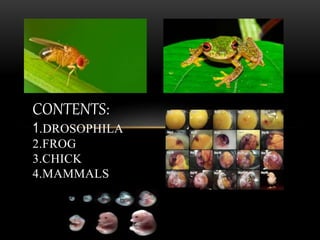
CONTENTS:
1.DROSOPHILA
2.FROG
3.CHICK
4.MAMMALS
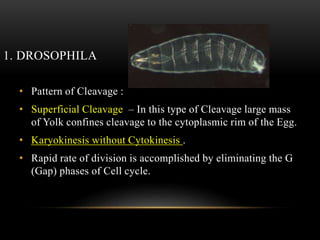
1. DROSOPHILA
• Pattern of Cleavage :
• Superficial Cleavage – In this type of Cleavage large mass
of Yolk confines cleavage to the cytoplasmic rim of the Egg.
• Karyokinesis without Cytokinesis .
• Rapid rate of division is accomplished by eliminating the G
(Gap) phases of Cell cycle.
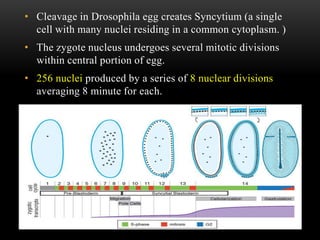
• Cleavage in Drosophila egg creates Syncytium (a single
cell with many nuclei residing in a common cytoplasm. )
• The zygote nucleus undergoes several mitotic divisions
within central portion of egg.
• 256 nuclei produced by a series of 8 nuclear divisions
averaging 8 minute for each.
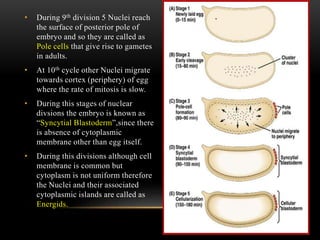
• During 9th division 5 Nuclei reach
the surface of posterior pole of
embryo and so they are called as
Pole cells that give rise to gametes
in adults.
• At 10th cycle other Nuclei migrate
towards cortex (periphery) of egg
where the rate of mitosis is slow.
• During this stages of nuclear
divsions the embryo is known as
“Syncytial Blastoderm”,since there
is absence of cytoplasmic
membrane other than egg itself.
• During this divisions although cell
membrane is common but
cytoplasm is not uniform therefore
the Nuclei and their associated
cytoplasmic islands are called as
Energids.
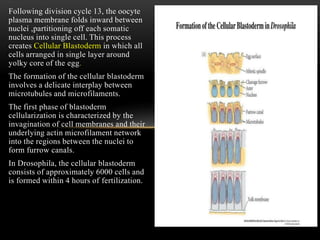
Following division cycle 13, the oocyte
plasma membrane folds inward between
nuclei ,partitioning off each somatic
nucleus into single cell. This process
creates Cellular Blastoderm in which all
cells arranged in single layer around
yolky core of the egg.
The formation of the cellular blastoderm
involves a delicate interplay between
microtubules and microfilaments.
The first phase of blastoderm
cellularization is characterized by the
invagination of cell membranes and their
underlying actin microfilament network
into the regions between the nuclei to
form furrow canals.
In Drosophila, the cellular blastoderm
consists of approximately 6000 cells and
is formed within 4 hours of fertilization.
2. FROG
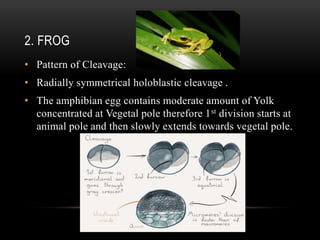
• Pattern of Cleavage:
• Radially symmetrical holoblastic cleavage .
• The amphibian egg contains moderate amount of Yolk
concentrated at Vegetal pole therefore 1st division starts at
animal pole and then slowly extends towards vegetal pole.
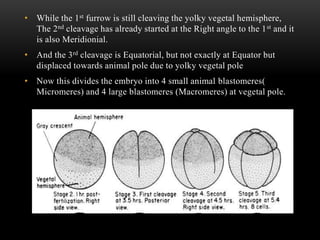
• While the 1st furrow is still cleaving the yolky vegetal hemisphere,
The 2nd cleavage has already started at the Right angle to the 1st and it
is also Meridionial.
• And the 3rd cleavage is Equatorial, but not exactly at Equator but
displaced towards animal pole due to yolky vegetal pole
• Now this divides the embryo into 4 small animal blastomeres(
Micromeres) and 4 large blastomeres (Macromeres) at vegetal pole.
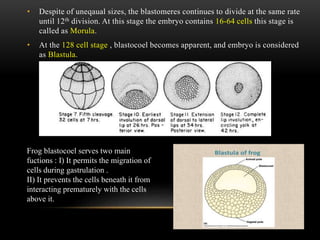
• Despite of uneqaual sizes, the blastomeres continues to divide at the same rate
until 12th division. At this stage the embryo contains 16-64 cells this stage is
called as Morula.
• At the 128 cell stage , blastocoel becomes apparent, and embryo is considered
as Blastula.
Frog blastocoel serves two main
fuctions : I) It permits the migration of
cells during gastrulation .
II) It prevents the cells beneath it from
interacting prematurely with the cells
above it.
IMPORTANT FACTORES :
• Various cell adhesion molecules keep the cleaving blastomeres
together .
• Such as EP- Cadherin
• MBT- Mid Blastula Transition genes – require for the modification of
certain promoters and their associated Nucleosomes during
blastulation process.
• Transcription factor Veg T protein , formed in the Vegetal cytoplasm
from localized maternal mRNA, The cells contain VegT becomes the
Endoderm cells and then this cells begins secretion of factors to
induce the cells above them to form Mesoderm.
3.CHICK
• Pattern of cleavage:
• Discoidal meroblastic cleavage
• Cleavage occurs only in the blastodisc ,which is about 2-3 mm in
diameter, at the Animal pole of the egg.
• The first 1st cleavage takes place centrally at the blastodisc , other
cleavages follow the pattern and create the single layered Blastoderm.
• So the early cleavage cells are continuous with one another and with the
yolk at their base.
• After this , vertical and equatorial cleavages divide the blastoderm in 5-6
cell layers thick.
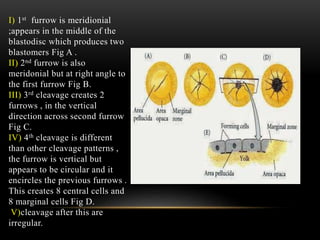
I) 1st furrow is meridionial
;appears in the middle of the
blastodisc which produces two
blastomers Fig A .
II) 2nd furrow is also
meridonial but at right angle to
the first furrow Fig B.
III) 3rd cleavage creates 2
furrows , in the vertical
direction across second furrow
Fig C.
IV) 4th cleavage is different
than other cleavage patterns ,
the furrow is vertical but
appears to be circular and it
encircles the previous furrows .
This creates 8 central cells and
8 marginal cells Fig D.
V)cleavage after this are
irregular.
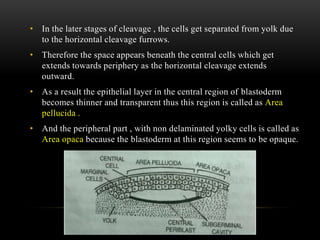
• In the later stages of cleavage , the cells get separated from yolk due
to the horizontal cleavage furrows.
• Therefore the space appears beneath the central cells which get
extends towards periphery as the horizontal cleavage extends
outward.
• As a result the epithelial layer in the central region of blastoderm
becomes thinner and transparent thus this region is called as Area
pellucida .
• And the peripheral part , with non delaminated yolky cells is called as
Area opaca because the blastoderm at this region seems to be opaque.
4.MAMMALS :
• In the entire animal kingdom mammalian eggs are the slowest in
terms of cleavage.
• The first cleavage starts after 24 hours of fertilization .
• This 1st cleavage is Meridional creates two blastomeres as llke other
animals studied so far.
• But in the 2nd cleavage, one of two blastomers divide meridionally
and the other divides Equatorially this type of cleavage is known
Rotational cleavage.
• Another major difference is the number of cells increases not evenly
like 2,4,8 etc. but it increases by odd number due to difference in
division time.
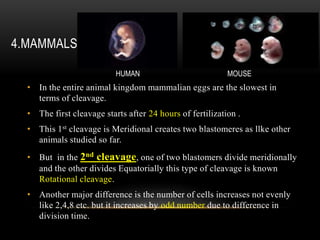
HUMAN MOUSE
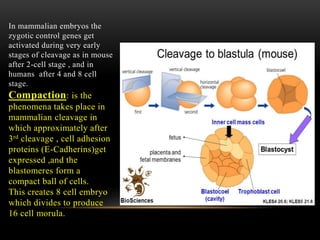
In mammalian embryos the
zygotic control genes get
activated during very early
stages of cleavage as in mouse
after 2-cell stage , and in
humans after 4 and 8 cell
stage.
Compaction: is the
phenomena takes place in
mammalian cleavage in
which approximately after
3rd cleavage , cell adhesion
proteins (E-Cadherins)get
expressed ,and the
blastomeres form a
compact ball of cells.
This creates 8 cell embryo
which divides to produce
16 cell morula.
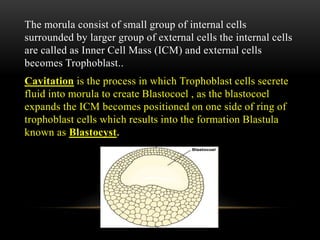
The morula consist of small group of internal cells
surrounded by larger group of external cells the internal cells
are called as Inner Cell Mass (ICM) and external cells
becomes Trophoblast..
Cavitation is the process in which Trophoblast cells secrete
fluid into morula to create Blastocoel , as the blastocoel
expands the ICM becomes positioned on one side of ring of
trophoblast cells which results into the formation Blastula
known as Blastocyst.
REFERNCES:
• Gilbert SF. Developmental Biology. 9th edition.
Sunderland (MA): Sinauer Associates; 2010.
• Lewis Wolpert, Rosa Beddington et al. Principes of
Development. 2nd edition.Oxford university press :
2002.
• NCBI Bookshelf. A service of the National Library of
Medicine, National Institutes of Health.
Cleavage and blastulation

Cleavage and blastulation

  • 1.
    -Created by Asst.Prof.Dnyaneshwari Joshi Departmentof Biotechnology NACS college. CLEAVAGE AND BLASTULATION
  • 2.
  • 3.
    1. DROSOPHILA • Patternof Cleavage : • Superficial Cleavage – In this type of Cleavage large mass of Yolk confines cleavage to the cytoplasmic rim of the Egg. • Karyokinesis without Cytokinesis . • Rapid rate of division is accomplished by eliminating the G (Gap) phases of Cell cycle.
  • 4.
    • Cleavage inDrosophila egg creates Syncytium (a single cell with many nuclei residing in a common cytoplasm. ) • The zygote nucleus undergoes several mitotic divisions within central portion of egg. • 256 nuclei produced by a series of 8 nuclear divisions averaging 8 minute for each.
  • 5.
    • During 9thdivision 5 Nuclei reach the surface of posterior pole of embryo and so they are called as Pole cells that give rise to gametes in adults. • At 10th cycle other Nuclei migrate towards cortex (periphery) of egg where the rate of mitosis is slow. • During this stages of nuclear divsions the embryo is known as “Syncytial Blastoderm”,since there is absence of cytoplasmic membrane other than egg itself. • During this divisions although cell membrane is common but cytoplasm is not uniform therefore the Nuclei and their associated cytoplasmic islands are called as Energids.
  • 6.
    Following division cycle13, the oocyte plasma membrane folds inward between nuclei ,partitioning off each somatic nucleus into single cell. This process creates Cellular Blastoderm in which all cells arranged in single layer around yolky core of the egg. The formation of the cellular blastoderm involves a delicate interplay between microtubules and microfilaments. The first phase of blastoderm cellularization is characterized by the invagination of cell membranes and their underlying actin microfilament network into the regions between the nuclei to form furrow canals. In Drosophila, the cellular blastoderm consists of approximately 6000 cells and is formed within 4 hours of fertilization.
  • 7.
    2. FROG • Patternof Cleavage: • Radially symmetrical holoblastic cleavage . • The amphibian egg contains moderate amount of Yolk concentrated at Vegetal pole therefore 1st division starts at animal pole and then slowly extends towards vegetal pole.
  • 8.
    • While the1st furrow is still cleaving the yolky vegetal hemisphere, The 2nd cleavage has already started at the Right angle to the 1st and it is also Meridionial. • And the 3rd cleavage is Equatorial, but not exactly at Equator but displaced towards animal pole due to yolky vegetal pole • Now this divides the embryo into 4 small animal blastomeres( Micromeres) and 4 large blastomeres (Macromeres) at vegetal pole.
  • 9.
    • Despite ofuneqaual sizes, the blastomeres continues to divide at the same rate until 12th division. At this stage the embryo contains 16-64 cells this stage is called as Morula. • At the 128 cell stage , blastocoel becomes apparent, and embryo is considered as Blastula. Frog blastocoel serves two main fuctions : I) It permits the migration of cells during gastrulation . II) It prevents the cells beneath it from interacting prematurely with the cells above it.
  • 10.
    IMPORTANT FACTORES : •Various cell adhesion molecules keep the cleaving blastomeres together . • Such as EP- Cadherin • MBT- Mid Blastula Transition genes – require for the modification of certain promoters and their associated Nucleosomes during blastulation process. • Transcription factor Veg T protein , formed in the Vegetal cytoplasm from localized maternal mRNA, The cells contain VegT becomes the Endoderm cells and then this cells begins secretion of factors to induce the cells above them to form Mesoderm.
  • 11.
    3.CHICK • Pattern ofcleavage: • Discoidal meroblastic cleavage • Cleavage occurs only in the blastodisc ,which is about 2-3 mm in diameter, at the Animal pole of the egg. • The first 1st cleavage takes place centrally at the blastodisc , other cleavages follow the pattern and create the single layered Blastoderm. • So the early cleavage cells are continuous with one another and with the yolk at their base. • After this , vertical and equatorial cleavages divide the blastoderm in 5-6 cell layers thick.
  • 12.
    I) 1st furrowis meridionial ;appears in the middle of the blastodisc which produces two blastomers Fig A . II) 2nd furrow is also meridonial but at right angle to the first furrow Fig B. III) 3rd cleavage creates 2 furrows , in the vertical direction across second furrow Fig C. IV) 4th cleavage is different than other cleavage patterns , the furrow is vertical but appears to be circular and it encircles the previous furrows . This creates 8 central cells and 8 marginal cells Fig D. V)cleavage after this are irregular.
  • 13.
    • In thelater stages of cleavage , the cells get separated from yolk due to the horizontal cleavage furrows. • Therefore the space appears beneath the central cells which get extends towards periphery as the horizontal cleavage extends outward. • As a result the epithelial layer in the central region of blastoderm becomes thinner and transparent thus this region is called as Area pellucida . • And the peripheral part , with non delaminated yolky cells is called as Area opaca because the blastoderm at this region seems to be opaque.
  • 14.
    4.MAMMALS : • Inthe entire animal kingdom mammalian eggs are the slowest in terms of cleavage. • The first cleavage starts after 24 hours of fertilization . • This 1st cleavage is Meridional creates two blastomeres as llke other animals studied so far. • But in the 2nd cleavage, one of two blastomers divide meridionally and the other divides Equatorially this type of cleavage is known Rotational cleavage. • Another major difference is the number of cells increases not evenly like 2,4,8 etc. but it increases by odd number due to difference in division time. HUMAN MOUSE
  • 15.
    In mammalian embryosthe zygotic control genes get activated during very early stages of cleavage as in mouse after 2-cell stage , and in humans after 4 and 8 cell stage. Compaction: is the phenomena takes place in mammalian cleavage in which approximately after 3rd cleavage , cell adhesion proteins (E-Cadherins)get expressed ,and the blastomeres form a compact ball of cells. This creates 8 cell embryo which divides to produce 16 cell morula.
  • 16.
    The morula consistof small group of internal cells surrounded by larger group of external cells the internal cells are called as Inner Cell Mass (ICM) and external cells becomes Trophoblast.. Cavitation is the process in which Trophoblast cells secrete fluid into morula to create Blastocoel , as the blastocoel expands the ICM becomes positioned on one side of ring of trophoblast cells which results into the formation Blastula known as Blastocyst.
  • 17.
    REFERNCES: • Gilbert SF.Developmental Biology. 9th edition. Sunderland (MA): Sinauer Associates; 2010. • Lewis Wolpert, Rosa Beddington et al. Principes of Development. 2nd edition.Oxford university press : 2002. • NCBI Bookshelf. A service of the National Library of Medicine, National Institutes of Health.