First Degree Functions
Most mathematical functions y = f(x) used in the real
world are “composed” with members from the following
three groups of formulas.
Most mathematical functions y = f(x) used in the real
world are “composed” with members from the following
three groups of formulas.
* The algebraic family – these are polynomials,
rational expressions and roots, etc..
First Degree Functions
Most mathematical functions y = f(x) used in the real
world are “composed” with members from the following
three groups of formulas.
* The algebraic family – these are polynomials,
rational expressions and roots, etc..
* The trigonometric family – these are sin(x),
cos(x), .. etc that come from line measurements.
First Degree Functions
Most mathematical functions y = f(x) used in the real
world are “composed” with members from the following
three groups of formulas.
* The algebraic family – these are polynomials,
rational expressions and roots, etc..
* The trigonometric family – these are sin(x),
cos(x), .. etc that come from line measurements.
* The exponential–log family – these are ex and ln(x)
that come from exponential contexts.
First Degree Functions
Most mathematical functions y = f(x) used in the real
world are “composed” with members from the following
three groups of formulas.
* The algebraic family – these are polynomials,
rational expressions and roots, etc..
* The trigonometric family – these are sin(x),
cos(x), .. etc that come from line measurements.
* The exponential–log family – these are ex and ln(x)
that come from exponential contexts.
Degree 1 or linear functions: f(x) = mx + b and
degree 2 or quadratic functions: f(x) = ax2 + bx + c
are especially important.
First Degree Functions
The algebraic family
The exponential–log family
The trigonometric family
Below is the MS Win-10 desktop scientific calculator,
a typical scientific calculator input panel:
Most mathematical functions y = f(x) used in the real
world are “composed” with members from the following
three groups of formulas.
* The algebraic family – these are polynomials,
rational expressions and roots, etc..
* The trigonometric family – these are sin(x),
cos(x), .. etc that come from line measurements.
* The exponential–log family – these are ex and ln(x)
that come from exponential contexts.
Degree 1 or linear functions: f(x) = mx + b and
degree 2 or quadratic functions: f(x) = ax2 + bx + c
are especially important.
First Degree Functions
Most mathematical functions y = f(x) used in the real
world are “composed” with members from the following
three groups of formulas.
* The algebraic family – these are polynomials,
rational expressions and roots, etc..
* The trigonometric family – these are sin(x),
cos(x), .. etc that come from line measurements.
* The exponential–log family – these are ex and ln(x)
that come from exponential contexts.
Degree 1 or linear functions: f(x) = mx + b and
degree 2 or quadratic functions: f(x) = ax2 + bx + c
are especially important.
First Degree Functions
We review below the basics of linear equations and
linear functions.
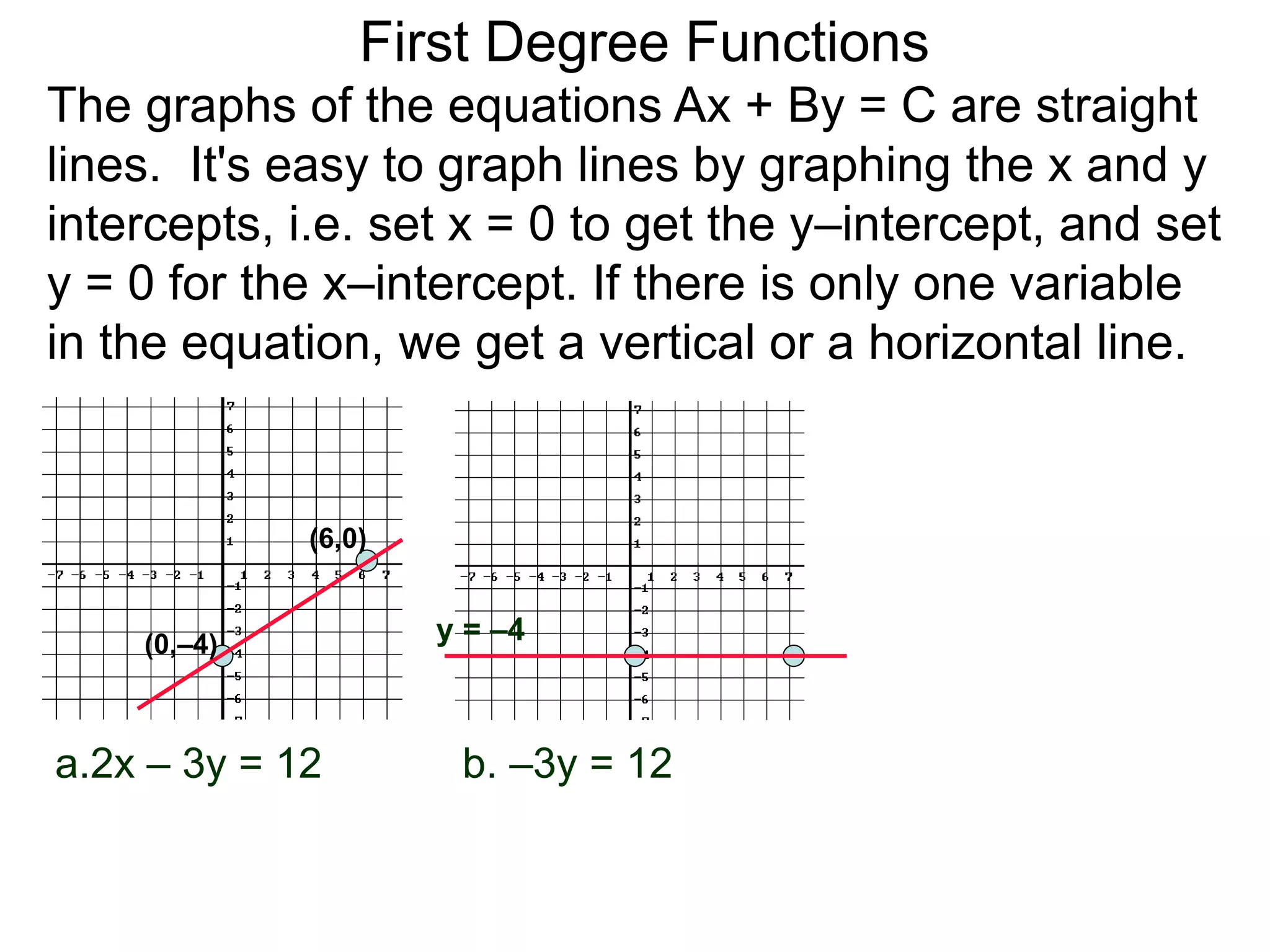
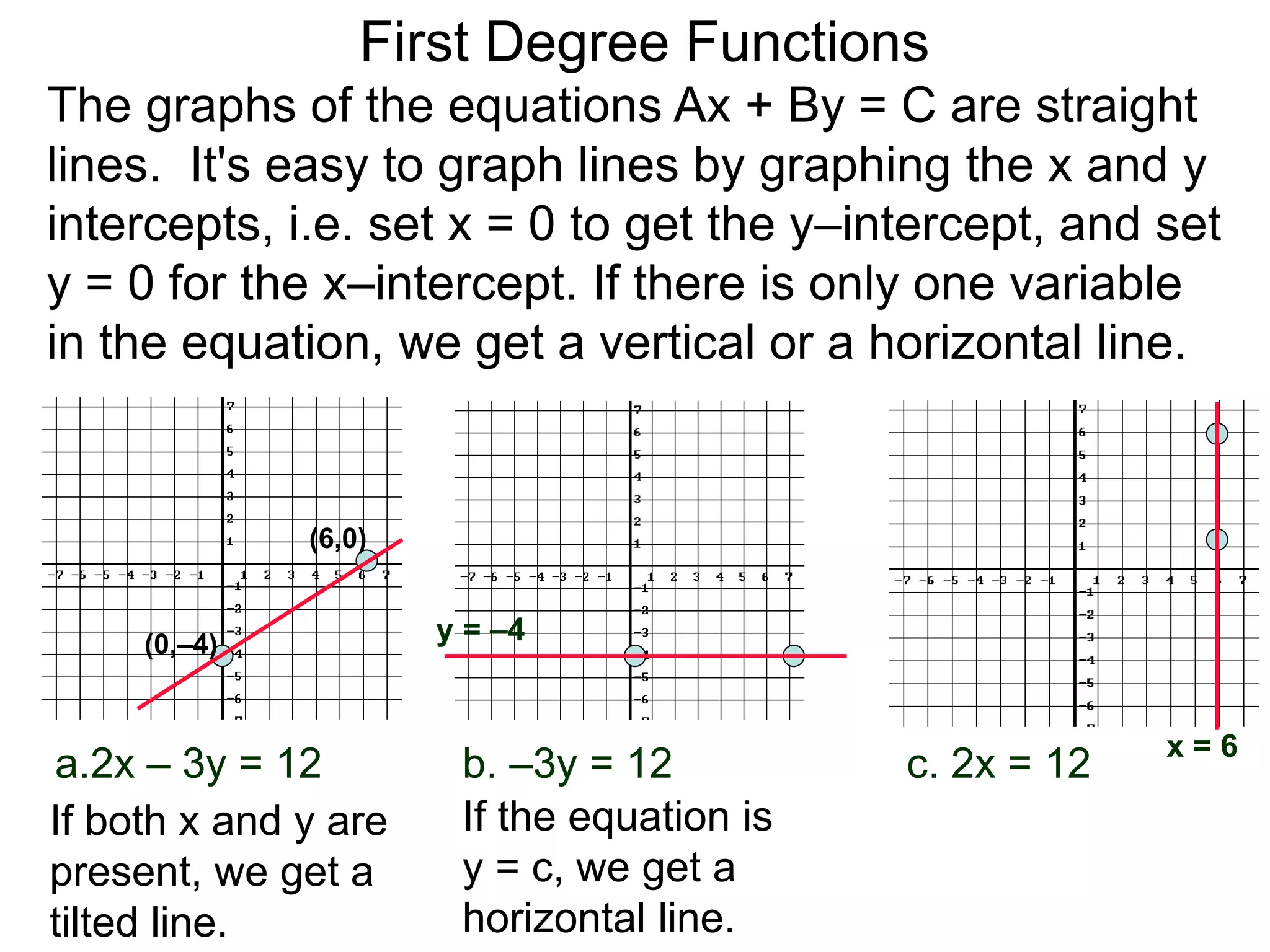
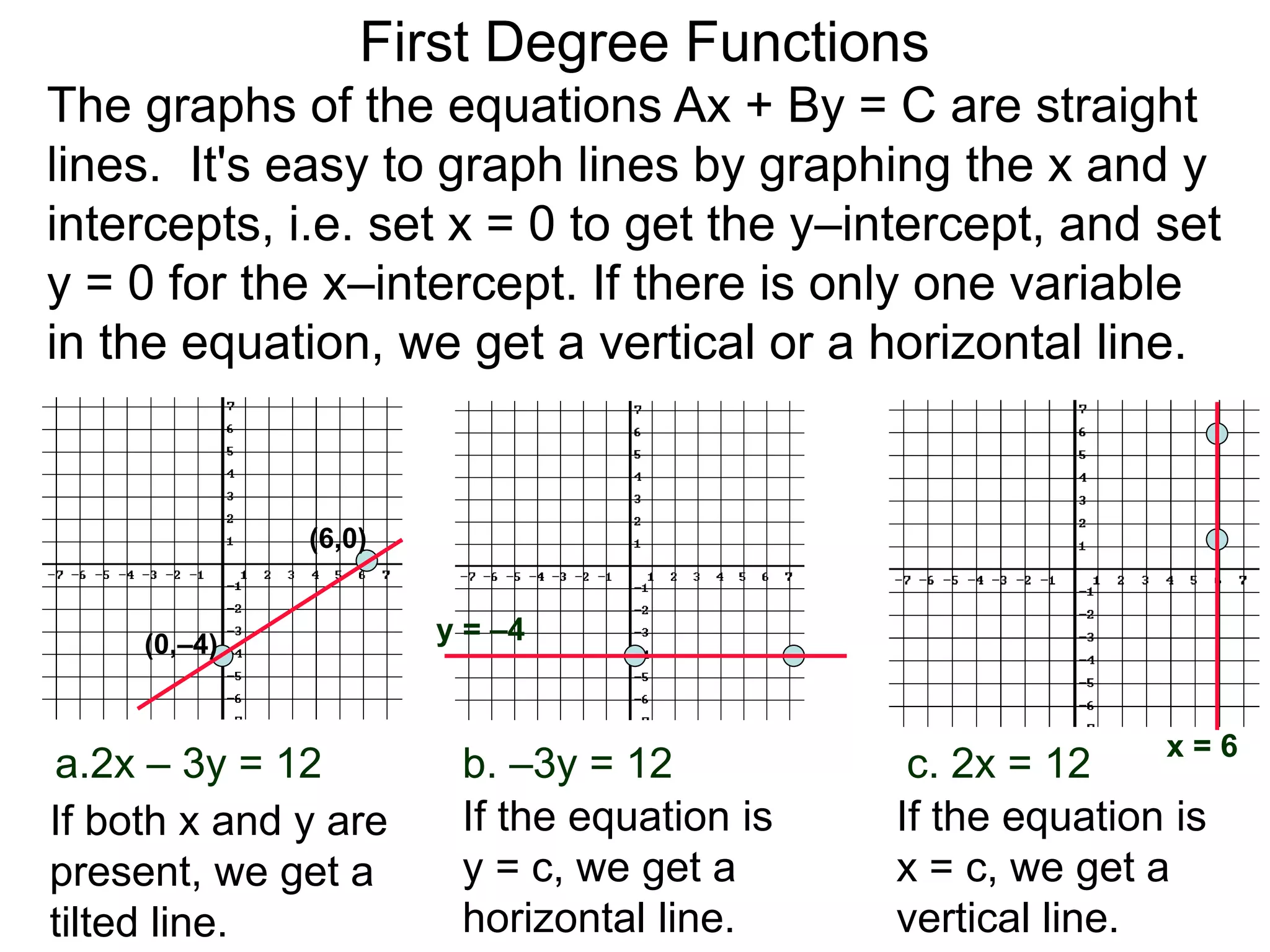
The graphs of the equations Ax + By = C are straight
lines.
First Degree Functions
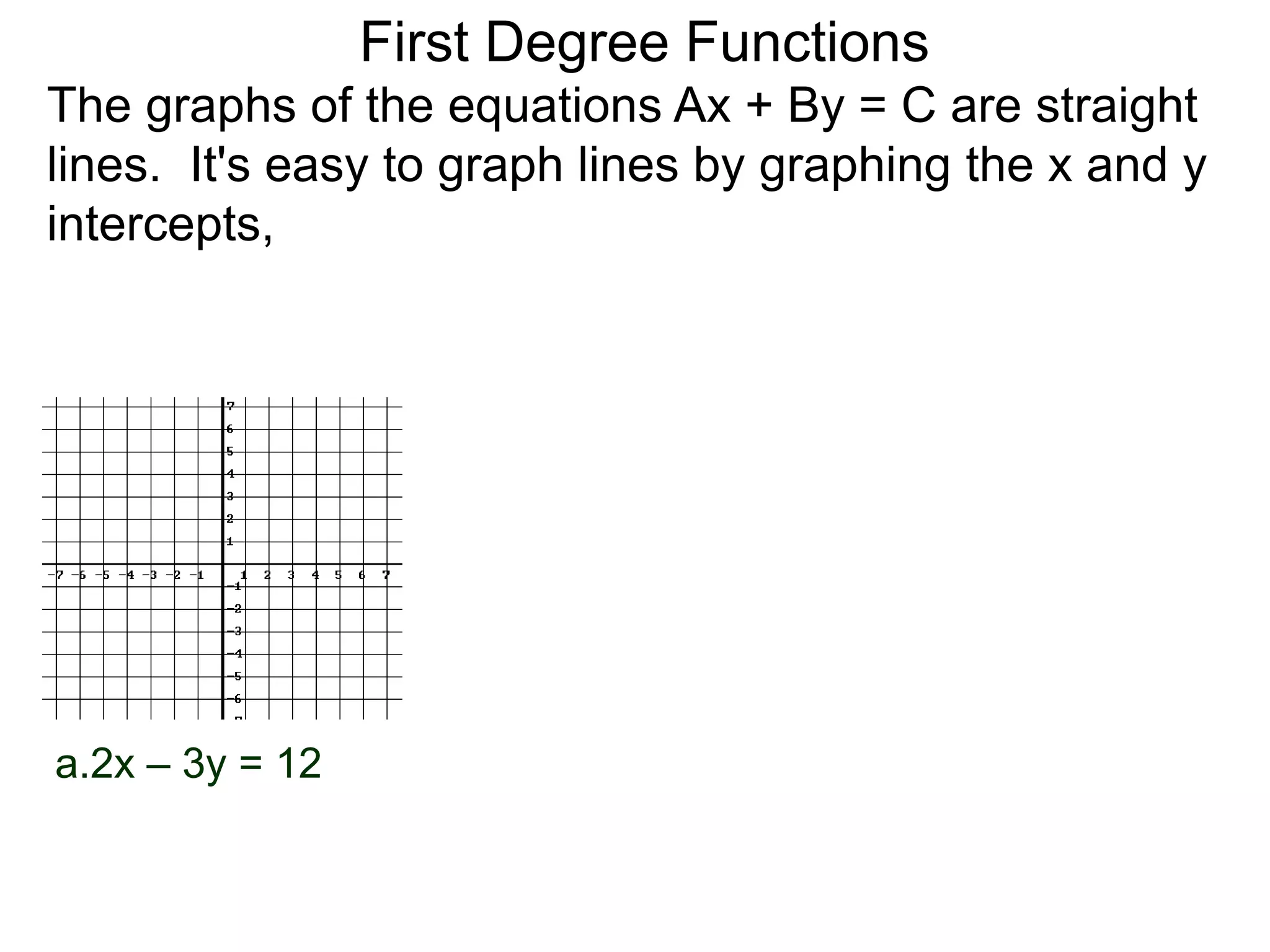
The graphs of the equations Ax + By = C are straight
lines. It's easy to graph lines by graphing the x and y
intercepts,
First Degree Functions
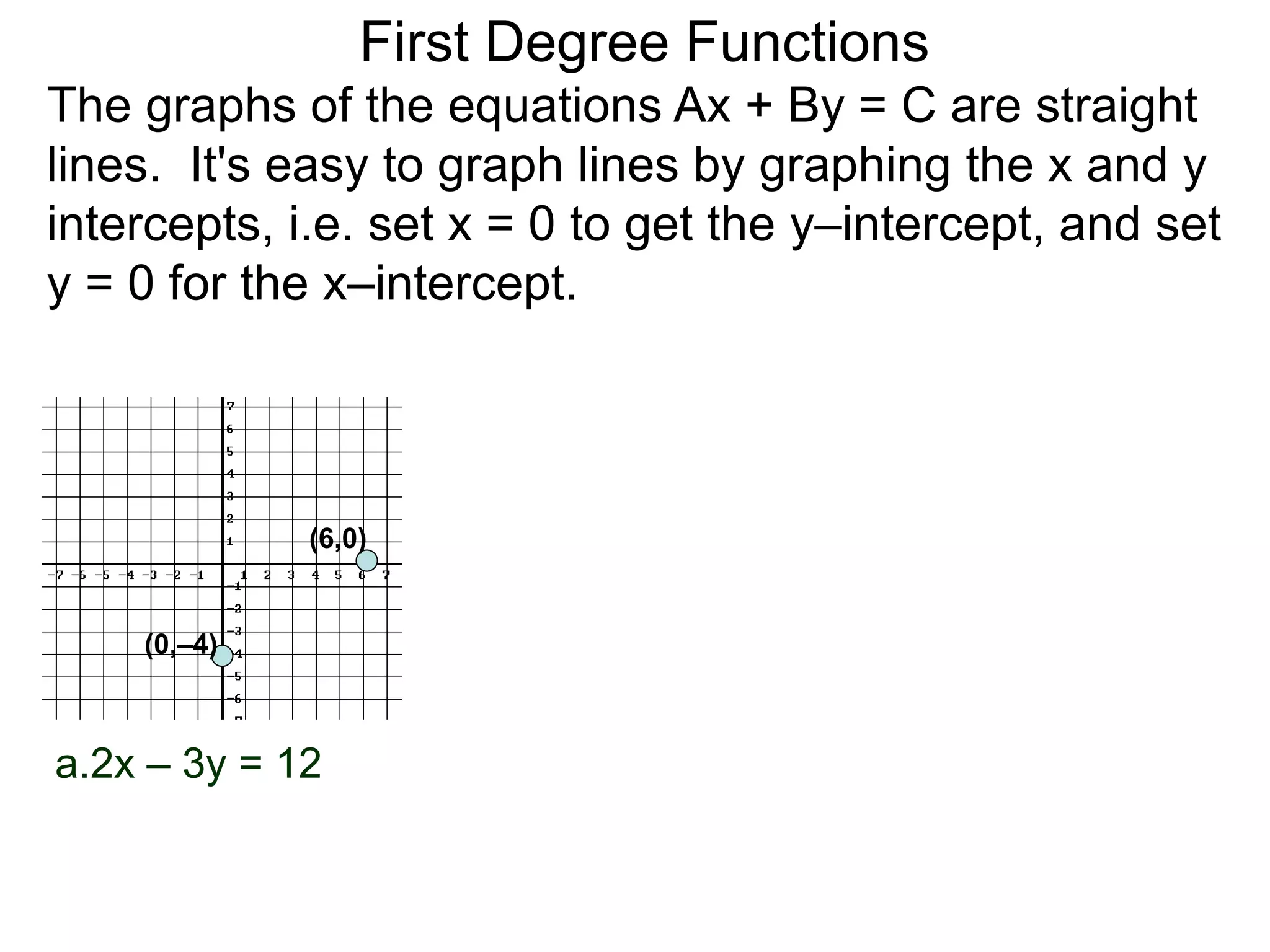
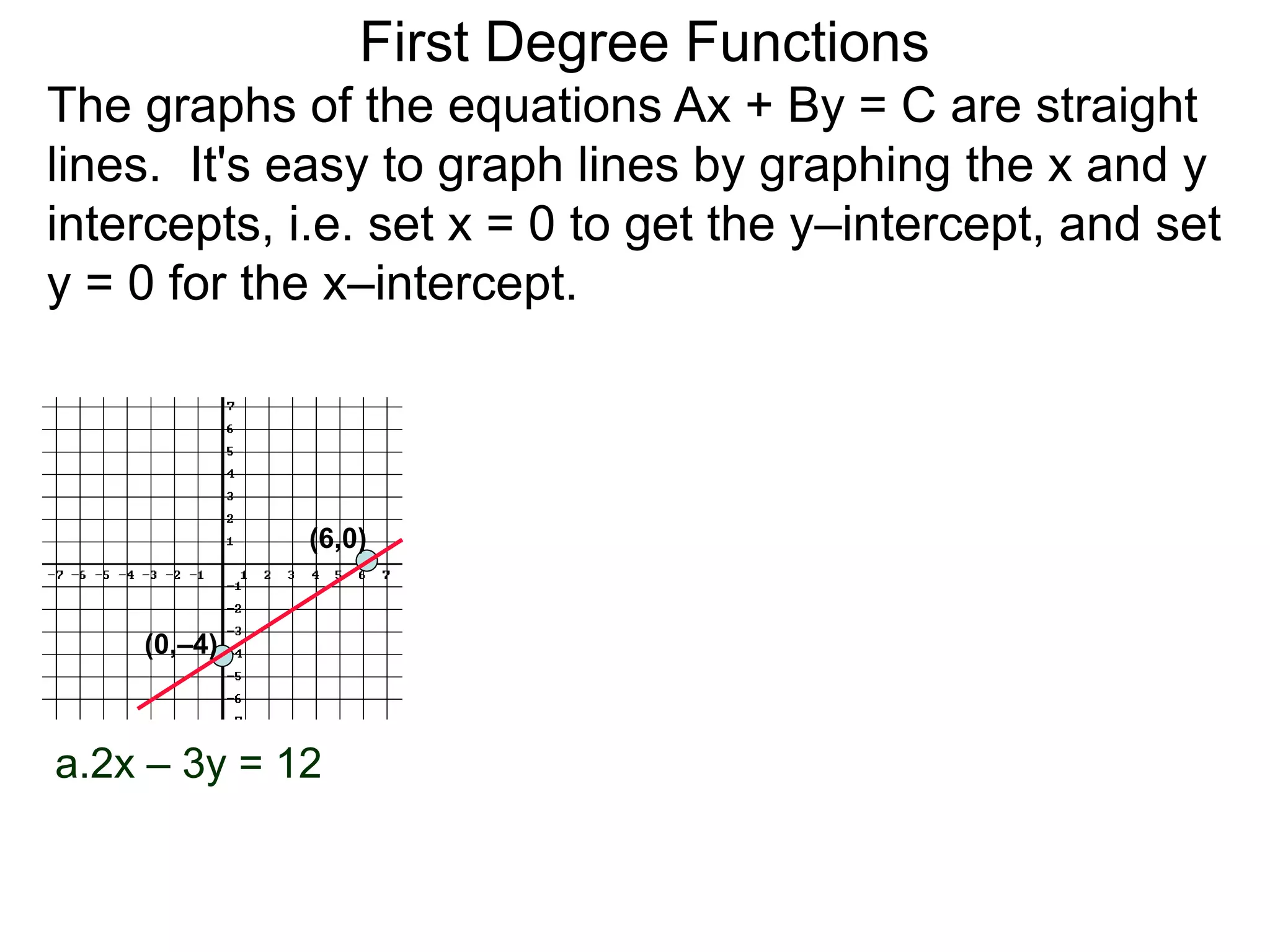
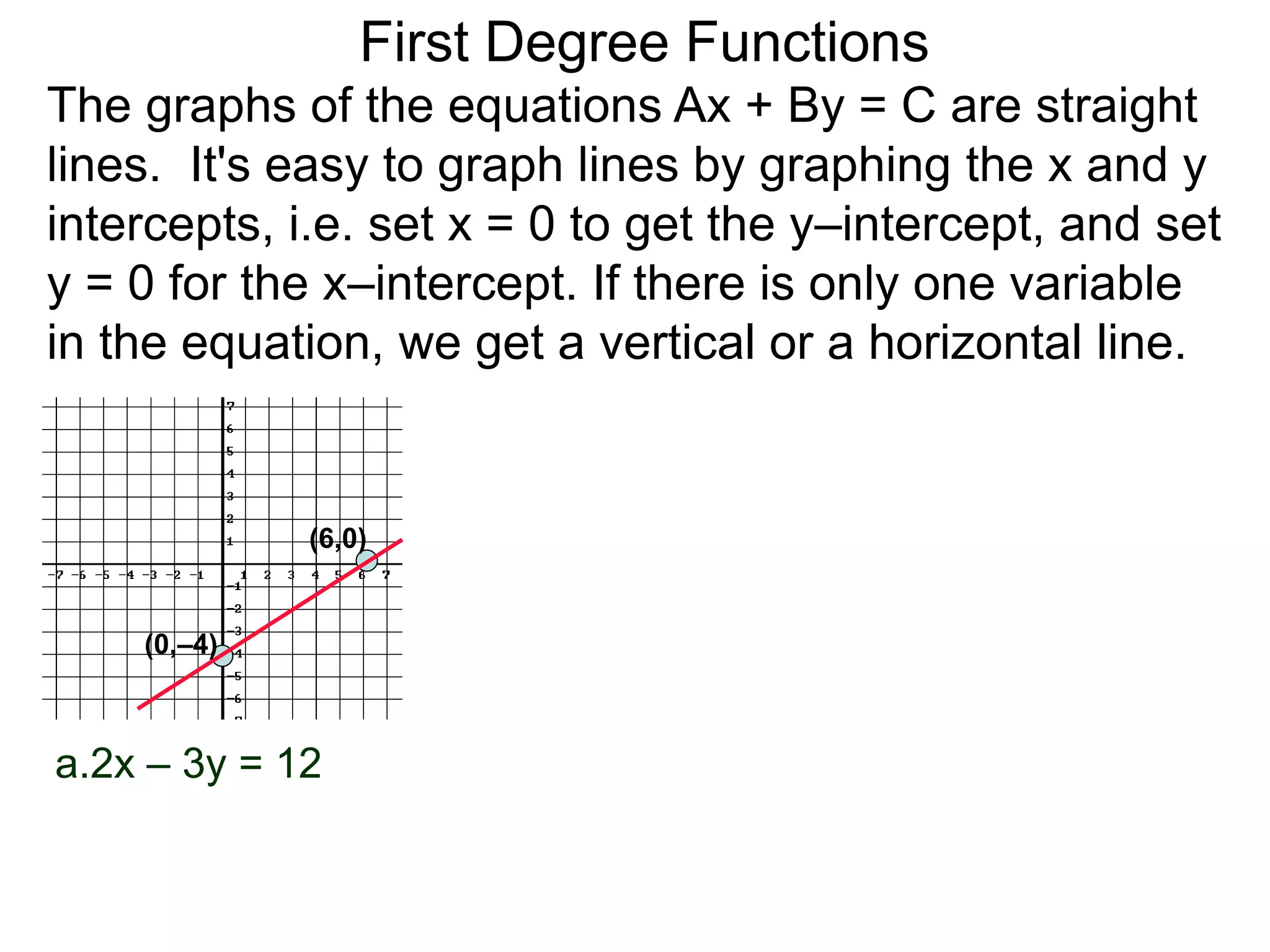
a.2x – 3y = 12
The graphs of the equations Ax + By = C are straight
lines. It's easy to graph lines by graphing the x and y
intercepts,
First Degree Functions
a.2x – 3y = 12
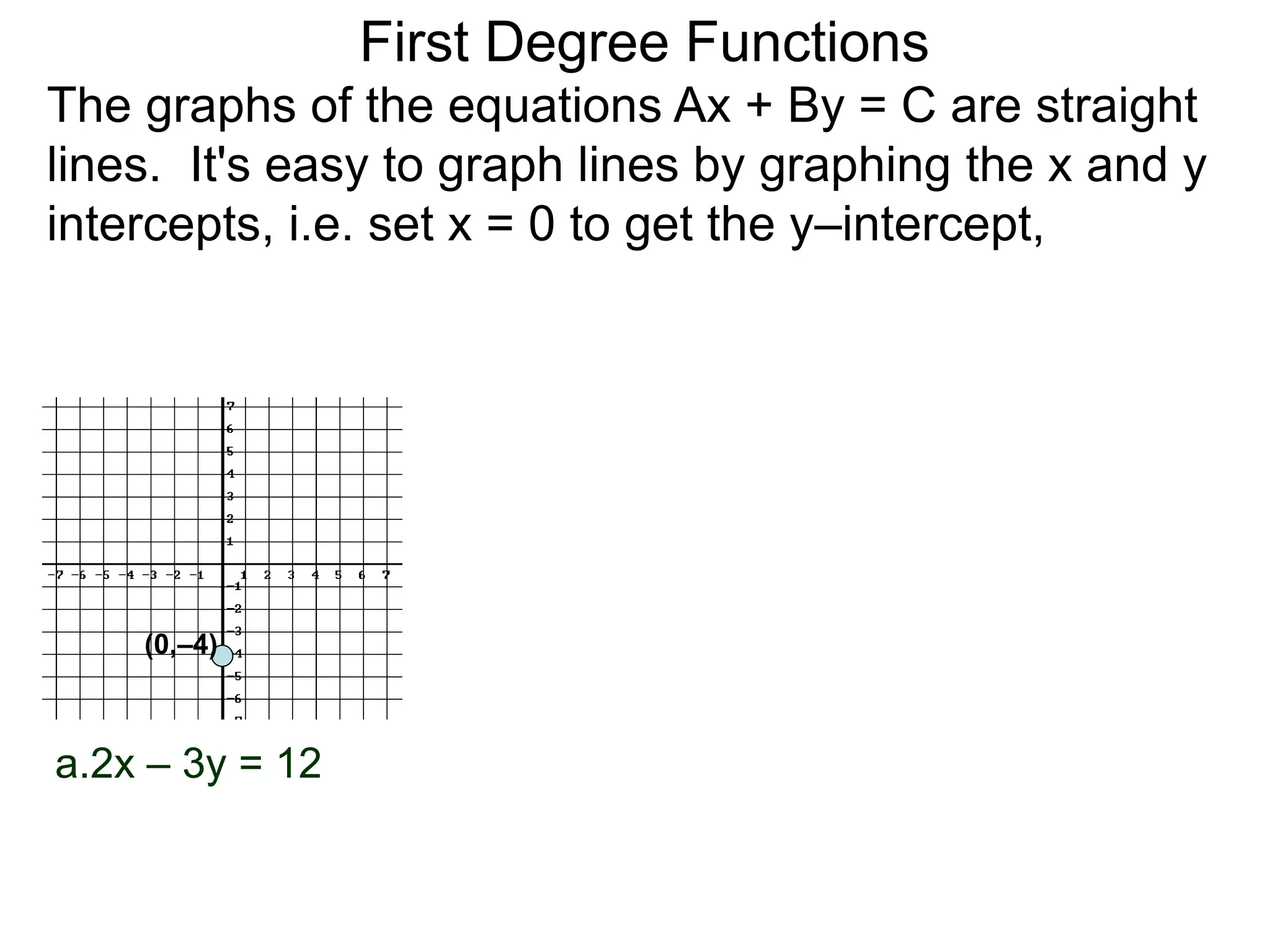
The graphs of the equations Ax + By = C are straight
lines. It's easy to graph lines by graphing the x and y
intercepts, i.e. set x = 0 to get the y–intercept,
(0,–4)
First Degree Functions
a.2x – 3y = 12
The graphs of the equations Ax + By = C are straight
lines. It's easy to graph lines by graphing the x and y
intercepts, i.e. set x = 0 to get the y–intercept, and set
y = 0 for the x–intercept.
(6,0)
(0,–4)
First Degree Functions
a.2x – 3y = 12
The graphs of the equations Ax + By = C are straight
lines. It's easy to graph lines by graphing the x and y
intercepts, i.e. set x = 0 to get the y–intercept, and set
y = 0 for the x–intercept.
(6,0)
(0,–4)
First Degree Functions
a.2x – 3y = 12
The graphs of the equations Ax + By = C are straight
lines. It's easy to graph lines by graphing the x and y
intercepts, i.e. set x = 0 to get the y–intercept, and set
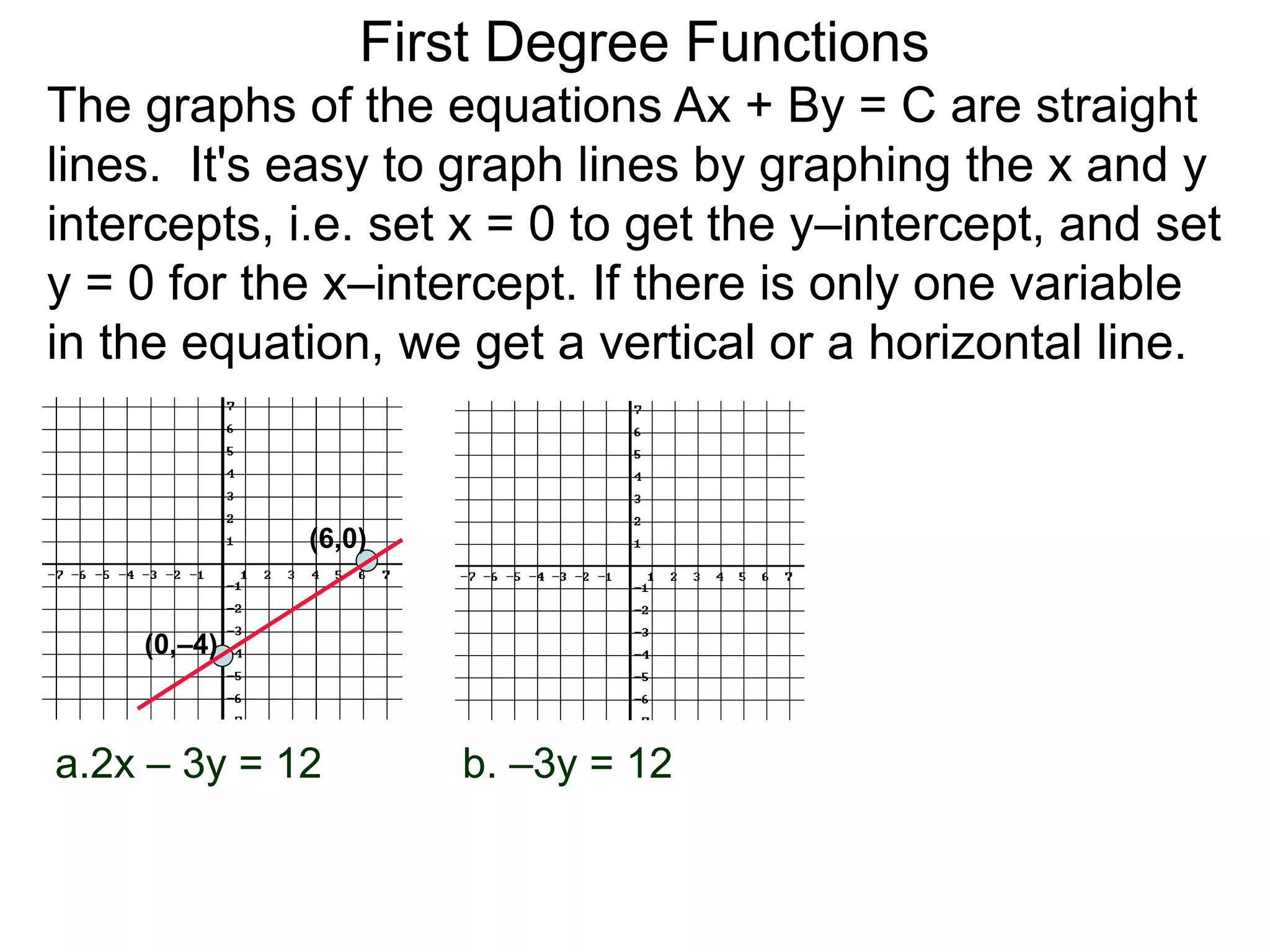
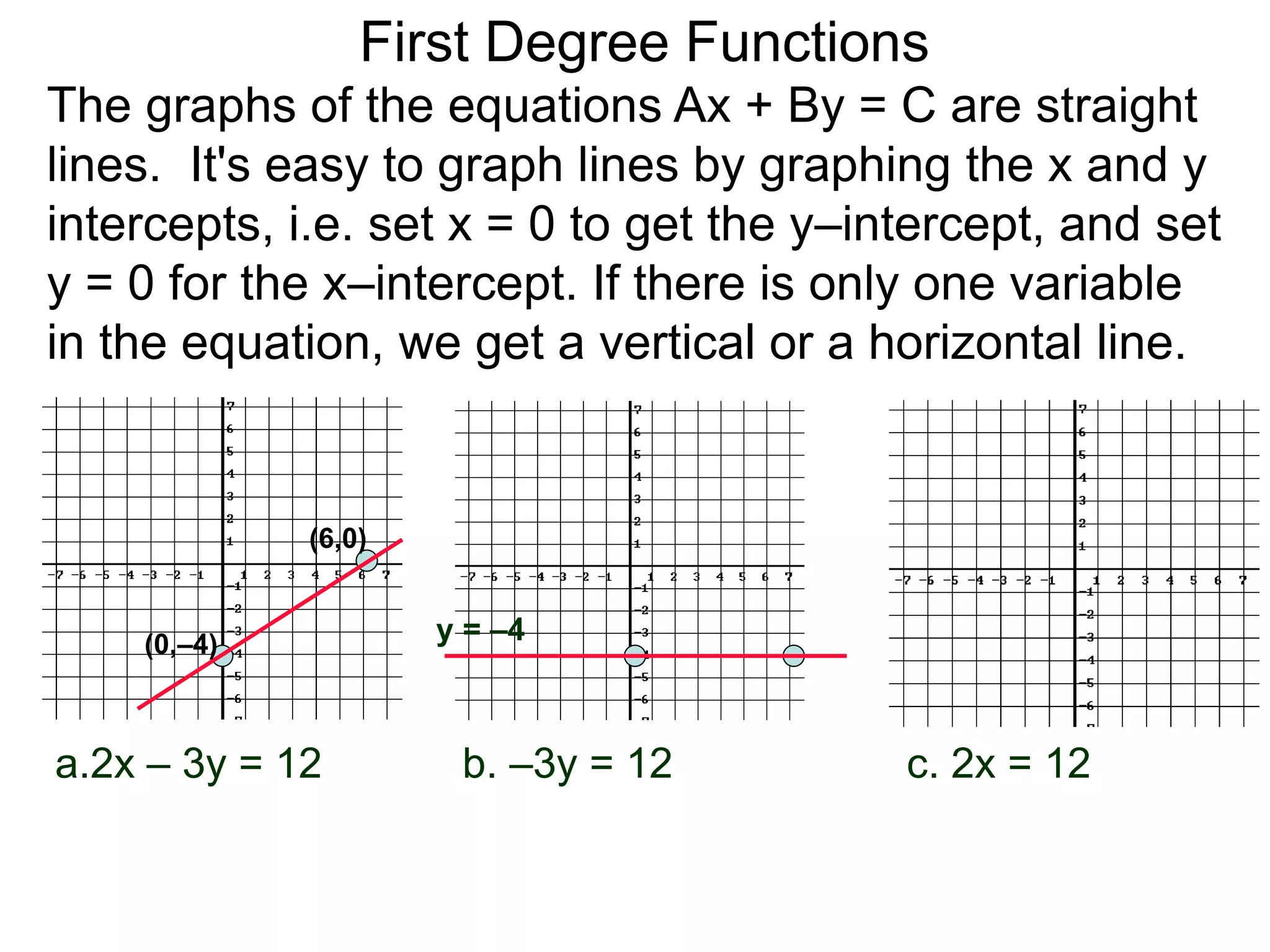
y = 0 for the x–intercept. If there is only one variable
in the equation, we get a vertical or a horizontal line.
(6,0)
(0,–4)
First Degree Functions
a.2x – 3y = 12 b. –3y = 12
The graphs of the equations Ax + By = C are straight
lines. It's easy to graph lines by graphing the x and y
intercepts, i.e. set x = 0 to get the y–intercept, and set
y = 0 for the x–intercept. If there is only one variable
in the equation, we get a vertical or a horizontal line.
(6,0)
(0,–4)
First Degree Functions
a.2x – 3y = 12 b. –3y = 12
The graphs of the equations Ax + By = C are straight
lines. It's easy to graph lines by graphing the x and y
intercepts, i.e. set x = 0 to get the y–intercept, and set
y = 0 for the x–intercept. If there is only one variable
in the equation, we get a vertical or a horizontal line.
(6,0)
(0,–4) y = –4
First Degree Functions
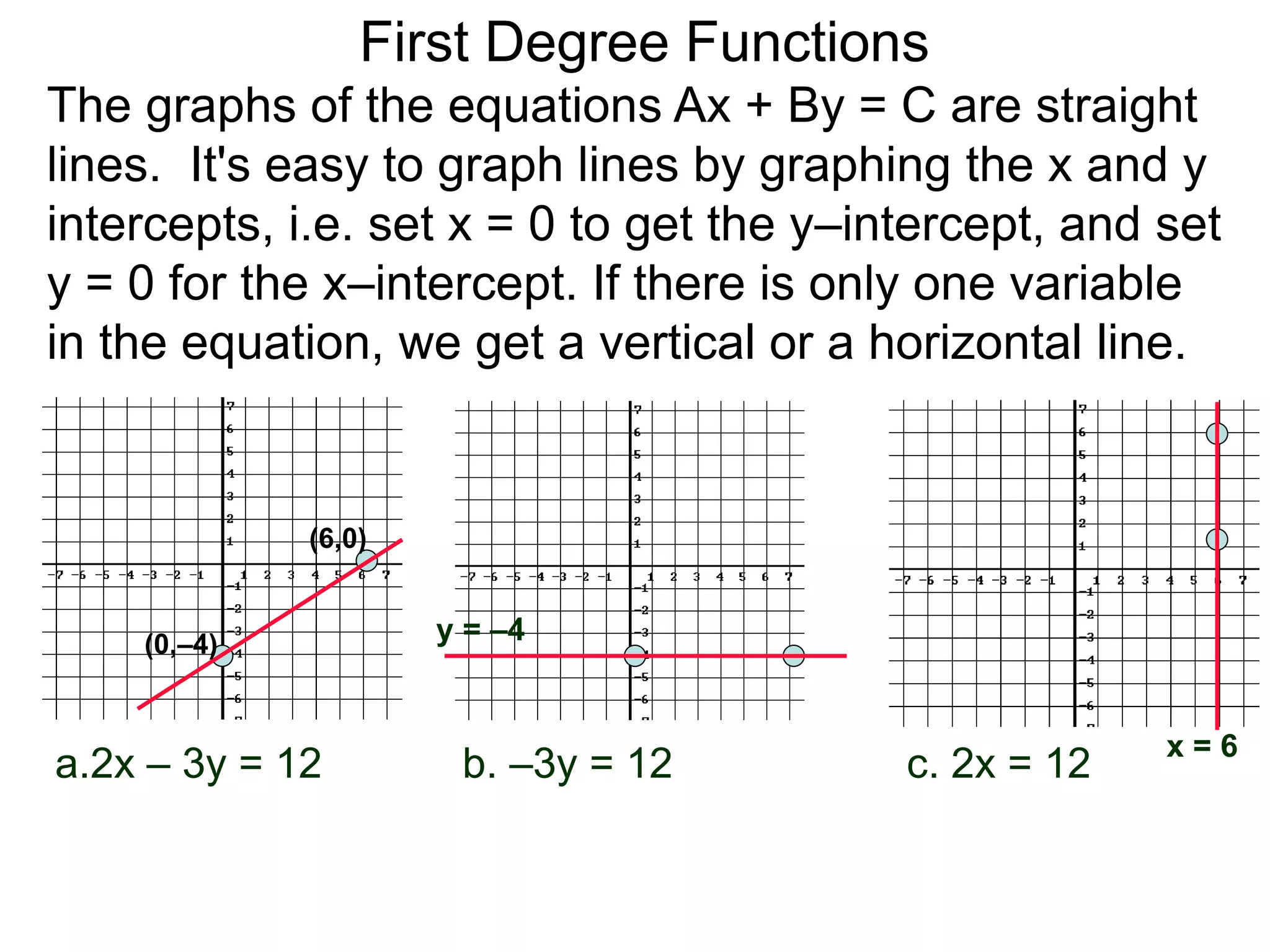
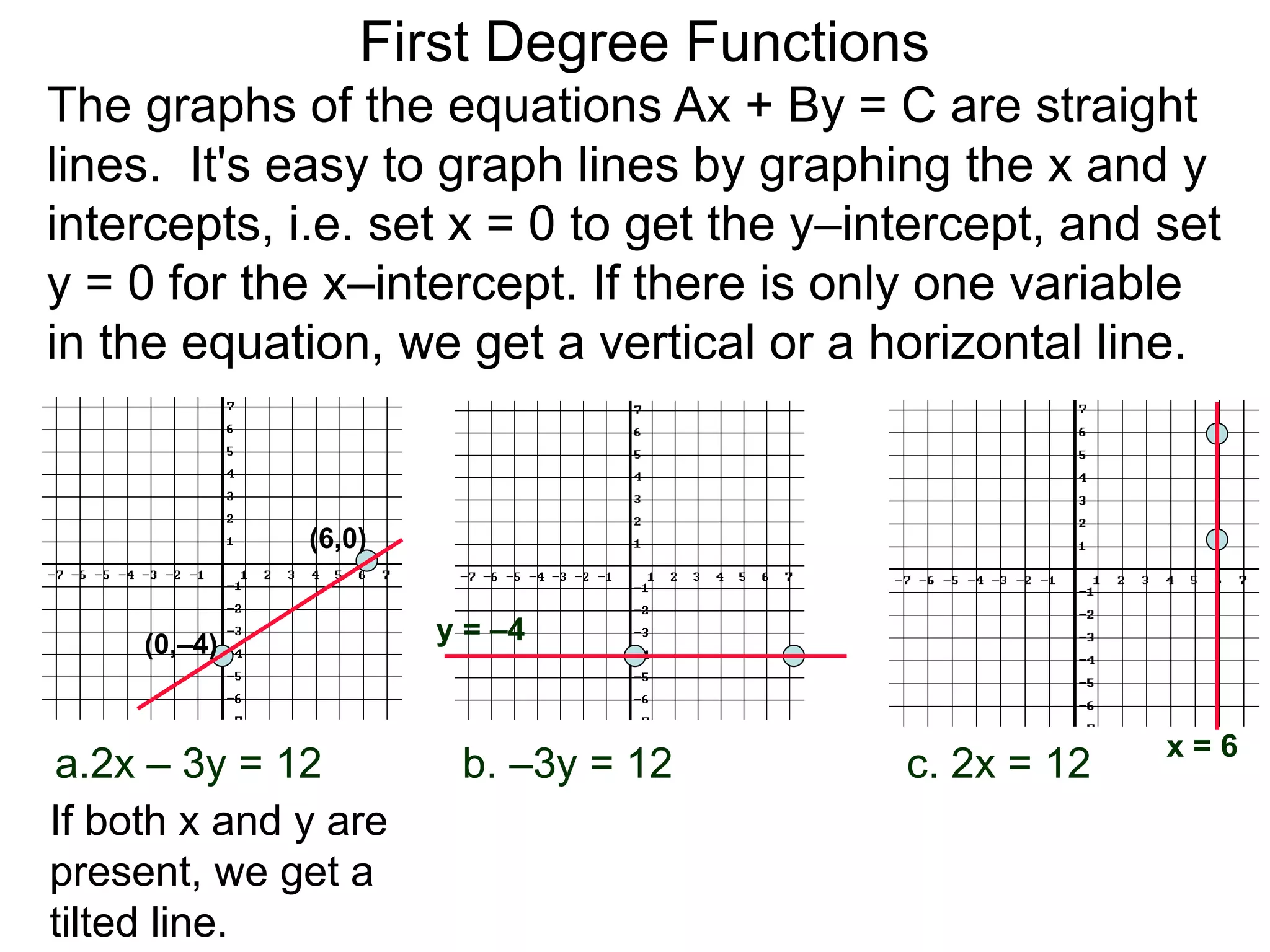
a.2x – 3y = 12 b. –3y = 12 c. 2x = 12
The graphs of the equations Ax + By = C are straight
lines. It's easy to graph lines by graphing the x and y
intercepts, i.e. set x = 0 to get the y–intercept, and set
y = 0 for the x–intercept. If there is only one variable
in the equation, we get a vertical or a horizontal line.
(6,0)
(0,–4) y = –4
First Degree Functions
a.2x – 3y = 12 b. –3y = 12 c. 2x = 12
The graphs of the equations Ax + By = C are straight
lines. It's easy to graph lines by graphing the x and y
intercepts, i.e. set x = 0 to get the y–intercept, and set
y = 0 for the x–intercept. If there is only one variable
in the equation, we get a vertical or a horizontal line.
(6,0)
(0,–4) y = –4
x = 6
First Degree Functions
a.2x – 3y = 12 b. –3y = 12 c. 2x = 12
If both x and y are
present, we get a
tilted line.
The graphs of the equations Ax + By = C are straight
lines. It's easy to graph lines by graphing the x and y
intercepts, i.e. set x = 0 to get the y–intercept, and set
y = 0 for the x–intercept. If there is only one variable
in the equation, we get a vertical or a horizontal line.
(6,0)
(0,–4) y = –4
x = 6
First Degree Functions
a.2x – 3y = 12 b. –3y = 12 c. 2x = 12
If both x and y are
present, we get a
tilted line.
If the equation is
y = c, we get a
horizontal line.
The graphs of the equations Ax + By = C are straight
lines. It's easy to graph lines by graphing the x and y
intercepts, i.e. set x = 0 to get the y–intercept, and set
y = 0 for the x–intercept. If there is only one variable
in the equation, we get a vertical or a horizontal line.
(6,0)
(0,–4) y = –4
x = 6
First Degree Functions
a.2x – 3y = 12 b. –3y = 12 c. 2x = 12
If both x and y are
present, we get a
tilted line.
If the equation is
y = c, we get a
horizontal line.
The graphs of the equations Ax + By = C are straight
lines. It's easy to graph lines by graphing the x and y
intercepts, i.e. set x = 0 to get the y–intercept, and set
y = 0 for the x–intercept. If there is only one variable
in the equation, we get a vertical or a horizontal line.
(6,0)
(0,–4) y = –4
x = 6
If the equation is
x = c, we get a
vertical line.
First Degree Functions
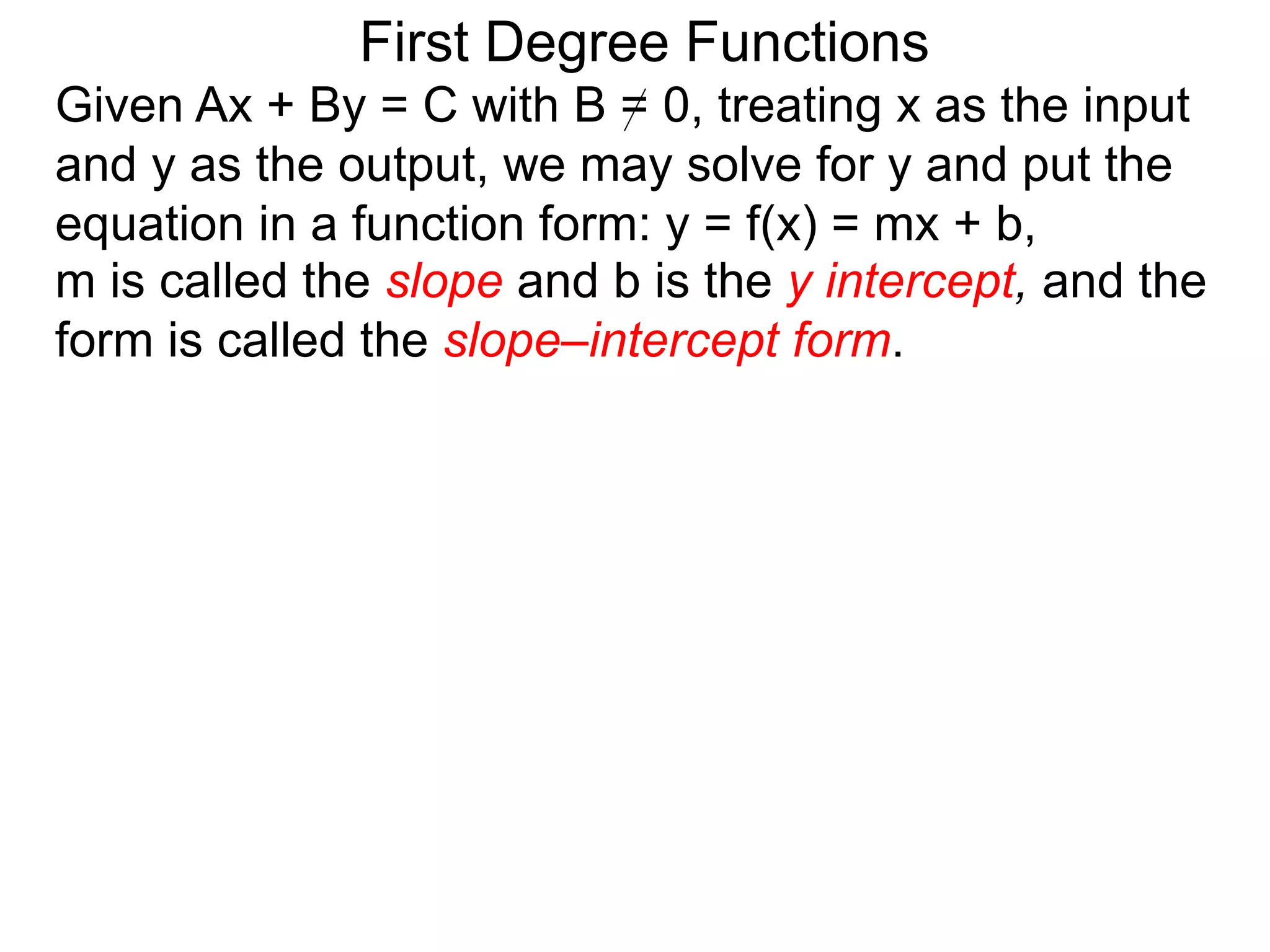
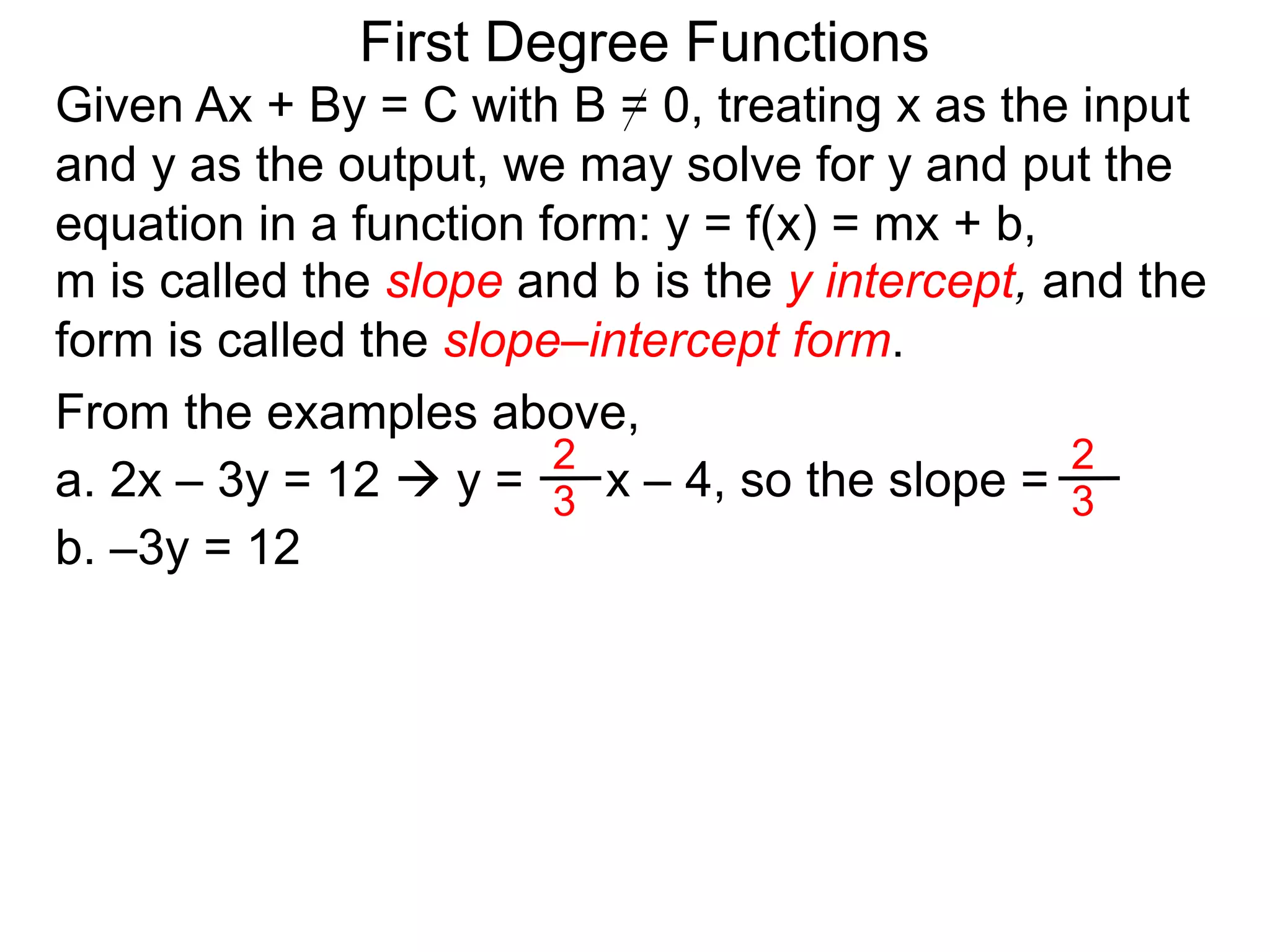
Given Ax + By = C with B = 0,
First Degree Functions
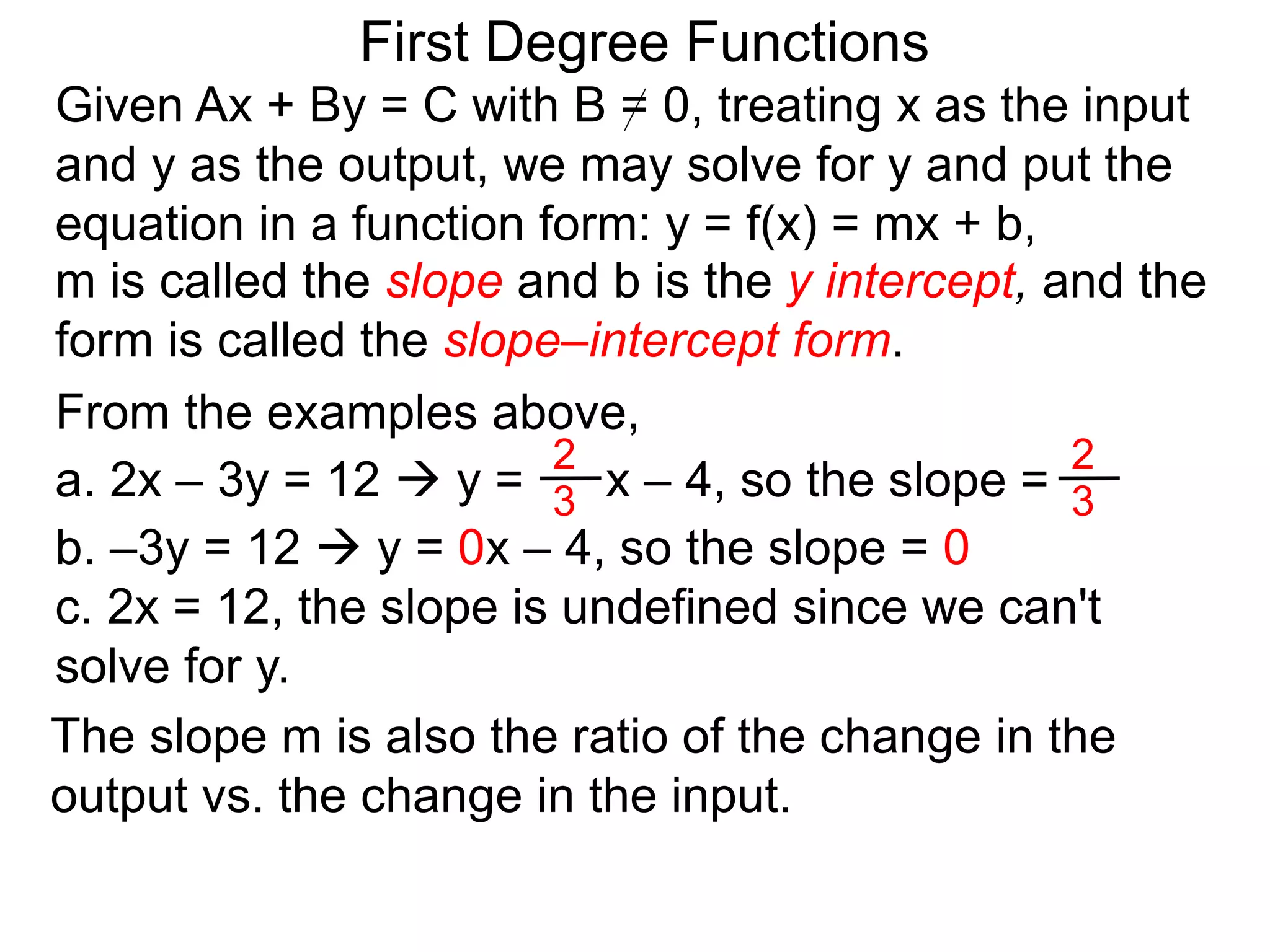
Given Ax + By = C with B = 0, treating x as the input
and y as the output, we may solve for y and put the
equation in a function form: y = f(x) = mx + b,
First Degree Functions
Given Ax + By = C with B = 0, treating x as the input
and y as the output, we may solve for y and put the
equation in a function form: y = f(x) = mx + b,
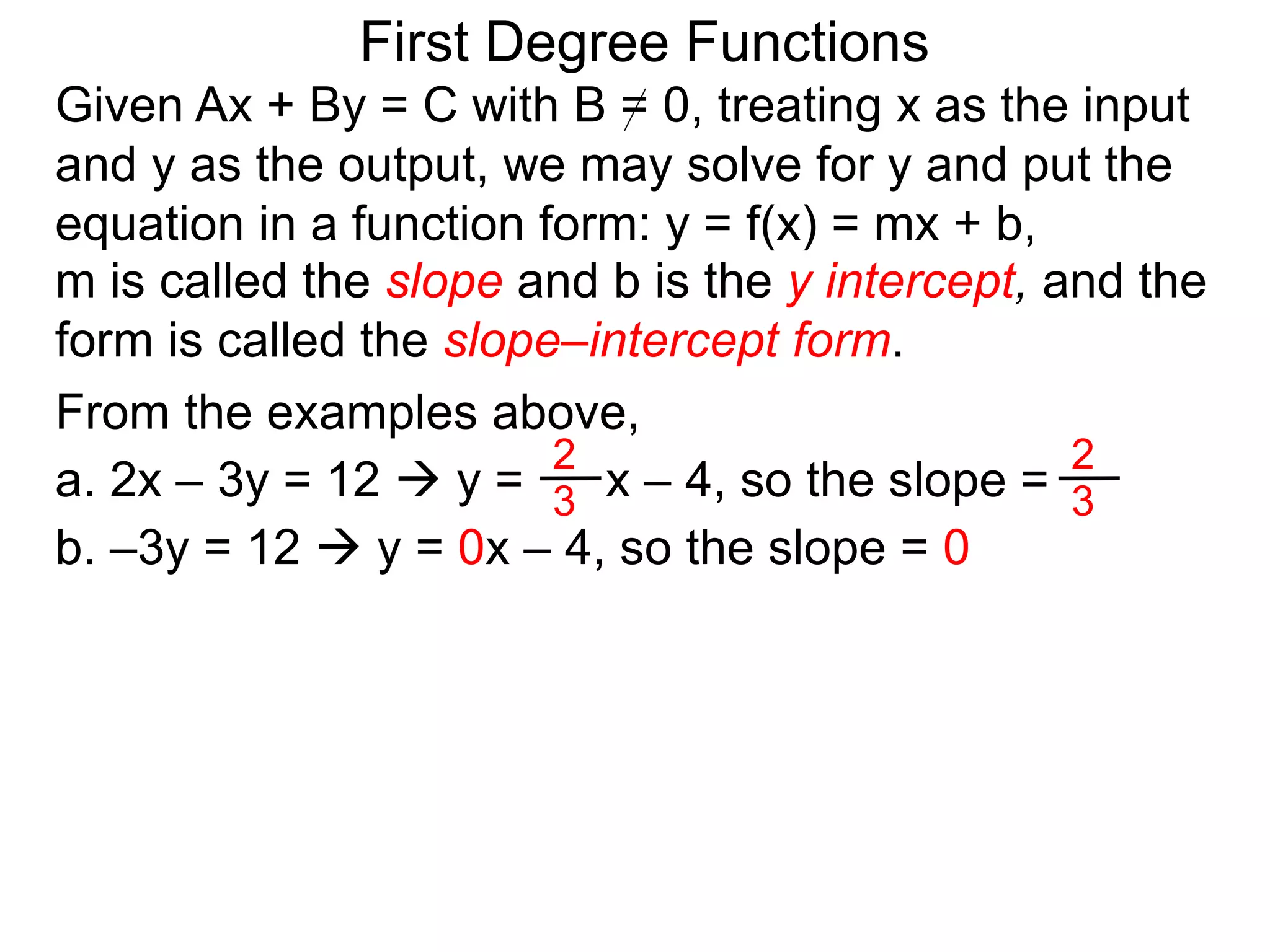
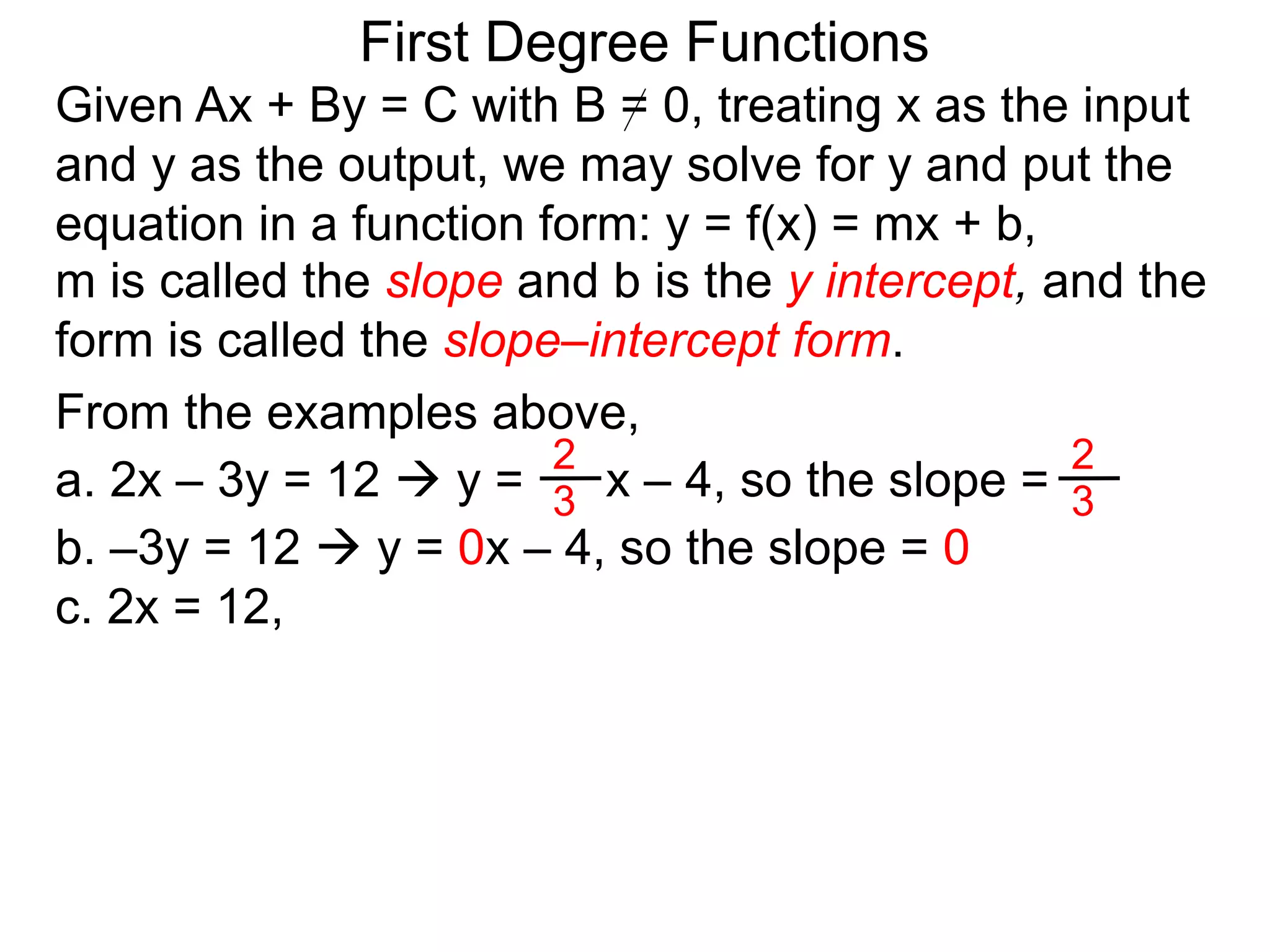
m is called the slope and b is the y intercept,
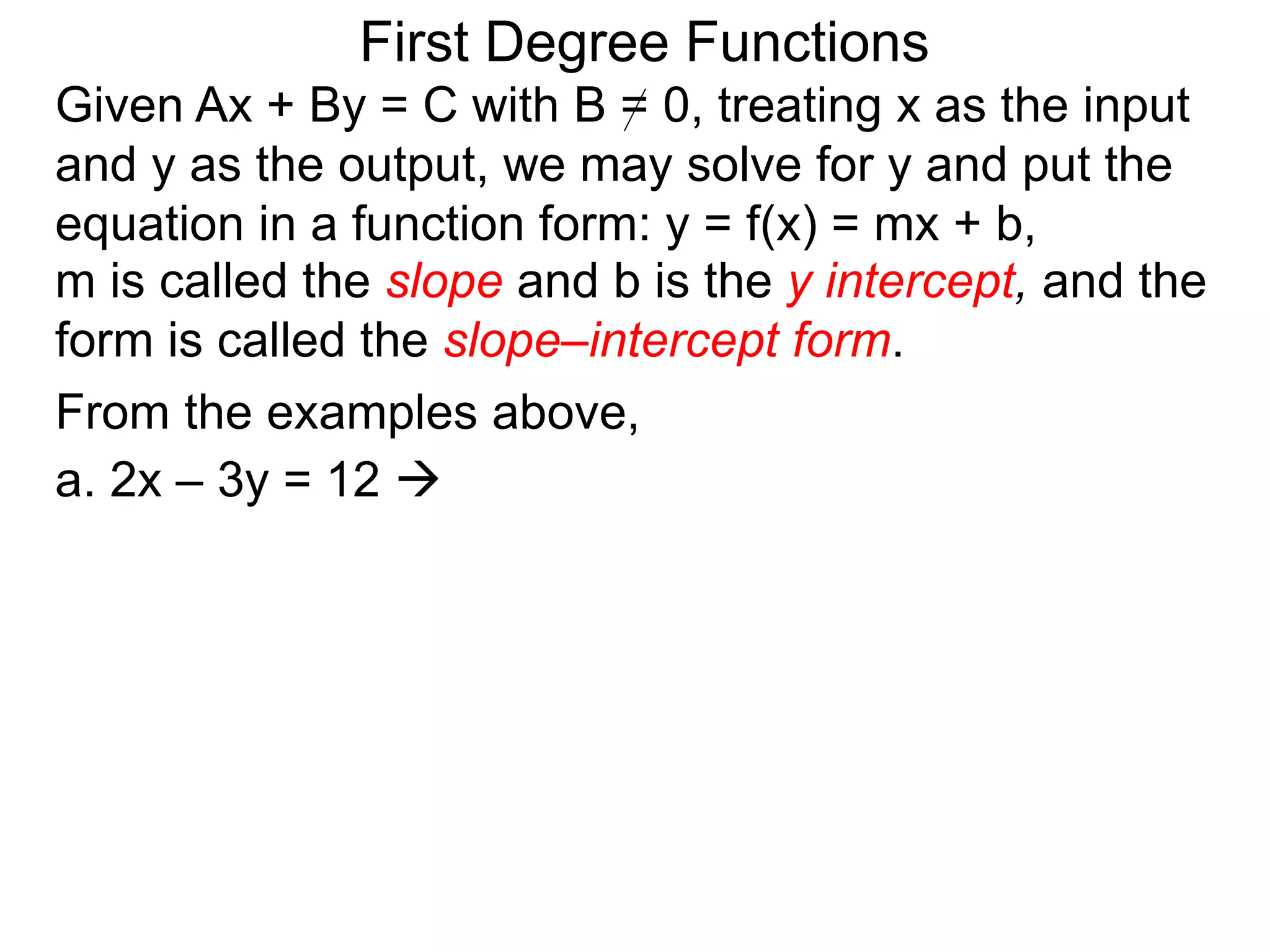
First Degree Functions
Given Ax + By = C with B = 0, treating x as the input
and y as the output, we may solve for y and put the
equation in a function form: y = f(x) = mx + b,
m is called the slope and b is the y intercept, and the
form is called the slope–intercept form.
First Degree Functions
Given Ax + By = C with B = 0, treating x as the input
and y as the output, we may solve for y and put the
equation in a function form: y = f(x) = mx + b,
m is called the slope and b is the y intercept, and the
form is called the slope–intercept form.
From the examples above,
a. 2x – 3y = 12 
First Degree Functions
Given Ax + By = C with B = 0, treating x as the input
and y as the output, we may solve for y and put the
equation in a function form: y = f(x) = mx + b,
m is called the slope and b is the y intercept, and the
form is called the slope–intercept form.
2
3
2
3
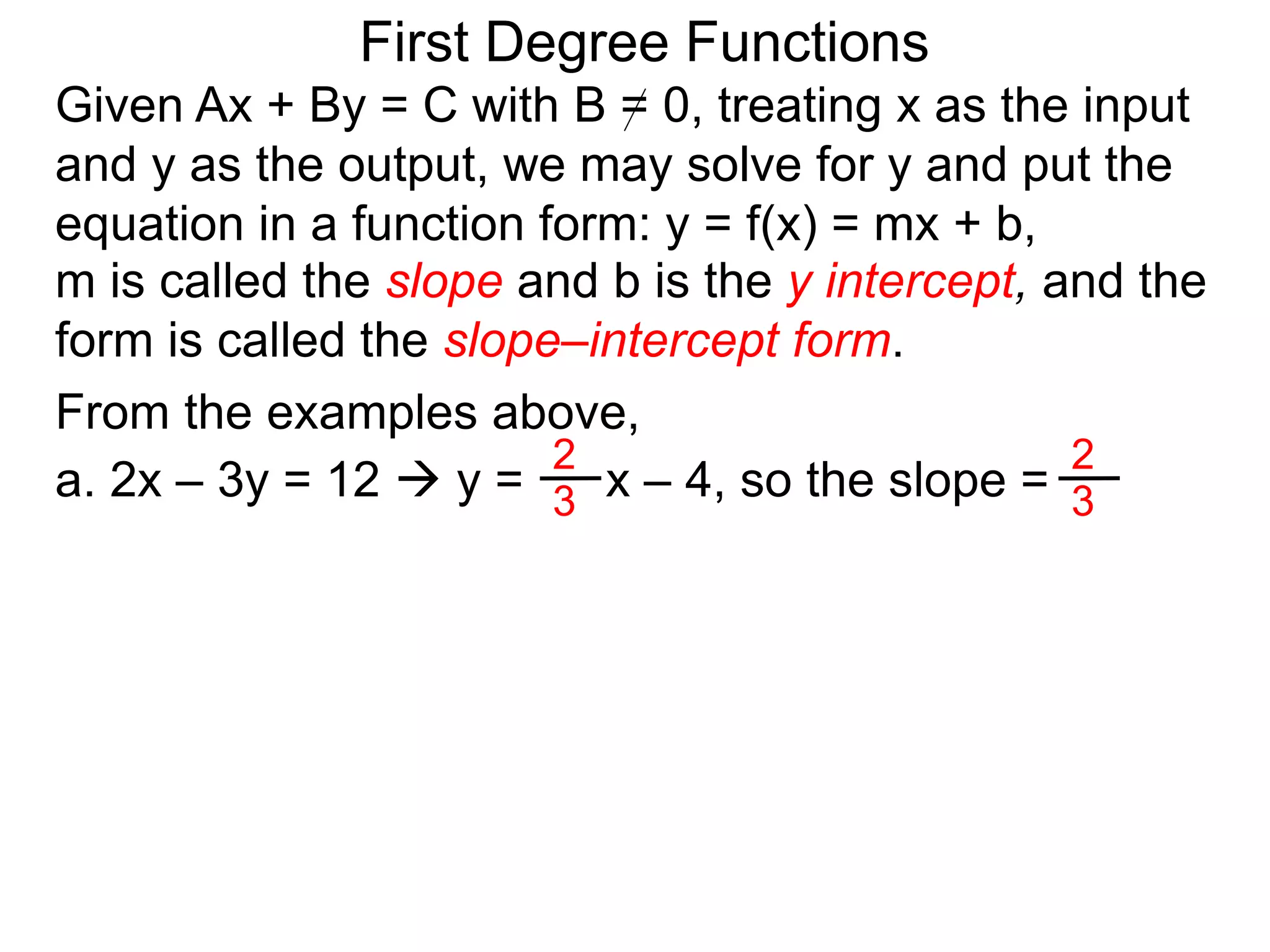
From the examples above,
a. 2x – 3y = 12  y = x – 4, so the slope =
First Degree Functions
Given Ax + By = C with B = 0, treating x as the input
and y as the output, we may solve for y and put the
equation in a function form: y = f(x) = mx + b,
m is called the slope and b is the y intercept, and the
form is called the slope–intercept form.
2
3
2
3
From the examples above,
a. 2x – 3y = 12  y = x – 4, so the slope =
b. –3y = 12
First Degree Functions
Given Ax + By = C with B = 0, treating x as the input
and y as the output, we may solve for y and put the
equation in a function form: y = f(x) = mx + b,
m is called the slope and b is the y intercept, and the
form is called the slope–intercept form.
2
3
2
3
From the examples above,
a. 2x – 3y = 12  y = x – 4, so the slope =
b. –3y = 12  y = 0x – 4, so the slope = 0
First Degree Functions
Given Ax + By = C with B = 0, treating x as the input
and y as the output, we may solve for y and put the
equation in a function form: y = f(x) = mx + b,
m is called the slope and b is the y intercept, and the
form is called the slope–intercept form.
2
3
2
3
From the examples above,
a. 2x – 3y = 12  y = x – 4, so the slope =
b. –3y = 12  y = 0x – 4, so the slope = 0
c. 2x = 12,
First Degree Functions
Given Ax + By = C with B = 0, treating x as the input
and y as the output, we may solve for y and put the
equation in a function form: y = f(x) = mx + b,
m is called the slope and b is the y intercept, and the
form is called the slope–intercept form.
2
3
2
3
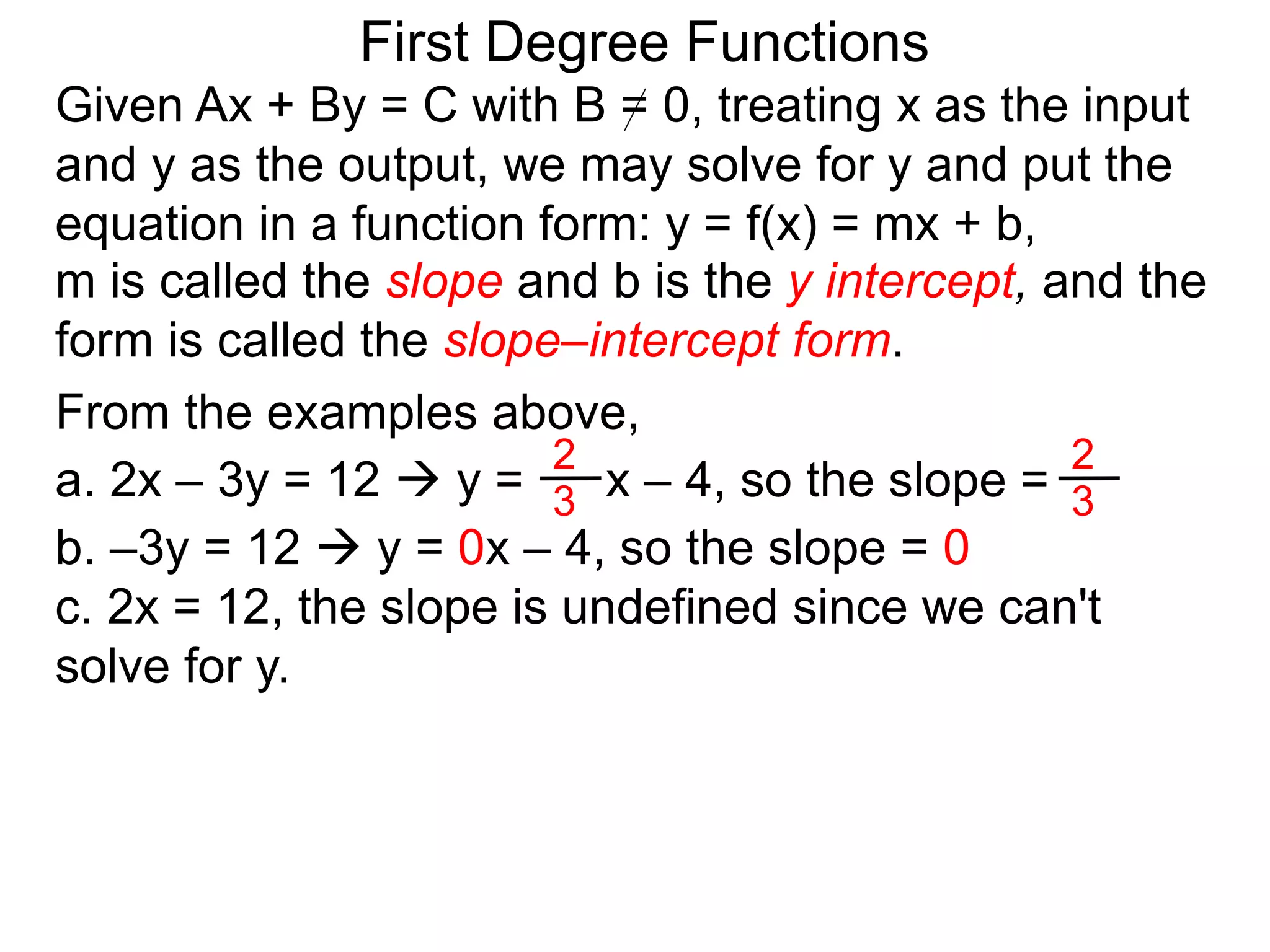
From the examples above,
a. 2x – 3y = 12  y = x – 4, so the slope =
b. –3y = 12  y = 0x – 4, so the slope = 0
c. 2x = 12, the slope is undefined since we can't
solve for y.
First Degree Functions
Given Ax + By = C with B = 0, treating x as the input
and y as the output, we may solve for y and put the
equation in a function form: y = f(x) = mx + b,
m is called the slope and b is the y intercept, and the
form is called the slope–intercept form.
The slope m is also the ratio of the change in the
output vs. the change in the input.
2
3
2
3
From the examples above,
a. 2x – 3y = 12  y = x – 4, so the slope =
b. –3y = 12  y = 0x – 4, so the slope = 0
c. 2x = 12, the slope is undefined since we can't
solve for y.
First Degree Functions
Given Ax + By = C with B = 0, treating x as the input
and y as the output, we may solve for y and put the
equation in a function form: y = f(x) = mx + b,
m is called the slope and b is the y intercept, and the
form is called the slope–intercept form.
The slope m is also the ratio of the amounts of
change in the output : the change in the input.
If two points on the line are given,
the slope is defined via the following formula.
2
3
2
3
From the examples above,
a. 2x – 3y = 12  y = x – 4, so the slope =
b. –3y = 12  y = 0x – 4, so the slope = 0
c. 2x = 12, the slope is undefined since we can't
solve for y.
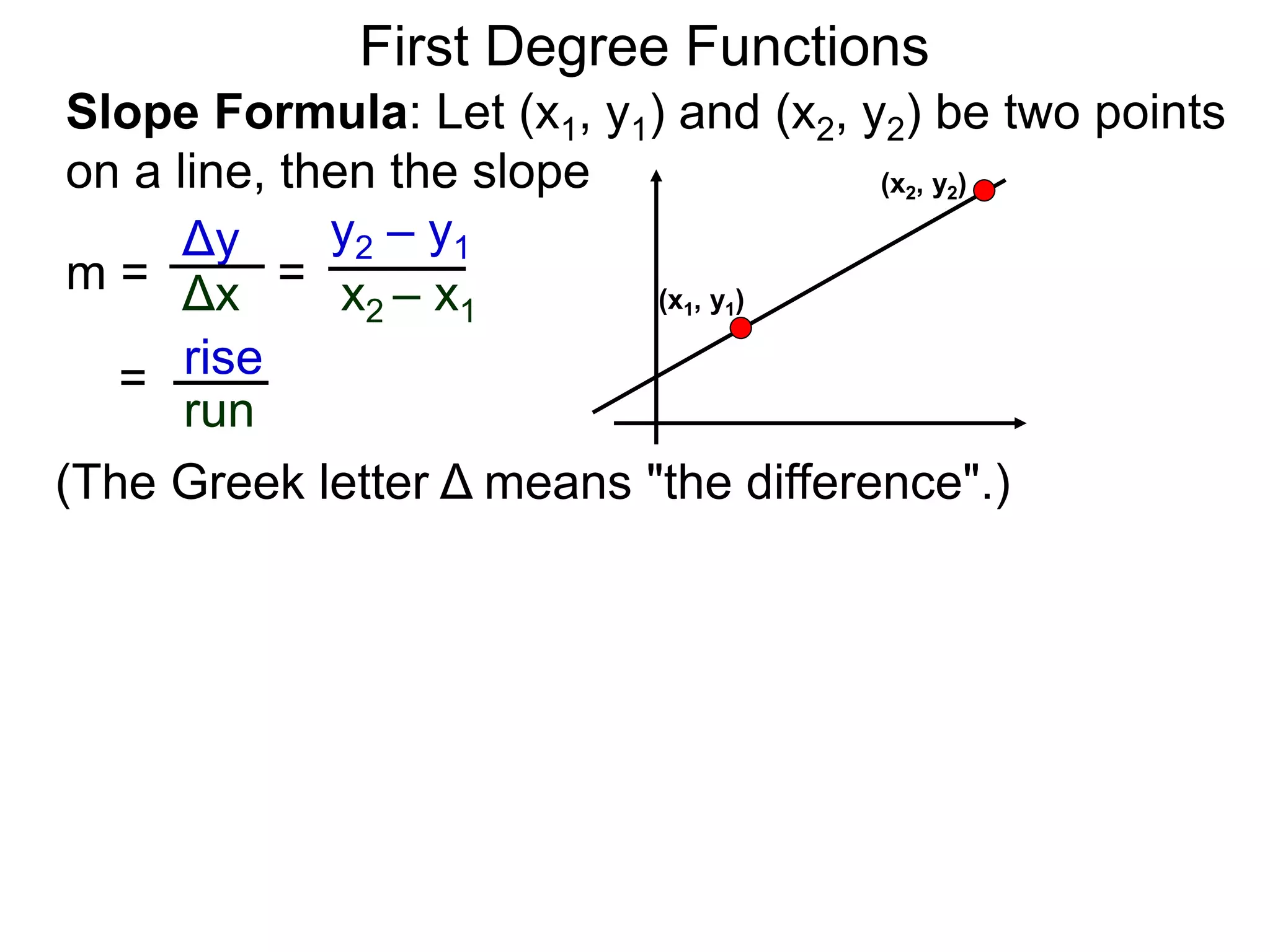
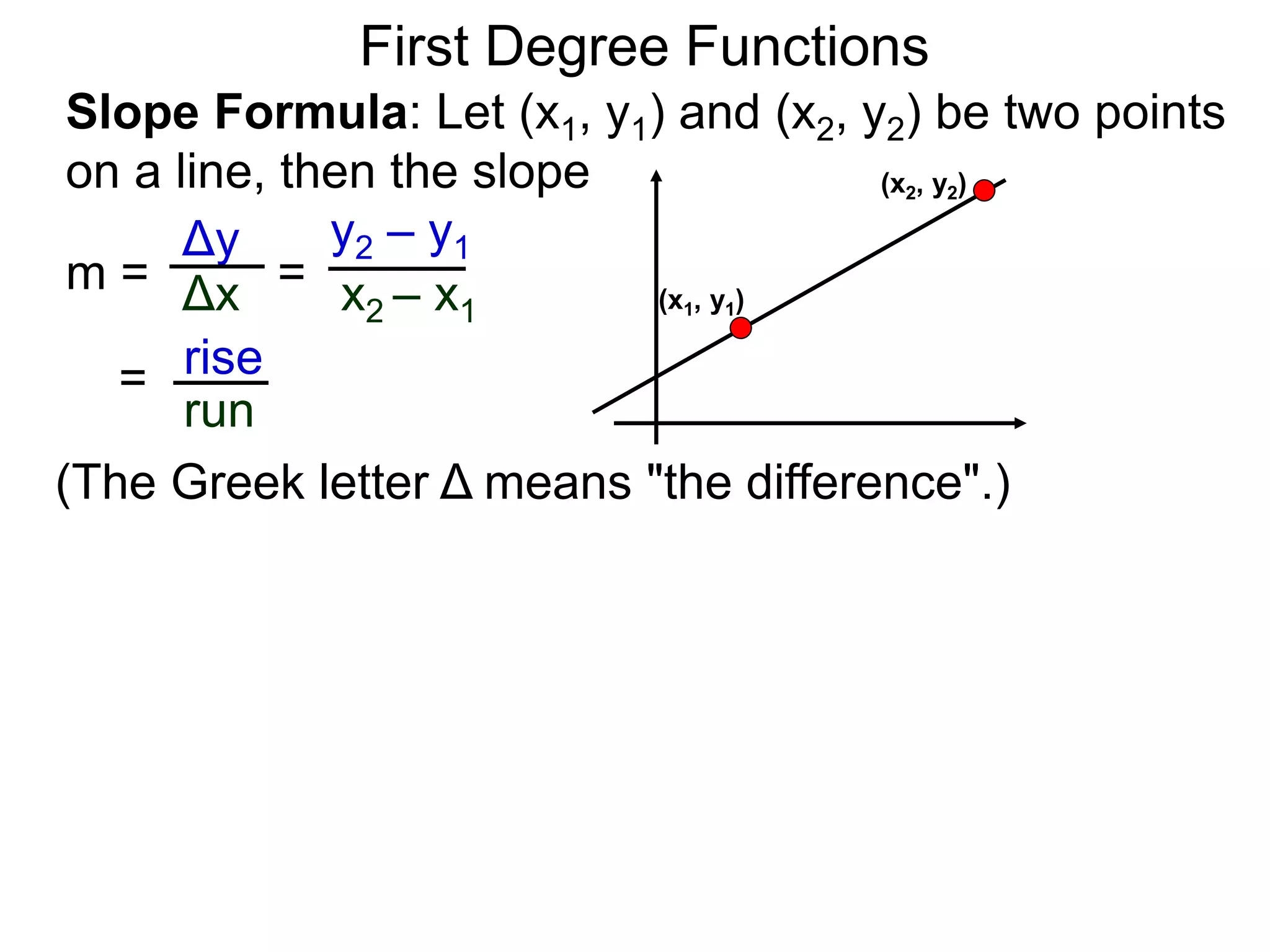
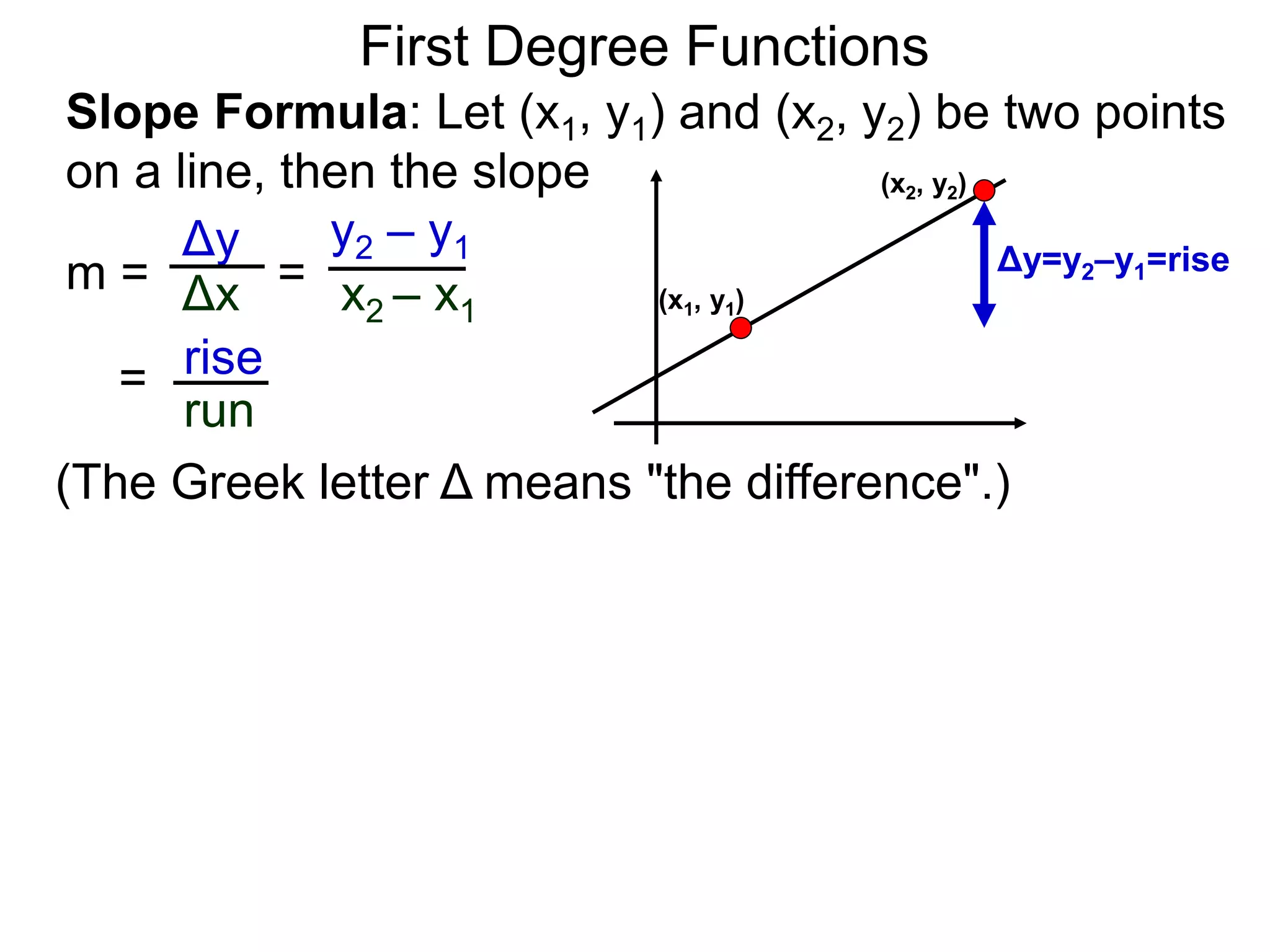
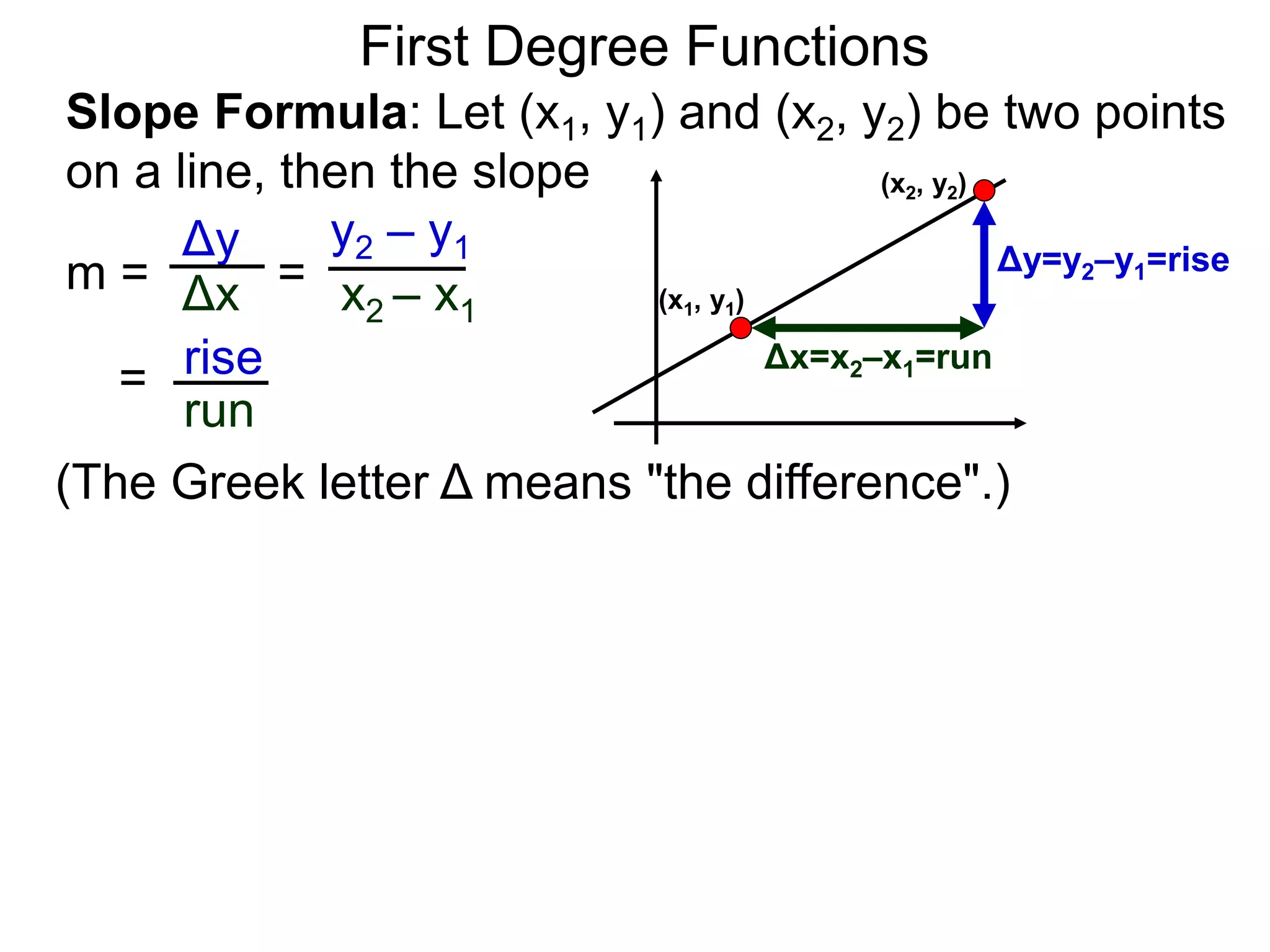
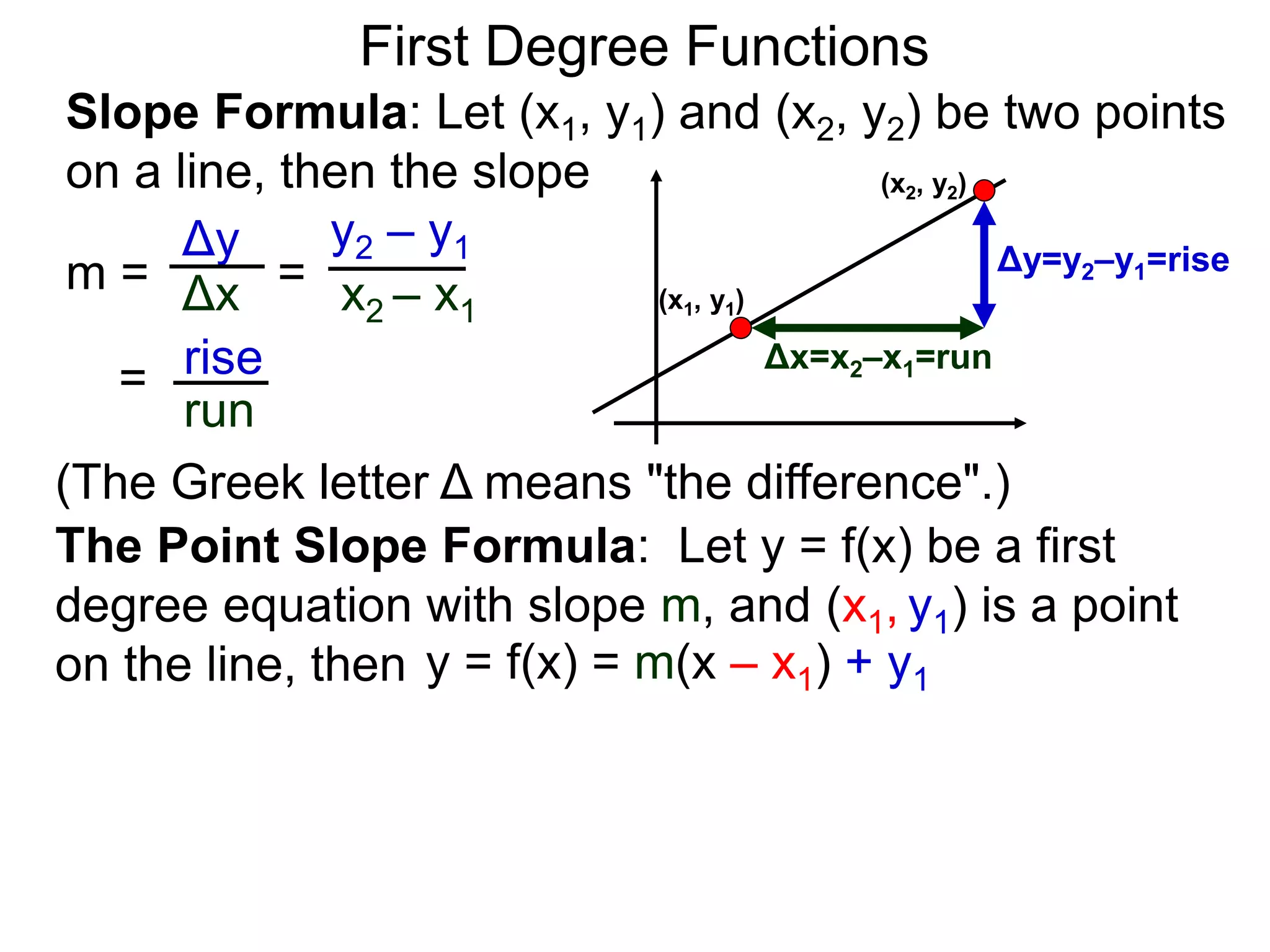
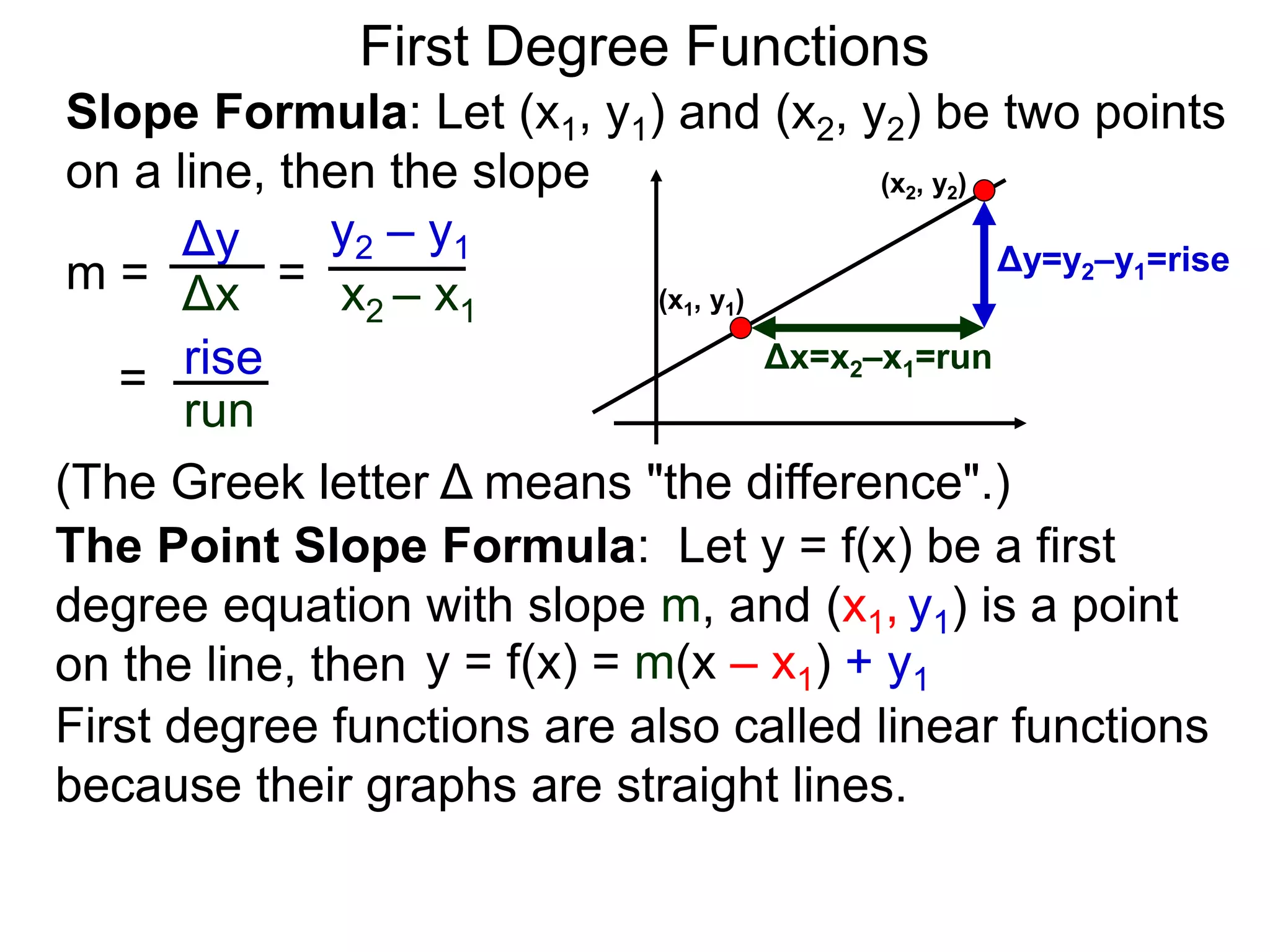
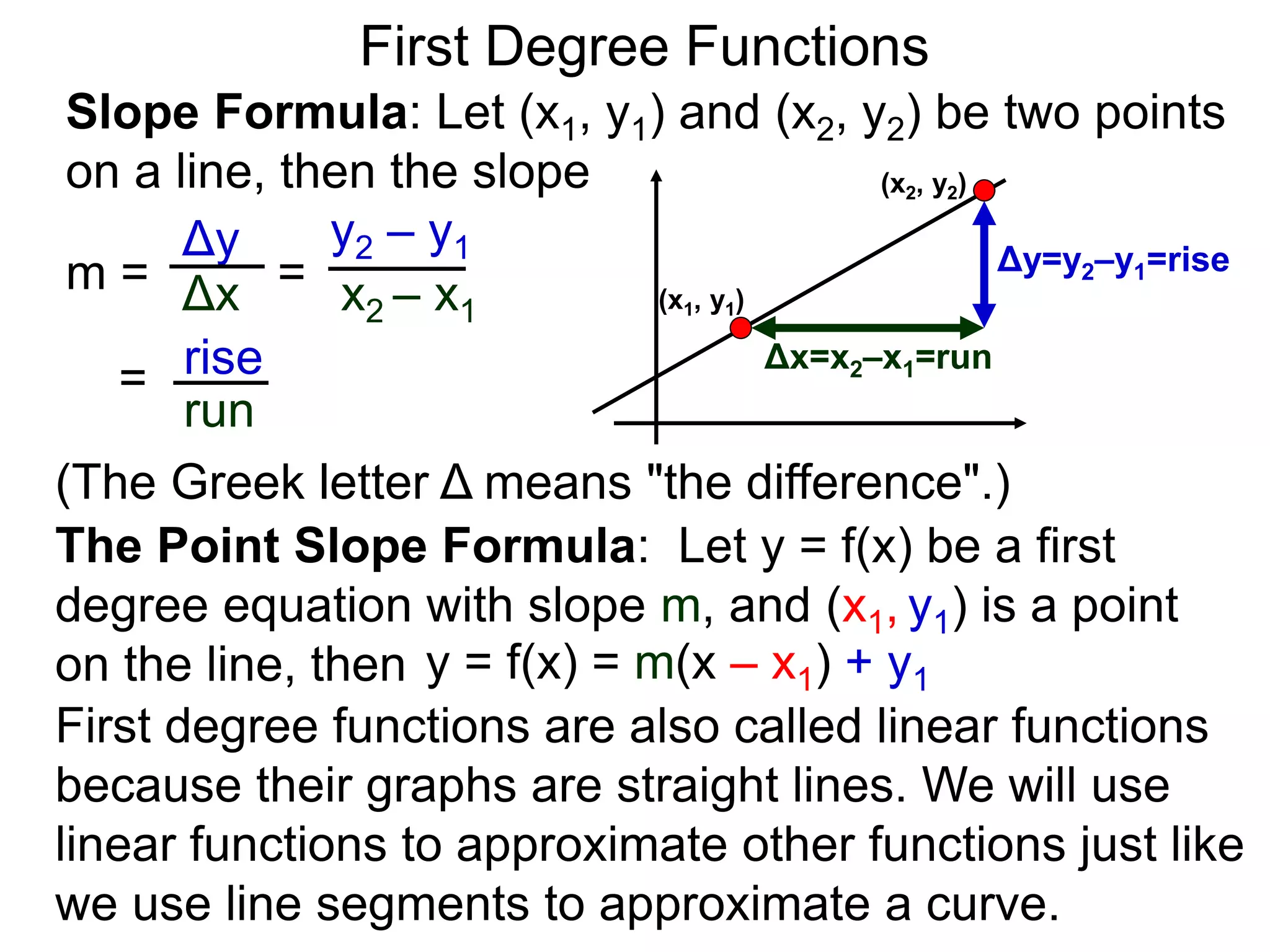
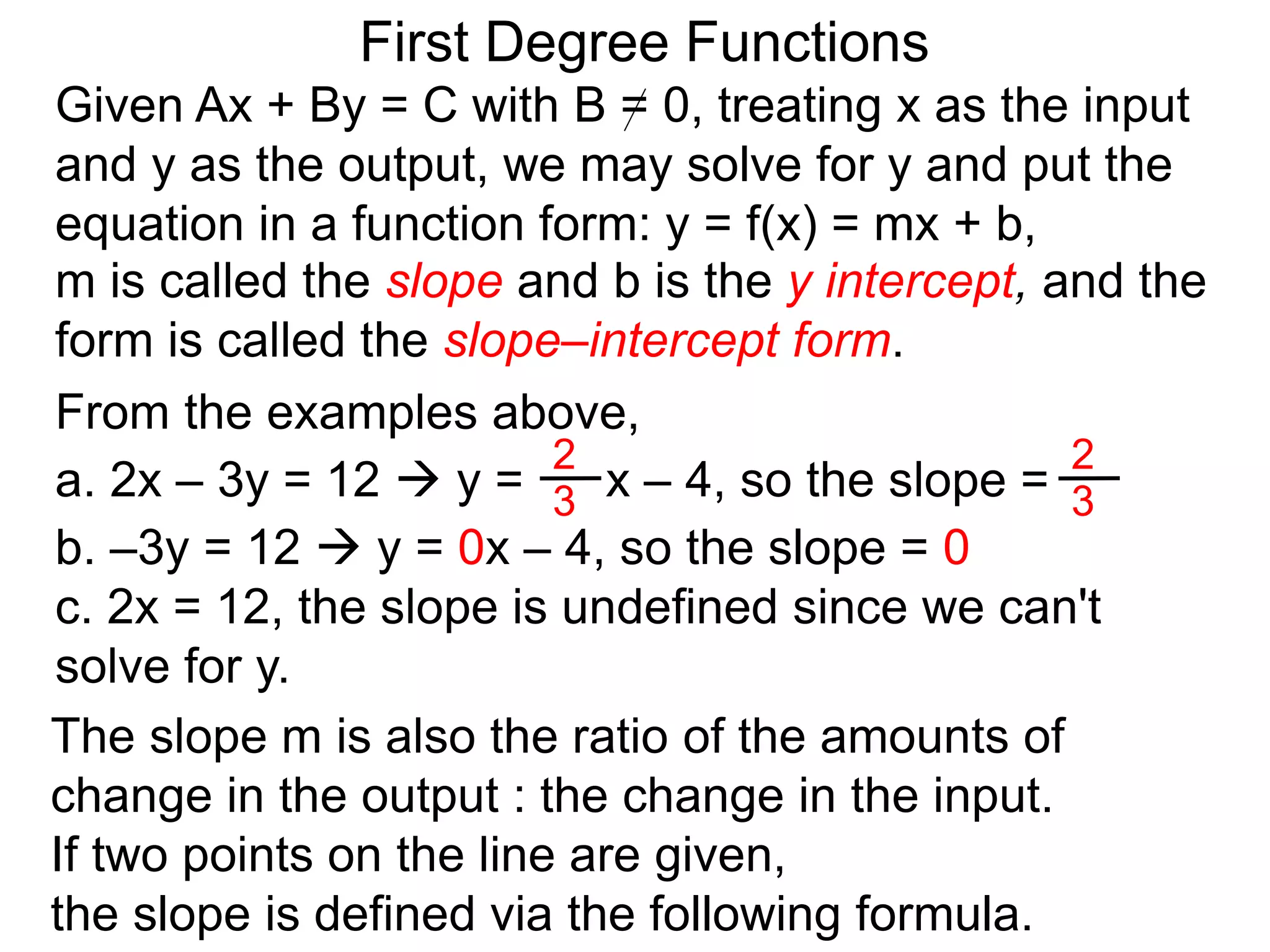
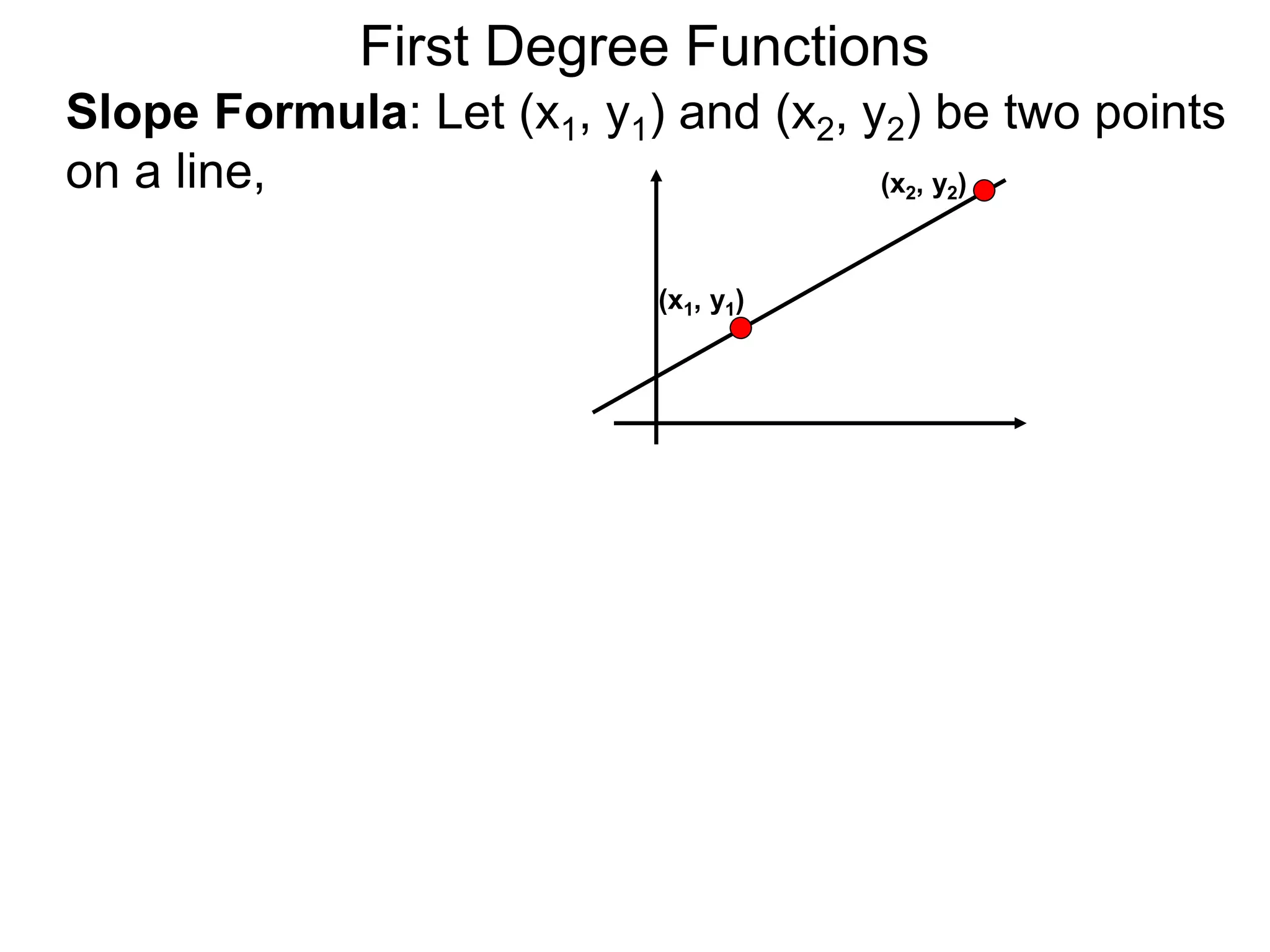
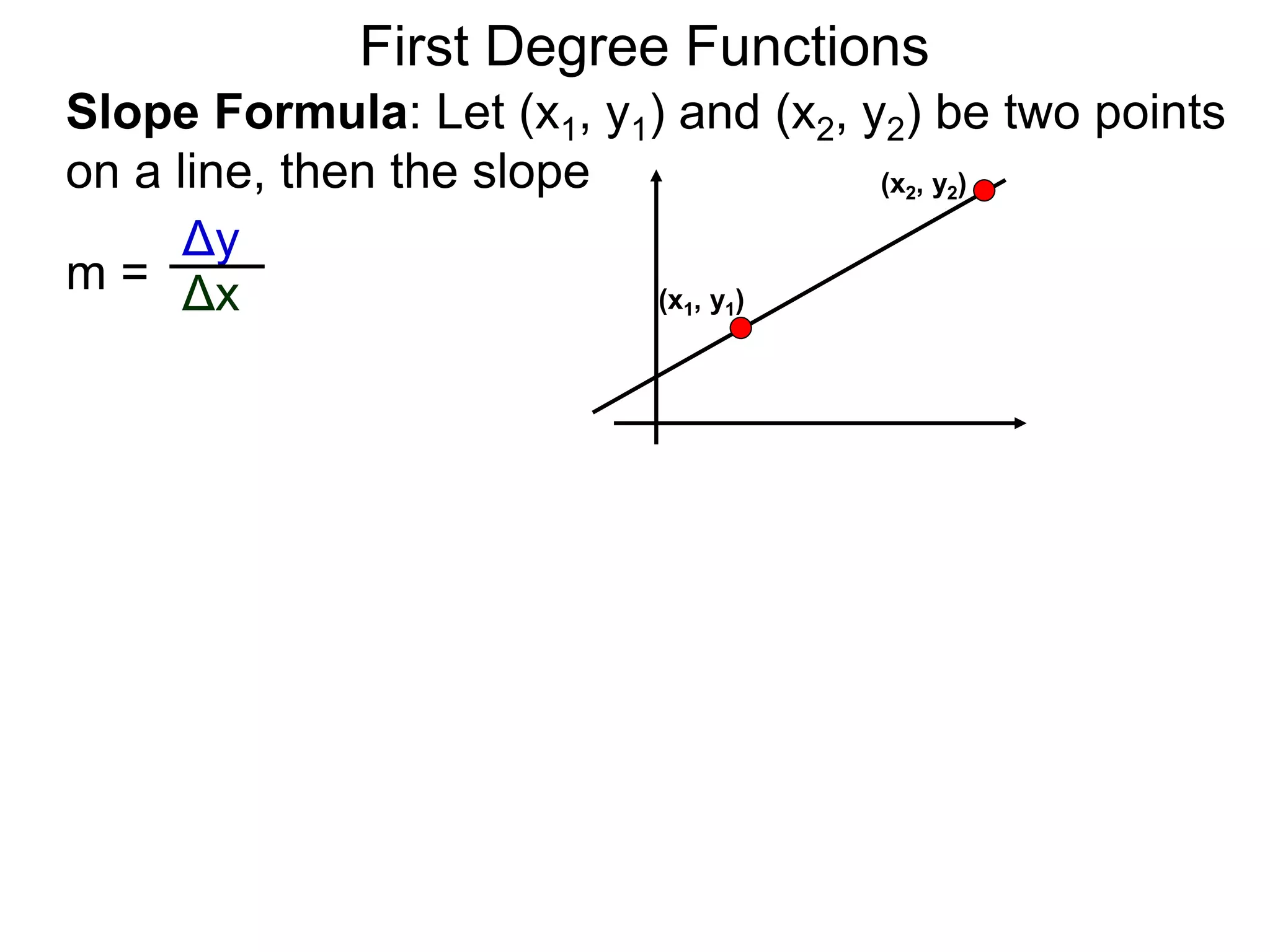
Slope Formula: Let (x1, y1) and (x2, y2) be two points
on a line,
First Degree Functions
(x1, y1)
(x2, y2)
Slope Formula: Let (x1, y1) and (x2, y2) be two points
on a line, then the slope
Δy
Δx
m =
First Degree Functions
(x1, y1)
(x2, y2)
Slope Formula: Let (x1, y1) and (x2, y2) be two points
on a line, then the slope
Δy
Δx
m =
First Degree Functions
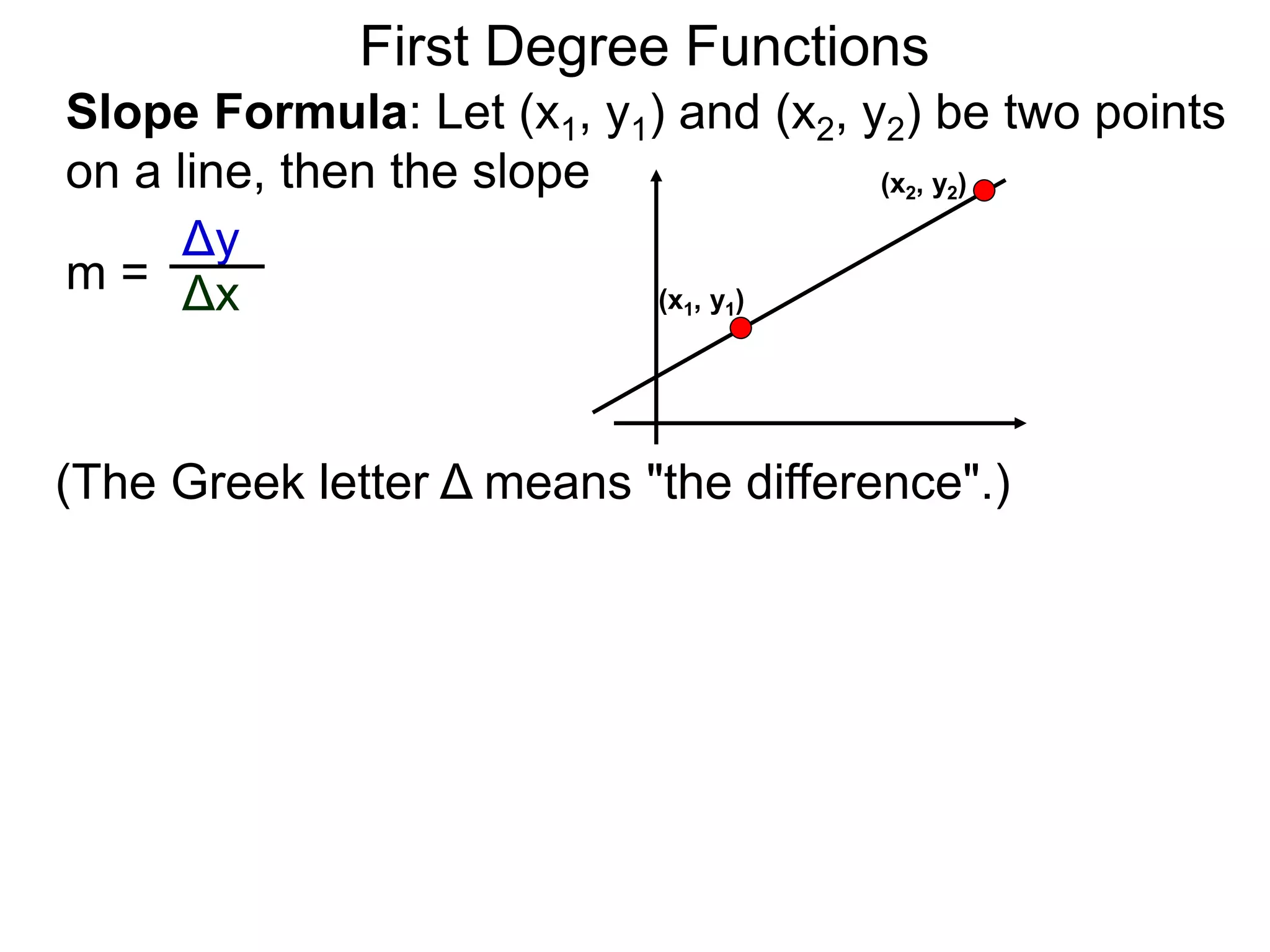
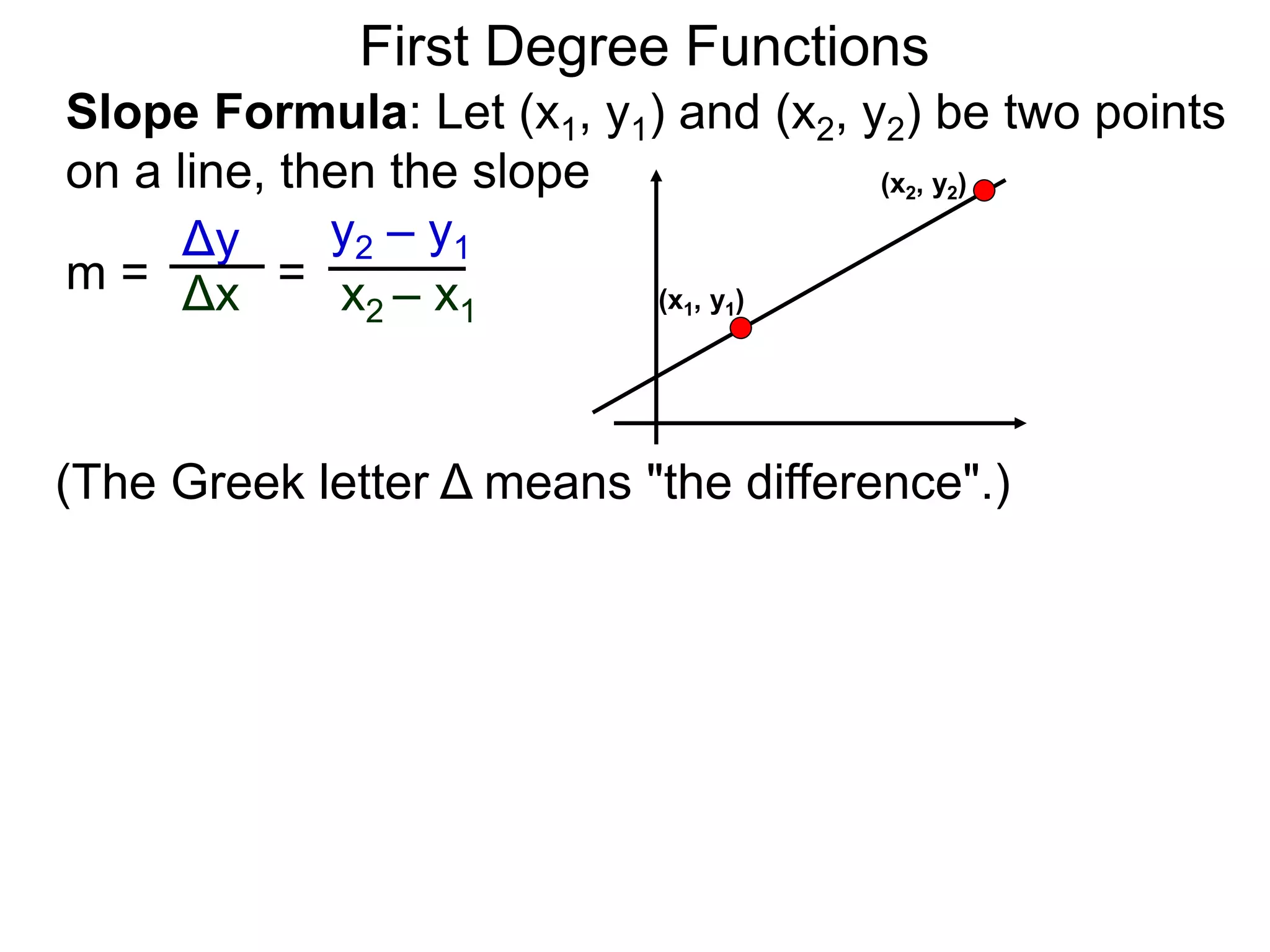
(The Greek letter Δ means "the difference".)
(x1, y1)
(x2, y2)
Slope Formula: Let (x1, y1) and (x2, y2) be two points
on a line, then the slope
Δy
Δx
y2 – y1
x2 – x1
m = =
First Degree Functions
(The Greek letter Δ means "the difference".)
(x1, y1)
(x2, y2)
Slope Formula: Let (x1, y1) and (x2, y2) be two points
on a line, then the slope
Δy
Δx
y2 – y1
x2 – x1
m =
rise
run
=
=
First Degree Functions
(The Greek letter Δ means "the difference".)
(x1, y1)
(x2, y2)
Slope Formula: Let (x1, y1) and (x2, y2) be two points
on a line, then the slope
Δy
Δx
y2 – y1
x2 – x1
m =
rise
run
=
= (x1, y1)
(x2, y2)
First Degree Functions
(The Greek letter Δ means "the difference".)
Slope Formula: Let (x1, y1) and (x2, y2) be two points
on a line, then the slope
Δy
Δx
y2 – y1
x2 – x1
m =
rise
run
=
= (x1, y1)
(x2, y2)
Δy=y2–y1=rise
First Degree Functions
(The Greek letter Δ means "the difference".)
Slope Formula: Let (x1, y1) and (x2, y2) be two points
on a line, then the slope
Δy
Δx
y2 – y1
x2 – x1
m =
rise
run
=
= (x1, y1)
(x2, y2)
Δy=y2–y1=rise
Δx=x2–x1=run
First Degree Functions
(The Greek letter Δ means "the difference".)
Slope Formula: Let (x1, y1) and (x2, y2) be two points
on a line, then the slope
Δy
Δx
y2 – y1
x2 – x1
m =
rise
run
=
= (x1, y1)
(x2, y2)
Δy=y2–y1=rise
Δx=x2–x1=run
The Point Slope Formula: Let y = f(x) be a first
degree equation with slope m, and (x1, y1) is a point
on the line, then y = f(x) = m(x – x1) + y1
First Degree Functions
(The Greek letter Δ means "the difference".)
Slope Formula: Let (x1, y1) and (x2, y2) be two points
on a line, then the slope
Δy
Δx
y2 – y1
x2 – x1
m =
rise
run
=
= (x1, y1)
(x2, y2)
Δy=y2–y1=rise
Δx=x2–x1=run
The Point Slope Formula: Let y = f(x) be a first
degree equation with slope m, and (x1, y1) is a point
on the line, then y = f(x) = m(x – x1) + y1
First degree functions are also called linear functions
because their graphs are straight lines.
First Degree Functions
(The Greek letter Δ means "the difference".)
Slope Formula: Let (x1, y1) and (x2, y2) be two points
on a line, then the slope
Δy
Δx
y2 – y1
x2 – x1
m =
rise
run
=
= (x1, y1)
(x2, y2)
Δy=y2–y1=rise
Δx=x2–x1=run
The Point Slope Formula: Let y = f(x) be a first
degree equation with slope m, and (x1, y1) is a point
on the line, then y = f(x) = m(x – x1) + y1
First degree functions are also called linear functions
because their graphs are straight lines. We will use
linear functions to approximate other functions just like
we use line segments to approximate a curve.
First Degree Functions
(The Greek letter Δ means "the difference".)
Linear Equations and Lines
Example A. A river floods regularly, and on a rock by
the river there is a mark indicating the highest point
the water level ever recorded.
At 12 pm July 11, the water level is 28 inches below
this mark. At 8 am July 12 the water is 18 inches
below this mark.
Linear Equations and Lines
Example A. A river floods regularly, and on a rock by
the river there is a mark indicating the highest point
the water level ever recorded.
At 12 pm July 11, the water level is 28 inches below
this mark. At 8 am July 12 the water is 18 inches
below this mark. Let x = time,
y = distance between the water level and the mark.
Find the linear function y = f(x) = mx + b
of the distance y in terms of time x.
Linear Equations and Lines
Example A. A river floods regularly, and on a rock by
the river there is a mark indicating the highest point
the water level ever recorded.
At 12 pm July 11, the water level is 28 inches below
this mark. At 8 am July 12 the water is 18 inches
below this mark. Let x = time,
y = distance between the water level and the mark.
Find the linear function y = f(x) = mx + b
of the distance y in terms of time x.
Since how the time was measured is not specified,
we may select the stating time 0 to be time of the
first observation.
Linear Equations and Lines
Example A. A river floods regularly, and on a rock by
the river there is a mark indicating the highest point
the water level ever recorded.
At 12 pm July 11, the water level is 28 inches below
this mark. At 8 am July 12 the water is 18 inches
below this mark. Let x = time,
y = distance between the water level and the mark.
Find the linear function y = f(x) = mx + b
of the distance y in terms of time x.
Since how the time was measured is not specified,
we may select the stating time 0 to be time of the
first observation.
By setting x = 0 (hr) at 12 pm July 11,
then x = 20 at 8 am of July 12.
Equations of Lines
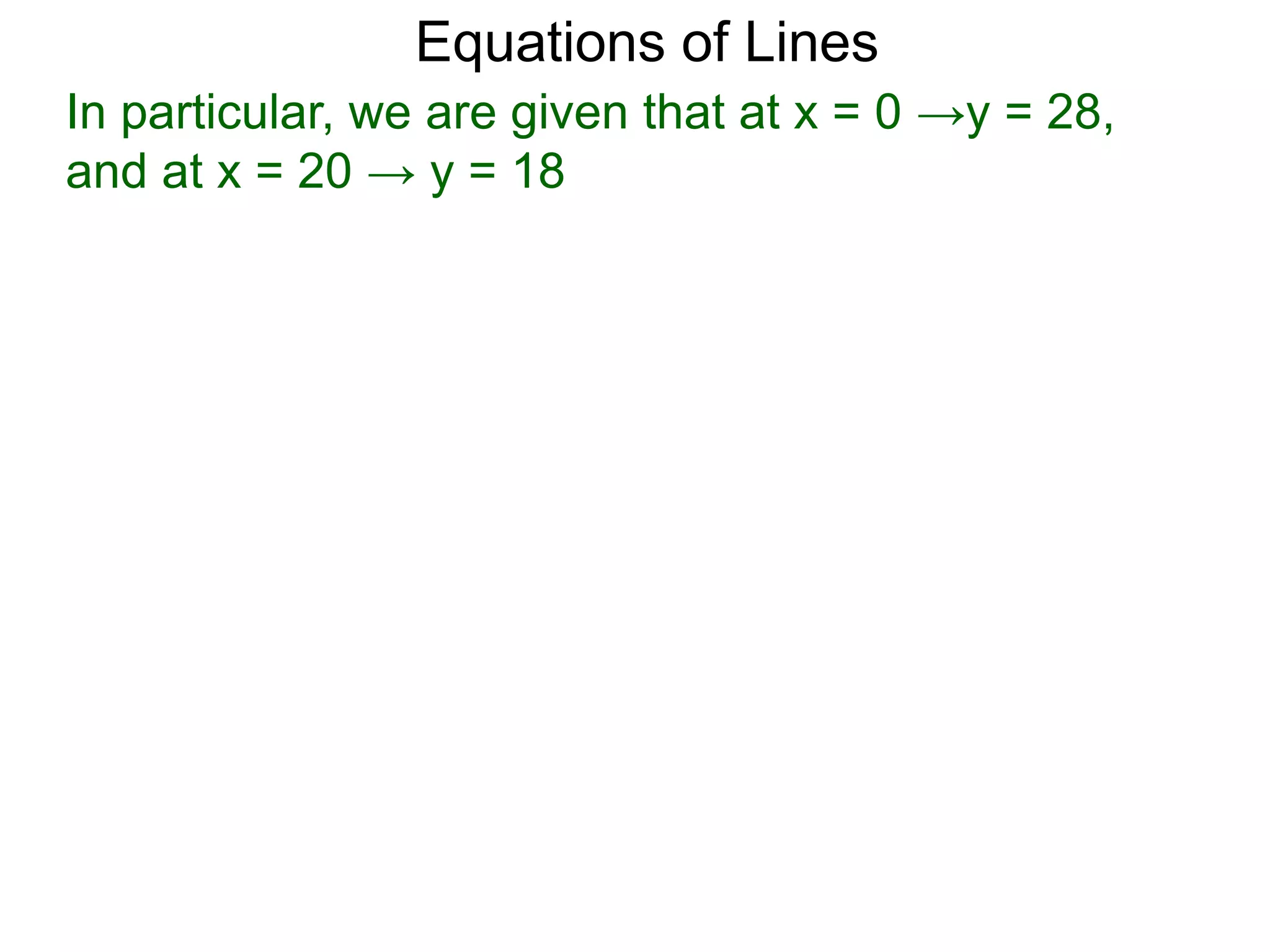
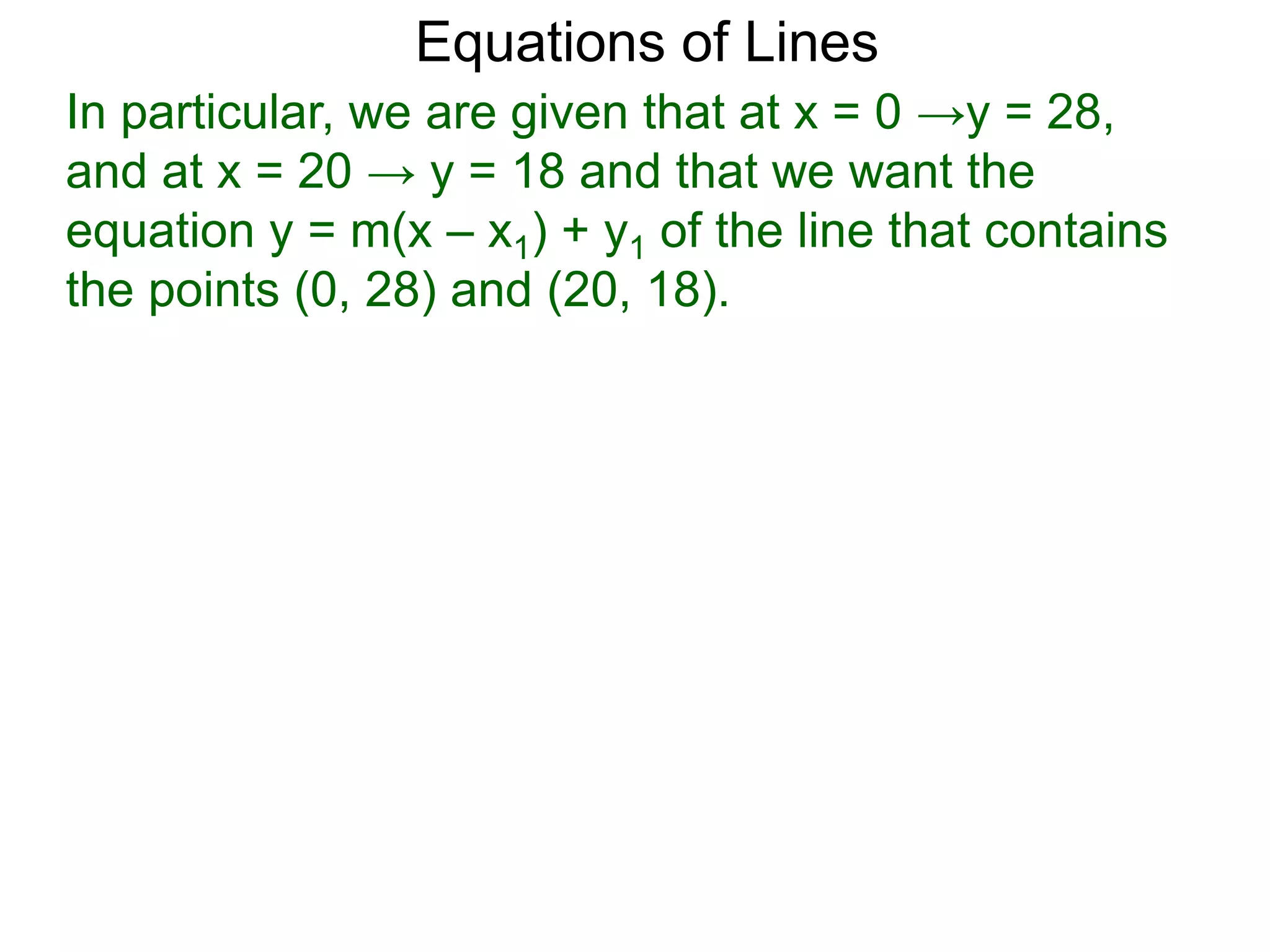
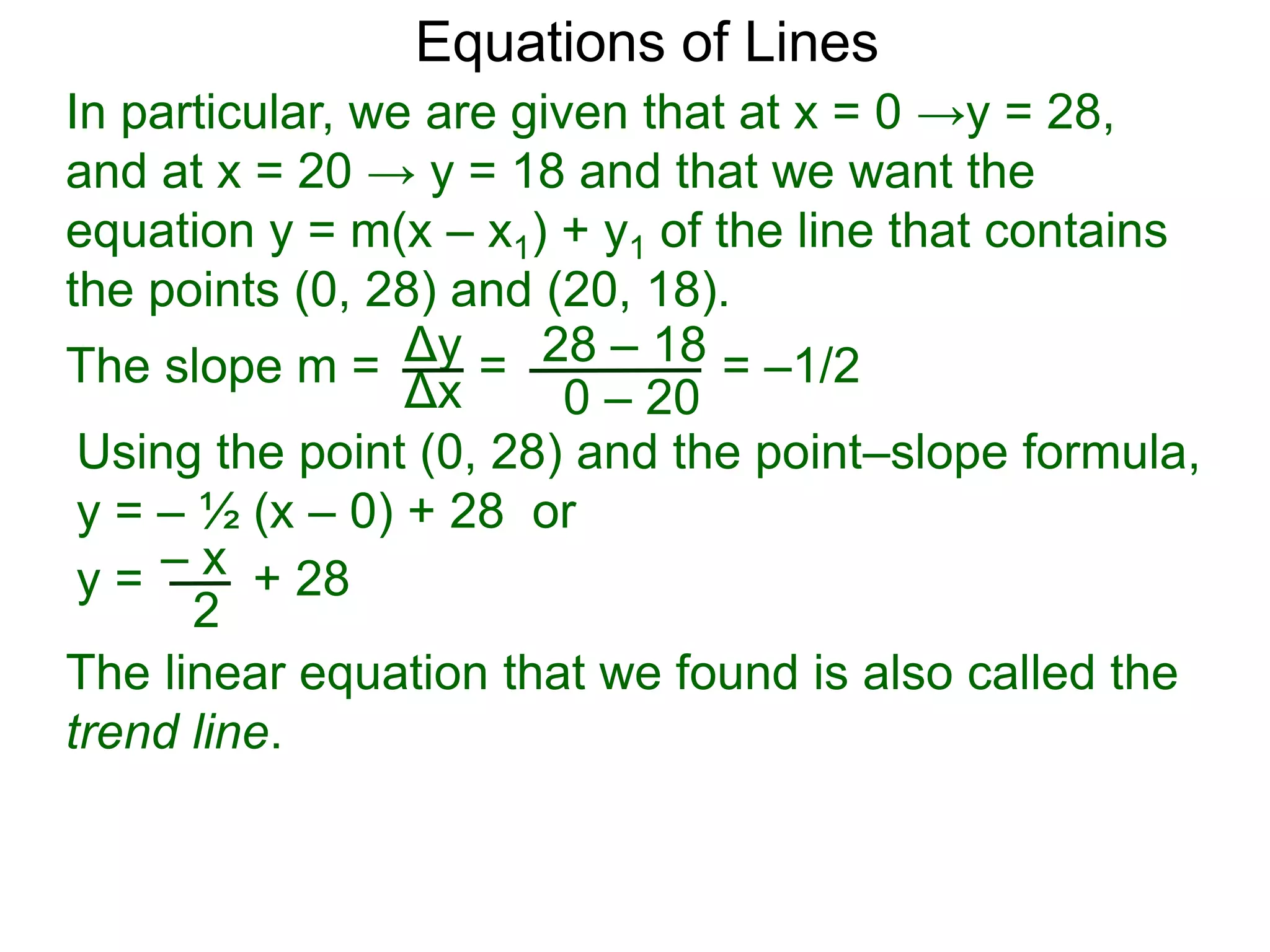
In particular, we are given that at x = 0 →y = 28,
and at x = 20 → y = 18
Equations of Lines
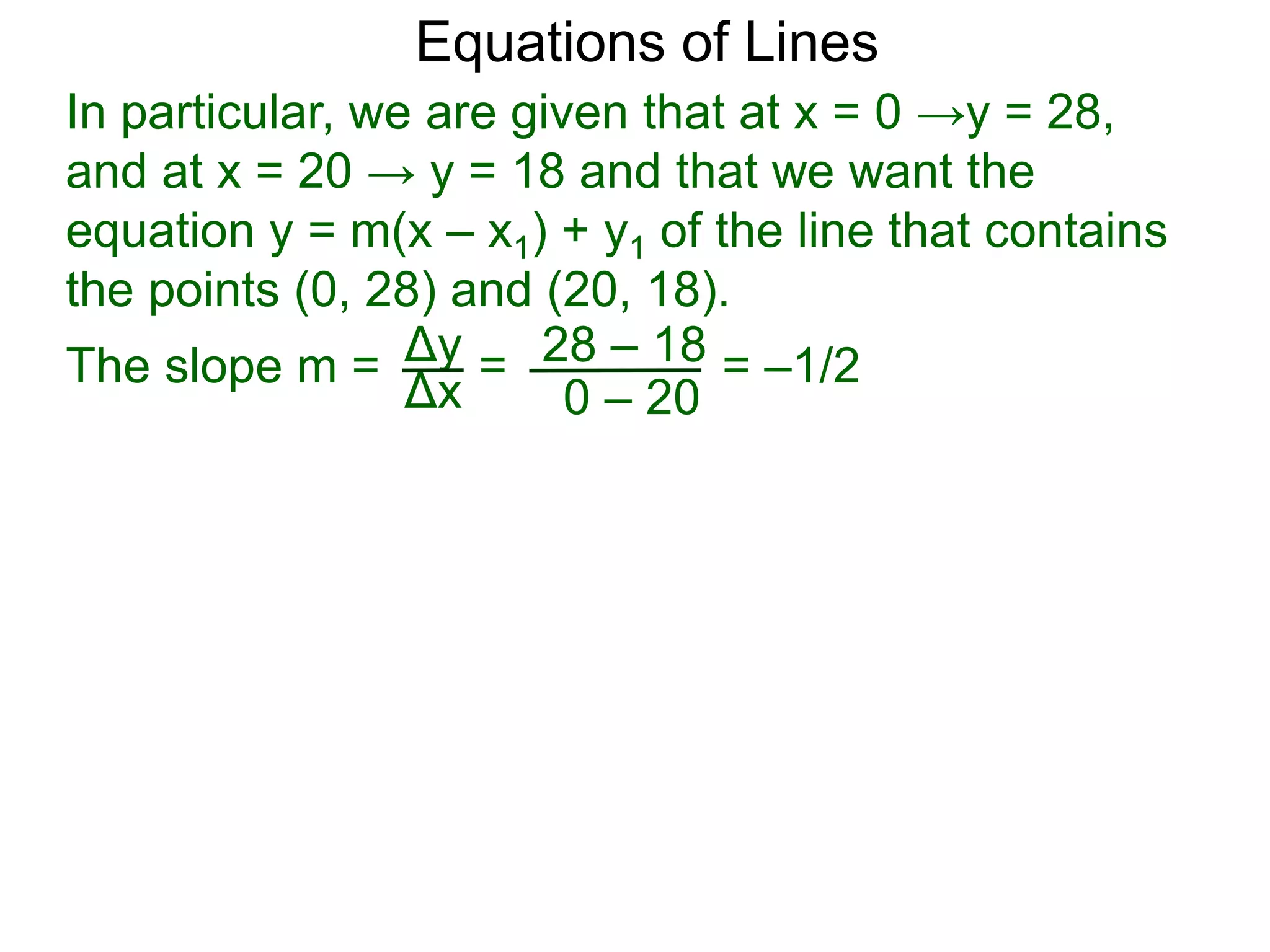
In particular, we are given that at x = 0 →y = 28,
and at x = 20 → y = 18 and that we want the
equation y = m(x – x1) + y1 of the line that contains
the points (0, 28) and (20, 18).
Δy
Δx
28 – 18
0 – 20
Equations of Lines
In particular, we are given that at x = 0 →y = 28,
and at x = 20 → y = 18 and that we want the
equation y = m(x – x1) + y1 of the line that contains
the points (0, 28) and (20, 18).
=
The slope m = = –1/2
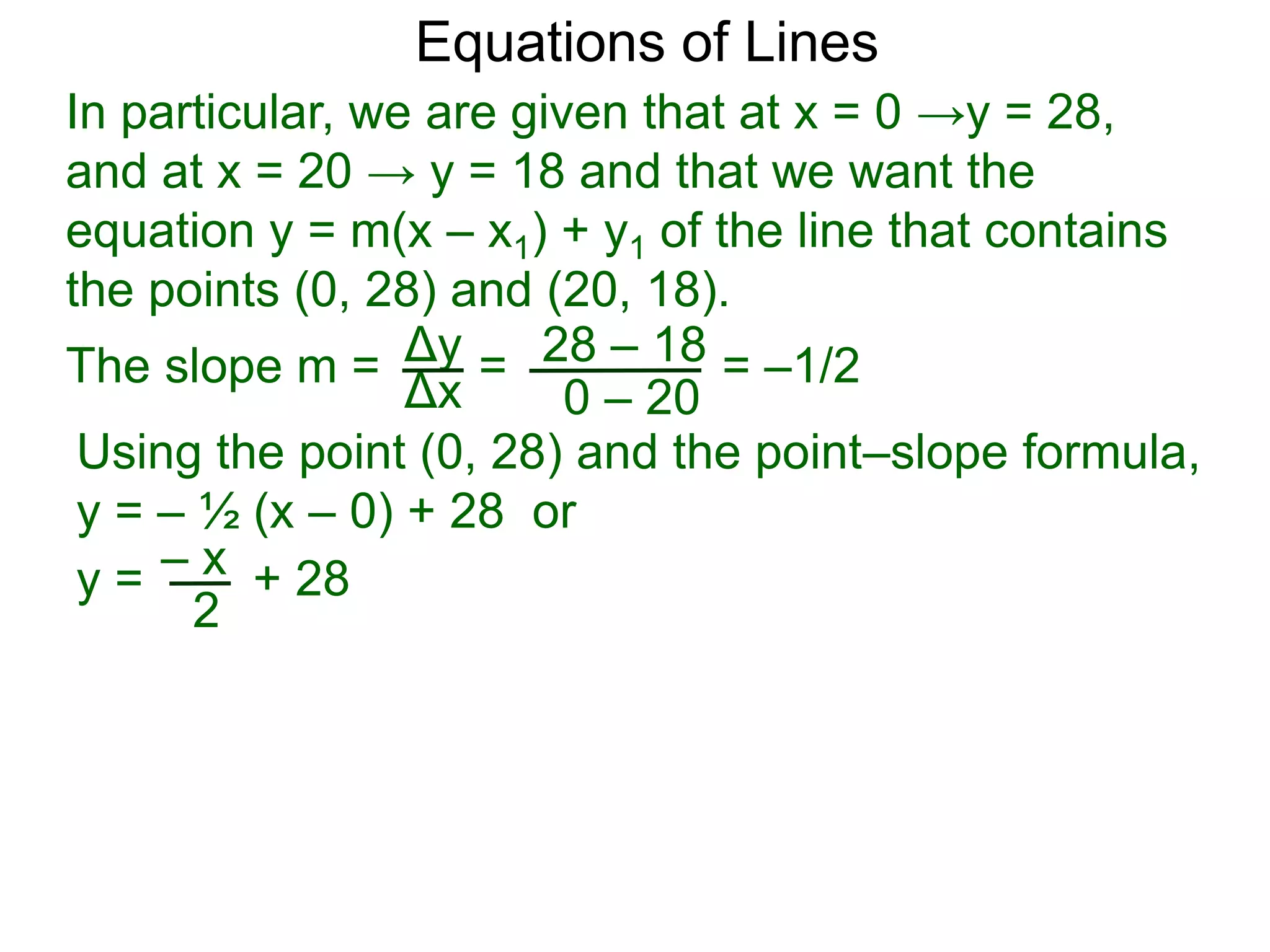
Using the point (0, 28) and the point–slope formula,
y = – ½ (x – 0) + 28 or
Δy
Δx
28 – 18
0 – 20
Equations of Lines
In particular, we are given that at x = 0 →y = 28,
and at x = 20 → y = 18 and that we want the
equation y = m(x – x1) + y1 of the line that contains
the points (0, 28) and (20, 18).
=
The slope m = = –1/2
– x
y = + 28
2
Using the point (0, 28) and the point–slope formula,
y = – ½ (x – 0) + 28 or
Δy
Δx
28 – 18
0 – 20
Equations of Lines
In particular, we are given that at x = 0 →y = 28,
and at x = 20 → y = 18 and that we want the
equation y = m(x – x1) + y1 of the line that contains
the points (0, 28) and (20, 18).
=
The slope m = = –1/2
– x
y = + 28
2
The linear equation that we found is also called the
trend line.
Using the point (0, 28) and the point–slope formula,
y = – ½ (x – 0) + 28 or
Δy
Δx
28 – 18
0 – 20
Equations of Lines
In particular, we are given that at x = 0 →y = 28,
and at x = 20 → y = 18 and that we want the
equation y = m(x – x1) + y1 of the line that contains
the points (0, 28) and (20, 18).
=
The slope m = = –1/2
– x
y = + 28
2
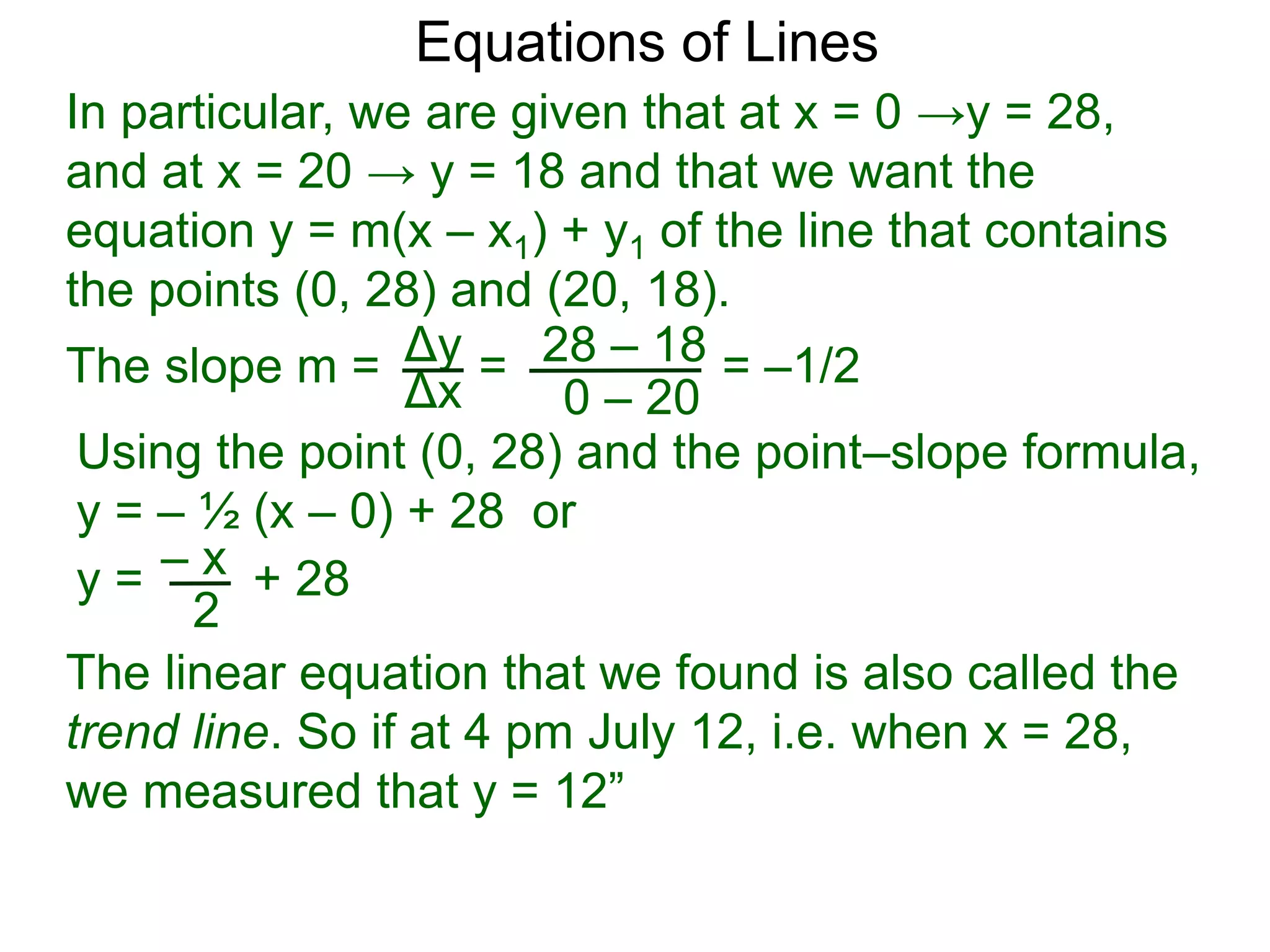
The linear equation that we found is also called the
trend line. So if at 4 pm July 12, i.e. when x = 28,
we measured that y = 12”
Using the point (0, 28) and the point–slope formula,
y = – ½ (x – 0) + 28 or
Δy
Δx
28 – 18
0 – 20
Equations of Lines
In particular, we are given that at x = 0 →y = 28,
and at x = 20 → y = 18 and that we want the
equation y = m(x – x1) + y1 of the line that contains
the points (0, 28) and (20, 18).
=
The slope m = = –1/2
– x
y = + 28
2
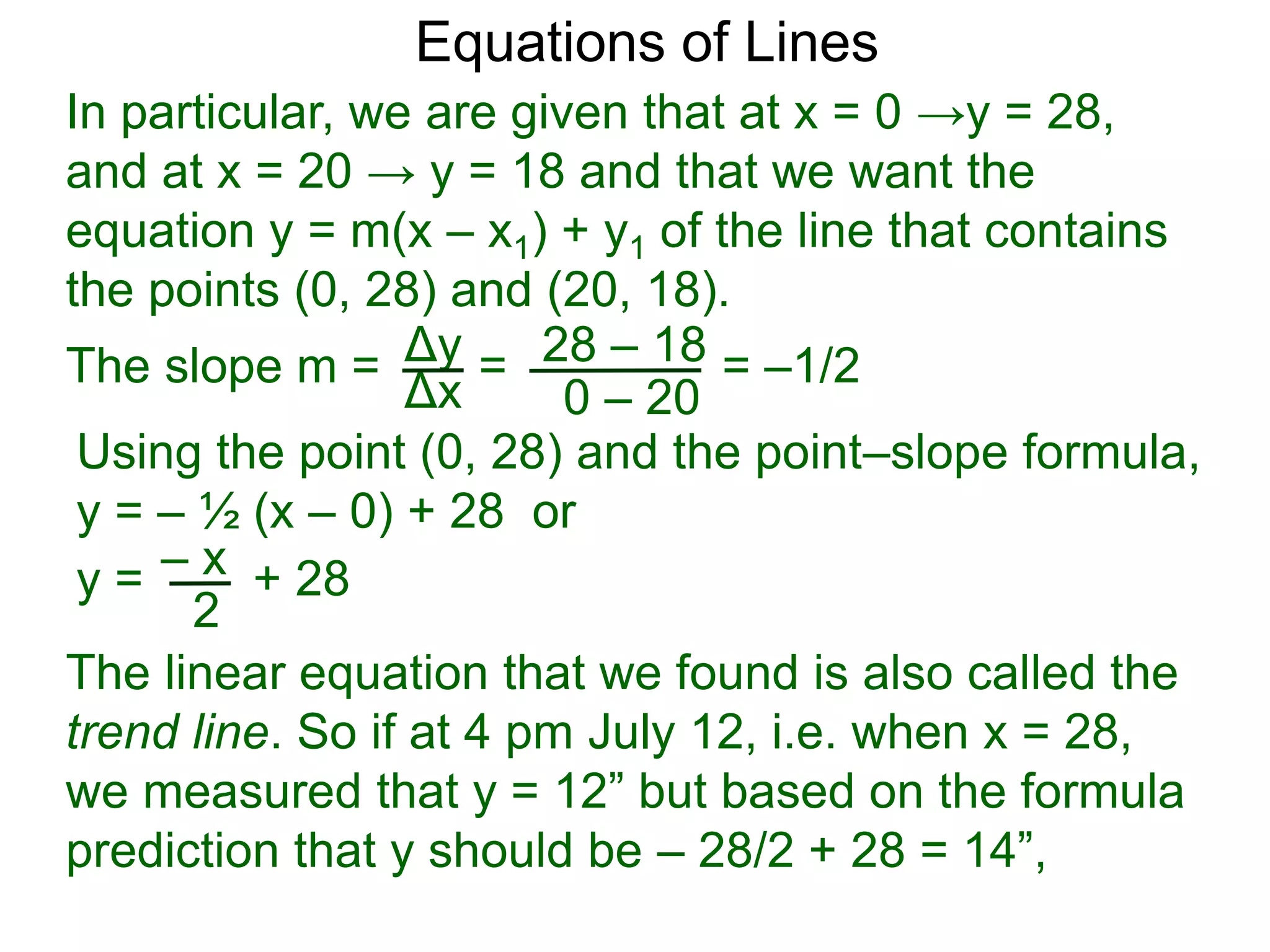
The linear equation that we found is also called the
trend line. So if at 4 pm July 12, i.e. when x = 28,
we measured that y = 12” but based on the formula
prediction that y should be – 28/2 + 28 = 14”,
Using the point (0, 28) and the point–slope formula,
y = – ½ (x – 0) + 28 or
Δy
Δx
28 – 18
0 – 20
Equations of Lines
In particular, we are given that at x = 0 →y = 28,
and at x = 20 → y = 18 and that we want the
equation y = m(x – x1) + y1 of the line that contains
the points (0, 28) and (20, 18).
=
The slope m = = –1/2
– x
y = + 28
2
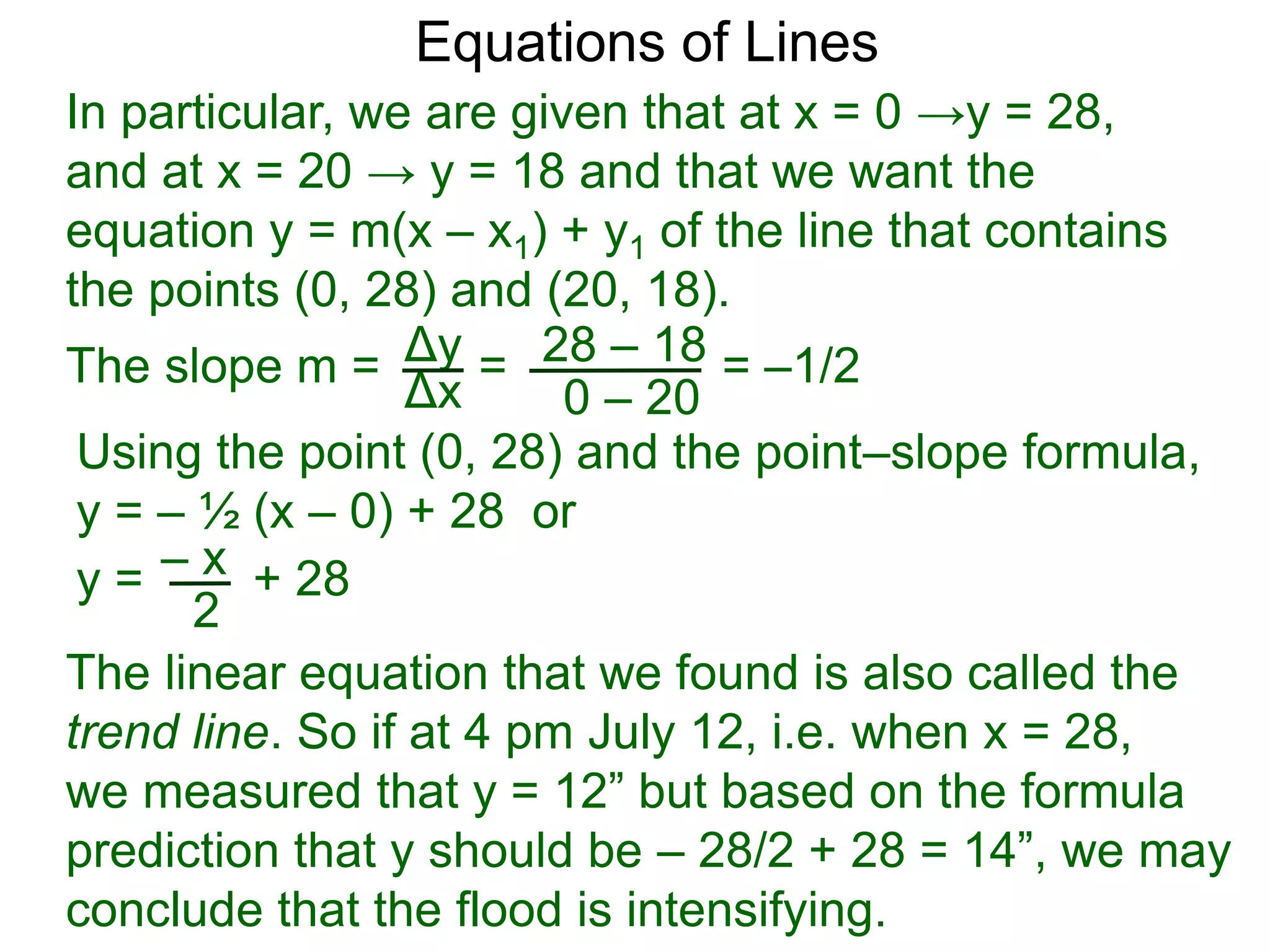
The linear equation that we found is also called the
trend line. So if at 4 pm July 12, i.e. when x = 28,
we measured that y = 12” but based on the formula
prediction that y should be – 28/2 + 28 = 14”, we may
conclude that the flood is intensifying.
More Facts on Slopes:
First Degree Functions
More Facts on Slopes:
• Parallel lines have the same slope.
First Degree Functions
More Facts on Slopes:
• Parallel lines have the same slope.
• Slopes of perpendicular lines are the negative
reciprocal of each other.
First Degree Functions
More Facts on Slopes:
• Parallel lines have the same slope.
• Slopes of perpendicular lines are the negative
reciprocal of each other.
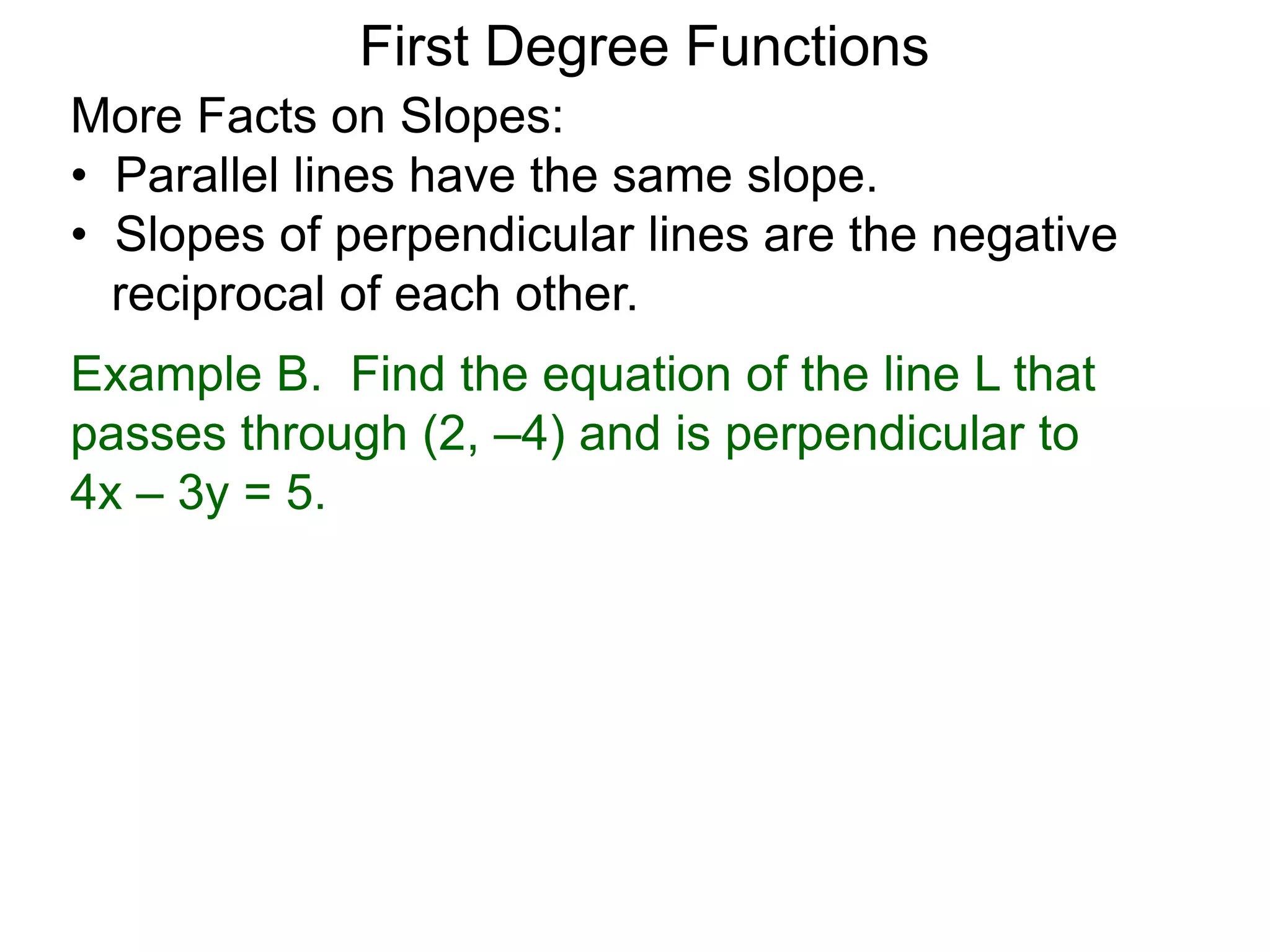
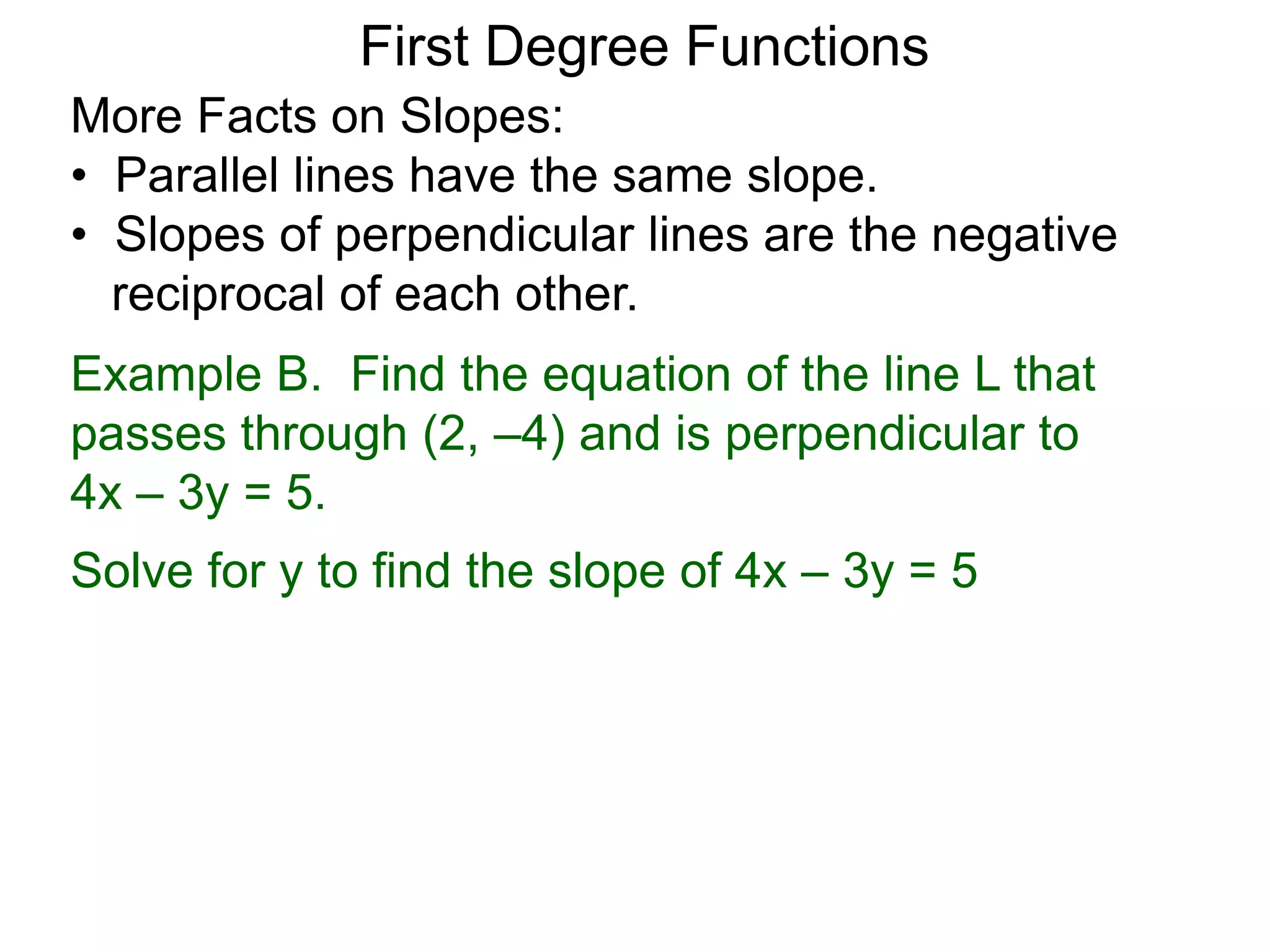
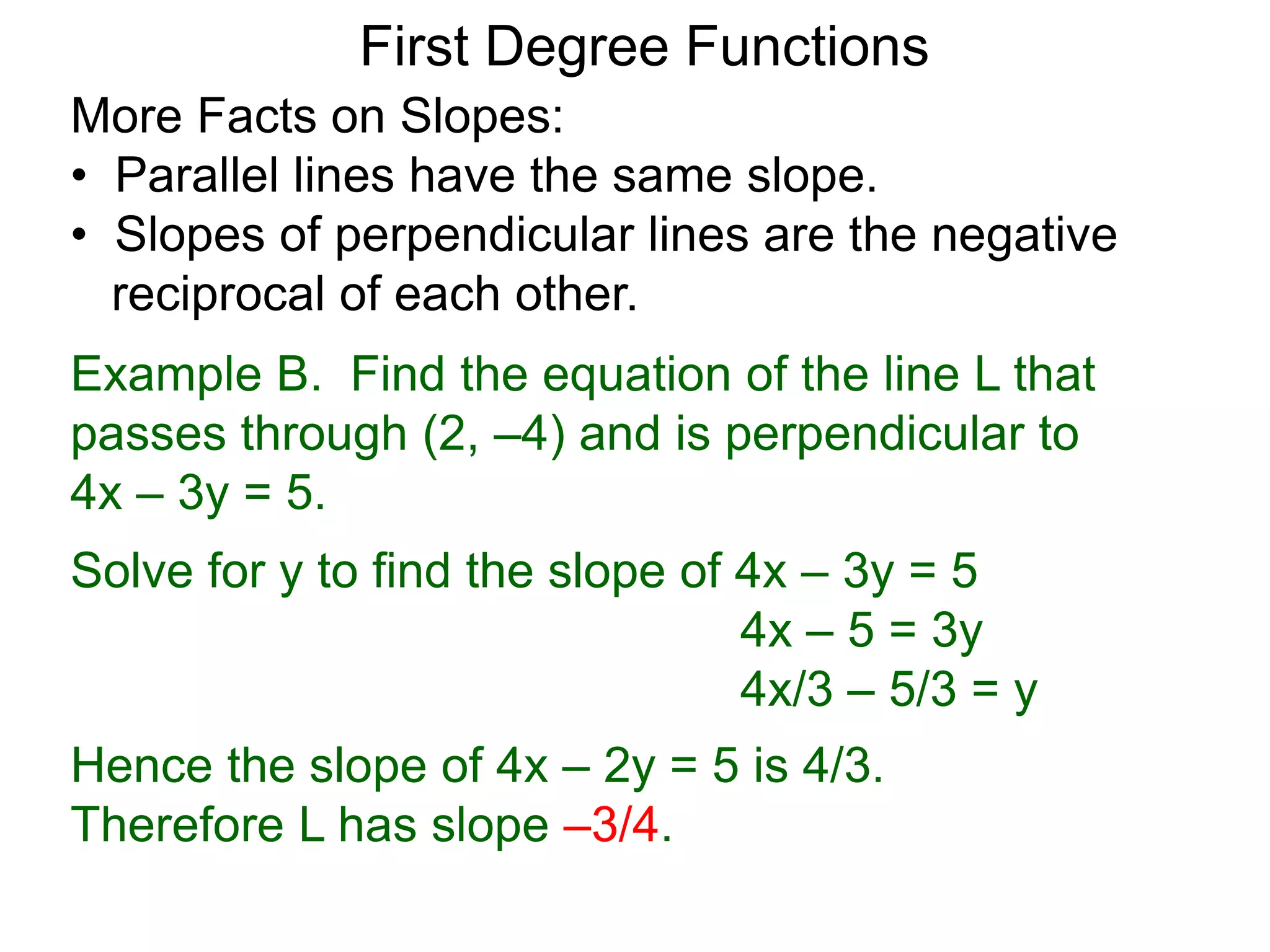
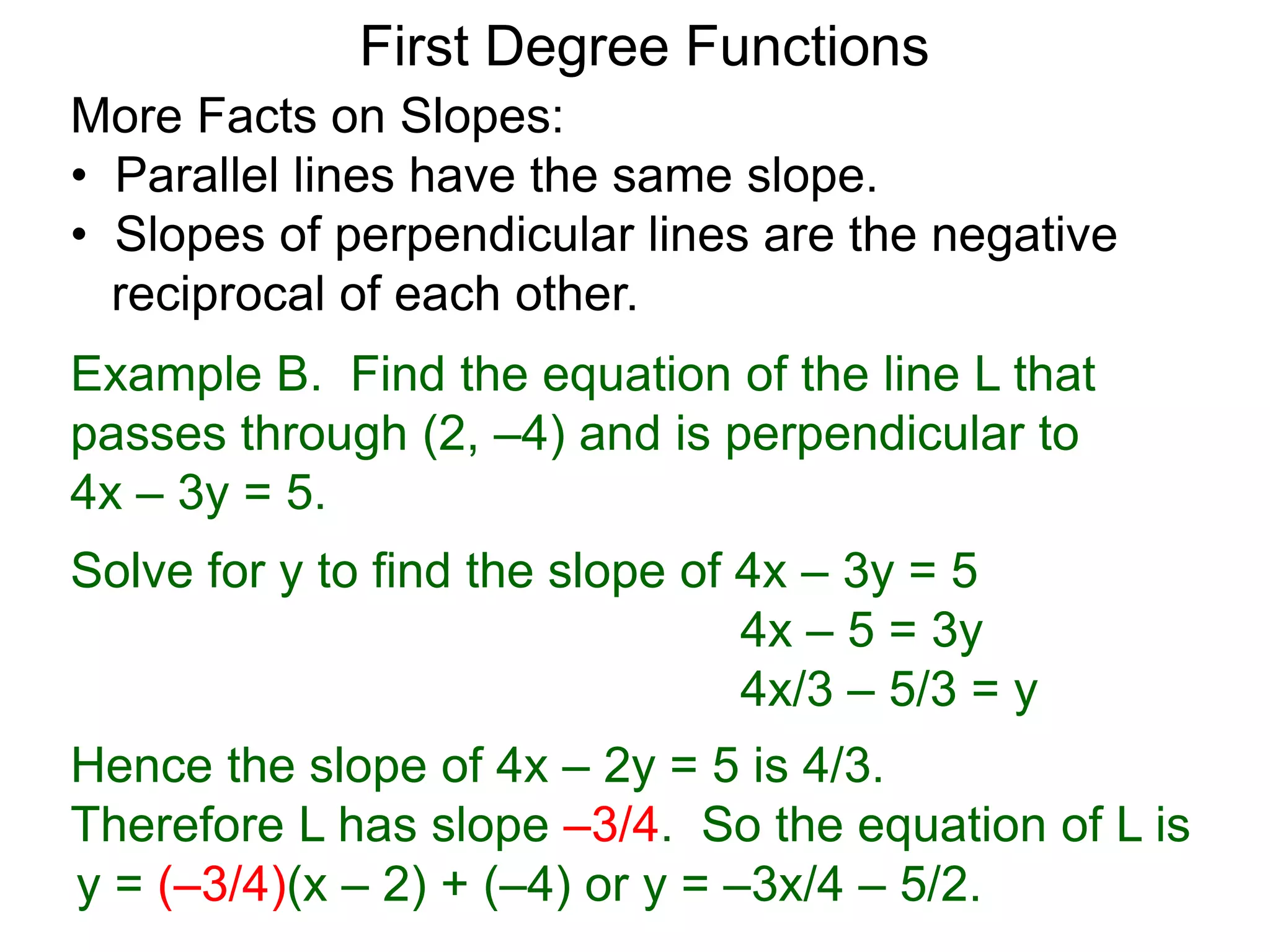
Example B. Find the equation of the line L that
passes through (2, –4) and is perpendicular to
4x – 3y = 5.
First Degree Functions
More Facts on Slopes:
• Parallel lines have the same slope.
• Slopes of perpendicular lines are the negative
reciprocal of each other.
Example B. Find the equation of the line L that
passes through (2, –4) and is perpendicular to
4x – 3y = 5.
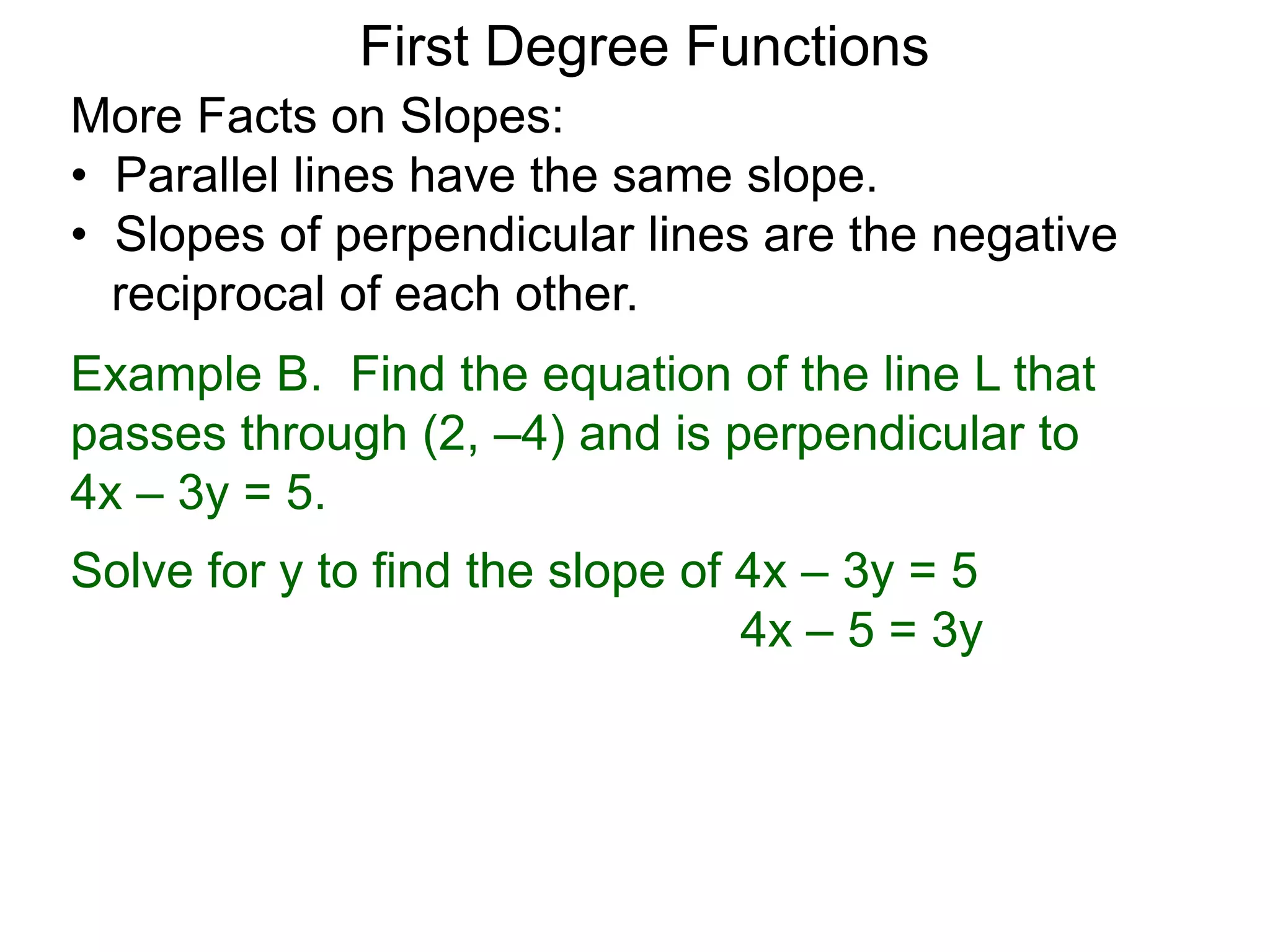
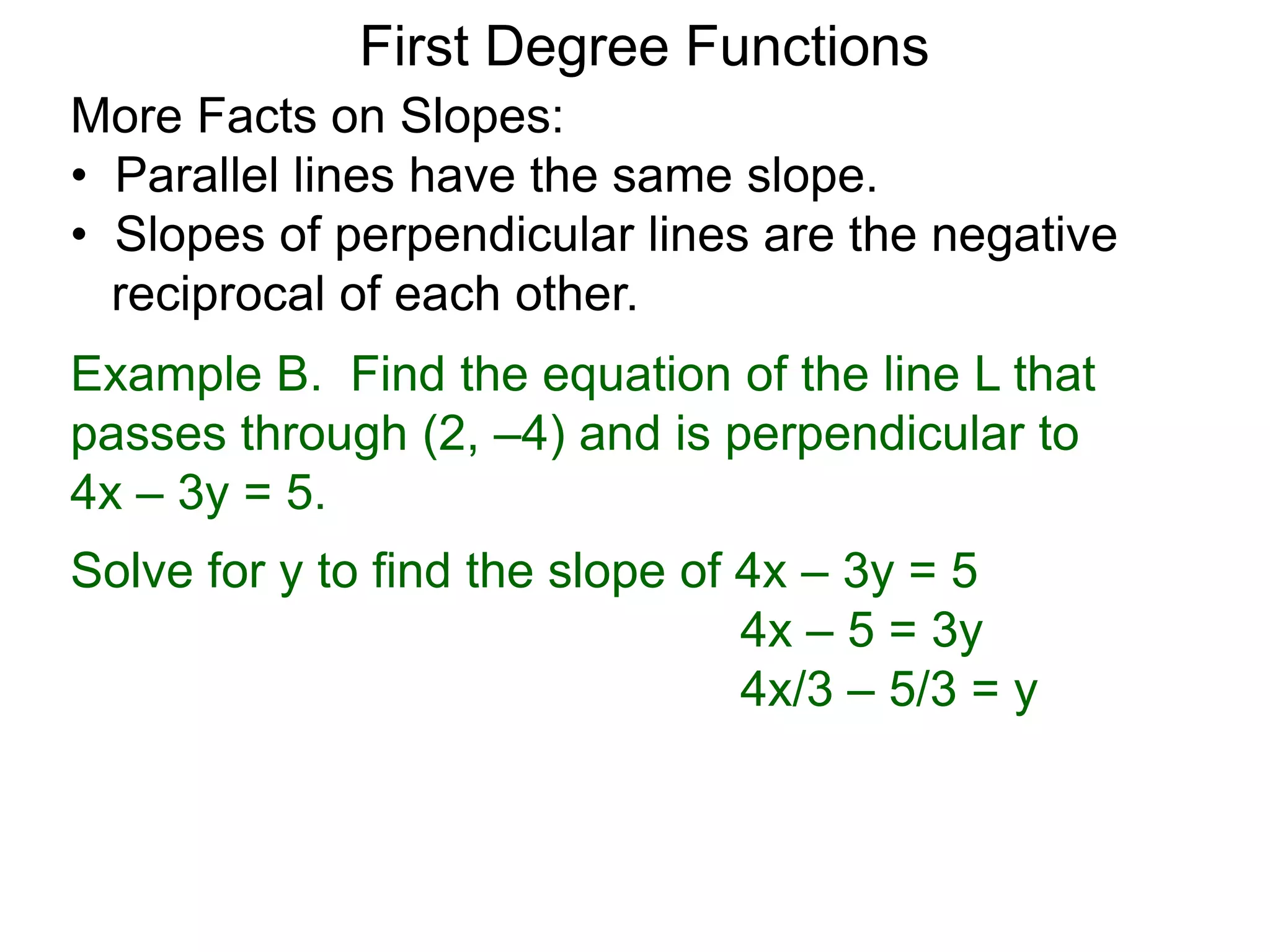
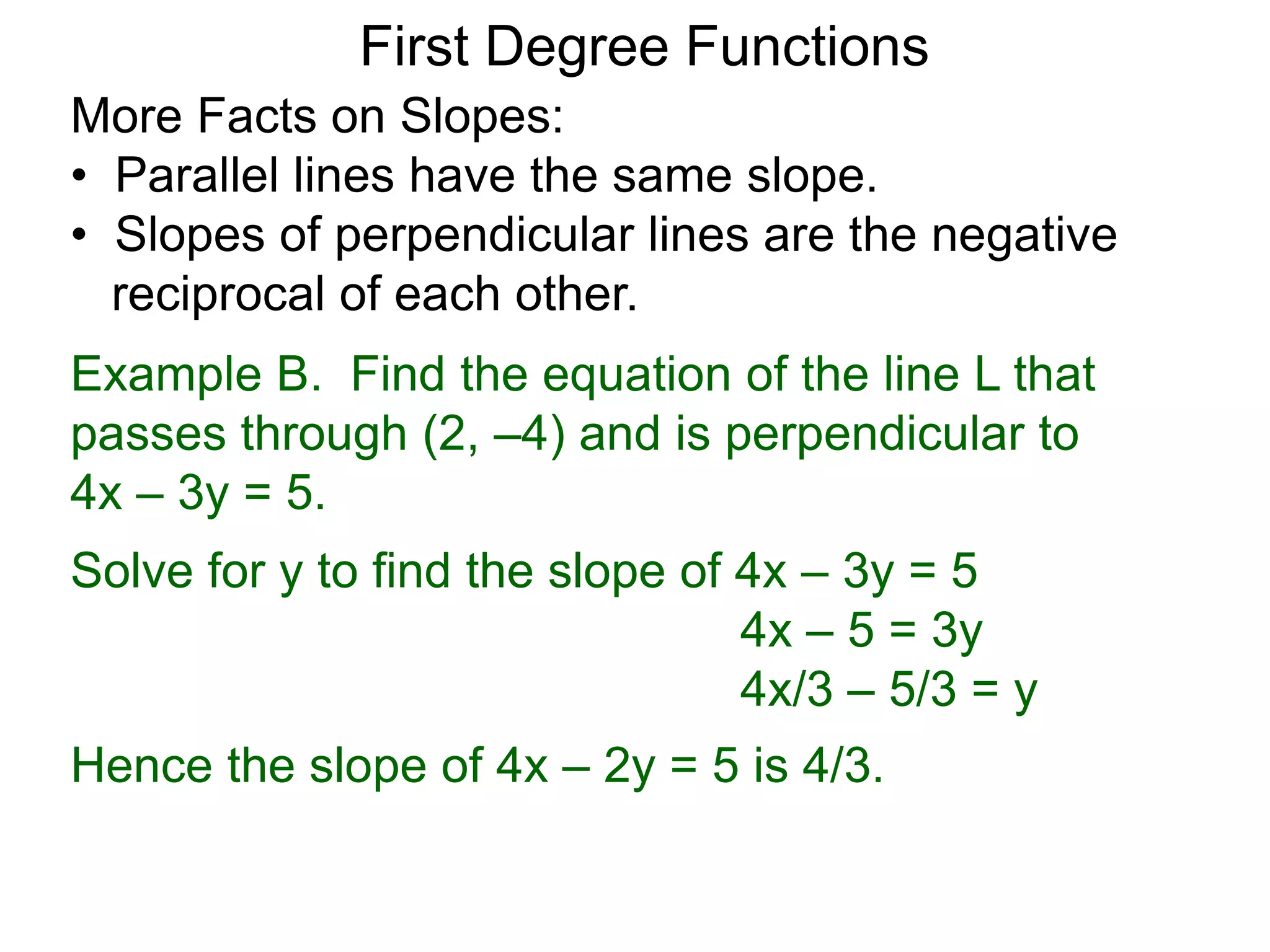
Solve for y to find the slope of 4x – 3y = 5
First Degree Functions
More Facts on Slopes:
• Parallel lines have the same slope.
• Slopes of perpendicular lines are the negative
reciprocal of each other.
Example B. Find the equation of the line L that
passes through (2, –4) and is perpendicular to
4x – 3y = 5.
Solve for y to find the slope of 4x – 3y = 5
4x – 5 = 3y
First Degree Functions
More Facts on Slopes:
• Parallel lines have the same slope.
• Slopes of perpendicular lines are the negative
reciprocal of each other.
Example B. Find the equation of the line L that
passes through (2, –4) and is perpendicular to
4x – 3y = 5.
Solve for y to find the slope of 4x – 3y = 5
4x – 5 = 3y
4x/3 – 5/3 = y
First Degree Functions
More Facts on Slopes:
• Parallel lines have the same slope.
• Slopes of perpendicular lines are the negative
reciprocal of each other.
Example B. Find the equation of the line L that
passes through (2, –4) and is perpendicular to
4x – 3y = 5.
Solve for y to find the slope of 4x – 3y = 5
4x – 5 = 3y
4x/3 – 5/3 = y
Hence the slope of 4x – 2y = 5 is 4/3.
First Degree Functions
More Facts on Slopes:
• Parallel lines have the same slope.
• Slopes of perpendicular lines are the negative
reciprocal of each other.
Example B. Find the equation of the line L that
passes through (2, –4) and is perpendicular to
4x – 3y = 5.
Solve for y to find the slope of 4x – 3y = 5
4x – 5 = 3y
4x/3 – 5/3 = y
Hence the slope of 4x – 2y = 5 is 4/3.
Therefore L has slope –3/4.
First Degree Functions
More Facts on Slopes:
• Parallel lines have the same slope.
• Slopes of perpendicular lines are the negative
reciprocal of each other.
Example B. Find the equation of the line L that
passes through (2, –4) and is perpendicular to
4x – 3y = 5.
Solve for y to find the slope of 4x – 3y = 5
4x – 5 = 3y
4x/3 – 5/3 = y
Hence the slope of 4x – 2y = 5 is 4/3.
Therefore L has slope –3/4. So the equation of L is
First Degree Functions
y = (–3/4)(x – 2) + (–4) or y = –3x/4 – 5/2.
Linear Equations and Lines
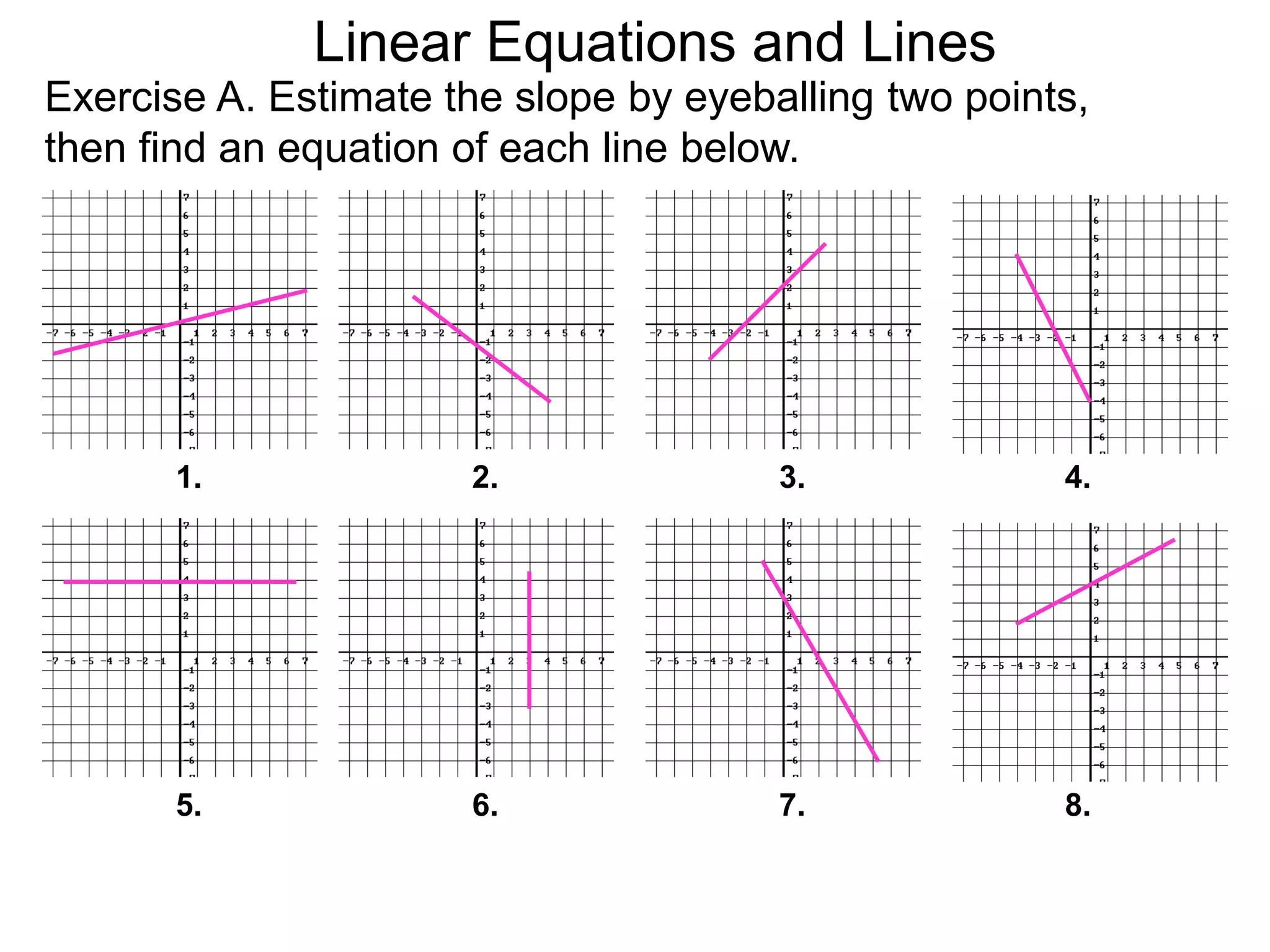
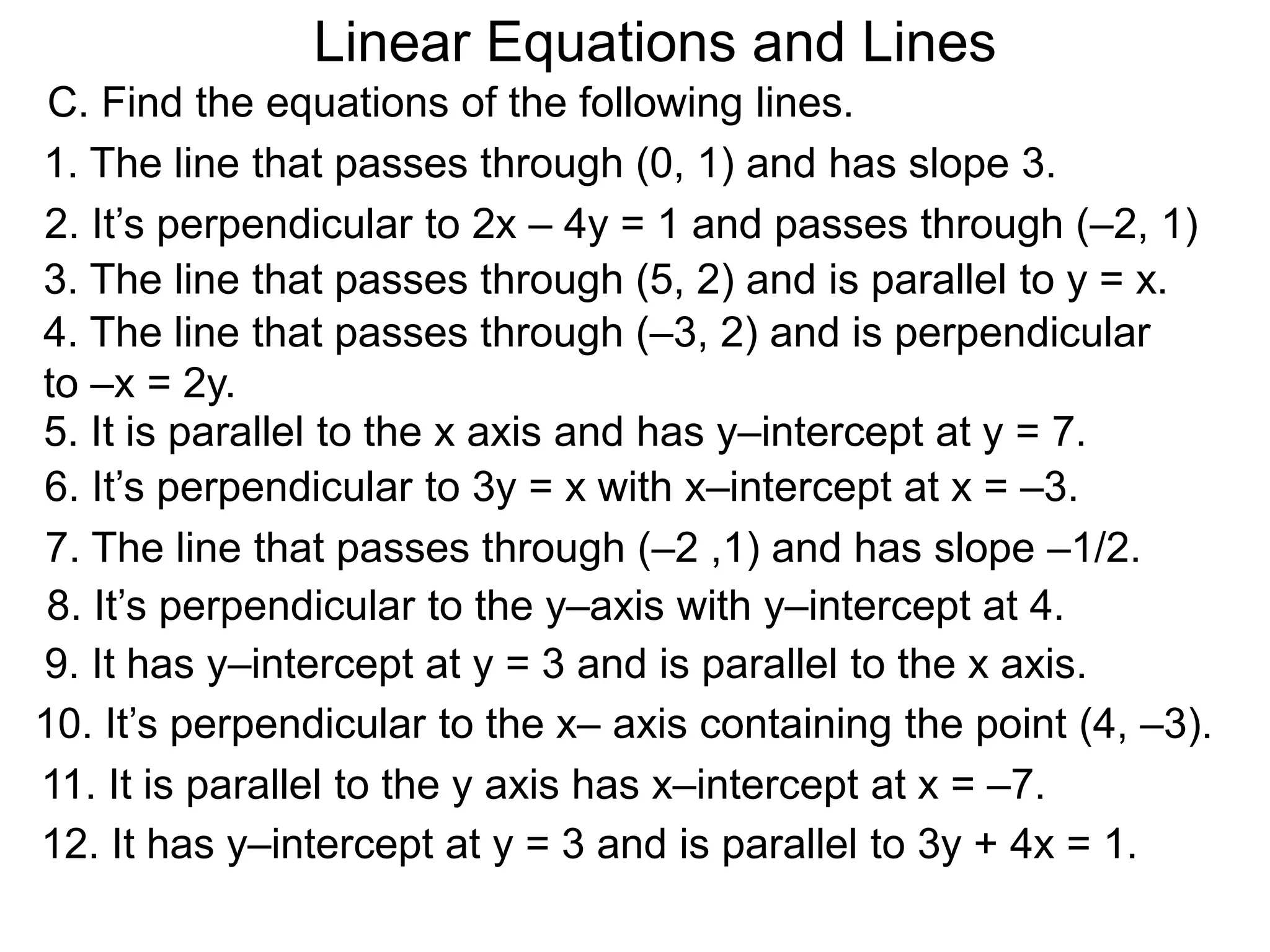
Exercise A. Estimate the slope by eyeballing two points,
then find an equation of each line below.
1. 2. 3. 4.
5. 6. 7. 8.
Linear Equations and Lines
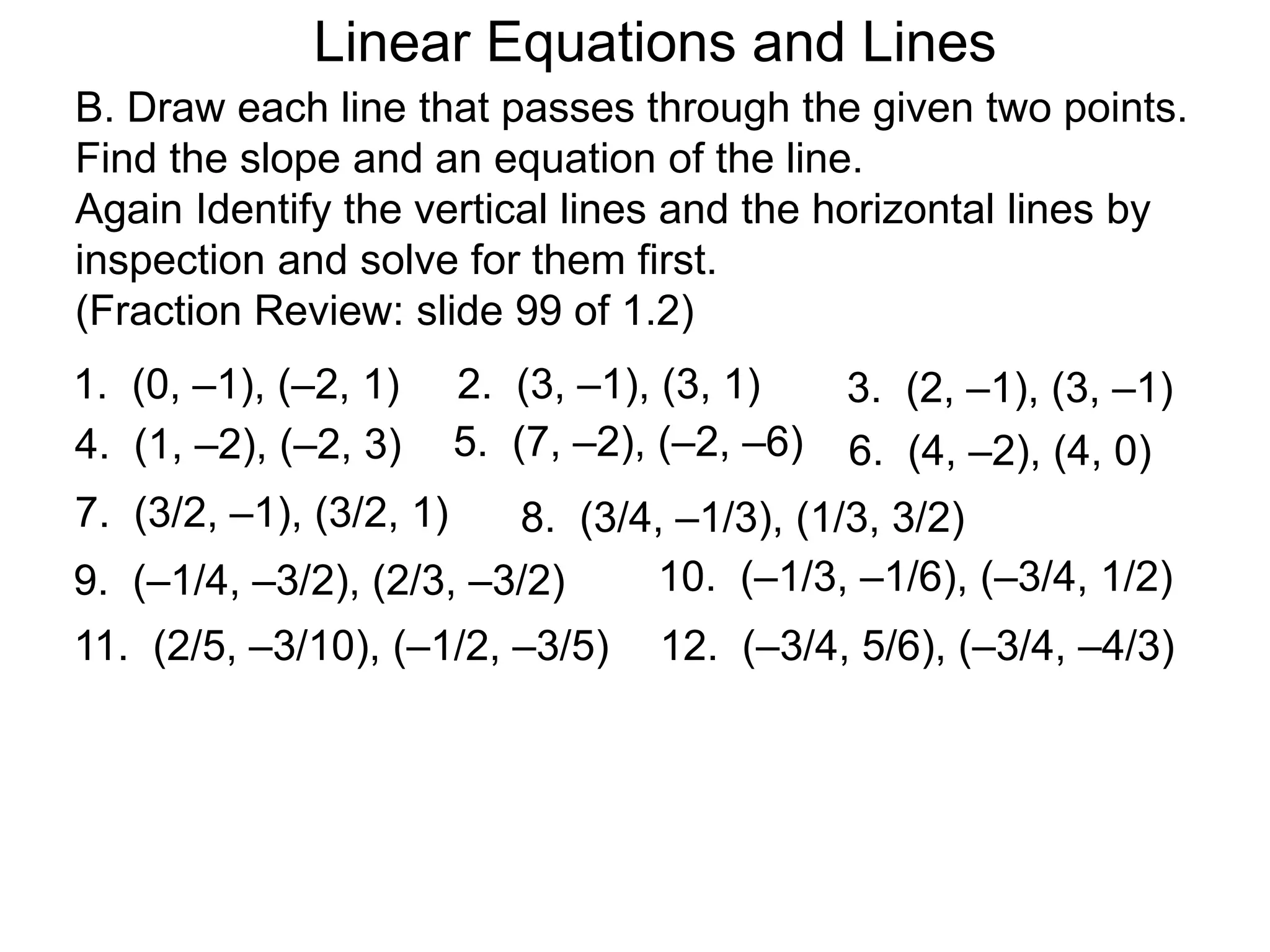
B. Draw each line that passes through the given two points.
Find the slope and an equation of the line.
Again Identify the vertical lines and the horizontal lines by
inspection and solve for them first.
(Fraction Review: slide 99 of 1.2)
1. (0, –1), (–2, 1) 2. (3, –1), (3, 1)
4. (1, –2), (–2, 3)
3. (2, –1), (3, –1)
6. (4, –2), (4, 0)
5. (7, –2), (–2, –6)
7. (3/2, –1), (3/2, 1) 8. (3/4, –1/3), (1/3, 3/2)
9. (–1/4, –3/2), (2/3, –3/2) 10. (–1/3, –1/6), (–3/4, 1/2)
11. (2/5, –3/10), (–1/2, –3/5) 12. (–3/4, 5/6), (–3/4, –4/3)
Linear Equations and Lines
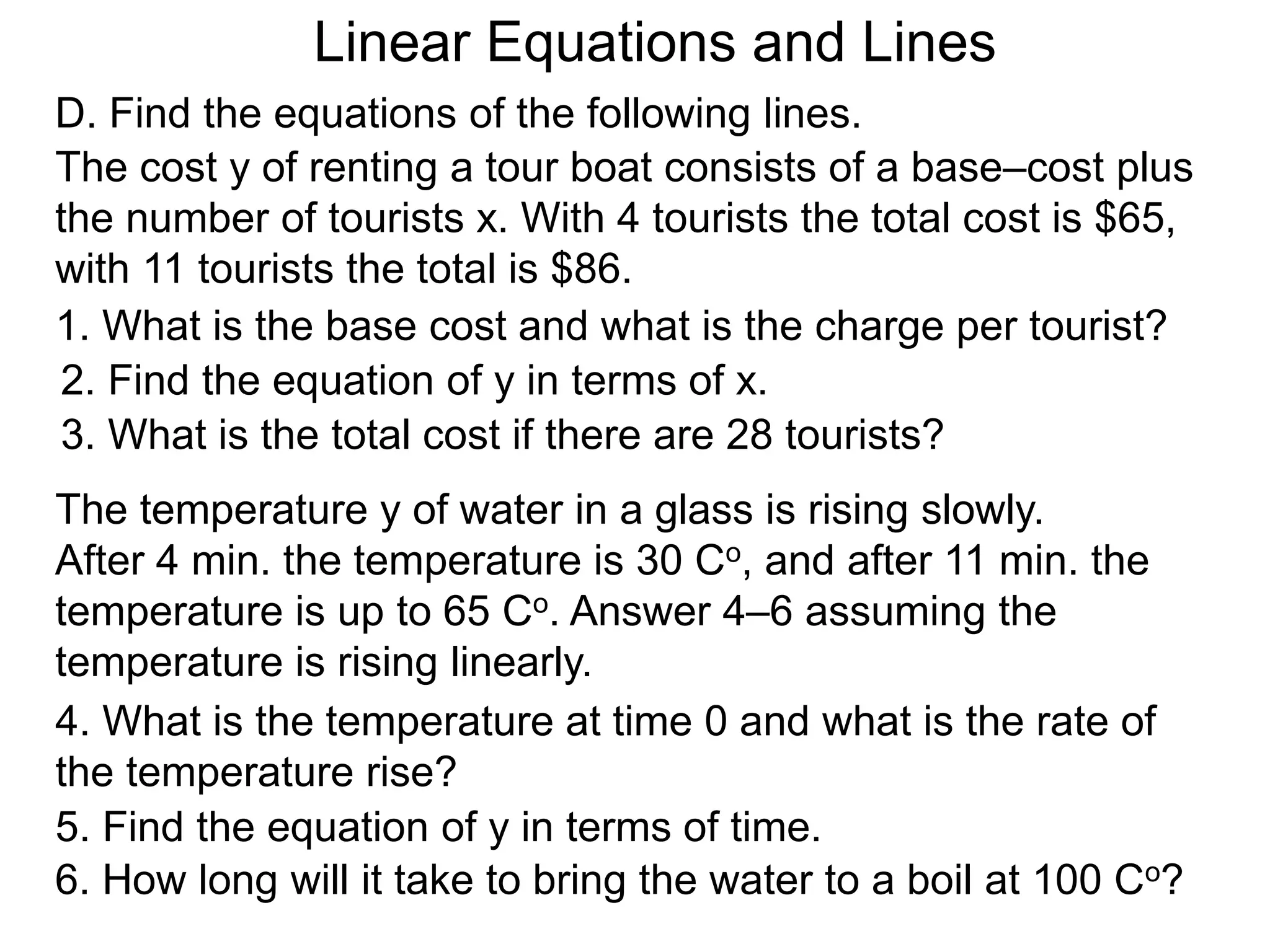
2. It’s perpendicular to 2x – 4y = 1 and passes through (–2, 1)
6. It’s perpendicular to 3y = x with x–intercept at x = –3.
12. It has y–intercept at y = 3 and is parallel to 3y + 4x = 1.
8. It’s perpendicular to the y–axis with y–intercept at 4.
9. It has y–intercept at y = 3 and is parallel to the x axis.
10. It’s perpendicular to the x– axis containing the point (4, –3).
11. It is parallel to the y axis has x–intercept at x = –7.
5. It is parallel to the x axis and has y–intercept at y = 7.
C. Find the equations of the following lines.
1. The line that passes through (0, 1) and has slope 3.
7. The line that passes through (–2 ,1) and has slope –1/2.
3. The line that passes through (5, 2) and is parallel to y = x.
4. The line that passes through (–3, 2) and is perpendicular
to –x = 2y.
Linear Equations and Lines
The cost y of renting a tour boat consists of a base–cost plus
the number of tourists x. With 4 tourists the total cost is $65,
with 11 tourists the total is $86.
1. What is the base cost and what is the charge per tourist?
2. Find the equation of y in terms of x.
3. What is the total cost if there are 28 tourists?
The temperature y of water in a glass is rising slowly.
After 4 min. the temperature is 30 Co, and after 11 min. the
temperature is up to 65 Co. Answer 4–6 assuming the
temperature is rising linearly.
4. What is the temperature at time 0 and what is the rate of
the temperature rise?
5. Find the equation of y in terms of time.
6. How long will it take to bring the water to a boil at 100 Co?
D. Find the equations of the following lines.
Linear Equations and Lines
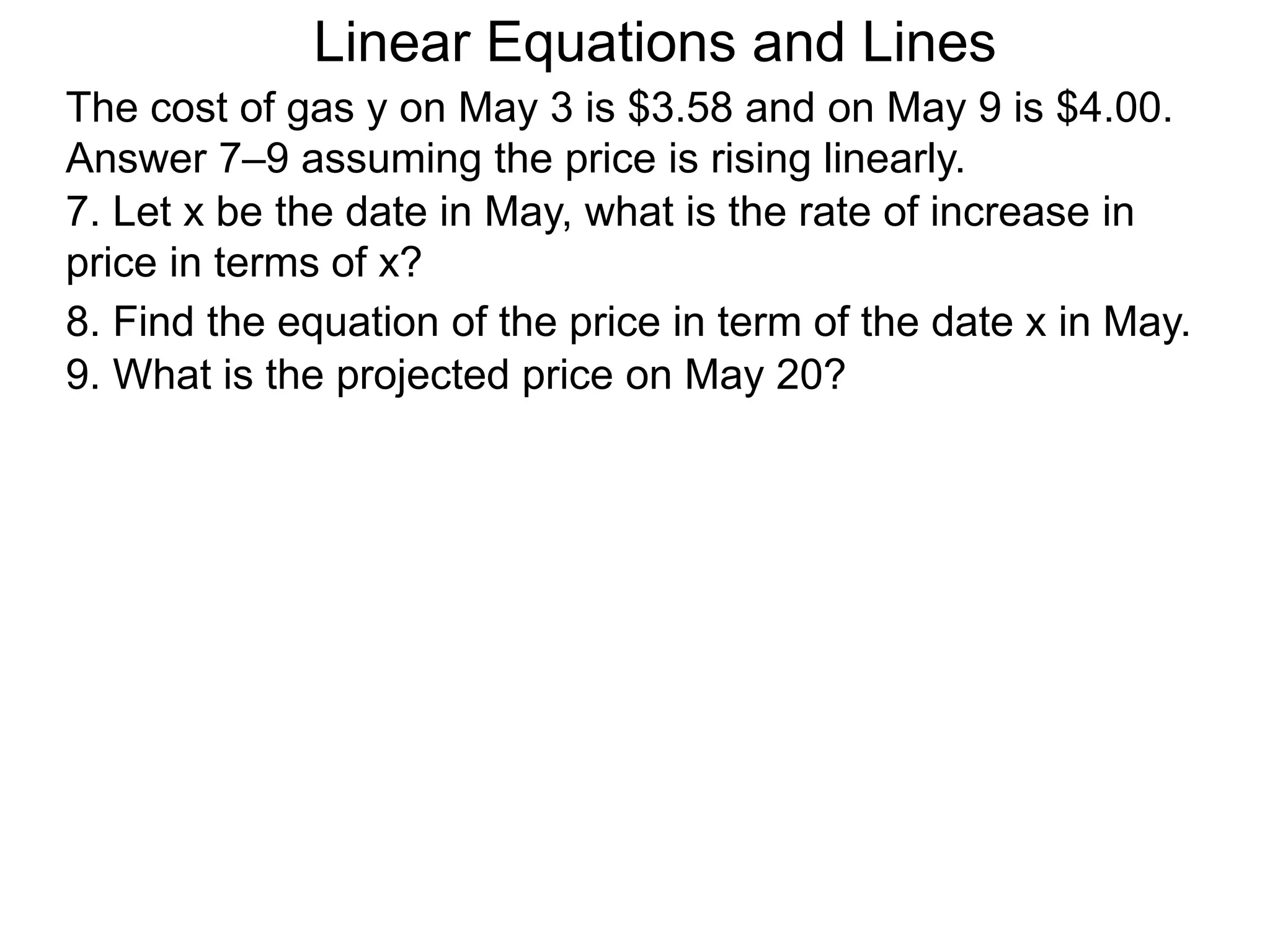
The cost of gas y on May 3 is $3.58 and on May 9 is $4.00.
Answer 7–9 assuming the price is rising linearly.
7. Let x be the date in May, what is the rate of increase in
price in terms of x?
8. Find the equation of the price in term of the date x in May.
9. What is the projected price on May 20?
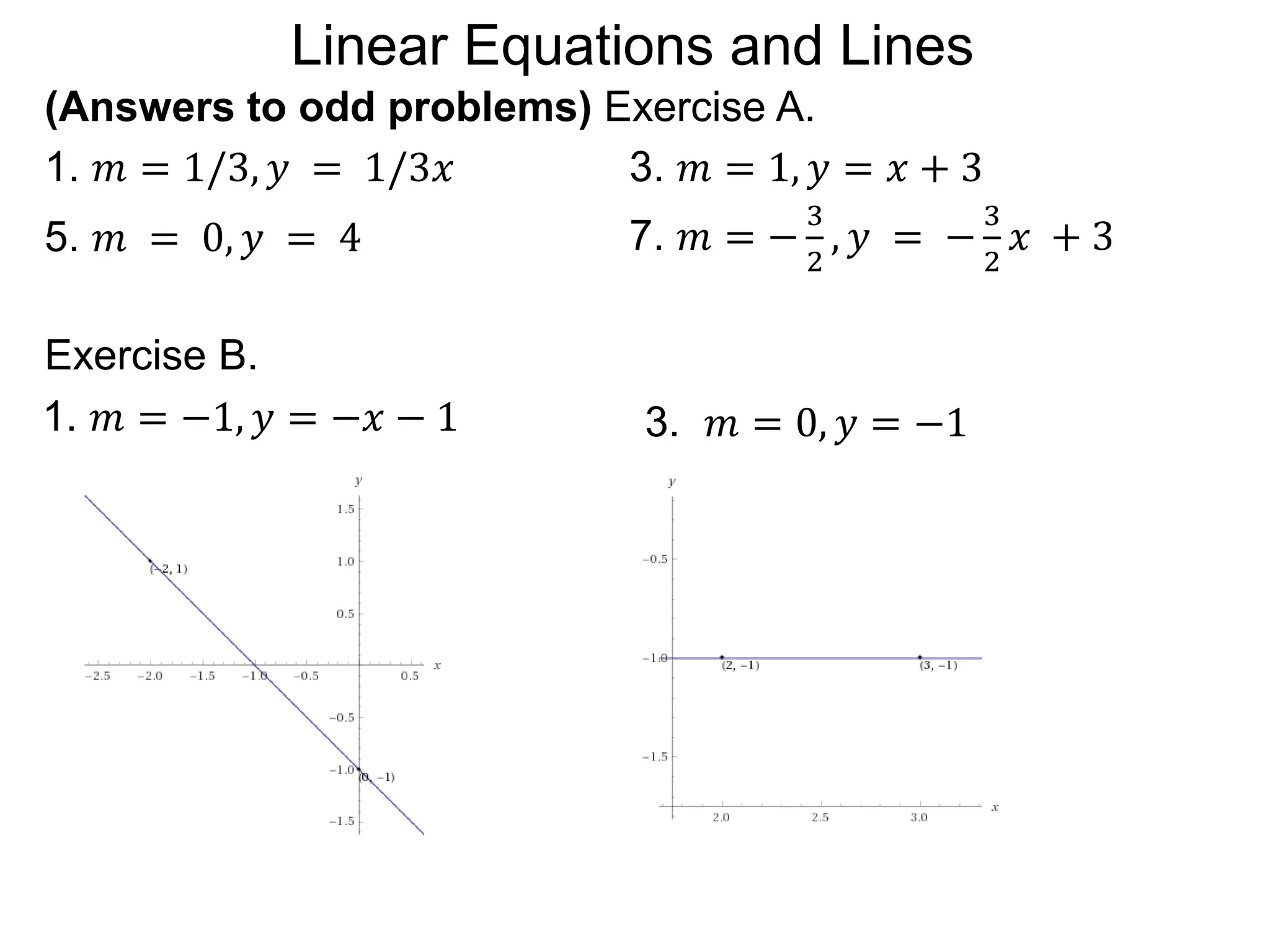
(Answers to odd problems) Exercise A.
1. 𝑚 = 1/3, 𝑦 = 1/3𝑥 3. 𝑚 = 1, 𝑦 = 𝑥 + 3
5. 𝑚 = 0, 𝑦 = 4 7. 𝑚 = −
3
2
, 𝑦 = −
3
2
𝑥 + 3
1. 𝑚 = −1, 𝑦 = −𝑥 − 1 3. 𝑚 = 0, 𝑦 = −1
Exercise B.
Linear Equations and Lines
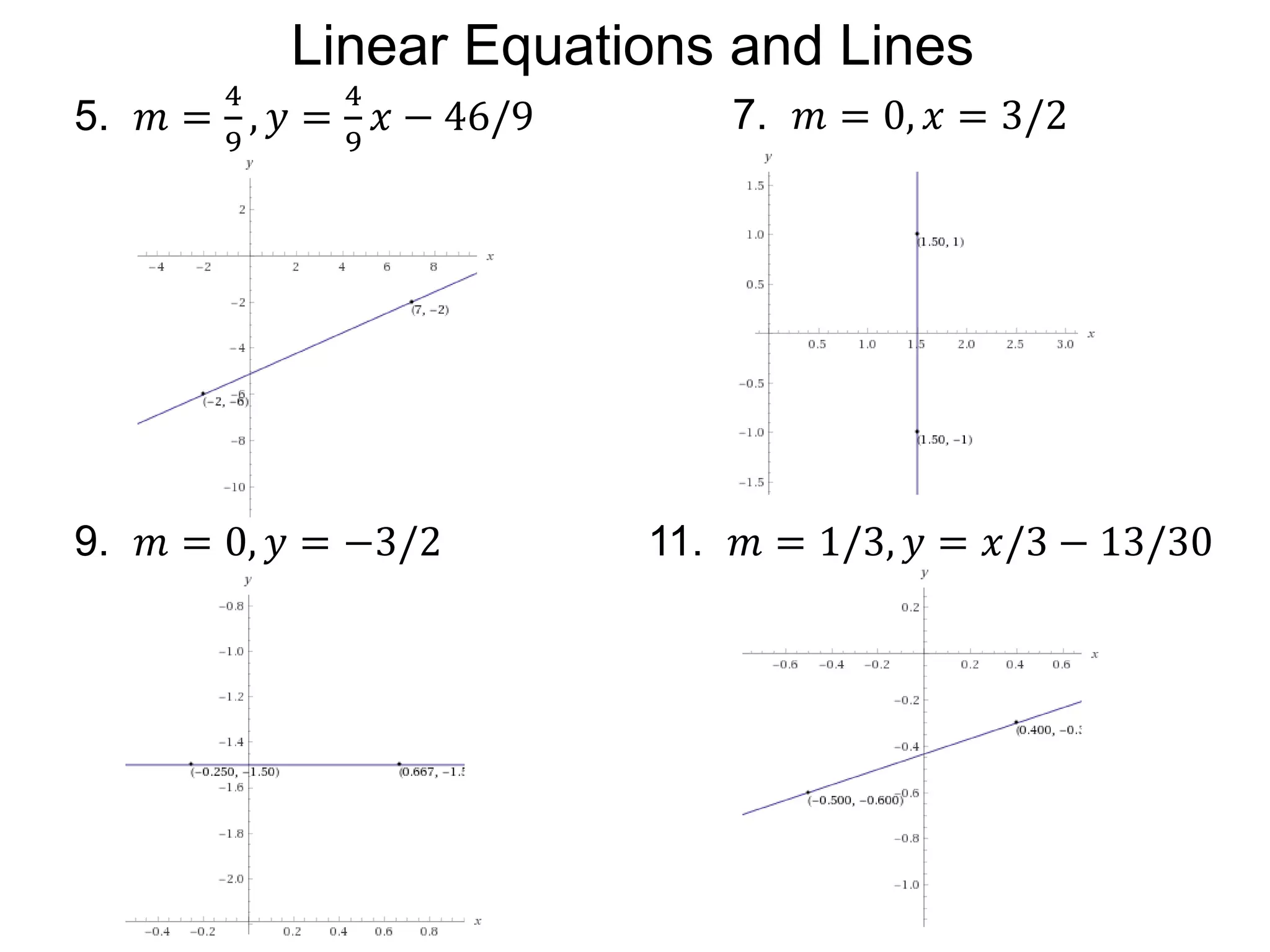
5. 𝑚 =
4
9
, 𝑦 =
4
9
𝑥 − 46/9 7. 𝑚 = 0, 𝑥 = 3/2
9. 𝑚 = 0, 𝑦 = −3/2 11. 𝑚 = 1/3, 𝑦 = 𝑥/3 − 13/30
Linear Equations and Lines
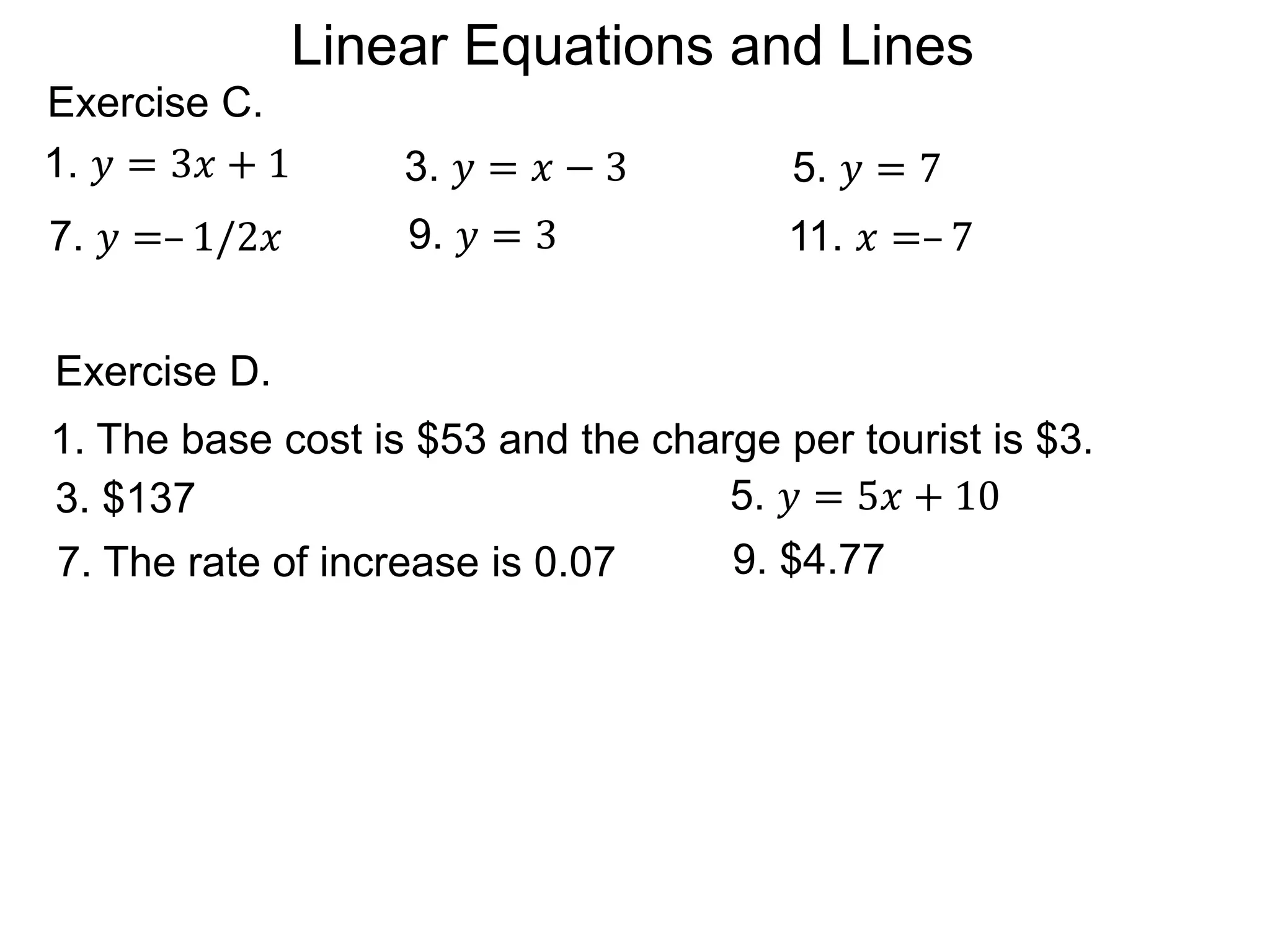
9. 𝑦 = 3 11. 𝑥 =– 7
5. 𝑦 = 7
Exercise C.
1. 𝑦 = 3𝑥 + 1
7. 𝑦 =– 1/2𝑥
3. 𝑦 = 𝑥 − 3
1. The base cost is $53 and the charge per tourist is $3.
3. $137
Exercise D.
5. 𝑦 = 5𝑥 + 10
9. $4.77
7. The rate of increase is 0.07
Linear Equations and Lines

11 graphs of first degree functions x

  • 1.
  • 2.
    First Degree Functions Mostmathematical functions y = f(x) used in the real world are “composed” with members from the following three groups of formulas.
  • 3.
    Most mathematical functionsy = f(x) used in the real world are “composed” with members from the following three groups of formulas. * The algebraic family – these are polynomials, rational expressions and roots, etc.. First Degree Functions
  • 4.
    Most mathematical functionsy = f(x) used in the real world are “composed” with members from the following three groups of formulas. * The algebraic family – these are polynomials, rational expressions and roots, etc.. * The trigonometric family – these are sin(x), cos(x), .. etc that come from line measurements. First Degree Functions
  • 5.
    Most mathematical functionsy = f(x) used in the real world are “composed” with members from the following three groups of formulas. * The algebraic family – these are polynomials, rational expressions and roots, etc.. * The trigonometric family – these are sin(x), cos(x), .. etc that come from line measurements. * The exponential–log family – these are ex and ln(x) that come from exponential contexts. First Degree Functions
  • 6.
    Most mathematical functionsy = f(x) used in the real world are “composed” with members from the following three groups of formulas. * The algebraic family – these are polynomials, rational expressions and roots, etc.. * The trigonometric family – these are sin(x), cos(x), .. etc that come from line measurements. * The exponential–log family – these are ex and ln(x) that come from exponential contexts. Degree 1 or linear functions: f(x) = mx + b and degree 2 or quadratic functions: f(x) = ax2 + bx + c are especially important. First Degree Functions
  • 7.
    First Degree Functions Thealgebraic family The exponential–log family The trigonometric family Below is the MS Win-10 desktop scientific calculator, a typical scientific calculator input panel:
  • 8.
    Most mathematical functionsy = f(x) used in the real world are “composed” with members from the following three groups of formulas. * The algebraic family – these are polynomials, rational expressions and roots, etc.. * The trigonometric family – these are sin(x), cos(x), .. etc that come from line measurements. * The exponential–log family – these are ex and ln(x) that come from exponential contexts. Degree 1 or linear functions: f(x) = mx + b and degree 2 or quadratic functions: f(x) = ax2 + bx + c are especially important. First Degree Functions
  • 9.
    Most mathematical functionsy = f(x) used in the real world are “composed” with members from the following three groups of formulas. * The algebraic family – these are polynomials, rational expressions and roots, etc.. * The trigonometric family – these are sin(x), cos(x), .. etc that come from line measurements. * The exponential–log family – these are ex and ln(x) that come from exponential contexts. Degree 1 or linear functions: f(x) = mx + b and degree 2 or quadratic functions: f(x) = ax2 + bx + c are especially important. First Degree Functions We review below the basics of linear equations and linear functions.
  • 10.
    The graphs ofthe equations Ax + By = C are straight lines. First Degree Functions
  • 11.
    The graphs ofthe equations Ax + By = C are straight lines. It's easy to graph lines by graphing the x and y intercepts, First Degree Functions
  • 12.
    a.2x – 3y= 12 The graphs of the equations Ax + By = C are straight lines. It's easy to graph lines by graphing the x and y intercepts, First Degree Functions
  • 13.
    a.2x – 3y= 12 The graphs of the equations Ax + By = C are straight lines. It's easy to graph lines by graphing the x and y intercepts, i.e. set x = 0 to get the y–intercept, (0,–4) First Degree Functions
  • 14.
    a.2x – 3y= 12 The graphs of the equations Ax + By = C are straight lines. It's easy to graph lines by graphing the x and y intercepts, i.e. set x = 0 to get the y–intercept, and set y = 0 for the x–intercept. (6,0) (0,–4) First Degree Functions
  • 15.
    a.2x – 3y= 12 The graphs of the equations Ax + By = C are straight lines. It's easy to graph lines by graphing the x and y intercepts, i.e. set x = 0 to get the y–intercept, and set y = 0 for the x–intercept. (6,0) (0,–4) First Degree Functions
  • 16.
    a.2x – 3y= 12 The graphs of the equations Ax + By = C are straight lines. It's easy to graph lines by graphing the x and y intercepts, i.e. set x = 0 to get the y–intercept, and set y = 0 for the x–intercept. If there is only one variable in the equation, we get a vertical or a horizontal line. (6,0) (0,–4) First Degree Functions
  • 17.
    a.2x – 3y= 12 b. –3y = 12 The graphs of the equations Ax + By = C are straight lines. It's easy to graph lines by graphing the x and y intercepts, i.e. set x = 0 to get the y–intercept, and set y = 0 for the x–intercept. If there is only one variable in the equation, we get a vertical or a horizontal line. (6,0) (0,–4) First Degree Functions
  • 18.
    a.2x – 3y= 12 b. –3y = 12 The graphs of the equations Ax + By = C are straight lines. It's easy to graph lines by graphing the x and y intercepts, i.e. set x = 0 to get the y–intercept, and set y = 0 for the x–intercept. If there is only one variable in the equation, we get a vertical or a horizontal line. (6,0) (0,–4) y = –4 First Degree Functions
  • 19.
    a.2x – 3y= 12 b. –3y = 12 c. 2x = 12 The graphs of the equations Ax + By = C are straight lines. It's easy to graph lines by graphing the x and y intercepts, i.e. set x = 0 to get the y–intercept, and set y = 0 for the x–intercept. If there is only one variable in the equation, we get a vertical or a horizontal line. (6,0) (0,–4) y = –4 First Degree Functions
  • 20.
    a.2x – 3y= 12 b. –3y = 12 c. 2x = 12 The graphs of the equations Ax + By = C are straight lines. It's easy to graph lines by graphing the x and y intercepts, i.e. set x = 0 to get the y–intercept, and set y = 0 for the x–intercept. If there is only one variable in the equation, we get a vertical or a horizontal line. (6,0) (0,–4) y = –4 x = 6 First Degree Functions
  • 21.
    a.2x – 3y= 12 b. –3y = 12 c. 2x = 12 If both x and y are present, we get a tilted line. The graphs of the equations Ax + By = C are straight lines. It's easy to graph lines by graphing the x and y intercepts, i.e. set x = 0 to get the y–intercept, and set y = 0 for the x–intercept. If there is only one variable in the equation, we get a vertical or a horizontal line. (6,0) (0,–4) y = –4 x = 6 First Degree Functions
  • 22.
    a.2x – 3y= 12 b. –3y = 12 c. 2x = 12 If both x and y are present, we get a tilted line. If the equation is y = c, we get a horizontal line. The graphs of the equations Ax + By = C are straight lines. It's easy to graph lines by graphing the x and y intercepts, i.e. set x = 0 to get the y–intercept, and set y = 0 for the x–intercept. If there is only one variable in the equation, we get a vertical or a horizontal line. (6,0) (0,–4) y = –4 x = 6 First Degree Functions
  • 23.
    a.2x – 3y= 12 b. –3y = 12 c. 2x = 12 If both x and y are present, we get a tilted line. If the equation is y = c, we get a horizontal line. The graphs of the equations Ax + By = C are straight lines. It's easy to graph lines by graphing the x and y intercepts, i.e. set x = 0 to get the y–intercept, and set y = 0 for the x–intercept. If there is only one variable in the equation, we get a vertical or a horizontal line. (6,0) (0,–4) y = –4 x = 6 If the equation is x = c, we get a vertical line. First Degree Functions
  • 24.
    First Degree Functions GivenAx + By = C with B = 0,
  • 25.
    First Degree Functions GivenAx + By = C with B = 0, treating x as the input and y as the output, we may solve for y and put the equation in a function form: y = f(x) = mx + b,
  • 26.
    First Degree Functions GivenAx + By = C with B = 0, treating x as the input and y as the output, we may solve for y and put the equation in a function form: y = f(x) = mx + b, m is called the slope and b is the y intercept,
  • 27.
    First Degree Functions GivenAx + By = C with B = 0, treating x as the input and y as the output, we may solve for y and put the equation in a function form: y = f(x) = mx + b, m is called the slope and b is the y intercept, and the form is called the slope–intercept form.
  • 28.
    First Degree Functions GivenAx + By = C with B = 0, treating x as the input and y as the output, we may solve for y and put the equation in a function form: y = f(x) = mx + b, m is called the slope and b is the y intercept, and the form is called the slope–intercept form. From the examples above, a. 2x – 3y = 12 
  • 29.
    First Degree Functions GivenAx + By = C with B = 0, treating x as the input and y as the output, we may solve for y and put the equation in a function form: y = f(x) = mx + b, m is called the slope and b is the y intercept, and the form is called the slope–intercept form. 2 3 2 3 From the examples above, a. 2x – 3y = 12  y = x – 4, so the slope =
  • 30.
    First Degree Functions GivenAx + By = C with B = 0, treating x as the input and y as the output, we may solve for y and put the equation in a function form: y = f(x) = mx + b, m is called the slope and b is the y intercept, and the form is called the slope–intercept form. 2 3 2 3 From the examples above, a. 2x – 3y = 12  y = x – 4, so the slope = b. –3y = 12
  • 31.
    First Degree Functions GivenAx + By = C with B = 0, treating x as the input and y as the output, we may solve for y and put the equation in a function form: y = f(x) = mx + b, m is called the slope and b is the y intercept, and the form is called the slope–intercept form. 2 3 2 3 From the examples above, a. 2x – 3y = 12  y = x – 4, so the slope = b. –3y = 12  y = 0x – 4, so the slope = 0
  • 32.
    First Degree Functions GivenAx + By = C with B = 0, treating x as the input and y as the output, we may solve for y and put the equation in a function form: y = f(x) = mx + b, m is called the slope and b is the y intercept, and the form is called the slope–intercept form. 2 3 2 3 From the examples above, a. 2x – 3y = 12  y = x – 4, so the slope = b. –3y = 12  y = 0x – 4, so the slope = 0 c. 2x = 12,
  • 33.
    First Degree Functions GivenAx + By = C with B = 0, treating x as the input and y as the output, we may solve for y and put the equation in a function form: y = f(x) = mx + b, m is called the slope and b is the y intercept, and the form is called the slope–intercept form. 2 3 2 3 From the examples above, a. 2x – 3y = 12  y = x – 4, so the slope = b. –3y = 12  y = 0x – 4, so the slope = 0 c. 2x = 12, the slope is undefined since we can't solve for y.
  • 34.
    First Degree Functions GivenAx + By = C with B = 0, treating x as the input and y as the output, we may solve for y and put the equation in a function form: y = f(x) = mx + b, m is called the slope and b is the y intercept, and the form is called the slope–intercept form. The slope m is also the ratio of the change in the output vs. the change in the input. 2 3 2 3 From the examples above, a. 2x – 3y = 12  y = x – 4, so the slope = b. –3y = 12  y = 0x – 4, so the slope = 0 c. 2x = 12, the slope is undefined since we can't solve for y.
  • 35.
    First Degree Functions GivenAx + By = C with B = 0, treating x as the input and y as the output, we may solve for y and put the equation in a function form: y = f(x) = mx + b, m is called the slope and b is the y intercept, and the form is called the slope–intercept form. The slope m is also the ratio of the amounts of change in the output : the change in the input. If two points on the line are given, the slope is defined via the following formula. 2 3 2 3 From the examples above, a. 2x – 3y = 12  y = x – 4, so the slope = b. –3y = 12  y = 0x – 4, so the slope = 0 c. 2x = 12, the slope is undefined since we can't solve for y.
  • 36.
    Slope Formula: Let(x1, y1) and (x2, y2) be two points on a line, First Degree Functions (x1, y1) (x2, y2)
  • 37.
    Slope Formula: Let(x1, y1) and (x2, y2) be two points on a line, then the slope Δy Δx m = First Degree Functions (x1, y1) (x2, y2)
  • 38.
    Slope Formula: Let(x1, y1) and (x2, y2) be two points on a line, then the slope Δy Δx m = First Degree Functions (The Greek letter Δ means "the difference".) (x1, y1) (x2, y2)
  • 39.
    Slope Formula: Let(x1, y1) and (x2, y2) be two points on a line, then the slope Δy Δx y2 – y1 x2 – x1 m = = First Degree Functions (The Greek letter Δ means "the difference".) (x1, y1) (x2, y2)
  • 40.
    Slope Formula: Let(x1, y1) and (x2, y2) be two points on a line, then the slope Δy Δx y2 – y1 x2 – x1 m = rise run = = First Degree Functions (The Greek letter Δ means "the difference".) (x1, y1) (x2, y2)
  • 41.
    Slope Formula: Let(x1, y1) and (x2, y2) be two points on a line, then the slope Δy Δx y2 – y1 x2 – x1 m = rise run = = (x1, y1) (x2, y2) First Degree Functions (The Greek letter Δ means "the difference".)
  • 42.
    Slope Formula: Let(x1, y1) and (x2, y2) be two points on a line, then the slope Δy Δx y2 – y1 x2 – x1 m = rise run = = (x1, y1) (x2, y2) Δy=y2–y1=rise First Degree Functions (The Greek letter Δ means "the difference".)
  • 43.
    Slope Formula: Let(x1, y1) and (x2, y2) be two points on a line, then the slope Δy Δx y2 – y1 x2 – x1 m = rise run = = (x1, y1) (x2, y2) Δy=y2–y1=rise Δx=x2–x1=run First Degree Functions (The Greek letter Δ means "the difference".)
  • 44.
    Slope Formula: Let(x1, y1) and (x2, y2) be two points on a line, then the slope Δy Δx y2 – y1 x2 – x1 m = rise run = = (x1, y1) (x2, y2) Δy=y2–y1=rise Δx=x2–x1=run The Point Slope Formula: Let y = f(x) be a first degree equation with slope m, and (x1, y1) is a point on the line, then y = f(x) = m(x – x1) + y1 First Degree Functions (The Greek letter Δ means "the difference".)
  • 45.
    Slope Formula: Let(x1, y1) and (x2, y2) be two points on a line, then the slope Δy Δx y2 – y1 x2 – x1 m = rise run = = (x1, y1) (x2, y2) Δy=y2–y1=rise Δx=x2–x1=run The Point Slope Formula: Let y = f(x) be a first degree equation with slope m, and (x1, y1) is a point on the line, then y = f(x) = m(x – x1) + y1 First degree functions are also called linear functions because their graphs are straight lines. First Degree Functions (The Greek letter Δ means "the difference".)
  • 46.
    Slope Formula: Let(x1, y1) and (x2, y2) be two points on a line, then the slope Δy Δx y2 – y1 x2 – x1 m = rise run = = (x1, y1) (x2, y2) Δy=y2–y1=rise Δx=x2–x1=run The Point Slope Formula: Let y = f(x) be a first degree equation with slope m, and (x1, y1) is a point on the line, then y = f(x) = m(x – x1) + y1 First degree functions are also called linear functions because their graphs are straight lines. We will use linear functions to approximate other functions just like we use line segments to approximate a curve. First Degree Functions (The Greek letter Δ means "the difference".)
  • 47.
    Linear Equations andLines Example A. A river floods regularly, and on a rock by the river there is a mark indicating the highest point the water level ever recorded. At 12 pm July 11, the water level is 28 inches below this mark. At 8 am July 12 the water is 18 inches below this mark.
  • 48.
    Linear Equations andLines Example A. A river floods regularly, and on a rock by the river there is a mark indicating the highest point the water level ever recorded. At 12 pm July 11, the water level is 28 inches below this mark. At 8 am July 12 the water is 18 inches below this mark. Let x = time, y = distance between the water level and the mark. Find the linear function y = f(x) = mx + b of the distance y in terms of time x.
  • 49.
    Linear Equations andLines Example A. A river floods regularly, and on a rock by the river there is a mark indicating the highest point the water level ever recorded. At 12 pm July 11, the water level is 28 inches below this mark. At 8 am July 12 the water is 18 inches below this mark. Let x = time, y = distance between the water level and the mark. Find the linear function y = f(x) = mx + b of the distance y in terms of time x. Since how the time was measured is not specified, we may select the stating time 0 to be time of the first observation.
  • 50.
    Linear Equations andLines Example A. A river floods regularly, and on a rock by the river there is a mark indicating the highest point the water level ever recorded. At 12 pm July 11, the water level is 28 inches below this mark. At 8 am July 12 the water is 18 inches below this mark. Let x = time, y = distance between the water level and the mark. Find the linear function y = f(x) = mx + b of the distance y in terms of time x. Since how the time was measured is not specified, we may select the stating time 0 to be time of the first observation. By setting x = 0 (hr) at 12 pm July 11, then x = 20 at 8 am of July 12.
  • 51.
    Equations of Lines Inparticular, we are given that at x = 0 →y = 28, and at x = 20 → y = 18
  • 52.
    Equations of Lines Inparticular, we are given that at x = 0 →y = 28, and at x = 20 → y = 18 and that we want the equation y = m(x – x1) + y1 of the line that contains the points (0, 28) and (20, 18).
  • 53.
    Δy Δx 28 – 18 0– 20 Equations of Lines In particular, we are given that at x = 0 →y = 28, and at x = 20 → y = 18 and that we want the equation y = m(x – x1) + y1 of the line that contains the points (0, 28) and (20, 18). = The slope m = = –1/2
  • 54.
    Using the point(0, 28) and the point–slope formula, y = – ½ (x – 0) + 28 or Δy Δx 28 – 18 0 – 20 Equations of Lines In particular, we are given that at x = 0 →y = 28, and at x = 20 → y = 18 and that we want the equation y = m(x – x1) + y1 of the line that contains the points (0, 28) and (20, 18). = The slope m = = –1/2 – x y = + 28 2
  • 55.
    Using the point(0, 28) and the point–slope formula, y = – ½ (x – 0) + 28 or Δy Δx 28 – 18 0 – 20 Equations of Lines In particular, we are given that at x = 0 →y = 28, and at x = 20 → y = 18 and that we want the equation y = m(x – x1) + y1 of the line that contains the points (0, 28) and (20, 18). = The slope m = = –1/2 – x y = + 28 2 The linear equation that we found is also called the trend line.
  • 56.
    Using the point(0, 28) and the point–slope formula, y = – ½ (x – 0) + 28 or Δy Δx 28 – 18 0 – 20 Equations of Lines In particular, we are given that at x = 0 →y = 28, and at x = 20 → y = 18 and that we want the equation y = m(x – x1) + y1 of the line that contains the points (0, 28) and (20, 18). = The slope m = = –1/2 – x y = + 28 2 The linear equation that we found is also called the trend line. So if at 4 pm July 12, i.e. when x = 28, we measured that y = 12”
  • 57.
    Using the point(0, 28) and the point–slope formula, y = – ½ (x – 0) + 28 or Δy Δx 28 – 18 0 – 20 Equations of Lines In particular, we are given that at x = 0 →y = 28, and at x = 20 → y = 18 and that we want the equation y = m(x – x1) + y1 of the line that contains the points (0, 28) and (20, 18). = The slope m = = –1/2 – x y = + 28 2 The linear equation that we found is also called the trend line. So if at 4 pm July 12, i.e. when x = 28, we measured that y = 12” but based on the formula prediction that y should be – 28/2 + 28 = 14”,
  • 58.
    Using the point(0, 28) and the point–slope formula, y = – ½ (x – 0) + 28 or Δy Δx 28 – 18 0 – 20 Equations of Lines In particular, we are given that at x = 0 →y = 28, and at x = 20 → y = 18 and that we want the equation y = m(x – x1) + y1 of the line that contains the points (0, 28) and (20, 18). = The slope m = = –1/2 – x y = + 28 2 The linear equation that we found is also called the trend line. So if at 4 pm July 12, i.e. when x = 28, we measured that y = 12” but based on the formula prediction that y should be – 28/2 + 28 = 14”, we may conclude that the flood is intensifying.
  • 59.
    More Facts onSlopes: First Degree Functions
  • 60.
    More Facts onSlopes: • Parallel lines have the same slope. First Degree Functions
  • 61.
    More Facts onSlopes: • Parallel lines have the same slope. • Slopes of perpendicular lines are the negative reciprocal of each other. First Degree Functions
  • 62.
    More Facts onSlopes: • Parallel lines have the same slope. • Slopes of perpendicular lines are the negative reciprocal of each other. Example B. Find the equation of the line L that passes through (2, –4) and is perpendicular to 4x – 3y = 5. First Degree Functions
  • 63.
    More Facts onSlopes: • Parallel lines have the same slope. • Slopes of perpendicular lines are the negative reciprocal of each other. Example B. Find the equation of the line L that passes through (2, –4) and is perpendicular to 4x – 3y = 5. Solve for y to find the slope of 4x – 3y = 5 First Degree Functions
  • 64.
    More Facts onSlopes: • Parallel lines have the same slope. • Slopes of perpendicular lines are the negative reciprocal of each other. Example B. Find the equation of the line L that passes through (2, –4) and is perpendicular to 4x – 3y = 5. Solve for y to find the slope of 4x – 3y = 5 4x – 5 = 3y First Degree Functions
  • 65.
    More Facts onSlopes: • Parallel lines have the same slope. • Slopes of perpendicular lines are the negative reciprocal of each other. Example B. Find the equation of the line L that passes through (2, –4) and is perpendicular to 4x – 3y = 5. Solve for y to find the slope of 4x – 3y = 5 4x – 5 = 3y 4x/3 – 5/3 = y First Degree Functions
  • 66.
    More Facts onSlopes: • Parallel lines have the same slope. • Slopes of perpendicular lines are the negative reciprocal of each other. Example B. Find the equation of the line L that passes through (2, –4) and is perpendicular to 4x – 3y = 5. Solve for y to find the slope of 4x – 3y = 5 4x – 5 = 3y 4x/3 – 5/3 = y Hence the slope of 4x – 2y = 5 is 4/3. First Degree Functions
  • 67.
    More Facts onSlopes: • Parallel lines have the same slope. • Slopes of perpendicular lines are the negative reciprocal of each other. Example B. Find the equation of the line L that passes through (2, –4) and is perpendicular to 4x – 3y = 5. Solve for y to find the slope of 4x – 3y = 5 4x – 5 = 3y 4x/3 – 5/3 = y Hence the slope of 4x – 2y = 5 is 4/3. Therefore L has slope –3/4. First Degree Functions
  • 68.
    More Facts onSlopes: • Parallel lines have the same slope. • Slopes of perpendicular lines are the negative reciprocal of each other. Example B. Find the equation of the line L that passes through (2, –4) and is perpendicular to 4x – 3y = 5. Solve for y to find the slope of 4x – 3y = 5 4x – 5 = 3y 4x/3 – 5/3 = y Hence the slope of 4x – 2y = 5 is 4/3. Therefore L has slope –3/4. So the equation of L is First Degree Functions y = (–3/4)(x – 2) + (–4) or y = –3x/4 – 5/2.
  • 69.
    Linear Equations andLines Exercise A. Estimate the slope by eyeballing two points, then find an equation of each line below. 1. 2. 3. 4. 5. 6. 7. 8.
  • 70.
    Linear Equations andLines B. Draw each line that passes through the given two points. Find the slope and an equation of the line. Again Identify the vertical lines and the horizontal lines by inspection and solve for them first. (Fraction Review: slide 99 of 1.2) 1. (0, –1), (–2, 1) 2. (3, –1), (3, 1) 4. (1, –2), (–2, 3) 3. (2, –1), (3, –1) 6. (4, –2), (4, 0) 5. (7, –2), (–2, –6) 7. (3/2, –1), (3/2, 1) 8. (3/4, –1/3), (1/3, 3/2) 9. (–1/4, –3/2), (2/3, –3/2) 10. (–1/3, –1/6), (–3/4, 1/2) 11. (2/5, –3/10), (–1/2, –3/5) 12. (–3/4, 5/6), (–3/4, –4/3)
  • 71.
    Linear Equations andLines 2. It’s perpendicular to 2x – 4y = 1 and passes through (–2, 1) 6. It’s perpendicular to 3y = x with x–intercept at x = –3. 12. It has y–intercept at y = 3 and is parallel to 3y + 4x = 1. 8. It’s perpendicular to the y–axis with y–intercept at 4. 9. It has y–intercept at y = 3 and is parallel to the x axis. 10. It’s perpendicular to the x– axis containing the point (4, –3). 11. It is parallel to the y axis has x–intercept at x = –7. 5. It is parallel to the x axis and has y–intercept at y = 7. C. Find the equations of the following lines. 1. The line that passes through (0, 1) and has slope 3. 7. The line that passes through (–2 ,1) and has slope –1/2. 3. The line that passes through (5, 2) and is parallel to y = x. 4. The line that passes through (–3, 2) and is perpendicular to –x = 2y.
  • 72.
    Linear Equations andLines The cost y of renting a tour boat consists of a base–cost plus the number of tourists x. With 4 tourists the total cost is $65, with 11 tourists the total is $86. 1. What is the base cost and what is the charge per tourist? 2. Find the equation of y in terms of x. 3. What is the total cost if there are 28 tourists? The temperature y of water in a glass is rising slowly. After 4 min. the temperature is 30 Co, and after 11 min. the temperature is up to 65 Co. Answer 4–6 assuming the temperature is rising linearly. 4. What is the temperature at time 0 and what is the rate of the temperature rise? 5. Find the equation of y in terms of time. 6. How long will it take to bring the water to a boil at 100 Co? D. Find the equations of the following lines.
  • 73.
    Linear Equations andLines The cost of gas y on May 3 is $3.58 and on May 9 is $4.00. Answer 7–9 assuming the price is rising linearly. 7. Let x be the date in May, what is the rate of increase in price in terms of x? 8. Find the equation of the price in term of the date x in May. 9. What is the projected price on May 20?
  • 74.
    (Answers to oddproblems) Exercise A. 1. 𝑚 = 1/3, 𝑦 = 1/3𝑥 3. 𝑚 = 1, 𝑦 = 𝑥 + 3 5. 𝑚 = 0, 𝑦 = 4 7. 𝑚 = − 3 2 , 𝑦 = − 3 2 𝑥 + 3 1. 𝑚 = −1, 𝑦 = −𝑥 − 1 3. 𝑚 = 0, 𝑦 = −1 Exercise B. Linear Equations and Lines
  • 75.
    5. 𝑚 = 4 9 ,𝑦 = 4 9 𝑥 − 46/9 7. 𝑚 = 0, 𝑥 = 3/2 9. 𝑚 = 0, 𝑦 = −3/2 11. 𝑚 = 1/3, 𝑦 = 𝑥/3 − 13/30 Linear Equations and Lines
  • 76.
    9. 𝑦 =3 11. 𝑥 =– 7 5. 𝑦 = 7 Exercise C. 1. 𝑦 = 3𝑥 + 1 7. 𝑦 =– 1/2𝑥 3. 𝑦 = 𝑥 − 3 1. The base cost is $53 and the charge per tourist is $3. 3. $137 Exercise D. 5. 𝑦 = 5𝑥 + 10 9. $4.77 7. The rate of increase is 0.07 Linear Equations and Lines