E VALUATING P OLYNOMIAL F UNCTIONS

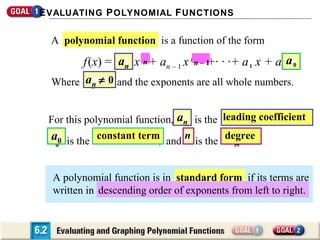
A polynomial function is a function of the form

f (x) = an x nn + an – 1 x nn––1 1 · ·+ a 1 x + a 0 a 0
+·
n
0
Where an ≠ 0 and the exponents are all whole numbers.
n
For this polynomial function, an is the
an
constant term
a
a 00 is the constant term, and n is the
n

leading coefficient
leading coefficient,
degree
degree.

A polynomial function is in standard form if its terms are
descending order of exponents from left to right.
written in descending order of exponents from left to right.
E VALUATING P OLYNOMIAL F UNCTIONS

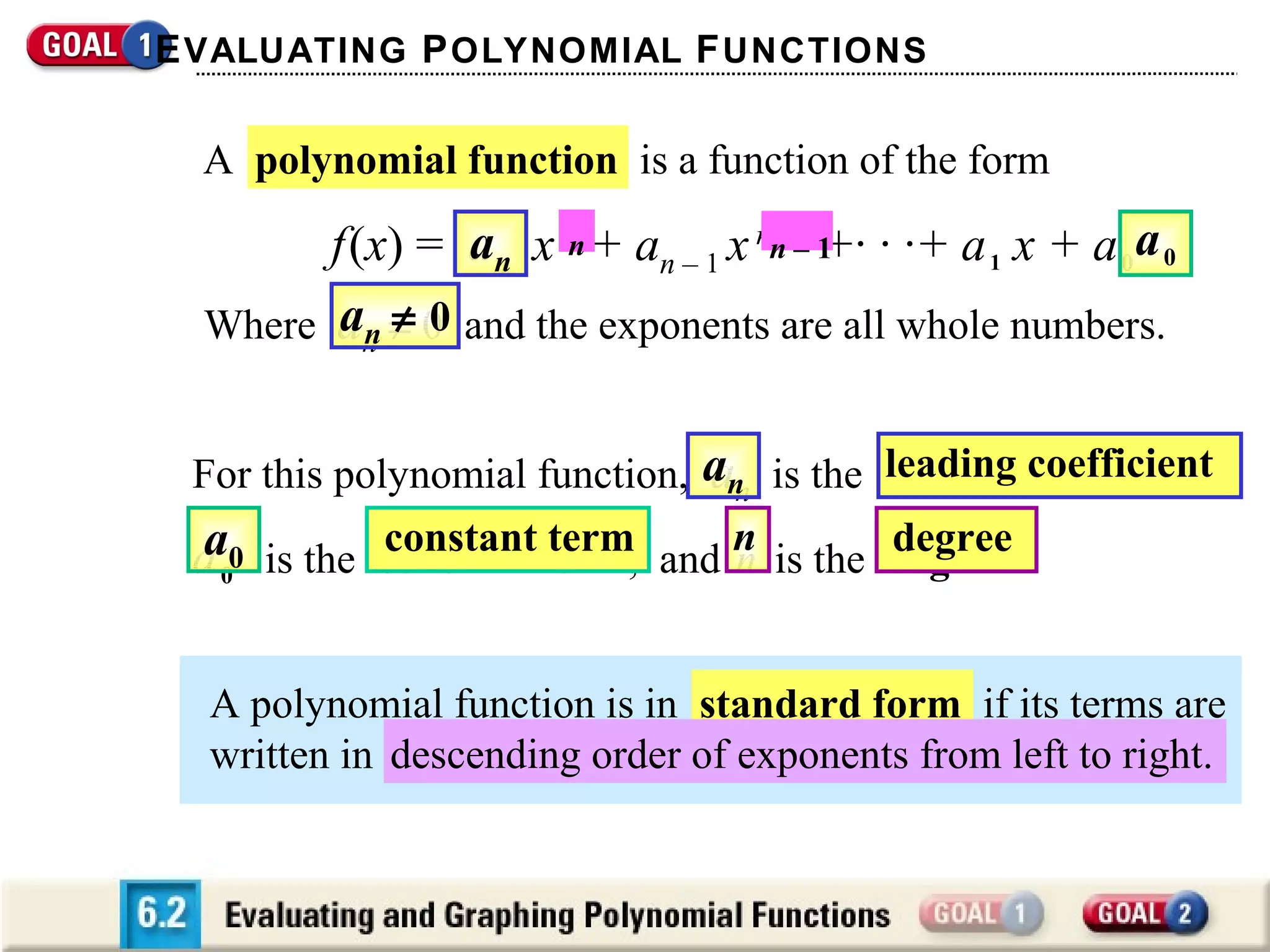
You are already familiar with some types of polynomial
functions. Here is a summary of common types of
polynomial functions.
Degree

Type

Standard Form

0

Constant

f (x) = a 0

1

Linear

f (x) = a1x + a 0

2

Quadratic

f (x) = a 2 x 2 + a 1 x + a 0

3

Cubic

f (x) = a 3 x 3 + a 2 x 2 + a 1 x + a 0

4

Quartic

f (x) = a4 x 4 + a 3 x 3 + a 2 x 2 + a 1 x + a 0
Identifying Polynomial Functions

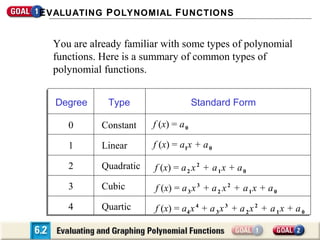
Decide whether the function is a polynomial function. If it is,
write the function in standard form and state its degree, type
and leading coefficient.

f (x) =

1 2
x – 3x4 – 7
2

S OLUTION
The function is a polynomial function.
Its standard form is f (x) = – 3x 4 +

1 2
x – 7.
2

It has degree 4, so it is a quartic function.
The leading coefficient is – 3.
Identifying Polynomial Functions

Decide whether the function is a polynomial function. If it is,
write the function in standard form and state its degree, type
and leading coefficient.

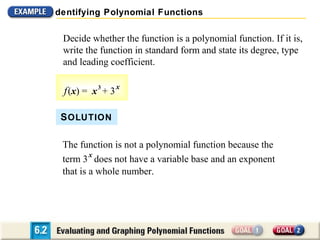
f (x) = x 3 + 3 x
S OLUTION
The function is not a polynomial function because the
x
term 3 does not have a variable base and an exponent
that is a whole number.
Identifying Polynomial Functions

Decide whether the function is a polynomial function. If it is,
write the function in standard form and state its degree, type
and leading coefficient.
–

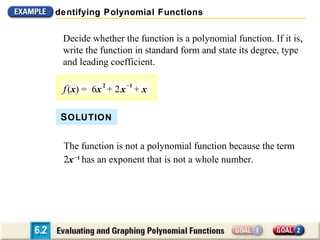
f (x) = 6x 2 + 2 x 1 + x
S OLUTION
The function is not a polynomial function because the term
2x –1 has an exponent that is not a whole number.
Identifying Polynomial Functions

Decide whether the function is a polynomial function. If it is,
write the function in standard form and state its degree, type
and leading coefficient.

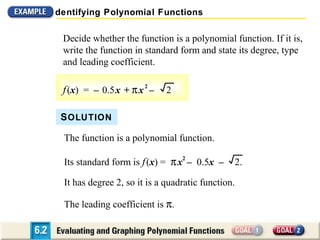
f (x) = – 0.5 x + π x 2 –

2

S OLUTION
The function is a polynomial function.
Its standard form is f (x) = π x2 – 0.5x –

2.

It has degree 2, so it is a quadratic function.
The leading coefficient is π.
Identifying Polynomial Functions

Polynomial function?

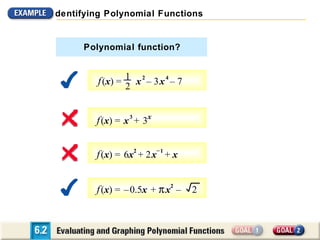
f (x) = 1 x 2 – 3 x 4 – 7
2
f (x) = x 3 + 3x
f (x) = 6x2 + 2 x– 1 + x
f (x) = – 0.5x + π x2 –

2
Using Synthetic Substitution

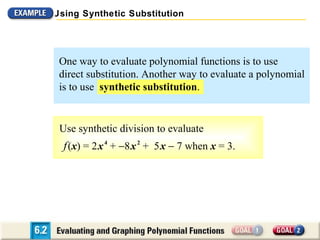
One way to evaluate polynomial functions is to use
direct substitution. Another way to evaluate a polynomial
is to use synthetic substitution.

Use synthetic division to evaluate

f (x) = 2 x 4 + −8 x 2 + 5 x − 7 when x = 3.
Using Synthetic Substitution

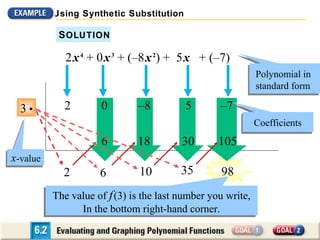
S OLUTION

2 x 4 + 0 x 3 + (–8 x 2) + 5 x + (–7)
Polynomial
Polynomial inin
standard form
standard form

3•
3

2

0

–8

5

–7
Coefficients

6

18

30

105

6

10

35

98

x-value

2

The value of (3) is the last number you write,
The value of ff(3) is the last number you write,
In the bottom right-hand corner.
G RAPHING P OLYNOMIAL F UNCTIONS

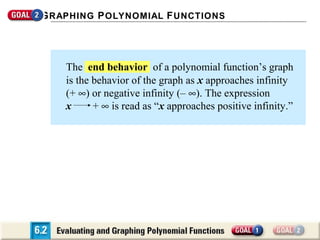
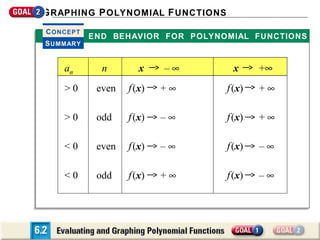
The end behavior of a polynomial function’s graph
is the behavior of the graph as x approaches infinity
(+ ∞) or negative infinity (– ∞). The expression
x
+ ∞ is read as “x approaches positive infinity.”
G RAPHING P OLYNOMIAL F UNCTIONS

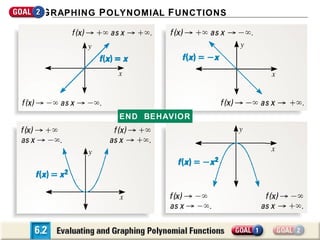
END BEHAVIOR
G RAPHING P OLYNOMIAL F UNCTIONS
C ONCEPT

END BEHAVIOR FOR POLYNOMIAL FUNCTIONS

S UMMARY

x

+∞

+∞

f (x)

+∞

f (x)

–∞

f (x)

+∞

even

f (x)

–∞

f (x)

–∞

odd

f (x)

+∞

f (x)

–∞

an

n

x

>0

even

f (x)

>0

odd

<0
<0

–∞
Graphing Polynomial Functions

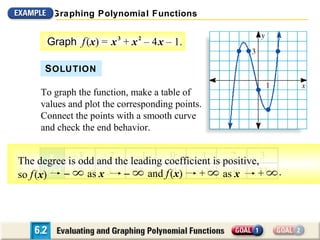
Graph f (x) = x 3 + x 2 – 4 x – 1.
S OLUTION
To graph the function, make a table of
values and plot the corresponding points.
Connect the points with a smooth curve
and check the end behavior.
x
–3
–2
–1
0
1
2
The degree is odd and the leading coefficient is positive, 3
–3 as3x
23
+
+
(x)
so f (x)f(x) – –7 as x 3 – 3 and f–1

.
Graphing Polynomial Functions

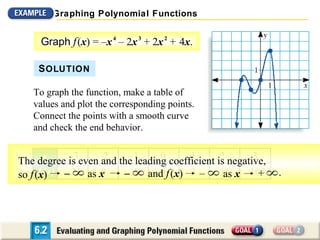
Graph f (x) = –x 4 – 2x 3 + 2x 2 + 4x.
S OLUTION
To graph the function, make a table of
values and plot the corresponding points.
Connect the points with a smooth curve
and check the end behavior.
x
0
1
2
3
The degree –3even–2 the leading coefficient is negative,
is
and –1
f (x) –
–21 as x
0
0
––1 and f (x) 3 – –16 x –105
+
as
so f (x)

.
Assignment

Evaluating and Graphing Polynomial Functions

  • 1.
    E VALUATING POLYNOMIAL F UNCTIONS A polynomial function is a function of the form f (x) = an x nn + an – 1 x nn––1 1 · ·+ a 1 x + a 0 a 0 +· n 0 Where an ≠ 0 and the exponents are all whole numbers. n For this polynomial function, an is the an constant term a a 00 is the constant term, and n is the n leading coefficient leading coefficient, degree degree. A polynomial function is in standard form if its terms are descending order of exponents from left to right. written in descending order of exponents from left to right.
  • 2.
    E VALUATING POLYNOMIAL F UNCTIONS You are already familiar with some types of polynomial functions. Here is a summary of common types of polynomial functions. Degree Type Standard Form 0 Constant f (x) = a 0 1 Linear f (x) = a1x + a 0 2 Quadratic f (x) = a 2 x 2 + a 1 x + a 0 3 Cubic f (x) = a 3 x 3 + a 2 x 2 + a 1 x + a 0 4 Quartic f (x) = a4 x 4 + a 3 x 3 + a 2 x 2 + a 1 x + a 0
  • 3.
    Identifying Polynomial Functions Decidewhether the function is a polynomial function. If it is, write the function in standard form and state its degree, type and leading coefficient. f (x) = 1 2 x – 3x4 – 7 2 S OLUTION The function is a polynomial function. Its standard form is f (x) = – 3x 4 + 1 2 x – 7. 2 It has degree 4, so it is a quartic function. The leading coefficient is – 3.
  • 4.
    Identifying Polynomial Functions Decidewhether the function is a polynomial function. If it is, write the function in standard form and state its degree, type and leading coefficient. f (x) = x 3 + 3 x S OLUTION The function is not a polynomial function because the x term 3 does not have a variable base and an exponent that is a whole number.
  • 5.
    Identifying Polynomial Functions Decidewhether the function is a polynomial function. If it is, write the function in standard form and state its degree, type and leading coefficient. – f (x) = 6x 2 + 2 x 1 + x S OLUTION The function is not a polynomial function because the term 2x –1 has an exponent that is not a whole number.
  • 6.
    Identifying Polynomial Functions Decidewhether the function is a polynomial function. If it is, write the function in standard form and state its degree, type and leading coefficient. f (x) = – 0.5 x + π x 2 – 2 S OLUTION The function is a polynomial function. Its standard form is f (x) = π x2 – 0.5x – 2. It has degree 2, so it is a quadratic function. The leading coefficient is π.
  • 7.
    Identifying Polynomial Functions Polynomialfunction? f (x) = 1 x 2 – 3 x 4 – 7 2 f (x) = x 3 + 3x f (x) = 6x2 + 2 x– 1 + x f (x) = – 0.5x + π x2 – 2
  • 8.
    Using Synthetic Substitution Oneway to evaluate polynomial functions is to use direct substitution. Another way to evaluate a polynomial is to use synthetic substitution. Use synthetic division to evaluate f (x) = 2 x 4 + −8 x 2 + 5 x − 7 when x = 3.
  • 9.
    Using Synthetic Substitution SOLUTION 2 x 4 + 0 x 3 + (–8 x 2) + 5 x + (–7) Polynomial Polynomial inin standard form standard form 3• 3 2 0 –8 5 –7 Coefficients 6 18 30 105 6 10 35 98 x-value 2 The value of (3) is the last number you write, The value of ff(3) is the last number you write, In the bottom right-hand corner. In the bottom right-hand corner.
  • 10.
    G RAPHING POLYNOMIAL F UNCTIONS The end behavior of a polynomial function’s graph is the behavior of the graph as x approaches infinity (+ ∞) or negative infinity (– ∞). The expression x + ∞ is read as “x approaches positive infinity.”
  • 11.
    G RAPHING POLYNOMIAL F UNCTIONS END BEHAVIOR
  • 12.
    G RAPHING POLYNOMIAL F UNCTIONS C ONCEPT END BEHAVIOR FOR POLYNOMIAL FUNCTIONS S UMMARY x +∞ +∞ f (x) +∞ f (x) –∞ f (x) +∞ even f (x) –∞ f (x) –∞ odd f (x) +∞ f (x) –∞ an n x >0 even f (x) >0 odd <0 <0 –∞
  • 13.
    Graphing Polynomial Functions Graphf (x) = x 3 + x 2 – 4 x – 1. S OLUTION To graph the function, make a table of values and plot the corresponding points. Connect the points with a smooth curve and check the end behavior. x –3 –2 –1 0 1 2 The degree is odd and the leading coefficient is positive, 3 –3 as3x 23 + + (x) so f (x)f(x) – –7 as x 3 – 3 and f–1 .
  • 14.
    Graphing Polynomial Functions Graphf (x) = –x 4 – 2x 3 + 2x 2 + 4x. S OLUTION To graph the function, make a table of values and plot the corresponding points. Connect the points with a smooth curve and check the end behavior. x 0 1 2 3 The degree –3even–2 the leading coefficient is negative, is and –1 f (x) – –21 as x 0 0 ––1 and f (x) 3 – –16 x –105 + as so f (x) .
  • 15.