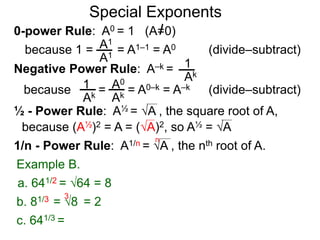
Exponents
Math 260
Dr. Frank Ma
LA Harbor College
Exponents
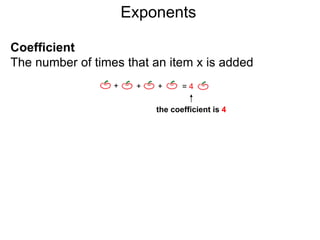
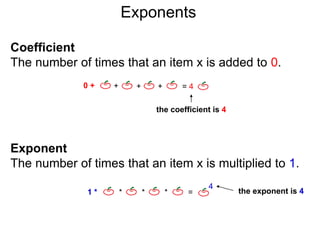
Coefficient
The number of times that an item x is added to 0.
+ = 4
+
+
the coefficient is 4
0 +
Exponents
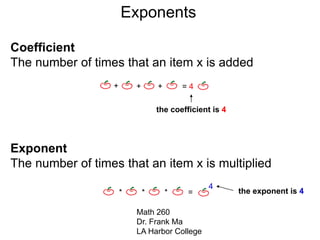
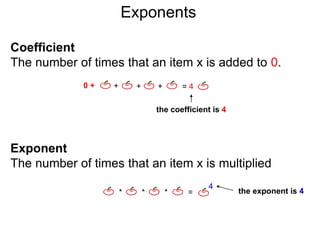
Coefficient
The number of times that an item x is added to 0.
Exponent
The number of times that an item x is multiplied to 1.
+ = 4
+
+
the coefficient is 4
0 +
1 * * * * =
4
the exponent is 4
Math 260
Dr. Frank Ma
LA Harbor College
Exponents
Coefficient
The number of times that an item x is added to 0.
Exponent
The number of times that an item x is multiplied to 1.
+ = 4
+
+
the coefficient is 4
0 +
1 * * * * =
4
the exponent is 4
Exponents
Coefficient
The number of times that an item x is added to 0.
Exponent
The number of times that an item x is multiplied to 1.
+ = 4
+
+
the coefficient is 4
0 +
1 * * * * =
4
the exponent is 4
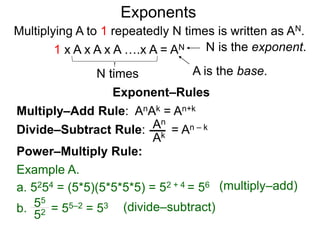
Exponents
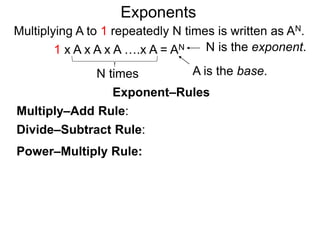
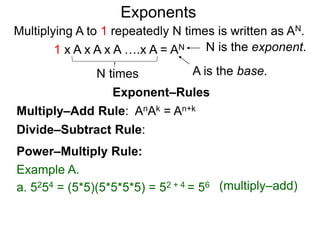
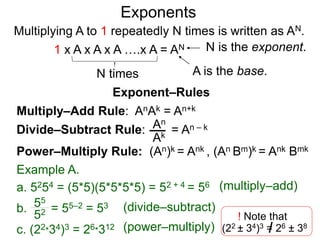
Multiplying A to 1 repeatedly N times is written as AN.
Exponents
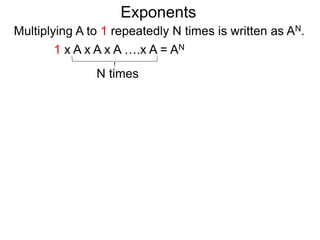
Multiplying A to 1 repeatedly N times is written as AN.
N times
1 x A x A x A ….x A = AN
Exponents
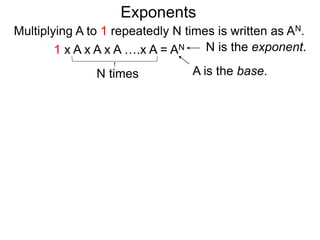
Multiplying A to 1 repeatedly N times is written as AN.
A is the base.
N is the exponent.
N times
1 x A x A x A ….x A = AN
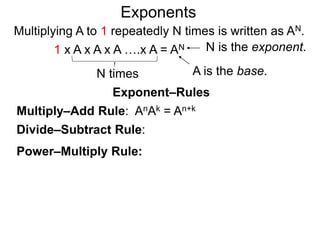
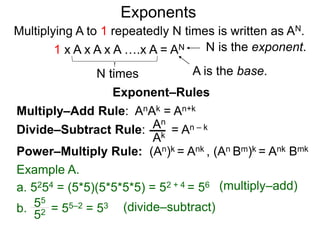
Multiply–Add Rule:
Divide–Subtract Rule:
Power–Multiply Rule:
Exponents
Exponent–Rules
Multiplying A to 1 repeatedly N times is written as AN.
A is the base.
N is the exponent.
N times
1 x A x A x A ….x A = AN
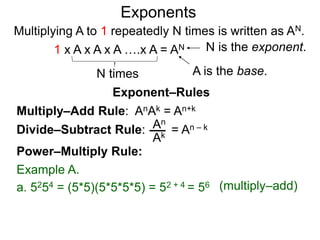
Multiply–Add Rule: AnAk = An+k
Divide–Subtract Rule:
Power–Multiply Rule:
Exponents
Exponent–Rules
Multiplying A to 1 repeatedly N times is written as AN.
A is the base.
N is the exponent.
N times
1 x A x A x A ….x A = AN
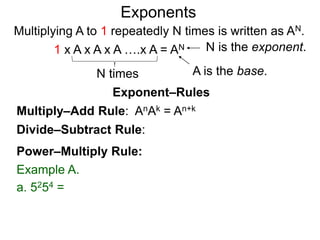
Multiply–Add Rule: AnAk = An+k
Divide–Subtract Rule:
Example A.
a. 5254 =
Power–Multiply Rule:
Exponents
Exponent–Rules
Multiplying A to 1 repeatedly N times is written as AN.
A is the base.
N is the exponent.
N times
1 x A x A x A ….x A = AN
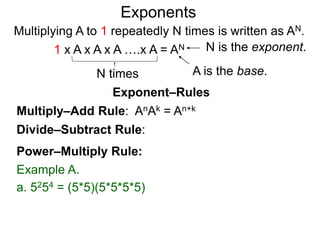
Multiply–Add Rule: AnAk = An+k
Divide–Subtract Rule:
Example A.
a. 5254 = (5*5)(5*5*5*5)
Power–Multiply Rule:
Exponents
Exponent–Rules
Multiplying A to 1 repeatedly N times is written as AN.
A is the base.
N is the exponent.
N times
1 x A x A x A ….x A = AN
Multiply–Add Rule: AnAk = An+k
Divide–Subtract Rule:
Example A.
a. 5254 = (5*5)(5*5*5*5) = 52 + 4 = 56
Power–Multiply Rule:
Exponents
(multiply–add)
Exponent–Rules
Multiplying A to 1 repeatedly N times is written as AN.
A is the base.
N is the exponent.
N times
1 x A x A x A ….x A = AN
Multiply–Add Rule: AnAk = An+k
Divide–Subtract Rule:
Example A.
a. 5254 = (5*5)(5*5*5*5) = 52 + 4 = 56
An
Ak
Power–Multiply Rule:
Exponents
= An – k
(multiply–add)
Exponent–Rules
Multiplying A to 1 repeatedly N times is written as AN.
A is the base.
N is the exponent.
N times
1 x A x A x A ….x A = AN
Multiply–Add Rule: AnAk = An+k
Divide–Subtract Rule:
Example A.
a. 5254 = (5*5)(5*5*5*5) = 52 + 4 = 56
An
Ak
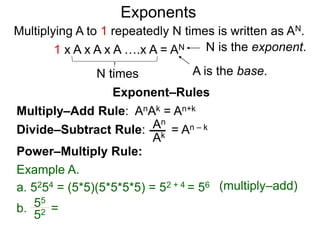
b. =
55
52
Power–Multiply Rule:
Exponents
= An – k
(multiply–add)
Exponent–Rules
Multiplying A to 1 repeatedly N times is written as AN.
A is the base.
N is the exponent.
N times
1 x A x A x A ….x A = AN
Multiply–Add Rule: AnAk = An+k
Divide–Subtract Rule:
Example A.
a. 5254 = (5*5)(5*5*5*5) = 52 + 4 = 56
An
Ak
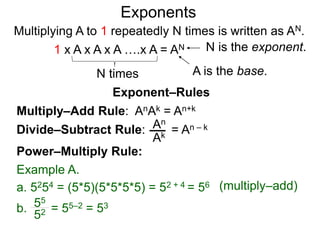
b. = 55–2 = 53
55
52
Power–Multiply Rule:
Exponents
= An – k
(multiply–add)
Exponent–Rules
Multiplying A to 1 repeatedly N times is written as AN.
A is the base.
N is the exponent.
N times
1 x A x A x A ….x A = AN
Multiply–Add Rule: AnAk = An+k
Divide–Subtract Rule:
Example A.
a. 5254 = (5*5)(5*5*5*5) = 52 + 4 = 56
An
Ak
b. = 55–2 = 53
55
52
Power–Multiply Rule:
Exponents
= An – k
(multiply–add)
(divide–subtract)
Exponent–Rules
Multiplying A to 1 repeatedly N times is written as AN.
A is the base.
N is the exponent.
N times
1 x A x A x A ….x A = AN
Multiply–Add Rule: AnAk = An+k
Divide–Subtract Rule:
Example A.
a. 5254 = (5*5)(5*5*5*5) = 52 + 4 = 56
An
Ak
b. = 55–2 = 53
55
52
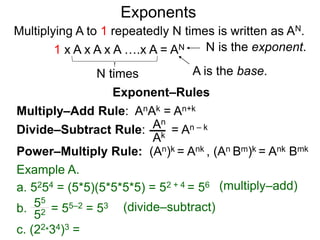
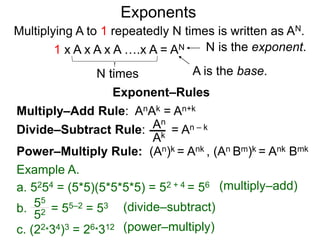
Power–Multiply Rule: (An)k = Ank , (An Bm)k = Ank Bmk
Exponents
= An – k
(multiply–add)
(divide–subtract)
Exponent–Rules
Multiplying A to 1 repeatedly N times is written as AN.
A is the base.
N is the exponent.
N times
1 x A x A x A ….x A = AN
Multiply–Add Rule: AnAk = An+k
Divide–Subtract Rule:
Example A.
a. 5254 = (5*5)(5*5*5*5) = 52 + 4 = 56
An
Ak
b. = 55–2 = 53
55
52
Power–Multiply Rule: (An)k = Ank , (An Bm)k = Ank Bmk
c. (22*34)3 =
Exponents
= An – k
(multiply–add)
(divide–subtract)
Exponent–Rules
Multiplying A to 1 repeatedly N times is written as AN.
A is the base.
N is the exponent.
N times
1 x A x A x A ….x A = AN
Multiply–Add Rule: AnAk = An+k
Divide–Subtract Rule:
Example A.
a. 5254 = (5*5)(5*5*5*5) = 52 + 4 = 56
An
Ak
b. = 55–2 = 53
55
52
Power–Multiply Rule: (An)k = Ank , (An Bm)k = Ank Bmk
c. (22*34)3 = 26*312
Exponents
= An – k
(multiply–add)
(divide–subtract)
(power–multiply)
Exponent–Rules
Multiplying A to 1 repeatedly N times is written as AN.
A is the base.
N is the exponent.
N times
1 x A x A x A ….x A = AN
Multiply–Add Rule: AnAk = An+k
Divide–Subtract Rule:
Example A.
a. 5254 = (5*5)(5*5*5*5) = 52 + 4 = 56
An
Ak
b. = 55–2 = 53
55
52
Power–Multiply Rule: (An)k = Ank , (An Bm)k = Ank Bmk
c. (22*34)3 = 26*312
Exponents
= An – k
(multiply–add)
(divide–subtract)
(power–multiply)
Exponent–Rules
! Note that
(22 ± 34)3 = 26 ± 38
Multiplying A to 1 repeatedly N times is written as AN.
A is the base.
N is the exponent.
N times
1 x A x A x A ….x A = AN
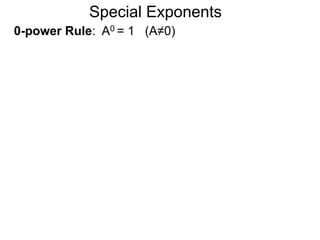
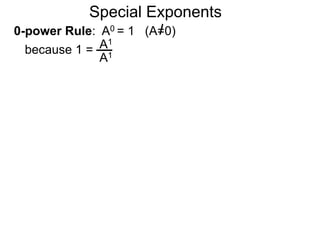
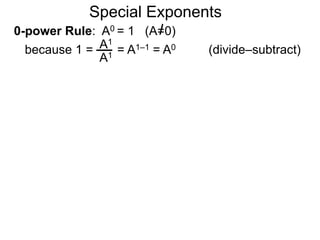
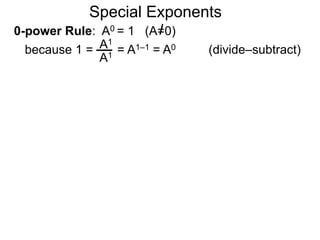
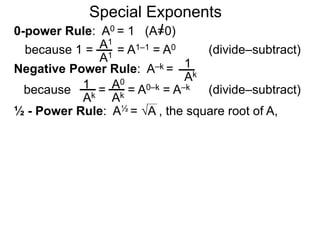
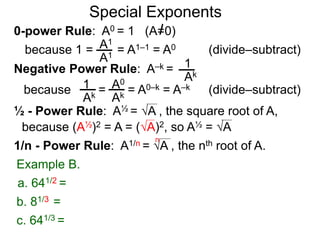
0-power Rule: A0 = 1 (A≠0)
Special Exponents
0-power Rule: A0 = 1 (A=0)
Special Exponents
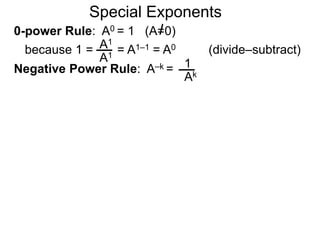
because 1 = A1
A1
0-power Rule: A0 = 1 (A=0)
Special Exponents
because 1 = = A1–1 = A0
A1
A1
(divide–subtract)
0-power Rule: A0 = 1 (A=0)
Special Exponents
because 1 = = A1–1 = A0
A1
A1
(divide–subtract)
0-power Rule: A0 = 1 (A=0)
1
Ak
Special Exponents
because 1 = = A1–1 = A0
A1
A1
Negative Power Rule: A–k =
(divide–subtract)
0-power Rule: A0 = 1 (A=0)
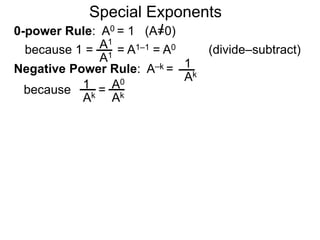
=
1
Ak
1
Ak
A0
Ak
Special Exponents
because 1 = = A1–1 = A0
A1
A1
Negative Power Rule: A–k =
because
(divide–subtract)
0-power Rule: A0 = 1 (A=0)
=
1
Ak
1
Ak
A0
Ak
Special Exponents
because 1 = = A1–1 = A0
A1
A1
Negative Power Rule: A–k =
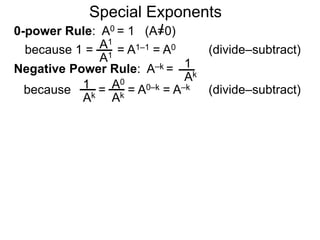
because = A0–k = A–k
(divide–subtract)
(divide–subtract)
0-power Rule: A0 = 1 (A=0)
=
1
Ak
1
Ak
A0
Ak
Special Exponents
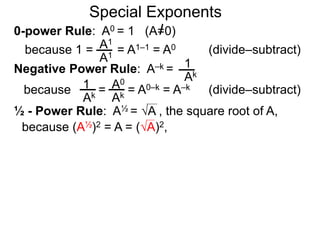
½ - Power Rule: A½ = A , the square root of A,
because 1 = = A1–1 = A0
A1
A1
Negative Power Rule: A–k =
because = A0–k = A–k
(divide–subtract)
(divide–subtract)
0-power Rule: A0 = 1 (A=0)
=
1
Ak
1
Ak
A0
Ak
Special Exponents
½ - Power Rule: A½ = A , the square root of A,
because (A½)2 = A = (A)2,
because 1 = = A1–1 = A0
A1
A1
Negative Power Rule: A–k =
because = A0–k = A–k
(divide–subtract)
(divide–subtract)
0-power Rule: A0 = 1 (A=0)
=
1
Ak
1
Ak
A0
Ak
Special Exponents
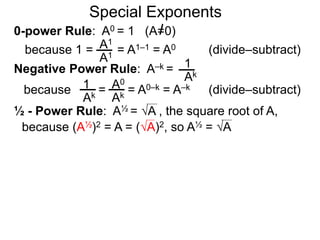
½ - Power Rule: A½ = A , the square root of A,
because (A½)2 = A = (A)2, so A½ = A
because 1 = = A1–1 = A0
A1
A1
Negative Power Rule: A–k =
because = A0–k = A–k
(divide–subtract)
(divide–subtract)
0-power Rule: A0 = 1 (A=0)
=
1
Ak
1
Ak
A0
Ak
Special Exponents
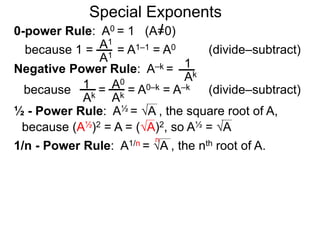
½ - Power Rule: A½ = A , the square root of A,
because (A½)2 = A = (A)2, so A½ = A
because 1 = = A1–1 = A0
A1
A1
Negative Power Rule: A–k =
because = A0–k = A–k
1/n - Power Rule: A1/n = A , the nth root of A.
n
(divide–subtract)
(divide–subtract)
0-power Rule: A0 = 1 (A=0)
=
1
Ak
1
Ak
A0
Ak
Special Exponents
½ - Power Rule: A½ = A , the square root of A,
because (A½)2 = A = (A)2, so A½ = A
Example B.
because 1 = = A1–1 = A0
A1
A1
Negative Power Rule: A–k =
because = A0–k = A–k
1/n - Power Rule: A1/n = A , the nth root of A.
n
c. 641/3 =
b. 81/3 =
a. 641/2 =
(divide–subtract)
(divide–subtract)
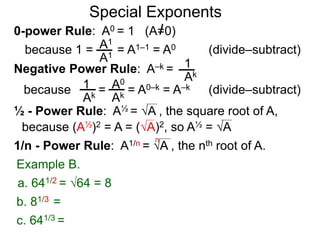
0-power Rule: A0 = 1 (A=0)
=
1
Ak
1
Ak
A0
Ak
Special Exponents
½ - Power Rule: A½ = A , the square root of A,
because (A½)2 = A = (A)2, so A½ = A
Example B.
because 1 = = A1–1 = A0
A1
A1
Negative Power Rule: A–k =
because = A0–k = A–k
1/n - Power Rule: A1/n = A , the nth root of A.
n
c. 641/3 =
b. 81/3 =
a. 641/2 = 64 = 8
(divide–subtract)
(divide–subtract)
0-power Rule: A0 = 1 (A=0)
=
1
Ak
1
Ak
A0
Ak
Special Exponents
½ - Power Rule: A½ = A , the square root of A,
because (A½)2 = A = (A)2, so A½ = A
Example B.
because 1 = = A1–1 = A0
A1
A1
Negative Power Rule: A–k =
because = A0–k = A–k
1/n - Power Rule: A1/n = A , the nth root of A.
n
c. 641/3 =
b. 81/3 = 8 = 2
3
a. 641/2 = 64 = 8
(divide–subtract)
(divide–subtract)
0-power Rule: A0 = 1 (A=0)
=
1
Ak
1
Ak
A0
Ak
Special Exponents
½ - Power Rule: A½ = A , the square root of A,
because (A½)2 = A = (A)2, so A½ = A
Example B.
because 1 = = A1–1 = A0
A1
A1
Negative Power Rule: A–k =
because = A0–k = A–k
1/n - Power Rule: A1/n = A , the nth root of A.
n
c. 641/3 = 64 = 4
3
b. 81/3 = 8 = 2
3
a. 641/2 = 64 = 8
(divide–subtract)
(divide–subtract)
Special Exponents
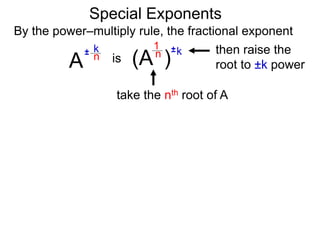
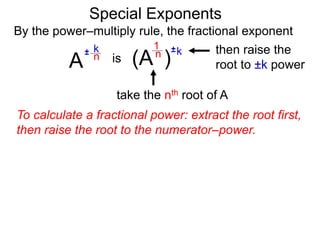
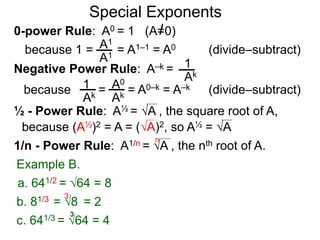
By the power–multiply rule, the fractional exponent
A
k
n
±
Special Exponents
By the power–multiply rule, the fractional exponent
A
k
n
±
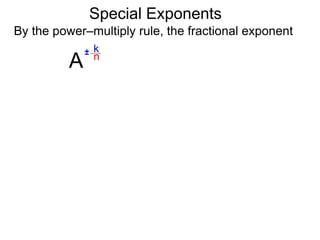
(A )
n
1
is
take the nth root of A
Special Exponents
By the power–multiply rule, the fractional exponent
A
k
n
±
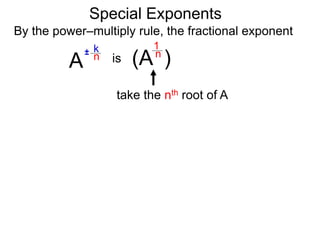
(A ) k
n ±
1
is
take the nth root of A
then raise the
root to ±k power
Special Exponents
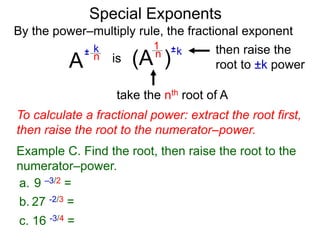
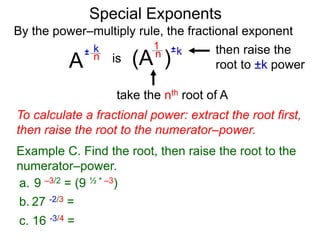
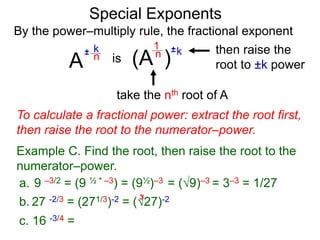
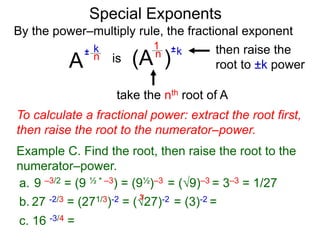
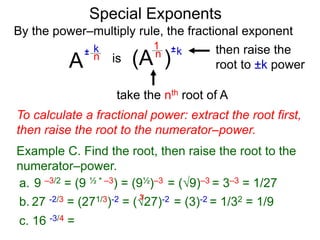
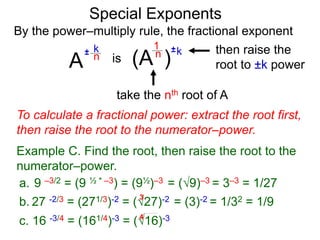
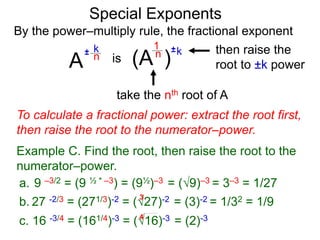
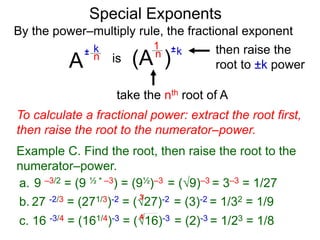
To calculate a fractional power: extract the root first,
then raise the root to the numerator–power.
By the power–multiply rule, the fractional exponent
A
k
n
±
(A ) k
n ±
1
is
take the nth root of A
then raise the
root to ±k power
Special Exponents
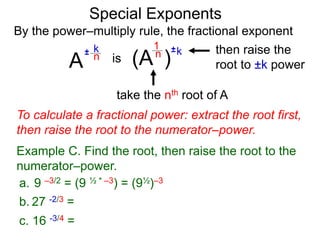
a. 9 –3/2 =
To calculate a fractional power: extract the root first,
then raise the root to the numerator–power.
Example C. Find the root, then raise the root to the
numerator–power.
By the power–multiply rule, the fractional exponent
A
k
n
±
(A ) k
n ±
1
is
take the nth root of A
then raise the
root to ±k power
c. 16 -3/4 =
b. 27 -2/3 =
Special Exponents
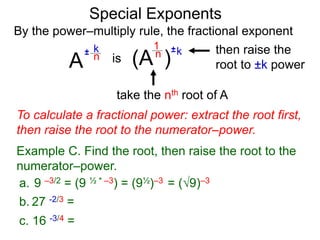
a. 9 –3/2 = (9 ½ * –3)
To calculate a fractional power: extract the root first,
then raise the root to the numerator–power.
Example C. Find the root, then raise the root to the
numerator–power.
By the power–multiply rule, the fractional exponent
A
k
n
±
(A ) k
n ±
1
is
take the nth root of A
then raise the
root to ±k power
c. 16 -3/4 =
b. 27 -2/3 =
Special Exponents
a. 9 –3/2 = (9 ½ * –3) = (9½)–3
To calculate a fractional power: extract the root first,
then raise the root to the numerator–power.
Example C. Find the root, then raise the root to the
numerator–power.
By the power–multiply rule, the fractional exponent
A
k
n
±
(A ) k
n ±
1
is
take the nth root of A
then raise the
root to ±k power
c. 16 -3/4 =
b. 27 -2/3 =
Special Exponents
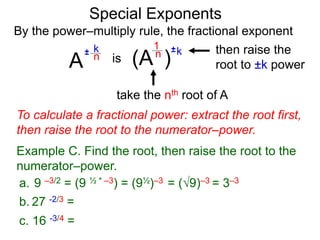
a. 9 –3/2 = (9 ½ * –3) = (9½)–3 = (9)–3
To calculate a fractional power: extract the root first,
then raise the root to the numerator–power.
Example C. Find the root, then raise the root to the
numerator–power.
By the power–multiply rule, the fractional exponent
A
k
n
±
(A ) k
n ±
1
is
take the nth root of A
then raise the
root to ±k power
c. 16 -3/4 =
b. 27 -2/3 =
Special Exponents
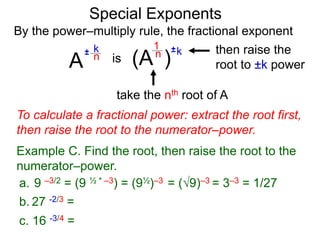
a. 9 –3/2 = (9 ½ * –3) = (9½)–3 = (9)–3 = 3–3
To calculate a fractional power: extract the root first,
then raise the root to the numerator–power.
Example C. Find the root, then raise the root to the
numerator–power.
By the power–multiply rule, the fractional exponent
A
k
n
±
(A ) k
n ±
1
is
take the nth root of A
then raise the
root to ±k power
c. 16 -3/4 =
b. 27 -2/3 =
Special Exponents
a. 9 –3/2 = (9 ½ * –3) = (9½)–3 = (9)–3 = 3–3 = 1/27
To calculate a fractional power: extract the root first,
then raise the root to the numerator–power.
Example C. Find the root, then raise the root to the
numerator–power.
By the power–multiply rule, the fractional exponent
A
k
n
±
(A ) k
n ±
1
is
take the nth root of A
then raise the
root to ±k power
c. 16 -3/4 =
b. 27 -2/3 =
Special Exponents
a. 9 –3/2 = (9 ½ * –3) = (9½)–3 = (9)–3 = 3–3 = 1/27
To calculate a fractional power: extract the root first,
then raise the root to the numerator–power.
Example C. Find the root, then raise the root to the
numerator–power.
By the power–multiply rule, the fractional exponent
A
k
n
±
(A ) k
n ±
1
is
take the nth root of A
then raise the
root to ±k power
c. 16 -3/4 =
b. 27 -2/3 = (271/3)-2 = (27)-2
3
Special Exponents
a. 9 –3/2 = (9 ½ * –3) = (9½)–3 = (9)–3 = 3–3 = 1/27
To calculate a fractional power: extract the root first,
then raise the root to the numerator–power.
Example C. Find the root, then raise the root to the
numerator–power.
By the power–multiply rule, the fractional exponent
A
k
n
±
(A ) k
n ±
1
is
take the nth root of A
then raise the
root to ±k power
c. 16 -3/4 =
b. 27 -2/3 = (271/3)-2 = (27)-2 = (3)-2 =
3
Special Exponents
a. 9 –3/2 = (9 ½ * –3) = (9½)–3 = (9)–3 = 3–3 = 1/27
To calculate a fractional power: extract the root first,
then raise the root to the numerator–power.
Example C. Find the root, then raise the root to the
numerator–power.
By the power–multiply rule, the fractional exponent
A
k
n
±
(A ) k
n ±
1
is
take the nth root of A
then raise the
root to ±k power
c. 16 -3/4 =
b. 27 -2/3 = (271/3)-2 = (27)-2 = (3)-2 = 1/32 = 1/9
3
Special Exponents
a. 9 –3/2 = (9 ½ * –3) = (9½)–3 = (9)–3 = 3–3 = 1/27
To calculate a fractional power: extract the root first,
then raise the root to the numerator–power.
Example C. Find the root, then raise the root to the
numerator–power.
By the power–multiply rule, the fractional exponent
A
k
n
±
(A ) k
n ±
1
is
take the nth root of A
then raise the
root to ±k power
c. 16 -3/4 = (161/4)-3 = (16)-3
4
b. 27 -2/3 = (271/3)-2 = (27)-2 = (3)-2 = 1/32 = 1/9
3
Special Exponents
a. 9 –3/2 = (9 ½ * –3) = (9½)–3 = (9)–3 = 3–3 = 1/27
To calculate a fractional power: extract the root first,
then raise the root to the numerator–power.
Example C. Find the root, then raise the root to the
numerator–power.
By the power–multiply rule, the fractional exponent
A
k
n
±
(A ) k
n ±
1
is
take the nth root of A
then raise the
root to ±k power
c. 16 -3/4 = (161/4)-3 = (16)-3 = (2)-3
4
b. 27 -2/3 = (271/3)-2 = (27)-2 = (3)-2 = 1/32 = 1/9
3
Special Exponents
a. 9 –3/2 = (9 ½ * –3) = (9½)–3 = (9)–3 = 3–3 = 1/27
To calculate a fractional power: extract the root first,
then raise the root to the numerator–power.
Example C. Find the root, then raise the root to the
numerator–power.
By the power–multiply rule, the fractional exponent
A
k
n
±
(A ) k
n ±
1
is
take the nth root of A
then raise the
root to ±k power
c. 16 -3/4 = (161/4)-3 = (16)-3 = (2)-3 = 1/23 = 1/8
4
b. 27 -2/3 = (271/3)-2 = (27)-2 = (3)-2 = 1/32 = 1/9
3
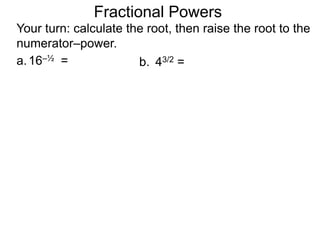
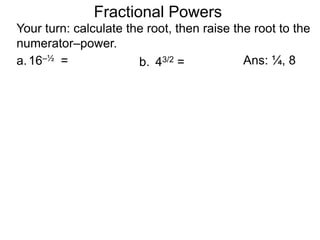
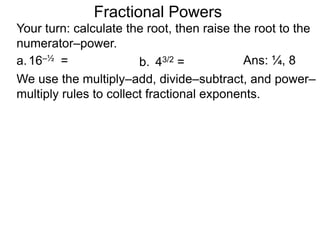
a.16–½ =
Fractional Powers
b. 43/2 =
Your turn: calculate the root, then raise the root to the
numerator–power.
a.16–½ =
Fractional Powers
b. 43/2 =
Your turn: calculate the root, then raise the root to the
numerator–power.
Ans: ¼, 8
a.16–½ =
Fractional Powers
b. 43/2 =
Your turn: calculate the root, then raise the root to the
numerator–power.
Ans: ¼, 8
We use the multiply–add, divide–subtract, and power–
multiply rules to collect fractional exponents.
a.16–½ =
Fractional Powers
b. 43/2 =
Your turn: calculate the root, then raise the root to the
numerator–power.
Ans: ¼, 8
We use the multiply–add, divide–subtract, and power–
multiply rules to collect fractional exponents.
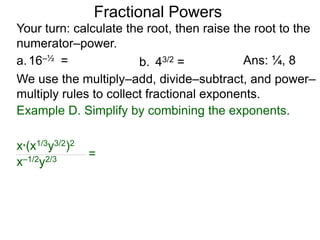
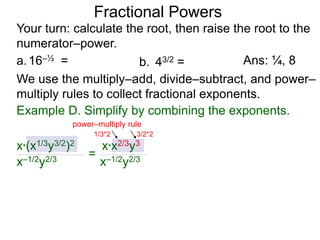
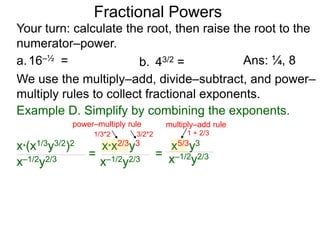
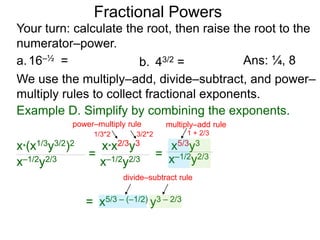
x*(x1/3y3/2)2
x–1/2y2/3
=
Example D. Simplify by combining the exponents.
a.16–½ =
Fractional Powers
b. 43/2 =
Your turn: calculate the root, then raise the root to the
numerator–power.
Ans: ¼, 8
We use the multiply–add, divide–subtract, and power–
multiply rules to collect fractional exponents.
x*(x1/3y3/2)2
x–1/2y2/3
=
x*x2/3y3
x–1/2y2/3
power–multiply rule
1/3*2 3/2*2
Example D. Simplify by combining the exponents.
a.16–½ =
Fractional Powers
b. 43/2 =
Your turn: calculate the root, then raise the root to the
numerator–power.
Ans: ¼, 8
We use the multiply–add, divide–subtract, and power–
multiply rules to collect fractional exponents.
x*(x1/3y3/2)2
x–1/2y2/3
=
x*x2/3y3
x–1/2y2/3
= x–1/2y2/3
x5/3y3
Example D. Simplify by combining the exponents.
power–multiply rule
1/3*2 3/2*2
multiply–add rule
1 + 2/3
a.16–½ =
Fractional Powers
b. 43/2 =
Your turn: calculate the root, then raise the root to the
numerator–power.
Ans: ¼, 8
We use the multiply–add, divide–subtract, and power–
multiply rules to collect fractional exponents.
x*(x1/3y3/2)2
x–1/2y2/3
=
x*x2/3y3
x–1/2y2/3
= x–1/2y2/3
=
x5/3y3
x5/3 – (–1/2) y3 – 2/3
Example D. Simplify by combining the exponents.
power–multiply rule
1/3*2 3/2*2
multiply–add rule
1 + 2/3
divide–subtract rule
a.16–½ =
Fractional Powers
b. 43/2 =
Your turn: calculate the root, then raise the root to the
numerator–power.
Ans: ¼, 8
We use the multiply–add, divide–subtract, and power–
multiply rules to collect fractional exponents.
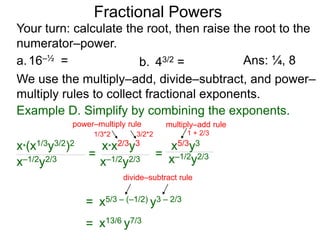
x*(x1/3y3/2)2
x–1/2y2/3
=
x*x2/3y3
x–1/2y2/3
= x–1/2y2/3
=
x5/3y3
x5/3 – (–1/2) y3 – 2/3
= x13/6 y7/3
Example D. Simplify by combining the exponents.
power–multiply rule
1/3*2 3/2*2
multiply–add rule
1 + 2/3
divide–subtract rule
Fractional Powers
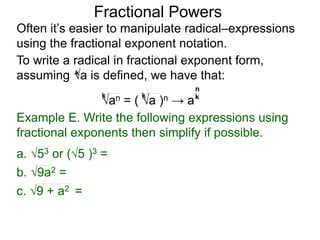
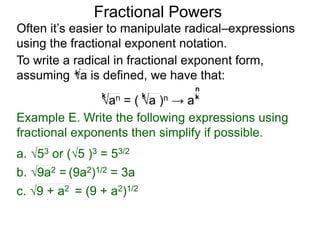
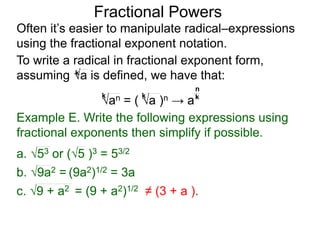
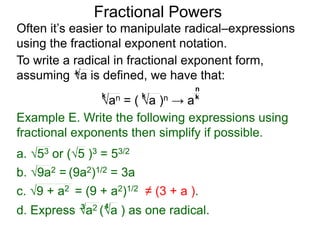
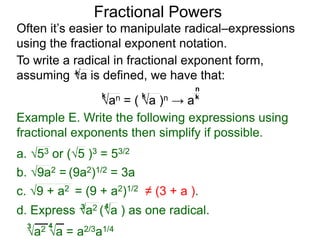
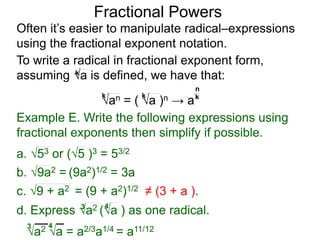
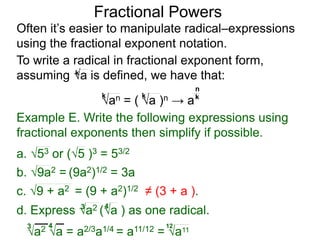
Often it’s easier to manipulate radical–expressions
using the fractional exponent notation.
Fractional Powers
Often it’s easier to manipulate radical–expressions
using the fractional exponent notation.
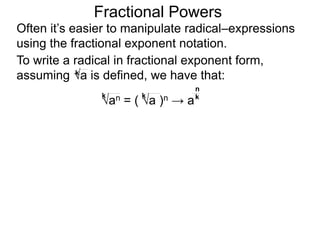
To write a radical in fractional exponent form,
assuming a is defined, we have that:
k
an = ( a )n → a
k k k
n
Fractional Powers
Often it’s easier to manipulate radical–expressions
using the fractional exponent notation.
To write a radical in fractional exponent form,
assuming a is defined, we have that:
k
an = ( a )n → a
k k k
n
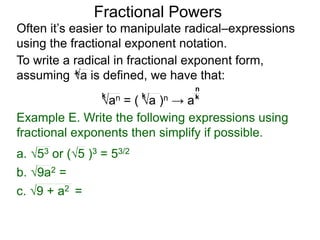
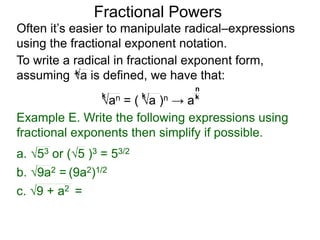
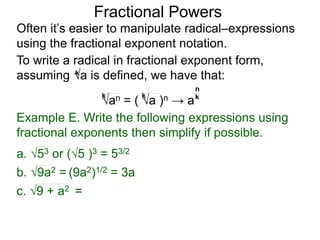
Example E. Write the following expressions using
fractional exponents then simplify if possible.
c. 9 + a2 =
a. 53 or (5 )3 =
b. 9a2 =
Fractional Powers
Often it’s easier to manipulate radical–expressions
using the fractional exponent notation.
To write a radical in fractional exponent form,
assuming a is defined, we have that:
k
an = ( a )n → a
k k k
n
Example E. Write the following expressions using
fractional exponents then simplify if possible.
c. 9 + a2 =
a. 53 or (5 )3 = 53/2
b. 9a2 =
Fractional Powers
Often it’s easier to manipulate radical–expressions
using the fractional exponent notation.
To write a radical in fractional exponent form,
assuming a is defined, we have that:
k
an = ( a )n → a
k k k
n
Example E. Write the following expressions using
fractional exponents then simplify if possible.
c. 9 + a2 =
a. 53 or (5 )3 = 53/2
b. 9a2 = (9a2)1/2
Fractional Powers
Often it’s easier to manipulate radical–expressions
using the fractional exponent notation.
To write a radical in fractional exponent form,
assuming a is defined, we have that:
k
an = ( a )n → a
k k k
n
Example E. Write the following expressions using
fractional exponents then simplify if possible.
c. 9 + a2 =
a. 53 or (5 )3 = 53/2
b. 9a2 = (9a2)1/2 = 3a
Fractional Powers
Often it’s easier to manipulate radical–expressions
using the fractional exponent notation.
To write a radical in fractional exponent form,
assuming a is defined, we have that:
k
an = ( a )n → a
k k k
n
Example E. Write the following expressions using
fractional exponents then simplify if possible.
c. 9 + a2 = (9 + a2)1/2
a. 53 or (5 )3 = 53/2
b. 9a2 = (9a2)1/2 = 3a
Fractional Powers
Often it’s easier to manipulate radical–expressions
using the fractional exponent notation.
To write a radical in fractional exponent form,
assuming a is defined, we have that:
k
an = ( a )n → a
k k k
n
Example E. Write the following expressions using
fractional exponents then simplify if possible.
c. 9 + a2 = (9 + a2)1/2 ≠ (3 + a ).
a. 53 or (5 )3 = 53/2
b. 9a2 = (9a2)1/2 = 3a
Fractional Powers
Often it’s easier to manipulate radical–expressions
using the fractional exponent notation.
d. Express a2 (a ) as one radical.
3 4
To write a radical in fractional exponent form,
assuming a is defined, we have that:
k
an = ( a )n → a
k k k
n
Example E. Write the following expressions using
fractional exponents then simplify if possible.
c. 9 + a2 = (9 + a2)1/2 ≠ (3 + a ).
a. 53 or (5 )3 = 53/2
b. 9a2 = (9a2)1/2 = 3a
Fractional Powers
Often it’s easier to manipulate radical–expressions
using the fractional exponent notation.
a2 a = a2/3a1/4
3 4
To write a radical in fractional exponent form,
assuming a is defined, we have that:
k
an = ( a )n → a
k k k
n
Example E. Write the following expressions using
fractional exponents then simplify if possible.
c. 9 + a2 = (9 + a2)1/2 ≠ (3 + a ).
a. 53 or (5 )3 = 53/2
b. 9a2 = (9a2)1/2 = 3a
d. Express a2 (a ) as one radical.
3 4
Fractional Powers
Often it’s easier to manipulate radical–expressions
using the fractional exponent notation.
a2 a = a2/3a1/4 = a11/12
3 4
To write a radical in fractional exponent form,
assuming a is defined, we have that:
k
an = ( a )n → a
k k k
n
Example E. Write the following expressions using
fractional exponents then simplify if possible.
c. 9 + a2 = (9 + a2)1/2 ≠ (3 + a ).
a. 53 or (5 )3 = 53/2
b. 9a2 = (9a2)1/2 = 3a
d. Express a2 (a ) as one radical.
3 4
Fractional Powers
Often it’s easier to manipulate radical–expressions
using the fractional exponent notation.
a2 a = a2/3a1/4 = a11/12 = a11
3 4 12
To write a radical in fractional exponent form,
assuming a is defined, we have that:
k
an = ( a )n → a
k k k
n
Example E. Write the following expressions using
fractional exponents then simplify if possible.
c. 9 + a2 = (9 + a2)1/2 ≠ (3 + a ).
a. 53 or (5 )3 = 53/2
b. 9a2 = (9a2)1/2 = 3a
d. Express a2 (a ) as one radical.
3 4
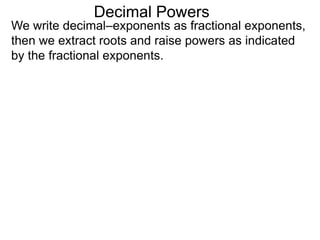
Decimal Powers
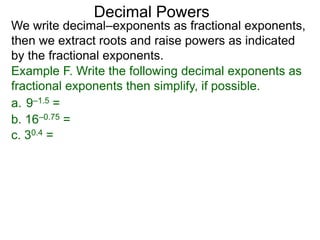
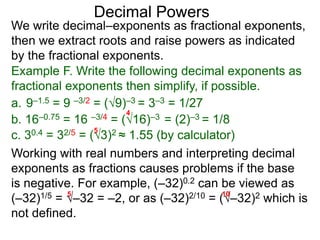
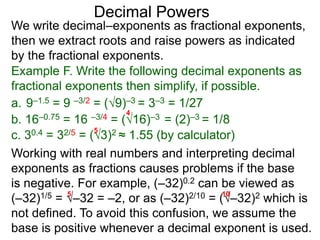
We write decimal–exponents as fractional exponents,
then we extract roots and raise powers as indicated
by the fractional exponents.
Decimal Powers
We write decimal–exponents as fractional exponents,
then we extract roots and raise powers as indicated
by the fractional exponents.
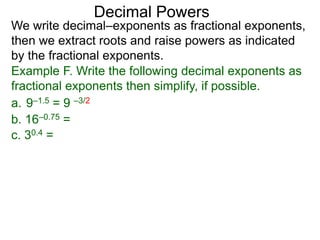
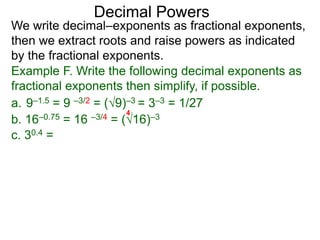
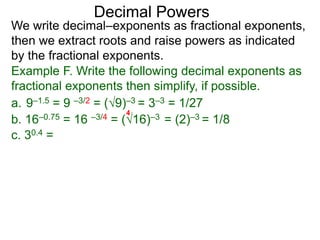
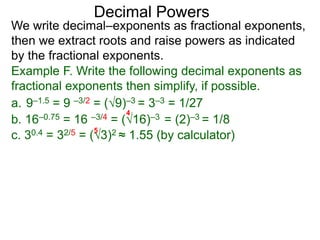
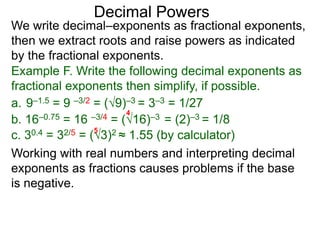
Example F. Write the following decimal exponents as
fractional exponents then simplify, if possible.
a. 9–1.5 =
b. 16–0.75 =
c. 30.4 =
Decimal Powers
We write decimal–exponents as fractional exponents,
then we extract roots and raise powers as indicated
by the fractional exponents.
Example F. Write the following decimal exponents as
fractional exponents then simplify, if possible.
a. 9–1.5 = 9 –3/2
b. 16–0.75 =
c. 30.4 =
Decimal Powers
We write decimal–exponents as fractional exponents,
then we extract roots and raise powers as indicated
by the fractional exponents.
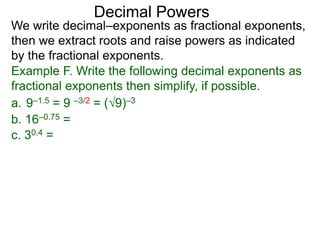
Example F. Write the following decimal exponents as
fractional exponents then simplify, if possible.
a. 9–1.5 = 9 –3/2 = (9)–3
b. 16–0.75 =
c. 30.4 =
Decimal Powers
We write decimal–exponents as fractional exponents,
then we extract roots and raise powers as indicated
by the fractional exponents.
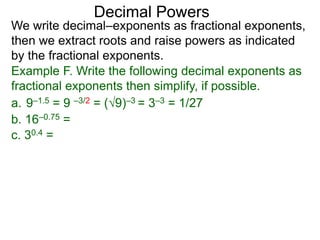
Example F. Write the following decimal exponents as
fractional exponents then simplify, if possible.
a. 9–1.5 = 9 –3/2 = (9)–3 = 3–3 = 1/27
b. 16–0.75 =
c. 30.4 =
Decimal Powers
We write decimal–exponents as fractional exponents,
then we extract roots and raise powers as indicated
by the fractional exponents.
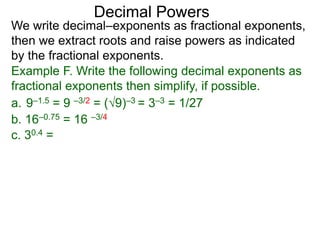
Example F. Write the following decimal exponents as
fractional exponents then simplify, if possible.
a. 9–1.5 = 9 –3/2 = (9)–3 = 3–3 = 1/27
b. 16–0.75 = 16 –3/4
c. 30.4 =
Decimal Powers
We write decimal–exponents as fractional exponents,
then we extract roots and raise powers as indicated
by the fractional exponents.
Example F. Write the following decimal exponents as
fractional exponents then simplify, if possible.
a. 9–1.5 = 9 –3/2 = (9)–3 = 3–3 = 1/27
b. 16–0.75 = 16 –3/4 = (16)–3
4
c. 30.4 =
Decimal Powers
We write decimal–exponents as fractional exponents,
then we extract roots and raise powers as indicated
by the fractional exponents.
Example F. Write the following decimal exponents as
fractional exponents then simplify, if possible.
a. 9–1.5 = 9 –3/2 = (9)–3 = 3–3 = 1/27
b. 16–0.75 = 16 –3/4 = (16)–3 = (2)–3 = 1/8
4
c. 30.4 =
Decimal Powers
We write decimal–exponents as fractional exponents,
then we extract roots and raise powers as indicated
by the fractional exponents.
Example F. Write the following decimal exponents as
fractional exponents then simplify, if possible.
a. 9–1.5 = 9 –3/2 = (9)–3 = 3–3 = 1/27
b. 16–0.75 = 16 –3/4 = (16)–3 = (2)–3 = 1/8
4
c. 30.4 = 32/5 = (3)2 ≈ 1.55 (by calculator)
5
Decimal Powers
We write decimal–exponents as fractional exponents,
then we extract roots and raise powers as indicated
by the fractional exponents.
Example F. Write the following decimal exponents as
fractional exponents then simplify, if possible.
a. 9–1.5 = 9 –3/2 = (9)–3 = 3–3 = 1/27
b. 16–0.75 = 16 –3/4 = (16)–3 = (2)–3 = 1/8
4
c. 30.4 = 32/5 = (3)2 ≈ 1.55 (by calculator)
5
Working with real numbers and interpreting decimal
exponents as fractions causes problems if the base
is negative.
Decimal Powers
We write decimal–exponents as fractional exponents,
then we extract roots and raise powers as indicated
by the fractional exponents.
Example F. Write the following decimal exponents as
fractional exponents then simplify, if possible.
a. 9–1.5 = 9 –3/2 = (9)–3 = 3–3 = 1/27
b. 16–0.75 = 16 –3/4 = (16)–3 = (2)–3 = 1/8
4
c. 30.4 = 32/5 = (3)2 ≈ 1.55 (by calculator)
5
Working with real numbers and interpreting decimal
exponents as fractions causes problems if the base
is negative. For example, (–32)0.2 can be viewed as
(–32)1/5 = –32 = –2, or as (–32)2/10 = (–32)2 which is
not defined.
5 10
Decimal Powers
We write decimal–exponents as fractional exponents,
then we extract roots and raise powers as indicated
by the fractional exponents.
Example F. Write the following decimal exponents as
fractional exponents then simplify, if possible.
a. 9–1.5 = 9 –3/2 = (9)–3 = 3–3 = 1/27
b. 16–0.75 = 16 –3/4 = (16)–3 = (2)–3 = 1/8
4
c. 30.4 = 32/5 = (3)2 ≈ 1.55 (by calculator)
5
Working with real numbers and interpreting decimal
exponents as fractions causes problems if the base
is negative. For example, (–32)0.2 can be viewed as
(–32)1/5 = –32 = –2, or as (–32)2/10 = (–32)2 which is
not defined. To avoid this confusion, we assume the
base is positive whenever a decimal exponent is used.
5 10
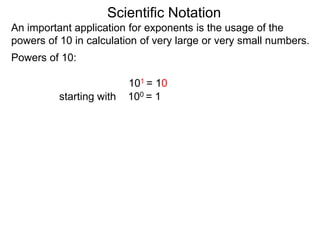
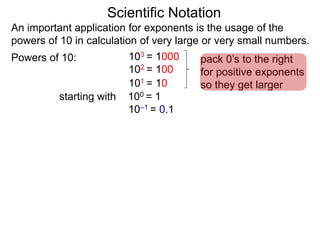
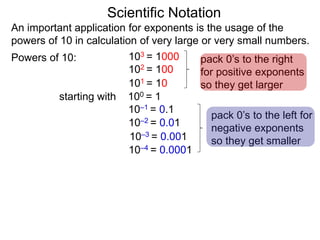
Scientific Notation
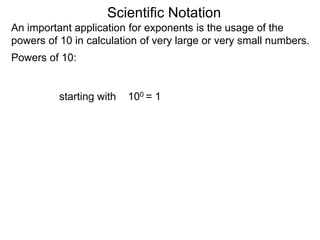
An important application for exponents is the usage of the
powers of 10 in calculation of very large or very small numbers.
100 = 1
Scientific Notation
An important application for exponents is the usage of the
powers of 10 in calculation of very large or very small numbers.
Powers of 10:
starting with
100 = 1
101 = 10
Scientific Notation
An important application for exponents is the usage of the
powers of 10 in calculation of very large or very small numbers.
Powers of 10:
starting with
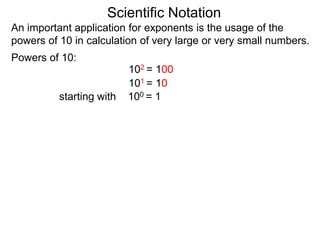
100 = 1
101 = 10
102 = 100
Scientific Notation
An important application for exponents is the usage of the
powers of 10 in calculation of very large or very small numbers.
Powers of 10:
starting with
100 = 1
101 = 10
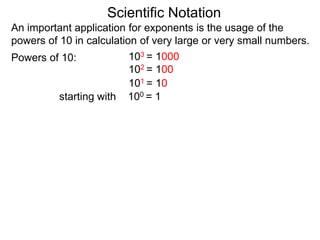
102 = 100
103 = 1000
Scientific Notation
An important application for exponents is the usage of the
powers of 10 in calculation of very large or very small numbers.
Powers of 10:
starting with
100 = 1
101 = 10
102 = 100
103 = 1000
Scientific Notation
An important application for exponents is the usage of the
powers of 10 in calculation of very large or very small numbers.
Powers of 10:
starting with
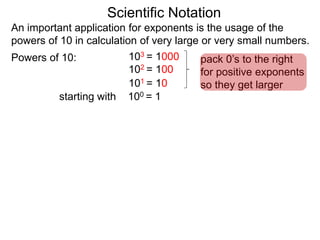
pack 0’s to the right
for positive exponents
so they get larger
100 = 1
101 = 10
102 = 100
103 = 1000
10–1 = 0.1
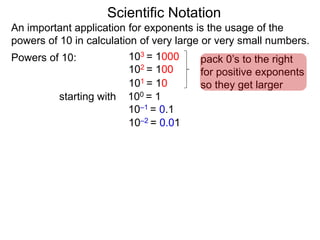
Scientific Notation
An important application for exponents is the usage of the
powers of 10 in calculation of very large or very small numbers.
Powers of 10:
starting with
pack 0’s to the right
for positive exponents
so they get larger
100 = 1
101 = 10
102 = 100
103 = 1000
10–1 = 0.1
10–2 = 0.01
Scientific Notation
An important application for exponents is the usage of the
powers of 10 in calculation of very large or very small numbers.
Powers of 10:
starting with
pack 0’s to the right
for positive exponents
so they get larger
100 = 1
101 = 10
102 = 100
103 = 1000
10–1 = 0.1
10–2 = 0.01
10–3 = 0.001
10–4 = 0.0001
Scientific Notation
An important application for exponents is the usage of the
powers of 10 in calculation of very large or very small numbers.
Powers of 10:
starting with
pack 0’s to the right
for positive exponents
so they get larger
pack 0’s to the left for
negative exponents
so they get smaller
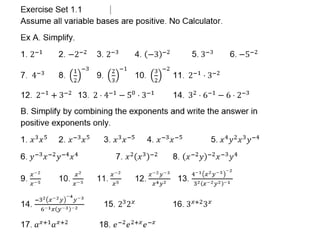
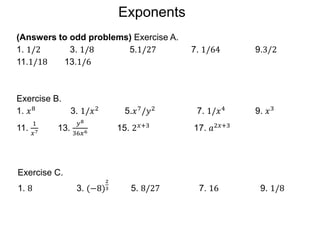
(Answers to odd problems) Exercise A.
1. 1/2 3. 1/8 5.1/27 7. 1/64 9.3/2
11.1/18 13.1/6
Exercise B.
1. 𝑥8
3. 1/𝑥2
5.𝑥7
/𝑦2
7. 1/𝑥4
9. 𝑥3
11.
1
𝑥7 13.
𝑦8
36𝑥6 15. 2𝑥+3 17. 𝑎2𝑥+3
Exercise C.
1. 8 3. (−8)
2
3 5. 8/27 7. 16 9. 1/8
Exponents
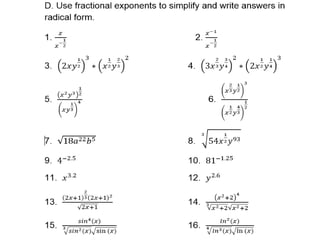
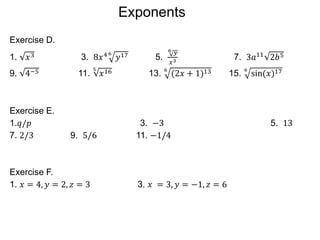
Exercise D.
1. 𝑥3 3. 8𝑥4 6
𝑦17 5.
6 𝑦
𝑥3 7. 3𝑎11
2𝑏5
9. 4−5 11.
5
𝑥16 13.
6
(2𝑥 + 1)13 15.
6
sin(𝑥)17
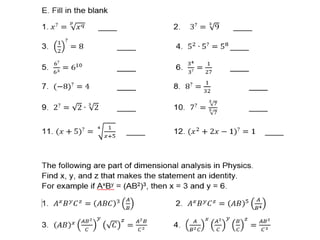
Exercise E.
1.𝑞/𝑝 3. −3 5. 13
7. 2/3 9. 5/6 11. −1/4
Exercise F.
1. 𝑥 = 4, 𝑦 = 2, 𝑧 = 3 3. 𝑥 = 3, 𝑦 = −1, 𝑧 = 6
Exponents

1 exponents yz

  • 1.
    Exponents Math 260 Dr. FrankMa LA Harbor College
  • 2.
    Exponents Coefficient The number oftimes that an item x is added to 0. + = 4 + + the coefficient is 4 0 +
  • 3.
    Exponents Coefficient The number oftimes that an item x is added to 0. Exponent The number of times that an item x is multiplied to 1. + = 4 + + the coefficient is 4 0 + 1 * * * * = 4 the exponent is 4 Math 260 Dr. Frank Ma LA Harbor College
  • 4.
    Exponents Coefficient The number oftimes that an item x is added to 0. Exponent The number of times that an item x is multiplied to 1. + = 4 + + the coefficient is 4 0 + 1 * * * * = 4 the exponent is 4
  • 5.
    Exponents Coefficient The number oftimes that an item x is added to 0. Exponent The number of times that an item x is multiplied to 1. + = 4 + + the coefficient is 4 0 + 1 * * * * = 4 the exponent is 4
  • 6.
    Exponents Multiplying A to1 repeatedly N times is written as AN.
  • 7.
    Exponents Multiplying A to1 repeatedly N times is written as AN. N times 1 x A x A x A ….x A = AN
  • 8.
    Exponents Multiplying A to1 repeatedly N times is written as AN. A is the base. N is the exponent. N times 1 x A x A x A ….x A = AN
  • 9.
    Multiply–Add Rule: Divide–Subtract Rule: Power–MultiplyRule: Exponents Exponent–Rules Multiplying A to 1 repeatedly N times is written as AN. A is the base. N is the exponent. N times 1 x A x A x A ….x A = AN
  • 10.
    Multiply–Add Rule: AnAk= An+k Divide–Subtract Rule: Power–Multiply Rule: Exponents Exponent–Rules Multiplying A to 1 repeatedly N times is written as AN. A is the base. N is the exponent. N times 1 x A x A x A ….x A = AN
  • 11.
    Multiply–Add Rule: AnAk= An+k Divide–Subtract Rule: Example A. a. 5254 = Power–Multiply Rule: Exponents Exponent–Rules Multiplying A to 1 repeatedly N times is written as AN. A is the base. N is the exponent. N times 1 x A x A x A ….x A = AN
  • 12.
    Multiply–Add Rule: AnAk= An+k Divide–Subtract Rule: Example A. a. 5254 = (5*5)(5*5*5*5) Power–Multiply Rule: Exponents Exponent–Rules Multiplying A to 1 repeatedly N times is written as AN. A is the base. N is the exponent. N times 1 x A x A x A ….x A = AN
  • 13.
    Multiply–Add Rule: AnAk= An+k Divide–Subtract Rule: Example A. a. 5254 = (5*5)(5*5*5*5) = 52 + 4 = 56 Power–Multiply Rule: Exponents (multiply–add) Exponent–Rules Multiplying A to 1 repeatedly N times is written as AN. A is the base. N is the exponent. N times 1 x A x A x A ….x A = AN
  • 14.
    Multiply–Add Rule: AnAk= An+k Divide–Subtract Rule: Example A. a. 5254 = (5*5)(5*5*5*5) = 52 + 4 = 56 An Ak Power–Multiply Rule: Exponents = An – k (multiply–add) Exponent–Rules Multiplying A to 1 repeatedly N times is written as AN. A is the base. N is the exponent. N times 1 x A x A x A ….x A = AN
  • 15.
    Multiply–Add Rule: AnAk= An+k Divide–Subtract Rule: Example A. a. 5254 = (5*5)(5*5*5*5) = 52 + 4 = 56 An Ak b. = 55 52 Power–Multiply Rule: Exponents = An – k (multiply–add) Exponent–Rules Multiplying A to 1 repeatedly N times is written as AN. A is the base. N is the exponent. N times 1 x A x A x A ….x A = AN
  • 16.
    Multiply–Add Rule: AnAk= An+k Divide–Subtract Rule: Example A. a. 5254 = (5*5)(5*5*5*5) = 52 + 4 = 56 An Ak b. = 55–2 = 53 55 52 Power–Multiply Rule: Exponents = An – k (multiply–add) Exponent–Rules Multiplying A to 1 repeatedly N times is written as AN. A is the base. N is the exponent. N times 1 x A x A x A ….x A = AN
  • 17.
    Multiply–Add Rule: AnAk= An+k Divide–Subtract Rule: Example A. a. 5254 = (5*5)(5*5*5*5) = 52 + 4 = 56 An Ak b. = 55–2 = 53 55 52 Power–Multiply Rule: Exponents = An – k (multiply–add) (divide–subtract) Exponent–Rules Multiplying A to 1 repeatedly N times is written as AN. A is the base. N is the exponent. N times 1 x A x A x A ….x A = AN
  • 18.
    Multiply–Add Rule: AnAk= An+k Divide–Subtract Rule: Example A. a. 5254 = (5*5)(5*5*5*5) = 52 + 4 = 56 An Ak b. = 55–2 = 53 55 52 Power–Multiply Rule: (An)k = Ank , (An Bm)k = Ank Bmk Exponents = An – k (multiply–add) (divide–subtract) Exponent–Rules Multiplying A to 1 repeatedly N times is written as AN. A is the base. N is the exponent. N times 1 x A x A x A ….x A = AN
  • 19.
    Multiply–Add Rule: AnAk= An+k Divide–Subtract Rule: Example A. a. 5254 = (5*5)(5*5*5*5) = 52 + 4 = 56 An Ak b. = 55–2 = 53 55 52 Power–Multiply Rule: (An)k = Ank , (An Bm)k = Ank Bmk c. (22*34)3 = Exponents = An – k (multiply–add) (divide–subtract) Exponent–Rules Multiplying A to 1 repeatedly N times is written as AN. A is the base. N is the exponent. N times 1 x A x A x A ….x A = AN
  • 20.
    Multiply–Add Rule: AnAk= An+k Divide–Subtract Rule: Example A. a. 5254 = (5*5)(5*5*5*5) = 52 + 4 = 56 An Ak b. = 55–2 = 53 55 52 Power–Multiply Rule: (An)k = Ank , (An Bm)k = Ank Bmk c. (22*34)3 = 26*312 Exponents = An – k (multiply–add) (divide–subtract) (power–multiply) Exponent–Rules Multiplying A to 1 repeatedly N times is written as AN. A is the base. N is the exponent. N times 1 x A x A x A ….x A = AN
  • 21.
    Multiply–Add Rule: AnAk= An+k Divide–Subtract Rule: Example A. a. 5254 = (5*5)(5*5*5*5) = 52 + 4 = 56 An Ak b. = 55–2 = 53 55 52 Power–Multiply Rule: (An)k = Ank , (An Bm)k = Ank Bmk c. (22*34)3 = 26*312 Exponents = An – k (multiply–add) (divide–subtract) (power–multiply) Exponent–Rules ! Note that (22 ± 34)3 = 26 ± 38 Multiplying A to 1 repeatedly N times is written as AN. A is the base. N is the exponent. N times 1 x A x A x A ….x A = AN
  • 22.
    0-power Rule: A0= 1 (A≠0) Special Exponents
  • 23.
    0-power Rule: A0= 1 (A=0) Special Exponents because 1 = A1 A1
  • 24.
    0-power Rule: A0= 1 (A=0) Special Exponents because 1 = = A1–1 = A0 A1 A1 (divide–subtract)
  • 25.
    0-power Rule: A0= 1 (A=0) Special Exponents because 1 = = A1–1 = A0 A1 A1 (divide–subtract)
  • 26.
    0-power Rule: A0= 1 (A=0) 1 Ak Special Exponents because 1 = = A1–1 = A0 A1 A1 Negative Power Rule: A–k = (divide–subtract)
  • 27.
    0-power Rule: A0= 1 (A=0) = 1 Ak 1 Ak A0 Ak Special Exponents because 1 = = A1–1 = A0 A1 A1 Negative Power Rule: A–k = because (divide–subtract)
  • 28.
    0-power Rule: A0= 1 (A=0) = 1 Ak 1 Ak A0 Ak Special Exponents because 1 = = A1–1 = A0 A1 A1 Negative Power Rule: A–k = because = A0–k = A–k (divide–subtract) (divide–subtract)
  • 29.
    0-power Rule: A0= 1 (A=0) = 1 Ak 1 Ak A0 Ak Special Exponents ½ - Power Rule: A½ = A , the square root of A, because 1 = = A1–1 = A0 A1 A1 Negative Power Rule: A–k = because = A0–k = A–k (divide–subtract) (divide–subtract)
  • 30.
    0-power Rule: A0= 1 (A=0) = 1 Ak 1 Ak A0 Ak Special Exponents ½ - Power Rule: A½ = A , the square root of A, because (A½)2 = A = (A)2, because 1 = = A1–1 = A0 A1 A1 Negative Power Rule: A–k = because = A0–k = A–k (divide–subtract) (divide–subtract)
  • 31.
    0-power Rule: A0= 1 (A=0) = 1 Ak 1 Ak A0 Ak Special Exponents ½ - Power Rule: A½ = A , the square root of A, because (A½)2 = A = (A)2, so A½ = A because 1 = = A1–1 = A0 A1 A1 Negative Power Rule: A–k = because = A0–k = A–k (divide–subtract) (divide–subtract)
  • 32.
    0-power Rule: A0= 1 (A=0) = 1 Ak 1 Ak A0 Ak Special Exponents ½ - Power Rule: A½ = A , the square root of A, because (A½)2 = A = (A)2, so A½ = A because 1 = = A1–1 = A0 A1 A1 Negative Power Rule: A–k = because = A0–k = A–k 1/n - Power Rule: A1/n = A , the nth root of A. n (divide–subtract) (divide–subtract)
  • 33.
    0-power Rule: A0= 1 (A=0) = 1 Ak 1 Ak A0 Ak Special Exponents ½ - Power Rule: A½ = A , the square root of A, because (A½)2 = A = (A)2, so A½ = A Example B. because 1 = = A1–1 = A0 A1 A1 Negative Power Rule: A–k = because = A0–k = A–k 1/n - Power Rule: A1/n = A , the nth root of A. n c. 641/3 = b. 81/3 = a. 641/2 = (divide–subtract) (divide–subtract)
  • 34.
    0-power Rule: A0= 1 (A=0) = 1 Ak 1 Ak A0 Ak Special Exponents ½ - Power Rule: A½ = A , the square root of A, because (A½)2 = A = (A)2, so A½ = A Example B. because 1 = = A1–1 = A0 A1 A1 Negative Power Rule: A–k = because = A0–k = A–k 1/n - Power Rule: A1/n = A , the nth root of A. n c. 641/3 = b. 81/3 = a. 641/2 = 64 = 8 (divide–subtract) (divide–subtract)
  • 35.
    0-power Rule: A0= 1 (A=0) = 1 Ak 1 Ak A0 Ak Special Exponents ½ - Power Rule: A½ = A , the square root of A, because (A½)2 = A = (A)2, so A½ = A Example B. because 1 = = A1–1 = A0 A1 A1 Negative Power Rule: A–k = because = A0–k = A–k 1/n - Power Rule: A1/n = A , the nth root of A. n c. 641/3 = b. 81/3 = 8 = 2 3 a. 641/2 = 64 = 8 (divide–subtract) (divide–subtract)
  • 36.
    0-power Rule: A0= 1 (A=0) = 1 Ak 1 Ak A0 Ak Special Exponents ½ - Power Rule: A½ = A , the square root of A, because (A½)2 = A = (A)2, so A½ = A Example B. because 1 = = A1–1 = A0 A1 A1 Negative Power Rule: A–k = because = A0–k = A–k 1/n - Power Rule: A1/n = A , the nth root of A. n c. 641/3 = 64 = 4 3 b. 81/3 = 8 = 2 3 a. 641/2 = 64 = 8 (divide–subtract) (divide–subtract)
  • 37.
    Special Exponents By thepower–multiply rule, the fractional exponent A k n ±
  • 38.
    Special Exponents By thepower–multiply rule, the fractional exponent A k n ± (A ) n 1 is take the nth root of A
  • 39.
    Special Exponents By thepower–multiply rule, the fractional exponent A k n ± (A ) k n ± 1 is take the nth root of A then raise the root to ±k power
  • 40.
    Special Exponents To calculatea fractional power: extract the root first, then raise the root to the numerator–power. By the power–multiply rule, the fractional exponent A k n ± (A ) k n ± 1 is take the nth root of A then raise the root to ±k power
  • 41.
    Special Exponents a. 9–3/2 = To calculate a fractional power: extract the root first, then raise the root to the numerator–power. Example C. Find the root, then raise the root to the numerator–power. By the power–multiply rule, the fractional exponent A k n ± (A ) k n ± 1 is take the nth root of A then raise the root to ±k power c. 16 -3/4 = b. 27 -2/3 =
  • 42.
    Special Exponents a. 9–3/2 = (9 ½ * –3) To calculate a fractional power: extract the root first, then raise the root to the numerator–power. Example C. Find the root, then raise the root to the numerator–power. By the power–multiply rule, the fractional exponent A k n ± (A ) k n ± 1 is take the nth root of A then raise the root to ±k power c. 16 -3/4 = b. 27 -2/3 =
  • 43.
    Special Exponents a. 9–3/2 = (9 ½ * –3) = (9½)–3 To calculate a fractional power: extract the root first, then raise the root to the numerator–power. Example C. Find the root, then raise the root to the numerator–power. By the power–multiply rule, the fractional exponent A k n ± (A ) k n ± 1 is take the nth root of A then raise the root to ±k power c. 16 -3/4 = b. 27 -2/3 =
  • 44.
    Special Exponents a. 9–3/2 = (9 ½ * –3) = (9½)–3 = (9)–3 To calculate a fractional power: extract the root first, then raise the root to the numerator–power. Example C. Find the root, then raise the root to the numerator–power. By the power–multiply rule, the fractional exponent A k n ± (A ) k n ± 1 is take the nth root of A then raise the root to ±k power c. 16 -3/4 = b. 27 -2/3 =
  • 45.
    Special Exponents a. 9–3/2 = (9 ½ * –3) = (9½)–3 = (9)–3 = 3–3 To calculate a fractional power: extract the root first, then raise the root to the numerator–power. Example C. Find the root, then raise the root to the numerator–power. By the power–multiply rule, the fractional exponent A k n ± (A ) k n ± 1 is take the nth root of A then raise the root to ±k power c. 16 -3/4 = b. 27 -2/3 =
  • 46.
    Special Exponents a. 9–3/2 = (9 ½ * –3) = (9½)–3 = (9)–3 = 3–3 = 1/27 To calculate a fractional power: extract the root first, then raise the root to the numerator–power. Example C. Find the root, then raise the root to the numerator–power. By the power–multiply rule, the fractional exponent A k n ± (A ) k n ± 1 is take the nth root of A then raise the root to ±k power c. 16 -3/4 = b. 27 -2/3 =
  • 47.
    Special Exponents a. 9–3/2 = (9 ½ * –3) = (9½)–3 = (9)–3 = 3–3 = 1/27 To calculate a fractional power: extract the root first, then raise the root to the numerator–power. Example C. Find the root, then raise the root to the numerator–power. By the power–multiply rule, the fractional exponent A k n ± (A ) k n ± 1 is take the nth root of A then raise the root to ±k power c. 16 -3/4 = b. 27 -2/3 = (271/3)-2 = (27)-2 3
  • 48.
    Special Exponents a. 9–3/2 = (9 ½ * –3) = (9½)–3 = (9)–3 = 3–3 = 1/27 To calculate a fractional power: extract the root first, then raise the root to the numerator–power. Example C. Find the root, then raise the root to the numerator–power. By the power–multiply rule, the fractional exponent A k n ± (A ) k n ± 1 is take the nth root of A then raise the root to ±k power c. 16 -3/4 = b. 27 -2/3 = (271/3)-2 = (27)-2 = (3)-2 = 3
  • 49.
    Special Exponents a. 9–3/2 = (9 ½ * –3) = (9½)–3 = (9)–3 = 3–3 = 1/27 To calculate a fractional power: extract the root first, then raise the root to the numerator–power. Example C. Find the root, then raise the root to the numerator–power. By the power–multiply rule, the fractional exponent A k n ± (A ) k n ± 1 is take the nth root of A then raise the root to ±k power c. 16 -3/4 = b. 27 -2/3 = (271/3)-2 = (27)-2 = (3)-2 = 1/32 = 1/9 3
  • 50.
    Special Exponents a. 9–3/2 = (9 ½ * –3) = (9½)–3 = (9)–3 = 3–3 = 1/27 To calculate a fractional power: extract the root first, then raise the root to the numerator–power. Example C. Find the root, then raise the root to the numerator–power. By the power–multiply rule, the fractional exponent A k n ± (A ) k n ± 1 is take the nth root of A then raise the root to ±k power c. 16 -3/4 = (161/4)-3 = (16)-3 4 b. 27 -2/3 = (271/3)-2 = (27)-2 = (3)-2 = 1/32 = 1/9 3
  • 51.
    Special Exponents a. 9–3/2 = (9 ½ * –3) = (9½)–3 = (9)–3 = 3–3 = 1/27 To calculate a fractional power: extract the root first, then raise the root to the numerator–power. Example C. Find the root, then raise the root to the numerator–power. By the power–multiply rule, the fractional exponent A k n ± (A ) k n ± 1 is take the nth root of A then raise the root to ±k power c. 16 -3/4 = (161/4)-3 = (16)-3 = (2)-3 4 b. 27 -2/3 = (271/3)-2 = (27)-2 = (3)-2 = 1/32 = 1/9 3
  • 52.
    Special Exponents a. 9–3/2 = (9 ½ * –3) = (9½)–3 = (9)–3 = 3–3 = 1/27 To calculate a fractional power: extract the root first, then raise the root to the numerator–power. Example C. Find the root, then raise the root to the numerator–power. By the power–multiply rule, the fractional exponent A k n ± (A ) k n ± 1 is take the nth root of A then raise the root to ±k power c. 16 -3/4 = (161/4)-3 = (16)-3 = (2)-3 = 1/23 = 1/8 4 b. 27 -2/3 = (271/3)-2 = (27)-2 = (3)-2 = 1/32 = 1/9 3
  • 53.
    a.16–½ = Fractional Powers b.43/2 = Your turn: calculate the root, then raise the root to the numerator–power.
  • 54.
    a.16–½ = Fractional Powers b.43/2 = Your turn: calculate the root, then raise the root to the numerator–power. Ans: ¼, 8
  • 55.
    a.16–½ = Fractional Powers b.43/2 = Your turn: calculate the root, then raise the root to the numerator–power. Ans: ¼, 8 We use the multiply–add, divide–subtract, and power– multiply rules to collect fractional exponents.
  • 56.
    a.16–½ = Fractional Powers b.43/2 = Your turn: calculate the root, then raise the root to the numerator–power. Ans: ¼, 8 We use the multiply–add, divide–subtract, and power– multiply rules to collect fractional exponents. x*(x1/3y3/2)2 x–1/2y2/3 = Example D. Simplify by combining the exponents.
  • 57.
    a.16–½ = Fractional Powers b.43/2 = Your turn: calculate the root, then raise the root to the numerator–power. Ans: ¼, 8 We use the multiply–add, divide–subtract, and power– multiply rules to collect fractional exponents. x*(x1/3y3/2)2 x–1/2y2/3 = x*x2/3y3 x–1/2y2/3 power–multiply rule 1/3*2 3/2*2 Example D. Simplify by combining the exponents.
  • 58.
    a.16–½ = Fractional Powers b.43/2 = Your turn: calculate the root, then raise the root to the numerator–power. Ans: ¼, 8 We use the multiply–add, divide–subtract, and power– multiply rules to collect fractional exponents. x*(x1/3y3/2)2 x–1/2y2/3 = x*x2/3y3 x–1/2y2/3 = x–1/2y2/3 x5/3y3 Example D. Simplify by combining the exponents. power–multiply rule 1/3*2 3/2*2 multiply–add rule 1 + 2/3
  • 59.
    a.16–½ = Fractional Powers b.43/2 = Your turn: calculate the root, then raise the root to the numerator–power. Ans: ¼, 8 We use the multiply–add, divide–subtract, and power– multiply rules to collect fractional exponents. x*(x1/3y3/2)2 x–1/2y2/3 = x*x2/3y3 x–1/2y2/3 = x–1/2y2/3 = x5/3y3 x5/3 – (–1/2) y3 – 2/3 Example D. Simplify by combining the exponents. power–multiply rule 1/3*2 3/2*2 multiply–add rule 1 + 2/3 divide–subtract rule
  • 60.
    a.16–½ = Fractional Powers b.43/2 = Your turn: calculate the root, then raise the root to the numerator–power. Ans: ¼, 8 We use the multiply–add, divide–subtract, and power– multiply rules to collect fractional exponents. x*(x1/3y3/2)2 x–1/2y2/3 = x*x2/3y3 x–1/2y2/3 = x–1/2y2/3 = x5/3y3 x5/3 – (–1/2) y3 – 2/3 = x13/6 y7/3 Example D. Simplify by combining the exponents. power–multiply rule 1/3*2 3/2*2 multiply–add rule 1 + 2/3 divide–subtract rule
  • 61.
    Fractional Powers Often it’seasier to manipulate radical–expressions using the fractional exponent notation.
  • 62.
    Fractional Powers Often it’seasier to manipulate radical–expressions using the fractional exponent notation. To write a radical in fractional exponent form, assuming a is defined, we have that: k an = ( a )n → a k k k n
  • 63.
    Fractional Powers Often it’seasier to manipulate radical–expressions using the fractional exponent notation. To write a radical in fractional exponent form, assuming a is defined, we have that: k an = ( a )n → a k k k n Example E. Write the following expressions using fractional exponents then simplify if possible. c. 9 + a2 = a. 53 or (5 )3 = b. 9a2 =
  • 64.
    Fractional Powers Often it’seasier to manipulate radical–expressions using the fractional exponent notation. To write a radical in fractional exponent form, assuming a is defined, we have that: k an = ( a )n → a k k k n Example E. Write the following expressions using fractional exponents then simplify if possible. c. 9 + a2 = a. 53 or (5 )3 = 53/2 b. 9a2 =
  • 65.
    Fractional Powers Often it’seasier to manipulate radical–expressions using the fractional exponent notation. To write a radical in fractional exponent form, assuming a is defined, we have that: k an = ( a )n → a k k k n Example E. Write the following expressions using fractional exponents then simplify if possible. c. 9 + a2 = a. 53 or (5 )3 = 53/2 b. 9a2 = (9a2)1/2
  • 66.
    Fractional Powers Often it’seasier to manipulate radical–expressions using the fractional exponent notation. To write a radical in fractional exponent form, assuming a is defined, we have that: k an = ( a )n → a k k k n Example E. Write the following expressions using fractional exponents then simplify if possible. c. 9 + a2 = a. 53 or (5 )3 = 53/2 b. 9a2 = (9a2)1/2 = 3a
  • 67.
    Fractional Powers Often it’seasier to manipulate radical–expressions using the fractional exponent notation. To write a radical in fractional exponent form, assuming a is defined, we have that: k an = ( a )n → a k k k n Example E. Write the following expressions using fractional exponents then simplify if possible. c. 9 + a2 = (9 + a2)1/2 a. 53 or (5 )3 = 53/2 b. 9a2 = (9a2)1/2 = 3a
  • 68.
    Fractional Powers Often it’seasier to manipulate radical–expressions using the fractional exponent notation. To write a radical in fractional exponent form, assuming a is defined, we have that: k an = ( a )n → a k k k n Example E. Write the following expressions using fractional exponents then simplify if possible. c. 9 + a2 = (9 + a2)1/2 ≠ (3 + a ). a. 53 or (5 )3 = 53/2 b. 9a2 = (9a2)1/2 = 3a
  • 69.
    Fractional Powers Often it’seasier to manipulate radical–expressions using the fractional exponent notation. d. Express a2 (a ) as one radical. 3 4 To write a radical in fractional exponent form, assuming a is defined, we have that: k an = ( a )n → a k k k n Example E. Write the following expressions using fractional exponents then simplify if possible. c. 9 + a2 = (9 + a2)1/2 ≠ (3 + a ). a. 53 or (5 )3 = 53/2 b. 9a2 = (9a2)1/2 = 3a
  • 70.
    Fractional Powers Often it’seasier to manipulate radical–expressions using the fractional exponent notation. a2 a = a2/3a1/4 3 4 To write a radical in fractional exponent form, assuming a is defined, we have that: k an = ( a )n → a k k k n Example E. Write the following expressions using fractional exponents then simplify if possible. c. 9 + a2 = (9 + a2)1/2 ≠ (3 + a ). a. 53 or (5 )3 = 53/2 b. 9a2 = (9a2)1/2 = 3a d. Express a2 (a ) as one radical. 3 4
  • 71.
    Fractional Powers Often it’seasier to manipulate radical–expressions using the fractional exponent notation. a2 a = a2/3a1/4 = a11/12 3 4 To write a radical in fractional exponent form, assuming a is defined, we have that: k an = ( a )n → a k k k n Example E. Write the following expressions using fractional exponents then simplify if possible. c. 9 + a2 = (9 + a2)1/2 ≠ (3 + a ). a. 53 or (5 )3 = 53/2 b. 9a2 = (9a2)1/2 = 3a d. Express a2 (a ) as one radical. 3 4
  • 72.
    Fractional Powers Often it’seasier to manipulate radical–expressions using the fractional exponent notation. a2 a = a2/3a1/4 = a11/12 = a11 3 4 12 To write a radical in fractional exponent form, assuming a is defined, we have that: k an = ( a )n → a k k k n Example E. Write the following expressions using fractional exponents then simplify if possible. c. 9 + a2 = (9 + a2)1/2 ≠ (3 + a ). a. 53 or (5 )3 = 53/2 b. 9a2 = (9a2)1/2 = 3a d. Express a2 (a ) as one radical. 3 4
  • 73.
    Decimal Powers We writedecimal–exponents as fractional exponents, then we extract roots and raise powers as indicated by the fractional exponents.
  • 74.
    Decimal Powers We writedecimal–exponents as fractional exponents, then we extract roots and raise powers as indicated by the fractional exponents. Example F. Write the following decimal exponents as fractional exponents then simplify, if possible. a. 9–1.5 = b. 16–0.75 = c. 30.4 =
  • 75.
    Decimal Powers We writedecimal–exponents as fractional exponents, then we extract roots and raise powers as indicated by the fractional exponents. Example F. Write the following decimal exponents as fractional exponents then simplify, if possible. a. 9–1.5 = 9 –3/2 b. 16–0.75 = c. 30.4 =
  • 76.
    Decimal Powers We writedecimal–exponents as fractional exponents, then we extract roots and raise powers as indicated by the fractional exponents. Example F. Write the following decimal exponents as fractional exponents then simplify, if possible. a. 9–1.5 = 9 –3/2 = (9)–3 b. 16–0.75 = c. 30.4 =
  • 77.
    Decimal Powers We writedecimal–exponents as fractional exponents, then we extract roots and raise powers as indicated by the fractional exponents. Example F. Write the following decimal exponents as fractional exponents then simplify, if possible. a. 9–1.5 = 9 –3/2 = (9)–3 = 3–3 = 1/27 b. 16–0.75 = c. 30.4 =
  • 78.
    Decimal Powers We writedecimal–exponents as fractional exponents, then we extract roots and raise powers as indicated by the fractional exponents. Example F. Write the following decimal exponents as fractional exponents then simplify, if possible. a. 9–1.5 = 9 –3/2 = (9)–3 = 3–3 = 1/27 b. 16–0.75 = 16 –3/4 c. 30.4 =
  • 79.
    Decimal Powers We writedecimal–exponents as fractional exponents, then we extract roots and raise powers as indicated by the fractional exponents. Example F. Write the following decimal exponents as fractional exponents then simplify, if possible. a. 9–1.5 = 9 –3/2 = (9)–3 = 3–3 = 1/27 b. 16–0.75 = 16 –3/4 = (16)–3 4 c. 30.4 =
  • 80.
    Decimal Powers We writedecimal–exponents as fractional exponents, then we extract roots and raise powers as indicated by the fractional exponents. Example F. Write the following decimal exponents as fractional exponents then simplify, if possible. a. 9–1.5 = 9 –3/2 = (9)–3 = 3–3 = 1/27 b. 16–0.75 = 16 –3/4 = (16)–3 = (2)–3 = 1/8 4 c. 30.4 =
  • 81.
    Decimal Powers We writedecimal–exponents as fractional exponents, then we extract roots and raise powers as indicated by the fractional exponents. Example F. Write the following decimal exponents as fractional exponents then simplify, if possible. a. 9–1.5 = 9 –3/2 = (9)–3 = 3–3 = 1/27 b. 16–0.75 = 16 –3/4 = (16)–3 = (2)–3 = 1/8 4 c. 30.4 = 32/5 = (3)2 ≈ 1.55 (by calculator) 5
  • 82.
    Decimal Powers We writedecimal–exponents as fractional exponents, then we extract roots and raise powers as indicated by the fractional exponents. Example F. Write the following decimal exponents as fractional exponents then simplify, if possible. a. 9–1.5 = 9 –3/2 = (9)–3 = 3–3 = 1/27 b. 16–0.75 = 16 –3/4 = (16)–3 = (2)–3 = 1/8 4 c. 30.4 = 32/5 = (3)2 ≈ 1.55 (by calculator) 5 Working with real numbers and interpreting decimal exponents as fractions causes problems if the base is negative.
  • 83.
    Decimal Powers We writedecimal–exponents as fractional exponents, then we extract roots and raise powers as indicated by the fractional exponents. Example F. Write the following decimal exponents as fractional exponents then simplify, if possible. a. 9–1.5 = 9 –3/2 = (9)–3 = 3–3 = 1/27 b. 16–0.75 = 16 –3/4 = (16)–3 = (2)–3 = 1/8 4 c. 30.4 = 32/5 = (3)2 ≈ 1.55 (by calculator) 5 Working with real numbers and interpreting decimal exponents as fractions causes problems if the base is negative. For example, (–32)0.2 can be viewed as (–32)1/5 = –32 = –2, or as (–32)2/10 = (–32)2 which is not defined. 5 10
  • 84.
    Decimal Powers We writedecimal–exponents as fractional exponents, then we extract roots and raise powers as indicated by the fractional exponents. Example F. Write the following decimal exponents as fractional exponents then simplify, if possible. a. 9–1.5 = 9 –3/2 = (9)–3 = 3–3 = 1/27 b. 16–0.75 = 16 –3/4 = (16)–3 = (2)–3 = 1/8 4 c. 30.4 = 32/5 = (3)2 ≈ 1.55 (by calculator) 5 Working with real numbers and interpreting decimal exponents as fractions causes problems if the base is negative. For example, (–32)0.2 can be viewed as (–32)1/5 = –32 = –2, or as (–32)2/10 = (–32)2 which is not defined. To avoid this confusion, we assume the base is positive whenever a decimal exponent is used. 5 10
  • 85.
    Scientific Notation An importantapplication for exponents is the usage of the powers of 10 in calculation of very large or very small numbers.
  • 86.
    100 = 1 ScientificNotation An important application for exponents is the usage of the powers of 10 in calculation of very large or very small numbers. Powers of 10: starting with
  • 87.
    100 = 1 101= 10 Scientific Notation An important application for exponents is the usage of the powers of 10 in calculation of very large or very small numbers. Powers of 10: starting with
  • 88.
    100 = 1 101= 10 102 = 100 Scientific Notation An important application for exponents is the usage of the powers of 10 in calculation of very large or very small numbers. Powers of 10: starting with
  • 89.
    100 = 1 101= 10 102 = 100 103 = 1000 Scientific Notation An important application for exponents is the usage of the powers of 10 in calculation of very large or very small numbers. Powers of 10: starting with
  • 90.
    100 = 1 101= 10 102 = 100 103 = 1000 Scientific Notation An important application for exponents is the usage of the powers of 10 in calculation of very large or very small numbers. Powers of 10: starting with pack 0’s to the right for positive exponents so they get larger
  • 91.
    100 = 1 101= 10 102 = 100 103 = 1000 10–1 = 0.1 Scientific Notation An important application for exponents is the usage of the powers of 10 in calculation of very large or very small numbers. Powers of 10: starting with pack 0’s to the right for positive exponents so they get larger
  • 92.
    100 = 1 101= 10 102 = 100 103 = 1000 10–1 = 0.1 10–2 = 0.01 Scientific Notation An important application for exponents is the usage of the powers of 10 in calculation of very large or very small numbers. Powers of 10: starting with pack 0’s to the right for positive exponents so they get larger
  • 93.
    100 = 1 101= 10 102 = 100 103 = 1000 10–1 = 0.1 10–2 = 0.01 10–3 = 0.001 10–4 = 0.0001 Scientific Notation An important application for exponents is the usage of the powers of 10 in calculation of very large or very small numbers. Powers of 10: starting with pack 0’s to the right for positive exponents so they get larger pack 0’s to the left for negative exponents so they get smaller
  • 97.
    (Answers to oddproblems) Exercise A. 1. 1/2 3. 1/8 5.1/27 7. 1/64 9.3/2 11.1/18 13.1/6 Exercise B. 1. 𝑥8 3. 1/𝑥2 5.𝑥7 /𝑦2 7. 1/𝑥4 9. 𝑥3 11. 1 𝑥7 13. 𝑦8 36𝑥6 15. 2𝑥+3 17. 𝑎2𝑥+3 Exercise C. 1. 8 3. (−8) 2 3 5. 8/27 7. 16 9. 1/8 Exponents
  • 98.
    Exercise D. 1. 𝑥33. 8𝑥4 6 𝑦17 5. 6 𝑦 𝑥3 7. 3𝑎11 2𝑏5 9. 4−5 11. 5 𝑥16 13. 6 (2𝑥 + 1)13 15. 6 sin(𝑥)17 Exercise E. 1.𝑞/𝑝 3. −3 5. 13 7. 2/3 9. 5/6 11. −1/4 Exercise F. 1. 𝑥 = 4, 𝑦 = 2, 𝑧 = 3 3. 𝑥 = 3, 𝑦 = −1, 𝑧 = 6 Exponents