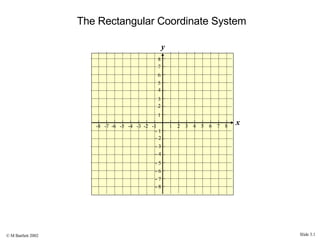
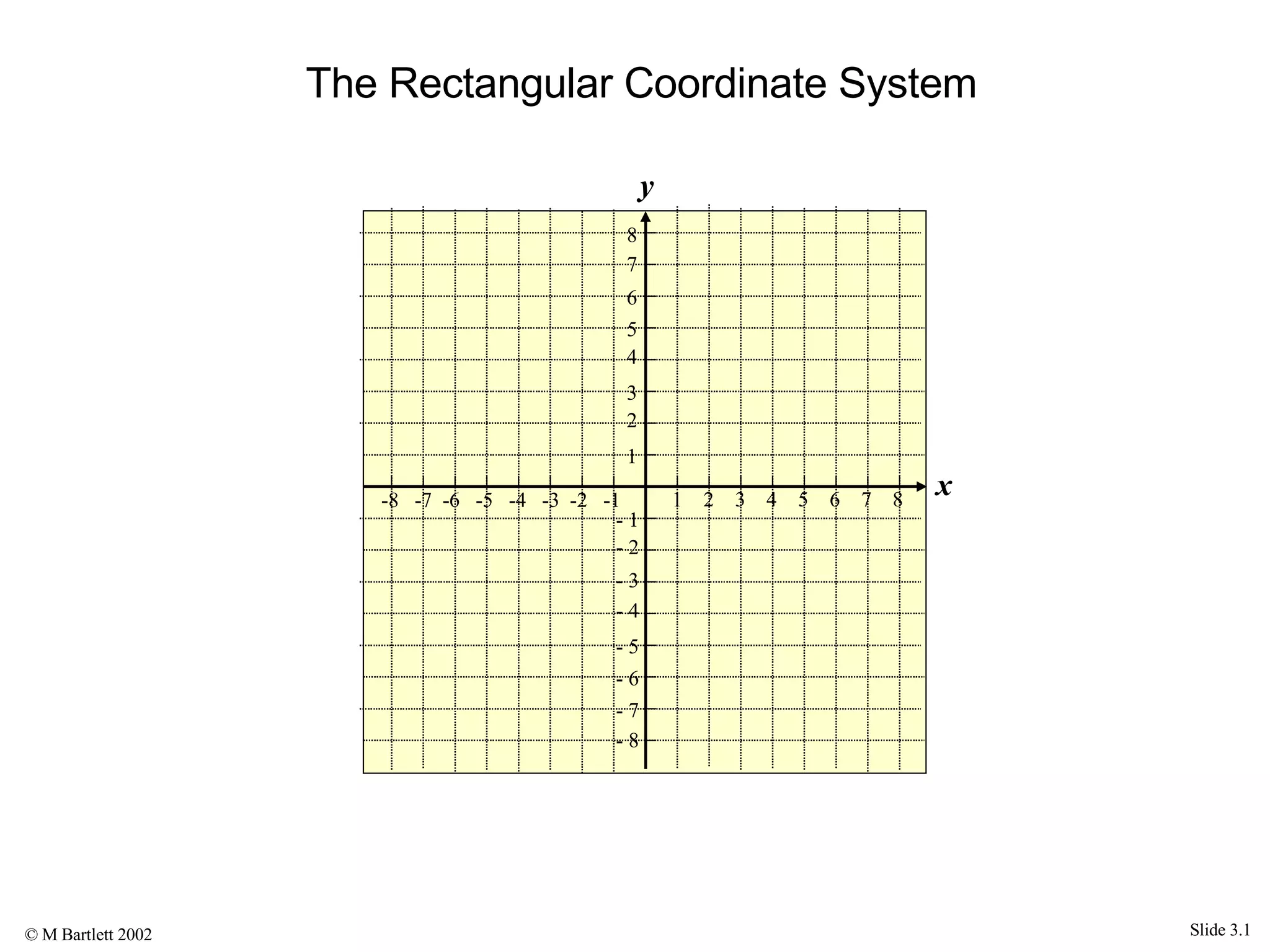
1  2  3  4  5  6  7  8 -8  -7  -6  -5  -4  -3  -2  -1 8 7 6 5 4 3 2 1 - 8 - 7 - 6 - 5 - 4 - 3 - 2 - 1 x y The Rectangular Coordinate System © M Bartlett 2002 Slide 3.1
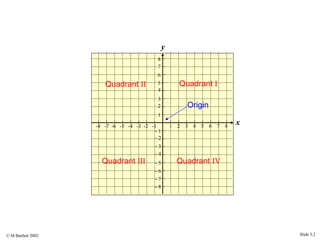
1  2  3  4  5  6  7  8 -8  -7  -6  -5  -4  -3  -2  -1 8 7 6 5 4 3 2 1 - 8 - 7 - 6 - 5 - 4 - 3 - 2 - 1 x y Quadrant  I Quadrant  II Quadrant  III Quadrant  IV Origin © M Bartlett 2002 Slide 3.2
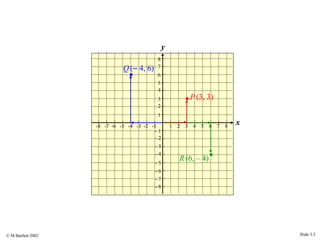
1  2  3  4  5  6  7  8 -8  -7  -6  -5  -4  -3  -2  -1 8 7 6 5 4 3 2 1 - 8 - 7 - 6 - 5 - 4 - 3 - 2 - 1 x y P   (3, 3) Q   ( –  4, 6) R   (6, – 4) © M Bartlett 2002 Slide 3.3
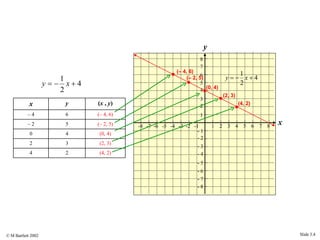
(– 4, 6)  (– 2, 5)  (0, 4)  (2, 3)  (4, 2)  © M Bartlett 2002 Slide 3.4 1  2  3  4  5  6  7  8 -8  -7  -6  -5  -4  -3  -2  -1 8 7 6 5 4 3 2 1 - 8 - 7 - 6 - 5 - 4 - 3 - 2 - 1 x y (4, 2) 2 4 (2, 3) 3 2 (0, 4) 4 0 (– 2, 5) 5 –  2 (– 4, 6) 6 –  4 ( x  ,  y ) y x
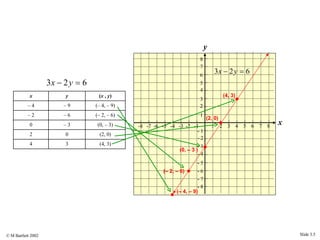
(– 4, – 9)  (– 2, – 6)  (0, – 3 )  (2, 0)  (4, 3)  © M Bartlett 2002 Slide 3.5 1  2  3  4  5  6  7  8 -8  -7  -6  -5  -4  -3  -2  -1 8 7 6 5 4 3 2 1 - 8 - 7 - 6 - 5 - 4 - 3 - 2 - 1 x y (4, 3) 3 4 (2, 0) 0 2 (0, – 3) –  3 0 (– 2, – 6) –  6 –  2 (– 4, – 9) –  9  –  4 ( x  ,  y ) y x
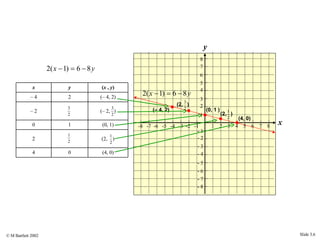
(4, 0)   (0, 1 )   (– 4, 2)   © M Bartlett 2002 Slide 3.6 1  2  3  4  5  6  7  8 -8  -7  -6  -5  -4  -3  -2  -1 8 7 6 5 4 3 2 1 - 8 - 7 - 6 - 5 - 4 - 3 - 2 - 1 x y (4, 0) 0 4 (2,  ) 2 (0, 1) 1 0 (– 2,  ) –  2 (– 4, 2) 2 –  4 ( x  ,  y ) y x (2,  )   (2,  )
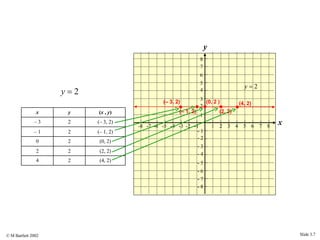
(– 3, 2)  (– 1, 2)  (0, 2 )  (2, 2)  (4, 2)  © M Bartlett 2002 Slide 3.7 1  2  3  4  5  6  7  8 -8  -7  -6  -5  -4  -3  -2  -1 8 7 6 5 4 3 2 1 - 8 - 7 - 6 - 5 - 4 - 3 - 2 - 1 x y (4, 2) 2 4 (2, 2) 2 2 (0, 2) 2 0 (– 1, 2) 2 –  1 (– 3, 2) 2 –  3 ( x  ,  y ) y x
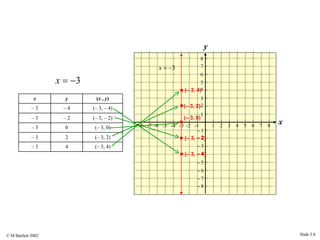
(– 3, – 4)  (– 3, – 2)  (– 3, 0)  (– 3, 2)  (– 3, 4)  © M Bartlett 2002 Slide 3.8 1  2  3  4  5  6  7  8 -8  -7  -6  -5  -4  -3  -2  -1 8 7 6 5 4 3 2 1 - 8 - 7 - 6 - 5 - 4 - 3 - 2 - 1 x y (– 3, 4) 4 –  3 (– 3, 2) 2 –  3 (– 3, 0) 0 –  3 (– 3, – 2) –  2 –  3 (– 3, – 4) –  4 –  3 ( x  ,  y ) y x
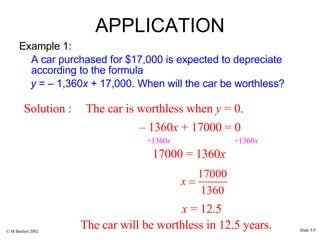
APPLICATION Example 1:  A car purchased for $17,000 is expected to depreciate according to the formula  y  = – 1,360 x  + 17,000. When will the car be worthless? © M Bartlett 2002 Slide 3.9 Solution : The car is worthless when  y  = 0. –  1360 x  + 17000 = 0 17000 = 1360 x +1360 x +1360 x x  = 12.5 The car will be worthless in 12.5 years.
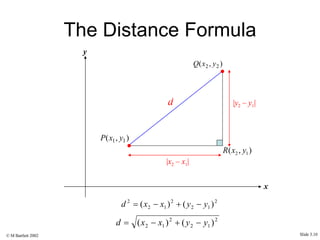
The Distance Formula d | x 2  –  x 1 | | y 2  –  y 1 | x y © M Bartlett 2002 Slide 3.10
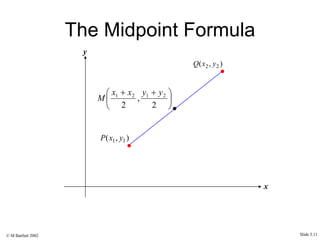
The Midpoint Formula © M Bartlett 2002 Slide 3.11 x y
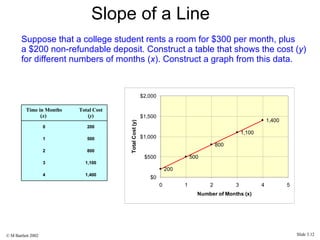
Slope of a Line Suppose that a college student rents a room for $300 per month, plus a $200 non-refundable deposit. Construct a table that shows the cost ( y ) for different numbers of months ( x ). Construct a graph from this data. © M Bartlett 2002 Slide 3.12 1,400   4 1,100   3 800   2 500   1 200   0 Total Cost ( y )   Time in Months ( x )
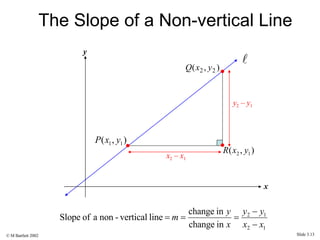
The Slope of a Non-vertical Line x 2  –  x 1 y 2  –  y 1 © M Bartlett 2002 Slide 3.13 x y
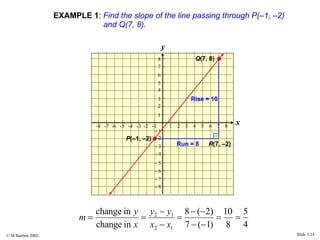
EXAMPLE 1 :  Find the slope of the line passing through P(–1, –2)   and Q(7, 8). P (–1, –2) Q (7, 8) Run = 8 R (7, –2) Rise = 10 © M Bartlett 2002 Slide 3.14 1  2  3  4  5  6  7  8 -8  -7  -6  -5  -4  -3  -2  -1 8 7 6 5 4 3 2 1 - 8 - 7 - 6 - 5 - 4 - 3 - 2 - 1 x y
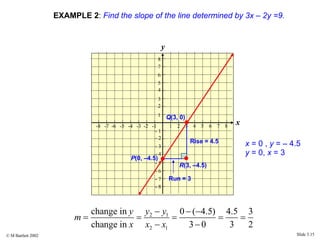
EXAMPLE 2 :  Find the slope of the line determined by 3x – 2y =9. P (0, –4.5) Q (3, 0) R (3, –4.5) x  = 0 ,  y  = – 4.5 y  = 0,  x  = 3 Rise = 4.5 Run = 3 © M Bartlett 2002 Slide 3.15 1  2  3  4  5  6  7  8 -8  -7  -6  -5  -4  -3  -2  -1 8 7 6 5 4 3 2 1 - 8 - 7 - 6 - 5 - 4 - 3 - 2 - 1 x y
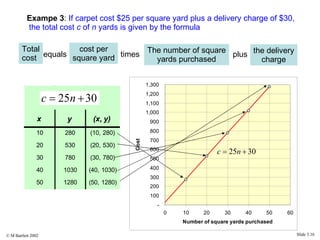
Exampe 3 :  If carpet cost $25 per square yard plus a delivery charge of $30, the total cost  c  of  n  yards is given by the formula Total cost equals cost per square yard times The number of square yards purchased plus the delivery charge © M Bartlett 2002 Slide 3.16
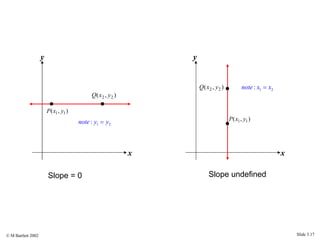
Slope = 0 Slope undefined © M Bartlett 2002 Slide 3.17 x y x y
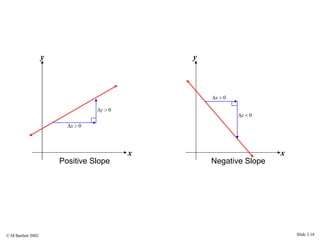
Positive Slope Negative Slope © M Bartlett 2002 Slide 3.18 x y x y
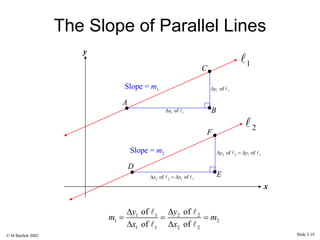
The Slope of Parallel Lines A C B Slope =  m 1 D F  E Slope =  m 2 © M Bartlett 2002 Slide 3.19 x y
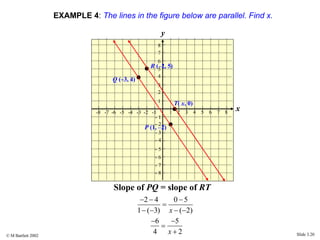
EXAMPLE 4 :  The lines in the figure below are parallel. Find x.  R  (–2, 5) T (  x , 0) Q  (–3, 4) P  (1, –2) Slope of  PQ  = slope of  RT © M Bartlett 2002 Slide 3.20 1  2  3  4  5  6  7  8 -8  -7  -6  -5  -4  -3  -2  -1 8 7 6 5 4 3 2 1 - 8 - 7 - 6 - 5 - 4 - 3 - 2 - 1 x y
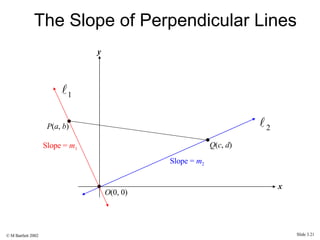
The Slope of Perpendicular Lines P ( a ,  b ) Slope =  m 1 O (0, 0) Q ( c ,  d ) Slope =  m 2 © M Bartlett 2002 Slide 3.21 x y
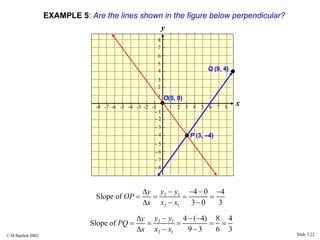
EXAMPLE 5 :  Are the lines shown in the figure below perpendicular?  Q  (9, 4) O (0, 0) P  (3, –4) © M Bartlett 2002 Slide 3.22 1  2  3  4  5  6  7  8 -8  -7  -6  -5  -4  -3  -2  -1 8 7 6 5 4 3 2 1 - 8 - 7 - 6 - 5 - 4 - 3 - 2 - 1 x y
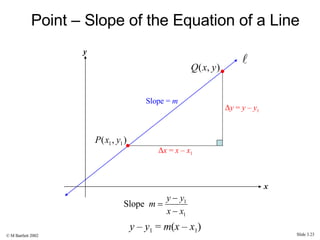
Point – Slope of the Equation of a Line Δ x  =  x  –  x 1 © M Bartlett 2002 Slide 3.23 Slope =  m Δ y  =  y  –  y 1 y  –  y 1  =  m ( x  –  x 1 ) x y
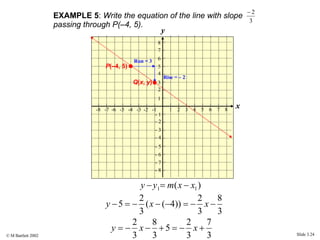
EXAMPLE 5 :  Write the equation of the line with slope  passing through P(–4, 5). P (–4, 5) © M Bartlett 2002 Slide 3.24 Q ( x ,  y ) Run = 3 Rise = – 2  1  2  3  4  5  6  7  8 -8  -7  -6  -5  -4  -3  -2  -1 8 7 6 5 4 3 2 1 - 8 - 7 - 6 - 5 - 4 - 3 - 2 - 1 x y
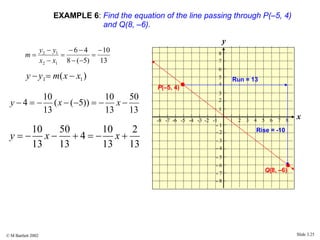
EXAMPLE 6 :  Find the equation of the line passing through P(–5, 4)   and Q(8, –6). P (–5, 4) Run = 13 Q (8, –6) Rise = -10 © M Bartlett 2002 Slide 3.25 1  2  3  4  5  6  7  8 -8  -7  -6  -5  -4  -3  -2  -1 8 7 6 5 4 3 2 1 - 8 - 7 - 6 - 5 - 4 - 3 - 2 - 1 x y
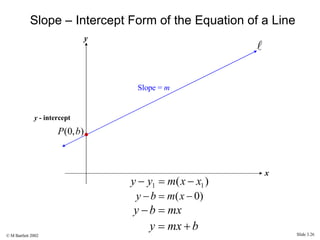
Slope – Intercept Form of the Equation of a Line © M Bartlett 2002 Slide 3.26 Slope =  m y  - intercept x y
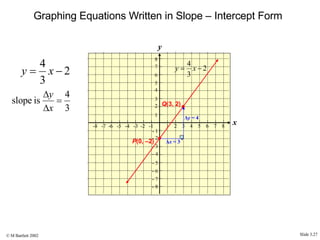
Graphing Equations Written in Slope – Intercept Form © M Bartlett 2002 Slide 3.27 P (0, –2) Q (3, 2) Δ x  =  3 Δ y  =  4 1  2  3  4  5  6  7  8 -8  -7  -6  -5  -4  -3  -2  -1 8 7 6 5 4 3 2 1 - 8 - 7 - 6 - 5 - 4 - 3 - 2 - 1 x y
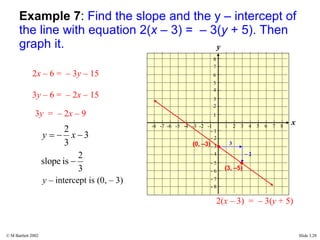
Example 7 :  Find the slope and the y – intercept of the line with equation 2( x  – 3) =  – 3( y  + 5). Then graph it. 2 x  – 6 =  – 3 y  – 15  3 y  – 6 =  – 2 x  – 15  3 y   =  – 2 x  – 9  y  – intercept is (0, – 3) 3 –  2  (0, –3) (3, –5) 2( x  – 3)  =  – 3( y  + 5)  Slide 3.28 © M Bartlett 2002 1  2  3  4  5  6  7  8 -8  -7  -6  -5  -4  -3  -2  -1 8 7 6 5 4 3 2 1 - 8 - 7 - 6 - 5 - 4 - 3 - 2 - 1 x y
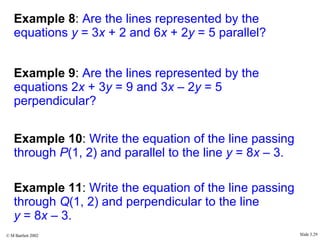
Example 8 :  Are the lines represented by the equations  y  = 3 x  + 2 and 6 x  + 2 y  = 5 parallel? Example 9 :  Are the lines represented by the equations 2 x  + 3 y  = 9 and 3 x  – 2 y  = 5 perpendicular? Example 10 :  Write the equation of the line passing through  P (1, 2) and parallel to the line  y  = 8 x  – 3. Example 11 :  Write the equation of the line passing through  Q (1, 2) and perpendicular to the line  y  = 8 x  – 3. Slide 3.29 © M Bartlett 2002
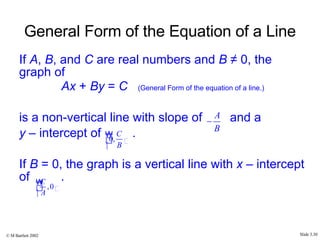
General Form of the Equation of a Line If  A ,  B , and  C  are real numbers and  B   ≠ 0, the graph of  Ax  +  By  =  C  (General Form of the equation of a line.) is a non-vertical line with slope of  and a  y  – intercept of  .  If  B  = 0, the graph is a vertical line with  x  – intercept of  . Slide 3.30 © M Bartlett 2002
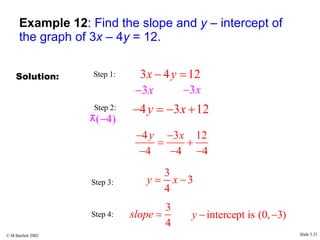
Example 12 :  Find the slope and  y  – intercept of the graph of 3 x  – 4 y  = 12. Slide 3.31 © M Bartlett 2002 Solution: Step 3:  Step 4:  Step 1:  Step 2:
Summary General Form  A x +  B y =  C A  and  B  cannot both be 0. Slope – intercept form  y  =  mx  +  b The slope  m , and the  y -intercept is (0,  b ). Point – slope form  y  –  y 1  =  m ( x  –  x 1 ) The slope is  m , and the line passes  through ( x 1 ,  y 1 ). A horizontal line  y  =  b The slope is 0, and the  y  intercept is (0,  b ). A vertical Line  x  =  a There is no defined slope, and the  x -intercept is ( a , 0). Slide 3.32 © M Bartlett 2002
Example 13 :  A taxi cab was purchased for $24,300. Its salvage value at the end of its 7-year useful life is expected to be $1,900. If  y  is the value of the taxi cab after  x -years of use, and  y  and  x  are related by the equation of a line,   a. Find the equation of the line, called the    depreciation equation .  b. Find the value of the taxi cab after 3 years.  c. Find the economic meaning of the  y -intercept of    the line.   d. Find the economic meaning  of the slope of the    line.  Slide 3.33 © M Bartlett 2002
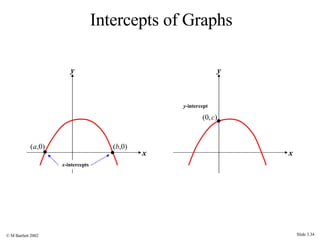
© M Bartlett 2002 Slide 3.34 Intercepts of Graphs x -intercepts y -intercept x y x y
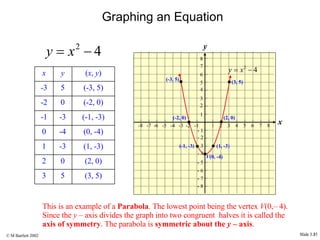
Graphing an Equation © M Bartlett 2002 Slide 3.1 Slide 3.35 (-3, 5) (-2, 0) (-1, -3) (1, -3) (2, 0) (3, 5) V (0, -4) This is an example of a  Parabola . The lowest point being the vertex  V (0,– 4). Since the  y  – axis divides the graph into two congruent  halves it is called the axis of symmetry . The parabola is  symmetric about the  y  – axis . 1  2  3  4  5  6  7  8 -8  -7  -6  -5  -4  -3  -2  -1 8 7 6 5 4 3 2 1 - 8 - 7 - 6 - 5 - 4 - 3 - 2 - 1 x y (3, 5) 5 3 (2, 0) 0 2 (1, -3) -3 1 (0, -4) -4 0 (-1, -3) -3 -1 (-2, 0) 0 -2 (-3, 5) 5 -3 ( x ,  y ) y x
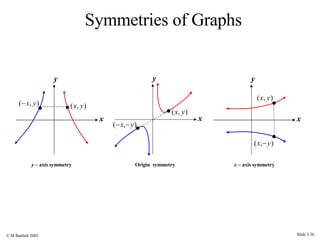
© M Bartlett 2002 Slide 3.36 Symmetries of Graphs y  – axis symmetry Origin  symmetry x  – axis symmetry x y x y x y
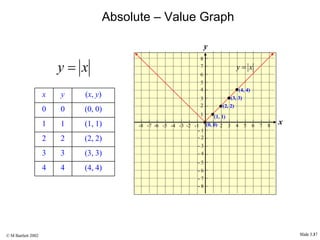
Absolute – Value Graph © M Bartlett 2002 Slide 3.1 Slide 3.37 (1, 1) (2, 2) (0, 0) (3, 3) (4, 4) 1  2  3  4  5  6  7  8 -8  -7  -6  -5  -4  -3  -2  -1 8 7 6 5 4 3 2 1 - 8 - 7 - 6 - 5 - 4 - 3 - 2 - 1 x y (4, 4) 4 4 (3, 3) 3 3 (2, 2) 2 2 (1, 1) 1 1 (0, 0) 0 0 ( x ,  y ) y x
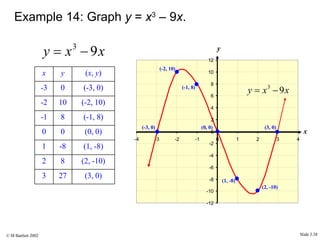
Example 14: Graph  y  =  x 3  – 9 x . (-3, 0) (-2, 10) (-1, 8) (0, 0) (1, -8) (2, -10) (3, 0) © M Bartlett 2002 Slide 3.38 y   x   (3, 0) 27 3 (2, -10) 8 2 (1, -8) -8 1 (0, 0) 0 0 (-1, 8) 8 -1 (-2, 10) 10 -2 (-3, 0) 0 -3 ( x ,  y ) y x
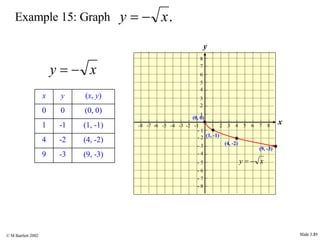
© M Bartlett 2002 Slide 3.1 Slide 3.39 (1, -1) (4, -2) (0, 0) (9, -3) 1  2  3  4  5  6  7  8 -8  -7  -6  -5  -4  -3  -2  -1 8 7 6 5 4 3 2 1 - 8 - 7 - 6 - 5 - 4 - 3 - 2 - 1 x y (9, -3) -3 9 (4, -2) -2 4 (1, -1) -1 1 (0, 0) 0 0 ( x ,  y ) y x Example 15: Graph
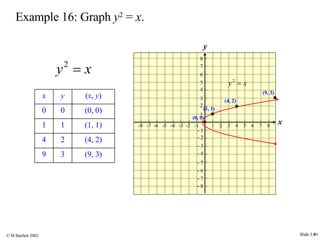
© M Bartlett 2002 Slide 3.1 Slide 3.40 (1, 1) (4, 2) (0, 0) (9, 3) Example 16: Graph  y 2  =  x . 1  2  3  4  5  6  7  8 -8  -7  -6  -5  -4  -3  -2  -1 8 7 6 5 4 3 2 1 - 8 - 7 - 6 - 5 - 4 - 3 - 2 - 1 x y (9, 3) 3 9 (4, 2) 2 4 (1, 1) 1 1 (0, 0) 0 0 ( x ,  y ) y x
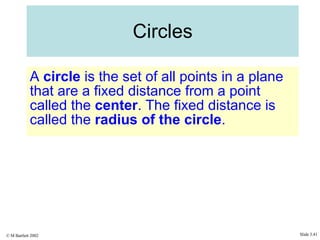
Circles A  circle  is the set of all points in a plane that are a fixed distance from a point called the  center . The fixed distance is called the  radius of the circle . © M Bartlett 2002 Slide 3.41
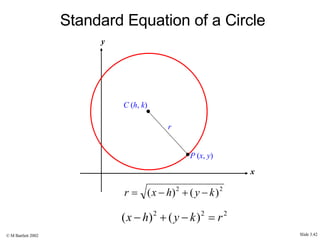
Standard Equation of a Circle C  ( h ,  k ) P  ( x ,  y ) r © M Bartlett 2002 Slide 3.42 y x
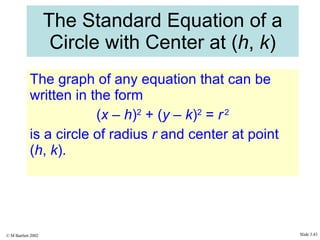
The Standard Equation of a Circle with Center at ( h ,  k ) The graph of any equation that can be written in the form ( x  –  h ) 2  + ( y  –  k ) 2  =  r   2 is a circle of radius  r  and center at point ( h ,  k ). © M Bartlett 2002 Slide 3.43
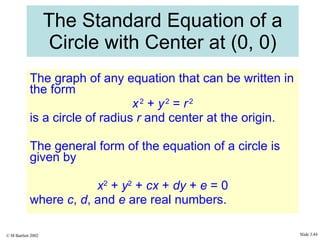
The Standard Equation of a Circle with Center at (0, 0) The graph of any equation that can be written in the form x   2  +  y   2  =  r   2 is a circle of radius  r  and center at the origin. The general form of the equation of a circle is given by x 2  +  y 2  +  cx  +  dy  +  e  = 0 where  c ,  d , and  e  are real numbers. © M Bartlett 2002 Slide 3.44
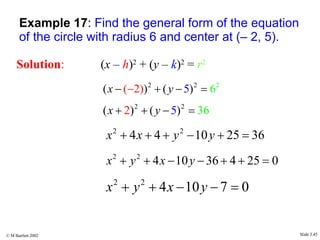
Example 17 :  Find the general form of the equation of the circle with radius 6 and center at (– 2, 5).  Slide 3.45 © M Bartlett 2002 Solution :  ( x  –  h ) 2  + ( y  –  k ) 2  =  r 2
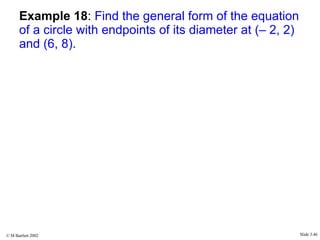
Example 18 :  Find the general form of the equation of a circle with endpoints of its diameter at (– 2, 2) and (6, 8).  Slide 3.46 © M Bartlett 2002
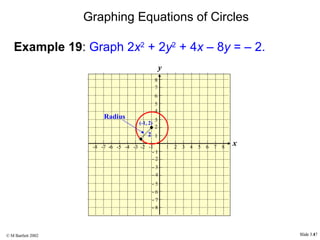
Graphing Equations of Circles © M Bartlett 2002 Slide 3.1 Slide 3.47 (-1, 2) Example 19 :  Graph 2 x 2  + 2 y 2  + 4 x  – 8 y  = – 2.  Radius 2 1  2  3  4  5  6  7  8 -8  -7  -6  -5  -4  -3  -2  -1 8 7 6 5 4 3 2 1 - 8 - 7 - 6 - 5 - 4 - 3 - 2 - 1 x y
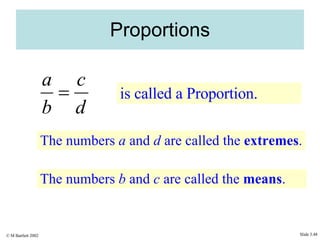
Proportions is called a Proportion. The numbers  a  and  d  are called the  extremes . The numbers  b  and  c  are called the  means .  © M Bartlett 2002 Slide 3.48
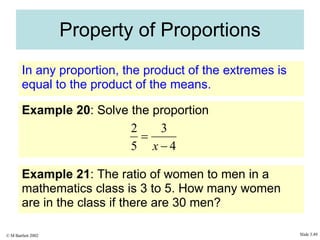
Property of Proportions © M Bartlett 2002 Slide 3.49 In any proportion, the product of the extremes is  equal to the product of the means. Example 21 : The ratio of women to men in a  mathematics class is 3 to 5. How many women  are in the class if there are 30 men?  Example 20 : Solve the proportion
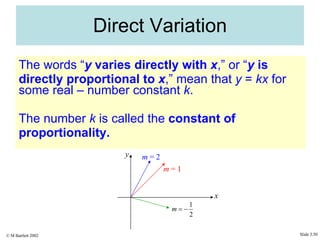
Direct Variation The words “ y  varies directly with  x ,” or “ y  is  directly proportional to  x ,” mean that  y  =  kx  for some real – number constant  k . The number  k  is called the  constant of  proportionality. © M Bartlett 2002 Slide 3.50 m  = 2 m  = 1 y x
Example 22 :  The distance that an object will fall in  t  seconds varies directly with the square of  t . An object falls 16 feet in 1 second. How long will it take to fall 144 feet?  Slide 3.51 © M Bartlett 2002
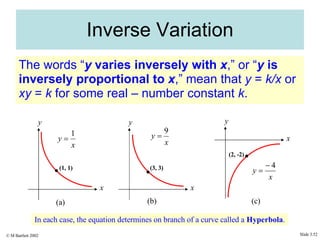
Inverse Variation © M Bartlett 2002 Slide 3.52 The words “ y  varies inversely with  x ,” or “ y  is  inversely proportional to  x ,” mean that  y  =  k/x  or  xy  =  k  for some real – number constant  k . (1, 1) (3, 3) (2, -2) In each case, the equation determines on branch of a curve called a  Hyperbola . y x (c) y x (a) y x (b)
Example 23 :  Intensity of illumination from a light source varies inversely with the square of the distance from the source. If the intensity of the light source is 100 lumens at a distance of 20 feet, find the intensity at 30 feet.  Slide 3.53 © M Bartlett 2002
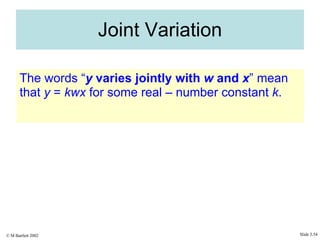
Joint Variation © M Bartlett 2002 Slide 3.54 The words “ y  varies jointly with  w  and  x ” mean  that  y  =  kwx  for some real – number constant  k .
Example 24 :  The area of a rectangle varies jointly with its length and width. Find the constant of proportionality.  Slide 3.55 © M Bartlett 2002
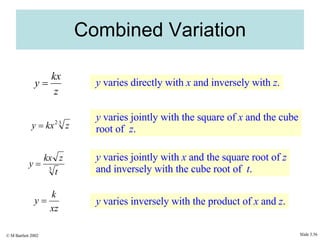
Combined Variation © M Bartlett 2002 Slide 3.56 y  varies directly with  x  and inversely with  z . y  varies jointly with the square of  x  and the cube root of  z . y  varies jointly with  x  and the square root of  z and inversely with the cube root of  t . y  varies inversely with the product of  x  and  z .
Example 25 :  The power, in watts, dissipated as heat in a resistor varies directly with the square of the voltage and inversely with the resistance. If 20 volts are placed across a 20-ohm resistor, it will dissipate 20 watts. What voltage across a 10-ohm resistor will dissipate 40 watts?  Slide 3.57 © M Bartlett 2002
Rectangular Coordinate System & Graphs

  • 1.
    1 2 3 4 5 6 7 8 -8 -7 -6 -5 -4 -3 -2 -1 8 7 6 5 4 3 2 1 - 8 - 7 - 6 - 5 - 4 - 3 - 2 - 1 x y The Rectangular Coordinate System © M Bartlett 2002 Slide 3.1
  • 2.
    1 2 3 4 5 6 7 8 -8 -7 -6 -5 -4 -3 -2 -1 8 7 6 5 4 3 2 1 - 8 - 7 - 6 - 5 - 4 - 3 - 2 - 1 x y Quadrant I Quadrant II Quadrant III Quadrant IV Origin © M Bartlett 2002 Slide 3.2
  • 3.
    1 2 3 4 5 6 7 8 -8 -7 -6 -5 -4 -3 -2 -1 8 7 6 5 4 3 2 1 - 8 - 7 - 6 - 5 - 4 - 3 - 2 - 1 x y P (3, 3) Q ( – 4, 6) R (6, – 4) © M Bartlett 2002 Slide 3.3
  • 4.
    (– 4, 6) (– 2, 5) (0, 4) (2, 3) (4, 2) © M Bartlett 2002 Slide 3.4 1 2 3 4 5 6 7 8 -8 -7 -6 -5 -4 -3 -2 -1 8 7 6 5 4 3 2 1 - 8 - 7 - 6 - 5 - 4 - 3 - 2 - 1 x y (4, 2) 2 4 (2, 3) 3 2 (0, 4) 4 0 (– 2, 5) 5 – 2 (– 4, 6) 6 – 4 ( x , y ) y x
  • 5.
    (– 4, –9) (– 2, – 6) (0, – 3 ) (2, 0) (4, 3) © M Bartlett 2002 Slide 3.5 1 2 3 4 5 6 7 8 -8 -7 -6 -5 -4 -3 -2 -1 8 7 6 5 4 3 2 1 - 8 - 7 - 6 - 5 - 4 - 3 - 2 - 1 x y (4, 3) 3 4 (2, 0) 0 2 (0, – 3) – 3 0 (– 2, – 6) – 6 – 2 (– 4, – 9) – 9 – 4 ( x , y ) y x
  • 6.
    (4, 0) (0, 1 ) (– 4, 2) © M Bartlett 2002 Slide 3.6 1 2 3 4 5 6 7 8 -8 -7 -6 -5 -4 -3 -2 -1 8 7 6 5 4 3 2 1 - 8 - 7 - 6 - 5 - 4 - 3 - 2 - 1 x y (4, 0) 0 4 (2, ) 2 (0, 1) 1 0 (– 2, ) – 2 (– 4, 2) 2 – 4 ( x , y ) y x (2, ) (2, )
  • 7.
    (– 3, 2) (– 1, 2) (0, 2 ) (2, 2) (4, 2) © M Bartlett 2002 Slide 3.7 1 2 3 4 5 6 7 8 -8 -7 -6 -5 -4 -3 -2 -1 8 7 6 5 4 3 2 1 - 8 - 7 - 6 - 5 - 4 - 3 - 2 - 1 x y (4, 2) 2 4 (2, 2) 2 2 (0, 2) 2 0 (– 1, 2) 2 – 1 (– 3, 2) 2 – 3 ( x , y ) y x
  • 8.
    (– 3, –4) (– 3, – 2) (– 3, 0) (– 3, 2) (– 3, 4) © M Bartlett 2002 Slide 3.8 1 2 3 4 5 6 7 8 -8 -7 -6 -5 -4 -3 -2 -1 8 7 6 5 4 3 2 1 - 8 - 7 - 6 - 5 - 4 - 3 - 2 - 1 x y (– 3, 4) 4 – 3 (– 3, 2) 2 – 3 (– 3, 0) 0 – 3 (– 3, – 2) – 2 – 3 (– 3, – 4) – 4 – 3 ( x , y ) y x
  • 9.
    APPLICATION Example 1: A car purchased for $17,000 is expected to depreciate according to the formula y = – 1,360 x + 17,000. When will the car be worthless? © M Bartlett 2002 Slide 3.9 Solution : The car is worthless when y = 0. – 1360 x + 17000 = 0 17000 = 1360 x +1360 x +1360 x x = 12.5 The car will be worthless in 12.5 years.
  • 10.
    The Distance Formulad | x 2 – x 1 | | y 2 – y 1 | x y © M Bartlett 2002 Slide 3.10
  • 11.
    The Midpoint Formula© M Bartlett 2002 Slide 3.11 x y
  • 12.
    Slope of aLine Suppose that a college student rents a room for $300 per month, plus a $200 non-refundable deposit. Construct a table that shows the cost ( y ) for different numbers of months ( x ). Construct a graph from this data. © M Bartlett 2002 Slide 3.12 1,400   4 1,100   3 800   2 500   1 200   0 Total Cost ( y )   Time in Months ( x )
  • 13.
    The Slope ofa Non-vertical Line x 2 – x 1 y 2 – y 1 © M Bartlett 2002 Slide 3.13 x y
  • 14.
    EXAMPLE 1 : Find the slope of the line passing through P(–1, –2) and Q(7, 8). P (–1, –2) Q (7, 8) Run = 8 R (7, –2) Rise = 10 © M Bartlett 2002 Slide 3.14 1 2 3 4 5 6 7 8 -8 -7 -6 -5 -4 -3 -2 -1 8 7 6 5 4 3 2 1 - 8 - 7 - 6 - 5 - 4 - 3 - 2 - 1 x y
  • 15.
    EXAMPLE 2 : Find the slope of the line determined by 3x – 2y =9. P (0, –4.5) Q (3, 0) R (3, –4.5) x = 0 , y = – 4.5 y = 0, x = 3 Rise = 4.5 Run = 3 © M Bartlett 2002 Slide 3.15 1 2 3 4 5 6 7 8 -8 -7 -6 -5 -4 -3 -2 -1 8 7 6 5 4 3 2 1 - 8 - 7 - 6 - 5 - 4 - 3 - 2 - 1 x y
  • 16.
    Exampe 3 : If carpet cost $25 per square yard plus a delivery charge of $30, the total cost c of n yards is given by the formula Total cost equals cost per square yard times The number of square yards purchased plus the delivery charge © M Bartlett 2002 Slide 3.16
  • 17.
    Slope = 0Slope undefined © M Bartlett 2002 Slide 3.17 x y x y
  • 18.
    Positive Slope NegativeSlope © M Bartlett 2002 Slide 3.18 x y x y
  • 19.
    The Slope ofParallel Lines A C B Slope = m 1 D F E Slope = m 2 © M Bartlett 2002 Slide 3.19 x y
  • 20.
    EXAMPLE 4 : The lines in the figure below are parallel. Find x. R (–2, 5) T ( x , 0) Q (–3, 4) P (1, –2) Slope of PQ = slope of RT © M Bartlett 2002 Slide 3.20 1 2 3 4 5 6 7 8 -8 -7 -6 -5 -4 -3 -2 -1 8 7 6 5 4 3 2 1 - 8 - 7 - 6 - 5 - 4 - 3 - 2 - 1 x y
  • 21.
    The Slope ofPerpendicular Lines P ( a , b ) Slope = m 1 O (0, 0) Q ( c , d ) Slope = m 2 © M Bartlett 2002 Slide 3.21 x y
  • 22.
    EXAMPLE 5 : Are the lines shown in the figure below perpendicular? Q (9, 4) O (0, 0) P (3, –4) © M Bartlett 2002 Slide 3.22 1 2 3 4 5 6 7 8 -8 -7 -6 -5 -4 -3 -2 -1 8 7 6 5 4 3 2 1 - 8 - 7 - 6 - 5 - 4 - 3 - 2 - 1 x y
  • 23.
    Point – Slopeof the Equation of a Line Δ x = x – x 1 © M Bartlett 2002 Slide 3.23 Slope = m Δ y = y – y 1 y – y 1 = m ( x – x 1 ) x y
  • 24.
    EXAMPLE 5 : Write the equation of the line with slope passing through P(–4, 5). P (–4, 5) © M Bartlett 2002 Slide 3.24 Q ( x , y ) Run = 3 Rise = – 2 1 2 3 4 5 6 7 8 -8 -7 -6 -5 -4 -3 -2 -1 8 7 6 5 4 3 2 1 - 8 - 7 - 6 - 5 - 4 - 3 - 2 - 1 x y
  • 25.
    EXAMPLE 6 : Find the equation of the line passing through P(–5, 4) and Q(8, –6). P (–5, 4) Run = 13 Q (8, –6) Rise = -10 © M Bartlett 2002 Slide 3.25 1 2 3 4 5 6 7 8 -8 -7 -6 -5 -4 -3 -2 -1 8 7 6 5 4 3 2 1 - 8 - 7 - 6 - 5 - 4 - 3 - 2 - 1 x y
  • 26.
    Slope – InterceptForm of the Equation of a Line © M Bartlett 2002 Slide 3.26 Slope = m y - intercept x y
  • 27.
    Graphing Equations Writtenin Slope – Intercept Form © M Bartlett 2002 Slide 3.27 P (0, –2) Q (3, 2) Δ x = 3 Δ y = 4 1 2 3 4 5 6 7 8 -8 -7 -6 -5 -4 -3 -2 -1 8 7 6 5 4 3 2 1 - 8 - 7 - 6 - 5 - 4 - 3 - 2 - 1 x y
  • 28.
    Example 7 : Find the slope and the y – intercept of the line with equation 2( x – 3) = – 3( y + 5). Then graph it. 2 x – 6 = – 3 y – 15 3 y – 6 = – 2 x – 15 3 y = – 2 x – 9 y – intercept is (0, – 3) 3 – 2 (0, –3) (3, –5) 2( x – 3) = – 3( y + 5) Slide 3.28 © M Bartlett 2002 1 2 3 4 5 6 7 8 -8 -7 -6 -5 -4 -3 -2 -1 8 7 6 5 4 3 2 1 - 8 - 7 - 6 - 5 - 4 - 3 - 2 - 1 x y
  • 29.
    Example 8 : Are the lines represented by the equations y = 3 x + 2 and 6 x + 2 y = 5 parallel? Example 9 : Are the lines represented by the equations 2 x + 3 y = 9 and 3 x – 2 y = 5 perpendicular? Example 10 : Write the equation of the line passing through P (1, 2) and parallel to the line y = 8 x – 3. Example 11 : Write the equation of the line passing through Q (1, 2) and perpendicular to the line y = 8 x – 3. Slide 3.29 © M Bartlett 2002
  • 30.
    General Form ofthe Equation of a Line If A , B , and C are real numbers and B ≠ 0, the graph of Ax + By = C (General Form of the equation of a line.) is a non-vertical line with slope of and a y – intercept of . If B = 0, the graph is a vertical line with x – intercept of . Slide 3.30 © M Bartlett 2002
  • 31.
    Example 12 : Find the slope and y – intercept of the graph of 3 x – 4 y = 12. Slide 3.31 © M Bartlett 2002 Solution: Step 3: Step 4: Step 1: Step 2:
  • 32.
    Summary General Form A x + B y = C A and B cannot both be 0. Slope – intercept form y = mx + b The slope m , and the y -intercept is (0, b ). Point – slope form y – y 1 = m ( x – x 1 ) The slope is m , and the line passes through ( x 1 , y 1 ). A horizontal line y = b The slope is 0, and the y intercept is (0, b ). A vertical Line x = a There is no defined slope, and the x -intercept is ( a , 0). Slide 3.32 © M Bartlett 2002
  • 33.
    Example 13 : A taxi cab was purchased for $24,300. Its salvage value at the end of its 7-year useful life is expected to be $1,900. If y is the value of the taxi cab after x -years of use, and y and x are related by the equation of a line, a. Find the equation of the line, called the depreciation equation . b. Find the value of the taxi cab after 3 years. c. Find the economic meaning of the y -intercept of the line. d. Find the economic meaning of the slope of the line. Slide 3.33 © M Bartlett 2002
  • 34.
    © M Bartlett2002 Slide 3.34 Intercepts of Graphs x -intercepts y -intercept x y x y
  • 35.
    Graphing an Equation© M Bartlett 2002 Slide 3.1 Slide 3.35 (-3, 5) (-2, 0) (-1, -3) (1, -3) (2, 0) (3, 5) V (0, -4) This is an example of a Parabola . The lowest point being the vertex V (0,– 4). Since the y – axis divides the graph into two congruent halves it is called the axis of symmetry . The parabola is symmetric about the y – axis . 1 2 3 4 5 6 7 8 -8 -7 -6 -5 -4 -3 -2 -1 8 7 6 5 4 3 2 1 - 8 - 7 - 6 - 5 - 4 - 3 - 2 - 1 x y (3, 5) 5 3 (2, 0) 0 2 (1, -3) -3 1 (0, -4) -4 0 (-1, -3) -3 -1 (-2, 0) 0 -2 (-3, 5) 5 -3 ( x , y ) y x
  • 36.
    © M Bartlett2002 Slide 3.36 Symmetries of Graphs y – axis symmetry Origin symmetry x – axis symmetry x y x y x y
  • 37.
    Absolute – ValueGraph © M Bartlett 2002 Slide 3.1 Slide 3.37 (1, 1) (2, 2) (0, 0) (3, 3) (4, 4) 1 2 3 4 5 6 7 8 -8 -7 -6 -5 -4 -3 -2 -1 8 7 6 5 4 3 2 1 - 8 - 7 - 6 - 5 - 4 - 3 - 2 - 1 x y (4, 4) 4 4 (3, 3) 3 3 (2, 2) 2 2 (1, 1) 1 1 (0, 0) 0 0 ( x , y ) y x
  • 38.
    Example 14: Graph y = x 3 – 9 x . (-3, 0) (-2, 10) (-1, 8) (0, 0) (1, -8) (2, -10) (3, 0) © M Bartlett 2002 Slide 3.38 y x (3, 0) 27 3 (2, -10) 8 2 (1, -8) -8 1 (0, 0) 0 0 (-1, 8) 8 -1 (-2, 10) 10 -2 (-3, 0) 0 -3 ( x , y ) y x
  • 39.
    © M Bartlett2002 Slide 3.1 Slide 3.39 (1, -1) (4, -2) (0, 0) (9, -3) 1 2 3 4 5 6 7 8 -8 -7 -6 -5 -4 -3 -2 -1 8 7 6 5 4 3 2 1 - 8 - 7 - 6 - 5 - 4 - 3 - 2 - 1 x y (9, -3) -3 9 (4, -2) -2 4 (1, -1) -1 1 (0, 0) 0 0 ( x , y ) y x Example 15: Graph
  • 40.
    © M Bartlett2002 Slide 3.1 Slide 3.40 (1, 1) (4, 2) (0, 0) (9, 3) Example 16: Graph y 2 = x . 1 2 3 4 5 6 7 8 -8 -7 -6 -5 -4 -3 -2 -1 8 7 6 5 4 3 2 1 - 8 - 7 - 6 - 5 - 4 - 3 - 2 - 1 x y (9, 3) 3 9 (4, 2) 2 4 (1, 1) 1 1 (0, 0) 0 0 ( x , y ) y x
  • 41.
    Circles A circle is the set of all points in a plane that are a fixed distance from a point called the center . The fixed distance is called the radius of the circle . © M Bartlett 2002 Slide 3.41
  • 42.
    Standard Equation ofa Circle C ( h , k ) P ( x , y ) r © M Bartlett 2002 Slide 3.42 y x
  • 43.
    The Standard Equationof a Circle with Center at ( h , k ) The graph of any equation that can be written in the form ( x – h ) 2 + ( y – k ) 2 = r 2 is a circle of radius r and center at point ( h , k ). © M Bartlett 2002 Slide 3.43
  • 44.
    The Standard Equationof a Circle with Center at (0, 0) The graph of any equation that can be written in the form x 2 + y 2 = r 2 is a circle of radius r and center at the origin. The general form of the equation of a circle is given by x 2 + y 2 + cx + dy + e = 0 where c , d , and e are real numbers. © M Bartlett 2002 Slide 3.44
  • 45.
    Example 17 : Find the general form of the equation of the circle with radius 6 and center at (– 2, 5). Slide 3.45 © M Bartlett 2002 Solution : ( x – h ) 2 + ( y – k ) 2 = r 2
  • 46.
    Example 18 : Find the general form of the equation of a circle with endpoints of its diameter at (– 2, 2) and (6, 8). Slide 3.46 © M Bartlett 2002
  • 47.
    Graphing Equations ofCircles © M Bartlett 2002 Slide 3.1 Slide 3.47 (-1, 2) Example 19 : Graph 2 x 2 + 2 y 2 + 4 x – 8 y = – 2. Radius 2 1 2 3 4 5 6 7 8 -8 -7 -6 -5 -4 -3 -2 -1 8 7 6 5 4 3 2 1 - 8 - 7 - 6 - 5 - 4 - 3 - 2 - 1 x y
  • 48.
    Proportions is calleda Proportion. The numbers a and d are called the extremes . The numbers b and c are called the means . © M Bartlett 2002 Slide 3.48
  • 49.
    Property of Proportions© M Bartlett 2002 Slide 3.49 In any proportion, the product of the extremes is equal to the product of the means. Example 21 : The ratio of women to men in a mathematics class is 3 to 5. How many women are in the class if there are 30 men? Example 20 : Solve the proportion
  • 50.
    Direct Variation Thewords “ y varies directly with x ,” or “ y is directly proportional to x ,” mean that y = kx for some real – number constant k . The number k is called the constant of proportionality. © M Bartlett 2002 Slide 3.50 m = 2 m = 1 y x
  • 51.
    Example 22 : The distance that an object will fall in t seconds varies directly with the square of t . An object falls 16 feet in 1 second. How long will it take to fall 144 feet? Slide 3.51 © M Bartlett 2002
  • 52.
    Inverse Variation ©M Bartlett 2002 Slide 3.52 The words “ y varies inversely with x ,” or “ y is inversely proportional to x ,” mean that y = k/x or xy = k for some real – number constant k . (1, 1) (3, 3) (2, -2) In each case, the equation determines on branch of a curve called a Hyperbola . y x (c) y x (a) y x (b)
  • 53.
    Example 23 : Intensity of illumination from a light source varies inversely with the square of the distance from the source. If the intensity of the light source is 100 lumens at a distance of 20 feet, find the intensity at 30 feet. Slide 3.53 © M Bartlett 2002
  • 54.
    Joint Variation ©M Bartlett 2002 Slide 3.54 The words “ y varies jointly with w and x ” mean that y = kwx for some real – number constant k .
  • 55.
    Example 24 : The area of a rectangle varies jointly with its length and width. Find the constant of proportionality. Slide 3.55 © M Bartlett 2002
  • 56.
    Combined Variation ©M Bartlett 2002 Slide 3.56 y varies directly with x and inversely with z . y varies jointly with the square of x and the cube root of z . y varies jointly with x and the square root of z and inversely with the cube root of t . y varies inversely with the product of x and z .
  • 57.
    Example 25 : The power, in watts, dissipated as heat in a resistor varies directly with the square of the voltage and inversely with the resistance. If 20 volts are placed across a 20-ohm resistor, it will dissipate 20 watts. What voltage across a 10-ohm resistor will dissipate 40 watts? Slide 3.57 © M Bartlett 2002