Slopes and the Difference Quotient
http://www.lahc.edu/math/precalculus/math_260a.html
In order to discuss mathematics precisely, basic
geometric information and formulas concerning
graphs are given in function notation.
Slopes and the Difference Quotient
Given x, the output of a function is denoted as y or
as f(x).
In order to discuss mathematics precisely, basic
geometric information and formulas concerning
graphs are given in function notation.
Slopes and the Difference Quotient
Given x, the output of a function is denoted as y or
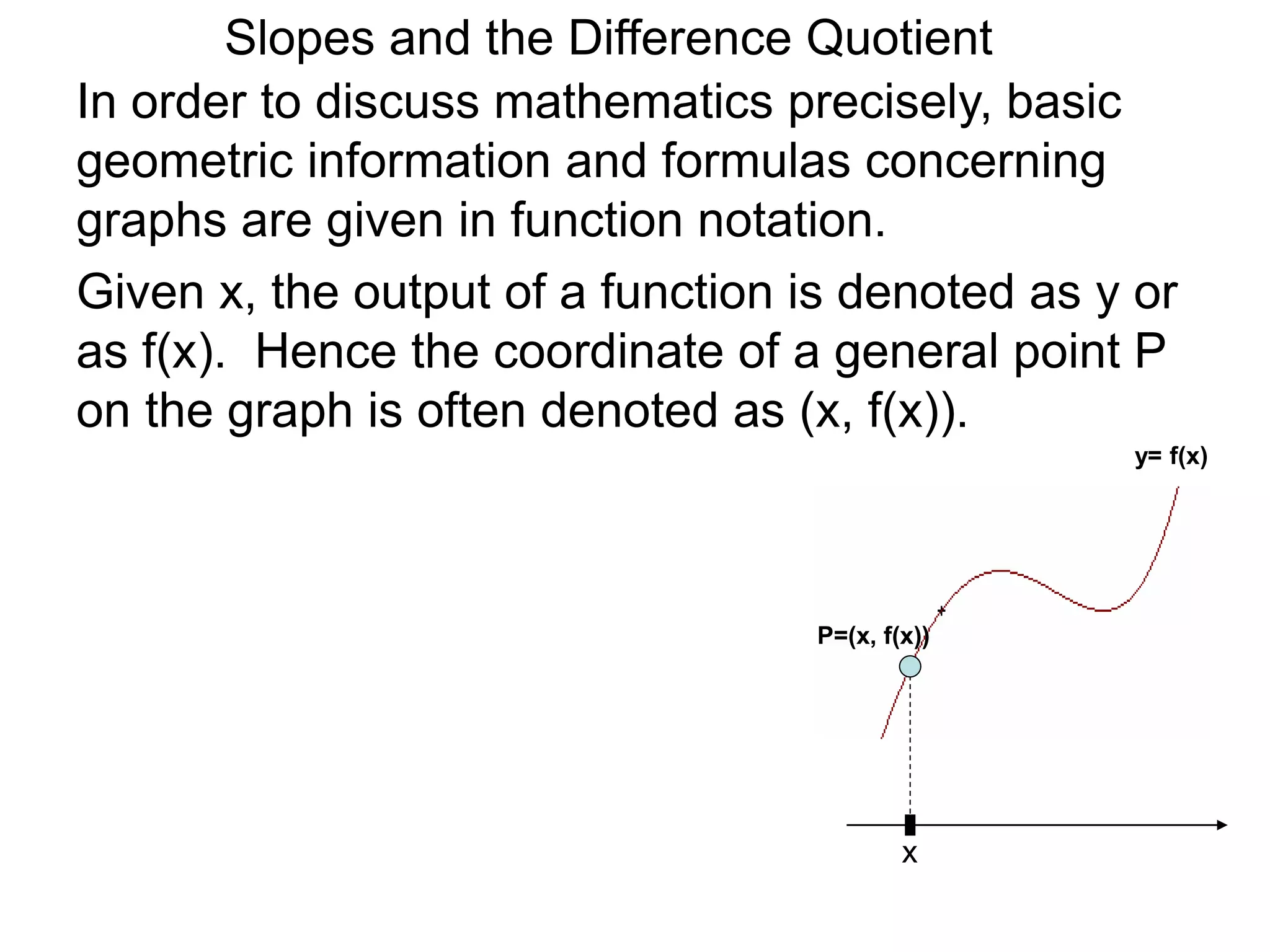
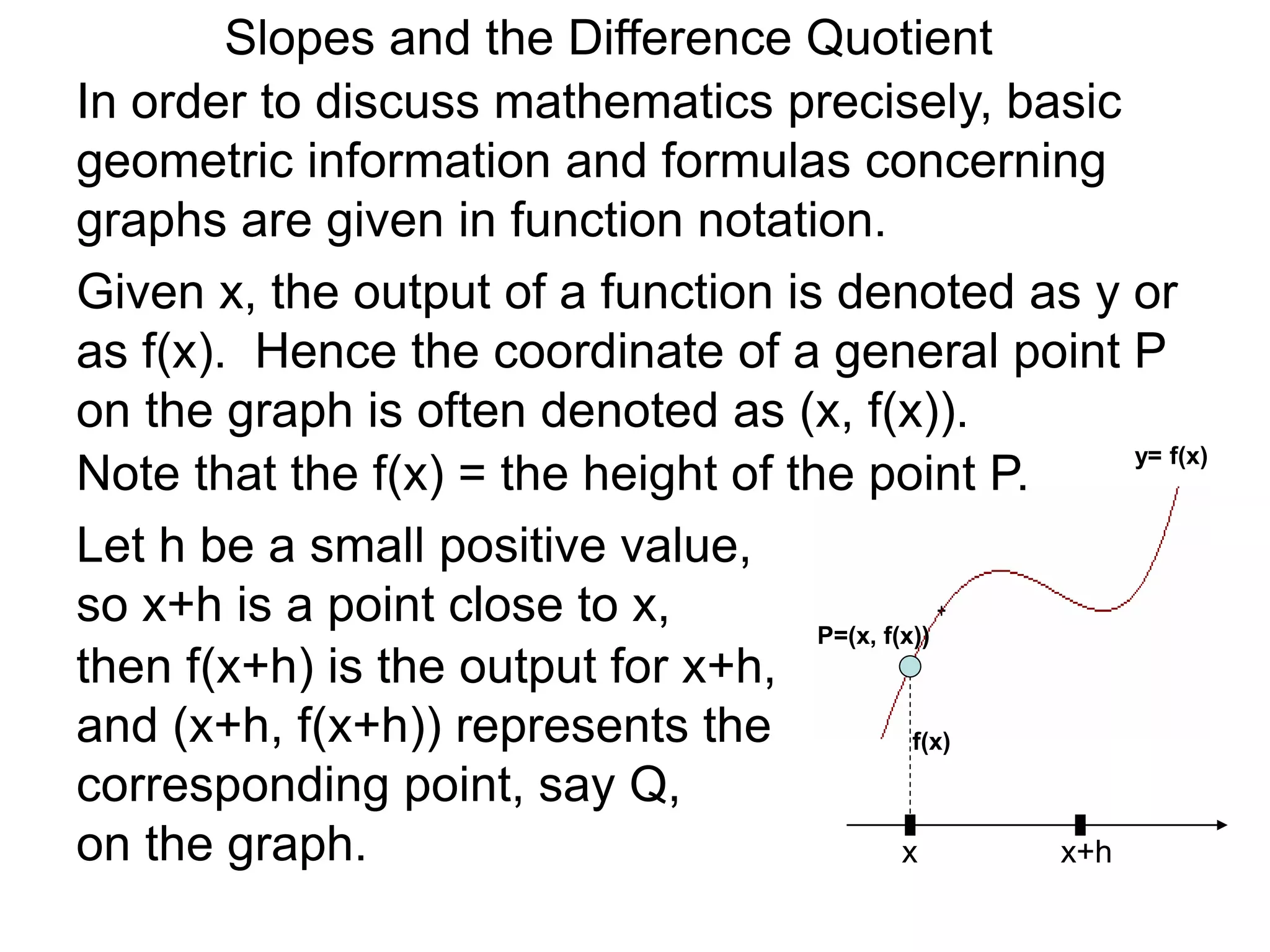
as f(x). Hence the coordinate of a general point P
on the graph is often denoted as (x, f(x)).
In order to discuss mathematics precisely, basic
geometric information and formulas concerning
graphs are given in function notation.
Slopes and the Difference Quotient
Given x, the output of a function is denoted as y or
as f(x). Hence the coordinate of a general point P
on the graph is often denoted as (x, f(x)).
x
P=(x, f(x))
In order to discuss mathematics precisely, basic
geometric information and formulas concerning
graphs are given in function notation.
y= f(x)
Slopes and the Difference Quotient
Given x, the output of a function is denoted as y or
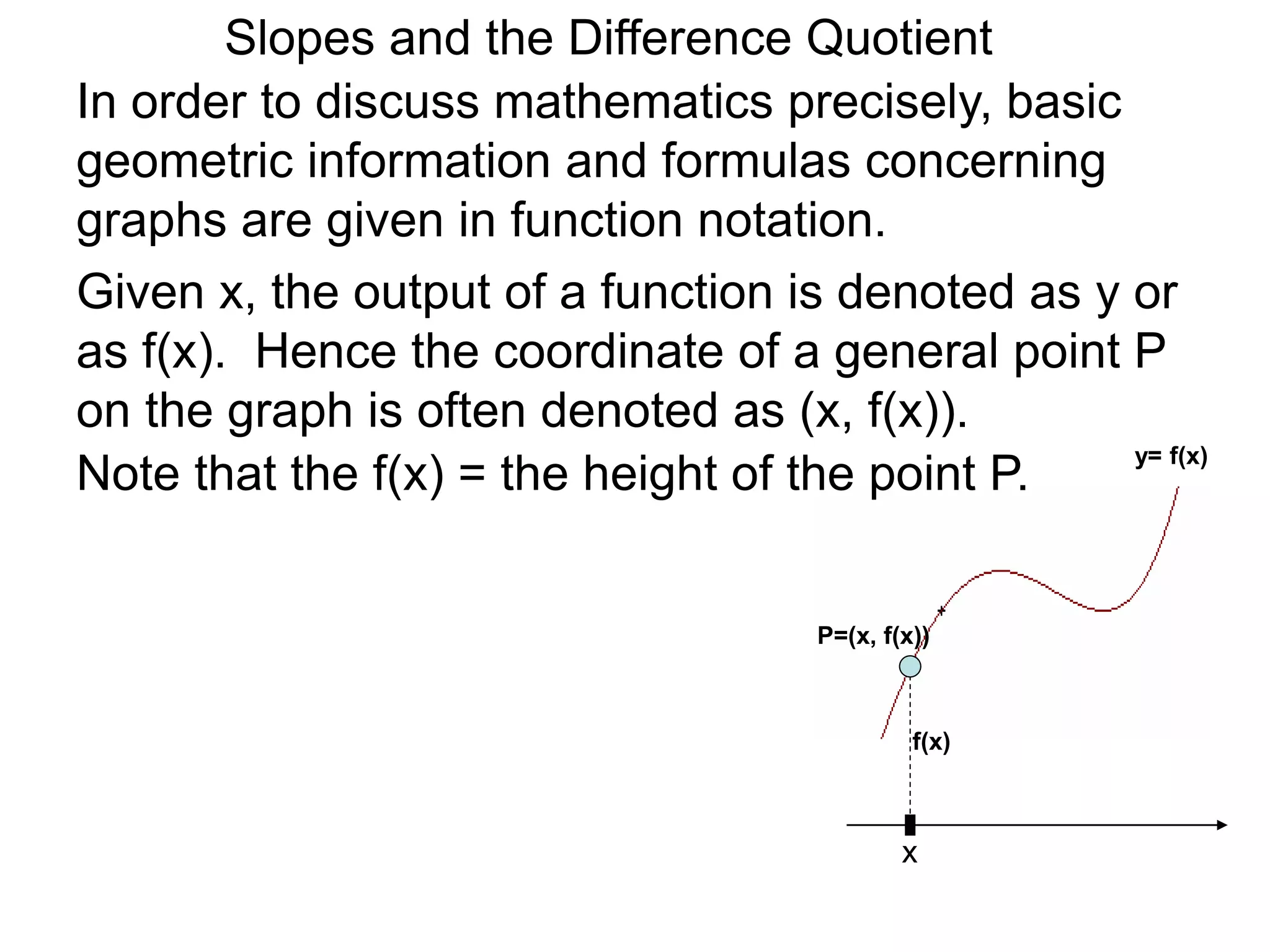
as f(x). Hence the coordinate of a general point P
on the graph is often denoted as (x, f(x)).
In order to discuss mathematics precisely, basic
geometric information and formulas concerning
graphs are given in function notation.
x
P=(x, f(x))
y= f(x)
f(x)
Note that the f(x) = the height of the point P.
Slopes and the Difference Quotient
Given x, the output of a function is denoted as y or
as f(x). Hence the coordinate of a general point P
on the graph is often denoted as (x, f(x)).
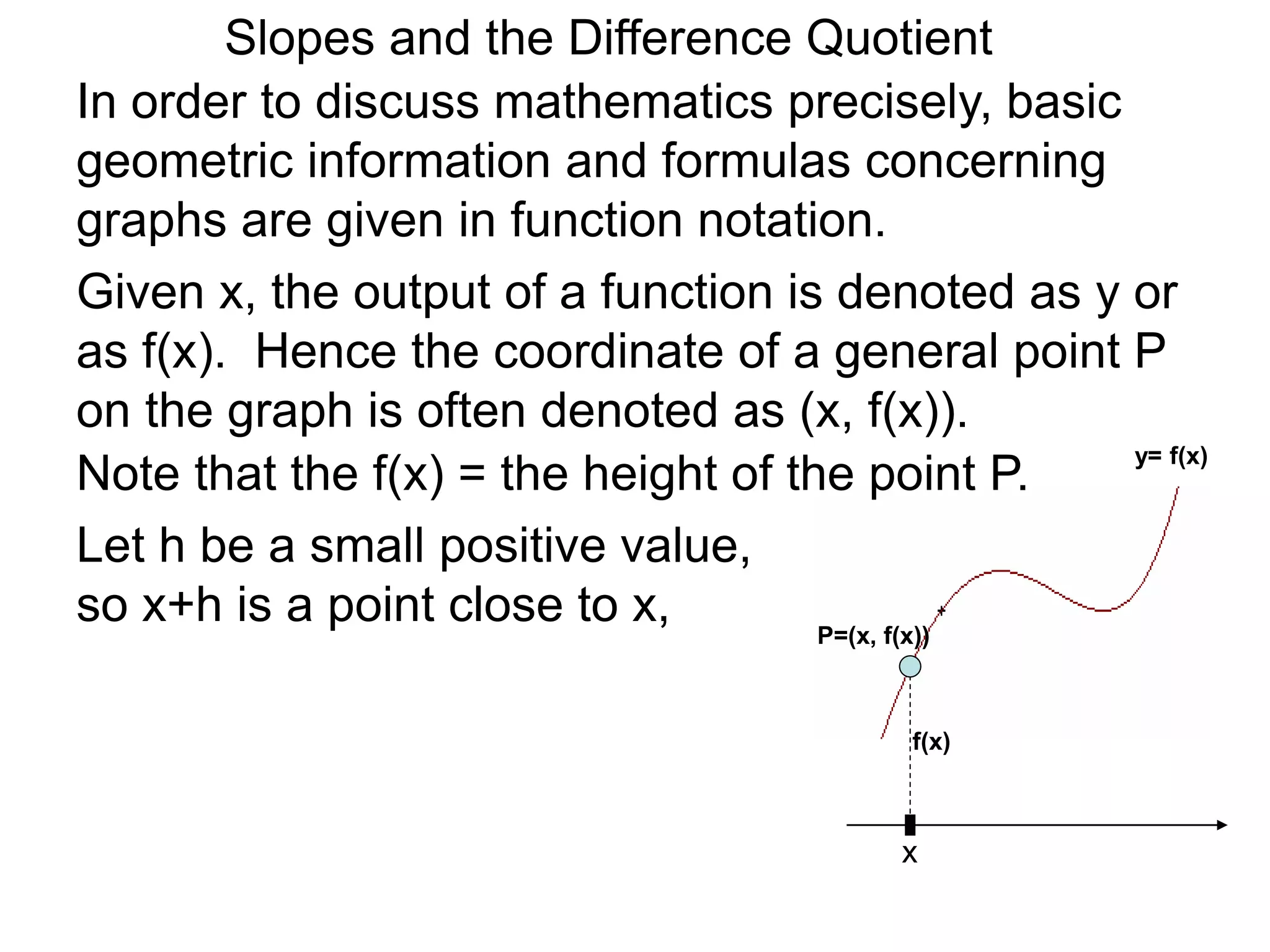
Let h be a small positive value,
so x+h is a point close to x,
In order to discuss mathematics precisely, basic
geometric information and formulas concerning
graphs are given in function notation.
x
P=(x, f(x))
y= f(x)
f(x)
Note that the f(x) = the height of the point P.
Slopes and the Difference Quotient
Given x, the output of a function is denoted as y or
as f(x). Hence the coordinate of a general point P
on the graph is often denoted as (x, f(x)).
x
P=(x, f(x))
Note that the f(x) = the height of the point P.
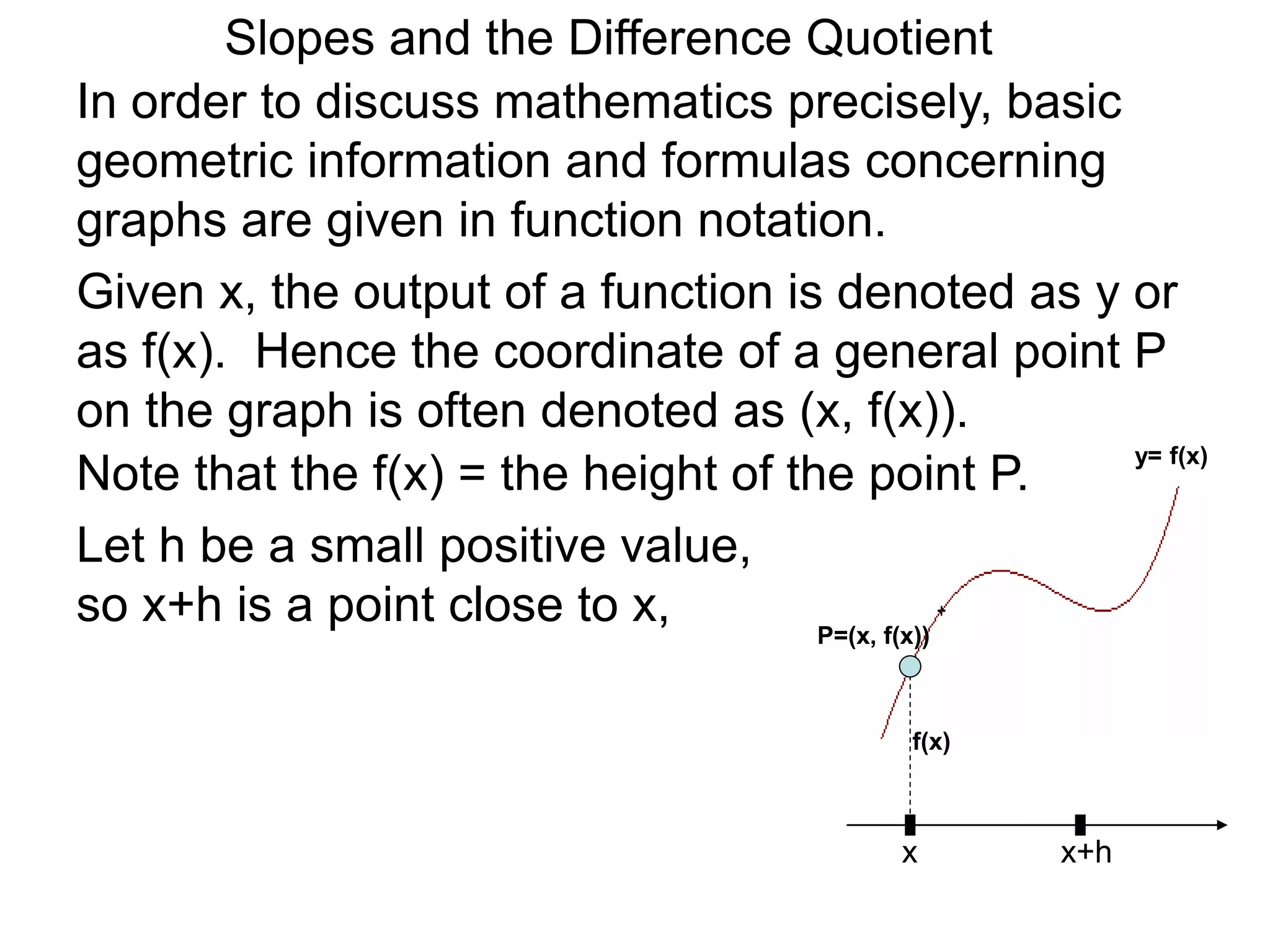
Let h be a small positive value,
so x+h is a point close to x,
x+h
In order to discuss mathematics precisely, basic
geometric information and formulas concerning
graphs are given in function notation.
f(x)
y= f(x)
Slopes and the Difference Quotient
Given x, the output of a function is denoted as y or
as f(x). Hence the coordinate of a general point P
on the graph is often denoted as (x, f(x)).
x
P=(x, f(x))
Note that the f(x) = the height of the point P.
Let h be a small positive value,
so x+h is a point close to x,
x+h
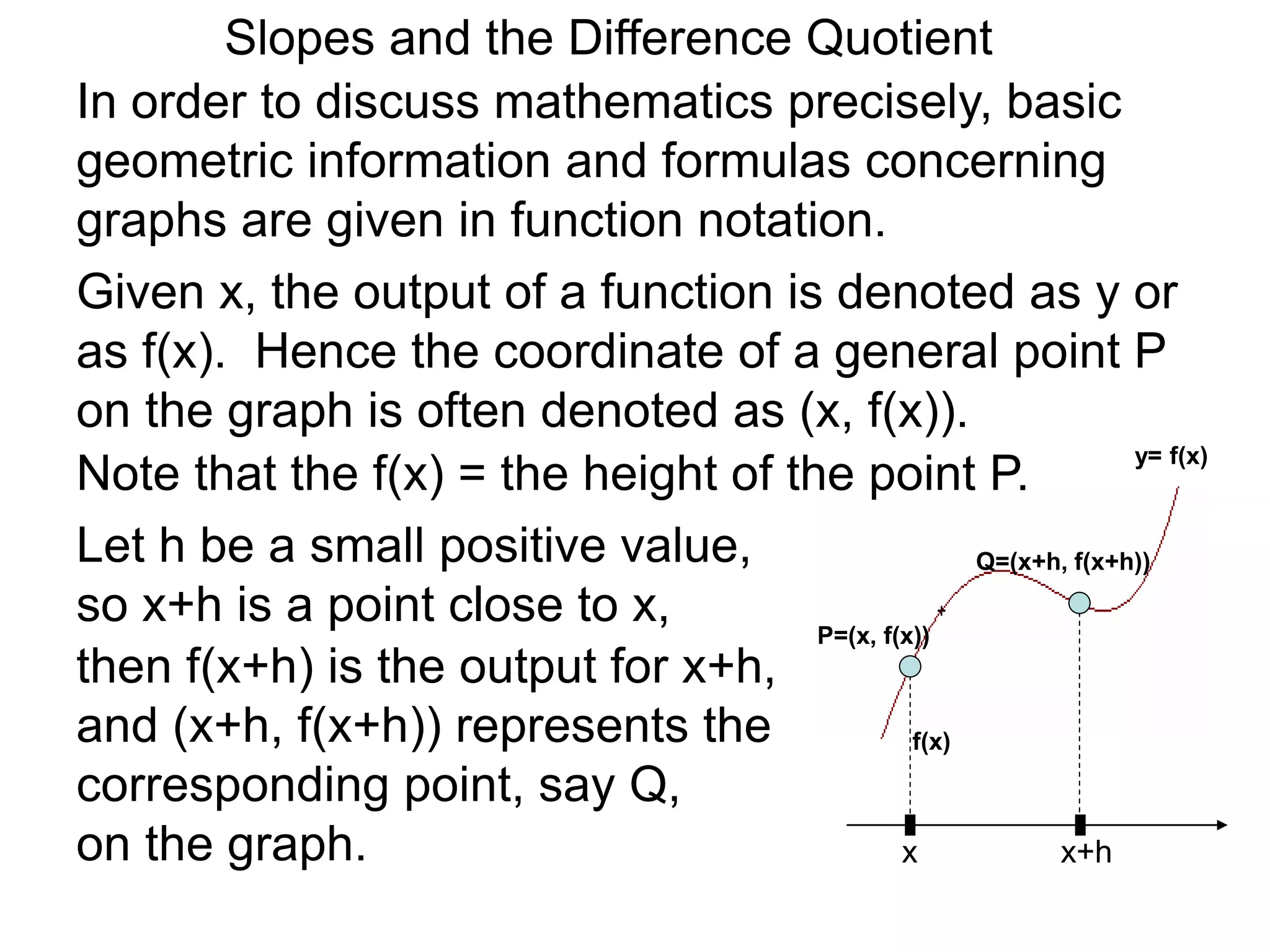
then f(x+h) is the output for x+h,
and (x+h, f(x+h)) represents the
corresponding point, say Q,
on the graph.
In order to discuss mathematics precisely, basic
geometric information and formulas concerning
graphs are given in function notation.
f(x)
y= f(x)
Slopes and the Difference Quotient
Given x, the output of a function is denoted as y or
as f(x). Hence the coordinate of a general point P
on the graph is often denoted as (x, f(x)).
x
P=(x, f(x))
Note that the f(x) = the height of the point P.
Let h be a small positive value,
so x+h is a point close to x,
x+h
then f(x+h) is the output for x+h,
and (x+h, f(x+h)) represents the
corresponding point, say Q,
on the graph.
In order to discuss mathematics precisely, basic
geometric information and formulas concerning
graphs are given in function notation.
Q=(x+h, f(x+h))
f(x)
y= f(x)
Slopes and the Difference Quotient
Given x, the output of a function is denoted as y or
as f(x). Hence the coordinate of a general point P
on the graph is often denoted as (x, f(x)).
x
P=(x, f(x))
Note that the f(x) = the height of the point P.
Let h be a small positive value,
so x+h is a point close to x,
x+h
then f(x+h) is the output for x+h,
and (x+h, f(x+h)) represents the
corresponding point, say Q,
on the graph.
In order to discuss mathematics precisely, basic
geometric information and formulas concerning
graphs are given in function notation.
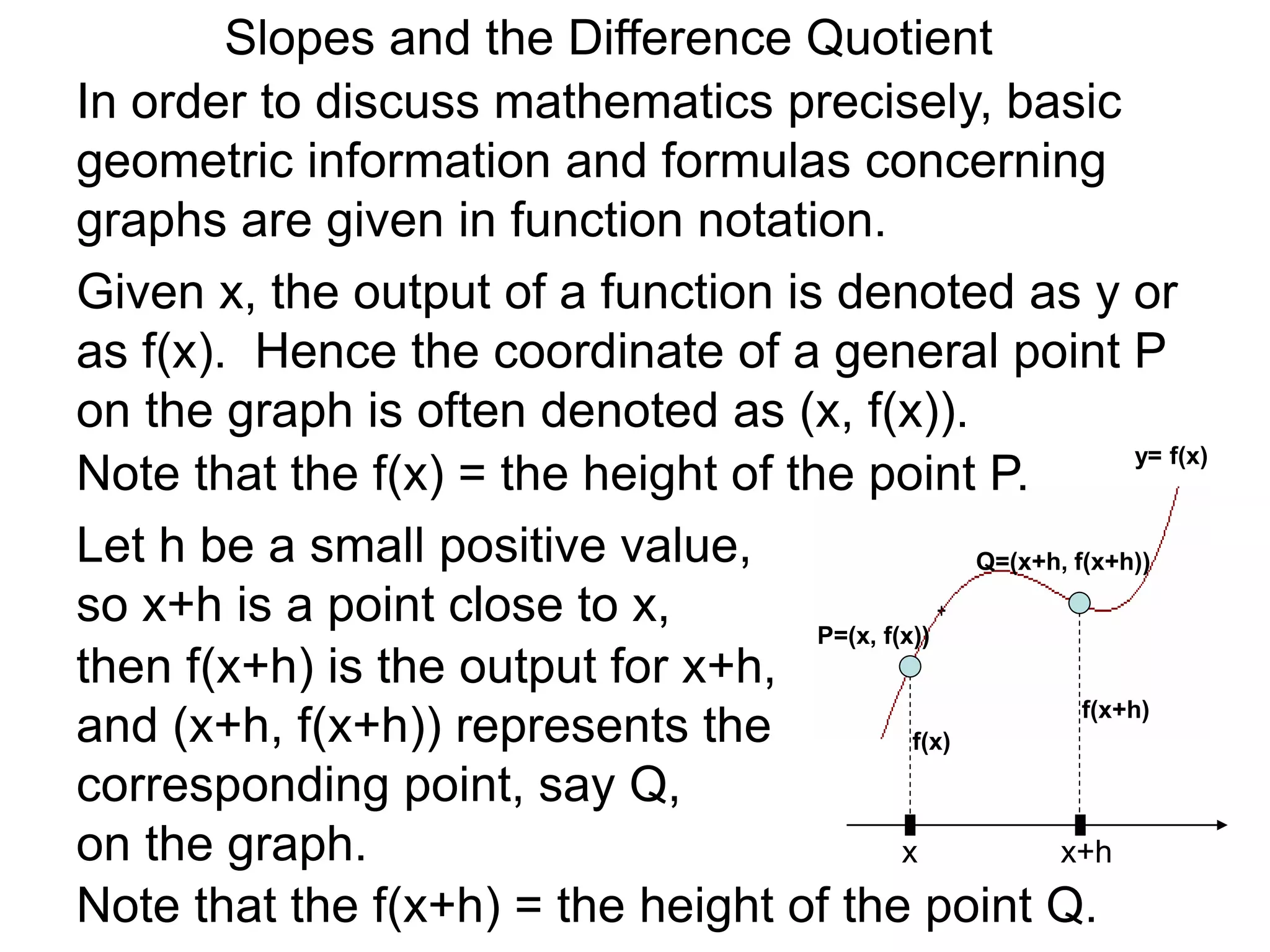
Note that the f(x+h) = the height of the point Q.
Q=(x+h, f(x+h))
f(x)
f(x+h)
y= f(x)
Slopes and the Difference Quotient
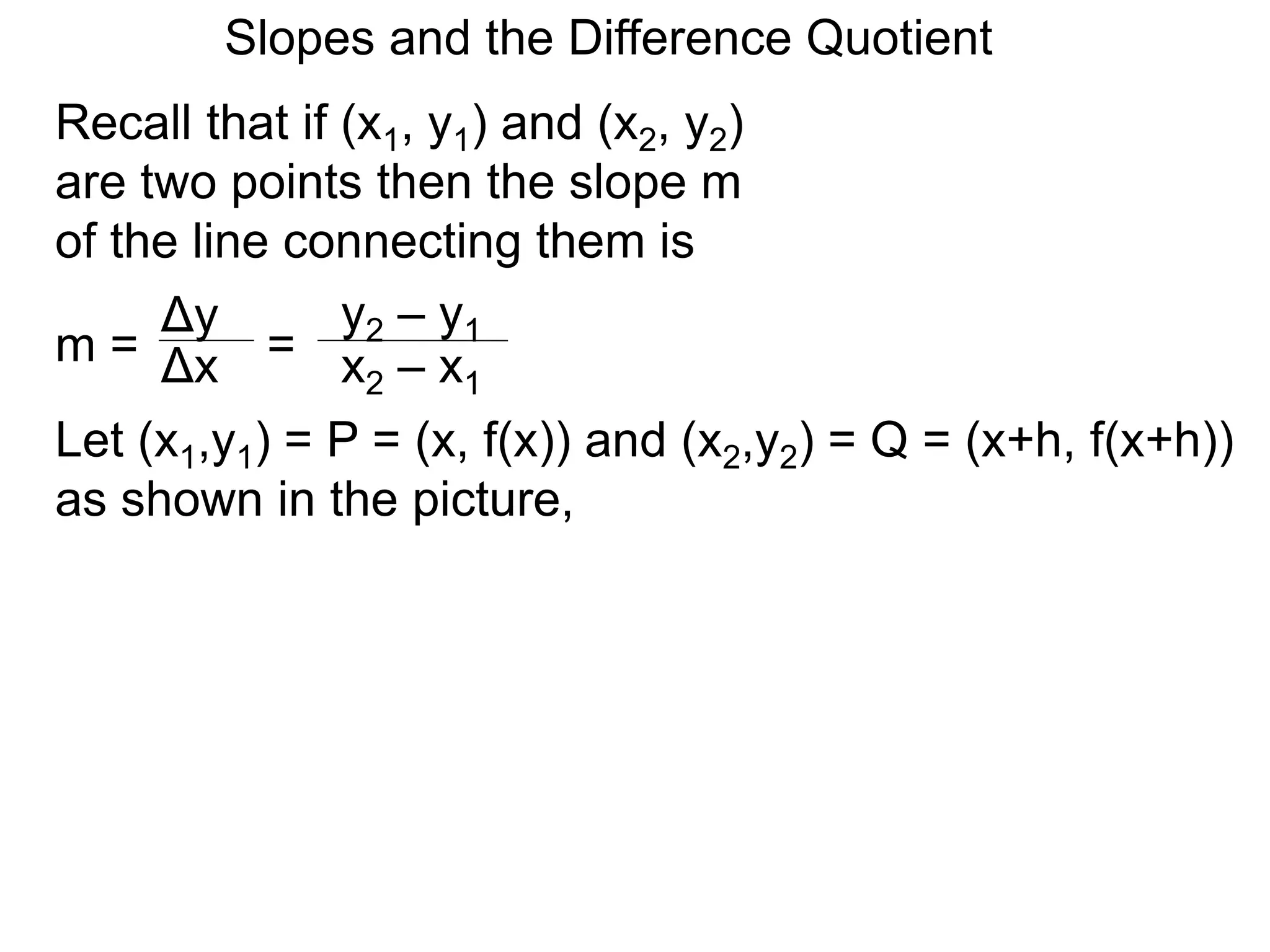
Recall that if (x1, y1) and (x2, y2)
are two points then the slope m
of the line connecting them is
Δy
m =
y2 – y1
= x2 – x1
Δx
Slopes and the Difference Quotient
Recall that if (x1, y1) and (x2, y2)
are two points then the slope m
of the line connecting them is
Δy
m =
y2 – y1
= x2 – x1
Δx
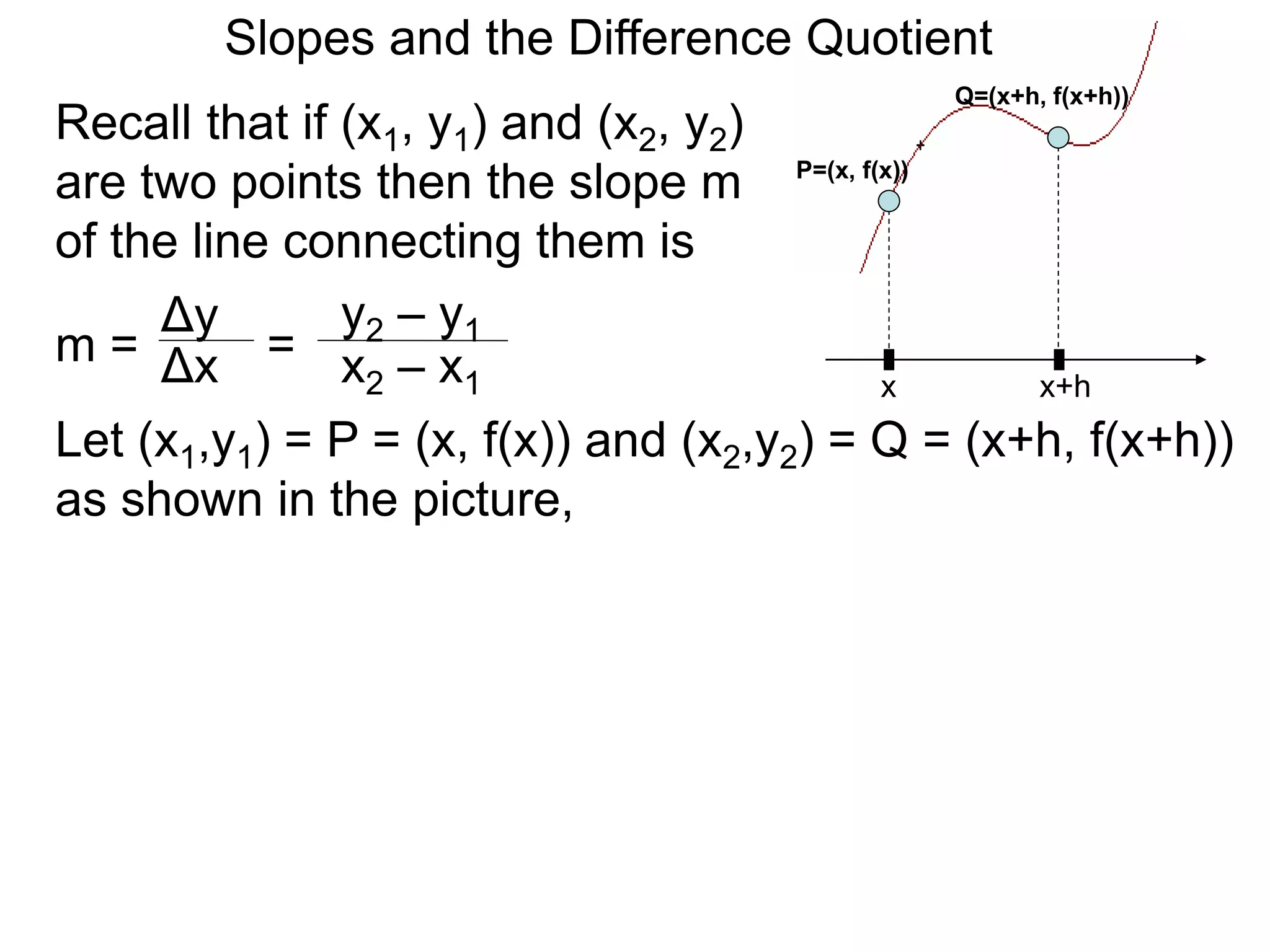
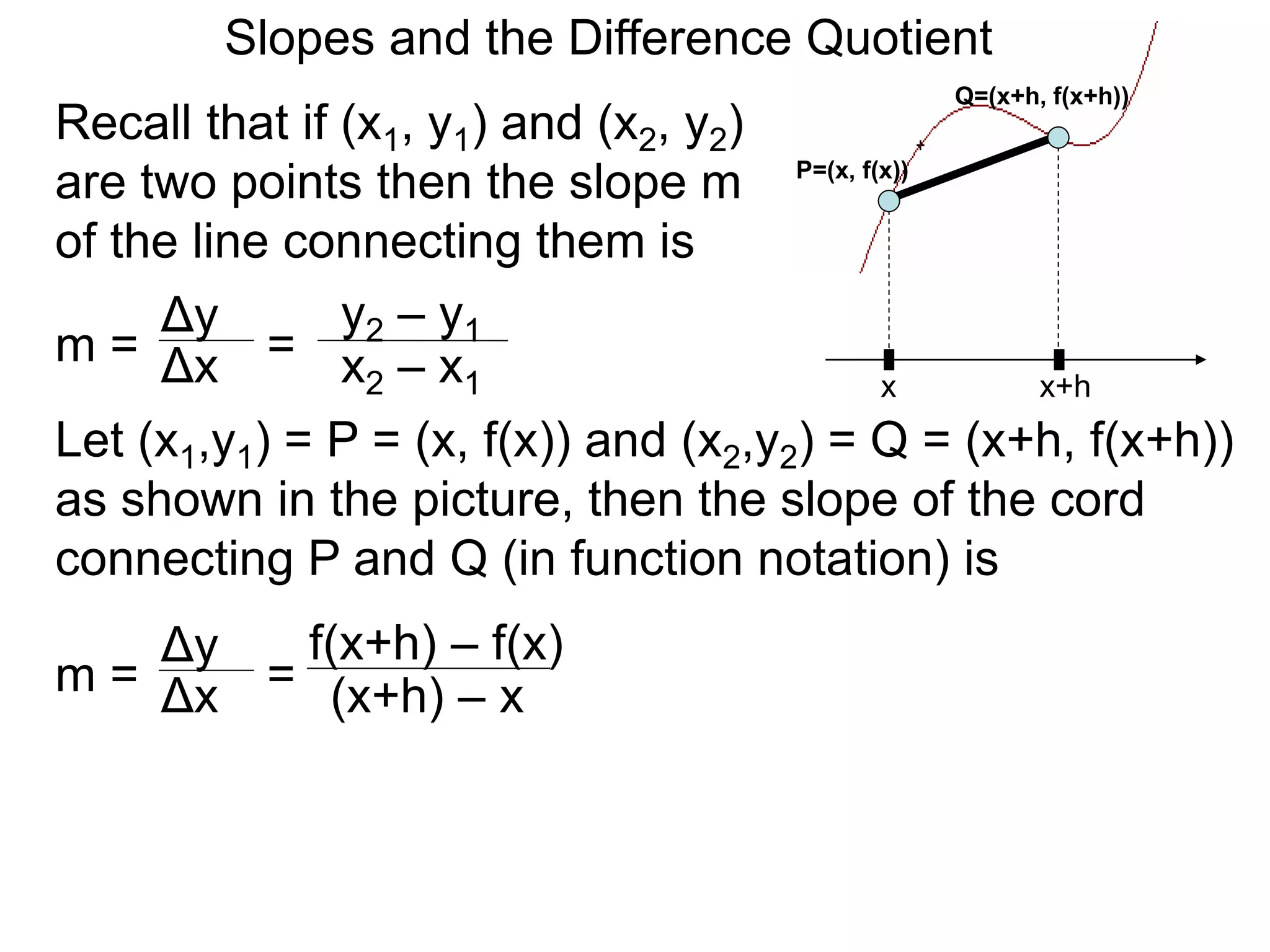
Let (x1,y1) = P = (x, f(x)) and (x2,y2) = Q = (x+h, f(x+h))
as shown in the picture,
Slopes and the Difference Quotient
Recall that if (x1, y1) and (x2, y2)
are two points then the slope m
of the line connecting them is
x
P=(x, f(x))
x+h
Q=(x+h, f(x+h))
Δy
m =
y2 – y1
= x2 – x1
Δx
Let (x1,y1) = P = (x, f(x)) and (x2,y2) = Q = (x+h, f(x+h))
as shown in the picture,
Slopes and the Difference Quotient
Recall that if (x1, y1) and (x2, y2)
are two points then the slope m
of the line connecting them is
x
P=(x, f(x))
x+h
Q=(x+h, f(x+h))
Δy
m =
y2 – y1
= x2 – x1
Δx
Let (x1,y1) = P = (x, f(x)) and (x2,y2) = Q = (x+h, f(x+h))
as shown in the picture, then the slope of the cord
connecting P and Q (in function notation) is
Slopes and the Difference Quotient
Recall that if (x1, y1) and (x2, y2)
are two points then the slope m
of the line connecting them is
x
P=(x, f(x))
x+h
Q=(x+h, f(x+h))
Δy
m =
y2 – y1
= x2 – x1
Δx
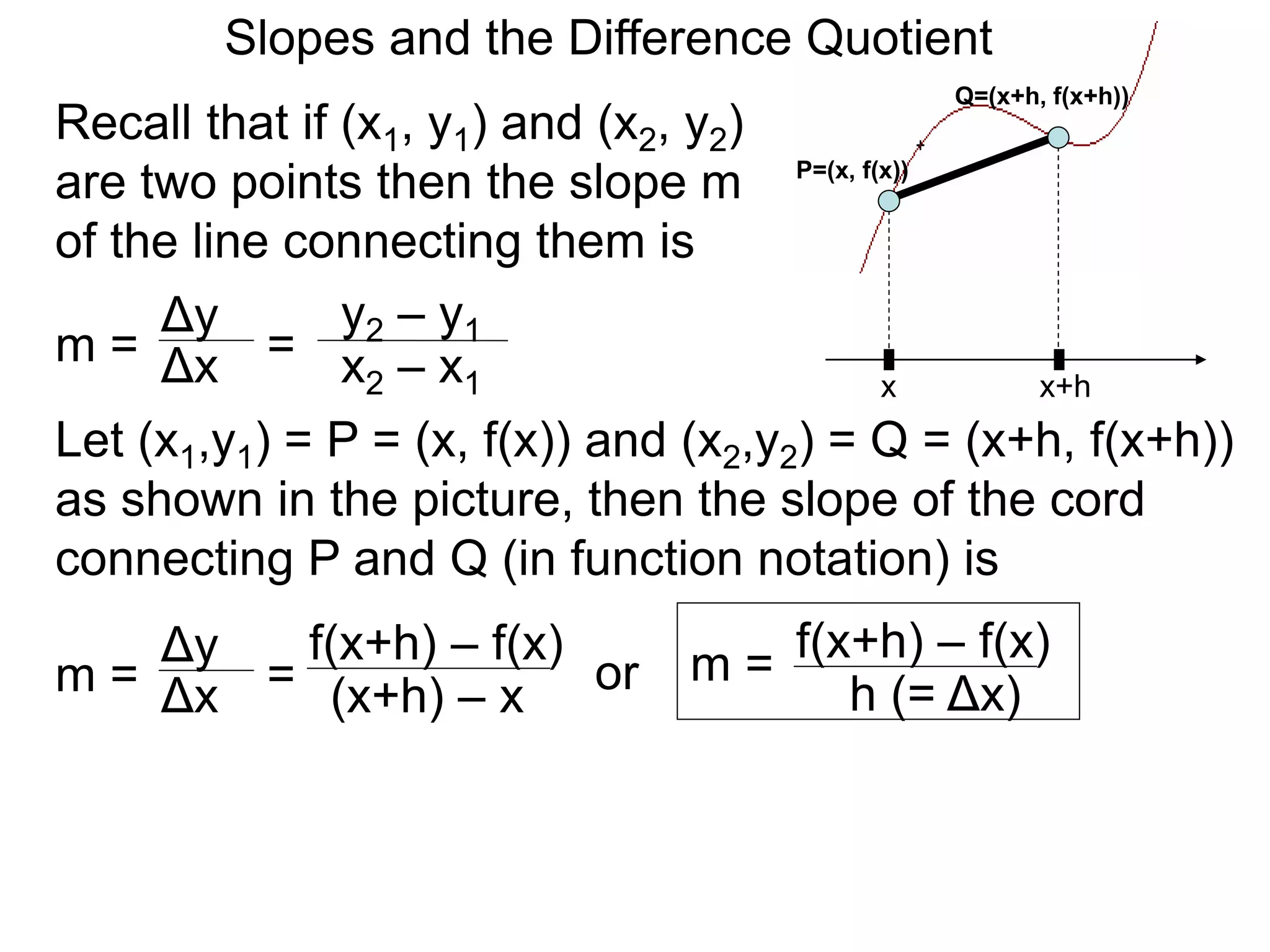
Let (x1,y1) = P = (x, f(x)) and (x2,y2) = Q = (x+h, f(x+h))
as shown in the picture, then the slope of the cord
connecting P and Q (in function notation) is
Δy
m =
f(x+h) – f(x)
= (x+h) – x
Δx
Slopes and the Difference Quotient
Recall that if (x1, y1) and (x2, y2)
are two points then the slope m
of the line connecting them is
x
P=(x, f(x))
x+h
Q=(x+h, f(x+h))
Δy
m =
y2 – y1
= x2 – x1
Δx
Let (x1,y1) = P = (x, f(x)) and (x2,y2) = Q = (x+h, f(x+h))
as shown in the picture, then the slope of the cord
connecting P and Q (in function notation) is
Δy
m =
f(x+h) – f(x)
= (x+h) – x
Δx or
Slopes and the Difference Quotient
m = f(x+h) – f(x)
h (= Δx)
Recall that if (x1, y1) and (x2, y2)
are two points then the slope m
of the line connecting them is
x
P=(x, f(x))
x+h
Q=(x+h, f(x+h))
Δy
m =
y2 – y1
= x2 – x1
Δx
Let (x1,y1) = P = (x, f(x)) and (x2,y2) = Q = (x+h, f(x+h))
as shown in the picture, then the slope of the cord
connecting P and Q (in function notation) is
Δy
m =
f(x+h) – f(x)
= (x+h) – x
Δx or
This is the "difference quotient" formula for slopes
Slopes and the Difference Quotient
m = f(x+h) – f(x)
h (= Δx)
Recall that if (x1, y1) and (x2, y2)
are two points then the slope m
of the line connecting them is
x
P=(x, f(x))
x+h
Q=(x+h, f(x+h))
Δy
m =
y2 – y1
= x2 – x1
Δx
Let (x1,y1) = P = (x, f(x)) and (x2,y2) = Q = (x+h, f(x+h))
as shown in the picture, then the slope of the cord
connecting P and Q (in function notation) is
Δy
m =
f(x+h) – f(x)
= (x+h) – x
Δx or m = f(x+h) – f(x)
h (= Δx)
f(x+h)–f(x) = Δy
because f(x+h) – f(x) = difference in height
This is the "difference quotient" formula for slopes
Slopes and the Difference Quotient
Recall that if (x1, y1) and (x2, y2)
are two points then the slope m
of the line connecting them is
x
P=(x, f(x))
x+h
Q=(x+h, f(x+h))
Δy
m =
y2 – y1
= x2 – x1
Δx
Let (x1,y1) = P = (x, f(x)) and (x2,y2) = Q = (x+h, f(x+h))
as shown in the picture, then the slope of the cord
connecting P and Q (in function notation) is
Δy
m =
f(x+h) – f(x)
= (x+h) – x
Δx or
h=Δx
f(x+h)–f(x) = Δy
because f(x+h) – f(x) = difference in height and
h = (x+h) – x = Δx = difference in the x's, as shown.
This is the "difference quotient" formula for slopes.
Slopes and the Difference Quotient
m = f(x+h) – f(x)
h (= Δx)
Example A.
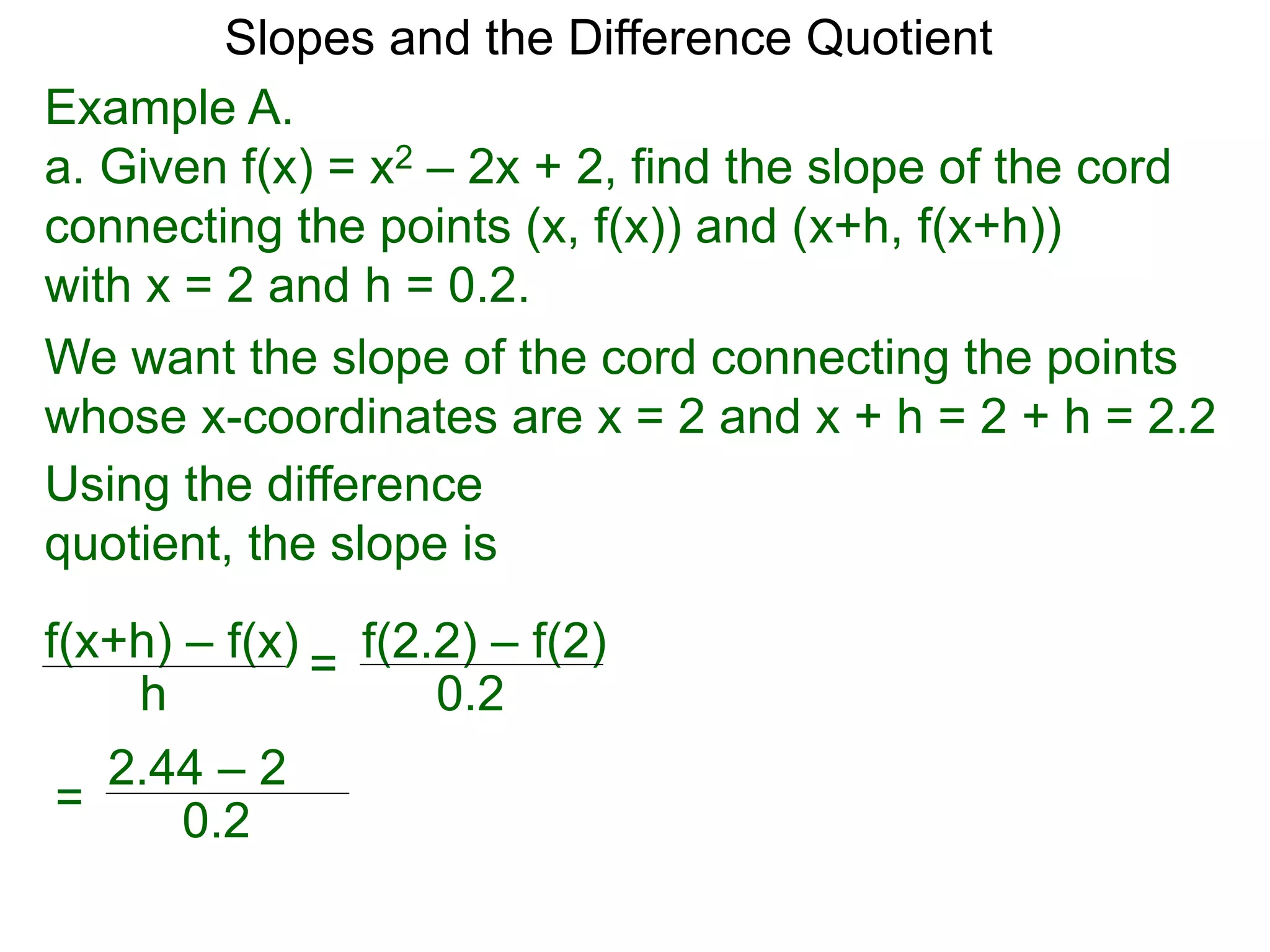
a. Given f(x) = x2 – 2x + 2, find the slope of the cord
connecting the points (x, f(x)) and (x+h, f(x+h))
with x = 2 and h = 0.2.
Slopes and the Difference Quotient
Example A.
a. Given f(x) = x2 – 2x + 2, find the slope of the cord
connecting the points (x, f(x)) and (x+h, f(x+h))
with x = 2 and h = 0.2.
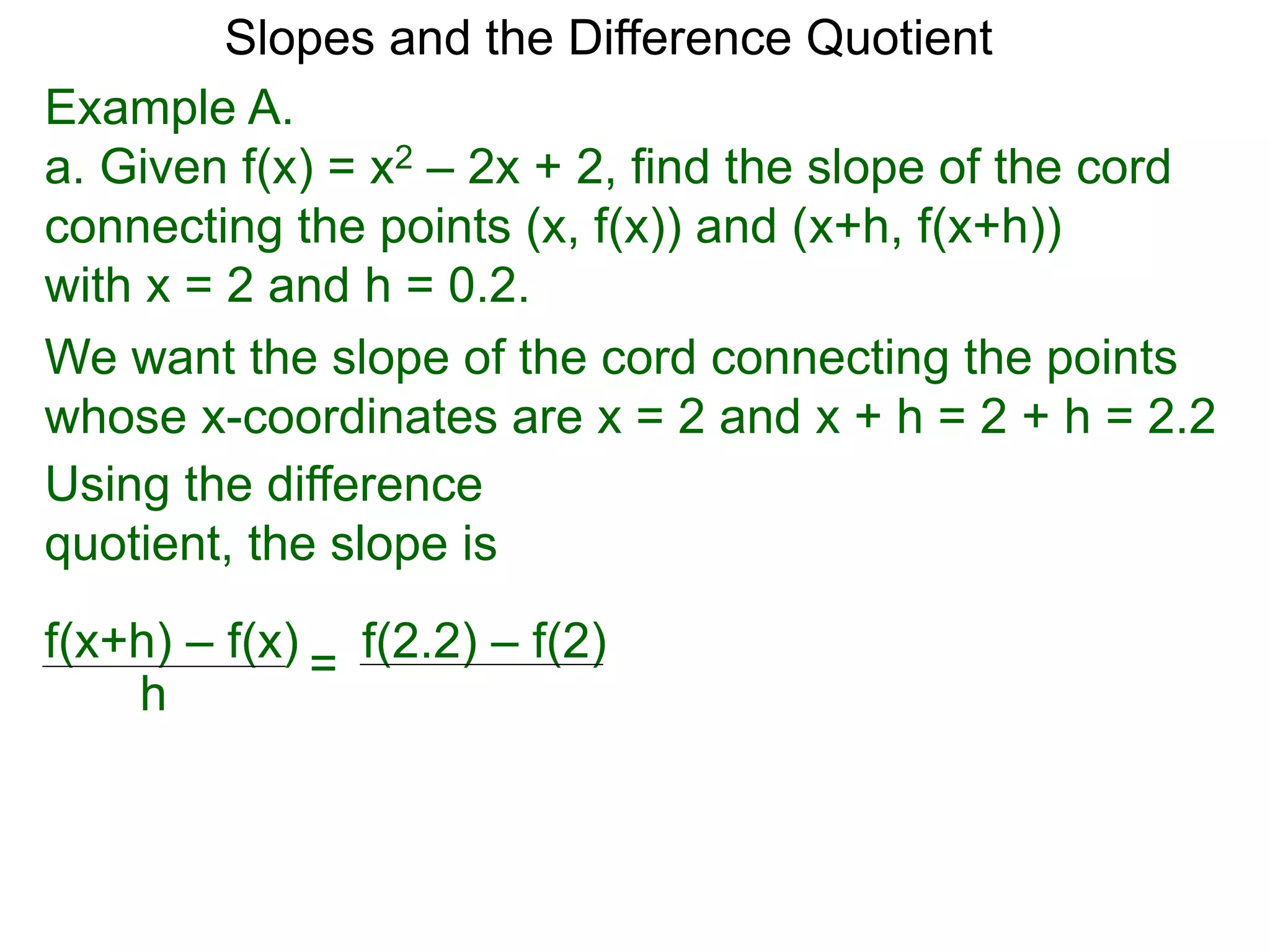
We want the slope of the cord connecting the points
whose x-coordinates are x = 2 and x + h = 2 + h = 2.2.
Slopes and the Difference Quotient
Example A.
a. Given f(x) = x2 – 2x + 2, find the slope of the cord
connecting the points (x, f(x)) and (x+h, f(x+h))
with x = 2 and h = 0.2.
f(x+h) – f(x)
h
Using the difference
quotient, the slope is
We want the slope of the cord connecting the points
whose x-coordinates are x = 2 and x + h = 2 + h = 2.2
Slopes and the Difference Quotient
Example A.
a. Given f(x) = x2 – 2x + 2, find the slope of the cord
connecting the points (x, f(x)) and (x+h, f(x+h))
with x = 2 and h = 0.2.
f(x+h) – f(x)
h
Using the difference
quotient, the slope is
We want the slope of the cord connecting the points
whose x-coordinates are x = 2 and x + h = 2 + h = 2.2
f(2.2) – f(2)
=
Slopes and the Difference Quotient
Example A.
a. Given f(x) = x2 – 2x + 2, find the slope of the cord
connecting the points (x, f(x)) and (x+h, f(x+h))
with x = 2 and h = 0.2.
f(x+h) – f(x)
h
Using the difference
quotient, the slope is
We want the slope of the cord connecting the points
whose x-coordinates are x = 2 and x + h = 2 + h = 2.2
f(2.2) – f(2)
0.2
=
Slopes and the Difference Quotient
Example A.
a. Given f(x) = x2 – 2x + 2, find the slope of the cord
connecting the points (x, f(x)) and (x+h, f(x+h))
with x = 2 and h = 0.2.
f(x+h) – f(x)
h
Using the difference
quotient, the slope is
We want the slope of the cord connecting the points
whose x-coordinates are x = 2 and x + h = 2 + h = 2.2
f(2.2) – f(2)
0.2
=
=
2.44 – 2
0.2
Slopes and the Difference Quotient
Example A.
a. Given f(x) = x2 – 2x + 2, find the slope of the cord
connecting the points (x, f(x)) and (x+h, f(x+h))
with x = 2 and h = 0.2.
f(x+h) – f(x)
h
Using the difference
quotient, the slope is
We want the slope of the cord connecting the points
whose x-coordinates are x = 2 and x + h = 2 + h = 2.2
f(2.2) – f(2)
0.2
=
=
2.44 – 2
0.2 =
0.44
0.2
Slopes and the Difference Quotient
Example A.
a. Given f(x) = x2 – 2x + 2, find the slope of the cord
connecting the points (x, f(x)) and (x+h, f(x+h))
with x = 2 and h = 0.2.
f(x+h) – f(x)
h
Using the difference
quotient, the slope is
We want the slope of the cord connecting the points
whose x-coordinates are x = 2 and x + h = 2 + h = 2.2
f(2.2) – f(2)
0.2
=
=
2.44 – 2
0.2
= 2.2
=
0.44
0.2
Slopes and the Difference Quotient
Example A.
a. Given f(x) = x2 – 2x + 2, find the slope of the cord
connecting the points (x, f(x)) and (x+h, f(x+h))
with x = 2 and h = 0.2.
f(x+h) – f(x)
h
Using the difference
quotient, the slope is
We want the slope of the cord connecting the points
whose x-coordinates are x = 2 and x + h = 2 + h = 2.2
f(2.2) – f(2)
0.2
=
=
2.44 – 2
0.2
= 2.2
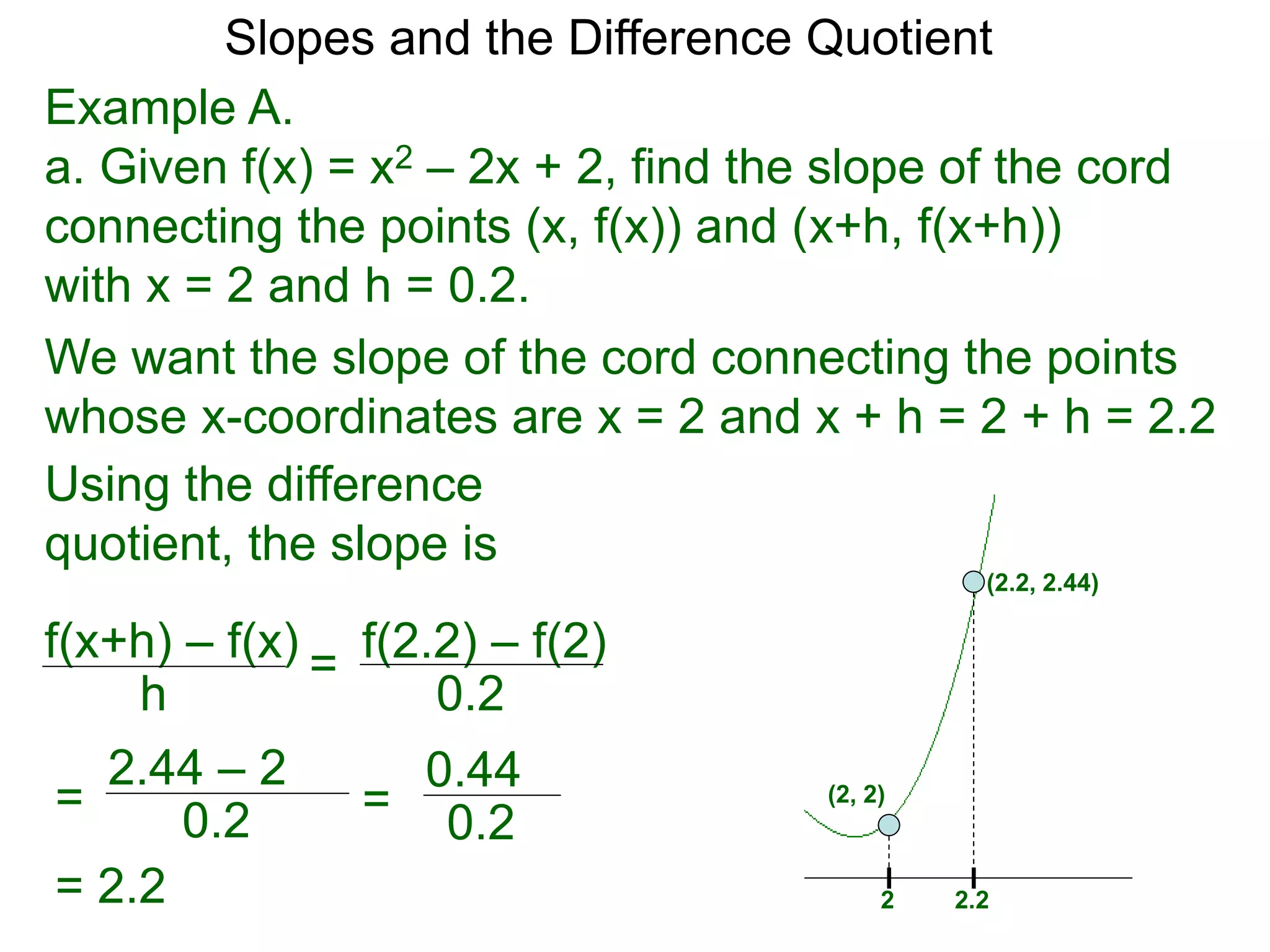
(2.2, 2.44)
(2, 2)
2 2.2
=
0.44
0.2
Slopes and the Difference Quotient
Example A.
a. Given f(x) = x2 – 2x + 2, find the slope of the cord
connecting the points (x, f(x)) and (x+h, f(x+h))
with x = 2 and h = 0.2.
f(x+h) – f(x)
h
Using the difference
quotient, the slope is
We want the slope of the cord connecting the points
whose x-coordinates are x = 2 and x + h = 2 + h = 2.2
f(2.2) – f(2)
0.2
=
=
2.44 – 2
0.2
= 2.2
(2.2, 2.44)
(2, 2)
2 2.2
=
0.44
0.2
0.44
0.2
slope m = 2.2
Slopes and the Difference Quotient
The algebra of calculating the slopes of some basic
types of functions are given below.
Slope Algebra
The algebra of calculating the slopes of some basic
types of functions are given below.
Slope Algebra
Example B. Simplify the difference quotient.
Make sure the h is cancelled.
a. (2nd degree polynomials) f(x) = –2x2 + 3x + 1
The algebra of calculating the slopes of some basic
types of functions are given below.
Slope Algebra
Example B. Simplify the difference quotient.
Make sure the h is cancelled.
f(x+h) – f(x)
h
=
a. (2nd degree polynomials) f(x) = –2x2 + 3x + 1
The algebra of calculating the slopes of some basic
types of functions are given below.
Slope Algebra
Example B. Simplify the difference quotient.
Make sure the h is cancelled.
f(x+h) – f(x)
h
=
–2(x+h)2 + 3(x+h) + 1 – [–2x2 +3x +1]
h
a. (2nd degree polynomials) f(x) = –2x2 + 3x + 1
The algebra of calculating the slopes of some basic
types of functions are given below.
Slope Algebra
Example B. Simplify the difference quotient.
Make sure the h is cancelled.
f(x+h) – f(x)
h
=
–2(x+h)2 + 3(x+h) + 1 – [–2x2 +3x +1]
h
a. (2nd degree polynomials) f(x) = –2x2 + 3x + 1
–2x2 –4xh –2h2 +3x +3h +1 – [–2x2 +3x +1]
h
=
The algebra of calculating the slopes of some basic
types of functions are given below.
Slope Algebra
Example B. Simplify the difference quotient.
Make sure the h is cancelled.
f(x+h) – f(x)
h
=
–2(x+h)2 + 3(x+h) + 1 – [–2x2 +3x +1]
h
a. (2nd degree polynomials) f(x) = –2x2 + 3x + 1
–2x2 –4xh –2h2 +3x +3h +1 – [–2x2 +3x +1]
h
=
–4xh –2h2 +3h
h
=
h(–4x –2h +3)
h
=
The algebra of calculating the slopes of some basic
types of functions are given below.
Slope Algebra
Example B. Simplify the difference quotient.
Make sure the h is cancelled.
f(x+h) – f(x)
h
=
–2(x+h)2 + 3(x+h) + 1 – [–2x2 +3x +1]
h
a. (2nd degree polynomials) f(x) = –2x2 + 3x + 1
–2x2 –4xh –2h2 +3x +3h +1 – [–2x2 +3x +1]
h
=
–4xh –2h2 +3h
h
=
h(–4x –2h +3)
h
= = –4x –2h +3
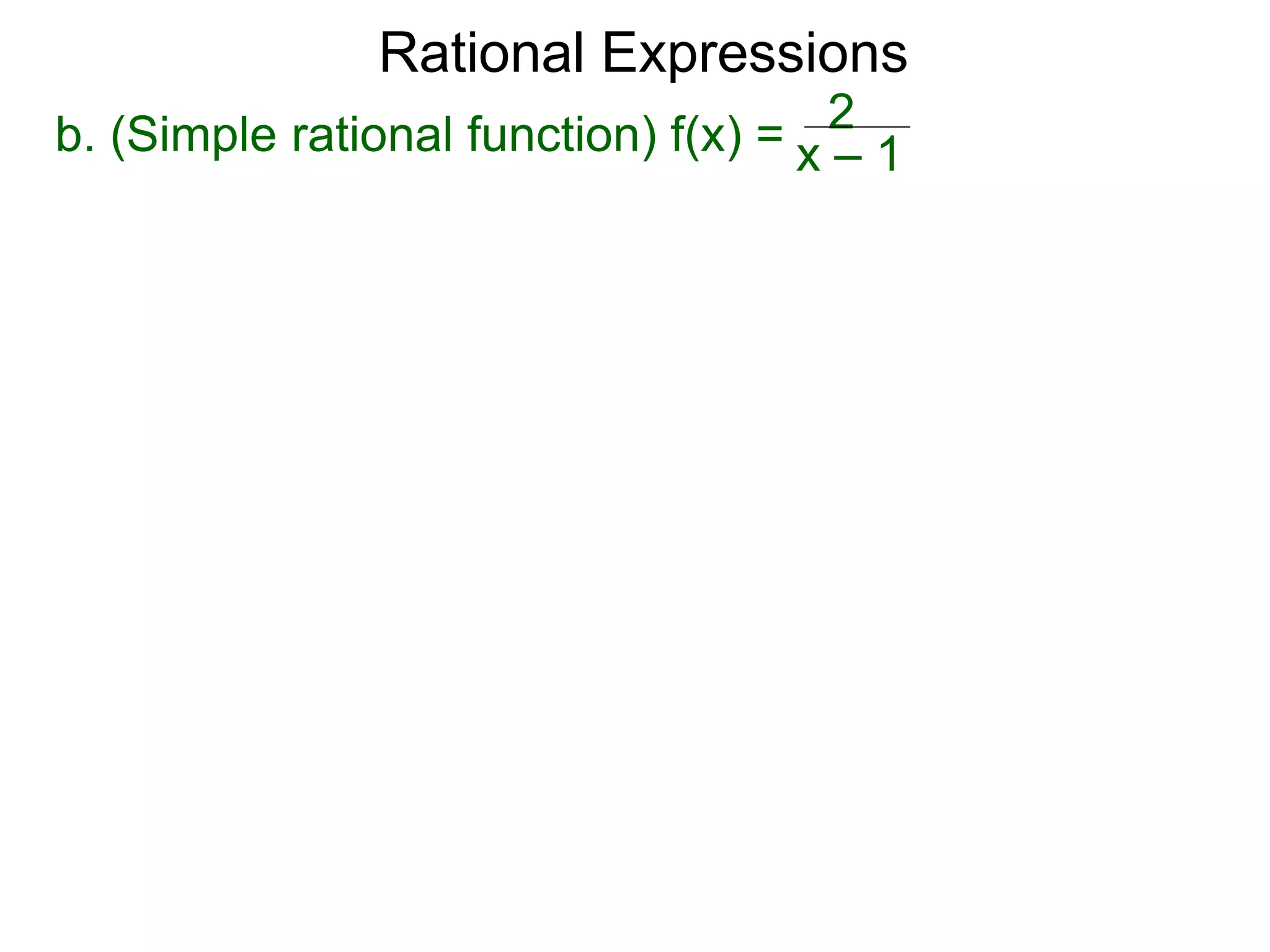
Rational Expressions
b. (Simple rational function) f(x) = x – 1
2
Rational Expressions
b. (Simple rational function) f(x) = x – 1
2
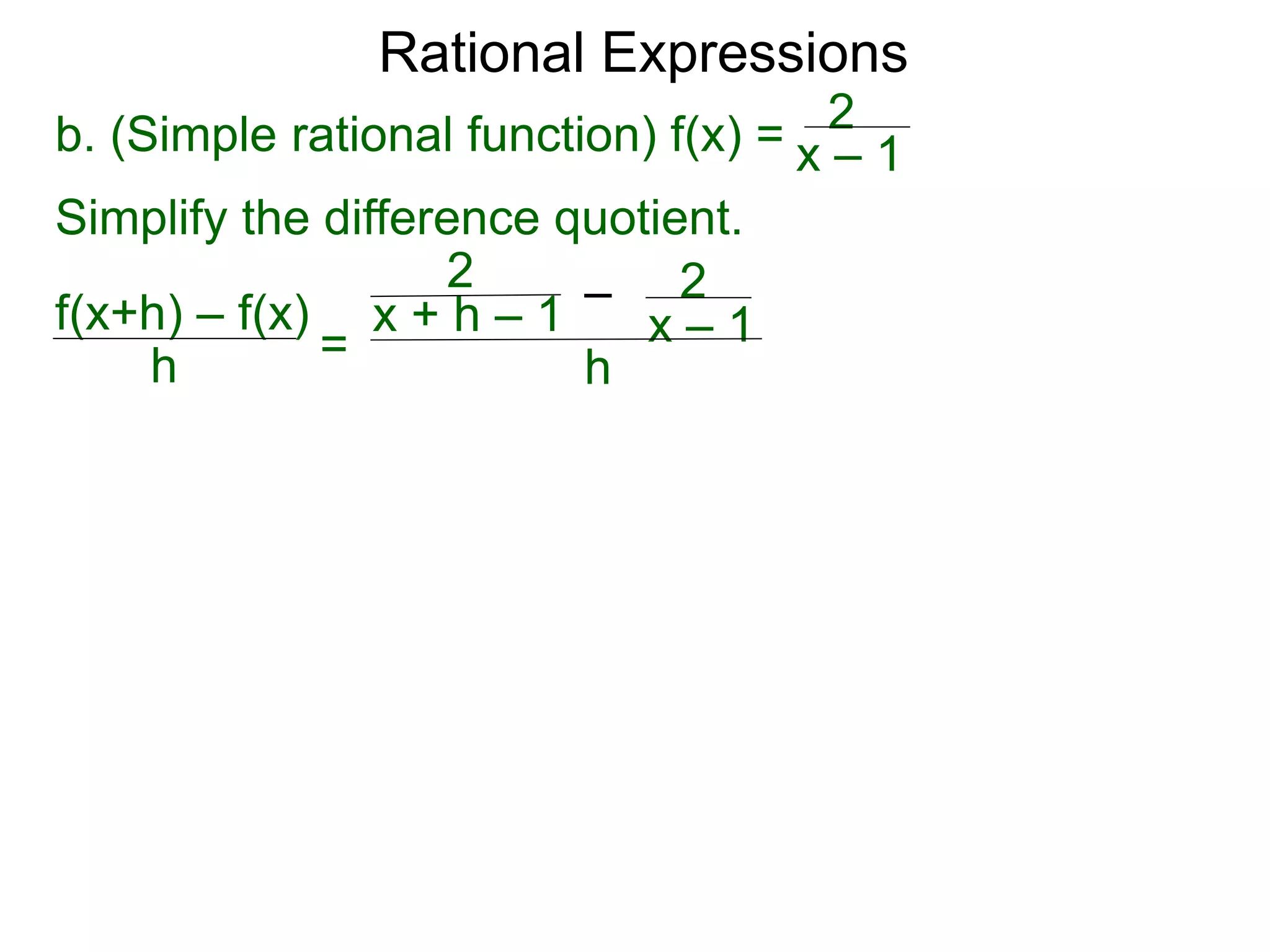
Simplify the difference quotient.
Rational Expressions
–
x + h – 1
2
x – 1
2
h
b. (Simple rational function) f(x) = x – 1
2
Simplify the difference quotient.
f(x+h) – f(x)
h =
Rational Expressions
–
x + h – 1
2
x – 1
2
h
Multiply the top and bottom by (x + h – 1)(x – 1)
to remove fractions in the numerator.
b. (Simple rational function) f(x) = x – 1
2
Simplify the difference quotient.
f(x+h) – f(x)
h =
Rational Expressions
–
x + h – 1
2
x – 1
2
h
Multiply the top and bottom by (x + h – 1)(x – 1)
to remove fractions in the numerator.
b. (Simple rational function) f(x) = x – 1
2
Simplify the difference quotient.
f(x+h) – f(x)
h =
–
x + h – 1
2
x – 1
2
h
[ ]
Rational Expressions
–
x + h – 1
2
x – 1
2
h
Multiply the top and bottom by (x + h – 1)(x – 1)
to remove fractions in the numerator.
(x + h –1)(x – 1)
(x + h –1)(x – 1)
*
b. (Simple rational function) f(x) = x – 1
2
Simplify the difference quotient.
f(x+h) – f(x)
h =
–
x + h – 1
2
x – 1
2
h
[ ]
Rational Expressions
–
x + h – 1
2
x – 1
2
h
Multiply the top and bottom by (x + h – 1)(x – 1)
to remove fractions in the numerator.
(x + h –1)(x – 1)
(x + h –1)(x – 1)
*
=
–
2(x – 1) 2(x + h –1)
h
b. (Simple rational function) f(x) = x – 1
2
Simplify the difference quotient.
f(x+h) – f(x)
h =
–
x + h – 1
2
x – 1
2
h
(x + h –1)(x – 1)
[ ]
Rational Expressions
–
x + h – 1
2
x – 1
2
h
Multiply the top and bottom by (x + h – 1)(x – 1)
to remove fractions in the numerator.
(x + h –1)(x – 1)
(x + h –1)(x – 1)
*
=
–
2(x – 1) 2(x + h –1)
h
b. (Simple rational function) f(x) = x – 1
2
Simplify the difference quotient.
f(x+h) – f(x)
h =
–
x + h – 1
2
x – 1
2
h
(x + h –1)(x – 1) =
– 2h
h(x + h –1)(x – 1)
[ ]
Rational Expressions
–
x + h – 1
2
x – 1
2
h
Multiply the top and bottom by (x + h – 1)(x – 1)
to remove fractions in the numerator.
(x + h –1)(x – 1)
(x + h –1)(x – 1)
*
=
–
2(x – 1) 2(x + h –1)
h
b. (Simple rational function) f(x) = x – 1
2
Simplify the difference quotient.
f(x+h) – f(x)
h =
–
x + h – 1
2
x – 1
2
h
(x + h –1)(x – 1) =
– 2h
h(x + h –1)(x – 1)
=
–2
(x + h –1)(x – 1)
[ ]
Rational Expressions
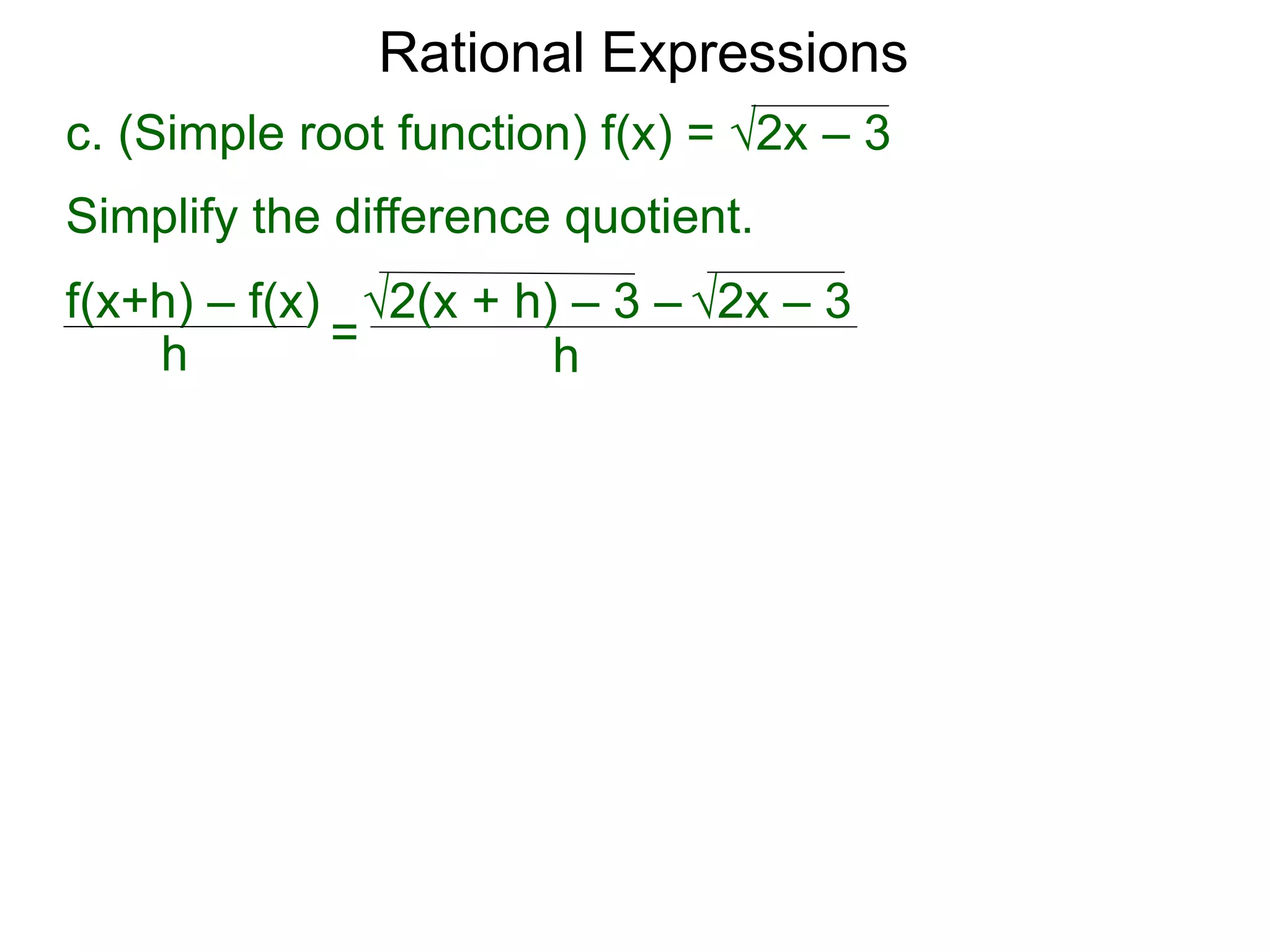
c. (Simple root function) f(x) = √2x – 3
Simplify the difference quotient.
f(x+h) – f(x)
h
Rational Expressions
h
c. (Simple root function) f(x) = √2x – 3
Simplify the difference quotient.
f(x+h) – f(x)
h =
√2(x + h) – 3 – √2x – 3
Rational Expressions
h
c. (Simple root function) f(x) = √2x – 3
Simplify the difference quotient.
f(x+h) – f(x)
h =
√2(x + h) – 3 – √2x – 3
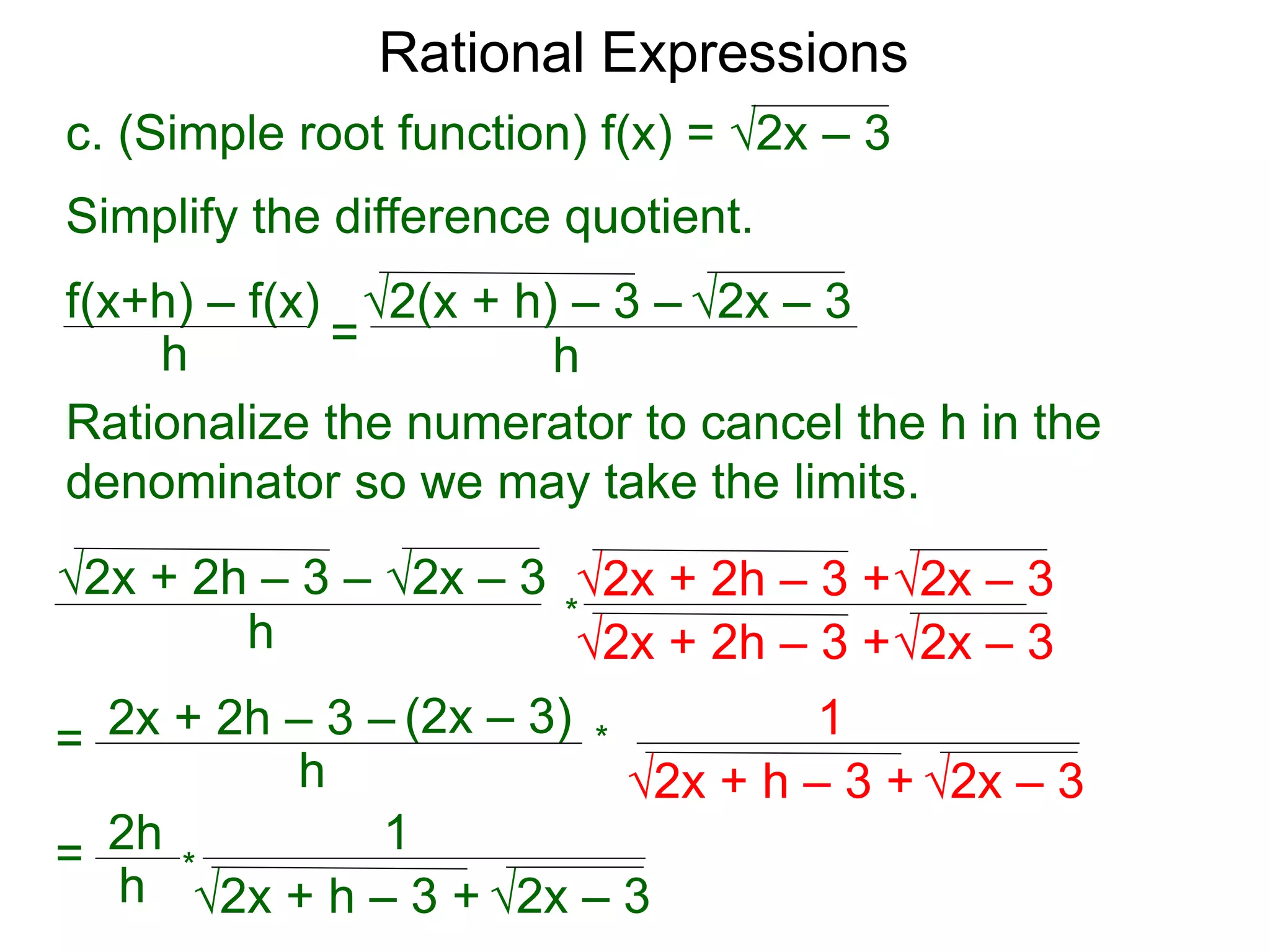
Rationalize the numerator to cancel the h in the
denominator so we may take the limits.
h
√2x + 2h – 3 – √2x – 3
*
√2x + 2h – 3 +√2x – 3
Rational Expressions
h
c. (Simple root function) f(x) = √2x – 3
Simplify the difference quotient.
f(x+h) – f(x)
h =
√2(x + h) – 3 – √2x – 3
Rationalize the numerator to cancel the h in the
denominator so we may take the limits.
h
√2x + 2h – 3 – √2x – 3
*
=
√2x + 2h – 3 +√2x – 3
2x + 2h – 3 – (2x – 3)
h √2x – 3
√2x + h – 3 +
1
*
Rational Expressions
h
c. (Simple root function) f(x) = √2x – 3
Simplify the difference quotient.
f(x+h) – f(x)
h =
√2(x + h) – 3 – √2x – 3
Rationalize the numerator to cancel the h in the
denominator so we may take the limits.
h
√2x + 2h – 3 – √2x – 3
*
=
√2x + 2h – 3 +√2x – 3
2x + 2h – 3 – (2x – 3)
h √2x – 3
√2x + h – 3 +
1
= 2h
h √2x – 3
√2x + h – 3 +
1
*
*
Rational Expressions
h
c. (Simple root function) f(x) = √2x – 3
Simplify the difference quotient.
f(x+h) – f(x)
h =
√2(x + h) – 3 – √2x – 3
Rationalize the numerator to cancel the h in the
denominator so we may take the limits.
h
√2x + 2h – 3 – √2x – 3
*
=
√2x + 2h – 3 +√2x – 3
2x + 2h – 3 – (2x – 3)
h √2x – 3
√2x + h – 3 +
1
= 2h
h √2x – 3
√2x + h – 3 +
1
=
√2x – 3
√2x + h – 3 +
2
*
*
Another version of the difference
quotient formula is to use points
P = (a, f(a)) and Q= (b, f(b)). We get
a
P=(a, f(a))
b
Q=(b, f(b))
Δy
m =
f(b) – f(a)
= b – a
Δx
b-a=Δx
f(b)–f(a) = Δy
Slopes and the Difference Quotient
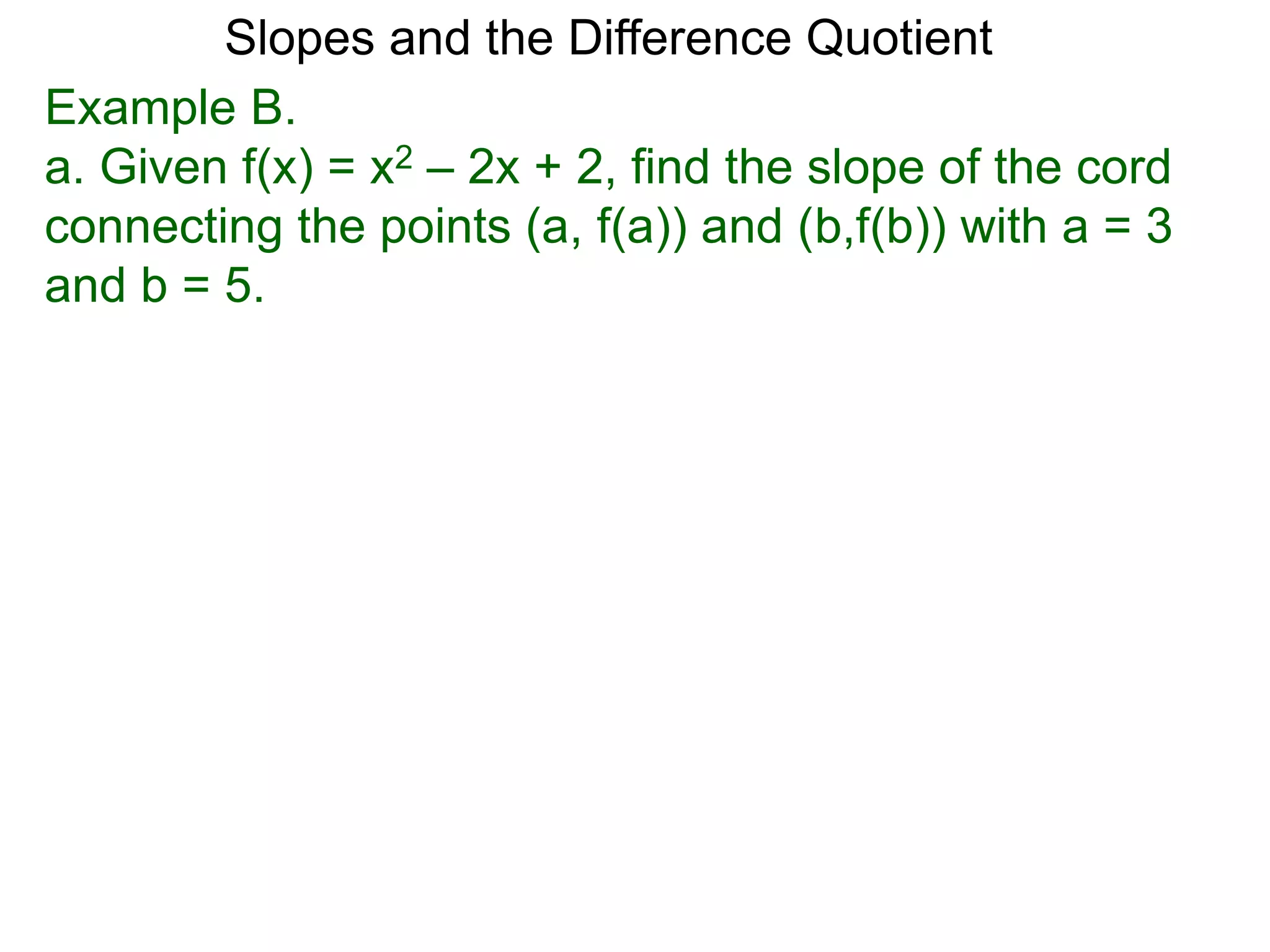
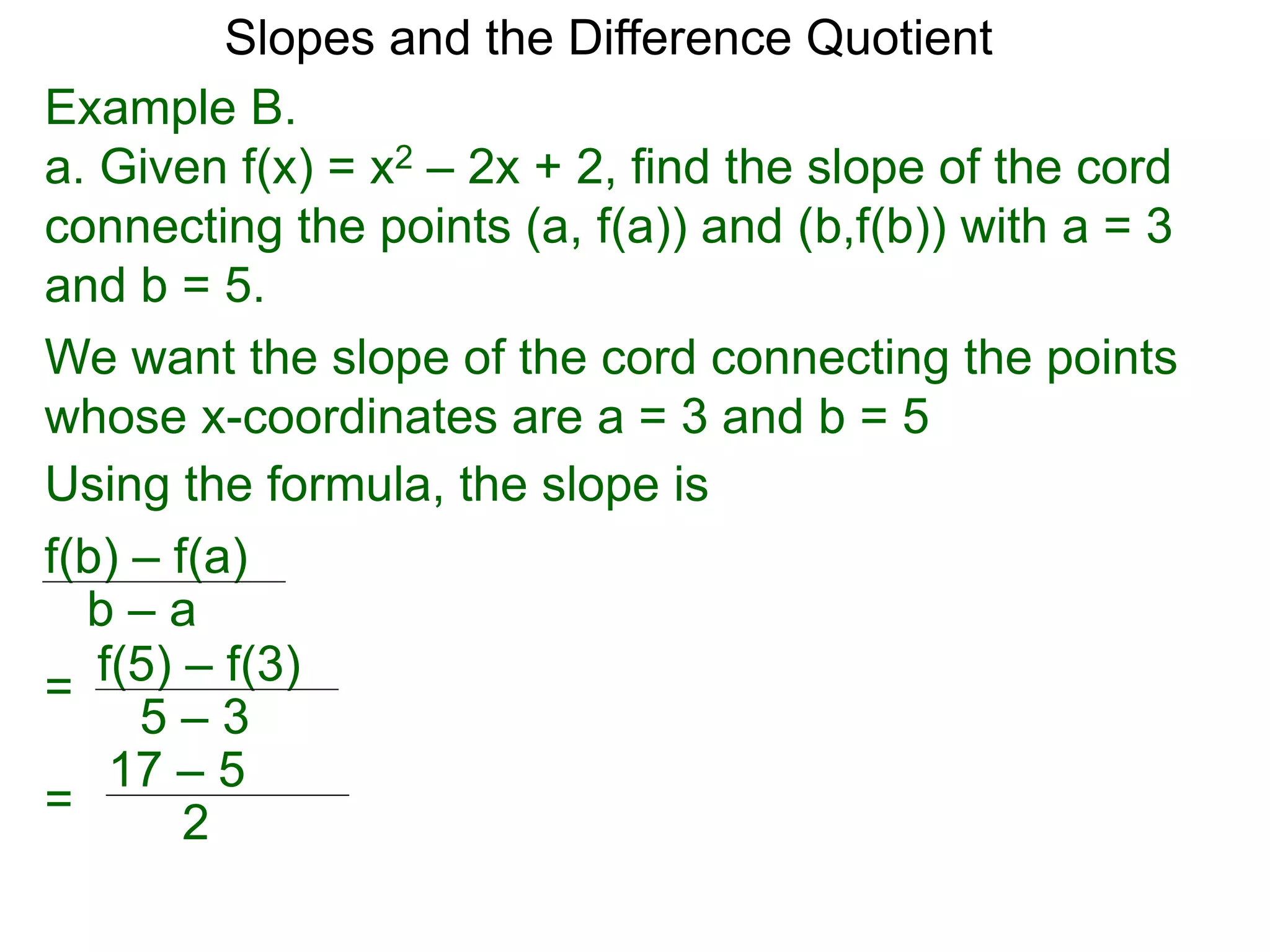
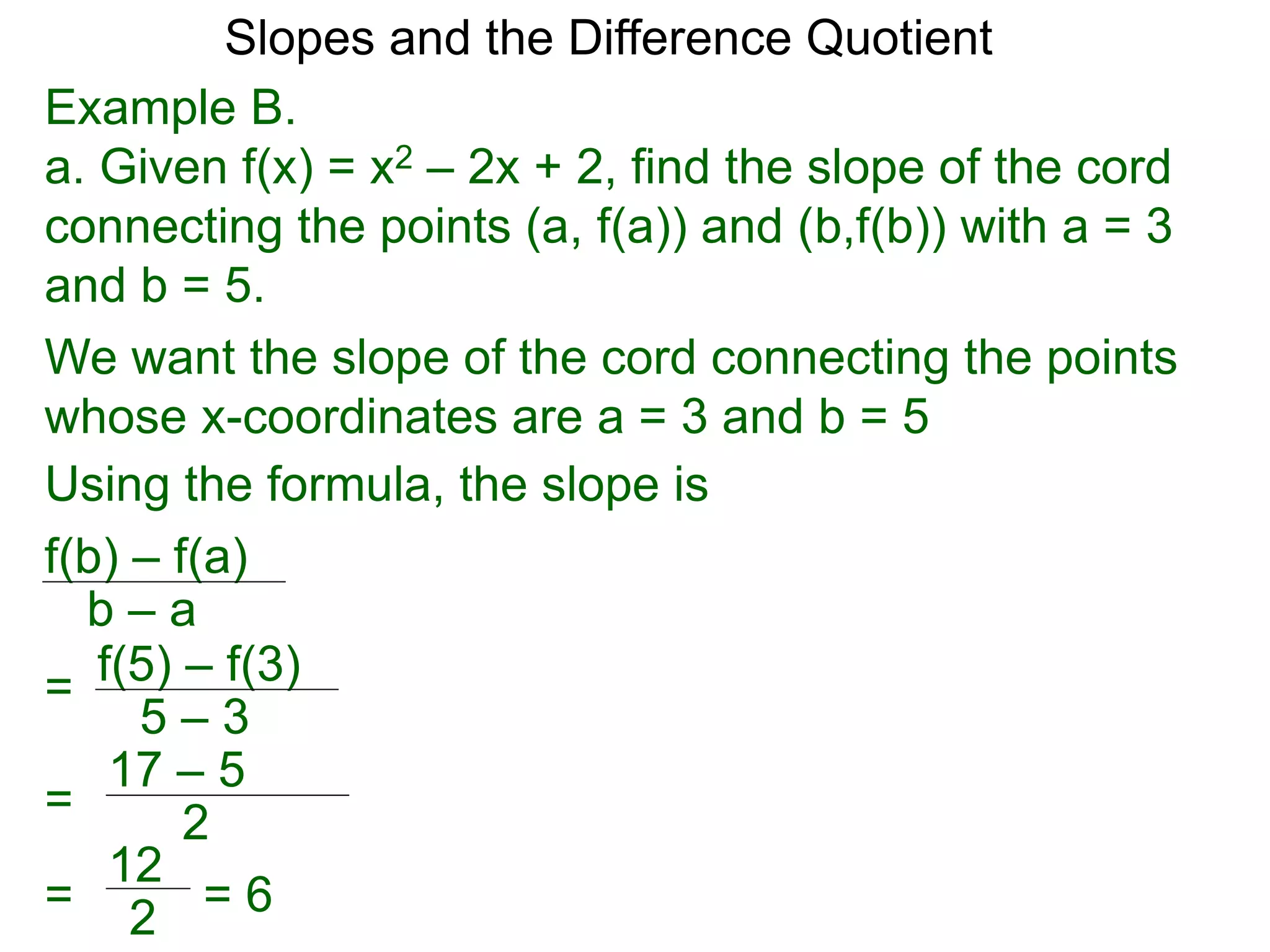
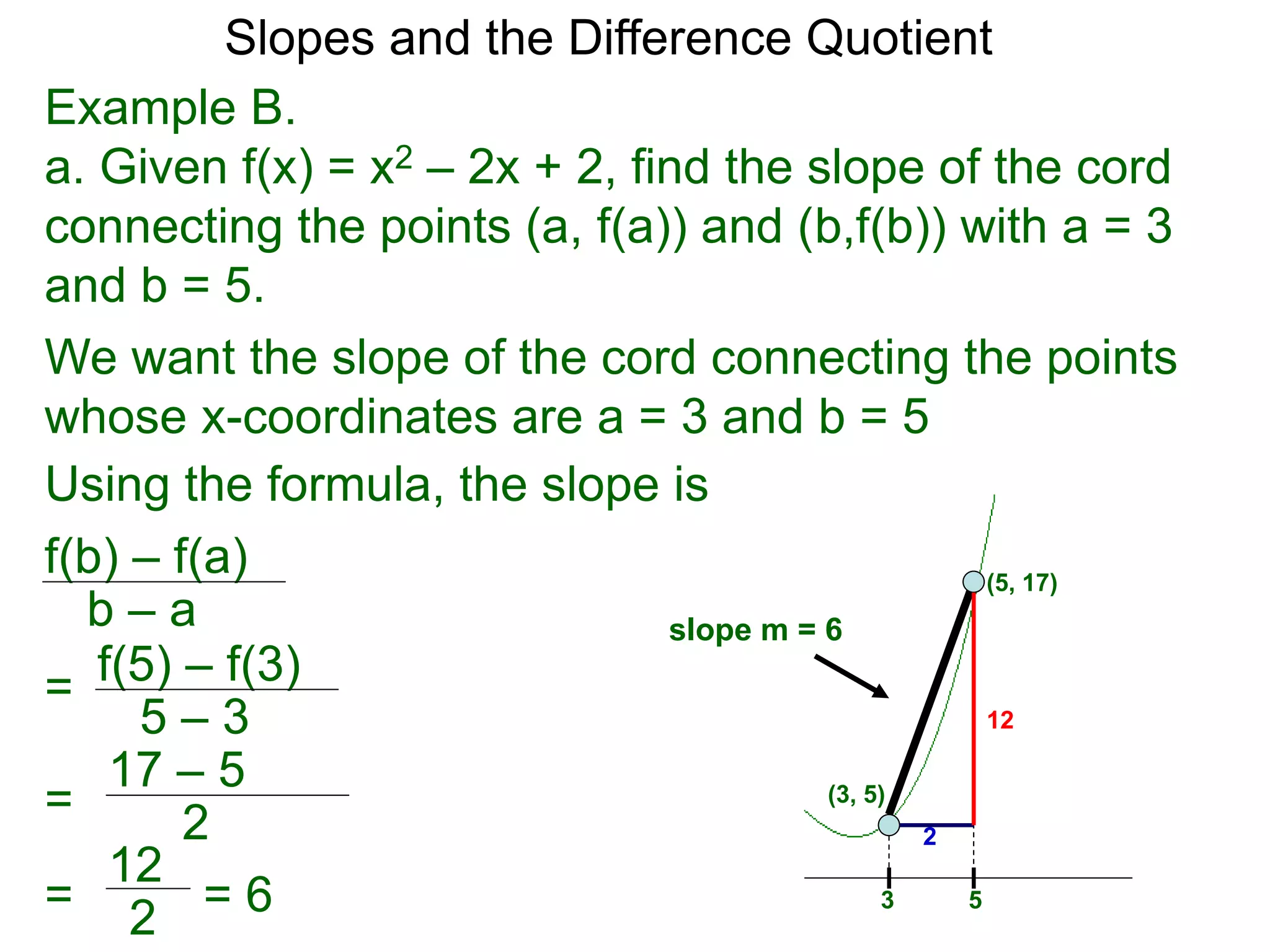
Example B.
a. Given f(x) = x2 – 2x + 2, find the slope of the cord
connecting the points (a, f(a)) and (b,f(b)) with a = 3
and b = 5.
Slopes and the Difference Quotient
Example B.
a. Given f(x) = x2 – 2x + 2, find the slope of the cord
connecting the points (a, f(a)) and (b,f(b)) with a = 3
and b = 5.
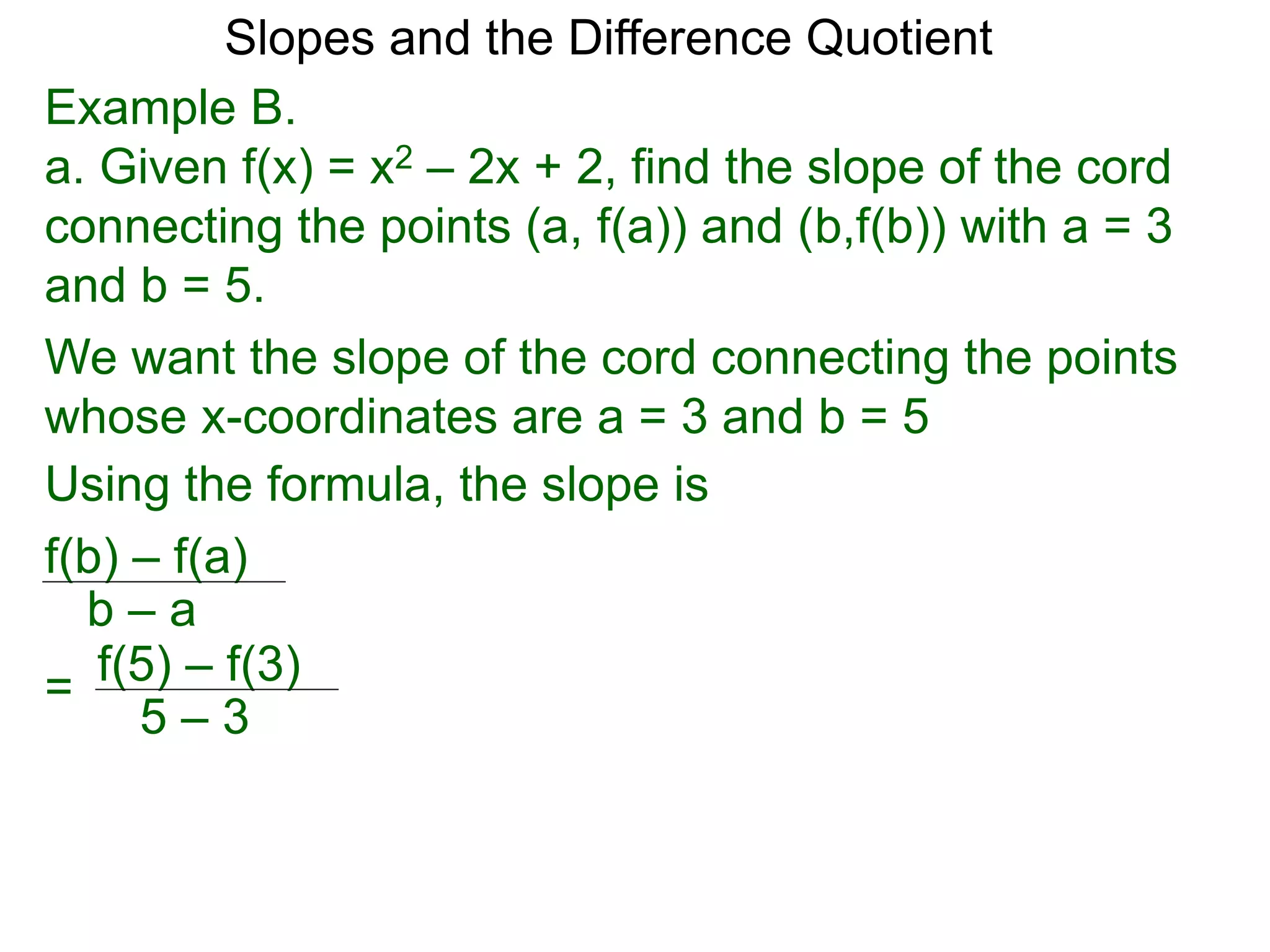
We want the slope of the cord connecting the points
whose x-coordinates are a = 3 and b = 5
Slopes and the Difference Quotient
Example B.
a. Given f(x) = x2 – 2x + 2, find the slope of the cord
connecting the points (a, f(a)) and (b,f(b)) with a = 3
and b = 5.
f(b) – f(a)
b – a
Using the formula, the slope is
We want the slope of the cord connecting the points
whose x-coordinates are a = 3 and b = 5
Slopes and the Difference Quotient
Example B.
a. Given f(x) = x2 – 2x + 2, find the slope of the cord
connecting the points (a, f(a)) and (b,f(b)) with a = 3
and b = 5.
f(b) – f(a)
b – a
Using the formula, the slope is
We want the slope of the cord connecting the points
whose x-coordinates are a = 3 and b = 5
f(5) – f(3)
5 – 3
=
Slopes and the Difference Quotient
Example B.
a. Given f(x) = x2 – 2x + 2, find the slope of the cord
connecting the points (a, f(a)) and (b,f(b)) with a = 3
and b = 5.
f(b) – f(a)
b – a
Using the formula, the slope is
We want the slope of the cord connecting the points
whose x-coordinates are a = 3 and b = 5
f(5) – f(3)
5 – 3
=
=
17 – 5
2
Slopes and the Difference Quotient
Example B.
a. Given f(x) = x2 – 2x + 2, find the slope of the cord
connecting the points (a, f(a)) and (b,f(b)) with a = 3
and b = 5.
f(b) – f(a)
b – a
Using the formula, the slope is
We want the slope of the cord connecting the points
whose x-coordinates are a = 3 and b = 5
f(5) – f(3)
5 – 3
=
=
17 – 5
2
= 6
=
12
2
Slopes and the Difference Quotient
Example B.
a. Given f(x) = x2 – 2x + 2, find the slope of the cord
connecting the points (a, f(a)) and (b,f(b)) with a = 3
and b = 5.
f(b) – f(a)
b – a
Using the formula, the slope is
We want the slope of the cord connecting the points
whose x-coordinates are a = 3 and b = 5
f(5) – f(3)
5 – 3
=
=
17 – 5
2
= 6
(5, 17)
(3, 5)
3 5
=
12
2
Slopes and the Difference Quotient
Example B.
a. Given f(x) = x2 – 2x + 2, find the slope of the cord
connecting the points (a, f(a)) and (b,f(b)) with a = 3
and b = 5.
f(b) – f(a)
b – a
Using the formula, the slope is
We want the slope of the cord connecting the points
whose x-coordinates are a = 3 and b = 5
f(5) – f(3)
5 – 3
=
=
17 – 5
2
= 6
(5, 17)
(3, 5)
3 5
=
12
2
12
2
slope m = 6
Slopes and the Difference Quotient
b. Given f(x) = x2 – 2x + 2, simplify the difference
quotient slope of the cord connecting the points
(a, f(a)) and (b, f(b)).
(b, f(b))
(a, f(a))
a b
f(b)-f(a)
b-a
Slopes and the Difference Quotient
b. Given f(x) = x2 – 2x + 2, simplify the difference
quotient slope of the cord connecting the points
(a, f(a)) and (b, f(b)).
f(b) – f(a)
b – a
We are to simplify the 2nd form of the difference
quotient formula with f(x) = x2 – 2x + 2
(b, f(b))
(a, f(a))
a b
f(b)-f(a)
b-a
Slopes and the Difference Quotient
b. Given f(x) = x2 – 2x + 2, simplify the difference
quotient slope of the cord connecting the points
(a, f(a)) and (b, f(b)).
f(b) – f(a)
b – a
We are to simplify the 2nd form of the difference
quotient formula with f(x) = x2 – 2x + 2
=
b2 – 2b + 2 – [ a2 – 2a + 2]
b – a
(b, f(b))
(a, f(a))
a b
f(b)-f(a)
b-a
Slopes and the Difference Quotient
b. Given f(x) = x2 – 2x + 2, simplify the difference
quotient slope of the cord connecting the points
(a, f(a)) and (b, f(b)).
f(b) – f(a)
b – a
We are to simplify the 2nd form of the difference
quotient formula with f(x) = x2 – 2x + 2
=
b2 – 2b + 2 – [ a2 – 2a + 2]
b – a
=
b2 – a2 – 2b + 2a
b – a
(b, f(b))
(a, f(a))
a b
f(b)-f(a)
b-a
Slopes and the Difference Quotient
b. Given f(x) = x2 – 2x + 2, simplify the difference
quotient slope of the cord connecting the points
(a, f(a)) and (b, f(b)).
f(b) – f(a)
b – a
We are to simplify the 2nd form of the difference
quotient formula with f(x) = x2 – 2x + 2
=
b2 – 2b + 2 – [ a2 – 2a + 2]
b – a
=
b2 – a2 – 2b + 2a
b – a
= (b – a)(b + a) – 2(b – a)
b – a
(b, f(b))
(a, f(a))
a b
f(b)-f(a)
b-a
Slopes and the Difference Quotient
b. Given f(x) = x2 – 2x + 2, simplify the difference
quotient slope of the cord connecting the points
(a, f(a)) and (b, f(b)).
f(b) – f(a)
b – a
We are to simplify the 2nd form of the difference
quotient formula with f(x) = x2 – 2x + 2
=
b2 – 2b + 2 – [ a2 – 2a + 2]
b – a
=
b2 – a2 – 2b + 2a
b – a
= (b – a)(b + a) – 2(b – a)
b – a
= (b – a) [(b + a) – 2]
b – a
(b, f(b))
(a, f(a))
a b
f(b)-f(a)
b-a
Slopes and the Difference Quotient
b. Given f(x) = x2 – 2x + 2, simplify the difference
quotient slope of the cord connecting the points
(a, f(a)) and (b, f(b)).
f(b) – f(a)
b – a
We are to simplify the 2nd form of the difference
quotient formula with f(x) = x2 – 2x + 2
=
b2 – 2b + 2 – [ a2 – 2a + 2]
b – a
=
b2 – a2 – 2b + 2a
b – a
= (b – a)(b + a) – 2(b – a)
b – a
= (b – a) [(b + a) – 2]
b – a
= b + a – 2
(b, f(b))
(a, f(a))
a b
f(b)-f(a)
b-a
Slopes and the Difference Quotient
Exercise A.
Given the following f(x), x, and h find f(x+h) – f(x)
1. y = 3x+2, x = 2, h = 0.1 2. y = –2x + 3, x= – 4, h = 0.05
3. y = 2x2 + 1, x = 1, h = 0.1 4. y = –x2 + 3, x= –2, h = –0.2
B. Given the following f(x), simplify Δy = f(x+h) – f(x)
1. y = 3x+2 2. y = –2x + 3
3. y = 2x2 + 1 4. y = –x2 + 3
C. Simplify the difference quotient f(x+h) – f(x)
h
of the following functions that show up in calculus.
“Simplify” in this case means to transform the difference
quotient so the denominator “h” is canceled.
5. y = x2 – x +2 6. y = –x2 + 3x – 1
Slopes and the Difference Quotient
1. y = 2x + 3 2. y = –½ x + 5
3. y = –4x – 3 4. y = mx + b
7. y = – 3x2 – 2x – 4 8. y = ax2 + bx + c
Slopes and the Difference Quotient
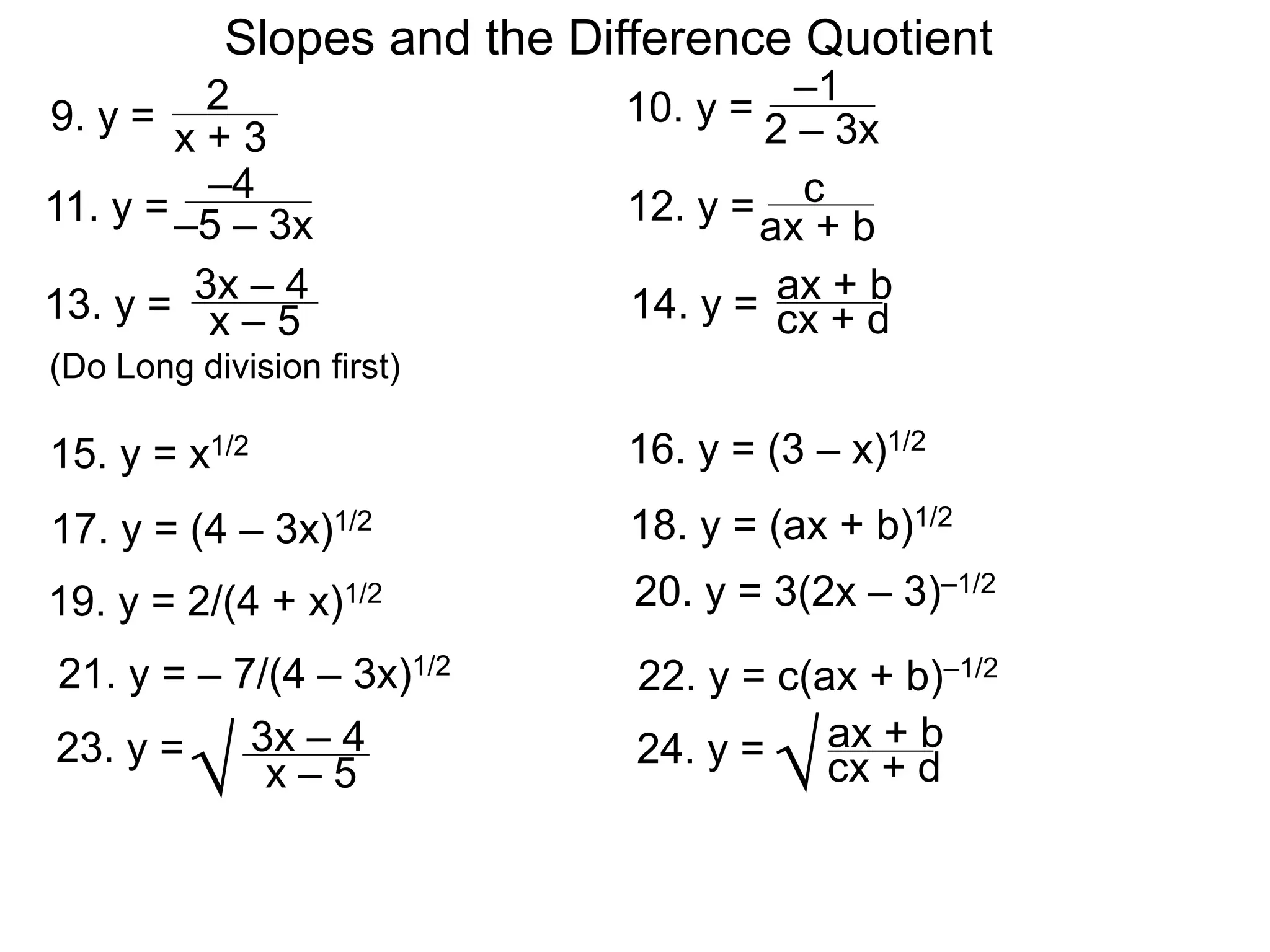
9. y = 2
x + 3
–1
2 – 3x
16. y = (3 – x)1/2
15. y = x1/2
10. y =
–4
–5 – 3x
11. y = 12. y =ax + b
cx + d
3x – 4
x – 5
13. y = 14. y =
c
ax + b
17. y = (4 – 3x)1/2 18. y = (ax + b)1/2
19. y = 2/(4 + x)1/2 20. y = 3(2x – 3)–1/2
21. y = – 7/(4 – 3x)1/2
22. y = c(ax + b)–1/2
cx + d
3x – 4
x – 5
23. y = 24. y = ax + b
√ √
(Do Long division first)
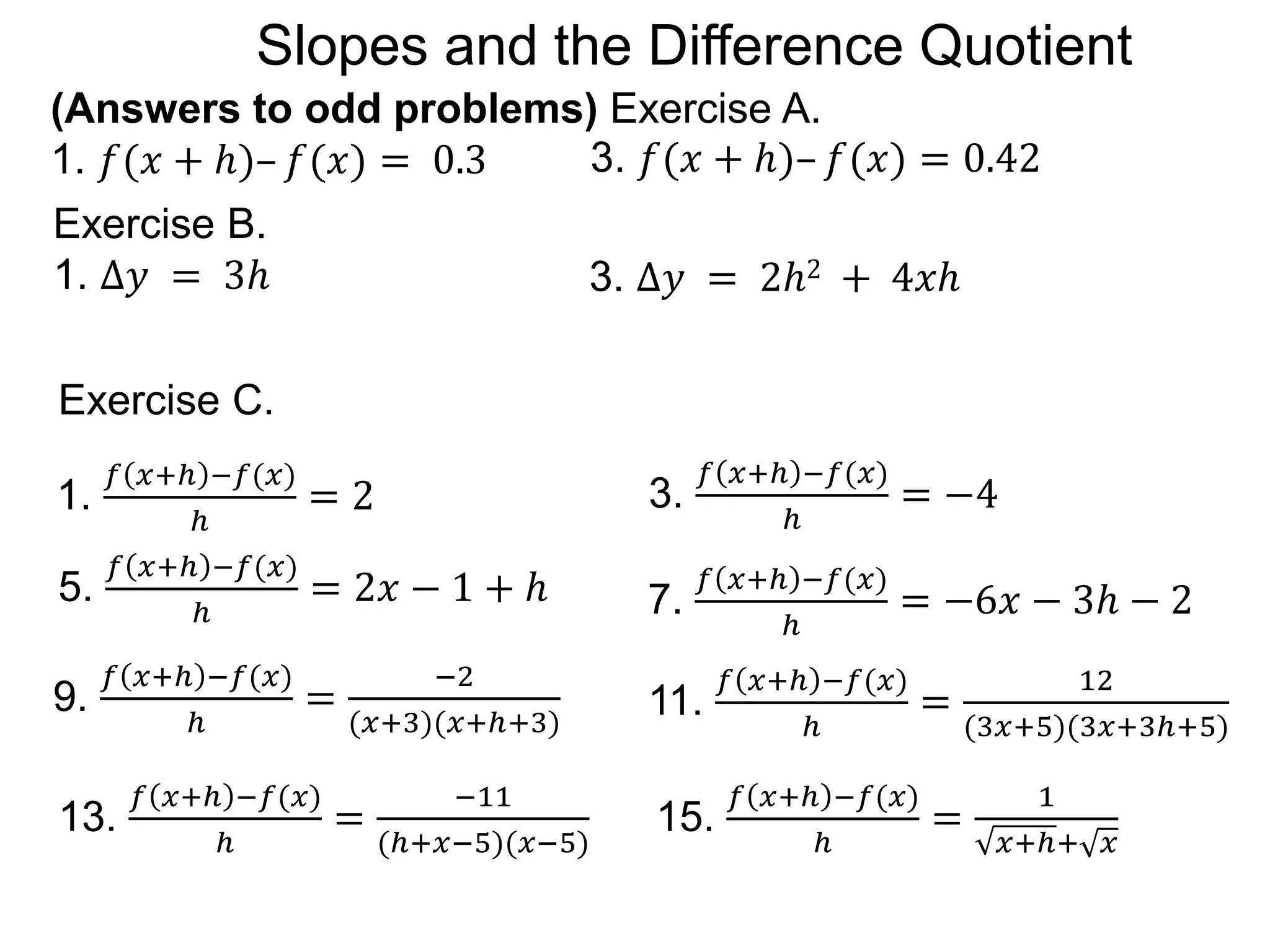
(Answers to odd problems) Exercise A.
1. 𝑓(𝑥 + ℎ)– 𝑓(𝑥) = 0.3 3. 𝑓(𝑥 + ℎ)– 𝑓(𝑥) = 0.42
Exercise B.
1. Δ𝑦 = 3ℎ 3. Δ𝑦 = 2ℎ2 + 4𝑥ℎ
Exercise C.
5.
𝑓 𝑥+ℎ −𝑓(𝑥)
ℎ
= 2𝑥 − 1 + ℎ
1.
𝑓 𝑥+ℎ −𝑓(𝑥)
ℎ
= 2 3.
𝑓 𝑥+ℎ −𝑓(𝑥)
ℎ
= −4
7.
𝑓 𝑥+ℎ −𝑓(𝑥)
ℎ
= −6𝑥 − 3ℎ − 2
9.
𝑓 𝑥+ℎ −𝑓(𝑥)
ℎ
=
−2
(𝑥+3)(𝑥+ℎ+3)
11.
𝑓 𝑥+ℎ −𝑓(𝑥)
ℎ
=
12
(3𝑥+5)(3𝑥+3ℎ+5)
13.
𝑓 𝑥+ℎ −𝑓(𝑥)
ℎ
=
−11
(ℎ+𝑥−5)(𝑥−5)
15.
𝑓 𝑥+ℎ −𝑓(𝑥)
ℎ
=
1
𝑥+ℎ+ 𝑥
Slopes and the Difference Quotient
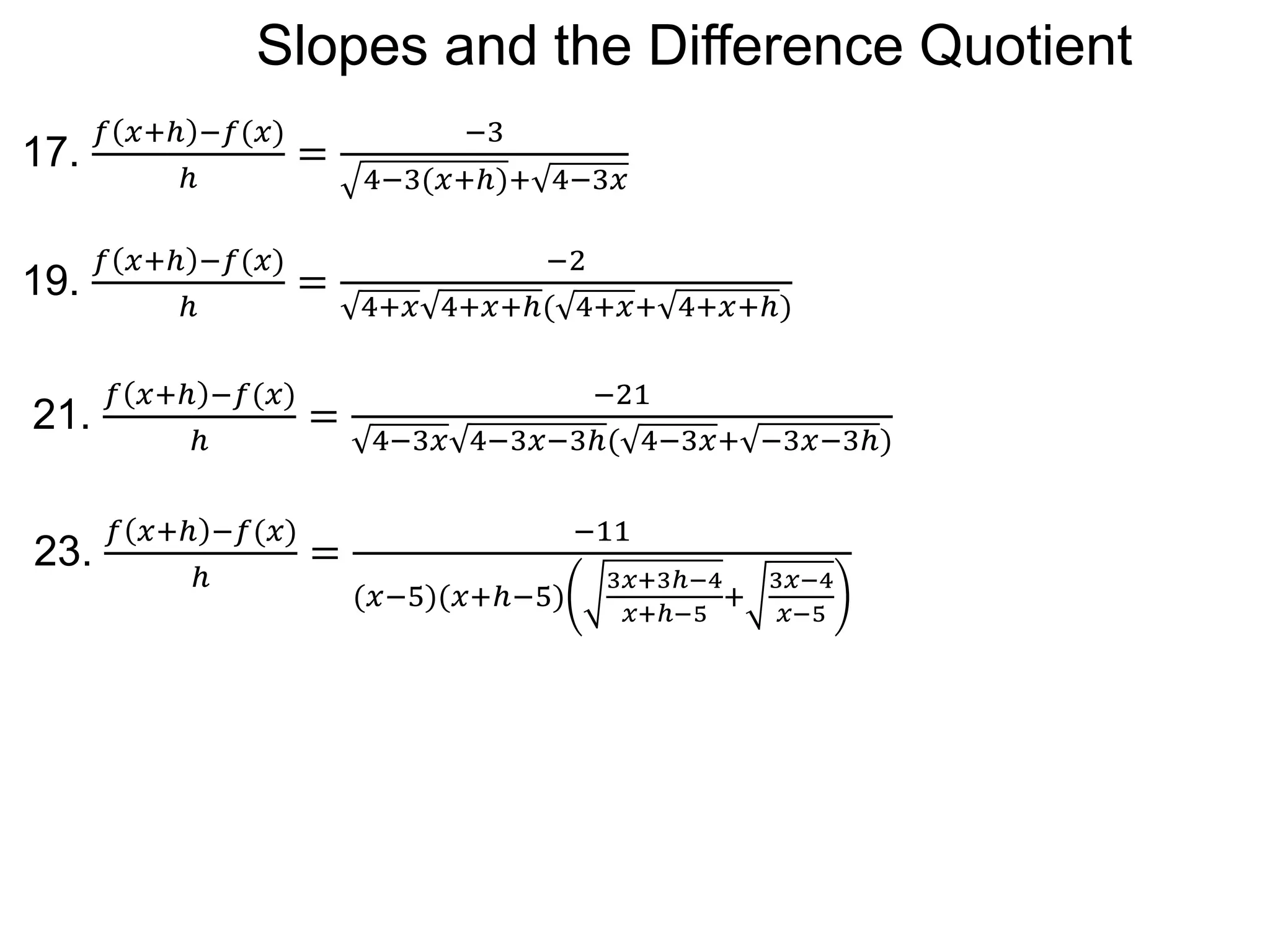
17.
𝑓 𝑥+ℎ −𝑓(𝑥)
ℎ
=
−3
4−3(𝑥+ℎ)+ 4−3𝑥
19.
𝑓 𝑥+ℎ −𝑓(𝑥)
ℎ
=
−2
4+𝑥 4+𝑥+ℎ( 4+𝑥+ 4+𝑥+ℎ)
21.
𝑓 𝑥+ℎ −𝑓(𝑥)
ℎ
=
−21
4−3𝑥 4−3𝑥−3ℎ( 4−3𝑥+ −3𝑥−3ℎ)
23.
𝑓 𝑥+ℎ −𝑓(𝑥)
ℎ
=
−11
(𝑥−5)(𝑥+ℎ−5)
3𝑥+3ℎ−4
𝑥+ℎ−5
+
3𝑥−4
𝑥−5
Slopes and the Difference Quotient

16 slopes and difference quotient x

  • 1.
    Slopes and theDifference Quotient http://www.lahc.edu/math/precalculus/math_260a.html
  • 2.
    In order todiscuss mathematics precisely, basic geometric information and formulas concerning graphs are given in function notation. Slopes and the Difference Quotient
  • 3.
    Given x, theoutput of a function is denoted as y or as f(x). In order to discuss mathematics precisely, basic geometric information and formulas concerning graphs are given in function notation. Slopes and the Difference Quotient
  • 4.
    Given x, theoutput of a function is denoted as y or as f(x). Hence the coordinate of a general point P on the graph is often denoted as (x, f(x)). In order to discuss mathematics precisely, basic geometric information and formulas concerning graphs are given in function notation. Slopes and the Difference Quotient
  • 5.
    Given x, theoutput of a function is denoted as y or as f(x). Hence the coordinate of a general point P on the graph is often denoted as (x, f(x)). x P=(x, f(x)) In order to discuss mathematics precisely, basic geometric information and formulas concerning graphs are given in function notation. y= f(x) Slopes and the Difference Quotient
  • 6.
    Given x, theoutput of a function is denoted as y or as f(x). Hence the coordinate of a general point P on the graph is often denoted as (x, f(x)). In order to discuss mathematics precisely, basic geometric information and formulas concerning graphs are given in function notation. x P=(x, f(x)) y= f(x) f(x) Note that the f(x) = the height of the point P. Slopes and the Difference Quotient
  • 7.
    Given x, theoutput of a function is denoted as y or as f(x). Hence the coordinate of a general point P on the graph is often denoted as (x, f(x)). Let h be a small positive value, so x+h is a point close to x, In order to discuss mathematics precisely, basic geometric information and formulas concerning graphs are given in function notation. x P=(x, f(x)) y= f(x) f(x) Note that the f(x) = the height of the point P. Slopes and the Difference Quotient
  • 8.
    Given x, theoutput of a function is denoted as y or as f(x). Hence the coordinate of a general point P on the graph is often denoted as (x, f(x)). x P=(x, f(x)) Note that the f(x) = the height of the point P. Let h be a small positive value, so x+h is a point close to x, x+h In order to discuss mathematics precisely, basic geometric information and formulas concerning graphs are given in function notation. f(x) y= f(x) Slopes and the Difference Quotient
  • 9.
    Given x, theoutput of a function is denoted as y or as f(x). Hence the coordinate of a general point P on the graph is often denoted as (x, f(x)). x P=(x, f(x)) Note that the f(x) = the height of the point P. Let h be a small positive value, so x+h is a point close to x, x+h then f(x+h) is the output for x+h, and (x+h, f(x+h)) represents the corresponding point, say Q, on the graph. In order to discuss mathematics precisely, basic geometric information and formulas concerning graphs are given in function notation. f(x) y= f(x) Slopes and the Difference Quotient
  • 10.
    Given x, theoutput of a function is denoted as y or as f(x). Hence the coordinate of a general point P on the graph is often denoted as (x, f(x)). x P=(x, f(x)) Note that the f(x) = the height of the point P. Let h be a small positive value, so x+h is a point close to x, x+h then f(x+h) is the output for x+h, and (x+h, f(x+h)) represents the corresponding point, say Q, on the graph. In order to discuss mathematics precisely, basic geometric information and formulas concerning graphs are given in function notation. Q=(x+h, f(x+h)) f(x) y= f(x) Slopes and the Difference Quotient
  • 11.
    Given x, theoutput of a function is denoted as y or as f(x). Hence the coordinate of a general point P on the graph is often denoted as (x, f(x)). x P=(x, f(x)) Note that the f(x) = the height of the point P. Let h be a small positive value, so x+h is a point close to x, x+h then f(x+h) is the output for x+h, and (x+h, f(x+h)) represents the corresponding point, say Q, on the graph. In order to discuss mathematics precisely, basic geometric information and formulas concerning graphs are given in function notation. Note that the f(x+h) = the height of the point Q. Q=(x+h, f(x+h)) f(x) f(x+h) y= f(x) Slopes and the Difference Quotient
  • 12.
    Recall that if(x1, y1) and (x2, y2) are two points then the slope m of the line connecting them is Δy m = y2 – y1 = x2 – x1 Δx Slopes and the Difference Quotient
  • 13.
    Recall that if(x1, y1) and (x2, y2) are two points then the slope m of the line connecting them is Δy m = y2 – y1 = x2 – x1 Δx Let (x1,y1) = P = (x, f(x)) and (x2,y2) = Q = (x+h, f(x+h)) as shown in the picture, Slopes and the Difference Quotient
  • 14.
    Recall that if(x1, y1) and (x2, y2) are two points then the slope m of the line connecting them is x P=(x, f(x)) x+h Q=(x+h, f(x+h)) Δy m = y2 – y1 = x2 – x1 Δx Let (x1,y1) = P = (x, f(x)) and (x2,y2) = Q = (x+h, f(x+h)) as shown in the picture, Slopes and the Difference Quotient
  • 15.
    Recall that if(x1, y1) and (x2, y2) are two points then the slope m of the line connecting them is x P=(x, f(x)) x+h Q=(x+h, f(x+h)) Δy m = y2 – y1 = x2 – x1 Δx Let (x1,y1) = P = (x, f(x)) and (x2,y2) = Q = (x+h, f(x+h)) as shown in the picture, then the slope of the cord connecting P and Q (in function notation) is Slopes and the Difference Quotient
  • 16.
    Recall that if(x1, y1) and (x2, y2) are two points then the slope m of the line connecting them is x P=(x, f(x)) x+h Q=(x+h, f(x+h)) Δy m = y2 – y1 = x2 – x1 Δx Let (x1,y1) = P = (x, f(x)) and (x2,y2) = Q = (x+h, f(x+h)) as shown in the picture, then the slope of the cord connecting P and Q (in function notation) is Δy m = f(x+h) – f(x) = (x+h) – x Δx Slopes and the Difference Quotient
  • 17.
    Recall that if(x1, y1) and (x2, y2) are two points then the slope m of the line connecting them is x P=(x, f(x)) x+h Q=(x+h, f(x+h)) Δy m = y2 – y1 = x2 – x1 Δx Let (x1,y1) = P = (x, f(x)) and (x2,y2) = Q = (x+h, f(x+h)) as shown in the picture, then the slope of the cord connecting P and Q (in function notation) is Δy m = f(x+h) – f(x) = (x+h) – x Δx or Slopes and the Difference Quotient m = f(x+h) – f(x) h (= Δx)
  • 18.
    Recall that if(x1, y1) and (x2, y2) are two points then the slope m of the line connecting them is x P=(x, f(x)) x+h Q=(x+h, f(x+h)) Δy m = y2 – y1 = x2 – x1 Δx Let (x1,y1) = P = (x, f(x)) and (x2,y2) = Q = (x+h, f(x+h)) as shown in the picture, then the slope of the cord connecting P and Q (in function notation) is Δy m = f(x+h) – f(x) = (x+h) – x Δx or This is the "difference quotient" formula for slopes Slopes and the Difference Quotient m = f(x+h) – f(x) h (= Δx)
  • 19.
    Recall that if(x1, y1) and (x2, y2) are two points then the slope m of the line connecting them is x P=(x, f(x)) x+h Q=(x+h, f(x+h)) Δy m = y2 – y1 = x2 – x1 Δx Let (x1,y1) = P = (x, f(x)) and (x2,y2) = Q = (x+h, f(x+h)) as shown in the picture, then the slope of the cord connecting P and Q (in function notation) is Δy m = f(x+h) – f(x) = (x+h) – x Δx or m = f(x+h) – f(x) h (= Δx) f(x+h)–f(x) = Δy because f(x+h) – f(x) = difference in height This is the "difference quotient" formula for slopes Slopes and the Difference Quotient
  • 20.
    Recall that if(x1, y1) and (x2, y2) are two points then the slope m of the line connecting them is x P=(x, f(x)) x+h Q=(x+h, f(x+h)) Δy m = y2 – y1 = x2 – x1 Δx Let (x1,y1) = P = (x, f(x)) and (x2,y2) = Q = (x+h, f(x+h)) as shown in the picture, then the slope of the cord connecting P and Q (in function notation) is Δy m = f(x+h) – f(x) = (x+h) – x Δx or h=Δx f(x+h)–f(x) = Δy because f(x+h) – f(x) = difference in height and h = (x+h) – x = Δx = difference in the x's, as shown. This is the "difference quotient" formula for slopes. Slopes and the Difference Quotient m = f(x+h) – f(x) h (= Δx)
  • 21.
    Example A. a. Givenf(x) = x2 – 2x + 2, find the slope of the cord connecting the points (x, f(x)) and (x+h, f(x+h)) with x = 2 and h = 0.2. Slopes and the Difference Quotient
  • 22.
    Example A. a. Givenf(x) = x2 – 2x + 2, find the slope of the cord connecting the points (x, f(x)) and (x+h, f(x+h)) with x = 2 and h = 0.2. We want the slope of the cord connecting the points whose x-coordinates are x = 2 and x + h = 2 + h = 2.2. Slopes and the Difference Quotient
  • 23.
    Example A. a. Givenf(x) = x2 – 2x + 2, find the slope of the cord connecting the points (x, f(x)) and (x+h, f(x+h)) with x = 2 and h = 0.2. f(x+h) – f(x) h Using the difference quotient, the slope is We want the slope of the cord connecting the points whose x-coordinates are x = 2 and x + h = 2 + h = 2.2 Slopes and the Difference Quotient
  • 24.
    Example A. a. Givenf(x) = x2 – 2x + 2, find the slope of the cord connecting the points (x, f(x)) and (x+h, f(x+h)) with x = 2 and h = 0.2. f(x+h) – f(x) h Using the difference quotient, the slope is We want the slope of the cord connecting the points whose x-coordinates are x = 2 and x + h = 2 + h = 2.2 f(2.2) – f(2) = Slopes and the Difference Quotient
  • 25.
    Example A. a. Givenf(x) = x2 – 2x + 2, find the slope of the cord connecting the points (x, f(x)) and (x+h, f(x+h)) with x = 2 and h = 0.2. f(x+h) – f(x) h Using the difference quotient, the slope is We want the slope of the cord connecting the points whose x-coordinates are x = 2 and x + h = 2 + h = 2.2 f(2.2) – f(2) 0.2 = Slopes and the Difference Quotient
  • 26.
    Example A. a. Givenf(x) = x2 – 2x + 2, find the slope of the cord connecting the points (x, f(x)) and (x+h, f(x+h)) with x = 2 and h = 0.2. f(x+h) – f(x) h Using the difference quotient, the slope is We want the slope of the cord connecting the points whose x-coordinates are x = 2 and x + h = 2 + h = 2.2 f(2.2) – f(2) 0.2 = = 2.44 – 2 0.2 Slopes and the Difference Quotient
  • 27.
    Example A. a. Givenf(x) = x2 – 2x + 2, find the slope of the cord connecting the points (x, f(x)) and (x+h, f(x+h)) with x = 2 and h = 0.2. f(x+h) – f(x) h Using the difference quotient, the slope is We want the slope of the cord connecting the points whose x-coordinates are x = 2 and x + h = 2 + h = 2.2 f(2.2) – f(2) 0.2 = = 2.44 – 2 0.2 = 0.44 0.2 Slopes and the Difference Quotient
  • 28.
    Example A. a. Givenf(x) = x2 – 2x + 2, find the slope of the cord connecting the points (x, f(x)) and (x+h, f(x+h)) with x = 2 and h = 0.2. f(x+h) – f(x) h Using the difference quotient, the slope is We want the slope of the cord connecting the points whose x-coordinates are x = 2 and x + h = 2 + h = 2.2 f(2.2) – f(2) 0.2 = = 2.44 – 2 0.2 = 2.2 = 0.44 0.2 Slopes and the Difference Quotient
  • 29.
    Example A. a. Givenf(x) = x2 – 2x + 2, find the slope of the cord connecting the points (x, f(x)) and (x+h, f(x+h)) with x = 2 and h = 0.2. f(x+h) – f(x) h Using the difference quotient, the slope is We want the slope of the cord connecting the points whose x-coordinates are x = 2 and x + h = 2 + h = 2.2 f(2.2) – f(2) 0.2 = = 2.44 – 2 0.2 = 2.2 (2.2, 2.44) (2, 2) 2 2.2 = 0.44 0.2 Slopes and the Difference Quotient
  • 30.
    Example A. a. Givenf(x) = x2 – 2x + 2, find the slope of the cord connecting the points (x, f(x)) and (x+h, f(x+h)) with x = 2 and h = 0.2. f(x+h) – f(x) h Using the difference quotient, the slope is We want the slope of the cord connecting the points whose x-coordinates are x = 2 and x + h = 2 + h = 2.2 f(2.2) – f(2) 0.2 = = 2.44 – 2 0.2 = 2.2 (2.2, 2.44) (2, 2) 2 2.2 = 0.44 0.2 0.44 0.2 slope m = 2.2 Slopes and the Difference Quotient
  • 31.
    The algebra ofcalculating the slopes of some basic types of functions are given below. Slope Algebra
  • 32.
    The algebra ofcalculating the slopes of some basic types of functions are given below. Slope Algebra Example B. Simplify the difference quotient. Make sure the h is cancelled. a. (2nd degree polynomials) f(x) = –2x2 + 3x + 1
  • 33.
    The algebra ofcalculating the slopes of some basic types of functions are given below. Slope Algebra Example B. Simplify the difference quotient. Make sure the h is cancelled. f(x+h) – f(x) h = a. (2nd degree polynomials) f(x) = –2x2 + 3x + 1
  • 34.
    The algebra ofcalculating the slopes of some basic types of functions are given below. Slope Algebra Example B. Simplify the difference quotient. Make sure the h is cancelled. f(x+h) – f(x) h = –2(x+h)2 + 3(x+h) + 1 – [–2x2 +3x +1] h a. (2nd degree polynomials) f(x) = –2x2 + 3x + 1
  • 35.
    The algebra ofcalculating the slopes of some basic types of functions are given below. Slope Algebra Example B. Simplify the difference quotient. Make sure the h is cancelled. f(x+h) – f(x) h = –2(x+h)2 + 3(x+h) + 1 – [–2x2 +3x +1] h a. (2nd degree polynomials) f(x) = –2x2 + 3x + 1 –2x2 –4xh –2h2 +3x +3h +1 – [–2x2 +3x +1] h =
  • 36.
    The algebra ofcalculating the slopes of some basic types of functions are given below. Slope Algebra Example B. Simplify the difference quotient. Make sure the h is cancelled. f(x+h) – f(x) h = –2(x+h)2 + 3(x+h) + 1 – [–2x2 +3x +1] h a. (2nd degree polynomials) f(x) = –2x2 + 3x + 1 –2x2 –4xh –2h2 +3x +3h +1 – [–2x2 +3x +1] h = –4xh –2h2 +3h h = h(–4x –2h +3) h =
  • 37.
    The algebra ofcalculating the slopes of some basic types of functions are given below. Slope Algebra Example B. Simplify the difference quotient. Make sure the h is cancelled. f(x+h) – f(x) h = –2(x+h)2 + 3(x+h) + 1 – [–2x2 +3x +1] h a. (2nd degree polynomials) f(x) = –2x2 + 3x + 1 –2x2 –4xh –2h2 +3x +3h +1 – [–2x2 +3x +1] h = –4xh –2h2 +3h h = h(–4x –2h +3) h = = –4x –2h +3
  • 38.
    Rational Expressions b. (Simplerational function) f(x) = x – 1 2
  • 39.
    Rational Expressions b. (Simplerational function) f(x) = x – 1 2 Simplify the difference quotient.
  • 40.
    Rational Expressions – x +h – 1 2 x – 1 2 h b. (Simple rational function) f(x) = x – 1 2 Simplify the difference quotient. f(x+h) – f(x) h =
  • 41.
    Rational Expressions – x +h – 1 2 x – 1 2 h Multiply the top and bottom by (x + h – 1)(x – 1) to remove fractions in the numerator. b. (Simple rational function) f(x) = x – 1 2 Simplify the difference quotient. f(x+h) – f(x) h =
  • 42.
    Rational Expressions – x +h – 1 2 x – 1 2 h Multiply the top and bottom by (x + h – 1)(x – 1) to remove fractions in the numerator. b. (Simple rational function) f(x) = x – 1 2 Simplify the difference quotient. f(x+h) – f(x) h = – x + h – 1 2 x – 1 2 h [ ]
  • 43.
    Rational Expressions – x +h – 1 2 x – 1 2 h Multiply the top and bottom by (x + h – 1)(x – 1) to remove fractions in the numerator. (x + h –1)(x – 1) (x + h –1)(x – 1) * b. (Simple rational function) f(x) = x – 1 2 Simplify the difference quotient. f(x+h) – f(x) h = – x + h – 1 2 x – 1 2 h [ ]
  • 44.
    Rational Expressions – x +h – 1 2 x – 1 2 h Multiply the top and bottom by (x + h – 1)(x – 1) to remove fractions in the numerator. (x + h –1)(x – 1) (x + h –1)(x – 1) * = – 2(x – 1) 2(x + h –1) h b. (Simple rational function) f(x) = x – 1 2 Simplify the difference quotient. f(x+h) – f(x) h = – x + h – 1 2 x – 1 2 h (x + h –1)(x – 1) [ ]
  • 45.
    Rational Expressions – x +h – 1 2 x – 1 2 h Multiply the top and bottom by (x + h – 1)(x – 1) to remove fractions in the numerator. (x + h –1)(x – 1) (x + h –1)(x – 1) * = – 2(x – 1) 2(x + h –1) h b. (Simple rational function) f(x) = x – 1 2 Simplify the difference quotient. f(x+h) – f(x) h = – x + h – 1 2 x – 1 2 h (x + h –1)(x – 1) = – 2h h(x + h –1)(x – 1) [ ]
  • 46.
    Rational Expressions – x +h – 1 2 x – 1 2 h Multiply the top and bottom by (x + h – 1)(x – 1) to remove fractions in the numerator. (x + h –1)(x – 1) (x + h –1)(x – 1) * = – 2(x – 1) 2(x + h –1) h b. (Simple rational function) f(x) = x – 1 2 Simplify the difference quotient. f(x+h) – f(x) h = – x + h – 1 2 x – 1 2 h (x + h –1)(x – 1) = – 2h h(x + h –1)(x – 1) = –2 (x + h –1)(x – 1) [ ]
  • 47.
    Rational Expressions c. (Simpleroot function) f(x) = √2x – 3 Simplify the difference quotient. f(x+h) – f(x) h
  • 48.
    Rational Expressions h c. (Simpleroot function) f(x) = √2x – 3 Simplify the difference quotient. f(x+h) – f(x) h = √2(x + h) – 3 – √2x – 3
  • 49.
    Rational Expressions h c. (Simpleroot function) f(x) = √2x – 3 Simplify the difference quotient. f(x+h) – f(x) h = √2(x + h) – 3 – √2x – 3 Rationalize the numerator to cancel the h in the denominator so we may take the limits. h √2x + 2h – 3 – √2x – 3 * √2x + 2h – 3 +√2x – 3 √2x + 2h – 3 +√2x – 3
  • 50.
    Rational Expressions h c. (Simpleroot function) f(x) = √2x – 3 Simplify the difference quotient. f(x+h) – f(x) h = √2(x + h) – 3 – √2x – 3 Rationalize the numerator to cancel the h in the denominator so we may take the limits. h √2x + 2h – 3 – √2x – 3 * = √2x + 2h – 3 +√2x – 3 √2x + 2h – 3 +√2x – 3 2x + 2h – 3 – (2x – 3) h √2x – 3 √2x + h – 3 + 1 *
  • 51.
    Rational Expressions h c. (Simpleroot function) f(x) = √2x – 3 Simplify the difference quotient. f(x+h) – f(x) h = √2(x + h) – 3 – √2x – 3 Rationalize the numerator to cancel the h in the denominator so we may take the limits. h √2x + 2h – 3 – √2x – 3 * = √2x + 2h – 3 +√2x – 3 √2x + 2h – 3 +√2x – 3 2x + 2h – 3 – (2x – 3) h √2x – 3 √2x + h – 3 + 1 = 2h h √2x – 3 √2x + h – 3 + 1 * *
  • 52.
    Rational Expressions h c. (Simpleroot function) f(x) = √2x – 3 Simplify the difference quotient. f(x+h) – f(x) h = √2(x + h) – 3 – √2x – 3 Rationalize the numerator to cancel the h in the denominator so we may take the limits. h √2x + 2h – 3 – √2x – 3 * = √2x + 2h – 3 +√2x – 3 √2x + 2h – 3 +√2x – 3 2x + 2h – 3 – (2x – 3) h √2x – 3 √2x + h – 3 + 1 = 2h h √2x – 3 √2x + h – 3 + 1 = √2x – 3 √2x + h – 3 + 2 * *
  • 53.
    Another version ofthe difference quotient formula is to use points P = (a, f(a)) and Q= (b, f(b)). We get a P=(a, f(a)) b Q=(b, f(b)) Δy m = f(b) – f(a) = b – a Δx b-a=Δx f(b)–f(a) = Δy Slopes and the Difference Quotient
  • 54.
    Example B. a. Givenf(x) = x2 – 2x + 2, find the slope of the cord connecting the points (a, f(a)) and (b,f(b)) with a = 3 and b = 5. Slopes and the Difference Quotient
  • 55.
    Example B. a. Givenf(x) = x2 – 2x + 2, find the slope of the cord connecting the points (a, f(a)) and (b,f(b)) with a = 3 and b = 5. We want the slope of the cord connecting the points whose x-coordinates are a = 3 and b = 5 Slopes and the Difference Quotient
  • 56.
    Example B. a. Givenf(x) = x2 – 2x + 2, find the slope of the cord connecting the points (a, f(a)) and (b,f(b)) with a = 3 and b = 5. f(b) – f(a) b – a Using the formula, the slope is We want the slope of the cord connecting the points whose x-coordinates are a = 3 and b = 5 Slopes and the Difference Quotient
  • 57.
    Example B. a. Givenf(x) = x2 – 2x + 2, find the slope of the cord connecting the points (a, f(a)) and (b,f(b)) with a = 3 and b = 5. f(b) – f(a) b – a Using the formula, the slope is We want the slope of the cord connecting the points whose x-coordinates are a = 3 and b = 5 f(5) – f(3) 5 – 3 = Slopes and the Difference Quotient
  • 58.
    Example B. a. Givenf(x) = x2 – 2x + 2, find the slope of the cord connecting the points (a, f(a)) and (b,f(b)) with a = 3 and b = 5. f(b) – f(a) b – a Using the formula, the slope is We want the slope of the cord connecting the points whose x-coordinates are a = 3 and b = 5 f(5) – f(3) 5 – 3 = = 17 – 5 2 Slopes and the Difference Quotient
  • 59.
    Example B. a. Givenf(x) = x2 – 2x + 2, find the slope of the cord connecting the points (a, f(a)) and (b,f(b)) with a = 3 and b = 5. f(b) – f(a) b – a Using the formula, the slope is We want the slope of the cord connecting the points whose x-coordinates are a = 3 and b = 5 f(5) – f(3) 5 – 3 = = 17 – 5 2 = 6 = 12 2 Slopes and the Difference Quotient
  • 60.
    Example B. a. Givenf(x) = x2 – 2x + 2, find the slope of the cord connecting the points (a, f(a)) and (b,f(b)) with a = 3 and b = 5. f(b) – f(a) b – a Using the formula, the slope is We want the slope of the cord connecting the points whose x-coordinates are a = 3 and b = 5 f(5) – f(3) 5 – 3 = = 17 – 5 2 = 6 (5, 17) (3, 5) 3 5 = 12 2 Slopes and the Difference Quotient
  • 61.
    Example B. a. Givenf(x) = x2 – 2x + 2, find the slope of the cord connecting the points (a, f(a)) and (b,f(b)) with a = 3 and b = 5. f(b) – f(a) b – a Using the formula, the slope is We want the slope of the cord connecting the points whose x-coordinates are a = 3 and b = 5 f(5) – f(3) 5 – 3 = = 17 – 5 2 = 6 (5, 17) (3, 5) 3 5 = 12 2 12 2 slope m = 6 Slopes and the Difference Quotient
  • 62.
    b. Given f(x)= x2 – 2x + 2, simplify the difference quotient slope of the cord connecting the points (a, f(a)) and (b, f(b)). (b, f(b)) (a, f(a)) a b f(b)-f(a) b-a Slopes and the Difference Quotient
  • 63.
    b. Given f(x)= x2 – 2x + 2, simplify the difference quotient slope of the cord connecting the points (a, f(a)) and (b, f(b)). f(b) – f(a) b – a We are to simplify the 2nd form of the difference quotient formula with f(x) = x2 – 2x + 2 (b, f(b)) (a, f(a)) a b f(b)-f(a) b-a Slopes and the Difference Quotient
  • 64.
    b. Given f(x)= x2 – 2x + 2, simplify the difference quotient slope of the cord connecting the points (a, f(a)) and (b, f(b)). f(b) – f(a) b – a We are to simplify the 2nd form of the difference quotient formula with f(x) = x2 – 2x + 2 = b2 – 2b + 2 – [ a2 – 2a + 2] b – a (b, f(b)) (a, f(a)) a b f(b)-f(a) b-a Slopes and the Difference Quotient
  • 65.
    b. Given f(x)= x2 – 2x + 2, simplify the difference quotient slope of the cord connecting the points (a, f(a)) and (b, f(b)). f(b) – f(a) b – a We are to simplify the 2nd form of the difference quotient formula with f(x) = x2 – 2x + 2 = b2 – 2b + 2 – [ a2 – 2a + 2] b – a = b2 – a2 – 2b + 2a b – a (b, f(b)) (a, f(a)) a b f(b)-f(a) b-a Slopes and the Difference Quotient
  • 66.
    b. Given f(x)= x2 – 2x + 2, simplify the difference quotient slope of the cord connecting the points (a, f(a)) and (b, f(b)). f(b) – f(a) b – a We are to simplify the 2nd form of the difference quotient formula with f(x) = x2 – 2x + 2 = b2 – 2b + 2 – [ a2 – 2a + 2] b – a = b2 – a2 – 2b + 2a b – a = (b – a)(b + a) – 2(b – a) b – a (b, f(b)) (a, f(a)) a b f(b)-f(a) b-a Slopes and the Difference Quotient
  • 67.
    b. Given f(x)= x2 – 2x + 2, simplify the difference quotient slope of the cord connecting the points (a, f(a)) and (b, f(b)). f(b) – f(a) b – a We are to simplify the 2nd form of the difference quotient formula with f(x) = x2 – 2x + 2 = b2 – 2b + 2 – [ a2 – 2a + 2] b – a = b2 – a2 – 2b + 2a b – a = (b – a)(b + a) – 2(b – a) b – a = (b – a) [(b + a) – 2] b – a (b, f(b)) (a, f(a)) a b f(b)-f(a) b-a Slopes and the Difference Quotient
  • 68.
    b. Given f(x)= x2 – 2x + 2, simplify the difference quotient slope of the cord connecting the points (a, f(a)) and (b, f(b)). f(b) – f(a) b – a We are to simplify the 2nd form of the difference quotient formula with f(x) = x2 – 2x + 2 = b2 – 2b + 2 – [ a2 – 2a + 2] b – a = b2 – a2 – 2b + 2a b – a = (b – a)(b + a) – 2(b – a) b – a = (b – a) [(b + a) – 2] b – a = b + a – 2 (b, f(b)) (a, f(a)) a b f(b)-f(a) b-a Slopes and the Difference Quotient
  • 69.
    Exercise A. Given thefollowing f(x), x, and h find f(x+h) – f(x) 1. y = 3x+2, x = 2, h = 0.1 2. y = –2x + 3, x= – 4, h = 0.05 3. y = 2x2 + 1, x = 1, h = 0.1 4. y = –x2 + 3, x= –2, h = –0.2 B. Given the following f(x), simplify Δy = f(x+h) – f(x) 1. y = 3x+2 2. y = –2x + 3 3. y = 2x2 + 1 4. y = –x2 + 3 C. Simplify the difference quotient f(x+h) – f(x) h of the following functions that show up in calculus. “Simplify” in this case means to transform the difference quotient so the denominator “h” is canceled. 5. y = x2 – x +2 6. y = –x2 + 3x – 1 Slopes and the Difference Quotient 1. y = 2x + 3 2. y = –½ x + 5 3. y = –4x – 3 4. y = mx + b 7. y = – 3x2 – 2x – 4 8. y = ax2 + bx + c
  • 70.
    Slopes and theDifference Quotient 9. y = 2 x + 3 –1 2 – 3x 16. y = (3 – x)1/2 15. y = x1/2 10. y = –4 –5 – 3x 11. y = 12. y =ax + b cx + d 3x – 4 x – 5 13. y = 14. y = c ax + b 17. y = (4 – 3x)1/2 18. y = (ax + b)1/2 19. y = 2/(4 + x)1/2 20. y = 3(2x – 3)–1/2 21. y = – 7/(4 – 3x)1/2 22. y = c(ax + b)–1/2 cx + d 3x – 4 x – 5 23. y = 24. y = ax + b √ √ (Do Long division first)
  • 71.
    (Answers to oddproblems) Exercise A. 1. 𝑓(𝑥 + ℎ)– 𝑓(𝑥) = 0.3 3. 𝑓(𝑥 + ℎ)– 𝑓(𝑥) = 0.42 Exercise B. 1. Δ𝑦 = 3ℎ 3. Δ𝑦 = 2ℎ2 + 4𝑥ℎ Exercise C. 5. 𝑓 𝑥+ℎ −𝑓(𝑥) ℎ = 2𝑥 − 1 + ℎ 1. 𝑓 𝑥+ℎ −𝑓(𝑥) ℎ = 2 3. 𝑓 𝑥+ℎ −𝑓(𝑥) ℎ = −4 7. 𝑓 𝑥+ℎ −𝑓(𝑥) ℎ = −6𝑥 − 3ℎ − 2 9. 𝑓 𝑥+ℎ −𝑓(𝑥) ℎ = −2 (𝑥+3)(𝑥+ℎ+3) 11. 𝑓 𝑥+ℎ −𝑓(𝑥) ℎ = 12 (3𝑥+5)(3𝑥+3ℎ+5) 13. 𝑓 𝑥+ℎ −𝑓(𝑥) ℎ = −11 (ℎ+𝑥−5)(𝑥−5) 15. 𝑓 𝑥+ℎ −𝑓(𝑥) ℎ = 1 𝑥+ℎ+ 𝑥 Slopes and the Difference Quotient
  • 72.
    17. 𝑓 𝑥+ℎ −𝑓(𝑥) ℎ = −3 4−3(𝑥+ℎ)+4−3𝑥 19. 𝑓 𝑥+ℎ −𝑓(𝑥) ℎ = −2 4+𝑥 4+𝑥+ℎ( 4+𝑥+ 4+𝑥+ℎ) 21. 𝑓 𝑥+ℎ −𝑓(𝑥) ℎ = −21 4−3𝑥 4−3𝑥−3ℎ( 4−3𝑥+ −3𝑥−3ℎ) 23. 𝑓 𝑥+ℎ −𝑓(𝑥) ℎ = −11 (𝑥−5)(𝑥+ℎ−5) 3𝑥+3ℎ−4 𝑥+ℎ−5 + 3𝑥−4 𝑥−5 Slopes and the Difference Quotient