05.10.15 Seite 1
Parking Management : International Perspective
Manfred Breithaupt
Sustainable Urban Transport Project
German International Cooperation (GIZ)
1. PARKING CHALLENGES
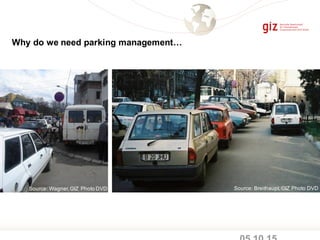
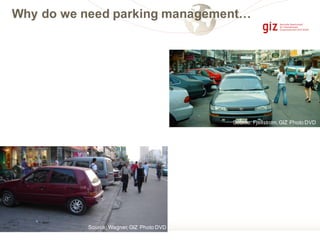
Why do we need parking management…
Source: Wagner Source: Breithaupt,GIZ Photo DVDSource: Wagner,GIZ Photo DVD
• Increasing emissions of green house gases pollutants and
noise caused by parking-space-search-traffic:
Ø Cruising for curb parking generates about 30% of the traffic
in central business districts
Ø Study of a 15-block business district (Los Angeles) shows
(per year):
1. 1.500.000 excess vehicle km = 38 trips around the world
2. Wastage of 177.000 liters of fuel
3. Production of 730 tons of carbon dioxide
(Source: Donald Shoup, The New York Times, March 29, 2007)
Parking? Why Manage it?
Parking? Why Manage it? (1)
4It is an important component of transportation
4Every vehicle needs a place to park, so just to increase
parking facilities is not a solution
4It is a major cost to a society
4It affects accessibility to a destination
4A typical automobile is parked for 23 hours a day and
uses several parking spaces a week
4Improper management hinders development of other
infrastructure
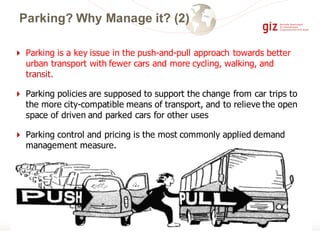
4 Parking is a key issue in the push-and-pull approach towards better
urban transport with fewer cars and more cycling, walking, and
transit.
4 Parking policies are supposed to support the change from car trips to
the more city-compatible means of transport, and to relieve the open
space of driven and parked cars for other uses
4 Parking control and pricing is the most commonly applied demand
management measure.
Parking? Why Manage it? (2)
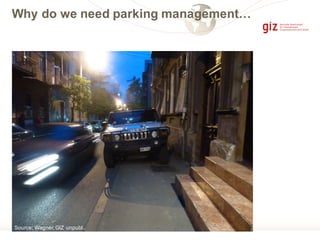
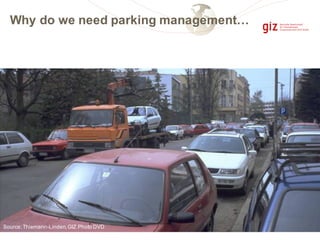
Why do we need parking management…
Source: Wagner,GIZ unpubl.
Source: Wagner,GIZ Photo DVD
Source: Fjellstrom,GIZ Photo DVD
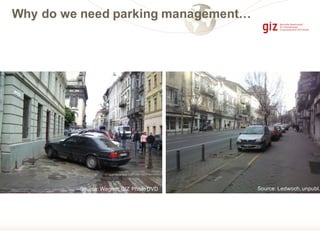
Why do we need parking management…
Source:Thiemann-Linden,GIZ Photo DVD
Why do we need parking management…
Source: Wagner,GIZ Photo DVD Source: Ledwoch,unpubl.
Why do we need parking management…
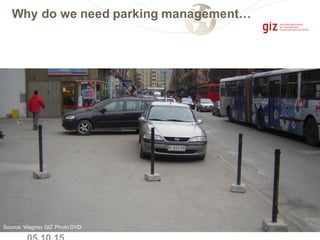
Source: Wagner,GIZ Photo DVD
Why do we need parking management…
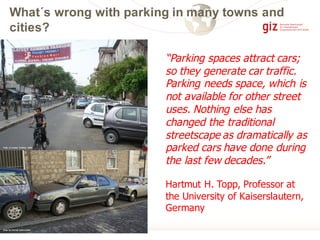
What´s wrong with parking in many towns and
cities?
“Parking spaces attract cars;
so they generate car traffic.
Parking needs space, which is
not available for other street
uses. Nothing else has
changed the traditional
streetscape as dramatically as
parked cars have done during
the last few decades.”
Hartmut H. Topp, Professor at
the University of Kaiserslautern,
Germany
Photo by Santosh Kodukula (2008)
Photo by Dominik Schmid(2006)
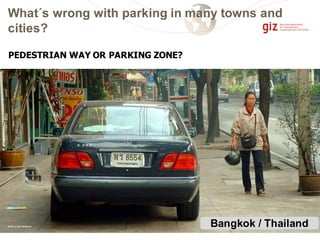
PEDESTRIAN WAY OR PARKING ZONE?
Photo by Karl Fjellstrom Bangkok / Thailand
What´s wrong with parking in many towns and
cities?
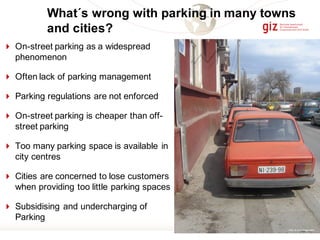
4 On-street parking as a widespread
phenomenon
4 Often lack of parking management
4 Parking regulations are not enforced
4 On-street parking is cheaper than off-
street parking
4 Too many parking space is available in
city centres
4 Cities are concerned to lose customers
when providing too little parking spaces
4 Subsidising and undercharging of
Parking
What´s wrong with parking in many towns
and cities?
Photo by ArminWagner (2007)
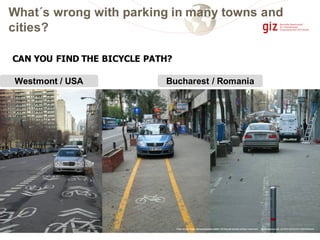
CAN YOU FIND THE BICYCLE PATH?
Bucharest / Romania
What´s wrong with parking in many towns and
cities?
Photos by Lloyd Wright, http://spacingmontreal.ca/2008/1 1/27/ bike-p ath- reve rts-to -pa rking-i n-west mount /, http://picasaweb.google. com/lh/ phot o/F2Jt c3V-Y-QKlcUkDSazeQ
Westmont / USA
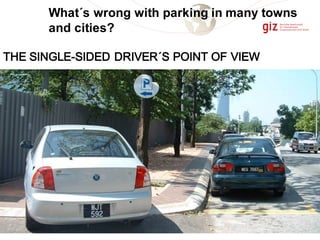
THE SINGLE-SIDED DRIVER´S POINT OF VIEW
Photo by Karl Fjellstrom
What´s wrong with parking in many towns
and cities?
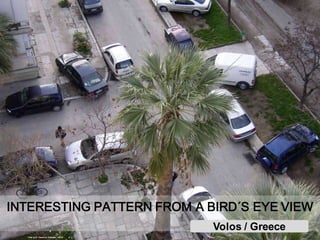
INTERESTING PATTERN FROM A BIRD´S EYE VIEW
Photo by Dr. Hanns-Uve Schwedler / EAUE
Volos / Greece
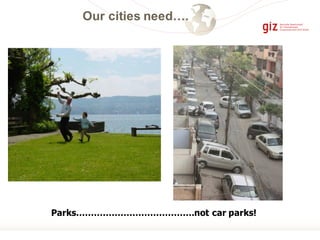
Our cities need….
Parks………………………………….not car parks!
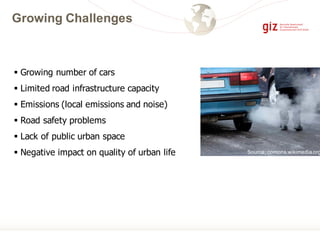
Growing Challenges
§ Growing number of cars
§ Limited road infrastructure capacity
§ Emissions (local emissions and noise)
§ Road safety problems
§ Lack of public urban space
§ Negative impact on quality of urban life Source: comons.wikimedia.org
2. PARKING STRATEGIES
Source: comons.wikimedia.org
What it does…
§ Less “wild“ parking
§ Higher availability of parking space
§ Less circulation to find a free or cheap parking spot
§ General speed-up of car traffic
§ Shift car users to other transport modes
§ higher attractivity of urban space
§ major revenue earner (medium-sized city: 5-20m USD)
What it doesn‘t…
§ Keep road users, commuters, residents away from visiting the city centre
§ lead to a decline of retailers
Parking management
Menu of Parking Regulation and Policies..
• Limit on-street parking time
(amount of time that a vehicle can
be left in a spot).
• Limit use of on-street parking
to area residents.
• Limit on-street parking of
large vehicles.
• Prohibit on-street parking on
certain routes at certain times
(such as arterials during rush
hour).
• Parking requirements / standards
(Min size per dwelling), going for
maximum parking alowance ( refer
to case Joburg)
• Unbundle Parking
• Mandatory off-street parking proof
to purchase vehicle
• Bicycle Parking
• Parking information systems
• Price parking depending on demand
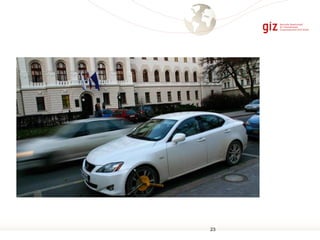
Okrepljen nadzor parkiranja
23
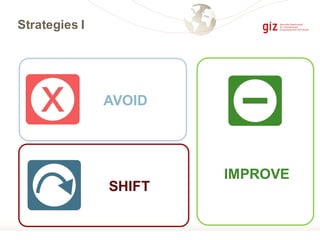
IMPROVE
Strategies I
AVOID
SHIFT
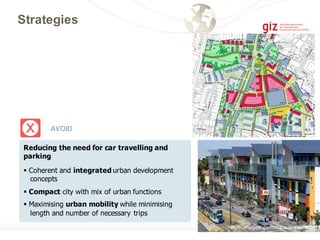
Reducing the need for car travelling and
parking
§ Coherent and integrated urban development
concepts
§ Compact city with mix of urban functions
§ Maximising urban mobility while minimising
length and number of necessary trips
Strategies
AVOID
Both images:comons.wikimedia.org
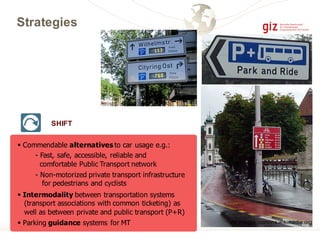
§ Commendable alternatives to car usage e.g.:
- Fast, safe, accessible, reliable and
comfortable Public Transport network
- Non-motorized private transport infrastructure
for pedestrians and cyclists
§ Intermodality between transportation systems
(transport associations with common ticketing) as
well as between private and public transport (P+R)
§ Parking guidance systems for MT
Strategies
All images:comons.wikimedia.org
SHIFT
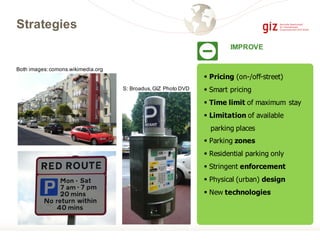
§ Pricing (on-/off-street)
§ Smart pricing
§ Time limit of maximum stay
§ Limitation of available
parking places
§ Parking zones
§ Residential parking only
§ Stringent enforcement
§ Physical (urban) design
§ New technologies
Strategies
S: Broadus,GIZ Photo DVD
Both images:comons.wikimedia.org
IMPROVE
Restraints on car use – On-street
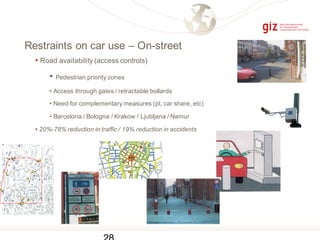
• Road availability (access controls)
• Pedestrian priority zones
• Access through gates / retractable bollards
• Need for complementary measures (pt, car share, etc)
• Barcelona / Bologna / Krakow / Ljubljana / Namur
• 20%-78% reduction in traffic / 19% reduction in accidents
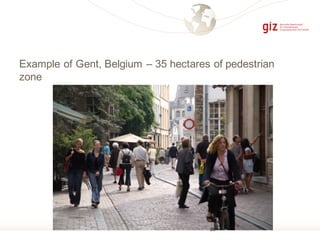
Example of Gent, Belgium – 35 hectares of pedestrian
zone
29
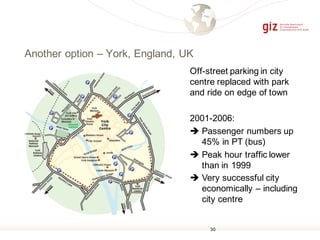
Another option – York, England, UK
Off-street parking in city
centre replaced with park
and ride on edge of town
2001-2006:
è Passenger numbers up
45% in PT (bus)
è Peak hour traffic lower
than in 1999
è Very successful city
economically – including
city centre
30
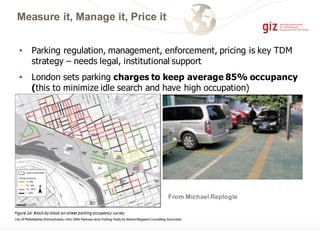
Measure it, Manage it, Price it
• Parking regulation, management, enforcement, pricing is key TDM
strategy – needs legal, institutional support
• London sets parking charges to keep average 85% occupancy
(this to minimize idle search and have high occupation)
Illegally parked cars block bikeways
and sidewalks in Changzhou
From Michael Replogle
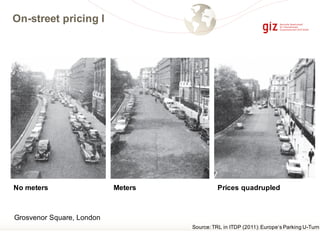
No meters Meters Prices quadrupled
Grosvenor Square, London
Source:TRL in ITDP (2011):Europe‘s Parking U-Turn
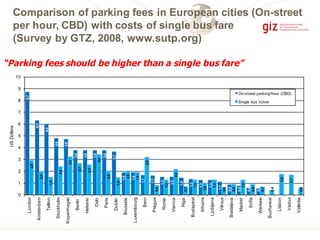
On-street pricing I
8,7
6,3
6,0
4,8
4,8
3,8
3,8
3,8
3,8
3,7
1,9
1,9
1,7
1,7
1,5
1,5
1,5
1,3
1,3
1,3
1,1
0,9
0,8
0,6
0,6
2,9
2,0
1,5
2,4
3,2
2,7
2,5
3,4
2,0
1,5
2,0
1,9
3,2
0,8
1,3
2,2
0,7
1,3
1,0
1,3
0,6
0,9
1,3
0,9
0,7
0,4
1,8
1,7
0,6
0
1
2
3
4
5
6
7
8
9
10
London
Amsterdam
Tallinn
Stockholm
Kopenhagen
Berlin
Helsinki
Oslo
Paris
Dublin
Brussels
Luxembourg
Bern
Prague
Rome
Vienna
Riga
Budapest
Athens
Ljubljana
Vilnius
Bratislava
Madrid
Sofia
Warsaw
Bucharest
Lisbon
Vaduz
Valletta
USDollars
On-street parking/hour (CBD)
Single bus ticket
Comparison of parking fees in European cities (On-street
per hour, CBD) with costs of single bus fare
(Survey by GTZ, 2008, www.sutp.org)
“Parking fees should be higher than a single bus fare”
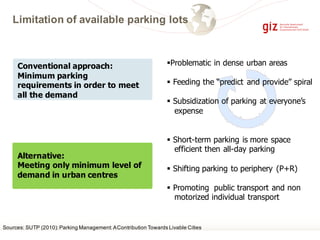
Limitation of available parking lots
Conventional approach:
Minimum parking
requirements in order to meet
all the demand
Alternative:
Meeting only minimum level of
demand in urban centres
§Problematic in dense urban areas
§ Feeding the “predict and provide” spiral
§ Subsidization of parking at everyone’s
expense
§ Short-term parking is more space
efficient then all-day parking
§ Shifting parking to periphery (P+R)
§ Promoting public transport and non
motorized individual transport
Sources: SUTP (2010):Parking Management:AContribution Towards Livable Cities
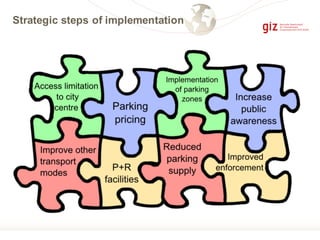
Strategic steps of implementation
3. BEST PRACTICES
Source: comons.wikimedia.org
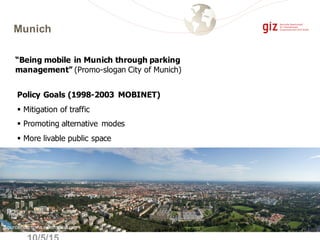
Munich
“Being mobile in Munich through parking
management” (Promo-slogan City of Munich)
Source: comons.wikimedia.org
Policy Goals (1998-2003 MOBINET)
§ Mitigation of traffic
§ Promoting alternative modes
§ More livable public space
Munich
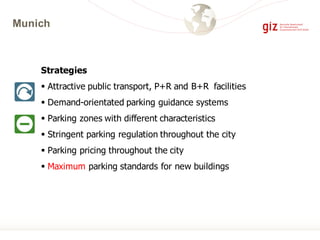
Strategies
§ Attractive public transport, P+R and B+R facilities
§ Demand-orientated parking guidance systems
§ Parking zones with different characteristics
§ Stringent parking regulation throughout the city
§ Parking pricing throughout the city
§ Maximum parking standards for new buildings
Munich
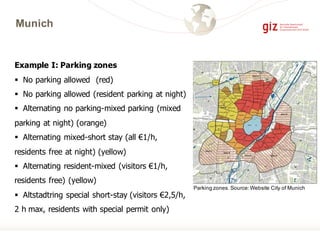
Example I: Parking zones
§ No parking allowed (red)
§ No parking allowed (resident parking at night)
§ Alternating no parking-mixed parking (mixed
parking at night) (orange)
§ Alternating mixed-short stay (all €1/h,
residents free at night) (yellow)
§ Alternating resident-mixed (visitors €1/h,
residents free) (yellow)
§ Altstadtring special short-stay (visitors €2,5/h,
2 h max, residents with special permit only)
Parking zones. Source:Website City of Munich
Munich
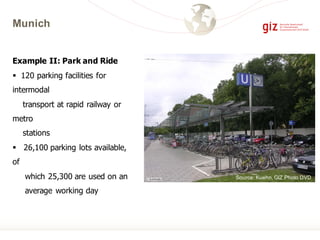
Example II: Park and Ride
§ 120 parking facilities for
intermodal
transport at rapid railway or
metro
stations
§ 26,100 parking lots available,
of
which 25,300 are used on an
average working day
Source: Kuehn,GIZ Photo DVD
Munich
Parking management in numbers
§ Car trips: - 14%
§ Bicycle: + 75%
§ Walking: + 61%
§ 1.700 fewer automobiles owned by
residents
§ Reduction of overnight parking by 25%,
§ Reduction of all-day parkers by 40%
Source: ITDP (2011): Europe‘s Parking U-Turn
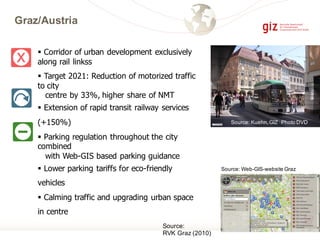
Graz/Austria
§ Corridor of urban development exclusively
along rail linkss
§ Target 2021: Reduction of motorized traffic
to city
centre by 33%, higher share of NMT
§ Extension of rapid transit railway services
(+150%)
§ Parking regulation throughout the city
combined
with Web-GIS based parking guidance
§ Lower parking tariffs for eco-friendly
vehicles
§ Calming traffic and upgrading urban space
in centre
Source:
RVK Graz (2010)
Source: Kuehn,GIZ Photo DVD
Source: Web-GIS-website Graz
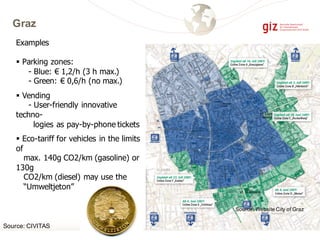
Graz
Examples
§ Parking zones:
- Blue: € 1,2/h (3 h max.)
- Green: € 0,6/h (no max.)
§ Vending
- User-friendly innovative
techno-
logies as pay-by-phone tickets
§ Eco-tariff for vehicles in the limits
of
max. 140g CO2/km (gasoline) or
130g
CO2/km (diesel) may use the
“Umweltjeton”
Source: CIVITAS
Source: Website City of Graz
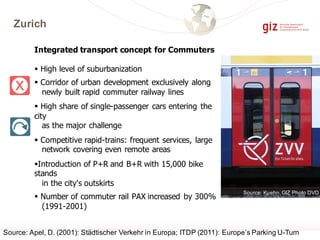
Zurich
Integrated transport concept for Commuters
§ High level of suburbanization
§ Corridor of urban development exclusively along
newly built rapid commuter railway lines
§ High share of single-passenger cars entering the
city
as the major challenge
§ Competitive rapid-trains: frequent services, large
network covering even remote areas
§Introduction of P+R and B+R with 15,000 bike
stands
in the city's outskirts
§ Number of commuter rail PAX increased by 300%
(1991-2001)
Source: Apel, D. (2001): Städtischer Verkehr in Europa; ITDP (2011): Europe’s Parking U-Turn
Source: Kuehn,GIZ Photo DVD
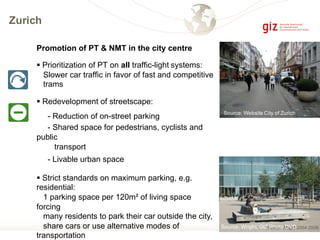
Zurich
Promotion of PT & NMT in the city centre
§ Prioritization of PT on all traffic-light systems:
Slower car traffic in favor of fast and competitive
trams
§ Redevelopment of streetscape:
- Reduction of on-street parking
- Shared space for pedestrians, cyclists and
public
transport
- Livable urban space
§ Strict standards on maximum parking, e.g.
residential:
1 parking space per 120m² of living space
forcing
many residents to park their car outside the city,
share cars or use alternative modes of
transportation
Source: Wright, GIZ Photo DVD
Source: Wright, GIZ DVD
Source: Website City of Zurich
Zurich
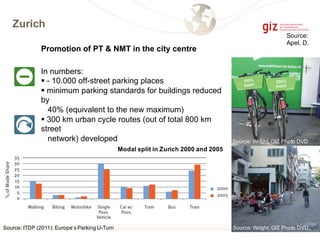
Promotion of PT & NMT in the city centre
In numbers:
§ - 10.000 off-street parking places
§ minimum parking standards for buildings reduced
by
40% (equivalent to the new maximum)
§ 300 km urban cycle routes (out of total 800 km
street
network) developed
Source:
Apel, D.
Source: Wright, GIZ Photo DVD
Modal split in Zurich 2000 and 2005
Source: ITDP (2011): Europe‘s Parking U-Turn
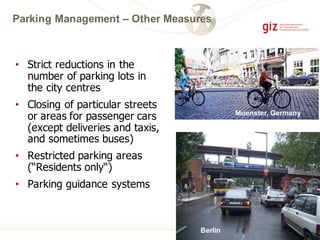
Parking Management – Other Measures
• Strict reductions in the
number of parking lots in
the city centres
• Closing of particular streets
or areas for passenger cars
(except deliveries and taxis,
and sometimes buses)
• Restricted parking areas
(“Residents only“)
• Parking guidance systems
Karl Fjellstrom
Muenster, Germany
Berlin
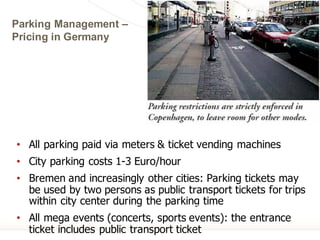
Parking Management –
Pricing in Germany
• All parking paid via meters & ticket vending machines
• City parking costs 1-3 Euro/hour
• Bremen and increasingly other cities: Parking tickets may
be used by two persons as public transport tickets for trips
within city center during the parking time
• All mega events (concerts, sports events): the entrance
ticket includes public transport ticket
Karl Fjellstrom
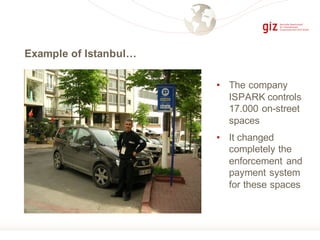
Example of Istanbul…
• The company
ISPARK controls
17.000 on-street
spaces
• It changed
completely the
enforcement and
payment system
for these spaces
How much money will it cost me?
• Ticket machines
• Per machine: E2500 investment, E250/yr maintenance (UK)
• Close enough to parked car to buy ticket without being fined!
• One machine per 10-20 bays
BUT!
• Mobile phone parking – parts of London 60% market share,
Tallinn 80%
• Mobile phone permits also possible
• Switch to mobile parking in Southwark, London, 2010:
• Cash collection and processing costs down 35%
• Meter faults down 56%
• Revenue up 6%
San Francisco real time parking guidance and
pricing
• San Francisco USA – measures occupancy of 12,000 off-street
AND 7,000 on-street parking spaces
• Changes prices in real time to keep occupancy close to 85%
• Info to drivers via internet, smartphone App, GPS
• Film at http://www.streetfilms.org/mba-the-right-price-for-parking/
• See www.sfpark.org (in English)
• And http://www.prnewswire.com/news-releases/streetline-raises-
the-bar-on-what-consumers-can-expect-from-parking-guidance-
apps-with-release-of-parker-30-151761085.html
Alternatives to Car Parking
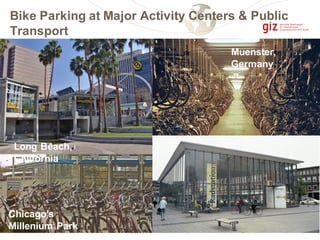
Bike Parking at Major Activity Centers & Public
Transport
Chicago’s
Millenium Park
Muenster,
Germany
Long Beach,
California
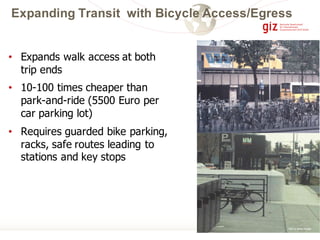
Expanding Transit with Bicycle Access/Egress
• Expands walk access at both
trip ends
• 10-100 times cheaper than
park-and-ride (5500 Euro per
car parking lot)
• Requires guarded bike parking,
racks, safe routes leading to
stations and key stops
Photo by Michael Replogle
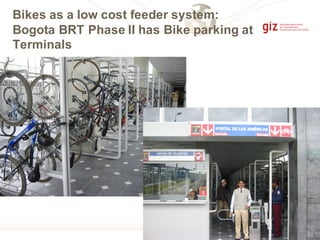
Bikes as a low cost feeder system:
Bogota BRT Phase II has Bike parking at
Terminals
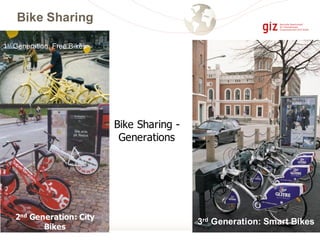
1st Generation: Free Bikes
2nd Generation: City
Bikes
3rd Generation: Smart Bikes
Bike Sharing -
Generations
Bike Sharing
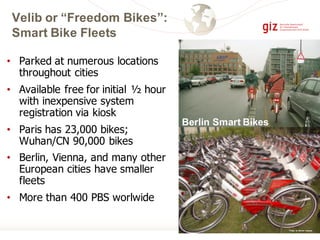
Velib or “Freedom Bikes”:
Smart Bike Fleets
• Parked at numerous locations
throughout cities
• Available free for initial ½ hour
with inexpensive system
registration via kiosk
• Paris has 23,000 bikes;
Wuhan/CN 90,000 bikes
• Berlin, Vienna, and many other
European cities have smaller
fleets
• More than 400 PBS worlwide
Berlin Smart Bikes
Photos by Michael Replogle
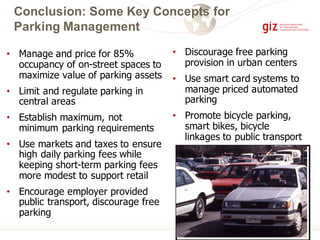
Conclusion: Some Key Concepts for
Parking Management
• Manage and price for 85%
occupancy of on-street spaces to
maximize value of parking assets
• Limit and regulate parking in
central areas
• Establish maximum, not
minimum parking requirements
• Use markets and taxes to ensure
high daily parking fees while
keeping short-term parking fees
more modest to support retail
• Encourage employer provided
public transport, discourage free
parking
• Discourage free parking
provision in urban centers
• Use smart card systems to
manage priced automated
parking
• Promote bicycle parking,
smart bikes, bicycle
linkages to public transport
For further information visit:
German International Cooperation
www.gtz.detransport
Sustainable Urban Transport Project
www.sutp.org
Source: comons.wikimedia.org

5.1 parking management mb_4.10.15

  • 1.
    05.10.15 Seite 1 ParkingManagement : International Perspective Manfred Breithaupt Sustainable Urban Transport Project German International Cooperation (GIZ)
  • 2.
  • 3.
    Why do weneed parking management… Source: Wagner Source: Breithaupt,GIZ Photo DVDSource: Wagner,GIZ Photo DVD
  • 4.
    • Increasing emissionsof green house gases pollutants and noise caused by parking-space-search-traffic: Ø Cruising for curb parking generates about 30% of the traffic in central business districts Ø Study of a 15-block business district (Los Angeles) shows (per year): 1. 1.500.000 excess vehicle km = 38 trips around the world 2. Wastage of 177.000 liters of fuel 3. Production of 730 tons of carbon dioxide (Source: Donald Shoup, The New York Times, March 29, 2007) Parking? Why Manage it?
  • 5.
    Parking? Why Manageit? (1) 4It is an important component of transportation 4Every vehicle needs a place to park, so just to increase parking facilities is not a solution 4It is a major cost to a society 4It affects accessibility to a destination 4A typical automobile is parked for 23 hours a day and uses several parking spaces a week 4Improper management hinders development of other infrastructure
  • 6.
    4 Parking isa key issue in the push-and-pull approach towards better urban transport with fewer cars and more cycling, walking, and transit. 4 Parking policies are supposed to support the change from car trips to the more city-compatible means of transport, and to relieve the open space of driven and parked cars for other uses 4 Parking control and pricing is the most commonly applied demand management measure. Parking? Why Manage it? (2)
  • 7.
    Why do weneed parking management… Source: Wagner,GIZ unpubl.
  • 8.
    Source: Wagner,GIZ PhotoDVD Source: Fjellstrom,GIZ Photo DVD Why do we need parking management…
  • 9.
    Source:Thiemann-Linden,GIZ Photo DVD Whydo we need parking management…
  • 10.
    Source: Wagner,GIZ PhotoDVD Source: Ledwoch,unpubl. Why do we need parking management…
  • 11.
    Source: Wagner,GIZ PhotoDVD Why do we need parking management…
  • 12.
    What´s wrong withparking in many towns and cities? “Parking spaces attract cars; so they generate car traffic. Parking needs space, which is not available for other street uses. Nothing else has changed the traditional streetscape as dramatically as parked cars have done during the last few decades.” Hartmut H. Topp, Professor at the University of Kaiserslautern, Germany Photo by Santosh Kodukula (2008) Photo by Dominik Schmid(2006)
  • 13.
    PEDESTRIAN WAY ORPARKING ZONE? Photo by Karl Fjellstrom Bangkok / Thailand What´s wrong with parking in many towns and cities?
  • 14.
    4 On-street parkingas a widespread phenomenon 4 Often lack of parking management 4 Parking regulations are not enforced 4 On-street parking is cheaper than off- street parking 4 Too many parking space is available in city centres 4 Cities are concerned to lose customers when providing too little parking spaces 4 Subsidising and undercharging of Parking What´s wrong with parking in many towns and cities? Photo by ArminWagner (2007)
  • 15.
    CAN YOU FINDTHE BICYCLE PATH? Bucharest / Romania What´s wrong with parking in many towns and cities? Photos by Lloyd Wright, http://spacingmontreal.ca/2008/1 1/27/ bike-p ath- reve rts-to -pa rking-i n-west mount /, http://picasaweb.google. com/lh/ phot o/F2Jt c3V-Y-QKlcUkDSazeQ Westmont / USA
  • 16.
    THE SINGLE-SIDED DRIVER´SPOINT OF VIEW Photo by Karl Fjellstrom What´s wrong with parking in many towns and cities?
  • 17.
    INTERESTING PATTERN FROMA BIRD´S EYE VIEW Photo by Dr. Hanns-Uve Schwedler / EAUE Volos / Greece
  • 18.
  • 19.
    Growing Challenges § Growingnumber of cars § Limited road infrastructure capacity § Emissions (local emissions and noise) § Road safety problems § Lack of public urban space § Negative impact on quality of urban life Source: comons.wikimedia.org
  • 20.
    2. PARKING STRATEGIES Source:comons.wikimedia.org
  • 21.
    What it does… §Less “wild“ parking § Higher availability of parking space § Less circulation to find a free or cheap parking spot § General speed-up of car traffic § Shift car users to other transport modes § higher attractivity of urban space § major revenue earner (medium-sized city: 5-20m USD) What it doesn‘t… § Keep road users, commuters, residents away from visiting the city centre § lead to a decline of retailers Parking management
  • 22.
    Menu of ParkingRegulation and Policies.. • Limit on-street parking time (amount of time that a vehicle can be left in a spot). • Limit use of on-street parking to area residents. • Limit on-street parking of large vehicles. • Prohibit on-street parking on certain routes at certain times (such as arterials during rush hour). • Parking requirements / standards (Min size per dwelling), going for maximum parking alowance ( refer to case Joburg) • Unbundle Parking • Mandatory off-street parking proof to purchase vehicle • Bicycle Parking • Parking information systems • Price parking depending on demand
  • 23.
  • 24.
  • 25.
    Reducing the needfor car travelling and parking § Coherent and integrated urban development concepts § Compact city with mix of urban functions § Maximising urban mobility while minimising length and number of necessary trips Strategies AVOID Both images:comons.wikimedia.org
  • 26.
    § Commendable alternativesto car usage e.g.: - Fast, safe, accessible, reliable and comfortable Public Transport network - Non-motorized private transport infrastructure for pedestrians and cyclists § Intermodality between transportation systems (transport associations with common ticketing) as well as between private and public transport (P+R) § Parking guidance systems for MT Strategies All images:comons.wikimedia.org SHIFT
  • 27.
    § Pricing (on-/off-street) §Smart pricing § Time limit of maximum stay § Limitation of available parking places § Parking zones § Residential parking only § Stringent enforcement § Physical (urban) design § New technologies Strategies S: Broadus,GIZ Photo DVD Both images:comons.wikimedia.org IMPROVE
  • 28.
    Restraints on caruse – On-street • Road availability (access controls) • Pedestrian priority zones • Access through gates / retractable bollards • Need for complementary measures (pt, car share, etc) • Barcelona / Bologna / Krakow / Ljubljana / Namur • 20%-78% reduction in traffic / 19% reduction in accidents
  • 29.
    Example of Gent,Belgium – 35 hectares of pedestrian zone 29
  • 30.
    Another option –York, England, UK Off-street parking in city centre replaced with park and ride on edge of town 2001-2006: è Passenger numbers up 45% in PT (bus) è Peak hour traffic lower than in 1999 è Very successful city economically – including city centre 30
  • 31.
    Measure it, Manageit, Price it • Parking regulation, management, enforcement, pricing is key TDM strategy – needs legal, institutional support • London sets parking charges to keep average 85% occupancy (this to minimize idle search and have high occupation) Illegally parked cars block bikeways and sidewalks in Changzhou From Michael Replogle
  • 32.
    No meters MetersPrices quadrupled Grosvenor Square, London Source:TRL in ITDP (2011):Europe‘s Parking U-Turn On-street pricing I
  • 33.
  • 34.
    Limitation of availableparking lots Conventional approach: Minimum parking requirements in order to meet all the demand Alternative: Meeting only minimum level of demand in urban centres §Problematic in dense urban areas § Feeding the “predict and provide” spiral § Subsidization of parking at everyone’s expense § Short-term parking is more space efficient then all-day parking § Shifting parking to periphery (P+R) § Promoting public transport and non motorized individual transport Sources: SUTP (2010):Parking Management:AContribution Towards Livable Cities
  • 35.
    Strategic steps ofimplementation
  • 36.
    3. BEST PRACTICES Source:comons.wikimedia.org
  • 37.
    Munich “Being mobile inMunich through parking management” (Promo-slogan City of Munich) Source: comons.wikimedia.org Policy Goals (1998-2003 MOBINET) § Mitigation of traffic § Promoting alternative modes § More livable public space
  • 38.
    Munich Strategies § Attractive publictransport, P+R and B+R facilities § Demand-orientated parking guidance systems § Parking zones with different characteristics § Stringent parking regulation throughout the city § Parking pricing throughout the city § Maximum parking standards for new buildings
  • 39.
    Munich Example I: Parkingzones § No parking allowed (red) § No parking allowed (resident parking at night) § Alternating no parking-mixed parking (mixed parking at night) (orange) § Alternating mixed-short stay (all €1/h, residents free at night) (yellow) § Alternating resident-mixed (visitors €1/h, residents free) (yellow) § Altstadtring special short-stay (visitors €2,5/h, 2 h max, residents with special permit only) Parking zones. Source:Website City of Munich
  • 40.
    Munich Example II: Parkand Ride § 120 parking facilities for intermodal transport at rapid railway or metro stations § 26,100 parking lots available, of which 25,300 are used on an average working day Source: Kuehn,GIZ Photo DVD
  • 41.
    Munich Parking management innumbers § Car trips: - 14% § Bicycle: + 75% § Walking: + 61% § 1.700 fewer automobiles owned by residents § Reduction of overnight parking by 25%, § Reduction of all-day parkers by 40% Source: ITDP (2011): Europe‘s Parking U-Turn
  • 42.
    Graz/Austria § Corridor ofurban development exclusively along rail linkss § Target 2021: Reduction of motorized traffic to city centre by 33%, higher share of NMT § Extension of rapid transit railway services (+150%) § Parking regulation throughout the city combined with Web-GIS based parking guidance § Lower parking tariffs for eco-friendly vehicles § Calming traffic and upgrading urban space in centre Source: RVK Graz (2010) Source: Kuehn,GIZ Photo DVD Source: Web-GIS-website Graz
  • 43.
    Graz Examples § Parking zones: -Blue: € 1,2/h (3 h max.) - Green: € 0,6/h (no max.) § Vending - User-friendly innovative techno- logies as pay-by-phone tickets § Eco-tariff for vehicles in the limits of max. 140g CO2/km (gasoline) or 130g CO2/km (diesel) may use the “Umweltjeton” Source: CIVITAS Source: Website City of Graz
  • 44.
    Zurich Integrated transport conceptfor Commuters § High level of suburbanization § Corridor of urban development exclusively along newly built rapid commuter railway lines § High share of single-passenger cars entering the city as the major challenge § Competitive rapid-trains: frequent services, large network covering even remote areas §Introduction of P+R and B+R with 15,000 bike stands in the city's outskirts § Number of commuter rail PAX increased by 300% (1991-2001) Source: Apel, D. (2001): Städtischer Verkehr in Europa; ITDP (2011): Europe’s Parking U-Turn Source: Kuehn,GIZ Photo DVD
  • 45.
    Zurich Promotion of PT& NMT in the city centre § Prioritization of PT on all traffic-light systems: Slower car traffic in favor of fast and competitive trams § Redevelopment of streetscape: - Reduction of on-street parking - Shared space for pedestrians, cyclists and public transport - Livable urban space § Strict standards on maximum parking, e.g. residential: 1 parking space per 120m² of living space forcing many residents to park their car outside the city, share cars or use alternative modes of transportation Source: Wright, GIZ Photo DVD Source: Wright, GIZ DVD Source: Website City of Zurich
  • 46.
    Zurich Promotion of PT& NMT in the city centre In numbers: § - 10.000 off-street parking places § minimum parking standards for buildings reduced by 40% (equivalent to the new maximum) § 300 km urban cycle routes (out of total 800 km street network) developed Source: Apel, D. Source: Wright, GIZ Photo DVD Source: Wright, GIZ Photo DVD Modal split in Zurich 2000 and 2005 Source: ITDP (2011): Europe‘s Parking U-Turn
  • 47.
    Parking Management –Other Measures • Strict reductions in the number of parking lots in the city centres • Closing of particular streets or areas for passenger cars (except deliveries and taxis, and sometimes buses) • Restricted parking areas (“Residents only“) • Parking guidance systems Karl Fjellstrom Muenster, Germany Berlin
  • 48.
    Parking Management – Pricingin Germany • All parking paid via meters & ticket vending machines • City parking costs 1-3 Euro/hour • Bremen and increasingly other cities: Parking tickets may be used by two persons as public transport tickets for trips within city center during the parking time • All mega events (concerts, sports events): the entrance ticket includes public transport ticket Karl Fjellstrom
  • 49.
    Example of Istanbul… •The company ISPARK controls 17.000 on-street spaces • It changed completely the enforcement and payment system for these spaces
  • 50.
    How much moneywill it cost me? • Ticket machines • Per machine: E2500 investment, E250/yr maintenance (UK) • Close enough to parked car to buy ticket without being fined! • One machine per 10-20 bays BUT! • Mobile phone parking – parts of London 60% market share, Tallinn 80% • Mobile phone permits also possible • Switch to mobile parking in Southwark, London, 2010: • Cash collection and processing costs down 35% • Meter faults down 56% • Revenue up 6%
  • 51.
    San Francisco realtime parking guidance and pricing • San Francisco USA – measures occupancy of 12,000 off-street AND 7,000 on-street parking spaces • Changes prices in real time to keep occupancy close to 85% • Info to drivers via internet, smartphone App, GPS • Film at http://www.streetfilms.org/mba-the-right-price-for-parking/ • See www.sfpark.org (in English) • And http://www.prnewswire.com/news-releases/streetline-raises- the-bar-on-what-consumers-can-expect-from-parking-guidance- apps-with-release-of-parker-30-151761085.html
  • 52.
  • 53.
    Bike Parking atMajor Activity Centers & Public Transport Chicago’s Millenium Park Muenster, Germany Long Beach, California
  • 54.
    Expanding Transit withBicycle Access/Egress • Expands walk access at both trip ends • 10-100 times cheaper than park-and-ride (5500 Euro per car parking lot) • Requires guarded bike parking, racks, safe routes leading to stations and key stops Photo by Michael Replogle
  • 55.
    Bikes as alow cost feeder system: Bogota BRT Phase II has Bike parking at Terminals
  • 56.
    1st Generation: FreeBikes 2nd Generation: City Bikes 3rd Generation: Smart Bikes Bike Sharing - Generations Bike Sharing
  • 57.
    Velib or “FreedomBikes”: Smart Bike Fleets • Parked at numerous locations throughout cities • Available free for initial ½ hour with inexpensive system registration via kiosk • Paris has 23,000 bikes; Wuhan/CN 90,000 bikes • Berlin, Vienna, and many other European cities have smaller fleets • More than 400 PBS worlwide Berlin Smart Bikes Photos by Michael Replogle
  • 58.
    Conclusion: Some KeyConcepts for Parking Management • Manage and price for 85% occupancy of on-street spaces to maximize value of parking assets • Limit and regulate parking in central areas • Establish maximum, not minimum parking requirements • Use markets and taxes to ensure high daily parking fees while keeping short-term parking fees more modest to support retail • Encourage employer provided public transport, discourage free parking • Discourage free parking provision in urban centers • Use smart card systems to manage priced automated parking • Promote bicycle parking, smart bikes, bicycle linkages to public transport
  • 59.
    For further informationvisit: German International Cooperation www.gtz.detransport Sustainable Urban Transport Project www.sutp.org Source: comons.wikimedia.org