Pedestrian  Safety & Urban Transport Geetam Tiwari Transportation Research and Injury Prevention Program Indian Institute of Technology, Delhi, India
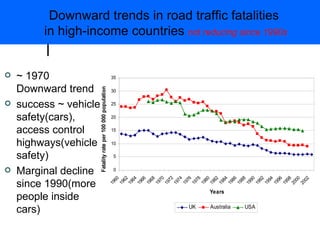
~ 1970 Downward trend success ~ vehicle safety(cars), access control highways(vehicle safety) Marginal decline since 1990(more people inside cars) Downward trends in road traffic fatalities  in high-income countries  not reducing since 1990s
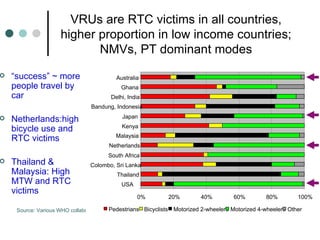
VRUs are RTC victims in all countries, higher proportion in low income countries; NMVs, PT dominant modes “ success” ~ more people travel by car  Netherlands:high bicycle use and RTC victims Thailand & Malaysia: High MTW and RTC victims Source: Various WHO collaborators in countries 0% 20% 40% 60% 80% 100% USA Thailand Colombo, Sri Lanka South Africa Netherlands Malaysia Kenya Japan Bandung, Indonesia Delhi, India Ghana Australia Pedestrians Bicyclists Motorized 2-wheelers Motorized 4-wheelers Other
Victims in URBAN RTC Highest share of RTC fatalities in urban areas are pedestrians regardless of country income; eg New York 54%  London 30% Johannesburg  33% Mexico city  52% Delhi  50% Mumbai  75% Tehran  33% Shanghai 40% Urban problem, not of development! ‘ Safe countries’ have achieved peds safety on highways, not in cities
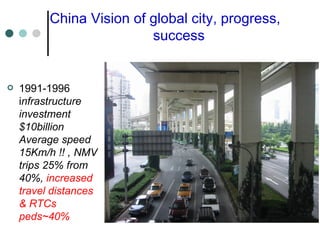
China Vision of global city, progress,  success 1991-1996 i nfrastructure investment $10billion Average speed 15Km/h !! , NMV trips 25% from 40%,  increased travel distances & RTCs peds~40%
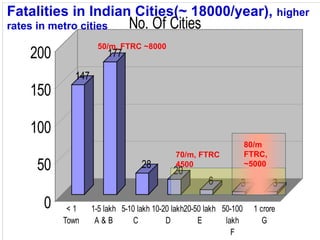
80/m FTRC, ~5000 70/m, FTRC 4500 50/m, FTRC ~8000 Fatalities in Indian Cities(~ 18000/year),  higher rates in metro cities
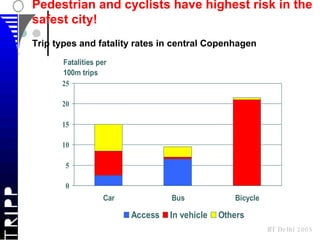
Pedestrian and cyclists have highest risk in the safest city! Trip types and fatality rates in central Copenhagen IIT Delhi 2005
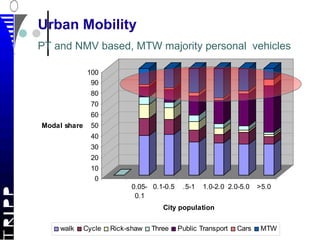
Urban Mobility PT and NMV based, MTW majority personal  vehicles
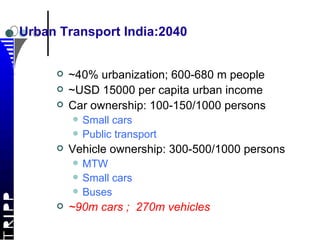
Urban Transport India:2040 ~40% urbanization; 600-680 m people ~USD 15000 per capita urban income Car ownership: 100-150/1000 persons Small cars Public transport Vehicle ownership: 300-500/1000 persons MTW Small cars Buses ~90m cars ;  270m vehicles
Priorities for Energy Efficient/Low EmissionUrban Transport Preserving walking and bicycle trips in all cities(20-60%) Mixed Landuse (short trips)  relationship between informal and formal sector (captive users) City speed limits < 50km/h( safety considerations) Safe infrastructure (network connectivity)
Priorities for Energy Efficient/low emission Urban Transport PT for serving 5-15km trips (30-40%) of total trips Safe walking and bicycling(feeder modes) Medium density to generate sufficient demand Fares to compete with MTW operating cost
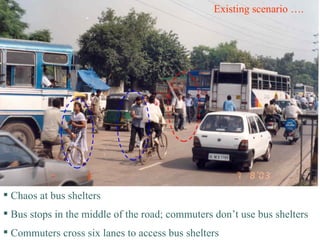
Existing scenario …. Chaos at bus shelters Bus stops in the middle of the road; commuters don’t use bus shelters Commuters cross six lanes to access bus shelters
Pedestrian safety The most influential factor ..in making a decision to cross at a designated crossing location is the distance of the crosswalk to desired destinations of pedestrians. (Handy, 1996; Shriver, 1997 )  Besides, improvements in safety and comfort for pedestrians can be obtained without major side effects on vehicle travel (Carsten et al., 1998).  Also it is evident that pedestrian safety can be affected by changes in the signal settings at signalized crosswalks(peds delay< 40 sec) (Garter, 1989).
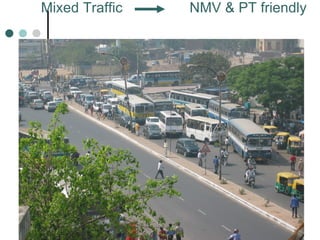
Mixed Traffic  NMV & PT friendly
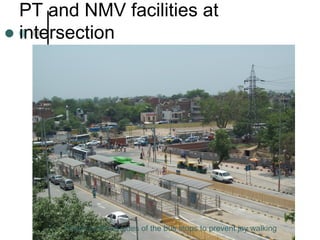
PT and NMV facilities at intersection Fence on three sides of the bus stops to prevent jay walking
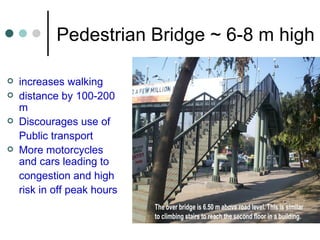
Pedestrian Bridge ~ 6-8 m high increases walking distance by 100-200 m Discourages use of Public transport  More motorcycles and cars leading to congestion and high risk in off peak hours
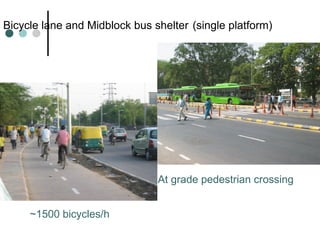
Bicycle lane and Midblock bus shelter   (single platform) ~1500 bicycles/h At grade pedestrian crossing
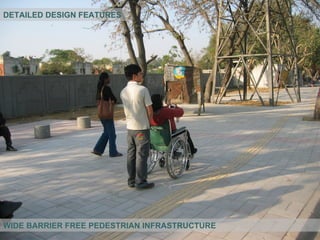
DETAILED DESIGN FEATURES WIDE BARRIER FREE PEDESTRIAN INFRASTRUCTURE
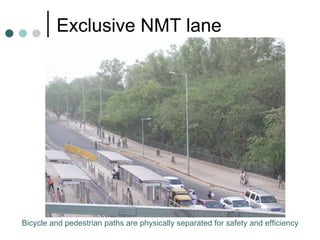
Exclusive NMT lane Bicycle and pedestrian paths are physically separated for safety and efficiency
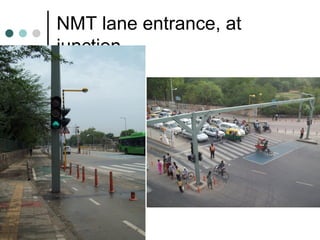
NMT lane entrance, at junction
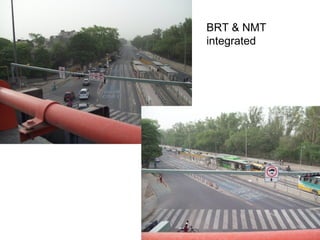
BRT & NMT integrated
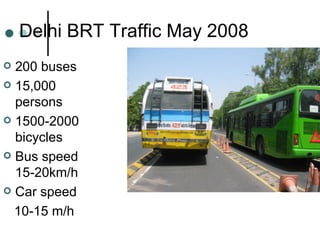
Delhi BRT Traffic May 2008 200 buses  15,000 persons 1500-2000 bicycles Bus speed 15-20km/h Car speed 10-15 m/h
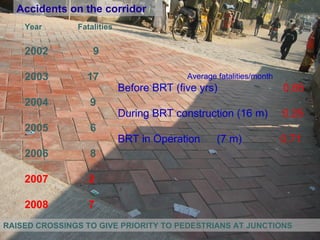
Accidents on the corridor RAISED CROSSINGS TO GIVE PRIORITY TO PEDESTRIANS AT JUNCTIONS Year                Fatalities   2002               9   2003             17   2004              9   2005              6   2006              8 2007  2 2008  7 Average fatalities/month Before BRT (five yrs)  0.85 During BRT construction (16 m)  0.25 BRT in Operation  (7 m)  0.71
Media Reports 2002-2006(november) “…why has the project been delayed?” 2007May-2008 May “…BRT-Big Road Trauma” Mis-reporting of design details  Sensationalizing fatal accidents
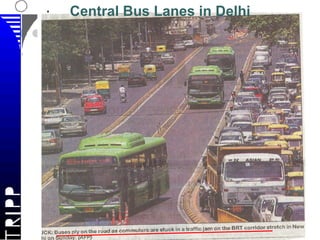
IIT Delhi  Jun 7, 2009 Central Bus Lanes in Delhi
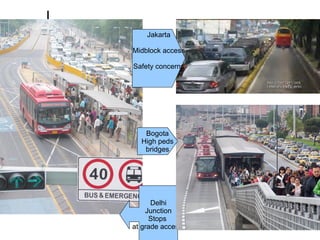
Jakarta Midblock access Safety concerns Delhi Junction Stops  at grade access  Bogota High peds bridges
Pedestrian Safety  challenge 1 Safe infrastructure Pedestrian infrastructure designs and norms from vehicles perspective Foot over bridges, underpass to ensure uninterrupted movements of cars More transport projects instead of transport solutions
Pedestrian Safety  challenge 2 Behavioural issues Counterintuitive results: Traffic education for children, stricter fines,  LIC peds vs HIC peds: findings about red light observance, gap acceptance, crossing behaviour Education and culture vs ease of implementation and effectiveness
Pedestrian Safety  challenge 3 Science in its infancy Counterintuitive results: marked pedestrian crossings increased fatalities by 20% compared to unmarked, raised crossings decreased fatalities by 40%( Hyden et al) Drivers speed increase near a zebra crossing (varhelyi, A, 1999) Poor understanding of city structures and pedestrian behaviour: pedestrian exposure Pedestrian safety requires safe cities ,  safe traffic system is a subset
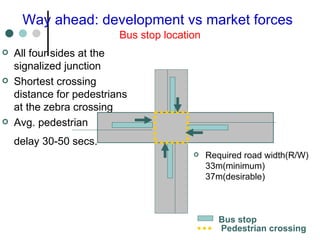
Way ahead: development vs market forces   Bus stop location All four sides at the signalized junction  Shortest crossing distance for pedestrians at the zebra crossing Avg. pedestrian  delay 30-50 secs.   Required road width(R/W) 33m(minimum) 37m(desirable) Bus stop Pedestrian crossing
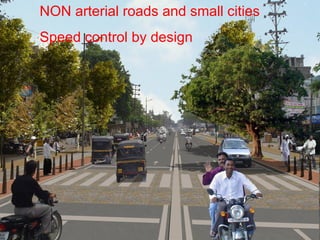
NON arterial roads and small cities Speed control by design

Pedestrian Safety and Urban Infrastructure

  • 1.
    Pedestrian Safety& Urban Transport Geetam Tiwari Transportation Research and Injury Prevention Program Indian Institute of Technology, Delhi, India
  • 2.
    ~ 1970 Downwardtrend success ~ vehicle safety(cars), access control highways(vehicle safety) Marginal decline since 1990(more people inside cars) Downward trends in road traffic fatalities in high-income countries not reducing since 1990s
  • 3.
    VRUs are RTCvictims in all countries, higher proportion in low income countries; NMVs, PT dominant modes “ success” ~ more people travel by car Netherlands:high bicycle use and RTC victims Thailand & Malaysia: High MTW and RTC victims Source: Various WHO collaborators in countries 0% 20% 40% 60% 80% 100% USA Thailand Colombo, Sri Lanka South Africa Netherlands Malaysia Kenya Japan Bandung, Indonesia Delhi, India Ghana Australia Pedestrians Bicyclists Motorized 2-wheelers Motorized 4-wheelers Other
  • 4.
    Victims in URBANRTC Highest share of RTC fatalities in urban areas are pedestrians regardless of country income; eg New York 54% London 30% Johannesburg 33% Mexico city 52% Delhi 50% Mumbai 75% Tehran 33% Shanghai 40% Urban problem, not of development! ‘ Safe countries’ have achieved peds safety on highways, not in cities
  • 5.
    China Vision ofglobal city, progress, success 1991-1996 i nfrastructure investment $10billion Average speed 15Km/h !! , NMV trips 25% from 40%, increased travel distances & RTCs peds~40%
  • 6.
    80/m FTRC, ~500070/m, FTRC 4500 50/m, FTRC ~8000 Fatalities in Indian Cities(~ 18000/year), higher rates in metro cities
  • 7.
    Pedestrian and cyclistshave highest risk in the safest city! Trip types and fatality rates in central Copenhagen IIT Delhi 2005
  • 8.
    Urban Mobility PTand NMV based, MTW majority personal vehicles
  • 9.
    Urban Transport India:2040~40% urbanization; 600-680 m people ~USD 15000 per capita urban income Car ownership: 100-150/1000 persons Small cars Public transport Vehicle ownership: 300-500/1000 persons MTW Small cars Buses ~90m cars ; 270m vehicles
  • 10.
    Priorities for EnergyEfficient/Low EmissionUrban Transport Preserving walking and bicycle trips in all cities(20-60%) Mixed Landuse (short trips) relationship between informal and formal sector (captive users) City speed limits < 50km/h( safety considerations) Safe infrastructure (network connectivity)
  • 11.
    Priorities for EnergyEfficient/low emission Urban Transport PT for serving 5-15km trips (30-40%) of total trips Safe walking and bicycling(feeder modes) Medium density to generate sufficient demand Fares to compete with MTW operating cost
  • 12.
    Existing scenario ….Chaos at bus shelters Bus stops in the middle of the road; commuters don’t use bus shelters Commuters cross six lanes to access bus shelters
  • 13.
    Pedestrian safety Themost influential factor ..in making a decision to cross at a designated crossing location is the distance of the crosswalk to desired destinations of pedestrians. (Handy, 1996; Shriver, 1997 ) Besides, improvements in safety and comfort for pedestrians can be obtained without major side effects on vehicle travel (Carsten et al., 1998). Also it is evident that pedestrian safety can be affected by changes in the signal settings at signalized crosswalks(peds delay< 40 sec) (Garter, 1989).
  • 14.
    Mixed Traffic NMV & PT friendly
  • 15.
    PT and NMVfacilities at intersection Fence on three sides of the bus stops to prevent jay walking
  • 16.
    Pedestrian Bridge ~6-8 m high increases walking distance by 100-200 m Discourages use of Public transport More motorcycles and cars leading to congestion and high risk in off peak hours
  • 17.
    Bicycle lane andMidblock bus shelter (single platform) ~1500 bicycles/h At grade pedestrian crossing
  • 18.
    DETAILED DESIGN FEATURESWIDE BARRIER FREE PEDESTRIAN INFRASTRUCTURE
  • 19.
    Exclusive NMT laneBicycle and pedestrian paths are physically separated for safety and efficiency
  • 20.
    NMT lane entrance,at junction
  • 21.
    BRT & NMTintegrated
  • 22.
    Delhi BRT TrafficMay 2008 200 buses 15,000 persons 1500-2000 bicycles Bus speed 15-20km/h Car speed 10-15 m/h
  • 23.
    Accidents on thecorridor RAISED CROSSINGS TO GIVE PRIORITY TO PEDESTRIANS AT JUNCTIONS Year                Fatalities   2002               9   2003             17   2004              9   2005              6   2006              8 2007 2 2008 7 Average fatalities/month Before BRT (five yrs) 0.85 During BRT construction (16 m) 0.25 BRT in Operation (7 m) 0.71
  • 24.
    Media Reports 2002-2006(november)“…why has the project been delayed?” 2007May-2008 May “…BRT-Big Road Trauma” Mis-reporting of design details Sensationalizing fatal accidents
  • 25.
    IIT Delhi Jun 7, 2009 Central Bus Lanes in Delhi
  • 26.
    Jakarta Midblock accessSafety concerns Delhi Junction Stops at grade access Bogota High peds bridges
  • 27.
    Pedestrian Safety challenge 1 Safe infrastructure Pedestrian infrastructure designs and norms from vehicles perspective Foot over bridges, underpass to ensure uninterrupted movements of cars More transport projects instead of transport solutions
  • 28.
    Pedestrian Safety challenge 2 Behavioural issues Counterintuitive results: Traffic education for children, stricter fines, LIC peds vs HIC peds: findings about red light observance, gap acceptance, crossing behaviour Education and culture vs ease of implementation and effectiveness
  • 29.
    Pedestrian Safety challenge 3 Science in its infancy Counterintuitive results: marked pedestrian crossings increased fatalities by 20% compared to unmarked, raised crossings decreased fatalities by 40%( Hyden et al) Drivers speed increase near a zebra crossing (varhelyi, A, 1999) Poor understanding of city structures and pedestrian behaviour: pedestrian exposure Pedestrian safety requires safe cities , safe traffic system is a subset
  • 30.
    Way ahead: developmentvs market forces Bus stop location All four sides at the signalized junction Shortest crossing distance for pedestrians at the zebra crossing Avg. pedestrian delay 30-50 secs. Required road width(R/W) 33m(minimum) 37m(desirable) Bus stop Pedestrian crossing
  • 31.
    NON arterial roadsand small cities Speed control by design