ROAD SAFETY 
Approach towards present and forthcoming challenges 
Prepared by: Ashish Parihar (141701)
2 
OUTLINES 
• Introduction 
• Selected location 
• Reason for Selection 
• Causes of accidents 
• Problems 
• Solutions 
• Government involvement 
• International issues in Road safety 
• Road safety measures across the world 
National Institute of Technology, Warangal 10/29/2014
National Institute of Technology, Warangal 10/29/2014 3 
“THE REAL ENEMY OF SAFETY IS NOT 
NON-COMPLIANCE BUT NON-THINKING”
4 
INTRODUCTION 
• Road injury is one of those man-made problems that 
we have the ability to solve, 
• Driving on Indian roads is much more different than 
driving else at some other place, 
• Safe road transport must be a key foundation stone of 
modern society, 
• Daily, there are thousands of casualties, 
• More than 100 governments committed at the UN to 
support the goal of the Decade of Action 
• According to the WHO, in the years 2008-2011 thirty-five 
Countries, with a total population of 680 million, 
introduced new road safety laws. 
National Institute of Technology, Warangal 10/29/2014
5 
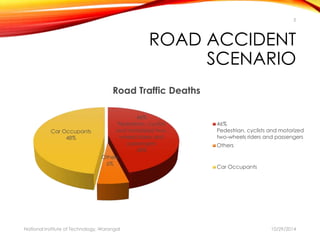
ROAD ACCIDENT 
SCENARIO 
46% 
Pedestrian, cyclists 
and motorized two-wheels 
riders and 
passengers 
46% 
Others 
6% 
Car Occupants 
48% 
Road Traffic Deaths 
46% 
Pedestrian, cyclists and motorized 
two-wheels riders and passengers 
Others 
Car Occupants 
National Institute of Technology, Warangal 10/29/2014
6 
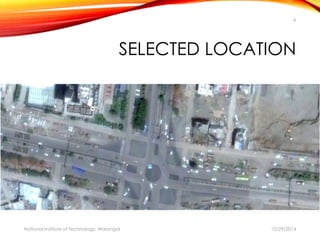
SELECTED LOCATION 
National Institute of Technology, Warangal 10/29/2014
7 
REASON FOR SELECTION 
• Transportation of goods to the city and from the city to some other 
places 
• Work based trips 
• Recreational purposes 
• School and college buses 
• Mix Traffic without channelization 
• No rotary, Roundabouts 
• Previous Accident Records 
• It is connected to the NH3 and MR10 
National Institute of Technology, Warangal 10/29/2014
8 
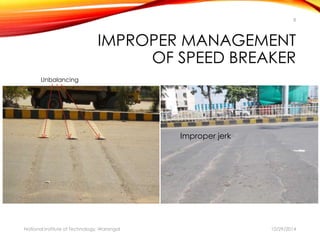
IMPROPER MANAGEMENT 
OF SPEED BREAKER 
Unbalancing 
Improper jerk 
National Institute of Technology, Warangal 10/29/2014
9 
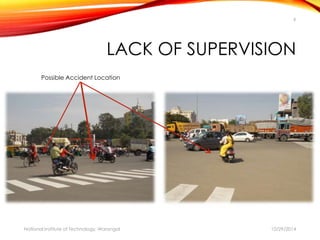
LACK OF SUPERVISION 
Possible Accident Location 
National Institute of Technology, Warangal 10/29/2014
10 
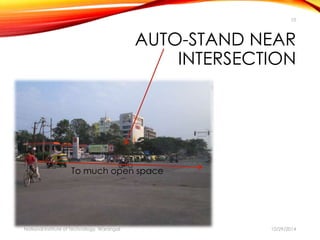
AUTO-STAND NEAR 
INTERSECTION 
To much open space 
National Institute of Technology, Warangal 10/29/2014
11 
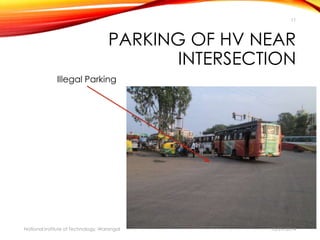
PARKING OF HV NEAR 
INTERSECTION 
Illegal Parking 
National Institute of Technology, Warangal 10/29/2014
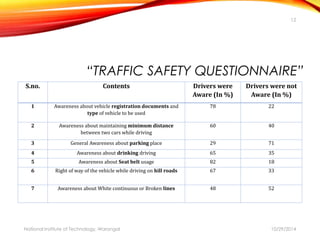
“TRAFFIC SAFETY QUESTIONNAIRE” 
S.no. Contents Drivers were 
Aware (In %) 
12 
Drivers were not 
Aware (In %) 
1 Awareness about vehicle registration documents and 
type of vehicle to be used 
78 22 
2 Awareness about maintaining minimum distance 
between two cars while driving 
60 40 
3 General Awareness about parking place 29 71 
4 Awareness about drinking driving 65 35 
5 Awareness about Seat belt usage 82 18 
6 Right of way of the vehicle while driving on hill roads 67 33 
7 Awareness about White continuous or Broken lines 48 52 
National Institute of Technology, Warangal 10/29/2014
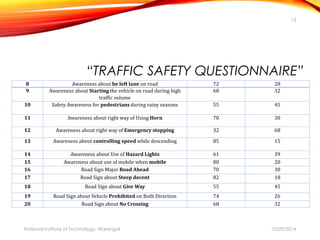
“TRAFFIC SAFETY QUESTIONNAIRE” 
8 Awareness about be left lane on road 72 28 
9 Awareness about Starting the vehicle on road during high 
traffic volume 
68 32 
10 Safety Awareness for pedestrians during rainy seasons 55 45 
11 Awareness about right way of Using Horn 70 30 
12 Awareness about right way of Emergency stopping 32 68 
13 Awareness about controlling speed while descending 85 15 
14 Awareness about Use of Hazard Lights 61 39 
15 Awareness about use of mobile when mobile 80 20 
16 Road Sign Major Road Ahead 70 30 
17 Road Sign about Steep decent 82 18 
18 Road Sign about Give Way 55 45 
19 Road Sign about Vehicle Prohibited on Both Direction 74 26 
20 Road Sign about No Crossing 68 32 
13 
National Institute of Technology, Warangal 10/29/2014
14 
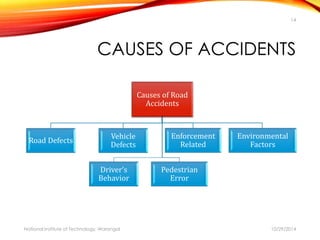
CAUSES OF ACCIDENTS 
Causes of Road 
Accidents 
Road Defects 
Vehicle 
Defects 
Driver’s 
Behavior 
Enforcement 
Related 
Pedestrian 
Error 
Environmental 
Factors 
National Institute of Technology, Warangal 10/29/2014
15 
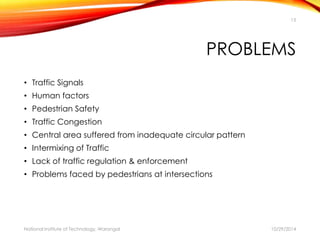
PROBLEMS 
• Traffic Signals 
• Human factors 
• Pedestrian Safety 
• Traffic Congestion 
• Central area suffered from inadequate circular pattern 
• Intermixing of Traffic 
• Lack of traffic regulation & enforcement 
• Problems faced by pedestrians at intersections 
National Institute of Technology, Warangal 10/29/2014
16 
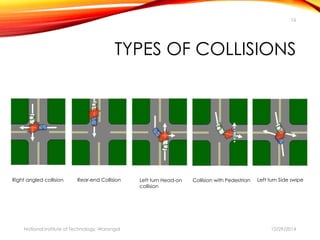
TYPES OF COLLISIONS 
Right angled collision Rear-end Collision Left turn Head-on 
collision 
Collision with Pedestrian Left turn Side swipe 
National Institute of Technology, Warangal 10/29/2014
17 
SOLUTIONS 
• Setting up of State Road Safety Councils and District Committees 
• 50 per cent fines collected from traffic violations 
• Replication of Malviya Nagar Intersection model 
• Identification of black spots and treatment thereof 
• Action against over-loading, drunken driving 
• Removal of liquor shops on NHs 
• Enforcement of use of seat belt in cars & ISI helmets by 2 wheelers 
• Emergency medical services 
National Institute of Technology, Warangal 10/29/2014
18 
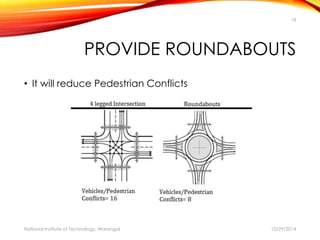
PROVIDE ROUNDABOUTS 
• It will reduce Pedestrian Conflicts 
National Institute of Technology, Warangal 10/29/2014
19 
GOVERNMENT 
INVOLVEMENT 
• A National Road Safety Week was observed throughout the Country 
during January 1st to 7th, 2012, 
• Road safety campaign through online media i.e. Internet and SMS 
(2012) 
• Computerization of records of RTOs and issuance of driving license, 
• NHAI through concessionaire is providing well equipped Ambulance, 
• Wayside Amenities at every 50 Kms (alternatively), 20,000 Sqm (2 Ha.) 
• The National Register and National Transport Portal, 
• Refresher Training for Heavy Vehicle Drivers, 
National Institute of Technology, Warangal 10/29/2014
20 
INTERNATIONAL ISSUES 
ON ROAD SAFETY 
• Road Traffic Injuries is a Global Epidemic 
• Every 6 seconds someone is killed or seriously injured on the world’s roads 
• With 1.3 million road deaths each year this is a global epidemic comparable to Malaria 
or Tuberculosis 
• Nine in ten road deaths and injuries are in developing countries 
• Pedestrians, cyclists and other vulnerable road users are the majority of those killed and 
injured. 
• Road crashes are the leading global cause of death for young people aged 10-24 
• According to UNICEF and the WHO, 260,000 children die and another 10 million are 
injured in road crashes every year. 
National Institute of Technology, Warangal 10/29/2014
21 
ROAD SAFETY MEASURES 
ACROSS THE WORLD 
• Stabilize and Reduce fatalities forecast level by 2020 
• Save up to 5 millions of lives, 
• Prevent up to 50 million serious injuries 
• United Nations Road Safety Collaboration (UNRSC) has developed a global plan 
• Identifies key capacity building and injury prevention measures 
• Holistic Safe System approach 
National Institute of Technology, Warangal 10/29/2014
22 
ROAD SAFETY MEASURES 
ACROSS THE WORLD 
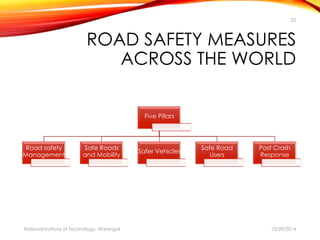
Five Pillars 
Road safety 
Management 
Safe Roads 
and Mobility 
Safer Vehicles 
Safe Road 
Users 
Post Crash 
Response 
National Institute of Technology, Warangal 10/29/2014
VISION ZERO 
“Vision Zero is the image of a future in which no one will be killed or 
seriously injured”
THANK YOU FOR YOUR 
ATTENTION 
Wishing you a Safe Journey. 
24 
National Institute of Technology, Warangal 10/29/2014

Road Safety Engineering

  • 1.
    ROAD SAFETY Approachtowards present and forthcoming challenges Prepared by: Ashish Parihar (141701)
  • 2.
    2 OUTLINES •Introduction • Selected location • Reason for Selection • Causes of accidents • Problems • Solutions • Government involvement • International issues in Road safety • Road safety measures across the world National Institute of Technology, Warangal 10/29/2014
  • 3.
    National Institute ofTechnology, Warangal 10/29/2014 3 “THE REAL ENEMY OF SAFETY IS NOT NON-COMPLIANCE BUT NON-THINKING”
  • 4.
    4 INTRODUCTION •Road injury is one of those man-made problems that we have the ability to solve, • Driving on Indian roads is much more different than driving else at some other place, • Safe road transport must be a key foundation stone of modern society, • Daily, there are thousands of casualties, • More than 100 governments committed at the UN to support the goal of the Decade of Action • According to the WHO, in the years 2008-2011 thirty-five Countries, with a total population of 680 million, introduced new road safety laws. National Institute of Technology, Warangal 10/29/2014
  • 5.
    5 ROAD ACCIDENT SCENARIO 46% Pedestrian, cyclists and motorized two-wheels riders and passengers 46% Others 6% Car Occupants 48% Road Traffic Deaths 46% Pedestrian, cyclists and motorized two-wheels riders and passengers Others Car Occupants National Institute of Technology, Warangal 10/29/2014
  • 6.
    6 SELECTED LOCATION National Institute of Technology, Warangal 10/29/2014
  • 7.
    7 REASON FORSELECTION • Transportation of goods to the city and from the city to some other places • Work based trips • Recreational purposes • School and college buses • Mix Traffic without channelization • No rotary, Roundabouts • Previous Accident Records • It is connected to the NH3 and MR10 National Institute of Technology, Warangal 10/29/2014
  • 8.
    8 IMPROPER MANAGEMENT OF SPEED BREAKER Unbalancing Improper jerk National Institute of Technology, Warangal 10/29/2014
  • 9.
    9 LACK OFSUPERVISION Possible Accident Location National Institute of Technology, Warangal 10/29/2014
  • 10.
    10 AUTO-STAND NEAR INTERSECTION To much open space National Institute of Technology, Warangal 10/29/2014
  • 11.
    11 PARKING OFHV NEAR INTERSECTION Illegal Parking National Institute of Technology, Warangal 10/29/2014
  • 12.
    “TRAFFIC SAFETY QUESTIONNAIRE” S.no. Contents Drivers were Aware (In %) 12 Drivers were not Aware (In %) 1 Awareness about vehicle registration documents and type of vehicle to be used 78 22 2 Awareness about maintaining minimum distance between two cars while driving 60 40 3 General Awareness about parking place 29 71 4 Awareness about drinking driving 65 35 5 Awareness about Seat belt usage 82 18 6 Right of way of the vehicle while driving on hill roads 67 33 7 Awareness about White continuous or Broken lines 48 52 National Institute of Technology, Warangal 10/29/2014
  • 13.
    “TRAFFIC SAFETY QUESTIONNAIRE” 8 Awareness about be left lane on road 72 28 9 Awareness about Starting the vehicle on road during high traffic volume 68 32 10 Safety Awareness for pedestrians during rainy seasons 55 45 11 Awareness about right way of Using Horn 70 30 12 Awareness about right way of Emergency stopping 32 68 13 Awareness about controlling speed while descending 85 15 14 Awareness about Use of Hazard Lights 61 39 15 Awareness about use of mobile when mobile 80 20 16 Road Sign Major Road Ahead 70 30 17 Road Sign about Steep decent 82 18 18 Road Sign about Give Way 55 45 19 Road Sign about Vehicle Prohibited on Both Direction 74 26 20 Road Sign about No Crossing 68 32 13 National Institute of Technology, Warangal 10/29/2014
  • 14.
    14 CAUSES OFACCIDENTS Causes of Road Accidents Road Defects Vehicle Defects Driver’s Behavior Enforcement Related Pedestrian Error Environmental Factors National Institute of Technology, Warangal 10/29/2014
  • 15.
    15 PROBLEMS •Traffic Signals • Human factors • Pedestrian Safety • Traffic Congestion • Central area suffered from inadequate circular pattern • Intermixing of Traffic • Lack of traffic regulation & enforcement • Problems faced by pedestrians at intersections National Institute of Technology, Warangal 10/29/2014
  • 16.
    16 TYPES OFCOLLISIONS Right angled collision Rear-end Collision Left turn Head-on collision Collision with Pedestrian Left turn Side swipe National Institute of Technology, Warangal 10/29/2014
  • 17.
    17 SOLUTIONS •Setting up of State Road Safety Councils and District Committees • 50 per cent fines collected from traffic violations • Replication of Malviya Nagar Intersection model • Identification of black spots and treatment thereof • Action against over-loading, drunken driving • Removal of liquor shops on NHs • Enforcement of use of seat belt in cars & ISI helmets by 2 wheelers • Emergency medical services National Institute of Technology, Warangal 10/29/2014
  • 18.
    18 PROVIDE ROUNDABOUTS • It will reduce Pedestrian Conflicts National Institute of Technology, Warangal 10/29/2014
  • 19.
    19 GOVERNMENT INVOLVEMENT • A National Road Safety Week was observed throughout the Country during January 1st to 7th, 2012, • Road safety campaign through online media i.e. Internet and SMS (2012) • Computerization of records of RTOs and issuance of driving license, • NHAI through concessionaire is providing well equipped Ambulance, • Wayside Amenities at every 50 Kms (alternatively), 20,000 Sqm (2 Ha.) • The National Register and National Transport Portal, • Refresher Training for Heavy Vehicle Drivers, National Institute of Technology, Warangal 10/29/2014
  • 20.
    20 INTERNATIONAL ISSUES ON ROAD SAFETY • Road Traffic Injuries is a Global Epidemic • Every 6 seconds someone is killed or seriously injured on the world’s roads • With 1.3 million road deaths each year this is a global epidemic comparable to Malaria or Tuberculosis • Nine in ten road deaths and injuries are in developing countries • Pedestrians, cyclists and other vulnerable road users are the majority of those killed and injured. • Road crashes are the leading global cause of death for young people aged 10-24 • According to UNICEF and the WHO, 260,000 children die and another 10 million are injured in road crashes every year. National Institute of Technology, Warangal 10/29/2014
  • 21.
    21 ROAD SAFETYMEASURES ACROSS THE WORLD • Stabilize and Reduce fatalities forecast level by 2020 • Save up to 5 millions of lives, • Prevent up to 50 million serious injuries • United Nations Road Safety Collaboration (UNRSC) has developed a global plan • Identifies key capacity building and injury prevention measures • Holistic Safe System approach National Institute of Technology, Warangal 10/29/2014
  • 22.
    22 ROAD SAFETYMEASURES ACROSS THE WORLD Five Pillars Road safety Management Safe Roads and Mobility Safer Vehicles Safe Road Users Post Crash Response National Institute of Technology, Warangal 10/29/2014
  • 23.
    VISION ZERO “VisionZero is the image of a future in which no one will be killed or seriously injured”
  • 24.
    THANK YOU FORYOUR ATTENTION Wishing you a Safe Journey. 24 National Institute of Technology, Warangal 10/29/2014