Planning and Design of Feeder
Services and Short Routes
Presentation by: BEST in Association with EMBARQ India
BEST e-Ticketing
Project
Presented By:
Mr. Om Prakash Gupta, IAS
General Manager, BES&T
Presented By:
Mr. Om Prakash Gupta, IAS
General Manager
BEST
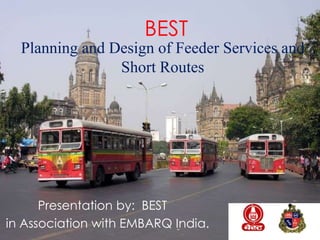
Presentation by: BEST
in Association with EMBARQ India.
Planning and Design of Feeder Services and
Short Routes
Feeder bus services are designed to pick up passengers in
a locality and take them to a transfer point where they make
an onward journey on a trunk service.
Trunk service can be another bus, or a rail based service
such as a tram, rapid transit or train.
Feeder buses act as part of a wider local network, or a
regional network.
Planning and design of feeder services requires
understanding of the existing origin-destination
points, network connectivity, ease of transfer from/to the
feeder service, competing alternatives, fare pricing, routing
etc.
Introduction
Serving short distances typically between 4-6kms
High frequency service
Serving residential/commercial areas from/to trunk routes
Providing last mile connectivity
Fare pricing a key factor because of other competing modes
Characteristics of a Feeder Service
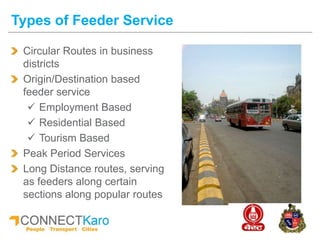
Circular Routes in business
districts
Origin/Destination based
feeder service
 Employment Based
 Residential Based
 Tourism Based
Peak Period Services
Long Distance routes, serving
as feeders along certain
sections along popular routes
Types of Feeder Service
Distance from the origin to destination
Travel Time based on actual traffic conditions (peak vs. non
peak)
Nature of stretch - congestion levels, signals, constraints
along the route
Availability of resources - Fleet Size and Personnel
Frequency of the service
Passenger potential
Coordination with trunk timings
Infrastructure at the trunk-end, eg: at the location
Planning of Feeder Services
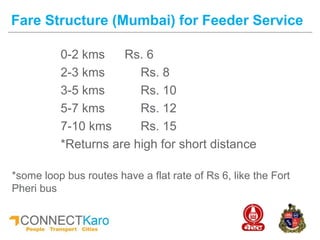
0-2 kms Rs. 6
2-3 kms Rs. 8
3-5 kms Rs. 10
5-7 kms Rs. 12
7-10 kms Rs. 15
*Returns are high for short distance
Fare Structure (Mumbai) for Feeder Service
*some loop bus routes have a flat rate of Rs 6, like the Fort
Pheri bus
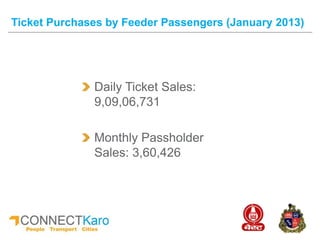
Daily Ticket Sales:
9,09,06,731
Monthly Passholder
Sales: 3,60,426
Ticket Purchases by Feeder Passengers (January 2013)
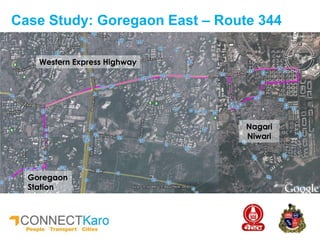
Western Express Highway
Goregaon
Station
Case Study: Goregaon East – Route 344
Nagari
Niwari
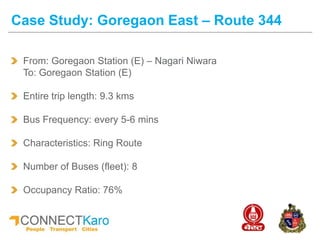
From: Goregaon Station (E) – Nagari Niwara
To: Goregaon Station (E)
Entire trip length: 9.3 kms
Bus Frequency: every 5-6 mins
Characteristics: Ring Route
Number of Buses (fleet): 8
Occupancy Ratio: 76%
Case Study: Goregaon East – Route 344
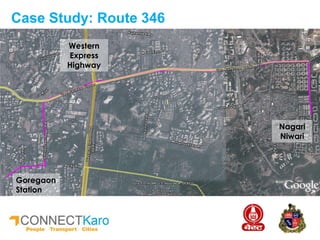
Western
Express
Highway
Goregaon
Station
Case Study: Route 346
Nagari
Niwari
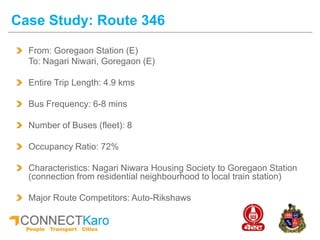
Case Study: Route 346
From: Goregaon Station (E)
To: Nagari Niwari, Goregaon (E)
Entire Trip Length: 4.9 kms
Bus Frequency: 6-8 mins
Number of Buses (fleet): 8
Occupancy Ratio: 72%
Characteristics: Nagari Niwara Housing Society to Goregaon Station
(connection from residential neighbourhood to local train station)
Major Route Competitors: Auto-Rikshaws
Western
Express
Highway
Goregaon
Station
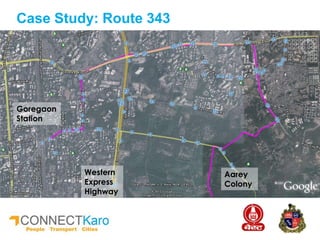
Case Study: Route 343
Aarey
Colony
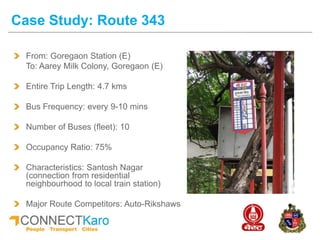
Case Study: Route 343
From: Goregaon Station (E)
To: Aarey Milk Colony, Goregaon (E)
Entire Trip Length: 4.7 kms
Bus Frequency: every 9-10 mins
Number of Buses (fleet): 10
Occupancy Ratio: 75%
Characteristics: Santosh Nagar
(connection from residential
neighbourhood to local train station)
Major Route Competitors: Auto-Rikshaws
Western Express
Highway
Goregaon
Station
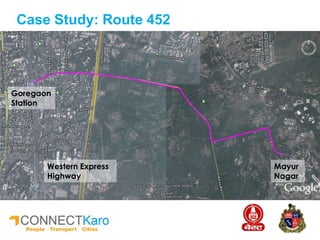
Case Study: Route 452
Mayur
Nagar
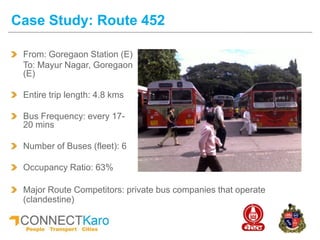
Case Study: Route 452
From: Goregaon Station (E)
To: Mayur Nagar, Goregaon
(E)
Entire trip length: 4.8 kms
Bus Frequency: every 17-
20 mins
Number of Buses (fleet): 6
Occupancy Ratio: 63%
Major Route Competitors: private bus companies that operate
(clandestine)
Ghatkopar
Station
Western
Express
Highway
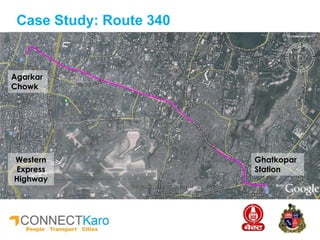
Case Study: Route 340
Agarkar
Chowk
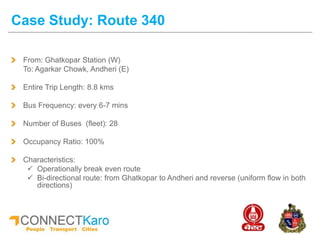
From: Ghatkopar Station (W)
To: Agarkar Chowk, Andheri (E)
Entire Trip Length: 8.8 kms
Bus Frequency: every 6-7 mins
Number of Buses (fleet): 28
Occupancy Ratio: 100%
Characteristics:
 Operationally break even route
 Bi-directional route: from Ghatkopar to Andheri and reverse (uniform flow in both
directions)
Case Study: Route 340
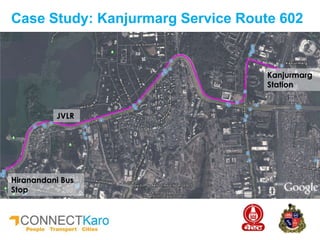
Kanjurmarg
Station
JVLR
Case Study: Kanjurmarg Service Route 602
Hiranandani Bus
Stop
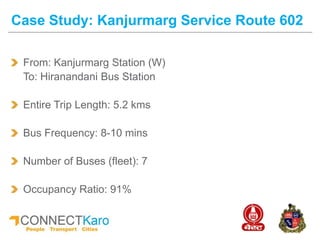
From: Kanjurmarg Station (W)
To: Hiranandani Bus Station
Entire Trip Length: 5.2 kms
Bus Frequency: 8-10 mins
Number of Buses (fleet): 7
Occupancy Ratio: 91%
Case Study: Kanjurmarg Service Route 602
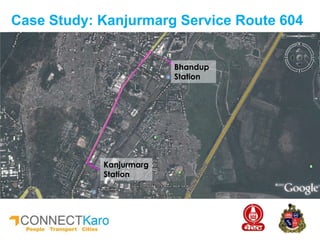
Bhandup
Station
Kanjurmarg
Station
Case Study: Kanjurmarg Service Route 604
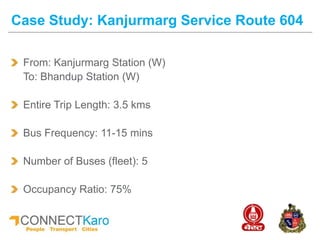
From: Kanjurmarg Station (W)
To: Bhandup Station (W)
Entire Trip Length: 3.5 kms
Bus Frequency: 11-15 mins
Number of Buses (fleet): 5
Occupancy Ratio: 75%
Case Study: Kanjurmarg Service Route 604
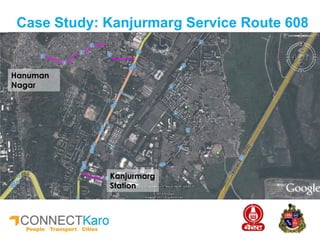
Case Study: Kanjurmarg Service Route 608
Kanjurmarg
Station
Hanuman
Nagar
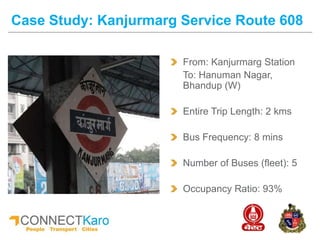
From: Kanjurmarg Station
To: Hanuman Nagar,
Bhandup (W)
Entire Trip Length: 2 kms
Bus Frequency: 8 mins
Number of Buses (fleet): 5
Occupancy Ratio: 93%
Case Study: Kanjurmarg Service Route 608
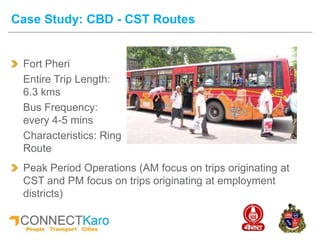
Fort Pheri
Entire Trip Length:
6.3 kms
Bus Frequency:
every 4-5 mins
Characteristics: Ring
Route
Case Study: CBD - CST Routes
Peak Period Operations (AM focus on trips originating at
CST and PM focus on trips originating at employment
districts)
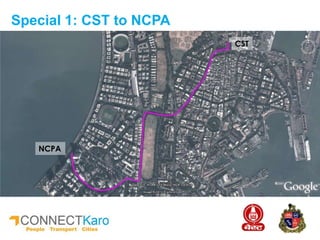
Special 1: CST to NCPA
CST
NCPA
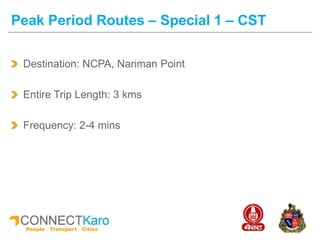
Destination: NCPA, Nariman Point
Entire Trip Length: 3 kms
Frequency: 2-4 mins
Peak Period Routes – Special 1 – CST
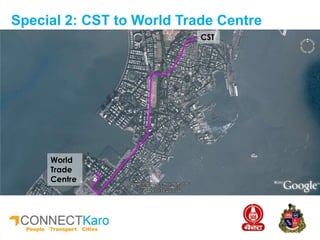
Special 2: CST to World Trade Centre
CST
World
Trade
Centre
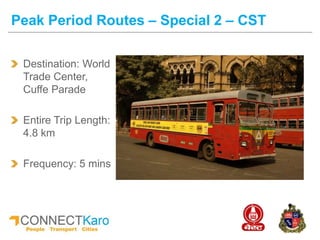
Destination: World
Trade Center,
Cuffe Parade
Entire Trip Length:
4.8 km
Frequency: 5 mins
Peak Period Routes – Special 2 – CST
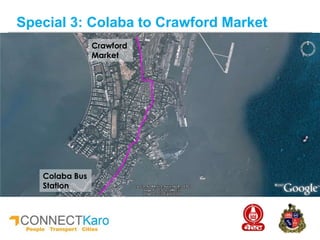
Special 3: Colaba to Crawford Market
Crawford
Market
Colaba Bus
Station
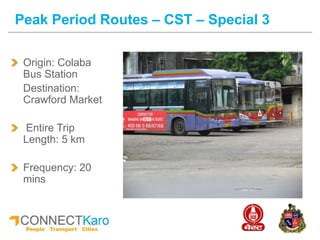
Origin: Colaba
Bus Station
Destination:
Crawford Market
Entire Trip
Length: 5 km
Frequency: 20
mins
Peak Period Routes – CST – Special 3
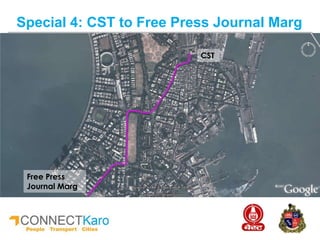
Special 4: CST to Free Press Journal Marg
CST
Free Press
Journal Marg
Destination: Freepress Journal Marg (Shipping Corporation
Building), Nariman Point
Entire Trip Length: 2.9 km
Frequency: 10 mins during PM peak periods
Peak Period Routes – CST – Special 4
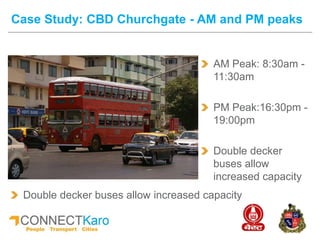
AM Peak: 8:30am -
11:30am
PM Peak:16:30pm -
19:00pm
Double decker
buses allow
increased capacity
Case Study: CBD Churchgate - AM and PM peaks
Double decker buses allow increased capacity
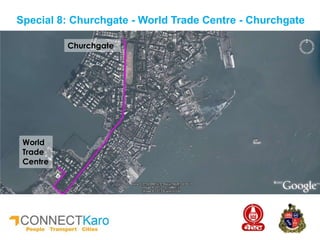
Special 8: Churchgate - World Trade Centre - Churchgate
Churchgate
World
Trade
Centre
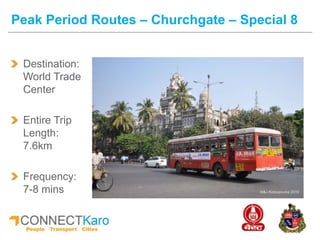
Destination:
World Trade
Center
Entire Trip
Length:
7.6km
Frequency:
7-8 mins
Peak Period Routes – Churchgate – Special 8
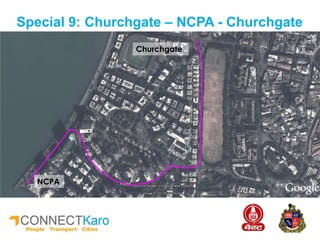
Special 9: Churchgate – NCPA - Churchgate
Churchgate
NCPA
Destination: NCPA, Nariman Point
Entire Trip Length: 3.5km
Frequency: 2-3 mins
Peak Period Routes – Churchgate – Special 9
Bandra to Sion
 all the long routes and catering as feeder services
Dadar
 no infrastructure or space close to station
 all routes are passing routes and serve as feeders
 alighting points are Plaza Cinema and Kabootar Khana on
the west side and Dadar TT on the east side
Long Routes Serving as Feeder
Lack of proper infrastructure at station areas for feeder buses
Station areas need to be organized with proper access to
pedestrians by providing footpaths, organizing vending
area, space allocation for auto/taxi stands
Ideally feeder lengths should be 5-7 kms but have gone beyond
7-8 kms from the stations in the recent times
For feeder services running time/kms has become very high
Limited resources- Fleet/Personnel
Challenges
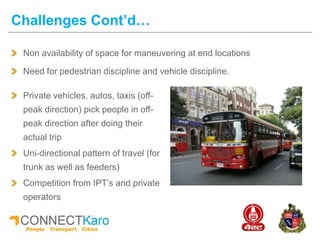
Non availability of space for maneuvering at end locations
Need for pedestrian discipline and vehicle discipline.
Challenges Cont’d…
Private vehicles, autos, taxis (off-
peak direction) pick people in off-
peak direction after doing their
actual trip
Uni-directional pattern of travel (for
trunk as well as feeders)
Competition from IPT’s and private
operators
Feeders are an integral part of mass transit system of a city
Provide last mile connectivity
Proper planning needs to be done to ensure safe and
reliable movement of passengers
Need for better integration between feeder services and
destination nodes
Summary
ANY QUESTIONS PLEASE ?
THANK YOU
Planning and Design of Feeder Services and Short Routes - BEST and EMBARQ India

Planning and Design of Feeder Services and Short Routes - BEST and EMBARQ India

  • 1.
    Planning and Designof Feeder Services and Short Routes Presentation by: BEST in Association with EMBARQ India
  • 2.
    BEST e-Ticketing Project Presented By: Mr.Om Prakash Gupta, IAS General Manager, BES&T Presented By: Mr. Om Prakash Gupta, IAS General Manager BEST Presentation by: BEST in Association with EMBARQ India. Planning and Design of Feeder Services and Short Routes
  • 3.
    Feeder bus servicesare designed to pick up passengers in a locality and take them to a transfer point where they make an onward journey on a trunk service. Trunk service can be another bus, or a rail based service such as a tram, rapid transit or train. Feeder buses act as part of a wider local network, or a regional network. Planning and design of feeder services requires understanding of the existing origin-destination points, network connectivity, ease of transfer from/to the feeder service, competing alternatives, fare pricing, routing etc. Introduction
  • 4.
    Serving short distancestypically between 4-6kms High frequency service Serving residential/commercial areas from/to trunk routes Providing last mile connectivity Fare pricing a key factor because of other competing modes Characteristics of a Feeder Service
  • 5.
    Circular Routes inbusiness districts Origin/Destination based feeder service  Employment Based  Residential Based  Tourism Based Peak Period Services Long Distance routes, serving as feeders along certain sections along popular routes Types of Feeder Service
  • 6.
    Distance from theorigin to destination Travel Time based on actual traffic conditions (peak vs. non peak) Nature of stretch - congestion levels, signals, constraints along the route Availability of resources - Fleet Size and Personnel Frequency of the service Passenger potential Coordination with trunk timings Infrastructure at the trunk-end, eg: at the location Planning of Feeder Services
  • 7.
    0-2 kms Rs.6 2-3 kms Rs. 8 3-5 kms Rs. 10 5-7 kms Rs. 12 7-10 kms Rs. 15 *Returns are high for short distance Fare Structure (Mumbai) for Feeder Service *some loop bus routes have a flat rate of Rs 6, like the Fort Pheri bus
  • 8.
    Daily Ticket Sales: 9,09,06,731 MonthlyPassholder Sales: 3,60,426 Ticket Purchases by Feeder Passengers (January 2013)
  • 9.
    Western Express Highway Goregaon Station CaseStudy: Goregaon East – Route 344 Nagari Niwari
  • 10.
    From: Goregaon Station(E) – Nagari Niwara To: Goregaon Station (E) Entire trip length: 9.3 kms Bus Frequency: every 5-6 mins Characteristics: Ring Route Number of Buses (fleet): 8 Occupancy Ratio: 76% Case Study: Goregaon East – Route 344
  • 11.
  • 12.
    Case Study: Route346 From: Goregaon Station (E) To: Nagari Niwari, Goregaon (E) Entire Trip Length: 4.9 kms Bus Frequency: 6-8 mins Number of Buses (fleet): 8 Occupancy Ratio: 72% Characteristics: Nagari Niwara Housing Society to Goregaon Station (connection from residential neighbourhood to local train station) Major Route Competitors: Auto-Rikshaws
  • 13.
  • 14.
    Case Study: Route343 From: Goregaon Station (E) To: Aarey Milk Colony, Goregaon (E) Entire Trip Length: 4.7 kms Bus Frequency: every 9-10 mins Number of Buses (fleet): 10 Occupancy Ratio: 75% Characteristics: Santosh Nagar (connection from residential neighbourhood to local train station) Major Route Competitors: Auto-Rikshaws
  • 15.
  • 16.
    Case Study: Route452 From: Goregaon Station (E) To: Mayur Nagar, Goregaon (E) Entire trip length: 4.8 kms Bus Frequency: every 17- 20 mins Number of Buses (fleet): 6 Occupancy Ratio: 63% Major Route Competitors: private bus companies that operate (clandestine)
  • 17.
  • 18.
    From: Ghatkopar Station(W) To: Agarkar Chowk, Andheri (E) Entire Trip Length: 8.8 kms Bus Frequency: every 6-7 mins Number of Buses (fleet): 28 Occupancy Ratio: 100% Characteristics:  Operationally break even route  Bi-directional route: from Ghatkopar to Andheri and reverse (uniform flow in both directions) Case Study: Route 340
  • 19.
    Kanjurmarg Station JVLR Case Study: KanjurmargService Route 602 Hiranandani Bus Stop
  • 20.
    From: Kanjurmarg Station(W) To: Hiranandani Bus Station Entire Trip Length: 5.2 kms Bus Frequency: 8-10 mins Number of Buses (fleet): 7 Occupancy Ratio: 91% Case Study: Kanjurmarg Service Route 602
  • 21.
  • 22.
    From: Kanjurmarg Station(W) To: Bhandup Station (W) Entire Trip Length: 3.5 kms Bus Frequency: 11-15 mins Number of Buses (fleet): 5 Occupancy Ratio: 75% Case Study: Kanjurmarg Service Route 604
  • 23.
    Case Study: KanjurmargService Route 608 Kanjurmarg Station Hanuman Nagar
  • 24.
    From: Kanjurmarg Station To:Hanuman Nagar, Bhandup (W) Entire Trip Length: 2 kms Bus Frequency: 8 mins Number of Buses (fleet): 5 Occupancy Ratio: 93% Case Study: Kanjurmarg Service Route 608
  • 25.
    Fort Pheri Entire TripLength: 6.3 kms Bus Frequency: every 4-5 mins Characteristics: Ring Route Case Study: CBD - CST Routes Peak Period Operations (AM focus on trips originating at CST and PM focus on trips originating at employment districts)
  • 26.
    Special 1: CSTto NCPA CST NCPA
  • 27.
    Destination: NCPA, NarimanPoint Entire Trip Length: 3 kms Frequency: 2-4 mins Peak Period Routes – Special 1 – CST
  • 28.
    Special 2: CSTto World Trade Centre CST World Trade Centre
  • 29.
    Destination: World Trade Center, CuffeParade Entire Trip Length: 4.8 km Frequency: 5 mins Peak Period Routes – Special 2 – CST
  • 30.
    Special 3: Colabato Crawford Market Crawford Market Colaba Bus Station
  • 31.
    Origin: Colaba Bus Station Destination: CrawfordMarket Entire Trip Length: 5 km Frequency: 20 mins Peak Period Routes – CST – Special 3
  • 32.
    Special 4: CSTto Free Press Journal Marg CST Free Press Journal Marg
  • 33.
    Destination: Freepress JournalMarg (Shipping Corporation Building), Nariman Point Entire Trip Length: 2.9 km Frequency: 10 mins during PM peak periods Peak Period Routes – CST – Special 4
  • 34.
    AM Peak: 8:30am- 11:30am PM Peak:16:30pm - 19:00pm Double decker buses allow increased capacity Case Study: CBD Churchgate - AM and PM peaks Double decker buses allow increased capacity
  • 35.
    Special 8: Churchgate- World Trade Centre - Churchgate Churchgate World Trade Centre
  • 36.
    Destination: World Trade Center Entire Trip Length: 7.6km Frequency: 7-8mins Peak Period Routes – Churchgate – Special 8
  • 37.
    Special 9: Churchgate– NCPA - Churchgate Churchgate NCPA
  • 38.
    Destination: NCPA, NarimanPoint Entire Trip Length: 3.5km Frequency: 2-3 mins Peak Period Routes – Churchgate – Special 9
  • 39.
    Bandra to Sion all the long routes and catering as feeder services Dadar  no infrastructure or space close to station  all routes are passing routes and serve as feeders  alighting points are Plaza Cinema and Kabootar Khana on the west side and Dadar TT on the east side Long Routes Serving as Feeder
  • 40.
    Lack of properinfrastructure at station areas for feeder buses Station areas need to be organized with proper access to pedestrians by providing footpaths, organizing vending area, space allocation for auto/taxi stands Ideally feeder lengths should be 5-7 kms but have gone beyond 7-8 kms from the stations in the recent times For feeder services running time/kms has become very high Limited resources- Fleet/Personnel Challenges
  • 41.
    Non availability ofspace for maneuvering at end locations Need for pedestrian discipline and vehicle discipline. Challenges Cont’d… Private vehicles, autos, taxis (off- peak direction) pick people in off- peak direction after doing their actual trip Uni-directional pattern of travel (for trunk as well as feeders) Competition from IPT’s and private operators
  • 42.
    Feeders are anintegral part of mass transit system of a city Provide last mile connectivity Proper planning needs to be done to ensure safe and reliable movement of passengers Need for better integration between feeder services and destination nodes Summary
  • 43.