
Carly Koinange
Share the Road Global Programme Lead
Division of Technology, Industry and
Economics
United Nations Environment Programme
(UNEP)
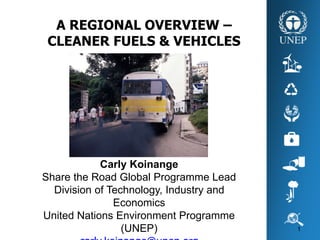
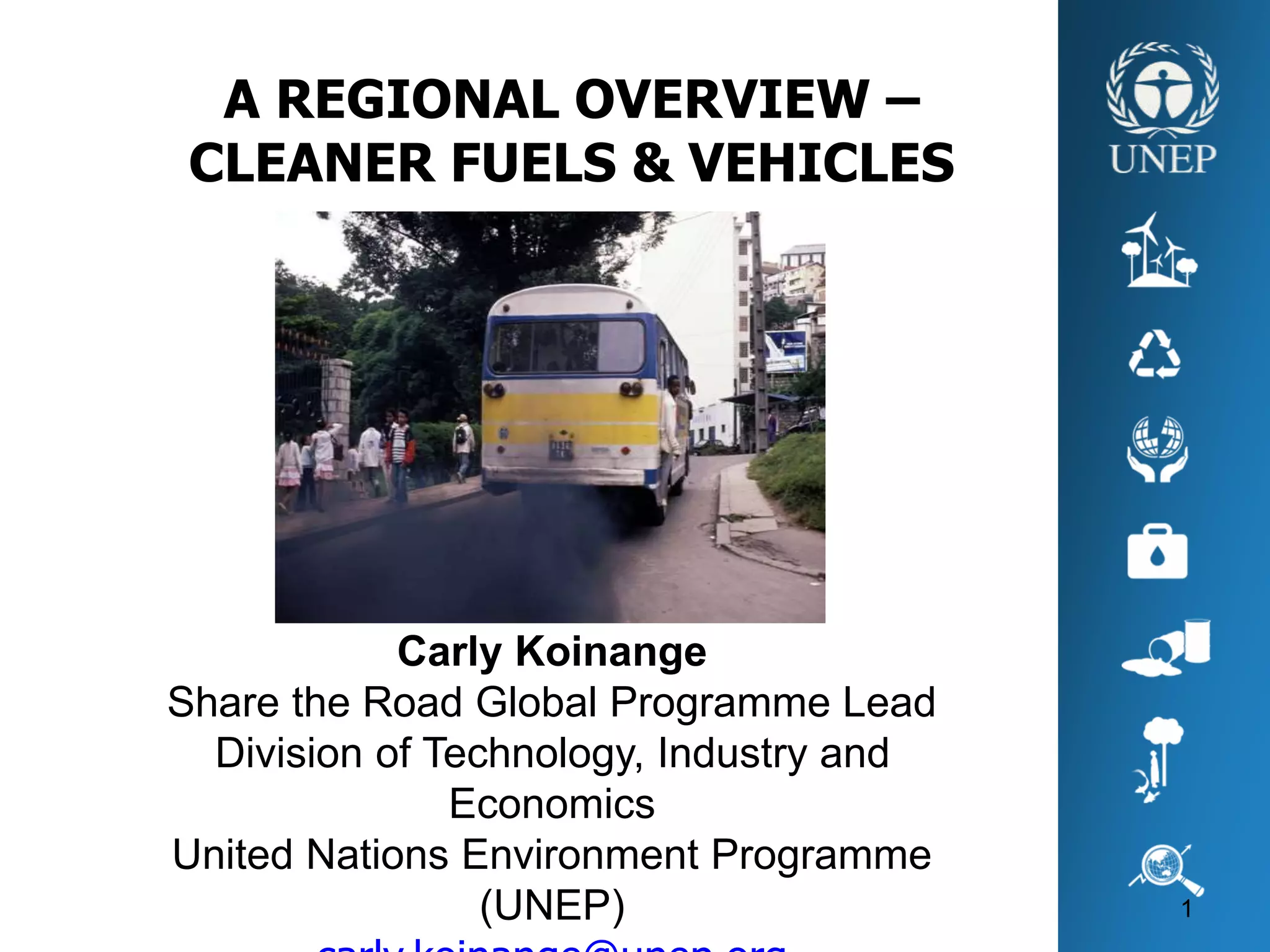
A REGIONAL OVERVIEW –
CLEANER FUELS & VEHICLES
1
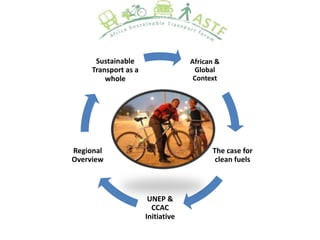
African &
Global
Context
The case for
clean fuels
UNEP &
CCAC
Initiative
Regional
Overview
Sustainable
Transport as a
whole
3
The Africa Context
4
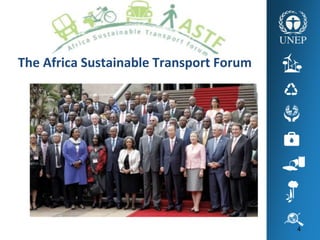
The Africa Sustainable Transport Forum
5
What is the ASTF?
• A forum with political level ownership
• Supported by World Bank, UNEP & UN-Habitat
• Members are Government (Ministries of
Transport & Environment) and other
stakeholders.
• All working together towards the Africa
Sustainable Transport Forum goal
6
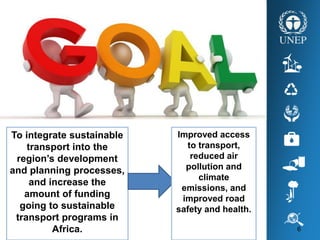
To integrate sustainable
transport into the
region’s development
and planning processes,
and increase the
amount of funding
going to sustainable
transport programs in
Africa.
Improved access
to transport,
reduced air
pollution and
climate
emissions, and
improved road
safety and health.
7
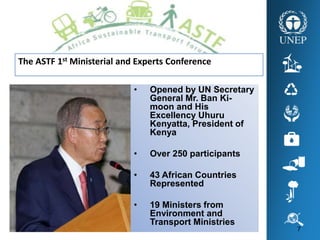
The ASTF 1st Ministerial and Experts Conference
• Opened by UN Secretary
General Mr. Ban Ki-
moon and His
Excellency Uhuru
Kenyatta, President of
Kenya
• Over 250 participants
• 43 African Countries
Represented
• 19 Ministers from
Environment and
Transport Ministries
8
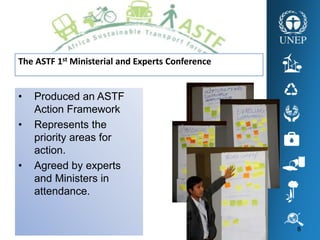
The ASTF 1st Ministerial and Experts Conference
• Produced an ASTF
Action Framework
• Represents the
priority areas for
action.
• Agreed by experts
and Ministers in
attendance.
9
The ASTF Action Framework
Road Safety
Vehicle Emissions and Energy Efficiency
Accessibility and Sustainable Infrastructure
Supporting activities (enabling conditions)
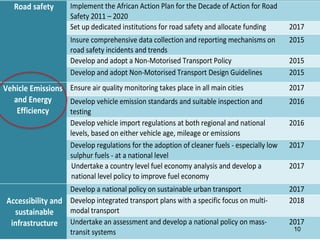
Road safety Implement the African Action Plan for the Decade of Action for Road
Safety 2011 – 2020
Set up dedicated institutions for road safety and allocate funding 2017
Insure comprehensive data collection and reporting mechanisms on
road safety incidents and trends
2015
Develop and adopt a Non-Motorised Transport Policy 2015
Develop and adopt Non-Motorised Transport Design Guidelines 2015
Vehicle Emissions
and Energy
Efficiency
Ensure air quality monitoring takes place in all main cities 2017
Develop vehicle emission standards and suitable inspection and
testing
2016
Develop vehicle import regulations at both regional and national
levels, based on either vehicle age, mileage or emissions
2016
Develop regulations for the adoption of cleaner fuels - especially low
sulphur fuels - at a national level
2017
Undertake a country level fuel economy analysis and develop a
national level policy to improve fuel economy
2017
Accessibility and
sustainable
infrastructure
Develop a national policy on sustainable urban transport 2017
Develop integrated transport plans with a specific focus on multi-
modal transport
2018
Undertake an assessment and develop a national policy on mass-
transit systems
2017
10
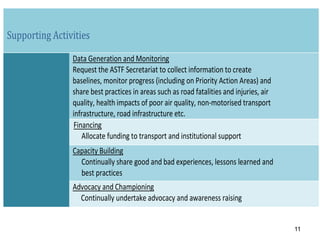
Supporting Activities
Data Generation and Monitoring
Request the ASTF Secretariat to collect information to create
baselines, monitor progress (including on Priority Action Areas) and
share best practices in areas such as road fatalities and injuries, air
quality, health impacts of poor air quality, non-motorised transport
infrastructure, road infrastructure etc.
Financing
Allocate funding to transport and institutional support
Capacity Building
Continually share good and bad experiences, lessons learned and
best practices
Advocacy and Championing
Continually undertake advocacy and awareness raising
Institutional Arrangements
11
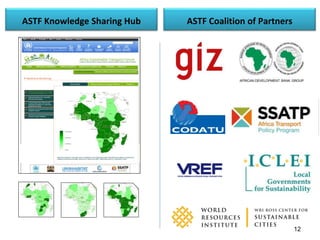
ASTF Knowledge Sharing Hub ASTF Coalition of Partners
12
13
 Contact us about the work you are doing,
challenges, etc.
 Use the ASTF website as a resource – review
progress for your country.
 Join the coalition of partners
14
The Global Context
15
16
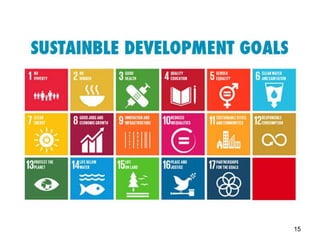
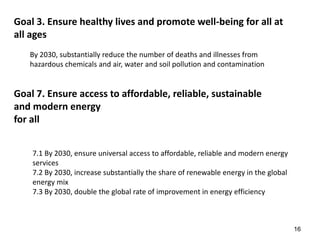
Goal 3. Ensure healthy lives and promote well-being for all at
all ages
By 2030, substantially reduce the number of deaths and illnesses from
hazardous chemicals and air, water and soil pollution and contamination
Goal 7. Ensure access to affordable, reliable, sustainable
and modern energy
for all
7.1 By 2030, ensure universal access to affordable, reliable and modern energy
services
7.2 By 2030, increase substantially the share of renewable energy in the global
energy mix
7.3 By 2030, double the global rate of improvement in energy efficiency
17
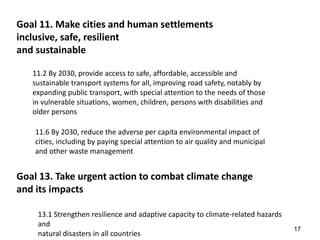
Goal 11. Make cities and human settlements
inclusive, safe, resilient
and sustainable
11.2 By 2030, provide access to safe, affordable, accessible and
sustainable transport systems for all, improving road safety, notably by
expanding public transport, with special attention to the needs of those
in vulnerable situations, women, children, persons with disabilities and
older persons
11.6 By 2030, reduce the adverse per capita environmental impact of
cities, including by paying special attention to air quality and municipal
and other waste management
Goal 13. Take urgent action to combat climate change
and its impacts
13.1 Strengthen resilience and adaptive capacity to climate-related hazards
and
natural disasters in all countries
18
The Case for Clean
Fuels
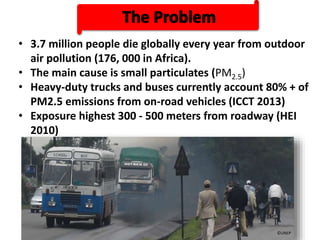
• 3.7 million people die globally every year from outdoor
air pollution (176, 000 in Africa).
• The main cause is small particulates (PM2.5)
• Heavy-duty trucks and buses currently account 80% + of
PM2.5 emissions from on-road vehicles (ICCT 2013)
• Exposure highest 300 - 500 meters from roadway (HEI
2010)
©UNEP
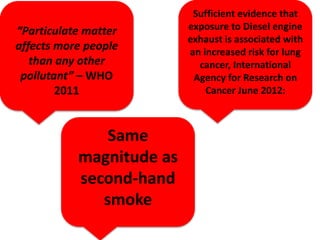
“Particulate matter
affects more people
than any other
pollutant” – WHO
2011
Sufficient evidence that
exposure to Diesel engine
exhaust is associated with
an increased risk for lung
cancer, International
Agency for Research on
Cancer June 2012:
Same
magnitude as
second-hand
smoke
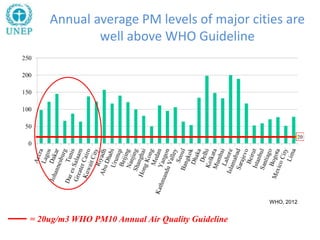
= 20ug/m3 WHO PM10 Annual Air Quality Guideline
WHO, 2012
Annual average PM levels of major cities are
well above WHO Guideline
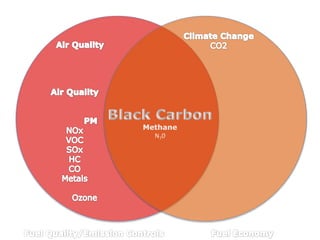
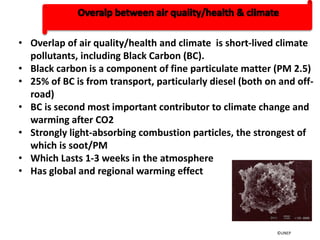
• Overlap of air quality/health and climate is short-lived climate
pollutants, including Black Carbon (BC).
• Black carbon is a component of fine particulate matter (PM 2.5)
• 25% of BC is from transport, particularly diesel (both on and off-
road)
• BC is second most important contributor to climate change and
warming after CO2
• Strongly light-absorbing combustion particles, the strongest of
which is soot/PM
• Which Lasts 1-3 weeks in the atmosphere
• Has global and regional warming effect
©UNEP
©UNEP
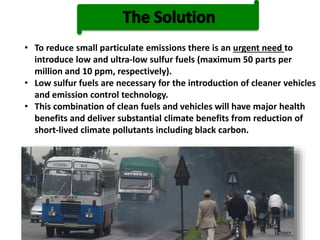
• To reduce small particulate emissions there is an urgent need to
introduce low and ultra-low sulfur fuels (maximum 50 parts per
million and 10 ppm, respectively).
• Low sulfur fuels are necessary for the introduction of cleaner vehicles
and emission control technology.
• This combination of clean fuels and vehicles will have major health
benefits and deliver substantial climate benefits from reduction of
short-lived climate pollutants including black carbon.
A global transition to Euro 6/VI vehicles and
10 ppm fuels by 2030 would:
• reduce global vehicle PM emissions by 90
percent and total adverse health
outcomes by 75 percent (from 2000 levels)
• save 25 million years of life cumulatively
and reduce early deaths by more than
210,000 lives in cities
• despite a projected 150 percent increase
in vehicle activity.
ICCT 2013: http://www.theicct.org/global-health-roadmap
©Michael Walsh
Potential for health benefits
India - 6.2 million years of life gained
Middle East – 4.5 million
Africa – 4.4 million
Asia-Pacific region - 3.4 million
China - 3.1 million
Latin America – 2 million
Non-EU Europe and Russia – 1 million
©Michael Walsh
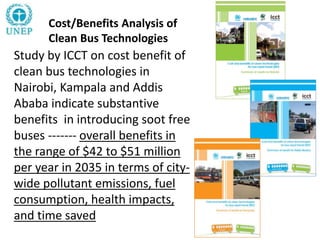
Cost/Benefits Analysis of
Clean Bus Technologies
Study by ICCT on cost benefit of
clean bus technologies in
Nairobi, Kampala and Addis
Ababa indicate substantive
benefits in introducing soot free
buses ------- overall benefits in
the range of $42 to $51 million
per year in 2035 in terms of city-
wide pollutant emissions, fuel
consumption, health impacts,
and time saved
28
UNEP & CCAC
©Elisa Dumitrescu/UNEP
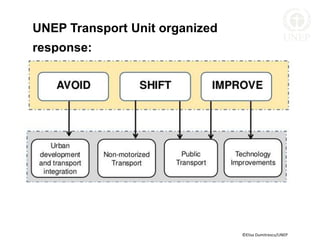
UNEP Transport Unit organized
response:
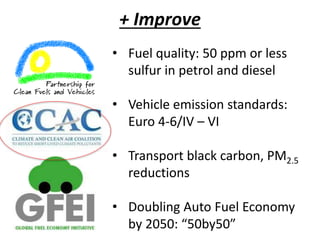
+ Improve
• Fuel quality: 50 ppm or less
sulfur in petrol and diesel
• Vehicle emission standards:
Euro 4-6/IV – VI
• Transport black carbon, PM2.5
reductions
• Doubling Auto Fuel Economy
by 2050: “50by50”
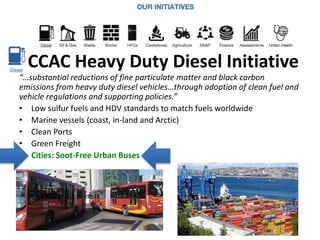
CCAC Heavy Duty Diesel Initiative
“…substantial reductions of fine particulate matter and black carbon
emissions from heavy duty diesel vehicles…through adoption of clean fuel and
vehicle regulations and supporting policies.”
• Low sulfur fuels and HDV standards to match fuels worldwide
• Marine vessels (coast, in-land and Arctic)
• Clean Ports
• Green Freight
• Cities: Soot-Free Urban Buses
BETTER COMBUSTION
CLEANER FUEL
TAILPIPE EMISSION CONTROLS
SOLVING THE DIESEL POLLUTION PROBLEM
REQUIRES A SYSTEMS APPROACH
32
Fuels & vehicles: a systems approach
32
NOx, PM, HC,
SO2, CO2
NOx, PM,
HC, SO2, CO2
Fuel quality: 50 ppm or below sulfur in fuels
Vehicle emission standards: Euro 4/IV and above
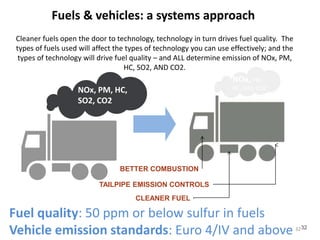
Cleaner fuels open the door to technology, technology in turn drives fuel quality. The
types of fuels used will affect the types of technology you can use effectively; and the
types of technology will drive fuel quality – and ALL determine emission of NOx, PM,
HC, SO2, AND CO2.
33
Regional Overview
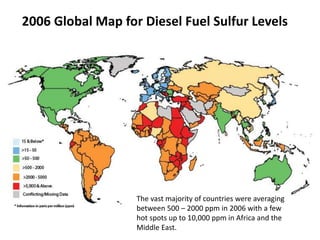
2006 Global Map for Diesel Fuel Sulfur Levels
The vast majority of countries were averaging
between 500 – 2000 ppm in 2006 with a few
hot spots up to 10,000 ppm in Africa and the
Middle East.
35
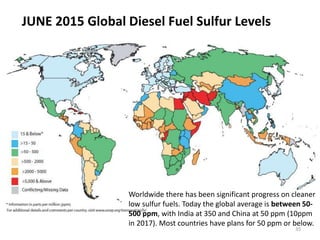
JUNE 2015 Global Diesel Fuel Sulfur Levels
Worldwide there has been significant progress on cleaner
low sulfur fuels. Today the global average is between 50-
500 ppm, with India at 350 and China at 50 ppm (10ppm
in 2017). Most countries have plans for 50 ppm or below.
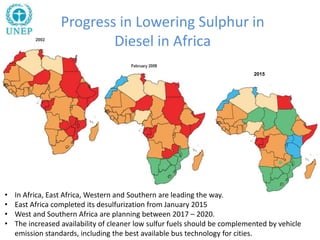
Progress in Lowering Sulphur in
Diesel in Africa
2015
• In Africa, East Africa, Western and Southern are leading the way.
• East Africa completed its desulfurization from January 2015
• West and Southern Africa are planning between 2017 – 2020.
• The increased availability of cleaner low sulfur fuels should be complemented by vehicle
emission standards, including the best available bus technology for cities.
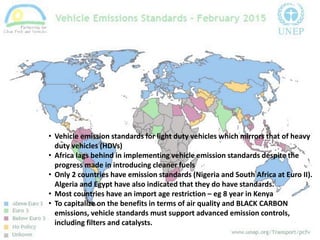
• Vehicle emission standards for light duty vehicles which mirrors that of heavy
duty vehicles (HDVs)
• Africa lags behind in implementing vehicle emission standards despite the
progress made in introducing cleaner fuels
• Only 2 countries have emission standards (Nigeria and South Africa at Euro II).
Algeria and Egypt have also indicated that they do have standards.
• Most countries have an import age restriction – eg 8 year in Kenya
• To capitalize on the benefits in terms of air quality and BLACK CARBON
emissions, vehicle standards must support advanced emission controls,
including filters and catalysts.
38
SUSTAINABLE
TRANSPORT AS A
WHOLE
39
Sustainable transport
“To ensure access to work, education,
goods and services, friends and family
without compromising the social and
ecological environment,including the
protection of the planet’s climate
Requires holistic & integrated outlook
THE REALITY
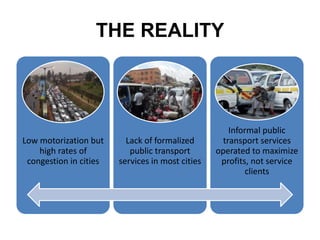
Low motorization but
high rates of
congestion in cities
Lack of formalized
public transport
services in most cities
Informal public
transport services
operated to maximize
profits, not service
clients
THE REALITY
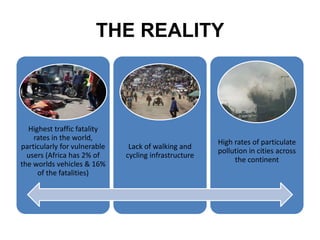
Highest traffic fatality
rates in the world,
particularly for vulnerable
users (Africa has 2% of
the worlds vehicles & 16%
of the fatalities)
Lack of walking and
cycling infrastructure
High rates of particulate
pollution in cities across
the continent
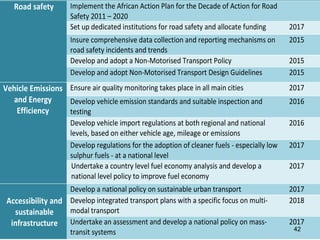
Road safety Implement the African Action Plan for the Decade of Action for Road
Safety 2011 – 2020
Set up dedicated institutions for road safety and allocate funding 2017
Insure comprehensive data collection and reporting mechanisms on
road safety incidents and trends
2015
Develop and adopt a Non-Motorised Transport Policy 2015
Develop and adopt Non-Motorised Transport Design Guidelines 2015
Vehicle Emissions
and Energy
Efficiency
Ensure air quality monitoring takes place in all main cities 2017
Develop vehicle emission standards and suitable inspection and
testing
2016
Develop vehicle import regulations at both regional and national
levels, based on either vehicle age, mileage or emissions
2016
Develop regulations for the adoption of cleaner fuels - especially low
sulphur fuels - at a national level
2017
Undertake a country level fuel economy analysis and develop a
national level policy to improve fuel economy
2017
Accessibility and
sustainable
infrastructure
Develop a national policy on sustainable urban transport 2017
Develop integrated transport plans with a specific focus on multi-
modal transport
2018
Undertake an assessment and develop a national policy on mass-
transit systems
2017
42
NON-MOTORIZED TRANSPORT
REALITY
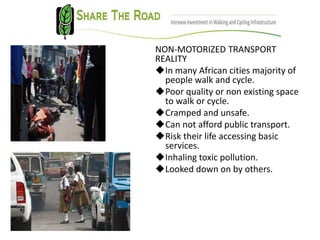
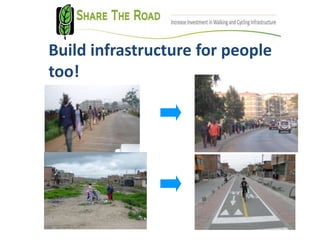
In many African cities majority of
people walk and cycle.
Poor quality or non existing space
to walk or cycle.
Cramped and unsafe.
Can not afford public transport.
Risk their life accessing basic
services.
Inhaling toxic pollution.
Looked down on by others.
Build infrastructure for people
too!
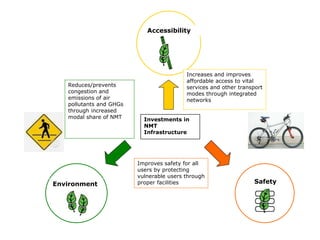
Gives a Triple Win!
Investments in
NMT
Infrastructure
Accessibility
Environment Safety
Increases and improves
affordable access to vital
services and other transport
modes through integrated
networks
Improves safety for all
users by protecting
vulnerable users through
proper facilities
Reduces/prevents
congestion and
emissions of air
pollutants and GHGs
through increased
modal share of NMT
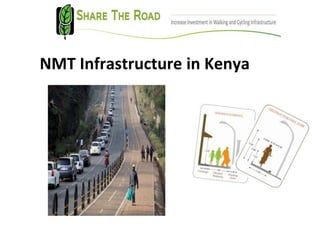
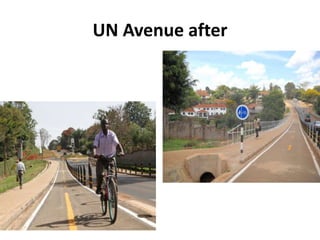
NMT Infrastructure in Kenya
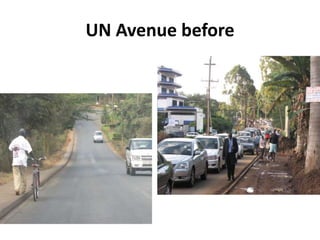
UN Avenue before
UN Avenue after
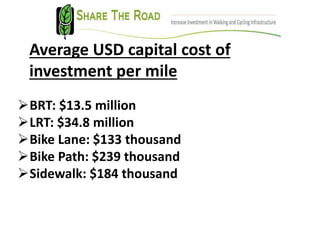
Average USD capital cost of
investment per mile
BRT: $13.5 million
LRT: $34.8 million
Bike Lane: $133 thousand
Bike Path: $239 thousand
Sidewalk: $184 thousand
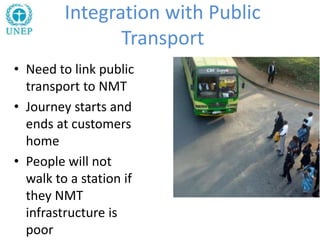
Integration with Public
Transport
• Need to link public
transport to NMT
• Journey starts and
ends at customers
home
• People will not
walk to a station if
they NMT
infrastructure is
poor
52
• 50 ppm and below fuels (diesel fuels)
• Cleaner buses (emission control
technologies)
• Efficient Public Transport
• Inspection & Maintenance programs
• Investment in Non Motorized Transport
UNEP Recommendations
THANK YOU
Carly Koinange
www.unep.org/transport
www.unep.org/transport/sharetheroad
www.unep.org/transport/astf
http://www.ccacoalition.org/

A REGIONAL OVERVIEW – CLEANER FUELS & VEHICLES

  • 1.
    Carly Koinange Share theRoad Global Programme Lead Division of Technology, Industry and Economics United Nations Environment Programme (UNEP) A REGIONAL OVERVIEW – CLEANER FUELS & VEHICLES 1
  • 2.
    African & Global Context The casefor clean fuels UNEP & CCAC Initiative Regional Overview Sustainable Transport as a whole
  • 3.
  • 4.
    4 The Africa SustainableTransport Forum
  • 5.
    5 What is theASTF? • A forum with political level ownership • Supported by World Bank, UNEP & UN-Habitat • Members are Government (Ministries of Transport & Environment) and other stakeholders. • All working together towards the Africa Sustainable Transport Forum goal
  • 6.
    6 To integrate sustainable transportinto the region’s development and planning processes, and increase the amount of funding going to sustainable transport programs in Africa. Improved access to transport, reduced air pollution and climate emissions, and improved road safety and health.
  • 7.
    7 The ASTF 1stMinisterial and Experts Conference • Opened by UN Secretary General Mr. Ban Ki- moon and His Excellency Uhuru Kenyatta, President of Kenya • Over 250 participants • 43 African Countries Represented • 19 Ministers from Environment and Transport Ministries
  • 8.
    8 The ASTF 1stMinisterial and Experts Conference • Produced an ASTF Action Framework • Represents the priority areas for action. • Agreed by experts and Ministers in attendance.
  • 9.
    9 The ASTF ActionFramework Road Safety Vehicle Emissions and Energy Efficiency Accessibility and Sustainable Infrastructure Supporting activities (enabling conditions)
  • 10.
    Road safety Implementthe African Action Plan for the Decade of Action for Road Safety 2011 – 2020 Set up dedicated institutions for road safety and allocate funding 2017 Insure comprehensive data collection and reporting mechanisms on road safety incidents and trends 2015 Develop and adopt a Non-Motorised Transport Policy 2015 Develop and adopt Non-Motorised Transport Design Guidelines 2015 Vehicle Emissions and Energy Efficiency Ensure air quality monitoring takes place in all main cities 2017 Develop vehicle emission standards and suitable inspection and testing 2016 Develop vehicle import regulations at both regional and national levels, based on either vehicle age, mileage or emissions 2016 Develop regulations for the adoption of cleaner fuels - especially low sulphur fuels - at a national level 2017 Undertake a country level fuel economy analysis and develop a national level policy to improve fuel economy 2017 Accessibility and sustainable infrastructure Develop a national policy on sustainable urban transport 2017 Develop integrated transport plans with a specific focus on multi- modal transport 2018 Undertake an assessment and develop a national policy on mass- transit systems 2017 10
  • 11.
    Supporting Activities Data Generationand Monitoring Request the ASTF Secretariat to collect information to create baselines, monitor progress (including on Priority Action Areas) and share best practices in areas such as road fatalities and injuries, air quality, health impacts of poor air quality, non-motorised transport infrastructure, road infrastructure etc. Financing Allocate funding to transport and institutional support Capacity Building Continually share good and bad experiences, lessons learned and best practices Advocacy and Championing Continually undertake advocacy and awareness raising Institutional Arrangements 11
  • 12.
    ASTF Knowledge SharingHub ASTF Coalition of Partners 12
  • 13.
    13  Contact usabout the work you are doing, challenges, etc.  Use the ASTF website as a resource – review progress for your country.  Join the coalition of partners
  • 14.
  • 15.
  • 16.
    16 Goal 3. Ensurehealthy lives and promote well-being for all at all ages By 2030, substantially reduce the number of deaths and illnesses from hazardous chemicals and air, water and soil pollution and contamination Goal 7. Ensure access to affordable, reliable, sustainable and modern energy for all 7.1 By 2030, ensure universal access to affordable, reliable and modern energy services 7.2 By 2030, increase substantially the share of renewable energy in the global energy mix 7.3 By 2030, double the global rate of improvement in energy efficiency
  • 17.
    17 Goal 11. Makecities and human settlements inclusive, safe, resilient and sustainable 11.2 By 2030, provide access to safe, affordable, accessible and sustainable transport systems for all, improving road safety, notably by expanding public transport, with special attention to the needs of those in vulnerable situations, women, children, persons with disabilities and older persons 11.6 By 2030, reduce the adverse per capita environmental impact of cities, including by paying special attention to air quality and municipal and other waste management Goal 13. Take urgent action to combat climate change and its impacts 13.1 Strengthen resilience and adaptive capacity to climate-related hazards and natural disasters in all countries
  • 18.
    18 The Case forClean Fuels
  • 19.
    • 3.7 millionpeople die globally every year from outdoor air pollution (176, 000 in Africa). • The main cause is small particulates (PM2.5) • Heavy-duty trucks and buses currently account 80% + of PM2.5 emissions from on-road vehicles (ICCT 2013) • Exposure highest 300 - 500 meters from roadway (HEI 2010) ©UNEP
  • 20.
    “Particulate matter affects morepeople than any other pollutant” – WHO 2011 Sufficient evidence that exposure to Diesel engine exhaust is associated with an increased risk for lung cancer, International Agency for Research on Cancer June 2012: Same magnitude as second-hand smoke
  • 21.
    = 20ug/m3 WHOPM10 Annual Air Quality Guideline WHO, 2012 Annual average PM levels of major cities are well above WHO Guideline
  • 23.
    • Overlap ofair quality/health and climate is short-lived climate pollutants, including Black Carbon (BC). • Black carbon is a component of fine particulate matter (PM 2.5) • 25% of BC is from transport, particularly diesel (both on and off- road) • BC is second most important contributor to climate change and warming after CO2 • Strongly light-absorbing combustion particles, the strongest of which is soot/PM • Which Lasts 1-3 weeks in the atmosphere • Has global and regional warming effect ©UNEP
  • 24.
    ©UNEP • To reducesmall particulate emissions there is an urgent need to introduce low and ultra-low sulfur fuels (maximum 50 parts per million and 10 ppm, respectively). • Low sulfur fuels are necessary for the introduction of cleaner vehicles and emission control technology. • This combination of clean fuels and vehicles will have major health benefits and deliver substantial climate benefits from reduction of short-lived climate pollutants including black carbon.
  • 25.
    A global transitionto Euro 6/VI vehicles and 10 ppm fuels by 2030 would: • reduce global vehicle PM emissions by 90 percent and total adverse health outcomes by 75 percent (from 2000 levels) • save 25 million years of life cumulatively and reduce early deaths by more than 210,000 lives in cities • despite a projected 150 percent increase in vehicle activity. ICCT 2013: http://www.theicct.org/global-health-roadmap ©Michael Walsh
  • 26.
    Potential for healthbenefits India - 6.2 million years of life gained Middle East – 4.5 million Africa – 4.4 million Asia-Pacific region - 3.4 million China - 3.1 million Latin America – 2 million Non-EU Europe and Russia – 1 million ©Michael Walsh
  • 27.
    Cost/Benefits Analysis of CleanBus Technologies Study by ICCT on cost benefit of clean bus technologies in Nairobi, Kampala and Addis Ababa indicate substantive benefits in introducing soot free buses ------- overall benefits in the range of $42 to $51 million per year in 2035 in terms of city- wide pollutant emissions, fuel consumption, health impacts, and time saved
  • 28.
  • 29.
  • 30.
    + Improve • Fuelquality: 50 ppm or less sulfur in petrol and diesel • Vehicle emission standards: Euro 4-6/IV – VI • Transport black carbon, PM2.5 reductions • Doubling Auto Fuel Economy by 2050: “50by50”
  • 31.
    CCAC Heavy DutyDiesel Initiative “…substantial reductions of fine particulate matter and black carbon emissions from heavy duty diesel vehicles…through adoption of clean fuel and vehicle regulations and supporting policies.” • Low sulfur fuels and HDV standards to match fuels worldwide • Marine vessels (coast, in-land and Arctic) • Clean Ports • Green Freight • Cities: Soot-Free Urban Buses
  • 32.
    BETTER COMBUSTION CLEANER FUEL TAILPIPEEMISSION CONTROLS SOLVING THE DIESEL POLLUTION PROBLEM REQUIRES A SYSTEMS APPROACH 32 Fuels & vehicles: a systems approach 32 NOx, PM, HC, SO2, CO2 NOx, PM, HC, SO2, CO2 Fuel quality: 50 ppm or below sulfur in fuels Vehicle emission standards: Euro 4/IV and above Cleaner fuels open the door to technology, technology in turn drives fuel quality. The types of fuels used will affect the types of technology you can use effectively; and the types of technology will drive fuel quality – and ALL determine emission of NOx, PM, HC, SO2, AND CO2.
  • 33.
  • 34.
    2006 Global Mapfor Diesel Fuel Sulfur Levels The vast majority of countries were averaging between 500 – 2000 ppm in 2006 with a few hot spots up to 10,000 ppm in Africa and the Middle East.
  • 35.
    35 JUNE 2015 GlobalDiesel Fuel Sulfur Levels Worldwide there has been significant progress on cleaner low sulfur fuels. Today the global average is between 50- 500 ppm, with India at 350 and China at 50 ppm (10ppm in 2017). Most countries have plans for 50 ppm or below.
  • 36.
    Progress in LoweringSulphur in Diesel in Africa 2015 • In Africa, East Africa, Western and Southern are leading the way. • East Africa completed its desulfurization from January 2015 • West and Southern Africa are planning between 2017 – 2020. • The increased availability of cleaner low sulfur fuels should be complemented by vehicle emission standards, including the best available bus technology for cities.
  • 37.
    • Vehicle emissionstandards for light duty vehicles which mirrors that of heavy duty vehicles (HDVs) • Africa lags behind in implementing vehicle emission standards despite the progress made in introducing cleaner fuels • Only 2 countries have emission standards (Nigeria and South Africa at Euro II). Algeria and Egypt have also indicated that they do have standards. • Most countries have an import age restriction – eg 8 year in Kenya • To capitalize on the benefits in terms of air quality and BLACK CARBON emissions, vehicle standards must support advanced emission controls, including filters and catalysts.
  • 38.
  • 39.
    39 Sustainable transport “To ensureaccess to work, education, goods and services, friends and family without compromising the social and ecological environment,including the protection of the planet’s climate Requires holistic & integrated outlook
  • 40.
    THE REALITY Low motorizationbut high rates of congestion in cities Lack of formalized public transport services in most cities Informal public transport services operated to maximize profits, not service clients
  • 41.
    THE REALITY Highest trafficfatality rates in the world, particularly for vulnerable users (Africa has 2% of the worlds vehicles & 16% of the fatalities) Lack of walking and cycling infrastructure High rates of particulate pollution in cities across the continent
  • 42.
    Road safety Implementthe African Action Plan for the Decade of Action for Road Safety 2011 – 2020 Set up dedicated institutions for road safety and allocate funding 2017 Insure comprehensive data collection and reporting mechanisms on road safety incidents and trends 2015 Develop and adopt a Non-Motorised Transport Policy 2015 Develop and adopt Non-Motorised Transport Design Guidelines 2015 Vehicle Emissions and Energy Efficiency Ensure air quality monitoring takes place in all main cities 2017 Develop vehicle emission standards and suitable inspection and testing 2016 Develop vehicle import regulations at both regional and national levels, based on either vehicle age, mileage or emissions 2016 Develop regulations for the adoption of cleaner fuels - especially low sulphur fuels - at a national level 2017 Undertake a country level fuel economy analysis and develop a national level policy to improve fuel economy 2017 Accessibility and sustainable infrastructure Develop a national policy on sustainable urban transport 2017 Develop integrated transport plans with a specific focus on multi- modal transport 2018 Undertake an assessment and develop a national policy on mass- transit systems 2017 42
  • 43.
    NON-MOTORIZED TRANSPORT REALITY In manyAfrican cities majority of people walk and cycle. Poor quality or non existing space to walk or cycle. Cramped and unsafe. Can not afford public transport. Risk their life accessing basic services. Inhaling toxic pollution. Looked down on by others.
  • 44.
  • 45.
  • 46.
    Investments in NMT Infrastructure Accessibility Environment Safety Increasesand improves affordable access to vital services and other transport modes through integrated networks Improves safety for all users by protecting vulnerable users through proper facilities Reduces/prevents congestion and emissions of air pollutants and GHGs through increased modal share of NMT
  • 47.
  • 48.
  • 49.
  • 50.
    Average USD capitalcost of investment per mile BRT: $13.5 million LRT: $34.8 million Bike Lane: $133 thousand Bike Path: $239 thousand Sidewalk: $184 thousand
  • 51.
    Integration with Public Transport •Need to link public transport to NMT • Journey starts and ends at customers home • People will not walk to a station if they NMT infrastructure is poor
  • 52.
    52 • 50 ppmand below fuels (diesel fuels) • Cleaner buses (emission control technologies) • Efficient Public Transport • Inspection & Maintenance programs • Investment in Non Motorized Transport UNEP Recommendations
  • 53.