05.10.15 Seite 1
Changing Course in
Urban Transport
FOR CHANGE
AN URGENT NEED
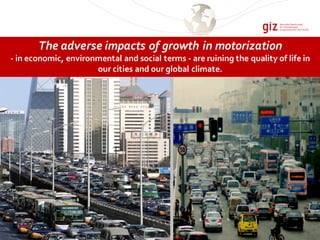
The adverse impacts of growth in motorization
- in economic, environmental and social terms - are ruining the quality of life in
our cities and our global climate.
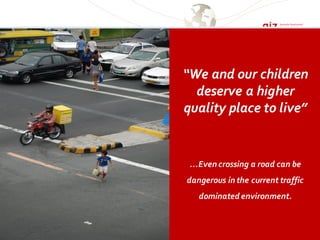
“We and our children
deserve a higher
quality place to live”
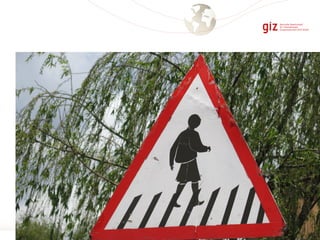
…Even crossing a road can be
dangerous in the current traffic
dominated environment.
TRANSPORT DILEMMA
THE URBAN
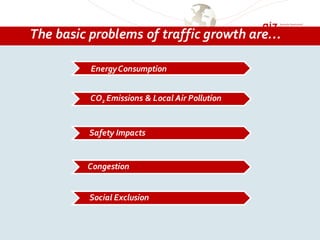
The basic problems of traffic growth are…
EnergyConsumption
CO2 Emissions & Local Air Pollution
Safety Impacts
Social Exclusion
Congestion
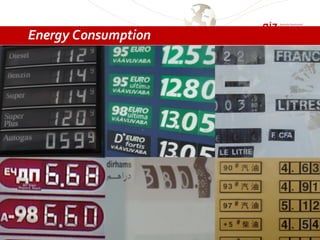
Energy Consumption
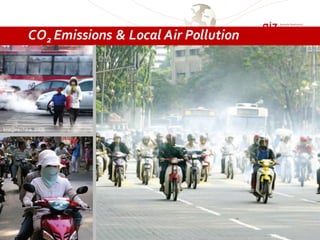
CO2 Emissions & Local Air Pollution
Imaginechina, 2009
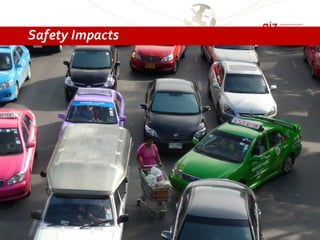
Safety Impacts
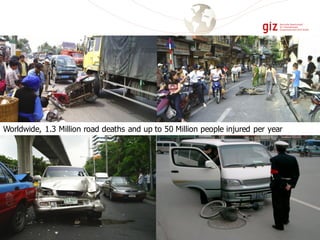
Worldwide, 1.3 Million road deaths and up to 50 Million people injured per year
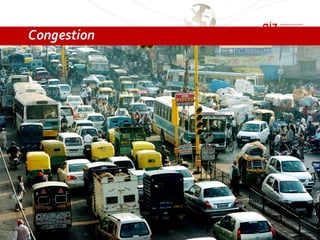
Congestion
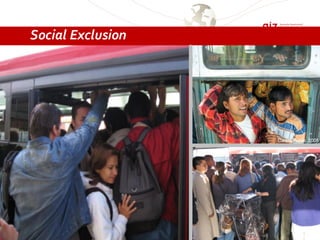
Social Exclusion
Carlos Pardo, 2005
Challenges in developing cities
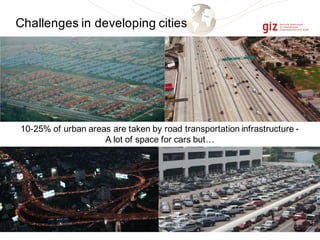
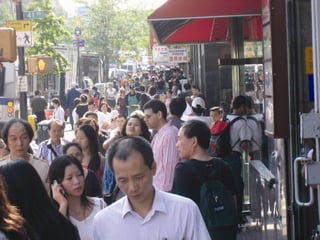
10-25% of urban areas are taken by road transportation infrastructure -
A lot of space for cars but…
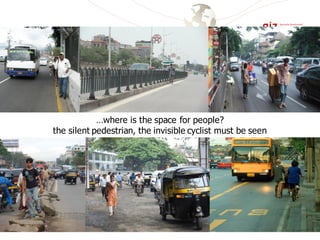
…where is the space for people?
the silent pedestrian, the invisible cyclist must be seen
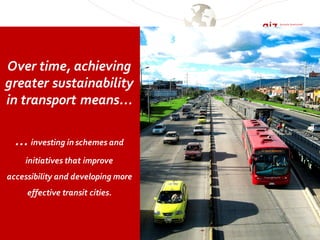
Over time, achieving
greater sustainability
in transport means...
... investing in schemes and
initiatives that improve
accessibility and developing more
effective transit cities.
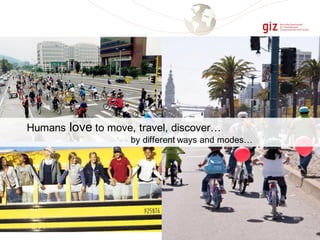
Humans love to move, travel, discover…
by different ways and modes…
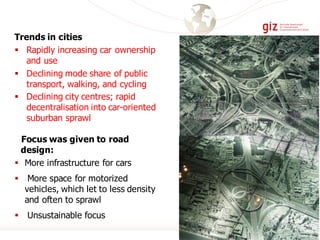
Trends in cities
§ Rapidly increasing car ownership
and use
§ Declining mode share of public
transport, walking, and cycling
§ Declining city centres; rapid
decentralisation into car-oriented
suburban sprawl
Focus was given to road
design:
§ More infrastructure for cars
§ More space for motorized
vehicles, which let to less density
and often to sprawl
§ Unsustainable focus
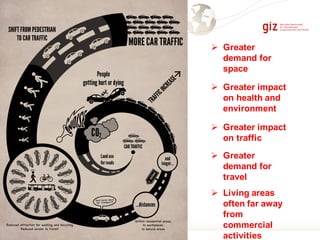
Ø Greater
demand for
space
Ø Greater
demand for
travel
Ø Living areas
often far away
from
commercial
activities
Ø Greater impact
on traffic
Ø Greater impact
on health and
environment
SUSTAINABLE MOBILITY
OPTIONS FOR
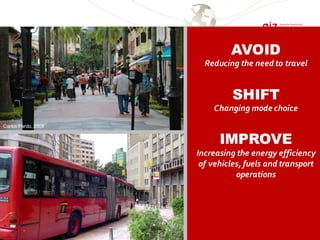
AVOID
Reducing the need to travel
SHIFT
Changing mode choice
IMPROVE
Increasing the energy efficiency
of vehicles, fuels and transport
operations
Carlos Pardo, 2008
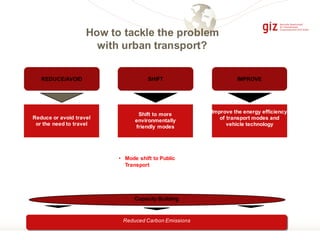
How to tackle the problem
with urban transport?
Reduced Carbon Emissions
Capacity Building
IMPROVE
Improve the energy efficiency
of transport modes and
vehicle technology
• Low-friction lubricants
• Optimal tire pressure
• Low Rolling Resistance Tires
• Speed limits, Eco-Driving
(Raising Awareness)
• Shift to alternative fuels
• …
SHIFT
Shift to more
environmentally
friendly modes
• Mode shift to Non-Motorized
Transport
• Mode shift to Public
Transport
• Public Transp.Integration
• TransportDemand
Management(TDM)
REDUCE/AVOID
• Integration of transport
and land-use planning
• Smart logistics concepts
• …
Reduce or avoid travel
or the need to travel
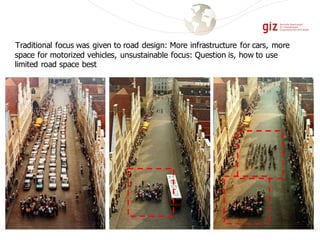
Traditional focus was given to road design: More infrastructure for cars, more
space for motorized vehicles, unsustainable focus: Question is, how to use
limited road space best
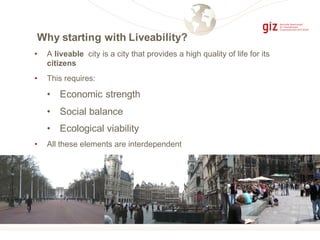
Why starting with Liveability?
• A liveable city is a city that provides a high quality of life for its
citizens
• This requires:
• Economic strength
• Social balance
• Ecological viability
• All these elements are interdependent
Other factors:
• Safety/Crime
• Schools and education
• Recreation
• Political stability
• Availability of goods/services
• Economic/Business conditions
What influences Liveability?
Direct transport related factors:
§ Infrastructure
§ Accessibility
§ Quality of architecture
§ Urban design
§ Public Transportation
§ Public places
§ ...etc.
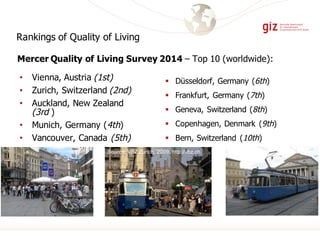
• Vienna, Austria (1st)
• Zurich, Switzerland (2nd)
• Auckland, New Zealand
(3rd )
• Munich, Germany (4th)
• Vancouver, Canada (5th)
§ Düsseldorf, Germany (6th)
§ Frankfurt, Germany (7th)
§ Geneva, Switzerland (8th)
§ Copenhagen, Denmark (9th)
§ Bern, Switzerland (10th)
Mercer Quality of Living Survey 2014 – Top 10 (worldwide):
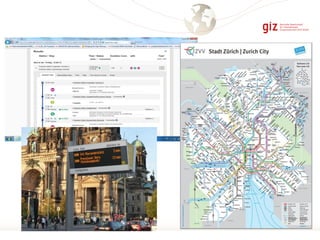
Source: VBZ Zurich, 2009, http://vbz.ch.
Rankings of Quality of Living
€€€190001500-
2000
Mixed
Traffic
€€
40000 –
60000
Heavy Rail/
Metro
€€€€€
€€€€€
€€€€€
€€€€€
€€€€€
€€€€€
€€€€€
€€€€€
€€€€€
€€€€€
€€€€€
€€€€€
€€€€€
€€€€€
€€€€€
€€€€€
€€€€€
€€€€€
€€€€€
€€€€€
€€€€€
€€€€€
€€€€€
€€€€€
€€€€€
€€€€€
€€€€€
€€€€€
€€€€€
€€€€€
€€€€€
€€€€€
€€€€€
€€€€€
€€€€€
€€€€€
60000 –
90000
Suburban
Rail
(e.g. Mumbai)
€
€€€
€€€
€€€
€€€
€€€
€€€
14000
€€
€€€
€€€
€€€
€€€
Cyclists
€€
€€€
€€€
€€€
€€€
€€€
9000
BRT
single lane
Pedestrians
5000
€€€
€€€
€€€
Regular
Bus
??
BRT
double lane
€
€€€€
€€€€
€€€€
€€€€
€€€€
€€€€
€€€€
€€€€
€€€€
€€€€
€€€€
Light Rail
€
€€€
€€€
€€€
€€€
€€€
€€€
€€€
18000 –
20000
(people per hour on 3.5 m wide lane in the city – PPHPD [PAX/hour/direction])
Source: Botma & Papendrecht, TU Delft 1991 andown figures
PPHPD
Range (à)
80000,
HKK
Maximum
PPHPD
achieved&
where (à)
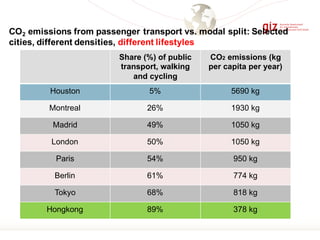
Share (%) of public
transport, walking
and cycling
CO2 emissions (kg
per capita per year)
Houston 5% 5690 kg
Montreal 26% 1930 kg
Madrid 49% 1050 kg
London 50% 1050 kg
Paris 54% 950 kg
Berlin 61% 774 kg
Tokyo 68% 818 kg
Hongkong 89% 378 kg
CO2 emissions from passenger transport vs. modal split: Selected
cities, different densities, different lifestyles
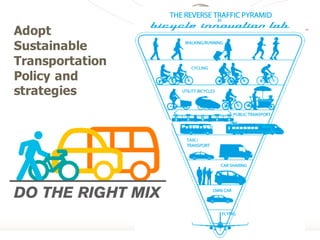
Adopt
Sustainable
Transportation
Policy and
strategies
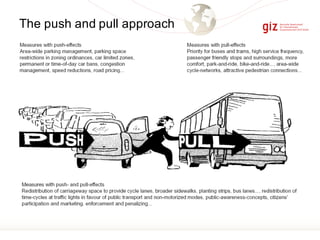
The push and pull approach
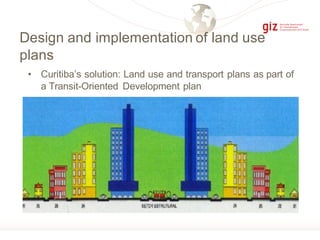
Design and implementation of land use
plans
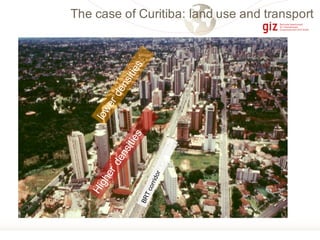
• Curitiba’s solution: Land use and transport plans as part of
a Transit-Oriented Development plan
The case of Curitiba: land use and transport
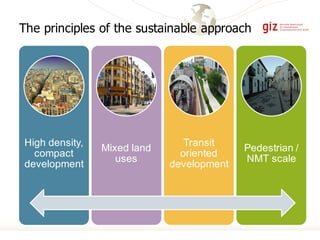
The principles of the sustainable approach
High density,
compact
development
Mixed land
uses
Transit
oriented
development
Pedestrian /
NMT scale
<<<
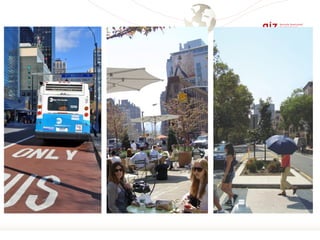
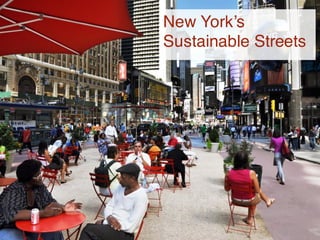
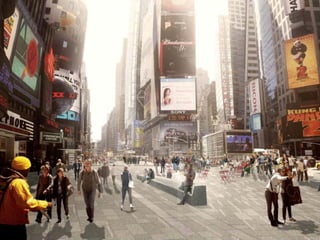
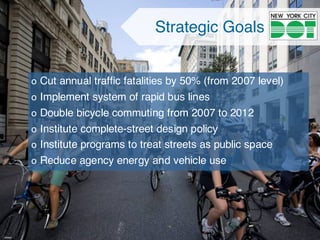
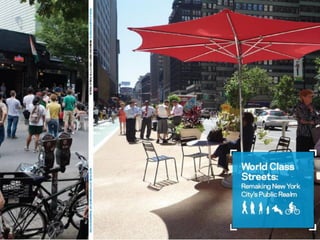
New York’s
Sustainable Streets
Strategic Goals
o Cut annual traffic fatalities by 50% (from 2007 level)
o Implement system of rapid bus lines
o Double bicycle commuting from 2007 to 2012
o Institute complete-street design policy
o Institute programs to treat streets as public space
o Reduce agency energy and vehicle use
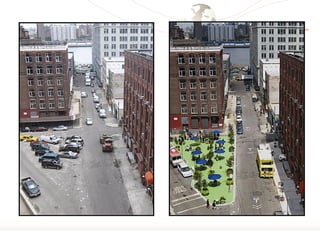
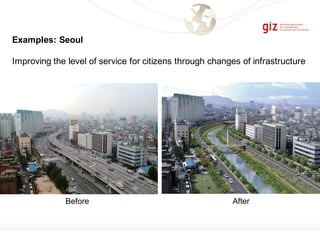
Examples: Seoul
Improving the level of service for citizens through changes of infrastructure
Before After
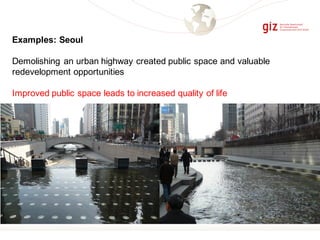
Examples: Seoul
Demolishing an urban highway created public space and valuable
redevelopment opportunities
Improved public space leads to increased quality of life
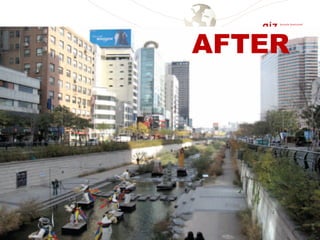
AFTER
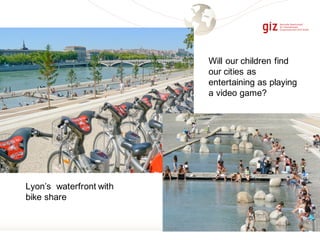
Lyon’s waterfront with
bike share
Will our children find
our cities as
entertaining as playing
a video game?
TRANSPORT
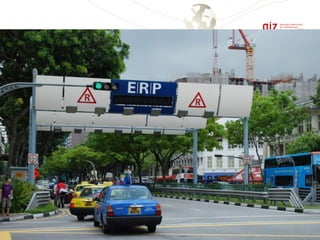
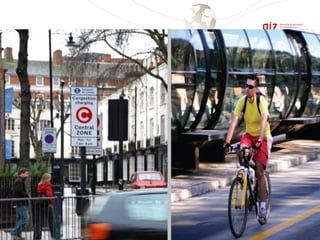
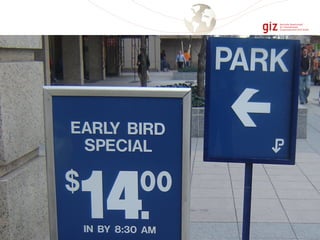
DEMAND MANAGEMENT
PUBLIC
TRANSIT
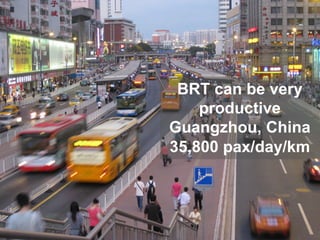
BRT can be very
productive
Guangzhou, China
35,800 pax/day/km
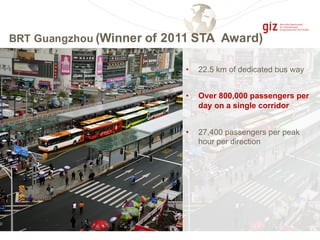
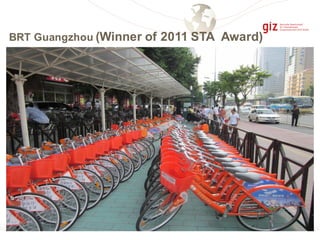
BRT Guangzhou (Winner of 2011 STA Award)
• 22.5 km of dedicated bus way
• Over 800,000 passengers per
day on a single corridor
• 27,400 passengers per peak
hour per direction
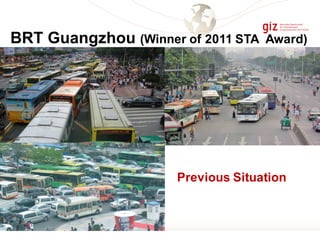
BRT Guangzhou (Winner of 2011 STA Award)
Previous Situation
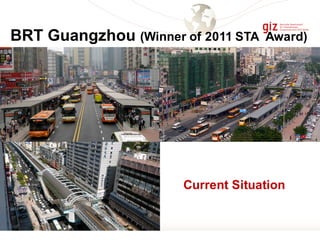
Current Situation
BRT Guangzhou (Winner of 2011 STA Award)
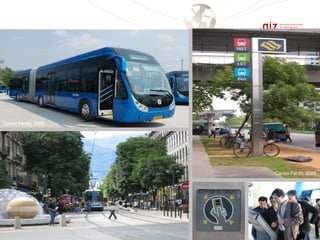
Carlos Pardo, 2008
Carlos Pardo, 2008
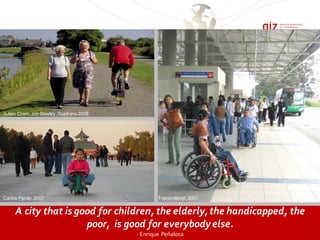
A city that is good for children, the elderly,the handicapped, the
poor, is good for everybodyelse.
- Enrique Peñalosa
Carlos Pardo, 2007
Julian Cram, Jon Bewley, Sustrans2008
Transmilenio, 2001
NON-MOTORIZED
TRANSPORT
Manfred Breithaupt, 2006
Judiza Zahir, 2008
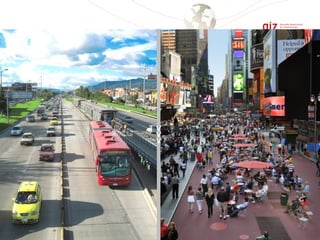
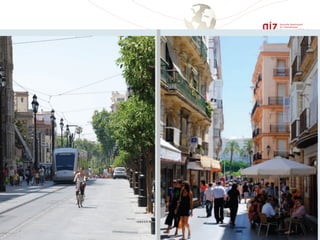
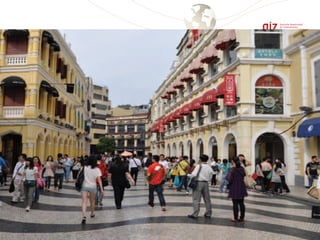
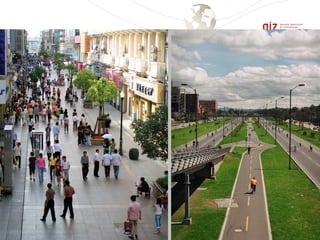
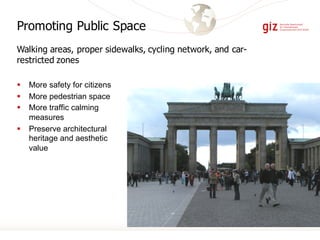
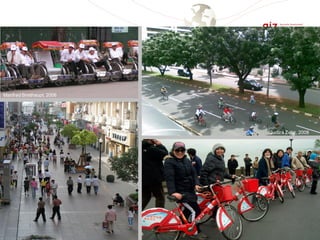
Walking areas, proper sidewalks, cycling network, and car-
restricted zones
§ More safety for citizens
§ More pedestrian space
§ More traffic calming
measures
§ Preserve architectural
heritage and aesthetic
value
Promoting Public Space
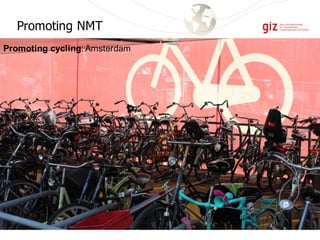
Promoting cycling: Amsterdam
Promoting NMT
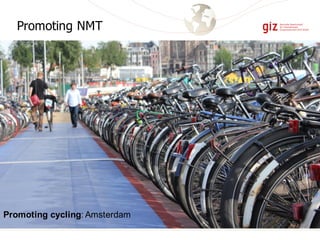
Promoting cycling: Amsterdam
Promoting NMT
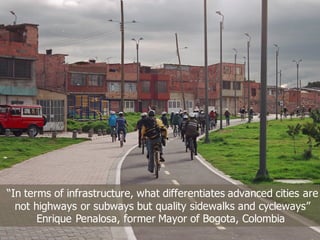
“In terms of infrastructure, what differentiates advanced cities are
not highways or subways but quality sidewalks and cycleways”
Enrique Penalosa, former Mayor of Bogota, Colombia
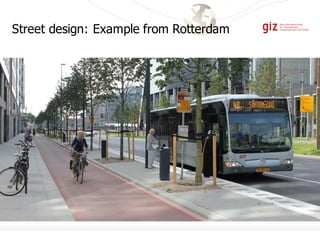
Street design: Example from Rotterdam
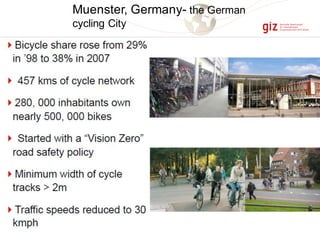
Muenster, Germany- the German
cycling City
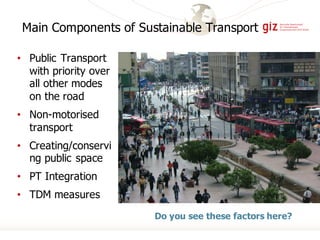
Main Components of Sustainable Transport
• Public Transport
with priority over
all other modes
on the road
• Non-motorised
transport
• Creating/conservi
ng public space
• PT Integration
• TDM measures
Do you see these factors here?
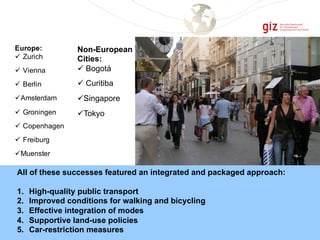
Non-European
Cities:
ü Bogotá
ü Curitiba
üSingapore
üTokyo
Europe:
ü Zurich
ü Vienna
ü Berlin
üAmsterdam
ü Groningen
ü Copenhagen
ü Freiburg
üMuenster
All of these successes featured an integrated and packaged approach:
1. High-quality public transport
2. Improved conditions for walking and bicycling
3. Effective integration of modes
4. Supportive land-use policies
5. Car-restriction measures
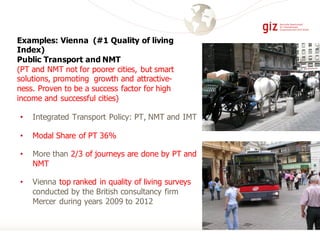
• Integrated Transport Policy: PT, NMT and IMT
• Modal Share of PT 36%
• More than 2/3 of journeys are done by PT and
NMT
• Vienna top ranked in quality of living surveys
conducted by the British consultancy firm
Mercer during years 2009 to 2012
Examples: Vienna (#1 Quality of living
Index)
Public Transport and NMT
(PT and NMT not for poorer cities, but smart
solutions, promoting growth and attractive-
ness. Proven to be a success factor for high
income and successful cities)
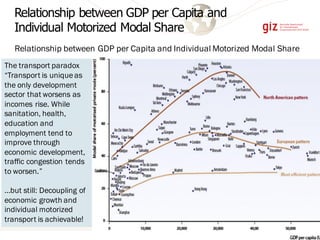
Relationship between GDP per Capita and
Individual Motorized Modal Share
Relationship between GDP per Capita and Individual Motorized Modal Share
The transport paradox
“Transport is uniqueas
the only development
sector that worsens as
incomes rise. While
sanitation, health,
education and
employment tend to
improve through
economic development,
traffic congestion tends
to worsen.”
…but still: Decoupling of
economic growth and
individual motorized
transport is achievable!
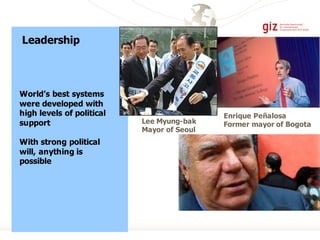
Leadership
World’s best systems
were developed with
high levels of political
support
With strong political
will, anything is
possible
Enrique Peñalosa
Former mayor of BogotaLee Myung-bak
Mayor of Seoul
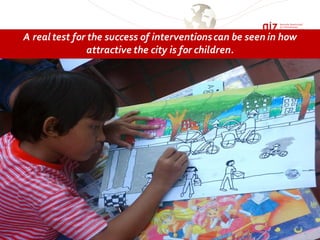
A realtest for the success of interventionscan be seen in how
attractive the city is for children.
We can certainly learn
much from the
development of
sustainable mobility
worldwide.
Changing course can
mean that strategic
societal objectives are
achieved, consistent with
individual preferences
and city quality of life
goals.
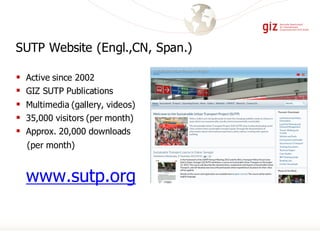
§ Active since 2002
§ GIZ SUTP Publications
§ Multimedia (gallery, videos)
§ 35,000 visitors (per month)
§ Approx. 20,000 downloads
(per month)
www.sutp.org
SUTP Website (Engl.,CN, Span.)
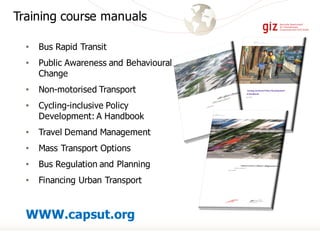
Training course manuals
• Bus Rapid Transit
• Public Awareness and Behavioural
Change
• Non-motorised Transport
• Cycling-inclusive Policy
Development: A Handbook
• Travel Demand Management
• Mass Transport Options
• Bus Regulation and Planning
• Financing Urban Transport
WWW.capsut.org
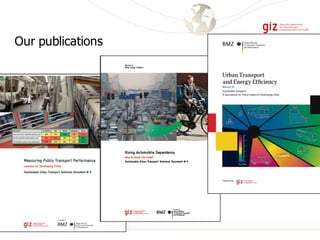
Our publications
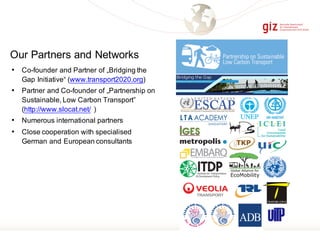
• Co-founder and Partner of „Bridging the
Gap Initiative“ (www.transport2020.org)
• Partner and Co-founder of „Partnership on
Sustainable, Low Carbon Transport”
(http://www.slocat.net/ )
• Numerous international partners
• Close cooperation with specialised
German and European consultants
Our Partners and Networks
GIZ SUTP project
sutp@sutp.org
transport@giz.de
Write to us for any assistance on making
Sustainable Urban Transport a reality in
your city

Changing course in urban transport

  • 1.
    05.10.15 Seite 1 ChangingCourse in Urban Transport
  • 2.
  • 3.
    The adverse impactsof growth in motorization - in economic, environmental and social terms - are ruining the quality of life in our cities and our global climate.
  • 4.
    “We and ourchildren deserve a higher quality place to live” …Even crossing a road can be dangerous in the current traffic dominated environment.
  • 7.
  • 8.
    The basic problemsof traffic growth are… EnergyConsumption CO2 Emissions & Local Air Pollution Safety Impacts Social Exclusion Congestion
  • 9.
  • 10.
    CO2 Emissions &Local Air Pollution Imaginechina, 2009
  • 11.
  • 12.
    Worldwide, 1.3 Millionroad deaths and up to 50 Million people injured per year
  • 13.
  • 14.
  • 15.
    Challenges in developingcities 10-25% of urban areas are taken by road transportation infrastructure - A lot of space for cars but…
  • 16.
    …where is thespace for people? the silent pedestrian, the invisible cyclist must be seen
  • 17.
    Over time, achieving greatersustainability in transport means... ... investing in schemes and initiatives that improve accessibility and developing more effective transit cities.
  • 18.
    Humans love tomove, travel, discover… by different ways and modes…
  • 19.
    Trends in cities §Rapidly increasing car ownership and use § Declining mode share of public transport, walking, and cycling § Declining city centres; rapid decentralisation into car-oriented suburban sprawl Focus was given to road design: § More infrastructure for cars § More space for motorized vehicles, which let to less density and often to sprawl § Unsustainable focus
  • 20.
    Ø Greater demand for space ØGreater demand for travel Ø Living areas often far away from commercial activities Ø Greater impact on traffic Ø Greater impact on health and environment
  • 21.
  • 22.
    AVOID Reducing the needto travel SHIFT Changing mode choice IMPROVE Increasing the energy efficiency of vehicles, fuels and transport operations Carlos Pardo, 2008
  • 23.
    How to tacklethe problem with urban transport? Reduced Carbon Emissions Capacity Building IMPROVE Improve the energy efficiency of transport modes and vehicle technology • Low-friction lubricants • Optimal tire pressure • Low Rolling Resistance Tires • Speed limits, Eco-Driving (Raising Awareness) • Shift to alternative fuels • … SHIFT Shift to more environmentally friendly modes • Mode shift to Non-Motorized Transport • Mode shift to Public Transport • Public Transp.Integration • TransportDemand Management(TDM) REDUCE/AVOID • Integration of transport and land-use planning • Smart logistics concepts • … Reduce or avoid travel or the need to travel
  • 24.
    Traditional focus wasgiven to road design: More infrastructure for cars, more space for motorized vehicles, unsustainable focus: Question is, how to use limited road space best
  • 25.
    Why starting withLiveability? • A liveable city is a city that provides a high quality of life for its citizens • This requires: • Economic strength • Social balance • Ecological viability • All these elements are interdependent
  • 26.
    Other factors: • Safety/Crime •Schools and education • Recreation • Political stability • Availability of goods/services • Economic/Business conditions What influences Liveability? Direct transport related factors: § Infrastructure § Accessibility § Quality of architecture § Urban design § Public Transportation § Public places § ...etc.
  • 27.
    • Vienna, Austria(1st) • Zurich, Switzerland (2nd) • Auckland, New Zealand (3rd ) • Munich, Germany (4th) • Vancouver, Canada (5th) § Düsseldorf, Germany (6th) § Frankfurt, Germany (7th) § Geneva, Switzerland (8th) § Copenhagen, Denmark (9th) § Bern, Switzerland (10th) Mercer Quality of Living Survey 2014 – Top 10 (worldwide): Source: VBZ Zurich, 2009, http://vbz.ch. Rankings of Quality of Living
  • 28.
    €€€190001500- 2000 Mixed Traffic €€ 40000 – 60000 Heavy Rail/ Metro €€€€€ €€€€€ €€€€€ €€€€€ €€€€€ €€€€€ €€€€€ €€€€€ €€€€€ €€€€€ €€€€€ €€€€€ €€€€€ €€€€€ €€€€€ €€€€€ €€€€€ €€€€€ €€€€€ €€€€€ €€€€€ €€€€€ €€€€€ €€€€€ €€€€€ €€€€€ €€€€€ €€€€€ €€€€€ €€€€€ €€€€€ €€€€€ €€€€€ €€€€€ €€€€€ €€€€€ 60000– 90000 Suburban Rail (e.g. Mumbai) € €€€ €€€ €€€ €€€ €€€ €€€ 14000 €€ €€€ €€€ €€€ €€€ Cyclists €€ €€€ €€€ €€€ €€€ €€€ 9000 BRT single lane Pedestrians 5000 €€€ €€€ €€€ Regular Bus ?? BRT double lane € €€€€ €€€€ €€€€ €€€€ €€€€ €€€€ €€€€ €€€€ €€€€ €€€€ €€€€ Light Rail € €€€ €€€ €€€ €€€ €€€ €€€ €€€ 18000 – 20000 (people per hour on 3.5 m wide lane in the city – PPHPD [PAX/hour/direction]) Source: Botma & Papendrecht, TU Delft 1991 andown figures PPHPD Range (à) 80000, HKK Maximum PPHPD achieved& where (à)
  • 29.
    Share (%) ofpublic transport, walking and cycling CO2 emissions (kg per capita per year) Houston 5% 5690 kg Montreal 26% 1930 kg Madrid 49% 1050 kg London 50% 1050 kg Paris 54% 950 kg Berlin 61% 774 kg Tokyo 68% 818 kg Hongkong 89% 378 kg CO2 emissions from passenger transport vs. modal split: Selected cities, different densities, different lifestyles
  • 30.
  • 31.
    The push andpull approach
  • 32.
    Design and implementationof land use plans • Curitiba’s solution: Land use and transport plans as part of a Transit-Oriented Development plan
  • 33.
    The case ofCuritiba: land use and transport
  • 34.
    The principles ofthe sustainable approach High density, compact development Mixed land uses Transit oriented development Pedestrian / NMT scale
  • 35.
  • 39.
  • 42.
    Strategic Goals o Cutannual traffic fatalities by 50% (from 2007 level) o Implement system of rapid bus lines o Double bicycle commuting from 2007 to 2012 o Institute complete-street design policy o Institute programs to treat streets as public space o Reduce agency energy and vehicle use
  • 45.
    Examples: Seoul Improving thelevel of service for citizens through changes of infrastructure Before After
  • 46.
    Examples: Seoul Demolishing anurban highway created public space and valuable redevelopment opportunities Improved public space leads to increased quality of life
  • 47.
  • 48.
    Lyon’s waterfront with bikeshare Will our children find our cities as entertaining as playing a video game?
  • 49.
  • 54.
  • 55.
    BRT can bevery productive Guangzhou, China 35,800 pax/day/km
  • 56.
    BRT Guangzhou (Winnerof 2011 STA Award) • 22.5 km of dedicated bus way • Over 800,000 passengers per day on a single corridor • 27,400 passengers per peak hour per direction
  • 57.
    BRT Guangzhou (Winnerof 2011 STA Award)
  • 58.
    BRT Guangzhou (Winnerof 2011 STA Award) Previous Situation
  • 59.
    Current Situation BRT Guangzhou(Winner of 2011 STA Award)
  • 61.
  • 63.
    A city thatis good for children, the elderly,the handicapped, the poor, is good for everybodyelse. - Enrique Peñalosa Carlos Pardo, 2007 Julian Cram, Jon Bewley, Sustrans2008 Transmilenio, 2001
  • 64.
  • 66.
  • 68.
    Walking areas, propersidewalks, cycling network, and car- restricted zones § More safety for citizens § More pedestrian space § More traffic calming measures § Preserve architectural heritage and aesthetic value Promoting Public Space
  • 69.
  • 70.
  • 72.
    “In terms ofinfrastructure, what differentiates advanced cities are not highways or subways but quality sidewalks and cycleways” Enrique Penalosa, former Mayor of Bogota, Colombia
  • 73.
    Street design: Examplefrom Rotterdam
  • 74.
    Muenster, Germany- theGerman cycling City
  • 75.
    Main Components ofSustainable Transport • Public Transport with priority over all other modes on the road • Non-motorised transport • Creating/conservi ng public space • PT Integration • TDM measures Do you see these factors here?
  • 76.
    Non-European Cities: ü Bogotá ü Curitiba üSingapore üTokyo Europe: üZurich ü Vienna ü Berlin üAmsterdam ü Groningen ü Copenhagen ü Freiburg üMuenster All of these successes featured an integrated and packaged approach: 1. High-quality public transport 2. Improved conditions for walking and bicycling 3. Effective integration of modes 4. Supportive land-use policies 5. Car-restriction measures
  • 77.
    • Integrated TransportPolicy: PT, NMT and IMT • Modal Share of PT 36% • More than 2/3 of journeys are done by PT and NMT • Vienna top ranked in quality of living surveys conducted by the British consultancy firm Mercer during years 2009 to 2012 Examples: Vienna (#1 Quality of living Index) Public Transport and NMT (PT and NMT not for poorer cities, but smart solutions, promoting growth and attractive- ness. Proven to be a success factor for high income and successful cities)
  • 78.
    Relationship between GDPper Capita and Individual Motorized Modal Share Relationship between GDP per Capita and Individual Motorized Modal Share The transport paradox “Transport is uniqueas the only development sector that worsens as incomes rise. While sanitation, health, education and employment tend to improve through economic development, traffic congestion tends to worsen.” …but still: Decoupling of economic growth and individual motorized transport is achievable!
  • 79.
    Leadership World’s best systems weredeveloped with high levels of political support With strong political will, anything is possible Enrique Peñalosa Former mayor of BogotaLee Myung-bak Mayor of Seoul
  • 80.
    A realtest forthe success of interventionscan be seen in how attractive the city is for children.
  • 81.
    We can certainlylearn much from the development of sustainable mobility worldwide. Changing course can mean that strategic societal objectives are achieved, consistent with individual preferences and city quality of life goals.
  • 82.
    § Active since2002 § GIZ SUTP Publications § Multimedia (gallery, videos) § 35,000 visitors (per month) § Approx. 20,000 downloads (per month) www.sutp.org SUTP Website (Engl.,CN, Span.)
  • 83.
    Training course manuals •Bus Rapid Transit • Public Awareness and Behavioural Change • Non-motorised Transport • Cycling-inclusive Policy Development: A Handbook • Travel Demand Management • Mass Transport Options • Bus Regulation and Planning • Financing Urban Transport WWW.capsut.org
  • 84.
  • 85.
    • Co-founder andPartner of „Bridging the Gap Initiative“ (www.transport2020.org) • Partner and Co-founder of „Partnership on Sustainable, Low Carbon Transport” (http://www.slocat.net/ ) • Numerous international partners • Close cooperation with specialised German and European consultants Our Partners and Networks
  • 86.
    GIZ SUTP project sutp@sutp.org transport@giz.de Writeto us for any assistance on making Sustainable Urban Transport a reality in your city