Parking Policy
From Despair and Conflict
towards Hope and Sustainability
Based	on	the	material	by	
Prof	Paul	Barter
http://www.reinventingparking.org/
INTERNATIONAL	PERSPECTIVE:		
KEY	CHOICES	AND	THREE	PARADIGMS
DO	parking	policy	differently,	THINK	about	parking	differently
2
Paul Barter, Reinventing Parking
We	will	look	at	how	parking	gets	
DONE	differently	in	different	places
In	the	process,	we	will	see	that	
doing	parking	differently	involves	
THINKING	differently
If	parking	policy	from	XXXX	could	be	
parachuted	into	Parkburg,	
what	would	they	do?
Mainstream	USA (such	as	LA)
Europe(especially	northern	and	central	Europe,	
such	as	London,	Berlin,	Amsterdam	or	Zurich)
Japan’s	large	cities
And	what	would	Donald	Shoup	(leading	
reformer	of	US	parking	policy)	advise?
Paul Barter, Reinventing Parking
But	first,	a	question
Some	of	the	responses	from	these	places	
would	involve	parking	price	rises	and/or	
constraining	parking	supply (at	least	relative	to	
current	plans	for	greatly	increased	supply)
Suppose	car	parking	prices	throughout		
Parkburg	were	to	rise,	what	responses	
are	available	to	car	users?
Paul Barter, Reinventing Parking
Motorist	options	if	parking	prices	rise	and/or	
parking	supply	is	constrained
Options	while	still	driving	car:	
Just	paying	(no	behaviour	
change)	is	an	option
Shift	parking	location	slightly	and	
walk
Reduce	parking	duration
Car-pooling/sharing	rides
Get	dropped	off(family	or	driver)
Valet	parking(often	linked	with	
restaurants)
Paul Barter, Reinventing Parking
Options	involving	mode	shift:	
Motorcycle
Auto-rickshaw	or	taxi	
Walking(very	likely	option	for	short	trips)
Bicycle or	Rickshaw
Public	transport
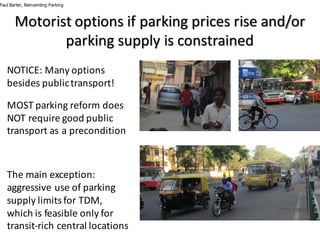
Motorist	options	if	parking	prices	rise	and/or	
parking	supply	is	constrained
NOTICE:	Many	options	
besides	public	transport!
MOST	parking	reform	does	
NOT	require	good	public	
transport	as	a	precondition
The	main	exception:	
aggressive	use	of	parking	
supply	limits	for	TDM,	
which	is	feasible	only	for	
transit-rich	central	locations
Paul Barter, Reinventing Parking
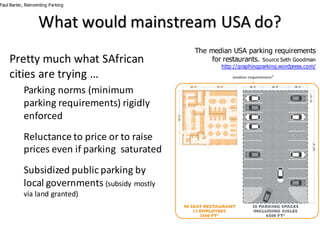
What	would	mainstream	USA	do?
Pretty	much	what	SAfrican	
cities	are	trying	…	
Parking	norms	(minimum	
parking	requirements)	rigidly	
enforced
Reluctance	to	price	or	to	raise	
prices	even	if	parking		saturated
Subsidized	public	parking	by	
local	governments	(subsidy	mostly	
via	land	granted)
Paul Barter, Reinventing Parking
The median USA parking requirements
for restaurants. Source Seth Goodman
http://graphingparking.wordpress.com/
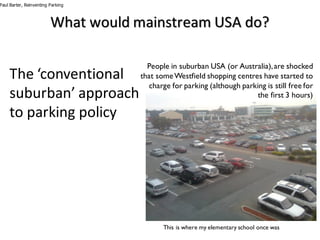
What	would	mainstream	USA	do?
The	‘conventional	
suburban’	approach	
to	parking	policy
People in suburban USA (or Australia),are shocked
that someWestfield shopping centres have started to
charge for parking (although parking is still free for
the first 3 hours)
This is where my elementary school once was
Paul Barter, Reinventing Parking
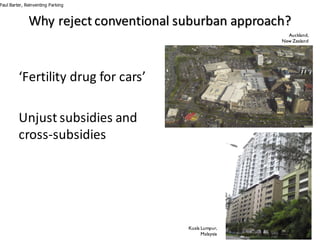
Why	reject	conventional	suburban	approach?
‘Fertility	drug	for	cars’
Unjust	subsidies	and	
cross-subsidies	
Auckland,
New Zealand
Paul Barter, Reinventing Parking
Kuala Lumpur,
Malaysia
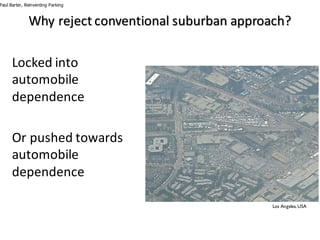
Locked	into	
automobile	
dependence
Or	pushed	towards	
automobile	
dependence
Paul Barter, Reinventing Parking
Los Angeles,USA
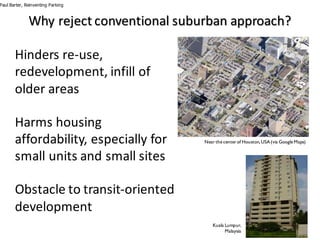
Why	reject	conventional	suburban	approach?
Hinders	re-use,	
redevelopment,	infill	of	
older	areas
Harms	housing	
affordability,	especially	for	
small	units	and	small	sites
Obstacle	to	transit-oriented	
development
Paul Barter, Reinventing Parking
Nearthe centerof Houston,USA (via Google Maps)
Kuala Lumpur,
Malaysia
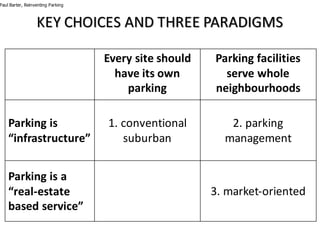
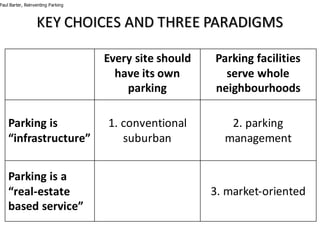
KEY	CHOICES	AND	THREE	PARADIGMS
Paul Barter, Reinventing Parking
Every	site	should	
have	its	own	
parking	
Parking	facilities	
serve	whole	
neighbourhoods
Parking	is	
“infrastructure”
1.	conventional	
suburban
2.	parking	
management
Parking	is	a	
“real-estate	
based	service”
3.	market-oriented
Initially,	same	as	suburban	USA	…	but	in	old	urban	fabric,	
this	works	badly
Then	try	public	parking	facilities	to	get	‘enough’	supply	…		
but	this	forced	to	manage	on-street
This	lead	to	the	“parking	management”	MINDSET
Parking	is	infrastructure	(like	streets	and	bus	stops)
Mostly	planned	district	by	district,	
not	site	by	site
Paul Barter, Reinventing Parking
What	would	Europeans	
(and	some	USA	inner	cities	too)	do?
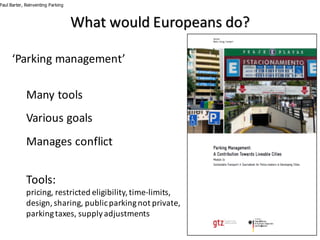
‘Parking	management’
Many	tools
Various	goals
Manages	conflict
Tools:	
pricing,	restricted	eligibility,	time-limits,	
design,	sharing,	public	parking	not	private,	
parking	taxes,	supply	adjustments
Paul Barter, Reinventing Parking
What	would	Europeans	do?
What	would	NW	Europeans	do?
Step-by-step	intensification	of	
on-street	parking	management
- Intensive	kerbside management
- Time	limits	often
- Pricing
- Residents’	permits/permit	zones
Paul Barter, Reinventing Parking
This sign is from inner Sydney (inner city
areas in US and Australia also deploy
intensive parking management)
What	would	NW	Europeans	do?
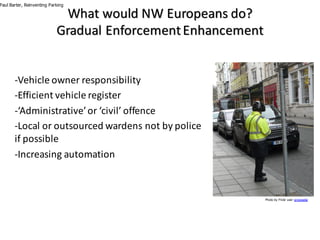
Gradual	Enforcement	Enhancement
-Vehicle	owner	responsibility
-Efficient	vehicle	register
-‘Administrative’	or	‘civil’	offence
-Local	or	outsourced	wardens	not	by	police	
if	possible
-Increasing	automation
Paul Barter, Reinventing Parking
Photo by Flickr user gregwake
What	would	NW	Europeans	do?	
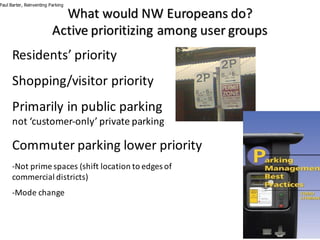
Active	prioritizing	among	user	groups
Residents’	priority
Shopping/visitor	priority
Primarily	in	public	parking	
not	‘customer-only’	private	parking
Commuter	parking	lower	priority
-Not	prime	spaces	(shift	location	to	edges	of	
commercial	districts)
-Mode	change
Paul Barter, Reinventing Parking
What	would	NW	Europeans	do?	
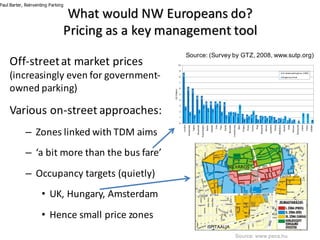
Pricing	as	a	key	management	tool
Off-street	at	market	prices	
(increasingly	even	for	government-
owned	parking)
Various	on-street	approaches:	
– Zones	linked	with	TDM	aims
– ‘a	bit	more	than	the	bus	fare’
– Occupancy	targets	(quietly)
• UK,	Hungary,	Amsterdam
• Hence	small	price	zones
Paul Barter, Reinventing Parking
Source: (Survey by GTZ, 2008, www.sutp.org)
Source: www.pecs.hu
What	would	NW	Europeans	do?	
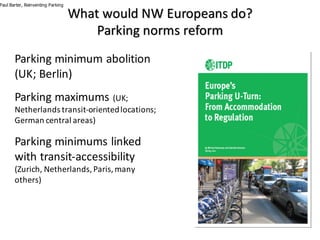
Parking	norms	reform
Parking	minimum	abolition	
(UK;	Berlin)
Parking	maximums	(UK;	
Netherlands	transit-oriented	locations;	
German	central	areas)
Parking	minimums	linked	
with	transit-accessibility	
(Zurich,	Netherlands,	Paris,	many	
others)
Paul Barter, Reinventing Parking
What	would	NW	Europeans	do?	
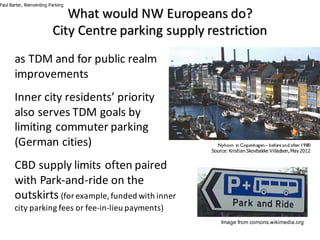
City	Centre	parking	supply	restriction	
as	TDM	and	for	public	realm	
improvements
Inner	city	residents’	priority	
also	serves	TDM	goals	by	
limiting	commuter	parking	
(German	cities)
CBD	supply	limits	often	paired	
with	Park-and-ride	on	the	
outskirts (for	example,	funded	with	inner	
city	parking	fees	or	fee-in-lieu	payments)
Paul Barter, Reinventing Parking
Image from comons.wikimedia.org
Nyhavn in Copenhagen– before and after1980
Source: Kristian Skovbakke Villadsen, May2012
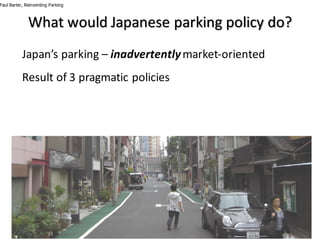
What	would	Japanese	parking	policy	do?
Paul Barter, Reinventing Parking
Japan’s	parking	– inadvertentlymarket-oriented
Result	of	3	pragmatic	policies
Paul Barter, Reinventing Parking
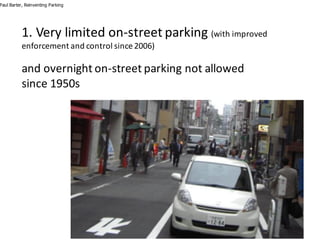
1.	Very	limited	on-street	parking	(with	improved	
enforcement	and	control	since	2006)	
and	overnight	on-street	parking	not	allowed
since	1950s
http://beta.adb.org/publications/parking-policy-asian-cities
Paul Barter, Reinventing Parking
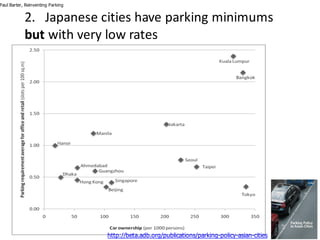
2.			Japanese	cities	have	parking	minimums	
but with	very	low	rates
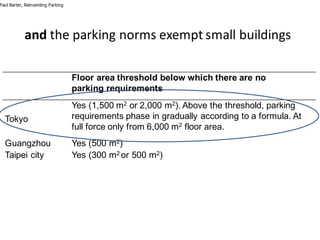
Floor area threshold below which there are no
parking requirements
Tokyo
Yes (1,500 m2 or 2,000 m2). Above the threshold, parking
requirements phase in gradually according to a formula. At
full force only from 6,000 m2 floor area.
Guangzhou Yes (500 m2)
Taipei city Yes (300 m2 or 500 m2)
and the	parking	norms	exempt	small	buildings
Paul Barter, Reinventing Parking
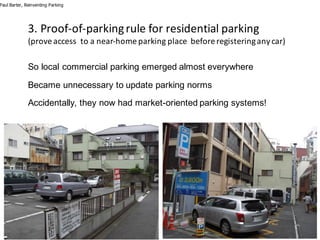
3.	Proof-of-parking	rule	for	residential	parking	
(prove	access		to	a	near-home	parking	place		before	registering	any	car)
So local commercial parking emerged almost everywhere
Became unnecessary to update parking norms
Accidentally, they now had market-oriented parking systems!
What	would	Japanese	parking	policy	do?
Paul Barter, Reinventing Parking
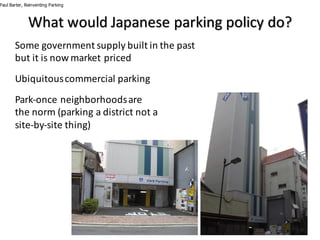
Some	government	supply	built	in	the	past	
but	it	is	now	market	priced
Ubiquitous	commercial	parking
Park-once	neighborhoods	are	
the	norm	(parking	a	district	not	a	
site-by-site	thing)
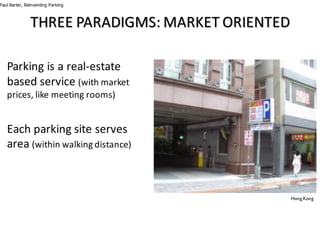
THREE	PARADIGMS:	MARKET	ORIENTED
Parking	is	a	real-estate	
based	service	(with	market	
prices,	like	meeting	rooms)
Each	parking	site	serves	
area	(within	walking	distance)
Paul Barter, Reinventing Parking
Hong Kong
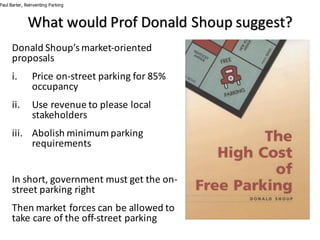
Donald	Shoup’s market-oriented	
proposals	
i. Price	on-street	parking	for	85%	
occupancy
ii. Use	revenue	to	please	local	
stakeholders
iii. Abolish	minimum	parking	
requirements
In	short,	government	must	get	the	on-
street	parking	right
Then	market	forces	can	be	allowed	to	
take	care	of	the	off-street	parking
Paul Barter, Reinventing Parking
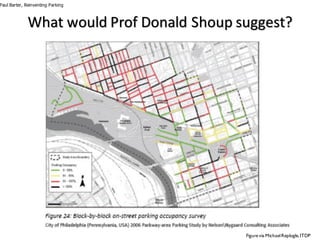
What	would	Prof	Donald	Shoup suggest?
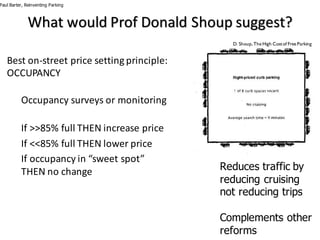
Best	on-street	price	setting	principle:	
OCCUPANCY
Occupancy	surveys	or	monitoring
If	>>85%	full	THEN	increase	price
If	<<85%	full	THEN	lower	price
If	occupancy	in	“sweet	spot”	
THEN	no	change
Paul Barter, Reinventing Parking
D. Shoup,The High Costof Free Parking
Reduces traffic by
reducing cruising
not reducing trips
Complements other
reforms
What	would	Prof	Donald	Shoup suggest?
Figure via MichaelReplogle,ITDP
Paul Barter, Reinventing Parking
KEY	CHOICES	AND	THREE	PARADIGMS
Paul Barter, Reinventing Parking
Every	site	should	
have	its	own	
parking	
Parking	facilities	
serve	whole	
neighbourhoods
Parking	is	
“infrastructure”
1.	conventional	
suburban
2.	parking	
management
Parking	is	a	
“real-estate	
based	service”
3.	market-oriented
FINAL	DISCUSSION:	LET’S	APPLY	
EACH	OF	THE	TWO	ALTERNATIVE	
APPROACHES	TO	PARKBURG
33
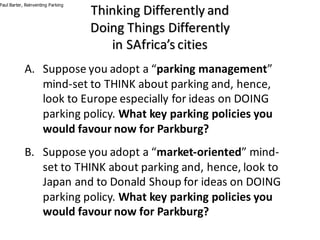
Thinking	Differently	and	
Doing	Things	Differently
in	SAfrica’s	cities
A. Suppose	you	adopt	a	“parking	management”	
mind-set	to	THINK	about	parking	and,	hence,	
look	to	Europe	especially	for	ideas	on	DOING	
parking	policy.	What	key	parking	policies	you	
would	favour	now	for	Parkburg?
B. Suppose	you	adopt	a	“market-oriented”	mind-
set	to	THINK	about	parking	and,	hence,	look	to	
Japan	and	to	Donald	Shoup	for	ideas	on	DOING	
parking	policy.	What	key	parking	policies	you	
would	favour	now	for	Parkburg?
Paul Barter, Reinventing Parking
1.	Who	should	bear	primary	responsibility	for	
supplying	parking	facilities?
(choose	ONE	option	below	that	best	matches	your	view)
A. Local	Government
B. Building	developers	and	owners
C. Businesses	supplying	parking	on	a	commercial	basis
Paul Barter, Reinventing Parking
Your	Attitudes	to	Parking:	Let’s	Debrief
2.	Which	of	the	following	should	be	the	primary	
criterion	for	setting	parking	charges?
(choose	ONE	option	below	that	best	matches	your	view)
A. Cost	of	providing	the	parking
B. Social	and	political	acceptability
C. Consistency	with	the	governments’	transport	and	
urban	policy	goals
D. Market	forces	of	supply	and	demand
Paul Barter, Reinventing Parking
3.	Where	should	a	motorist	heading	to	a	mid-sized	
mall	in	a	mixed-use	district	park	his/her	car?
(choose	ONE	option	below	that	best	matches	your	view)
A. In	the	mall’s	own	parking	facility
B. Any	legal	parking	space	in	the	area	that	is	
convenient	(while	paying	the	appropriate	parking	
charge)
Paul Barter, Reinventing Parking
4.	Suppose	the	motorist	in	the	previous	question	
parked	in	the	mall	parking	lot.	She	finishes	her	
shopping	and	goes	for	a	meal	in	a	restaurant	down	
the	street.	She	should:	
(choose	ONE	option	below	that	best	matches	your	view)
A. Leave	the	car	in	the	mall	parking	and	walk	to	the	
restaurant
B. Move	the	car	to	the	restaurant’s	parking	lot
Paul Barter, Reinventing Parking
5.	Which	of	the	following	is	the	MOST	important	
way	in	which	parking	causes	congestion?
(choose	ONE	option	below	that	best	matches	your	view)
A. Simply	by	being	at	the	kerb,	parking	hinders	traffic	flow	
(which	is	the	primary	purpose	of	the	roadway)
B. A	high	number	of	parking	spaces	in	busy	areas	encourages	
more	motorists	to	drive	than	the	roads	can	handle
C. Poorly	managed	on-street	parking	results	in	full	on-street	
parking	which	encourages	motorists	to	circle	in	search	of	
parking	and	to	wait	in	traffic	lanes	or	double	park
Paul Barter, Reinventing Parking
6.	What	is	your	reaction	to	the	idea	of	a	special	
Rs20	parking	surcharge	for	motorists	arriving	at	
peaking	in	AM	peak	hour	and	leaving	in	PM	peak?
(choose	ONE	option	below	that	best	matches	your	view)
A. Great	idea!
B. This	is	just	another	tax	grab	in	disguise!
C. Not	bad	but	if	parking	is	to	have	a	peak	surcharge	it	
should	reflect	times	of	peak	parking demand	not	
peak	traffic	demand
Paul Barter, Reinventing Parking
Parknagar’s best	hope	is	improved	
on-street	parking	management?
Improving	this	in	SAfrica	won’t	be	easy
Did	today’s	session	help	you	see	how	central	
and	important	on-street	management	is?
Paul Barter, Reinventing Parking

Parking policy TDM workshop