MECHANICALPROPERTIES
OF CERAMICS
SHARAD WALIA
MECHANICAL ENGINEERING
UPES, DEHRADUN
WHATARE CERAMICS…?
• A Ceramic is a non metallic solid material
comprising an inorganic compound of metal,
non-metal and metalloid atoms, primarily hold in
ionic or covalent bonds.
• The word Ceramics comes from a GREEK word
KERAMICOS means “burnt stuff.”
Abrief description about Mechanical
Properties of Ceramics
Here some general mechanical properties of ceramics are
described:
1. BRITTLE HIGH
2. HARDNESS HIGH
3. ELASTIC MODULUS HIGH
4. DENSITY LOW
5. DUCTILITY LOW
HARDNESS
• Hardness is defined as the ability of a material to
resist plastic deformation, usually by indentation.
• It is the property of a material which gives it the
ability to resist being permanently deformed
when a load is applied.
• So, greater the hardness of the material, the
greater resistance it has to deformation.
HARDNESS Cont…
• Hardness implies high resistance to deformation
and is associated with LARGE Modulus of
Elasticity.
• Hardness is affected by POROSITY in the
surface and as well as sub-surface, the GRAIN
SIZE of the microstructure and the grain
boundary phases of a material.
MICROHARDNESS
• Microhardness refers to the testing of hardness of
materials by using small applied loads.
• Microhardness testing, with applied loads under
10N, is typically used for smaller samples, thin
specimens, plated surfaces or thin films.
YOUNG’S MODULUS
• Young’s modulus is also known as Elastic Modulus.
• It is defined as the ratio of stress below the
proportional limit to the corresponding strain.
• It is the measure of rigidity of stiffness of a material.
• The greater the modulus, the stiffer the material, in
other words, the elastic strain resulting from the
application of the resulting stress is smaller.
FRACTURE TOUGHNESS
• In metallurgy, fracture toughness refers to a
property which describes the ability of a material
containing crack to resist further fracture.
• It is a quantitative way of expressing a material’s
resistance to brittle fracture.
• Brittle fracture is a characteristic of material with
less fracture toughness.
INSTRUMENTED TESTING
• The determination of the mechanical properties like
Young’s Modulus and Hardness, carried out using
INSTRUMENTED MICROHARDNESS TESTING
MACHINE.
• In instrumented indentation the microhardness
testing machine perform continuous measurement
and the results are automatically generated which can
be obtained from the system.
• Fracture toughness is further calculated from the
radial crack lengths generated in the specimen.
Cont…
• In the determination of Young’s Modulus and
Hardness a load of 1N was used and for the
calculation of fracture toughness a load of 2N was
used.
• Vicker’s indentation method, using square pyramidal
indenter, was used for the measurements.
• The system after recognizing the load vs. indentation
curve calculate stiffness (S) from the unloading part
of the curve at hmax.
𝑆 =
𝑑𝑃
𝑑ℎ
A typical load vs. indentation
curve
Cont…
• Using stiffness value, Reduced modulus is
evaluated by the system using
𝐸𝑟 =
𝜋
2
𝑆
𝐴
• Also the reduced modulus is given by
1
𝐸𝑟
=
1 − 𝜈𝑖
2
𝐸𝑖
+
1 − 𝜈𝑠
2
𝐸𝑠
where E and ν represent Young’s Modulus and
Poisson’s ratio of the indenter (i) and sample (s),
respectively.
Cont…
• The Hardness of the sample is given by
𝐻 =
𝑃
𝐴
• The contact area, A is an experimentally determined function of
the contact depth (hc ).
A = 𝑓(ℎ 𝑐)
• The contact depth (hc ) is related to the total displacement, h of
the indenter.
ℎ 𝑐 = ℎ 𝑚𝑎𝑥 − 𝜀
𝑃𝑚𝑎𝑥
𝑆
where Pmax is the peak load and ε is a constant related to the
geometry of indenter.
Cont…
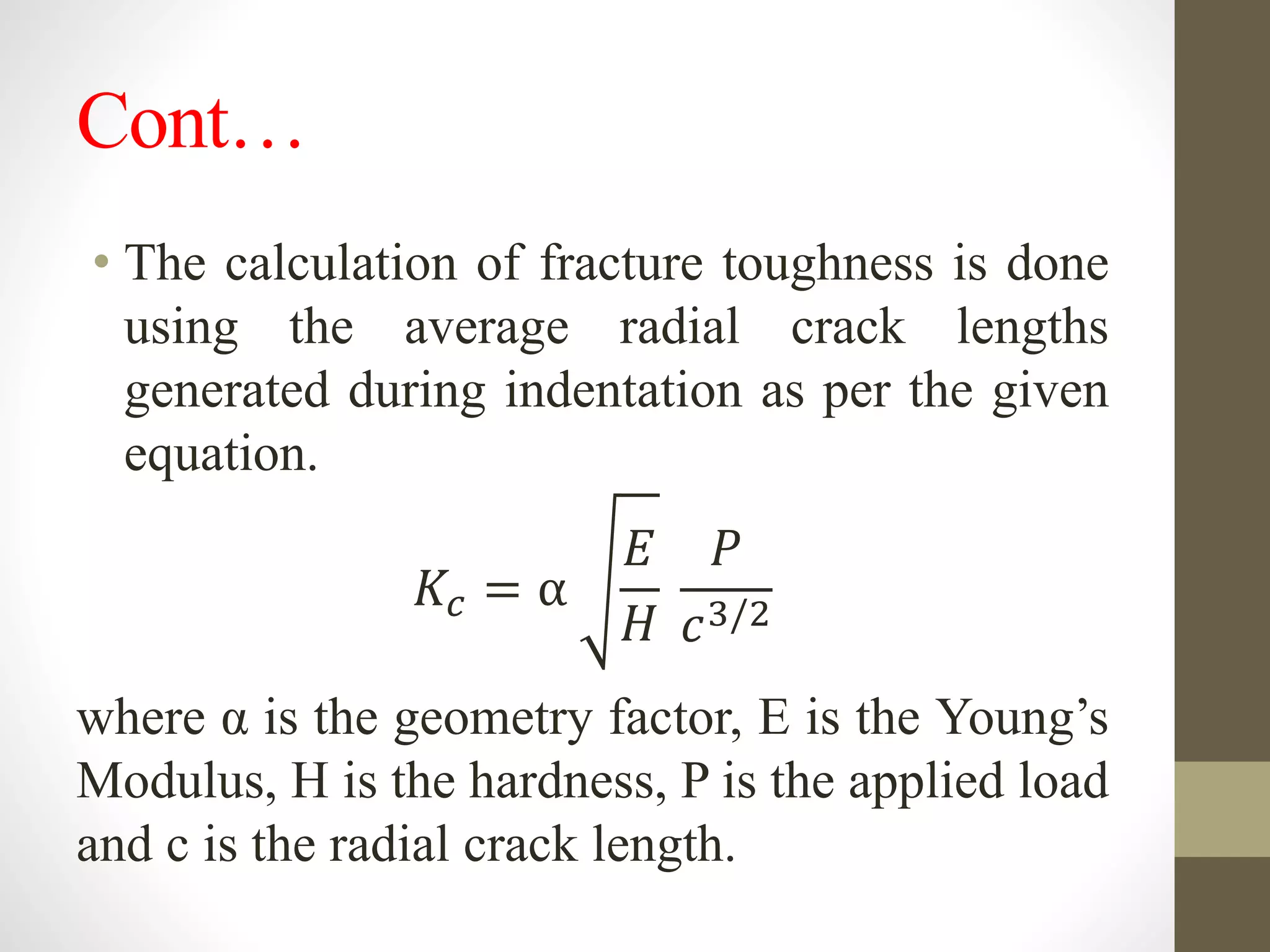
• The calculation of fracture toughness is done
using the average radial crack lengths
generated during indentation as per the given
equation.
𝐾𝑐 = α
𝐸
𝐻
𝑃
𝑐3/2
where α is the geometry factor, E is the Young’s
Modulus, H is the hardness, P is the applied load
and c is the radial crack length.
THANK YOU

Mechanical Properties of Ceramics

  • 1.
  • 2.
    WHATARE CERAMICS…? • ACeramic is a non metallic solid material comprising an inorganic compound of metal, non-metal and metalloid atoms, primarily hold in ionic or covalent bonds. • The word Ceramics comes from a GREEK word KERAMICOS means “burnt stuff.”
  • 3.
    Abrief description aboutMechanical Properties of Ceramics Here some general mechanical properties of ceramics are described: 1. BRITTLE HIGH 2. HARDNESS HIGH 3. ELASTIC MODULUS HIGH 4. DENSITY LOW 5. DUCTILITY LOW
  • 4.
    HARDNESS • Hardness isdefined as the ability of a material to resist plastic deformation, usually by indentation. • It is the property of a material which gives it the ability to resist being permanently deformed when a load is applied. • So, greater the hardness of the material, the greater resistance it has to deformation.
  • 5.
    HARDNESS Cont… • Hardnessimplies high resistance to deformation and is associated with LARGE Modulus of Elasticity. • Hardness is affected by POROSITY in the surface and as well as sub-surface, the GRAIN SIZE of the microstructure and the grain boundary phases of a material.
  • 6.
    MICROHARDNESS • Microhardness refersto the testing of hardness of materials by using small applied loads. • Microhardness testing, with applied loads under 10N, is typically used for smaller samples, thin specimens, plated surfaces or thin films.
  • 7.
    YOUNG’S MODULUS • Young’smodulus is also known as Elastic Modulus. • It is defined as the ratio of stress below the proportional limit to the corresponding strain. • It is the measure of rigidity of stiffness of a material. • The greater the modulus, the stiffer the material, in other words, the elastic strain resulting from the application of the resulting stress is smaller.
  • 8.
    FRACTURE TOUGHNESS • Inmetallurgy, fracture toughness refers to a property which describes the ability of a material containing crack to resist further fracture. • It is a quantitative way of expressing a material’s resistance to brittle fracture. • Brittle fracture is a characteristic of material with less fracture toughness.
  • 9.
    INSTRUMENTED TESTING • Thedetermination of the mechanical properties like Young’s Modulus and Hardness, carried out using INSTRUMENTED MICROHARDNESS TESTING MACHINE. • In instrumented indentation the microhardness testing machine perform continuous measurement and the results are automatically generated which can be obtained from the system. • Fracture toughness is further calculated from the radial crack lengths generated in the specimen.
  • 10.
    Cont… • In thedetermination of Young’s Modulus and Hardness a load of 1N was used and for the calculation of fracture toughness a load of 2N was used. • Vicker’s indentation method, using square pyramidal indenter, was used for the measurements. • The system after recognizing the load vs. indentation curve calculate stiffness (S) from the unloading part of the curve at hmax. 𝑆 = 𝑑𝑃 𝑑ℎ
  • 11.
    A typical loadvs. indentation curve
  • 12.
    Cont… • Using stiffnessvalue, Reduced modulus is evaluated by the system using 𝐸𝑟 = 𝜋 2 𝑆 𝐴 • Also the reduced modulus is given by 1 𝐸𝑟 = 1 − 𝜈𝑖 2 𝐸𝑖 + 1 − 𝜈𝑠 2 𝐸𝑠 where E and ν represent Young’s Modulus and Poisson’s ratio of the indenter (i) and sample (s), respectively.
  • 13.
    Cont… • The Hardnessof the sample is given by 𝐻 = 𝑃 𝐴 • The contact area, A is an experimentally determined function of the contact depth (hc ). A = 𝑓(ℎ 𝑐) • The contact depth (hc ) is related to the total displacement, h of the indenter. ℎ 𝑐 = ℎ 𝑚𝑎𝑥 − 𝜀 𝑃𝑚𝑎𝑥 𝑆 where Pmax is the peak load and ε is a constant related to the geometry of indenter.
  • 14.
    Cont… • The calculationof fracture toughness is done using the average radial crack lengths generated during indentation as per the given equation. 𝐾𝑐 = α 𝐸 𝐻 𝑃 𝑐3/2 where α is the geometry factor, E is the Young’s Modulus, H is the hardness, P is the applied load and c is the radial crack length.
  • 15.