Veermata Jijabai Technological
Institute Mumbai
Shape Memory Alloys and it’s
Applications in Civil
Engineering
Seminar on
Under The Guidance
of Dr. Priyanka
Jadhav
By
Pankaj Dhangare
M. Tech I(Structural)
Roll No-142040013
Content
Introduction
History
Literature reviews
Types of SMAs
Properties
Working principle
Applications
Case study
Conclusion
Introduction
 SMAs are the Materials which have the ability
to return to a predetermined shape when heated
or cooled.
 When it is heated above its transformation
temperature it undergoes a change in crystal
structure which causes it to return to its original
shape.
 The most common shape memory material is
an alloy of nickel and titanium called Nitinol
 This particular alloy has very good electrical
and mechanical properties, long fatigue life,
and high corrosion resistance
History
 1932: Chang and Read recorded the first
observation of the shape memory
transforation.
 1938: Greninger and Mooradian observed the
formation and disappearance of martensitic
phase by varying the temperature of a Cu-Zn
alloy.
 1951: Shape memory effect was observed
 1962-63: Ni-Ti alloys were first developed by
the United States Naval Ordnance
Laboratory.
 Mid-1990s – Memory metals start to become
widespread in medicine and soon move to
Literature reviews
 "Applications of Shape Memory Alloys in Civil
Engineering Structures - Overview, Limits and New
Ideas” by JANKE, L., et al.(2005). "Materials and
Structures” 38(June 2005): 578-592.
 A basic description of SMA highly non-linear material
behaviour in terms of shape memory effect and
superelasticity.
 It is followed by a brief introduction to Ni-Ti and Fe-Mn-Si
SMAs.
 Pre-existing and new applications in the fields of damping,
active vibration control and prestressing or posttensioning of
structures with fibres and tendons are being reviewed with
regard to civil engineering.
 New ideas for using SMAs in civil engineering structures are
proposed such as an improved concept for the active
confinement of concrete members.
Literature reviews….
 “Applications of Shape Memory Alloys in Civil
Structures” by Song, G., Ma, N., and Li, H.-N. (2006).,
Engineering Structures, 28, 1266-1274.
 The shape memory effect (SME) and pseudoelasticity,
two major properties of SMA associated with the
thermal-induced or stress-induced reversible hysteretic
phase transformation between austenite and martensite
are reviewed.
 These unique properties enable SMA to be used as
actuators, energy dissipaters and dampers for civil structure
control.
 Various applications in civil structures.
Literature reviews….
 “APPLICATION OF SMART MATERIALS IN CIVIL
ENGINEERING STRUCTURES,” by T.S.
Thandavamoorthy(2013) , Research in Civil Engineering
Structures-05 251-263.
 He described the characteristics of smart materials, the use of
SMA in construction and research, and their beneficial
aspects by reviewing the available information.
 He considered Shape Memory Alloy as SMART MATERIAL or
INTELLIGENT MATERIAL.
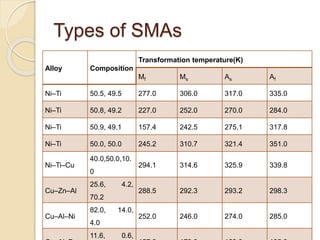
Types of SMAs
Alloy Composition
Transformation temperature(K)
Mf Ms As Af
Ni–Ti 50.5, 49.5 277.0 306.0 317.0 335.0
Ni–Ti 50.8, 49.2 227.0 252.0 270.0 284.0
Ni–Ti 50.9, 49.1 157.4 242.5 275.1 317.8
Ni–Ti 50.0, 50.0 245.2 310.7 321.4 351.0
Ni–Ti–Cu
40.0,50.0,10.
0
294.1 314.6 325.9 339.8
Cu–Zn–Al
25.6, 4.2,
70.2
288.5 292.3 293.2 298.3
Cu–Al–Ni
82.0, 14.0,
4.0
252.0 246.0 274.0 285.0
11.6, 0.6,
Properties
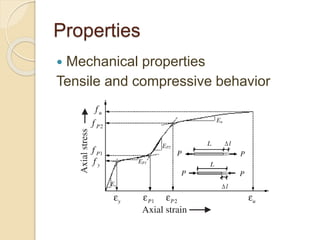
 Mechanical properties
Tensile and compressive behavior
Properties….
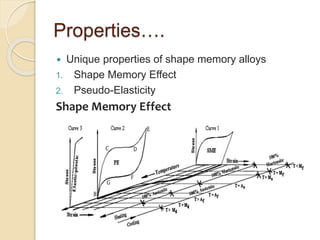
 Unique properties of shape memory alloys
1. Shape Memory Effect
2. Pseudo-Elasticity
Shape Memory Effect
Properties….
 Austenite and Martensite – Two phases
exhibited by SMA’s in solid state.
 If deformed in martensite phase, the
parent shape is regained upon heating.
 As and Af are the temperatures at which
transformation from martensite to
austenite starts and finishes.
 Transition dependant on temperature and
stress.
 Repeated use of shape memory effect
leads to functional fatigue.
Properties….
 Pseudo-Elasticity
o Occurs without temperature change.
o Based on stress induced mechanism
o This property allows the SMA’s to bear large
amounts of stress without undergoing permanent
deformation.
Working principle
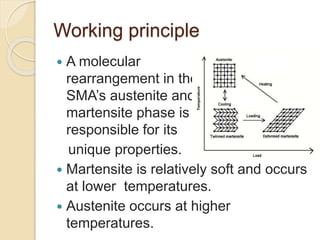
 A molecular
rearrangement in the
SMA’s austenite and
martensite phase is
responsible for its
unique properties.
 Martensite is relatively soft and occurs
at lower temperatures.
 Austenite occurs at higher
temperatures.
Working principle…..
 The shape of austenite structure is cubic.
 No change in size or shape is visible in
shape memory alloys until the Martensite
is deformed.
 To fix the parent shape, the metal must
be held in position and heated to about
500°C.
 The high temperature causes the atoms
to arrange themselves into the most
compact and regular pattern possible
resulting in a rigid cubic arrangement
(austenite phase).
Applications
 General applications
• Eyeglass Frames
• Helicopter blades
• Dental wires
 Applications in civil engineering/
structure
1. Reinforcement
 SMA’s are particularly beneficial for
construction in seismic regions.
 If SMA is used as reinforcement, it will yield
when subjected to high seismic loads but
will not retain significant permanent
deformations.
Applications….
2. Prestressing
 The benefits of employing SMAs in
prestressing include:
i. No involvement of jacking or strand-cutting
ii. No elastic shortening, friction, and
anchorage losses over time
 SMA strands are used in pre tensioning
and post tensioning.
Applications….
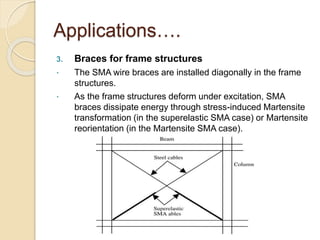
3. Braces for frame structures
 The SMA wire braces are installed diagonally in the frame
structures.
 As the frame structures deform under excitation, SMA
braces dissipate energy through stress-induced Martensite
transformation (in the superelastic SMA case) or Martensite
reorientation (in the Martensite SMA case).
Applications….
4. Damping element for
Bridges(restrainer)
 One of the main problems of bridges
during earthquakes is their unseating
because of excessive relative hinge
opening and displacement
 These limitations can be overcome
by introducing SMA restrainers as
they have larger elastic strain range
and can be brought back to its
original position even after
deformation.
Applications….
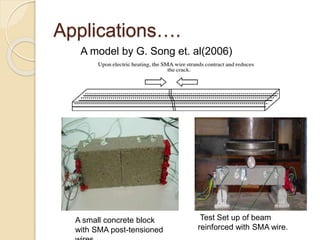
5. SMA for structural self-Rehabilitation
 The IRC(Intelligent Reinforced Concrete ) uses
stranded Martensite SMA wires for post-
tensioning .
 By monitoring the electric resistance change of
the SMA wires, the strain distribution inside the
concrete can be obtained. In the presence of
cracks due to explosions or earthquakes, by
electrically heating the SMA wires, the wire
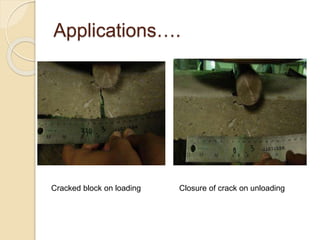
strands contracts and reduce the cracks.
 This self-rehabilitation can handle macro-sized
cracks.
 The concrete structure is intelligent since it has
the ability to sense and the ability to self-
Applications….
A small concrete block
with SMA post-tensioned
Test Set up of beam
reinforced with SMA wire.
A model by G. Song et. al(2006)
Applications….
Cracked block on loading Closure of crack on unloading
Applications….
6. SMA as FRP
 SMA-FRP reinforcing bars behave in a ductile manner and are
capable of dissipating energy.
 It was found that SMA-FRP bars have more potential to
improve the ductility and energy dissipation capability of
concrete structures compared to conventional FRP bars.
7. SMA as fibers
 The most crucial limitation of concrete is its low tensile
strength, compared to its compressive strength, which results
from the propagation of micro-cracks.
 This may be prevented by using prestrained SMA wires that
are embedded in the concrete matrix.
 Upon activation, these wires regain their original shape, and
consequently, initial compressive stresses are transmitted to
the concrete matrix.
Advantages
 Bio-compatibility
 Diverse Fields of Application
 Good Mechanical Properties (strong, corrosion
resistant)
Disadvantages
 These alloys are still relatively expensive to
manufacture and machine compared to other
materials such as steel and aluminum.
 Most SMA's have poor fatigue properties; this
means that while under the same loading
conditions (i.e. twisting, bending, compressing) a
steel component may survive for more than one
hundred times more cycles than an SMA
element.
Case study
1. Retrofitting Of the Basilica of San
Francesco at Assisi, Italy
 The Basilica of San Francesco was restored after being strongly
damaged by an earthquake of 1997 Umbria-March earthquake
(Castellano 2000).
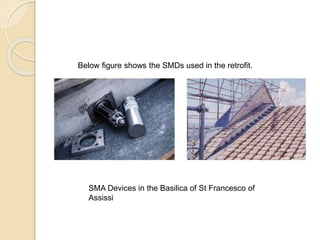
 The gable was completely disconnected from the roof and was then
linked to the roof again by means of Shape Memory Alloy Devices
(SMAD’s). Each SMAD is designed to take both tension and
compression forces, while consisting of SMA wires which are only
subjected to tension.
 In order to reduce the seismic forces transferred to the tympanum, a
connection between it and the roof was created using superelastic
SMAs
 The SMA device demonstrates different structural properties for
different horizontal forces. Under extremely intense horizontal loads,
the SMA stiffness increases to prevent collapse.
SMA Devices in the Basilica of St Francesco of
Assissi
Below figure shows the SMDs used in the retrofit.
Case study
2. Retrofitting of the bell tower of the Church
of San Giorgio at Trignano, Italy
 The S. Giorgio Church, located in Trignano,
Italy, was struck by a 4.8 Richter magnitude
earthquake on October 15, 1996, resulting in
significant damage to the bell tower within the
church.
 Following the earthquake, the tower was
rehabilitated using SMAs.
 The upgrade was carried out linking top and
bottom of the tower by means of hybrid
tendons.
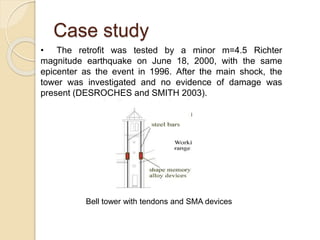
 Four vertical prestressing steel tie bars with
SMA devices were placed in the internal
corners of the bell tower to increase the flexural
resistance of the structure.
Case study
• The retrofit was tested by a minor m=4.5 Richter
magnitude earthquake on June 18, 2000, with the same
epicenter as the event in 1996. After the main shock, the
tower was investigated and no evidence of damage was
present (DESROCHES and SMITH 2003).
Bell tower with tendons and SMA devices
Conclusion
 SMA’s have the potential to be used
effectively in seismic regions.
 The high cost of SMAs is a major limiting
factor for its wider use in the construction
industry.
 Their capability to allow the development of
smart structures with active control of
strength and stiffness and ability of self-
healing and self-repairing opens the door for
exciting opportunities, making them the
construction material of the future.
 THANK YOU……….

SMA presentation

  • 1.
    Veermata Jijabai Technological InstituteMumbai Shape Memory Alloys and it’s Applications in Civil Engineering Seminar on Under The Guidance of Dr. Priyanka Jadhav By Pankaj Dhangare M. Tech I(Structural) Roll No-142040013
  • 2.
    Content Introduction History Literature reviews Types ofSMAs Properties Working principle Applications Case study Conclusion
  • 3.
    Introduction  SMAs arethe Materials which have the ability to return to a predetermined shape when heated or cooled.  When it is heated above its transformation temperature it undergoes a change in crystal structure which causes it to return to its original shape.  The most common shape memory material is an alloy of nickel and titanium called Nitinol  This particular alloy has very good electrical and mechanical properties, long fatigue life, and high corrosion resistance
  • 4.
    History  1932: Changand Read recorded the first observation of the shape memory transforation.  1938: Greninger and Mooradian observed the formation and disappearance of martensitic phase by varying the temperature of a Cu-Zn alloy.  1951: Shape memory effect was observed  1962-63: Ni-Ti alloys were first developed by the United States Naval Ordnance Laboratory.  Mid-1990s – Memory metals start to become widespread in medicine and soon move to
  • 5.
    Literature reviews  "Applicationsof Shape Memory Alloys in Civil Engineering Structures - Overview, Limits and New Ideas” by JANKE, L., et al.(2005). "Materials and Structures” 38(June 2005): 578-592.  A basic description of SMA highly non-linear material behaviour in terms of shape memory effect and superelasticity.  It is followed by a brief introduction to Ni-Ti and Fe-Mn-Si SMAs.  Pre-existing and new applications in the fields of damping, active vibration control and prestressing or posttensioning of structures with fibres and tendons are being reviewed with regard to civil engineering.  New ideas for using SMAs in civil engineering structures are proposed such as an improved concept for the active confinement of concrete members.
  • 6.
    Literature reviews….  “Applicationsof Shape Memory Alloys in Civil Structures” by Song, G., Ma, N., and Li, H.-N. (2006)., Engineering Structures, 28, 1266-1274.  The shape memory effect (SME) and pseudoelasticity, two major properties of SMA associated with the thermal-induced or stress-induced reversible hysteretic phase transformation between austenite and martensite are reviewed.  These unique properties enable SMA to be used as actuators, energy dissipaters and dampers for civil structure control.  Various applications in civil structures.
  • 7.
    Literature reviews….  “APPLICATIONOF SMART MATERIALS IN CIVIL ENGINEERING STRUCTURES,” by T.S. Thandavamoorthy(2013) , Research in Civil Engineering Structures-05 251-263.  He described the characteristics of smart materials, the use of SMA in construction and research, and their beneficial aspects by reviewing the available information.  He considered Shape Memory Alloy as SMART MATERIAL or INTELLIGENT MATERIAL.
  • 8.
    Types of SMAs AlloyComposition Transformation temperature(K) Mf Ms As Af Ni–Ti 50.5, 49.5 277.0 306.0 317.0 335.0 Ni–Ti 50.8, 49.2 227.0 252.0 270.0 284.0 Ni–Ti 50.9, 49.1 157.4 242.5 275.1 317.8 Ni–Ti 50.0, 50.0 245.2 310.7 321.4 351.0 Ni–Ti–Cu 40.0,50.0,10. 0 294.1 314.6 325.9 339.8 Cu–Zn–Al 25.6, 4.2, 70.2 288.5 292.3 293.2 298.3 Cu–Al–Ni 82.0, 14.0, 4.0 252.0 246.0 274.0 285.0 11.6, 0.6,
  • 9.
  • 10.
    Properties….  Unique propertiesof shape memory alloys 1. Shape Memory Effect 2. Pseudo-Elasticity Shape Memory Effect
  • 11.
    Properties….  Austenite andMartensite – Two phases exhibited by SMA’s in solid state.  If deformed in martensite phase, the parent shape is regained upon heating.  As and Af are the temperatures at which transformation from martensite to austenite starts and finishes.  Transition dependant on temperature and stress.  Repeated use of shape memory effect leads to functional fatigue.
  • 12.
    Properties….  Pseudo-Elasticity o Occurswithout temperature change. o Based on stress induced mechanism o This property allows the SMA’s to bear large amounts of stress without undergoing permanent deformation.
  • 13.
    Working principle  Amolecular rearrangement in the SMA’s austenite and martensite phase is responsible for its unique properties.  Martensite is relatively soft and occurs at lower temperatures.  Austenite occurs at higher temperatures.
  • 14.
    Working principle…..  Theshape of austenite structure is cubic.  No change in size or shape is visible in shape memory alloys until the Martensite is deformed.  To fix the parent shape, the metal must be held in position and heated to about 500°C.  The high temperature causes the atoms to arrange themselves into the most compact and regular pattern possible resulting in a rigid cubic arrangement (austenite phase).
  • 15.
    Applications  General applications •Eyeglass Frames • Helicopter blades • Dental wires  Applications in civil engineering/ structure 1. Reinforcement  SMA’s are particularly beneficial for construction in seismic regions.  If SMA is used as reinforcement, it will yield when subjected to high seismic loads but will not retain significant permanent deformations.
  • 16.
    Applications…. 2. Prestressing  Thebenefits of employing SMAs in prestressing include: i. No involvement of jacking or strand-cutting ii. No elastic shortening, friction, and anchorage losses over time  SMA strands are used in pre tensioning and post tensioning.
  • 17.
    Applications…. 3. Braces forframe structures  The SMA wire braces are installed diagonally in the frame structures.  As the frame structures deform under excitation, SMA braces dissipate energy through stress-induced Martensite transformation (in the superelastic SMA case) or Martensite reorientation (in the Martensite SMA case).
  • 18.
    Applications…. 4. Damping elementfor Bridges(restrainer)  One of the main problems of bridges during earthquakes is their unseating because of excessive relative hinge opening and displacement  These limitations can be overcome by introducing SMA restrainers as they have larger elastic strain range and can be brought back to its original position even after deformation.
  • 19.
    Applications…. 5. SMA forstructural self-Rehabilitation  The IRC(Intelligent Reinforced Concrete ) uses stranded Martensite SMA wires for post- tensioning .  By monitoring the electric resistance change of the SMA wires, the strain distribution inside the concrete can be obtained. In the presence of cracks due to explosions or earthquakes, by electrically heating the SMA wires, the wire strands contracts and reduce the cracks.  This self-rehabilitation can handle macro-sized cracks.  The concrete structure is intelligent since it has the ability to sense and the ability to self-
  • 20.
    Applications…. A small concreteblock with SMA post-tensioned Test Set up of beam reinforced with SMA wire. A model by G. Song et. al(2006)
  • 21.
    Applications…. Cracked block onloading Closure of crack on unloading
  • 22.
    Applications…. 6. SMA asFRP  SMA-FRP reinforcing bars behave in a ductile manner and are capable of dissipating energy.  It was found that SMA-FRP bars have more potential to improve the ductility and energy dissipation capability of concrete structures compared to conventional FRP bars. 7. SMA as fibers  The most crucial limitation of concrete is its low tensile strength, compared to its compressive strength, which results from the propagation of micro-cracks.  This may be prevented by using prestrained SMA wires that are embedded in the concrete matrix.  Upon activation, these wires regain their original shape, and consequently, initial compressive stresses are transmitted to the concrete matrix.
  • 23.
    Advantages  Bio-compatibility  DiverseFields of Application  Good Mechanical Properties (strong, corrosion resistant) Disadvantages  These alloys are still relatively expensive to manufacture and machine compared to other materials such as steel and aluminum.  Most SMA's have poor fatigue properties; this means that while under the same loading conditions (i.e. twisting, bending, compressing) a steel component may survive for more than one hundred times more cycles than an SMA element.
  • 24.
    Case study 1. RetrofittingOf the Basilica of San Francesco at Assisi, Italy  The Basilica of San Francesco was restored after being strongly damaged by an earthquake of 1997 Umbria-March earthquake (Castellano 2000).  The gable was completely disconnected from the roof and was then linked to the roof again by means of Shape Memory Alloy Devices (SMAD’s). Each SMAD is designed to take both tension and compression forces, while consisting of SMA wires which are only subjected to tension.  In order to reduce the seismic forces transferred to the tympanum, a connection between it and the roof was created using superelastic SMAs  The SMA device demonstrates different structural properties for different horizontal forces. Under extremely intense horizontal loads, the SMA stiffness increases to prevent collapse.
  • 25.
    SMA Devices inthe Basilica of St Francesco of Assissi Below figure shows the SMDs used in the retrofit.
  • 26.
    Case study 2. Retrofittingof the bell tower of the Church of San Giorgio at Trignano, Italy  The S. Giorgio Church, located in Trignano, Italy, was struck by a 4.8 Richter magnitude earthquake on October 15, 1996, resulting in significant damage to the bell tower within the church.  Following the earthquake, the tower was rehabilitated using SMAs.  The upgrade was carried out linking top and bottom of the tower by means of hybrid tendons.  Four vertical prestressing steel tie bars with SMA devices were placed in the internal corners of the bell tower to increase the flexural resistance of the structure.
  • 27.
    Case study • Theretrofit was tested by a minor m=4.5 Richter magnitude earthquake on June 18, 2000, with the same epicenter as the event in 1996. After the main shock, the tower was investigated and no evidence of damage was present (DESROCHES and SMITH 2003). Bell tower with tendons and SMA devices
  • 28.
    Conclusion  SMA’s havethe potential to be used effectively in seismic regions.  The high cost of SMAs is a major limiting factor for its wider use in the construction industry.  Their capability to allow the development of smart structures with active control of strength and stiffness and ability of self- healing and self-repairing opens the door for exciting opportunities, making them the construction material of the future.
  • 29.