5S   BASIC  TRAININGWhat is 5S and why do we want to do it?
What is 5S and why do we want to do it?5S is short for: Sort, Set in Order, Shine, Standardize 		and Sustain5S represents 5 disciplines for maintaining a visual workplace (visual controls and information systems).These are foundational to Kaizen (continuous improvement) and a manufacturing strategy based "Lean Manufacturing" (waste removing) concepts.5S is one of the activities that will help ensure our company’s survival.
Document ControlUpdating and modifying work instructions.
ISO 9001(2000) StandardQuality Department Orientation Overview
Quality SpecialistOrientation ProcessWelcome!
Quality Specialist trainingDefect Tracking
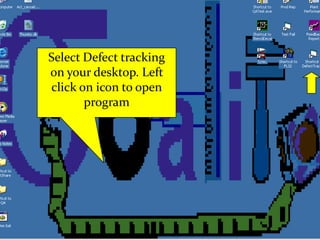
Select Defect tracking on your desktop. Left click on icon to open program
Team BuildingTeam Characteristics
Intro- How does a group form a Team?How teams differ from committees, councils, or work groups.The key characteristics or qualities of a team.
The difference between teams and groups.
Shared understanding and shared purpose, and why it's so important to teamwork.
Task vs. process, and why this is also important to teamwork.Team BuildingCommunication
Communication SkillsGood communication is critical to effective teamwork. Communicating is far more than talking and listening. It is sometimes a complex and puzzling process. However, effective communication is possible with the right approach, techniques and some practice.
Team BuildingDecision-Making
Making DecisionsList the various kinds of decision making. List the elements of consensus. Recognize when to use consensus, and when not to. List the criteria and resources required for consensus.
Team BuildingTeam Development
Intro- Team DevelopmentRecognize that teams mature over time and develop along commonly defined paths and milestones.
List the four stages of team development
Recognize that teams develop in unique ways, and they can move back and forth between one development stage and another. Team BuildingTeam Roles and Responsibilities
Team Roles and ResponsibilitiesList the fundamental roles required in a team. Recognize that team roles are specific and defined, but connected to one another as well. Determine some of the informal roles in teams. Recognize that not all roles are filled all the time. Respect and value the function and purpose of each team member.
Team BuildingTools and Techniques
Common ground rules and simple meeting techniques. Establish ground rules for effective meetings. Use various tools to collect ideas and information from team members. Distinguish the advantages and disadvantages of various meeting tools. Develop a road map for a meeting.
6 Step Problem – Solvingpart 1
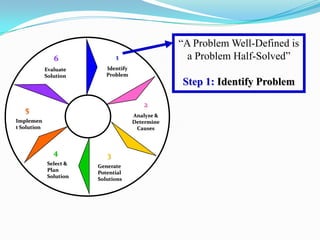
1Identify Problem     6Evaluate Solution2Analyze & Determine Causes     5Implement Solution4Select & Plan Solution3Generate Potential Solutions“A Problem Well-Defined is a Problem Half-Solved”Step 1:Identify Problem
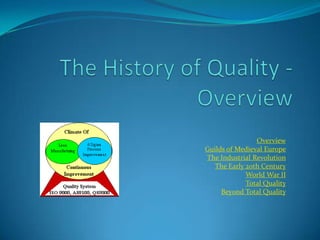
The History of Quality - OverviewOverviewGuilds of Medieval Europe The Industrial Revolution The Early 20th Century World War II Total Quality Beyond Total Quality
OverviewThe quality movement can trace its roots back to medieval Europe, where craftsmen began organizing into unions called guilds in the late 13th century. Until the early 19th century, manufacturing in the industrialized world tended to follow this craftsmanship model. The factory system, with its emphasis on product inspection, started in Great Britain in the mid-1750s and grew into the Industrial Revolution in the early 1800s.
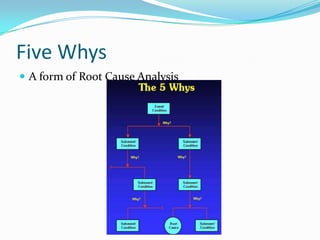
Five Whys A form of Root Cause Analysis
Cost of Quality (COQ)QA Specialist Reference
OverviewEvery time work is redone, the cost of quality increases. Obvious examples include: The reworking of a manufactured item. The retesting of an assembly. The rebuilding of a tool. The correction of a bank statement. The reworking of a service, such as the reprocessing of a loan operation or the replacement of a food order in a restaurant. In short, any cost that would not have been expended if quality were perfect contributes to the cost of quality.
PROJECT MANAGEMENT PRODUCTIVITY CHECKLISTQA Specialist Reference
Initial Project Fact Finding1. Write A List Of People Who Will Have Information You'll Need & The Types Of Information They're Likely ToPossess.2. Build Rapport With Them By Reflecting Their Preferred Communication Style.3. Prepare At Least One Open And One Closed Probe For Every Topic You Plan To Address.4. Gather Information until you’re sure about the Project's (a) Purpose, (b Outcome, (c) Value, (e PotentialProblems, (e) you’re Responsibility & Authority, (f) The Budget & (g) The Deadline.
Root Cause AnalysisQA Specialist Reference
InspirationsA Quality Department Collection
"Success under a good leader is the people's success." (attributed to Lao Tsu, aka Lao Zi, legendary Chinese Taoist philosopher, supposed to have lived between 600-400BC)
Developing SMART Goals for Your OrganizationTeam Building
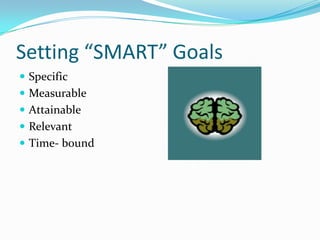
Setting “SMART” Goals SpecificMeasurableAttainableRelevantTime- bound
Role & ResponsibilityCharting (RACI)Quality Specialist Reference Guide
RESPONSIBLE…..”R”“The Doer”The “doer” is the individual(s) who actually complete the task. The “doer” Is responsible for action/implementation. Responsibility can be shared. The degree of responsibility is determined by the individual with the “A”.
ACCOUNTABLE…..”A”“The Buck Stops Here”The accountable person is the individual who is ultimately answerable for the activity or decision. This includes “yes” or “no” authority and veto power. Only one “A” can be assigned to an action.
CONSULT……”C”“In the Loop”The consult role is individual(s) (typically subject matter experts) to be consulted prior to a final decision or action. This is a predetermined need for two-way communication. Input from the designated position is required.
INFORM…..”I”“Keep in the Picture”This is individual (s) who needs to be informed after a decision or action is taken. They may be required to take action as a result of the outcome. It is a one-way communication.
Introduction to SPCQuality Specialist’s Reference guide
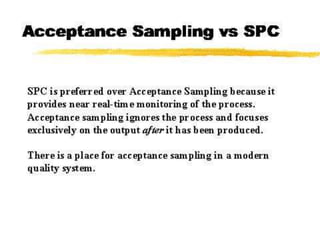
What is SPC? SPC stands for Statistical Process Control SPC does not refer to a particular technique, algorithm or procedure SPC is an optimization philosophy concerned with continuous process improvements, using a collection of (statistical) tools for data and process analysis making inferences about process behavior decision making SPC is a key component of Total Quality initiatives Ultimately, SPC seeks to maximize profit by improving product quality improving productivity streamlining process reducing wastage reducing emissions improving customer service, etc.
Sampling ProceduresInspection by AttributesQuality Specialist’s Reference
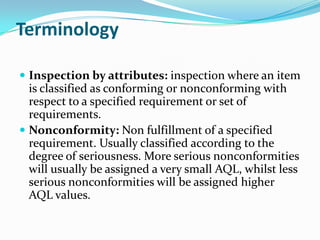
TerminologyInspection by attributes: inspection where an item is classified as conforming or nonconforming with respect to a specified requirement or set of requirements.Nonconformity: Non fulfillment of a specified requirement. Usually classified according to the degree of seriousness. More serious nonconformities will usually be assigned a very small AQL, whilst less serious nonconformities will be assigned higher AQL values.
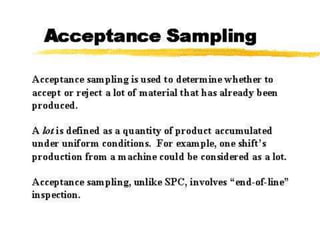
Acceptance SamplingQuality Specialist’s Reference Material
SCATTER DIAGRAMQuality Specialist’s reference guide

Quality Overview1.Ppt

  • 1.
    5S BASIC TRAININGWhat is 5S and why do we want to do it?
  • 2.
    What is 5Sand why do we want to do it?5S is short for: Sort, Set in Order, Shine, Standardize and Sustain5S represents 5 disciplines for maintaining a visual workplace (visual controls and information systems).These are foundational to Kaizen (continuous improvement) and a manufacturing strategy based "Lean Manufacturing" (waste removing) concepts.5S is one of the activities that will help ensure our company’s survival.
  • 3.
    Document ControlUpdating andmodifying work instructions.
  • 4.
    ISO 9001(2000) StandardQualityDepartment Orientation Overview
  • 5.
  • 6.
  • 7.
    Select Defect trackingon your desktop. Left click on icon to open program
  • 8.
  • 9.
    Intro- How doesa group form a Team?How teams differ from committees, councils, or work groups.The key characteristics or qualities of a team.
  • 10.
    The difference betweenteams and groups.
  • 11.
    Shared understanding andshared purpose, and why it's so important to teamwork.
  • 12.
    Task vs. process,and why this is also important to teamwork.Team BuildingCommunication
  • 13.
    Communication SkillsGood communicationis critical to effective teamwork. Communicating is far more than talking and listening. It is sometimes a complex and puzzling process. However, effective communication is possible with the right approach, techniques and some practice.
  • 14.
  • 15.
    Making DecisionsList thevarious kinds of decision making. List the elements of consensus. Recognize when to use consensus, and when not to. List the criteria and resources required for consensus.
  • 16.
  • 17.
    Intro- Team DevelopmentRecognizethat teams mature over time and develop along commonly defined paths and milestones.
  • 18.
    List the fourstages of team development
  • 19.
    Recognize that teamsdevelop in unique ways, and they can move back and forth between one development stage and another. Team BuildingTeam Roles and Responsibilities
  • 20.
    Team Roles andResponsibilitiesList the fundamental roles required in a team. Recognize that team roles are specific and defined, but connected to one another as well. Determine some of the informal roles in teams. Recognize that not all roles are filled all the time. Respect and value the function and purpose of each team member.
  • 21.
  • 22.
    Common ground rulesand simple meeting techniques. Establish ground rules for effective meetings. Use various tools to collect ideas and information from team members. Distinguish the advantages and disadvantages of various meeting tools. Develop a road map for a meeting.
  • 23.
    6 Step Problem– Solvingpart 1
  • 24.
    1Identify Problem 6Evaluate Solution2Analyze & Determine Causes 5Implement Solution4Select & Plan Solution3Generate Potential Solutions“A Problem Well-Defined is a Problem Half-Solved”Step 1:Identify Problem
  • 25.
    The History ofQuality - OverviewOverviewGuilds of Medieval Europe The Industrial Revolution The Early 20th Century World War II Total Quality Beyond Total Quality
  • 26.
    OverviewThe quality movementcan trace its roots back to medieval Europe, where craftsmen began organizing into unions called guilds in the late 13th century. Until the early 19th century, manufacturing in the industrialized world tended to follow this craftsmanship model. The factory system, with its emphasis on product inspection, started in Great Britain in the mid-1750s and grew into the Industrial Revolution in the early 1800s.
  • 27.
    Five Whys Aform of Root Cause Analysis
  • 28.
    Cost of Quality(COQ)QA Specialist Reference
  • 29.
    OverviewEvery time workis redone, the cost of quality increases. Obvious examples include: The reworking of a manufactured item. The retesting of an assembly. The rebuilding of a tool. The correction of a bank statement. The reworking of a service, such as the reprocessing of a loan operation or the replacement of a food order in a restaurant. In short, any cost that would not have been expended if quality were perfect contributes to the cost of quality.
  • 30.
    PROJECT MANAGEMENT PRODUCTIVITYCHECKLISTQA Specialist Reference
  • 31.
    Initial Project FactFinding1. Write A List Of People Who Will Have Information You'll Need & The Types Of Information They're Likely ToPossess.2. Build Rapport With Them By Reflecting Their Preferred Communication Style.3. Prepare At Least One Open And One Closed Probe For Every Topic You Plan To Address.4. Gather Information until you’re sure about the Project's (a) Purpose, (b Outcome, (c) Value, (e PotentialProblems, (e) you’re Responsibility & Authority, (f) The Budget & (g) The Deadline.
  • 32.
    Root Cause AnalysisQASpecialist Reference
  • 33.
  • 34.
    "Success under agood leader is the people's success." (attributed to Lao Tsu, aka Lao Zi, legendary Chinese Taoist philosopher, supposed to have lived between 600-400BC)
  • 35.
    Developing SMART Goalsfor Your OrganizationTeam Building
  • 36.
    Setting “SMART” GoalsSpecificMeasurableAttainableRelevantTime- bound
  • 37.
    Role & ResponsibilityCharting(RACI)Quality Specialist Reference Guide
  • 38.
    RESPONSIBLE…..”R”“The Doer”The “doer”is the individual(s) who actually complete the task. The “doer” Is responsible for action/implementation. Responsibility can be shared. The degree of responsibility is determined by the individual with the “A”.
  • 39.
    ACCOUNTABLE…..”A”“The Buck StopsHere”The accountable person is the individual who is ultimately answerable for the activity or decision. This includes “yes” or “no” authority and veto power. Only one “A” can be assigned to an action.
  • 40.
    CONSULT……”C”“In the Loop”Theconsult role is individual(s) (typically subject matter experts) to be consulted prior to a final decision or action. This is a predetermined need for two-way communication. Input from the designated position is required.
  • 41.
    INFORM…..”I”“Keep in thePicture”This is individual (s) who needs to be informed after a decision or action is taken. They may be required to take action as a result of the outcome. It is a one-way communication.
  • 42.
    Introduction to SPCQualitySpecialist’s Reference guide
  • 43.
    What is SPC?SPC stands for Statistical Process Control SPC does not refer to a particular technique, algorithm or procedure SPC is an optimization philosophy concerned with continuous process improvements, using a collection of (statistical) tools for data and process analysis making inferences about process behavior decision making SPC is a key component of Total Quality initiatives Ultimately, SPC seeks to maximize profit by improving product quality improving productivity streamlining process reducing wastage reducing emissions improving customer service, etc.
  • 44.
    Sampling ProceduresInspection byAttributesQuality Specialist’s Reference
  • 45.
    TerminologyInspection by attributes:inspection where an item is classified as conforming or nonconforming with respect to a specified requirement or set of requirements.Nonconformity: Non fulfillment of a specified requirement. Usually classified according to the degree of seriousness. More serious nonconformities will usually be assigned a very small AQL, whilst less serious nonconformities will be assigned higher AQL values.
  • 46.
  • 49.