Housekeeping and
Material Storage in the
Workplace
DAVID BEAVERS
GATEWAY COMMUNITY COLLEGE
What is housekeeping?
•Merriam-Webster defines housekeeping as “the care and
management of property and the provision of equipment
and services; the routine tasks that must be done in
order for a system to function or to function efficiently.”
•Housekeeping requirements fall under 29 CFR 1910.22.
•It is applicable to all places of employment, work sites,
and the home.
•Essentially, housekeeping can be easily explained as
keeping a worksite clean!
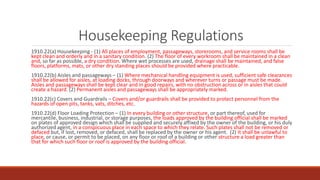
Housekeeping Regulations
1910.22(a) Housekeeping - (1) All places of employment, passageways, storerooms, and service rooms shall be
kept clean and orderly and in a sanitary condition. (2) The floor of every workroom shall be maintained in a clean
and, so far as possible, a dry condition. Where wet processes are used, drainage shall be maintained, and false
floors, platforms, mats, or other dry standing places should be provided where practicable.
1910.22(b) Aisles and passageways – (1) Where mechanical handling equipment is used, sufficient safe clearances
shall be allowed for aisles, at loading docks, through doorways and wherever turns or passage must be made.
Aisles and passageways shall be kept clear and in good repairs, with no obstruction across or in aisles that could
create a hazard. (2) Permanent aisles and passageways shall be appropriately marked.
1910.22(c) Covers and Guardrails – Covers and/or guardrails shall be provided to protect personnel from the
hazards of open pits, tanks, vats, ditches, etc.
1910.22(d) Floor Loading Protection – (1) In every building or other structure, or part thereof, used for
mercantile, business, industrial, or storage purposes, the loads approved by the building official shall be marked
on plates of approved design which shall be supplied and securely affixed by the owner of the building, or his duly
authorized agent, in a conspicuous place in each space to which they relate. Such plates shall not be removed or
defaced but, if lost, removed, or defaced, shall be replaced by the owner or his agent. (2) It shall be unlawful to
place, or cause, or permit to be placed, on any floor or roof of a building or other structure a load greater than
that for which such floor or roof is approved by the building official.
What is material storage?
•Material storage goes hand-in-hand with
housekeeping, and falls underneath 29 CFR
1910.176, “Material Handling and Storage”.
•Material storage is the proper and safe
storage of materials. This can apply to a
wide variety of things, such as products,
equipment, tools, lumber, and so on.
•1910.176(b) covers secure storage and
requires that “Storage of material shall not
create a hazard. Bags, containers, bundles,
etc., stored in tiers shall be stacked, blocked,
interlocked and limited in height so that
they are stable and secure against sliding or
collapse.”
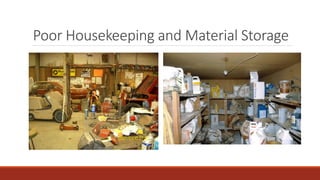
Poor Housekeeping and Material Storage
Potential and Real Costs of Poor
Housekeeping and Material Storage
Workers Compensation Payouts due to injuries caused by slips, trips, and falls
Higher insurance premiums
Poor employee health
Lost production time due to employees being away from work
Costs to retrain employees in proper guidelines
Slower production rates caused by employees having to be assigned modified/restricted duties
Falling objects causing damage to equipment, materials, or injuring employees due to unsafe
storage
Higher material losses in events such as fires
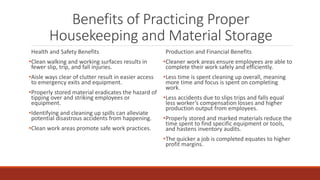
Benefits of Practicing Proper
Housekeeping and Material Storage
Health and Safety Benefits
•Clean walking and working surfaces results in
fewer slip, trip, and fall injuries.
•Aisle ways clear of clutter result in easier access
to emergency exits and equipment.
•Properly stored material eradicates the hazard of
tipping over and striking employees or
equipment.
•Identifying and cleaning up spills can alleviate
potential disastrous accidents from happening.
•Clean work areas promote safe work practices.
Production and Financial Benefits
•Cleaner work areas ensure employees are able to
complete their work safely and efficiently.
•Less time is spent cleaning up overall, meaning
more time and focus is spent on completing
work.
•Less accidents due to slips trips and falls equal
less worker’s compensation losses and higher
production output from employees.
•Properly stored and marked materials reduce the
time spent to find specific equipment or tools,
and hastens inventory audits.
•The quicker a job is completed equates to higher
profit margins.
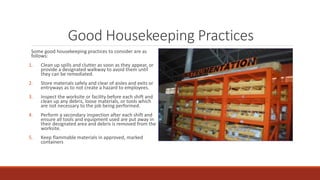
Good Housekeeping Practices
Some good housekeeping practices to consider are as
follows:
1. Clean up spills and clutter as soon as they appear, or
provide a designated walkway to avoid them until
they can be remediated.
2. Store materials safely and clear of aisles and exits or
entryways as to not create a hazard to employees.
3. Inspect the worksite or facility before each shift and
clean up any debris, loose materials, or tools which
are not necessary to the job being performed.
4. Perform a secondary inspection after each shift and
ensure all tools and equipment used are put away in
their designated area and debris is removed from the
worksite.
5. Keep flammable materials in approved, marked
containers
BEFORE AFTER
BEFORE AFTER
Inspection Sheet
5S of Housekeeping and Material Storage:
•SORT
•SET IN ORDER
•SHINE
•STANDARDIZE
•SUSTAIN
5S Inspection Checklist
Inspection Area
Department
Date
Inspection Completed By:
1S Sort Y / N Remarks
Only necessary items are in immediate work area
____
Trash is removed from work area and in correct bin
____
No items are left unattended
____
All tools, materials, and chemicals are properly
organized ____
2S Set In Order
Items are arranged in a tidy manner
____
Layout follows logical material flow pattern
____
Area layout is organized using ergonomic principals
____
Visual guides are easy to understand & follow (e.g.
floor marks) ____
3S Shine
Materials and equipment are free of contaminants
____
Tools, machinery and equipment are in good
condition ____
The work area is generally clean
____
4S Standardize
Standard labels and all items are in their specified
location ____
Records are updated, accurate and completely
labelled ____
Materials are organized
____
Materials are able to be retrieved quickly
____
5S Sustain
Employees adhere to company policy
____
No accident/incident reported due to negligence
____
Corrective / Preventive actions address previous
inspection ____
Signature: ___________________________________________ Date: ____________________________
References
OSHA 29 Code of Federal Regulations 1910.22, “Walking-Working Surfaces – General
Requirements”
OSHA 29 Code of Federal Regulations 1910.176, “Materials Handling and Storage – Handling
Materials – General”
OSHA Shipyard Employment eTool – Good Housekeeping
Miriam-Webster’s Dictionary, 2014 Edition
Aboitiz Power Company Before/After Pictures used with permission

OSH106AA Final Presentation - Housekeeping

  • 1.
    Housekeeping and Material Storagein the Workplace DAVID BEAVERS GATEWAY COMMUNITY COLLEGE
  • 2.
    What is housekeeping? •Merriam-Websterdefines housekeeping as “the care and management of property and the provision of equipment and services; the routine tasks that must be done in order for a system to function or to function efficiently.” •Housekeeping requirements fall under 29 CFR 1910.22. •It is applicable to all places of employment, work sites, and the home. •Essentially, housekeeping can be easily explained as keeping a worksite clean!
  • 3.
    Housekeeping Regulations 1910.22(a) Housekeeping- (1) All places of employment, passageways, storerooms, and service rooms shall be kept clean and orderly and in a sanitary condition. (2) The floor of every workroom shall be maintained in a clean and, so far as possible, a dry condition. Where wet processes are used, drainage shall be maintained, and false floors, platforms, mats, or other dry standing places should be provided where practicable. 1910.22(b) Aisles and passageways – (1) Where mechanical handling equipment is used, sufficient safe clearances shall be allowed for aisles, at loading docks, through doorways and wherever turns or passage must be made. Aisles and passageways shall be kept clear and in good repairs, with no obstruction across or in aisles that could create a hazard. (2) Permanent aisles and passageways shall be appropriately marked. 1910.22(c) Covers and Guardrails – Covers and/or guardrails shall be provided to protect personnel from the hazards of open pits, tanks, vats, ditches, etc. 1910.22(d) Floor Loading Protection – (1) In every building or other structure, or part thereof, used for mercantile, business, industrial, or storage purposes, the loads approved by the building official shall be marked on plates of approved design which shall be supplied and securely affixed by the owner of the building, or his duly authorized agent, in a conspicuous place in each space to which they relate. Such plates shall not be removed or defaced but, if lost, removed, or defaced, shall be replaced by the owner or his agent. (2) It shall be unlawful to place, or cause, or permit to be placed, on any floor or roof of a building or other structure a load greater than that for which such floor or roof is approved by the building official.
  • 4.
    What is materialstorage? •Material storage goes hand-in-hand with housekeeping, and falls underneath 29 CFR 1910.176, “Material Handling and Storage”. •Material storage is the proper and safe storage of materials. This can apply to a wide variety of things, such as products, equipment, tools, lumber, and so on. •1910.176(b) covers secure storage and requires that “Storage of material shall not create a hazard. Bags, containers, bundles, etc., stored in tiers shall be stacked, blocked, interlocked and limited in height so that they are stable and secure against sliding or collapse.”
  • 5.
    Poor Housekeeping andMaterial Storage
  • 6.
    Potential and RealCosts of Poor Housekeeping and Material Storage Workers Compensation Payouts due to injuries caused by slips, trips, and falls Higher insurance premiums Poor employee health Lost production time due to employees being away from work Costs to retrain employees in proper guidelines Slower production rates caused by employees having to be assigned modified/restricted duties Falling objects causing damage to equipment, materials, or injuring employees due to unsafe storage Higher material losses in events such as fires
  • 7.
    Benefits of PracticingProper Housekeeping and Material Storage Health and Safety Benefits •Clean walking and working surfaces results in fewer slip, trip, and fall injuries. •Aisle ways clear of clutter result in easier access to emergency exits and equipment. •Properly stored material eradicates the hazard of tipping over and striking employees or equipment. •Identifying and cleaning up spills can alleviate potential disastrous accidents from happening. •Clean work areas promote safe work practices. Production and Financial Benefits •Cleaner work areas ensure employees are able to complete their work safely and efficiently. •Less time is spent cleaning up overall, meaning more time and focus is spent on completing work. •Less accidents due to slips trips and falls equal less worker’s compensation losses and higher production output from employees. •Properly stored and marked materials reduce the time spent to find specific equipment or tools, and hastens inventory audits. •The quicker a job is completed equates to higher profit margins.
  • 8.
    Good Housekeeping Practices Somegood housekeeping practices to consider are as follows: 1. Clean up spills and clutter as soon as they appear, or provide a designated walkway to avoid them until they can be remediated. 2. Store materials safely and clear of aisles and exits or entryways as to not create a hazard to employees. 3. Inspect the worksite or facility before each shift and clean up any debris, loose materials, or tools which are not necessary to the job being performed. 4. Perform a secondary inspection after each shift and ensure all tools and equipment used are put away in their designated area and debris is removed from the worksite. 5. Keep flammable materials in approved, marked containers
  • 9.
  • 10.
  • 11.
    Inspection Sheet 5S ofHousekeeping and Material Storage: •SORT •SET IN ORDER •SHINE •STANDARDIZE •SUSTAIN 5S Inspection Checklist Inspection Area Department Date Inspection Completed By: 1S Sort Y / N Remarks Only necessary items are in immediate work area ____ Trash is removed from work area and in correct bin ____ No items are left unattended ____ All tools, materials, and chemicals are properly organized ____ 2S Set In Order Items are arranged in a tidy manner ____ Layout follows logical material flow pattern ____ Area layout is organized using ergonomic principals ____ Visual guides are easy to understand & follow (e.g. floor marks) ____ 3S Shine Materials and equipment are free of contaminants ____ Tools, machinery and equipment are in good condition ____ The work area is generally clean ____ 4S Standardize Standard labels and all items are in their specified location ____ Records are updated, accurate and completely labelled ____ Materials are organized ____ Materials are able to be retrieved quickly ____ 5S Sustain Employees adhere to company policy ____ No accident/incident reported due to negligence ____ Corrective / Preventive actions address previous inspection ____ Signature: ___________________________________________ Date: ____________________________
  • 12.
    References OSHA 29 Codeof Federal Regulations 1910.22, “Walking-Working Surfaces – General Requirements” OSHA 29 Code of Federal Regulations 1910.176, “Materials Handling and Storage – Handling Materials – General” OSHA Shipyard Employment eTool – Good Housekeeping Miriam-Webster’s Dictionary, 2014 Edition Aboitiz Power Company Before/After Pictures used with permission