Metals
Kalika Presents to you
What is aMetal?
• A metal is a material that is typically
hard, opaque, shiny, and has good
electrical and thermal conductivity.
Propertiesof Metals
• Physical state: Most of metals exists
as solids at room temperature except
mercury, gallium & cesium.
• Luster: Metals have the quality of
reflecting light from its surface and can
be polished e.g., gold, silver and
copper.
Why Metals Shine?
• Metallic solids and liquids share the
outer electrons freely. When light
shines on a lustrous metal, the loosely
bound electrons reflect incoming light,
giving the metal a shiny appearance.
Propertiesof Metals
• Malleability: Metals have the ability to
withstand hammering and can be made
into thin sheets known as foils.
• Ductility: Metals can be drawn into wires.
• Hardness: All metals are hard except
sodium and potassium, which are soft and
can be cut with a knife.
Propertiesof Metals
• Conductivity: Metals are good
conductors. Silver and copper are the
two best conductors of heat and
electricity. Lead is the poorest
conductor of heat.
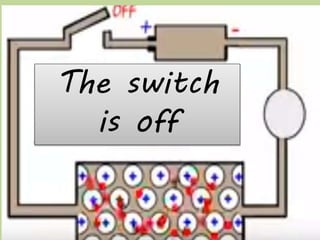
The switch
is off
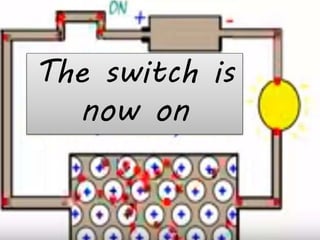
The switch is
now on
Whyare Metals GoodConductors?
• Metals are such good conductors of
heat and electricity all because the way
they are molecularly bonded.
• They contain free electrons(delocalized)
in their valence shell, these free
electrons move within structure of
metal when an electric current is
applied.
Propertiesof Metals
• Density: Metals have high density and are
very heavy. Iridium and osmium have the
highest densities where as lithium has the
lowest density.
• Melting and Boiling point: Metals have
high melting and boiling point. Tungsten
has the highest melting point where as
silver has low boiling point. Sodium and
potassium have low melting points.
Propertiesof Metals
• Sonority- Metal are sonorous, meaning
that metals have a unique ringing
sound if you strike them with
something hard.
• Tensile Strength- The ability of metal
to withstand a stretching force.

Metals

  • 1.
  • 2.
    What is aMetal? •A metal is a material that is typically hard, opaque, shiny, and has good electrical and thermal conductivity.
  • 4.
    Propertiesof Metals • Physicalstate: Most of metals exists as solids at room temperature except mercury, gallium & cesium. • Luster: Metals have the quality of reflecting light from its surface and can be polished e.g., gold, silver and copper.
  • 5.
    Why Metals Shine? •Metallic solids and liquids share the outer electrons freely. When light shines on a lustrous metal, the loosely bound electrons reflect incoming light, giving the metal a shiny appearance.
  • 6.
    Propertiesof Metals • Malleability:Metals have the ability to withstand hammering and can be made into thin sheets known as foils. • Ductility: Metals can be drawn into wires. • Hardness: All metals are hard except sodium and potassium, which are soft and can be cut with a knife.
  • 7.
    Propertiesof Metals • Conductivity:Metals are good conductors. Silver and copper are the two best conductors of heat and electricity. Lead is the poorest conductor of heat.
  • 8.
  • 9.
  • 10.
    Whyare Metals GoodConductors? •Metals are such good conductors of heat and electricity all because the way they are molecularly bonded. • They contain free electrons(delocalized) in their valence shell, these free electrons move within structure of metal when an electric current is applied.
  • 11.
    Propertiesof Metals • Density:Metals have high density and are very heavy. Iridium and osmium have the highest densities where as lithium has the lowest density. • Melting and Boiling point: Metals have high melting and boiling point. Tungsten has the highest melting point where as silver has low boiling point. Sodium and potassium have low melting points.
  • 12.
    Propertiesof Metals • Sonority-Metal are sonorous, meaning that metals have a unique ringing sound if you strike them with something hard. • Tensile Strength- The ability of metal to withstand a stretching force.