Electricity is Atomic !


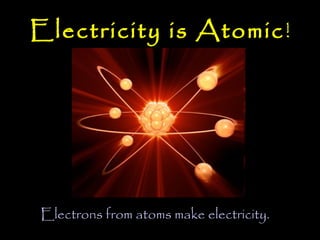
Electrons from atoms make electricity.
Electricity is Atomic !
• Normally, an electron stays near or “orbits”
  the nucleus of an atom.
• Electrons want to be as close to the nucleus
  as possible. Why?
• Rule of our universe: Opposite electric
  charges attract. Protons in nucleus are
  positive and electrons are negative.
• Why don’t electrons combine with protons?
Electricity is Atomic !
• Electrons are not really particles.
• Electrons are somewhat like waves.
  – Electrons can only exist at certain distances away
    from an atom’s nucleus (or waves disappear).
• Electrons repel each other.
• Electron locations depend on positive “pull”
  from protons in nucleus and negative “push”
  from other electrons.
Electricity is Atomic !
• Adding energy to an electron doesn’t make it
  move faster.
• Adding energy to an electron makes it move
  farther away from the nucleus.
• If enough energy is added, an electron can be
  removed from an atom completely.
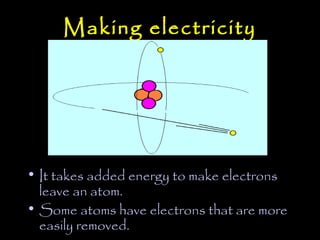
Making electricity


• It takes added energy to make electrons
  leave an atom.
• Some atoms have electrons that are more
  easily removed.
Electrons come in
           layers
• 1st layer can hold up to 2
• 2nd layer can hold up to 8
• 3rd layer can hold up to 18
• 4th layer can hold up to 18
• 5th layer can hold up to 32


• What is the most common conductor of
  electricity?
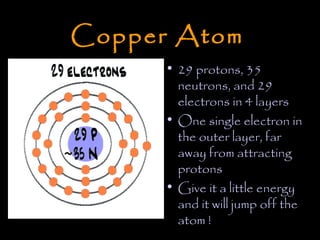
Copper Atom
      • 29 protons, 35
        neutrons, and 29
        electrons in 4 layers
      • One single electron in
        the outer layer, far
        away from attracting
        protons
      • Give it a little energy
        and it will jump off the
        atom !
Electrons come in
           layers
• A single outer (valence) electron is more easily
  removed from an atom
• The further away from the nucleus, the less
  the electron is attracted to the nucleus.
• The more layers of electrons repelling it, the
  more easily the electron can be removed from
  an atom.
• What is better than copper?
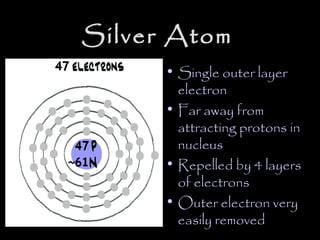
Silver Atom
      • Single outer layer
        electron
      • Far away from
        attracting protons in
        nucleus
      • Repelled by 4 layers
        of electrons
      • Outer electron very
        easily removed
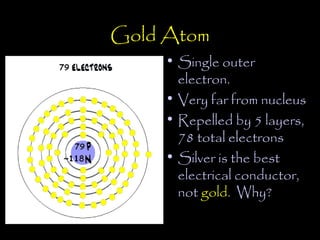
Gold Atom
     • Single outer
       electron.
     • Very far from nucleus
     • Repelled by 5 layers,
       78 total electrons
     • Silver is the best
       electrical conductor,
       not gold. Why?
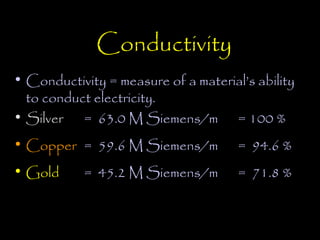
Conductivity
• Conductivity = measure of a material’s ability
  to conduct electricity.
• Silver = 63.0 M Siemens/m = 100 %
• Copper = 59.6 M Siemens/m           = 94.6 %
• Gold     = 45.2 M Siemens/m         = 71.8 %
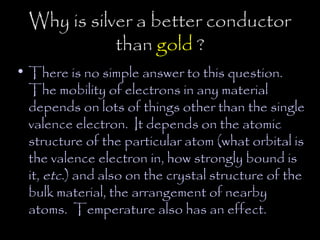
Why is silver a better conductor
             than gold ?
• There is no simple answer to this question.
  The mobility of electrons in any material
  depends on lots of things other than the single
  valence electron. It depends on the atomic
  structure of the particular atom (what orbital is
  the valence electron in, how strongly bound is
  it, etc.) and also on the crystal structure of the
  bulk material, the arrangement of nearby
  atoms. Temperature also has an effect.
Why copper instead of silver ?
• Copper is less expensive
  – $3.50/ lb vs. ~$300 / lb
• Copper is more abundant
  – 15 million tons/yr vs. ~18 thousand tons/yr
• Nearly as good a conductor (94.6% as good)
• Better conductor than gold (24.2 % better)
  – Gold plated on some electrical contacts because
    it doesn’t corrode
• Copper is ductile and malleable

Electricity is atomic

  • 1.
    Electricity is Atomic! Electrons from atoms make electricity.
  • 2.
    Electricity is Atomic! • Normally, an electron stays near or “orbits” the nucleus of an atom. • Electrons want to be as close to the nucleus as possible. Why? • Rule of our universe: Opposite electric charges attract. Protons in nucleus are positive and electrons are negative. • Why don’t electrons combine with protons?
  • 3.
    Electricity is Atomic! • Electrons are not really particles. • Electrons are somewhat like waves. – Electrons can only exist at certain distances away from an atom’s nucleus (or waves disappear). • Electrons repel each other. • Electron locations depend on positive “pull” from protons in nucleus and negative “push” from other electrons.
  • 4.
    Electricity is Atomic! • Adding energy to an electron doesn’t make it move faster. • Adding energy to an electron makes it move farther away from the nucleus. • If enough energy is added, an electron can be removed from an atom completely.
  • 5.
    Making electricity • Ittakes added energy to make electrons leave an atom. • Some atoms have electrons that are more easily removed.
  • 6.
    Electrons come in layers • 1st layer can hold up to 2 • 2nd layer can hold up to 8 • 3rd layer can hold up to 18 • 4th layer can hold up to 18 • 5th layer can hold up to 32 • What is the most common conductor of electricity?
  • 7.
    Copper Atom • 29 protons, 35 neutrons, and 29 electrons in 4 layers • One single electron in the outer layer, far away from attracting protons • Give it a little energy and it will jump off the atom !
  • 8.
    Electrons come in layers • A single outer (valence) electron is more easily removed from an atom • The further away from the nucleus, the less the electron is attracted to the nucleus. • The more layers of electrons repelling it, the more easily the electron can be removed from an atom. • What is better than copper?
  • 9.
    Silver Atom • Single outer layer electron • Far away from attracting protons in nucleus • Repelled by 4 layers of electrons • Outer electron very easily removed
  • 10.
    Gold Atom • Single outer electron. • Very far from nucleus • Repelled by 5 layers, 78 total electrons • Silver is the best electrical conductor, not gold. Why?
  • 11.
    Conductivity • Conductivity =measure of a material’s ability to conduct electricity. • Silver = 63.0 M Siemens/m = 100 % • Copper = 59.6 M Siemens/m = 94.6 % • Gold = 45.2 M Siemens/m = 71.8 %
  • 12.
    Why is silvera better conductor than gold ? • There is no simple answer to this question. The mobility of electrons in any material depends on lots of things other than the single valence electron. It depends on the atomic structure of the particular atom (what orbital is the valence electron in, how strongly bound is it, etc.) and also on the crystal structure of the bulk material, the arrangement of nearby atoms. Temperature also has an effect.
  • 13.
    Why copper insteadof silver ? • Copper is less expensive – $3.50/ lb vs. ~$300 / lb • Copper is more abundant – 15 million tons/yr vs. ~18 thousand tons/yr • Nearly as good a conductor (94.6% as good) • Better conductor than gold (24.2 % better) – Gold plated on some electrical contacts because it doesn’t corrode • Copper is ductile and malleable