What Is Electricity?
Electricity is a form of energy carried by the movement of electrons. An electron is a particle
that orbits the center of an atom. The electrons of some atoms, like those of copper and other
metals, are only loosely attached, which allows electricity to travel through these materials
easily. These types of materials are known as “conductors.”
Electricity is a form of energy that starts with atoms. Atoms are too small to see, but they make
up everything around us. All atoms are composed of subatomic particles among which are the
charged particles known as electrons and protons. Protons, which are found in the nucleus of an
atom, carry a positive charge (+), and electrons, which spin around the center of an atom, carry
a negative charge (-). Neutrons also exist in the nucleus of a typical atom and are uncharged.
Electricity is a form of energy that is associated with the buildup and movement of electrons and
protons. Electricity can be created by forcing electrons to flow from atom to atom. The force or
push of electricity is measured in volts.
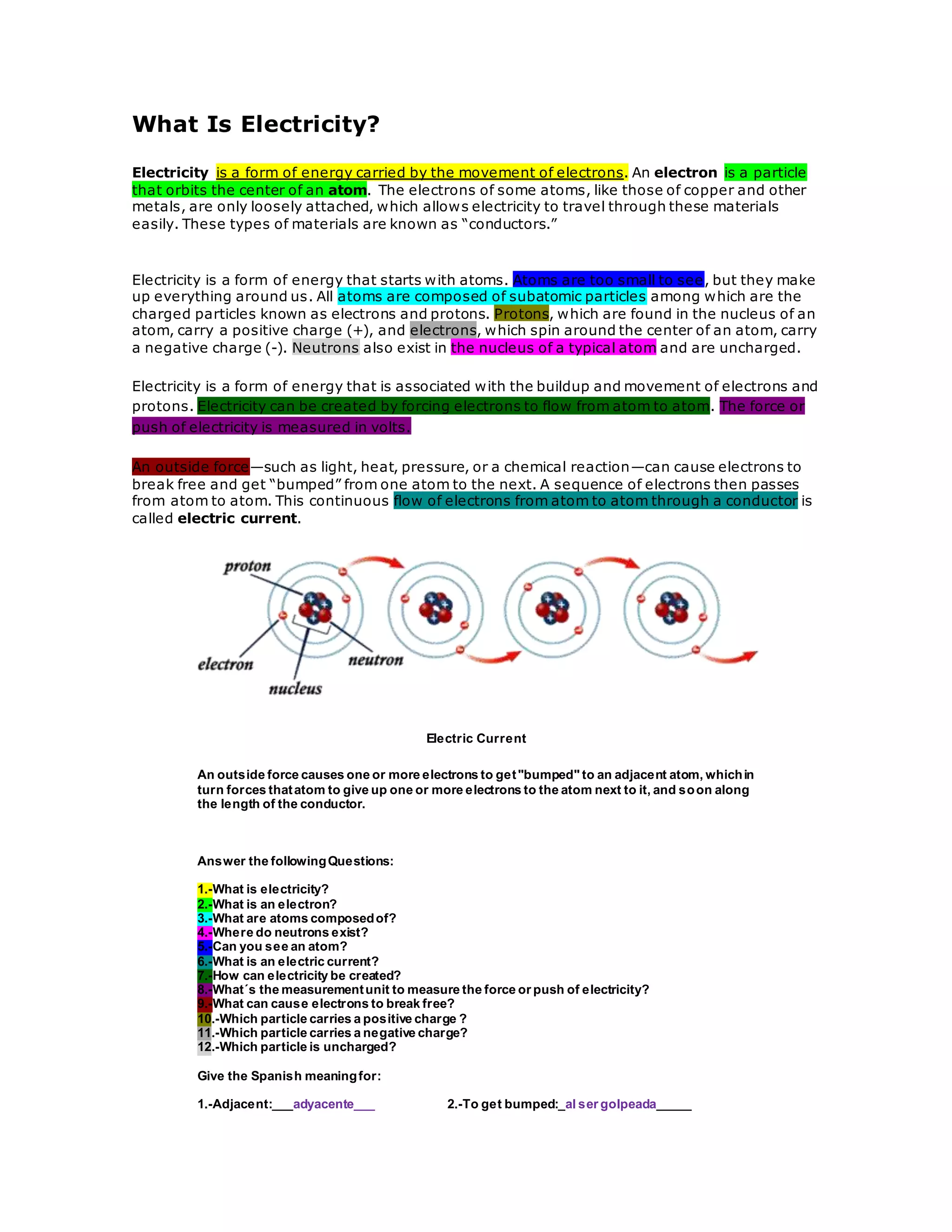
An outside force—such as light, heat, pressure, or a chemical reaction—can cause electrons to
break free and get “bumped” from one atom to the next. A sequence of electrons then passes
from atom to atom. This continuous flow of electrons from atom to atom through a conductor is
called electric current.
Electric Current
An outside force causes one or more electrons to get"bumped" to an adjacent atom, whichin
turn forces thatatom to give up one or more electrons to the atom next to it, and soon along
the length of the conductor.
Answer the followingQuestions:
1.-What is electricity?
2.-What is an electron?
3.-What are atoms composedof?
4.-Where do neutrons exist?
5.-Can you see an atom?
6.-What is an electric current?
7.-How can electricity be created?
8.-What´s the measurementunit to measure the force or push of electricity?
9.-What can cause electrons to break free?
10.-Which particle carries a positive charge ?
11.-Which particle carries a negative charge?
12.-Which particle is uncharged?
Give the Spanish meaningfor:
1.-Adjacent:___adyacente___ 2.-To get bumped:_al ser golpeada_____
3.-To carry:_transportar 4.-along:___a lo largo
5.-some:______algoo algunos 6.-copper:__cobre
7.-Charge:_____carga 8.-loosely:__flojamente
9.-Attached:____aderido 10.-make up:__conformar
11.-among:____entre 12.-known:__conocido
13.-found:____encontrado 14.-spin:___girar
15.-buildup:___compuesto 16.-to flow:__fluir
17.-from:___desde 18.-to break:__liberar
19.-through:___a traves 20.-current: corriente
Can you tell me
1.-What´s your name?
________________________________________________________________
2.-What´s your firstname?
_______________________________________________________________
3.-What´s your lastname?
_______________________________________________________________
4.-What´s your middle name?
_______________________________________________________________
5.-How old are you?
______________________________________________________________
6.-Are you single?
______________________________________________________________
7.-Are you a student?
______________________________________________________________
8.-What´s your IDnumber?
______________________________________________________________
9.-What´s your cell pone number?
_____________________________________________________________
10.-Are you married?
______________________________________________________________
11.-How are you?
_____________________________________________________________
12.-What´s your job?
___________________________________________________________
What is electricity

What is electricity

  • 1.
    What Is Electricity? Electricityis a form of energy carried by the movement of electrons. An electron is a particle that orbits the center of an atom. The electrons of some atoms, like those of copper and other metals, are only loosely attached, which allows electricity to travel through these materials easily. These types of materials are known as “conductors.” Electricity is a form of energy that starts with atoms. Atoms are too small to see, but they make up everything around us. All atoms are composed of subatomic particles among which are the charged particles known as electrons and protons. Protons, which are found in the nucleus of an atom, carry a positive charge (+), and electrons, which spin around the center of an atom, carry a negative charge (-). Neutrons also exist in the nucleus of a typical atom and are uncharged. Electricity is a form of energy that is associated with the buildup and movement of electrons and protons. Electricity can be created by forcing electrons to flow from atom to atom. The force or push of electricity is measured in volts. An outside force—such as light, heat, pressure, or a chemical reaction—can cause electrons to break free and get “bumped” from one atom to the next. A sequence of electrons then passes from atom to atom. This continuous flow of electrons from atom to atom through a conductor is called electric current. Electric Current An outside force causes one or more electrons to get"bumped" to an adjacent atom, whichin turn forces thatatom to give up one or more electrons to the atom next to it, and soon along the length of the conductor. Answer the followingQuestions: 1.-What is electricity? 2.-What is an electron? 3.-What are atoms composedof? 4.-Where do neutrons exist? 5.-Can you see an atom? 6.-What is an electric current? 7.-How can electricity be created? 8.-What´s the measurementunit to measure the force or push of electricity? 9.-What can cause electrons to break free? 10.-Which particle carries a positive charge ? 11.-Which particle carries a negative charge? 12.-Which particle is uncharged? Give the Spanish meaningfor: 1.-Adjacent:___adyacente___ 2.-To get bumped:_al ser golpeada_____
  • 2.
    3.-To carry:_transportar 4.-along:___alo largo 5.-some:______algoo algunos 6.-copper:__cobre 7.-Charge:_____carga 8.-loosely:__flojamente 9.-Attached:____aderido 10.-make up:__conformar 11.-among:____entre 12.-known:__conocido 13.-found:____encontrado 14.-spin:___girar 15.-buildup:___compuesto 16.-to flow:__fluir 17.-from:___desde 18.-to break:__liberar 19.-through:___a traves 20.-current: corriente Can you tell me 1.-What´s your name? ________________________________________________________________ 2.-What´s your firstname? _______________________________________________________________ 3.-What´s your lastname? _______________________________________________________________ 4.-What´s your middle name? _______________________________________________________________ 5.-How old are you? ______________________________________________________________ 6.-Are you single? ______________________________________________________________ 7.-Are you a student? ______________________________________________________________ 8.-What´s your IDnumber? ______________________________________________________________ 9.-What´s your cell pone number? _____________________________________________________________ 10.-Are you married? ______________________________________________________________ 11.-How are you? _____________________________________________________________ 12.-What´s your job? ___________________________________________________________