(B.PHARMACY) 5th Semester
Presented by
Ibrahim Mussa
Submitted to:
Ms . Mandeep Kaur
CONTENTS
 AUTACOID
 CLASSICAL AUTACOIDS
 HISTAMINE
 RECEPTORS: DISTRIBUTION AND FUNCTION
 PHARMACOLOGICAL ACTIONS
 SEROTONIN
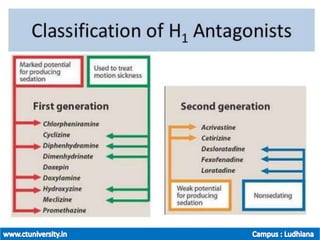
 H1 ANTAGONISTS
 PHARMACOLOGICAL ACTIONS OF SEROTONIN
 5-HT RECEPTORS
 5-HT RECEPTOR ANTAGONISTS
 Amine autacoids.
Histamine, 5-Hydroxytryp- tamine (Serotonin)
 Lipid derived autacoids
Prostaglandins, Leukotrienes, Platelet activating factor
 Peptide autacoids
Plasma kinins (Bradykinin, Kallidin), Angiotensin
This term is derived from Greek: autos—self, akos—
healing substance or remedy.
Histamine is an organic nitrogenous
compound involved in local immune
responses, as well as regulating physiological
function in the gut and acting as a
neurotransmitter for the brain, spinal cord,
and uterus. Histamine is involved in the
inflammatory response and has a central role
as a mediator of itching
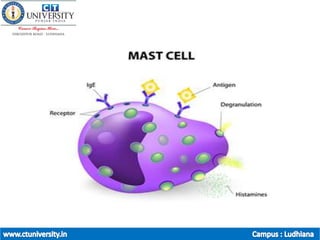
Present almost and stored in ;
• mast cell Tissues rice in histamine are skin gastric mucosa
and intestinal mucosa, lungs, liver and placenta.
• Non mast cell histamine occurs in brain , epidermis,
gastric mucosa and growing regions
• Also presents in body secretions, venoms and pathological
fluids
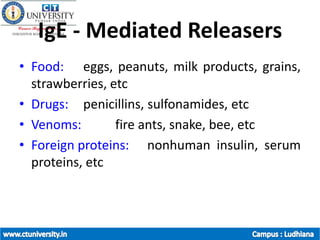
IgE - Mediated Releasers
• Food: eggs, peanuts, milk products, grains,
strawberries, etc
• Drugs: penicillins, sulfonamides, etc
• Venoms: fire ants, snake, bee, etc
• Foreign proteins: nonhuman insulin, serum
proteins, etc
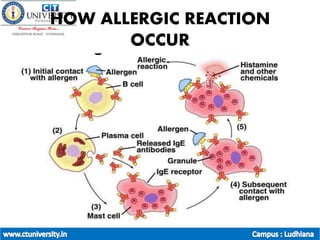
HOW ALLERGIC REACTION
OCCUR
H1 – Smooth muscle, endothelium, CNS.
Bronchoconstriction, vasodilation, separation of endothelial
cells, pain and itching, allergic rhinitis, motion sickness.
H2 – gastric parietal cell,
Regulate gastric acid secretion, vasodilation, inhibition of
IgE-dependent degranulation.
H3 - CNS cells, and some in peripheral NS. Presynaptic,
They also control release of DA, GABA, ACh, 5-HT & NE
H4 - Highly expressed in bone morrow and white blood
cells.
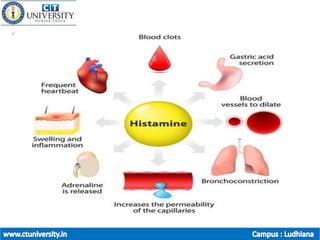
Blood vessels:
• Dilates arterioles, capillaries, venules ,
• IV injection- decreased BP
• Intradermal - Triple response
Red spot (dilatation)
Wheal (exudation of fluids)
Flare(Reflex arteriolar dilatation)
Heart
 H1 - decreased AV conduction
 H2 - increased chronotropy, decreased inotropy (speed
of contraction of muscles)
 H1, H2 - increased automaticity
Lung
 H1 – bronchoconstriction, increased mucus viscosity
 H2 - slight bronchodilation, increased mucus secretion
 H1 - stimulation of vagal sensory nerve endings: cough
Gastrointestinal System
 H2 - acid, fluid and pepsin secretion
 H1 - increased intestinal motility and secretions
Cutaneous Nerve Endings
 H1 - pain and itching
Glands
Histamine causes marked increase in gastric
secretion
PATHOPHYSIOLOGICAL ROLES
1. Gastric secretion
Non mast cell histamine occurs in gastric mucosa, possibly in cells
called ‘histaminocytes’ situated close to the parietal cells.
2. Allergic phenomena
Mediation of hyper- sensitivity reactions was the first role ascribed
to histamine.
3. As transmitter.
Histamine is believed to be the afferent transmitter which initiates
the sensation of itch and pain at sensory nerve endings.
4. Inflammation
Histamine is a mediator of vasodilatation and other changes that
occur during inflammation
Tissue growth and repair
Because growing and regenerating tissues
contain high concentrations of histamine,
H1 ANTAGONISTS
These drugs competitively antagonize actions
of histamine at the H1 receptors.
PHARMACOLOGICAL ACTIONS
1. Antagonism of histamine
They effectively block histamine induced
broncho constriction, contraction of intestinal
and other smooth muscle and triple
response—especially wheal, flare and itch
2. Anti-allergic action
Urticaria , itching and angioedema are well controlled.
Anaphylactic fall in BP is only partially prevented.
3. CNS
The older antihistamines produce variable degree of
CNS depression. This appears to depend on the
compound’s ability to penetrate
4. BP
Most anti-histaminics cause a fall in BP on i.v injection
5. Local anaesthetic
Some drugs like pheniramine, promethazine,
diphenhydramine have strong while others
have weak membrane stabilizing property.
However, they are not used clinically as local
anaesthetic because they cause irritation when
injected s.c.
SECOND GENERATION ANTIHISTAMINICS
Loratadine
Is a long-acting selective peripheral H1 antagonist
which lacks CNS depressant effects and is fast
acting.
Levocetirizine
is the active R(–) enantiomer of cetirizine. It is
effective at half the dose and appears to produce
less sedation and other side effects.
 Is an antihistamine, its principal effects are mediated via
selective inhibition of peripheral H1 receptors.
 Cetrizine is Used to relieve allergy symptoms such as
watery eyes, runny nose, itching eyes/nose, sneezing,
hives, and itching.
 It works by blocking a certain natural substance
(histamine) that your body makes during an allergic
reaction.
 It also have sedative effect. It may induce sleep
CETRIZINE
USES OF H1 ANTAGONIST
Pruritides
Allergic disorders
Common cold : cetrizine
Motion sickness: Promethzine
Vertigo: Cinnarizine
Cough : chlorpheniramine, diphenhydramine
sedative, hypnotic, anxiolytic
• Serotonin is a naturally occurring amine synthesized from the
tryptophan & commonly found in plants ,some fruits ,animal
tissues & insect venoms.
• In human being , it is found in enterochromaffin cells in of GIT
& CNS .
• Serotonin containing neurons are mainly found in, cortex,
hypothalamus , mid –brain, vomiting centre & spinal cord .
• These regulate sleep, body temperature & mood .
• A hormone melatonin is derived from serotonin .
PHARMACOLOGICAL ACTIONS
OF SEROTONIN
• Action on GIT
5-HT act as a local hormone & to regulate peristalsis movement.
• Action on CNS
It act as neurotransmitter in CNS
• Action on CVS
5-HT produces positive ionotropic EFFECT & chromotropic effect in
myocardium .
• Action on smooth muscles
5-HT constrict the smooth muscles of bronchia and GIT .
• Action on blood vessels
5-HT dilate the blood vessels of skeletal
muscles, coronary arteries & capillary of skin .
• Action on platelets
It enhance the aggregation of platelets &
haemostatis.
The 5-HT receptors are the receptors for
serotonin. They are located on the cell
membrane of nerve cells and other cell types
in animals, and mediate the effects of
serotonin as the endogenous ligand.
TYPES
5-HT1-receptors :occur mainly in CNS and some blood vessels
 Effects are neural inhibition and vasoconstriction.
 Act by inhibiting adenylate cyclase.
5-HT2-receptors : it occur in CNS and many peripheral sites
(especially blood vessels, platelets, autonomic neurons).
 it has Neuronal and smooth muscle effects are excitatory.
5-HT3 receptors: It occur in peripheral nervous system and in
CNS.
 Effects are excitatory, mediated via direct receptor-coupled ion
channel.
5-HT4-receptors, it occur mainly in the enteric
nervous system also in CNS.
Effects are excitatory, causing increased
gastrointestinal motility.
 Act by stimulating adenylate cyclase
PATHOPHYSIOLOGICAL ROLES
1. Neurotransmitter
2. Precursor of melatonin
3. Neuroendocrine functions
4. Nausea and vomiting
5. Migraine
6. Haemostasis
7. Hypertension
8. Intestinal motility
DRUGS AFFECTING 5-HT SYSTEM
 5-HT PRECURSORS:
Tryptophan increase brain 5-HT & produce behavioral effects.
 SYNTHESIS INHIBITORS
p-Chlorophenylalanin selectively inhibit tryptophan
hydroxylase & reduce 5-HT level in tissue .
 UPTAKE INHIBITORS
Tricyclic antidepressants inhibit 5-HT uptake along with NA
.Some like fluoxetine ,sertraline are selective serotonin
reuptake inhibitors.
 STORAGE INHIBITORS
Reserpine block 5-HT uptake into storage granules & cause
depletion of all cell monoamines .
DEGRADATION INHIBITORS
Non-selective MAO inhibitors: tranylcypromine
selective MAO –A inhibitors (chlorgyline)
increase 5-HT content by preventing its
degradation.
NEURONAL DEGENERATION
5,6-Dihydroxytryptamine selectively destroys
5-HT neurons .
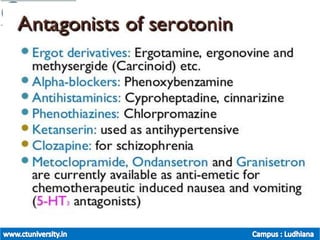
5-HT RECEPTOR ANTAGONISTS
• Cyproheptadine
• Methysergide
• Ketanserin
• Clozapine
• Risperidone
• Ondansetron
CYPROHEPTADINE
Cyproheptadine is an antihistamine used to
relieve allergy symptoms such as watery eyes,
runny nose, itching eyes/nose, sneezing, hives,
and itching. It works by blocking a certain natural
substance (histamine) that your body makes
during an allergic reaction
Side effects:
• drowsiness,
• dry mouth ,
• confusion.
METHYSERGIDE
• Antagonize action of 5-HT on smooth muscles including
that of blood
• Used for migraine prophylaxis
ONDANSETRON
• Selectively 5-HT3 Antagonist
• Remarkable efficacy in controlling nausea & vomiting
following administration of highly emetic anticancer drugs
& radiotherapy
KETANSERIN
Selective 5HT2 receptor blocking property with
action on 5HT1,5HT3 & 5HT4 receptors .
5HT induced vasoconstriction ,platelets
aggregation & contraction of airway smooth
muscles are antagonized but not contraction
of guinea pig ileum or rat stomach
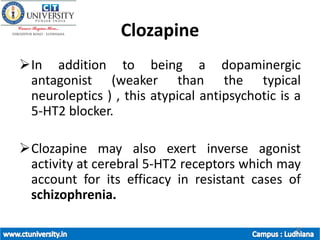
Clozapine
In addition to being a dopaminergic
antagonist (weaker than the typical
neuroleptics ) , this atypical antipsychotic is a
5-HT2 blocker.
Clozapine may also exert inverse agonist
activity at cerebral 5-HT2 receptors which may
account for its efficacy in resistant cases of
schizophrenia.
39
REFERENCE
• Goodman & Gilman’s “The Pharmacological basis of
Therapeutics” Eleventh Edition, 2001. Published By McGraw-
Hill Publishing Company.
• “Tripathi K D”; “Essential of Medical Pharmacology”; Fifth
edition 2003, Published by Jaypee Brothers .
pharmacology of Histamines , Serotonin and its antagonist