4th UNIT
ORAL CONTRACEPTIVES
Prepared by
G. Nikitha, M.Pharmacy
Assistant Professor
Department of Pharmaceutical Chemistry
Sree Dattha Institute Of Pharmacy
Hyderabad
1
Subject: Medicinal Chemistry-II
Year: B.Pharmacy 3rd Year
Semister: 1st Semister
Contents
 Introduction
 Types of oral contraceptives
 Mode of action
 Adverse effects and Uses
 Reference
2
Introduction
The advent of oral contraceptive pills has revolutionized the
method of contraception. They are also known as birth control pills.
They are composed of estrogen and progesterone or only
progesterone. Apart from being available over the counter other
advantage offered by them includes.
 Reliability
 Rapid reversal of fertility
 Reduced changes of developing premenstrual tension,
dysmenorrhoea, rheumatoid arthritis, haemolytic anaemia
 Reduced risk of pelvic inflammatory disease which is high with
IUCDs.
3
Types of oral contraceptives
1. Combination Pills
 These are the most common and safest method of contraception and
are 99-99.5% effective. They contained balanced formulation of
both oestrogen and progestins.
 The first pill is taken on 5th day of menstrual cycle and continued
till 21 days next 7 days are pill free period i.e no pills are taken on
those days. The next course starts on the 5th day of menses.
 Combination ills suppress the production of luteinizing hormone
(LH) and follicle stimulating hormone (FSH) by negative feedback
mechanism (feedback inhibition process).
4
 In the absence of LH and FSH ovulation is inhibited which is
similar to natural process occurring during pregnancy by the release
of oestrogen and progesterone from the ovaries and placenta. This
effect occurs mainly due to oestrogen.
 Progesterone ensures the withdrawal of bleeding after stopping the
medication. It also makes the cervical mucus thick by increasing the
viscosity and hence makes the sperm penetration difficult through
the cervix.
5
Combination pills are as follows:
a. Monophasic Combination Pills:
The name Monophasic is given to these combination pills as there is
no phasic increase or decrease in oestrogen and progestin content
during the time period of dosage i.e 21days.
b. Biphasic Combination Pills:
These pills on administration mimic the hormonal changes
occurring during the menstrual cycle. They contain fixed dose of
estrogen for about 21 days and the dose of progesterone is increased
for two successive periods.
 I period from day 1 to 10- Ethinyl oetradiol (35mg) and
norethindrone (0.5mg)
 II period from day 11 to 21- Ethinyl oetradiol (35mg) and
norethindrone (1.0mg)
 The remaining 7 days are pill free days.
6
c. Triphasic Combination Pills:
 These pills on administration mimic the hormonal changes
occurring during the menstrual cycle. They have higher dose of
oestrogen at mid cycle while progesterone doses are increase for
increased three successive phases.
 I period from day 1 to 06- Ethinyl oetradiol (30μg) and Norgetrel
(0.05mg)
 II period from day 7 to 11 - Ethinyl oetradiol (40μg) and Norgetrel
(0.075mg)
 III period from day 12 to 21- Ethinyl oetradiol (30μg) and Norgetrel
(0.125mg)
 The remaining 7 days are pill free days.
7
2. Progestin Pills/ Minipill:
 These pills are given to those individuals in whom oestrogen are
contraindicated. They contain small doses of progesterone and are
administrated throughout the menstrual cycle. The success rate of
minipills is less when compared to that of combination therapy. As
progesterone levels in blood stream increases, side effects like
headache, acne, breast tenderness, bleeding disorders and water
retention are seen,
 Progestin increases the viscosity of cervical mucus and makes the
sperm penetration difficult. They also prepare the endometrium
prematurely for secretory phase.
Examples:
 Norethindrone-0.35mg, Norgetrel-75μg.
 This pill is taken daily without interruption.
8
Mode of action:
 The mode of action is primarily on cervical mucus which is made
inhospitable to sperm, the progetogen probably also hinders
implantation through its effects on the endometrium and the motility
and secretion of the fallopian tube.
Trade name Progestin (dose) Oestrogen (dose)
Combined Pills
Mala-D[21 tabs and ferrous
sulphate]
60mg tabs
Norgetrel (0.3mg) Ethinyloestradiol (30μg)
Ovral-G Norgetrel (0.5mg) Ethinyl oestradiol (50μg)
Bandhan, Ovral Levonorgestrel (0.15mg) Ethinyl oestradiol (30μg)
NOVELON Desogestrel (0.15mg) Ethinyl oestradiol (30μg)
FEMLION Desogestrel (0.15mg) Ethinyl oestradiol (20μg)
Levonorgestrel 0.5mg and Ethinyl oestradiol 0.1mg taken as early as
possible but within 73 hours of unprotected intercourse and repeated after
12hour.
9
Side Effects:
 Nausea, vomiting
 Breast fullness
 Mastalgia
 Head ache
 Dizziness, Depression
 Pelvic Pain
 Weight gain
 Irritation, Skin changes
 Owing to fluid retension
10
3. Morning after pills/ Post-coital:
These pills are generally taken after unprotected sexual intercourse
and contain high dose of oestrogen and progestins.
Example: Centchroman is a non-steroidal contraceptive agent which
acts on oestrogen antagonist. In India the drug is available over the
counter under the brand name of Saheli. This drug is devoid of any
adverse effects characteristic to other oral contraceptives. On
cessation of centroman therapy, fertility reverses within 6 months
and the women can conceive.
11
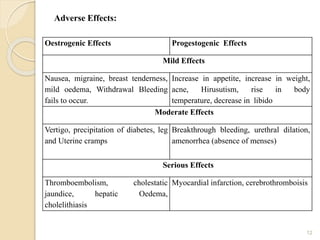
Adverse Effects:
12
Oestrogenic Effects Progestogenic Effects
Mild Effects
Nausea, migraine, breast tenderness,
mild oedema, Withdrawal Bleeding
fails to occur.
Increase in appetite, increase in weight,
acne, Hirusutism, rise in body
temperature, decrease in libido
Moderate Effects
Vertigo, precipitation of diabetes, leg
and Uterine cramps
Breakthrough bleeding, urethral dilation,
amenorrhea (absence of menses)
Serious Effects
Thromboembolism, cholestatic
jaundice, hepatic Oedema,
cholelithiasis
Myocardial infarction, cerebrothromboisis
Reference books
 Text book of Medicinal chemistry volume-1-3rd edition by
V.Alagarasamy.
 Text book of Medicinal chemistry volume-2-3rd edition by
V.Alagarasamy.
 Medicinal chemistry by Rama Rao Nadendla.
13
Thank YOU
14

4th unit oral contraceptives

  • 1.
    4th UNIT ORAL CONTRACEPTIVES Preparedby G. Nikitha, M.Pharmacy Assistant Professor Department of Pharmaceutical Chemistry Sree Dattha Institute Of Pharmacy Hyderabad 1 Subject: Medicinal Chemistry-II Year: B.Pharmacy 3rd Year Semister: 1st Semister
  • 2.
    Contents  Introduction  Typesof oral contraceptives  Mode of action  Adverse effects and Uses  Reference 2
  • 3.
    Introduction The advent oforal contraceptive pills has revolutionized the method of contraception. They are also known as birth control pills. They are composed of estrogen and progesterone or only progesterone. Apart from being available over the counter other advantage offered by them includes.  Reliability  Rapid reversal of fertility  Reduced changes of developing premenstrual tension, dysmenorrhoea, rheumatoid arthritis, haemolytic anaemia  Reduced risk of pelvic inflammatory disease which is high with IUCDs. 3
  • 4.
    Types of oralcontraceptives 1. Combination Pills  These are the most common and safest method of contraception and are 99-99.5% effective. They contained balanced formulation of both oestrogen and progestins.  The first pill is taken on 5th day of menstrual cycle and continued till 21 days next 7 days are pill free period i.e no pills are taken on those days. The next course starts on the 5th day of menses.  Combination ills suppress the production of luteinizing hormone (LH) and follicle stimulating hormone (FSH) by negative feedback mechanism (feedback inhibition process). 4
  • 5.
     In theabsence of LH and FSH ovulation is inhibited which is similar to natural process occurring during pregnancy by the release of oestrogen and progesterone from the ovaries and placenta. This effect occurs mainly due to oestrogen.  Progesterone ensures the withdrawal of bleeding after stopping the medication. It also makes the cervical mucus thick by increasing the viscosity and hence makes the sperm penetration difficult through the cervix. 5
  • 6.
    Combination pills areas follows: a. Monophasic Combination Pills: The name Monophasic is given to these combination pills as there is no phasic increase or decrease in oestrogen and progestin content during the time period of dosage i.e 21days. b. Biphasic Combination Pills: These pills on administration mimic the hormonal changes occurring during the menstrual cycle. They contain fixed dose of estrogen for about 21 days and the dose of progesterone is increased for two successive periods.  I period from day 1 to 10- Ethinyl oetradiol (35mg) and norethindrone (0.5mg)  II period from day 11 to 21- Ethinyl oetradiol (35mg) and norethindrone (1.0mg)  The remaining 7 days are pill free days. 6
  • 7.
    c. Triphasic CombinationPills:  These pills on administration mimic the hormonal changes occurring during the menstrual cycle. They have higher dose of oestrogen at mid cycle while progesterone doses are increase for increased three successive phases.  I period from day 1 to 06- Ethinyl oetradiol (30μg) and Norgetrel (0.05mg)  II period from day 7 to 11 - Ethinyl oetradiol (40μg) and Norgetrel (0.075mg)  III period from day 12 to 21- Ethinyl oetradiol (30μg) and Norgetrel (0.125mg)  The remaining 7 days are pill free days. 7
  • 8.
    2. Progestin Pills/Minipill:  These pills are given to those individuals in whom oestrogen are contraindicated. They contain small doses of progesterone and are administrated throughout the menstrual cycle. The success rate of minipills is less when compared to that of combination therapy. As progesterone levels in blood stream increases, side effects like headache, acne, breast tenderness, bleeding disorders and water retention are seen,  Progestin increases the viscosity of cervical mucus and makes the sperm penetration difficult. They also prepare the endometrium prematurely for secretory phase. Examples:  Norethindrone-0.35mg, Norgetrel-75μg.  This pill is taken daily without interruption. 8
  • 9.
    Mode of action: The mode of action is primarily on cervical mucus which is made inhospitable to sperm, the progetogen probably also hinders implantation through its effects on the endometrium and the motility and secretion of the fallopian tube. Trade name Progestin (dose) Oestrogen (dose) Combined Pills Mala-D[21 tabs and ferrous sulphate] 60mg tabs Norgetrel (0.3mg) Ethinyloestradiol (30μg) Ovral-G Norgetrel (0.5mg) Ethinyl oestradiol (50μg) Bandhan, Ovral Levonorgestrel (0.15mg) Ethinyl oestradiol (30μg) NOVELON Desogestrel (0.15mg) Ethinyl oestradiol (30μg) FEMLION Desogestrel (0.15mg) Ethinyl oestradiol (20μg) Levonorgestrel 0.5mg and Ethinyl oestradiol 0.1mg taken as early as possible but within 73 hours of unprotected intercourse and repeated after 12hour. 9
  • 10.
    Side Effects:  Nausea,vomiting  Breast fullness  Mastalgia  Head ache  Dizziness, Depression  Pelvic Pain  Weight gain  Irritation, Skin changes  Owing to fluid retension 10
  • 11.
    3. Morning afterpills/ Post-coital: These pills are generally taken after unprotected sexual intercourse and contain high dose of oestrogen and progestins. Example: Centchroman is a non-steroidal contraceptive agent which acts on oestrogen antagonist. In India the drug is available over the counter under the brand name of Saheli. This drug is devoid of any adverse effects characteristic to other oral contraceptives. On cessation of centroman therapy, fertility reverses within 6 months and the women can conceive. 11
  • 12.
    Adverse Effects: 12 Oestrogenic EffectsProgestogenic Effects Mild Effects Nausea, migraine, breast tenderness, mild oedema, Withdrawal Bleeding fails to occur. Increase in appetite, increase in weight, acne, Hirusutism, rise in body temperature, decrease in libido Moderate Effects Vertigo, precipitation of diabetes, leg and Uterine cramps Breakthrough bleeding, urethral dilation, amenorrhea (absence of menses) Serious Effects Thromboembolism, cholestatic jaundice, hepatic Oedema, cholelithiasis Myocardial infarction, cerebrothromboisis
  • 13.
    Reference books  Textbook of Medicinal chemistry volume-1-3rd edition by V.Alagarasamy.  Text book of Medicinal chemistry volume-2-3rd edition by V.Alagarasamy.  Medicinal chemistry by Rama Rao Nadendla. 13
  • 14.