Structural Activity Relationship Of
Some Anticonvulsant Drugs
- By:
Chhabi Acharya
Matina Awale
VIth Sem, B. Pharmacy
Hope Int’l College
We will discuss about:
Structural activity relationship of:
1.Hydantoin
2.Barbiturates
3.Benzodiazepines
4.Valproic Acid
5.Succinimides
1. Hydantoins
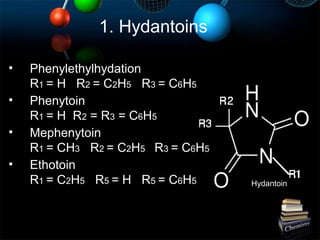
• Phenylethylhydation
R1 = H R2 = C2H5 R3 = C6H5
• Phenytoin
R1 = H R2 = R3 = C6H5
• Mephenytoin
R1 = CH3 R2 = C2H5 R3 = C6H5
• Ethotoin
R1 = C2H5 R5 = H R5 = C6H5 Hydantoin
Contd..
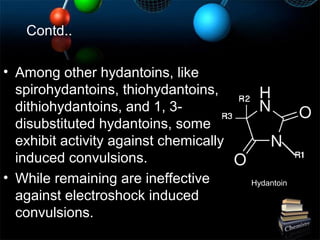
• A phenyl or other aromatic
substituents at C5 is
essential for the activity.
• Alkyl substituents at
position 5 may contribute to
sedation, a property absent
in phenytoin. Hydantoin Hydantoin
• Among other hydantoins, like
spirohydantoins, thiohydantoins,
dithiohydantoins, and 1, 3-
disubstituted hydantoins, some
exhibit activity against chemically
induced convulsions.
• While remaining are ineffective
against electroshock induced
convulsions.
Contd..
Hydantoin
2. Barbiturates
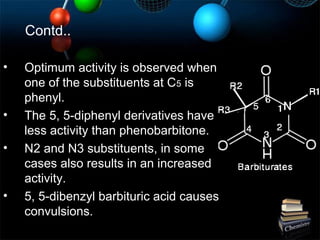
• Phenobarbitone
R1 = H R2 = C2H5 R3 = C6H5
• Mephobarbitone
R1 = CH3 R2 = C2H5 R3 = C6H5
• Metharbital
R1 = CH3 R2 = C2H5 R3 = C2H5
Contd..
• Optimum activity is observed when
one of the substituents at C5 is
phenyl.
• The 5, 5-diphenyl derivatives have
less activity than phenobarbitone.
• N2 and N3 substituents, in some
cases also results in an increased
activity.
• 5, 5-dibenzyl barbituric acid causes
convulsions.
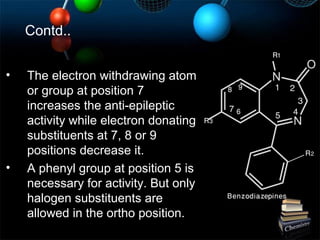
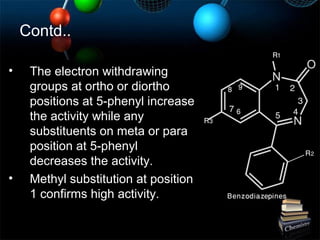
3. Benzodiazepines
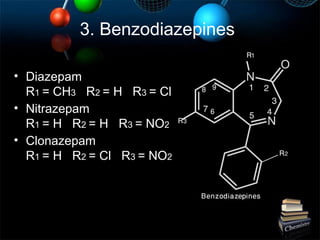
• Diazepam
R1 = CH3 R2 = H R3 = Cl
• Nitrazepam
R1 = H R2 = H R3 = NO2
• Clonazepam
R1 = H R2 = Cl R3 = NO2
Contd..
• The electron withdrawing atom
or group at position 7
increases the anti-epileptic
activity while electron donating
substituents at 7, 8 or 9
positions decrease it.
• A phenyl group at position 5 is
necessary for activity. But only
halogen substituents are
allowed in the ortho position.
Contd..
• The electron withdrawing
groups at ortho or diortho
positions at 5-phenyl increase
the activity while any
substituents on meta or para
position at 5-phenyl
decreases the activity.
• Methyl substitution at position
1 confirms high activity.
4. Valproic Acid
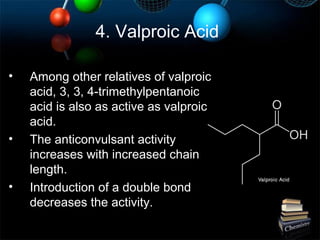
• Among other relatives of valproic
acid, 3, 3, 4-trimethylpentanoic
acid is also as active as valproic
acid.
• The anticonvulsant activity
increases with increased chain
length.
• Introduction of a double bond
decreases the activity.
5. Succinimides
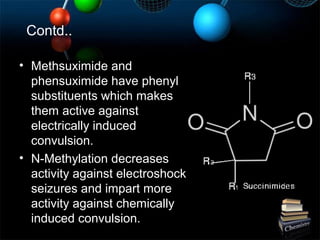
• Phensuximide
R1 = C6H5 R2 = H R3 = CH3
• Methsuximide
R1 = C6H5 R2 = R 3 = CH3
• Ethosuximide
R = C2H5 R2 = CH3 R3=H
Contd..
• Methsuximide and
phensuximide have phenyl
substituents which makes
them active against
electrically induced
convulsion.
• N-Methylation decreases
activity against electroshock
seizures and impart more
activity against chemically
induced convulsion.
Recent Development
• AWD 131-138: Chemically, AWD 131-138 is
1-(Cchloropheny1) Cmorpholino imidazolin-2-one
• This compound is currently in Phase I clinical
development.
• It possesses a broad spectrum of anticonvulsant
activity as well as anxiolytic action.
• Its mechanism of action is by blockade of the
voltage activated Ca2+ channel in a dose-
dependent manner.
Contd..
• Retigabine: Chemically, retigabine is
ethyl N-(2-amino-4-(4-fluorobenz 1 amino)phenylcarbamate
• It is structurally unrelated to currently marketed
anticonvulsant agents.
• It shows a unique mode of action by increasing
K+ conductance in neuronal cells.
• Phase I and II studies have shown good
tolerability and efficacy trials are ongoing.
Contd..
• Rufinamide
• Remacemide
• Pregabalin
• NPS 1776
• NW 1015
• Harkoseride
• Canaxolone
• Serotolide
References
• Burger’s Medicinal Chemistry and Drug Discovery,
Volume Vi, Nervous System Agent
• Foye’s Principle Of Medicinal Chemistry.
• Kadam – Bothara, Principle of Medicinal Chemistry,
Nirali Prakashan
• Structure from:
http://commons.wikimedia.org
Edited with chemdraw
SAR of Anticonvulsant Drugs