By-shreyansh pandey
j
4G is not one defined technology or standard, but
rather a collection of technologies at creating fully
packet-switched networks optimized for data.
4G Networks are projected to provide speed of
100Mbps while moving and 1Gbps while stationary.
4G DEFINITION
At the end of the 1940’s, the first radio telephone service
was introduced, and was designed to users in cars to the
public land-line based telephone network.
In the 1960’s, a system launched by Bell Systems, called,
Improved Mobile Telephone Service (IMTS), brought quite
a few improvements such as direct dialing and more
bandwidth. The very first analog systems were based upon
IMTS and were created in the late 60s and early 70s.
0G (ZERO GENERATION MOBILE
SYSTEM)
1G refers to the first-generation of wireless telephone
technology was developed in 1970’s.
1G had two major improvements:
the invention of the microprocessor
the digital transform of the control link between the phone and the cell site.
Analog signal
1G TECHNOLOGY
Around 1980’s
Better quality & capacity - More people could use there phones at the same time
Digital Signals – consist of 0’s & 1’s
2G TECHNOLOGY
Digital – consist of 0’s and 1’s
Digital signal:
1.Low level, 2.High level, 3.Rising edge
and 4.Falling edge
PREVIOUS TECHNOLOGY - 2G
Digital data can be compressed and multiplexed much
more effectively than analog voice encodings
Multiplexing -multiple analog message signals or digital
data streams are combined into one signal
For 1 and 2G standards, bandwidth maximum is 9.6
Kbit/sec, (I.E) approximately 6 times slower than an
ISDN
PREVIOUS TECHNOLOGY - 2G
Allows for lower powered radio signals that require less
battery
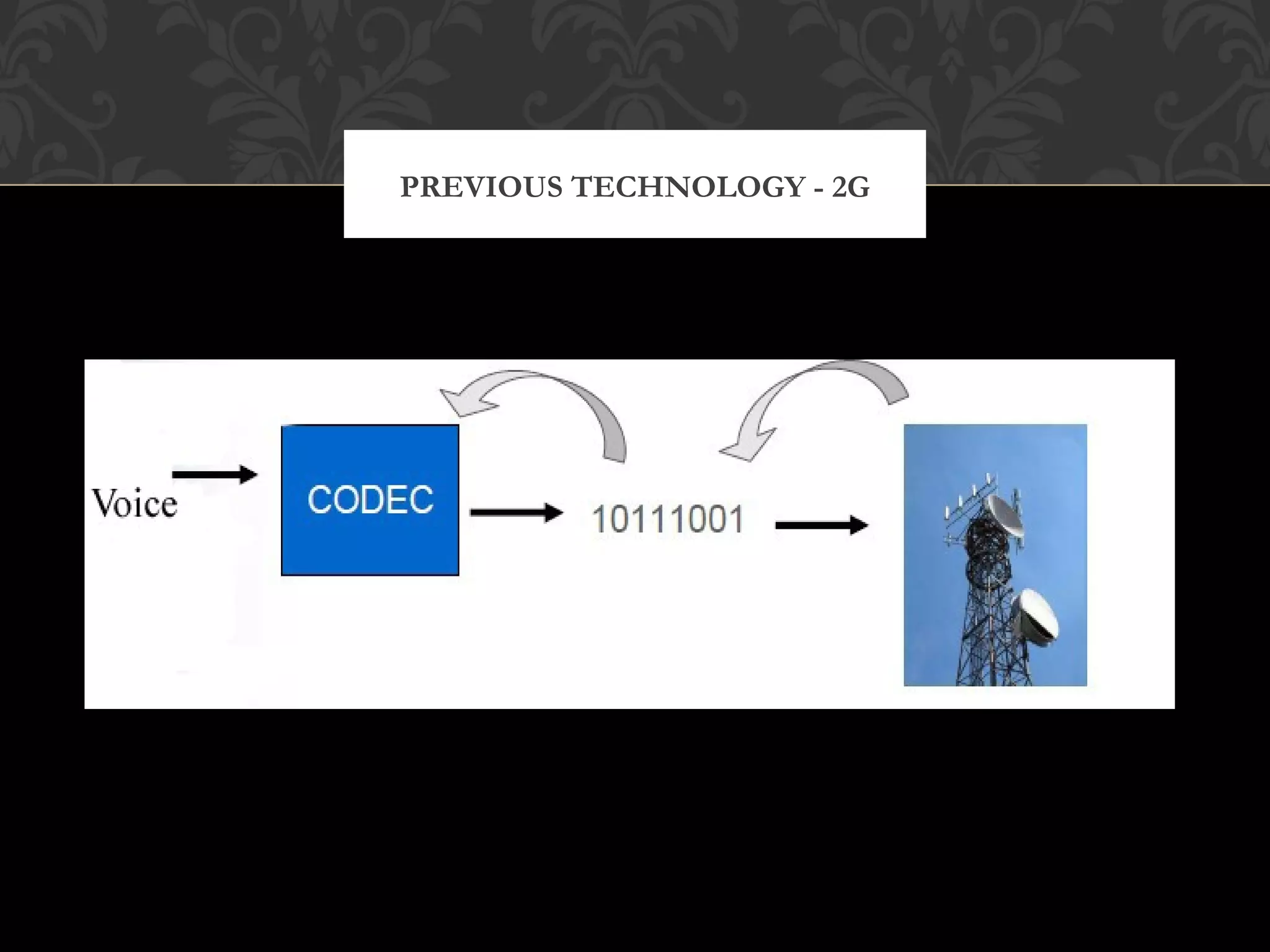
Power–CODEC introduction -program that encodes and
decodes digital data stream or signal
Translates data from digital to analog and vice versa
PREVIOUS TECHNOLOGY - 2G
The digital voice encoding allows digital error checking
increase sound quality
lowers the noise level
Going all-digital allowed for the introduction of digital
data transfer
SMS –“short message service”
E-mail
ADVANTAGES IN PREVIOUS
TECHNOLOGY - 2G
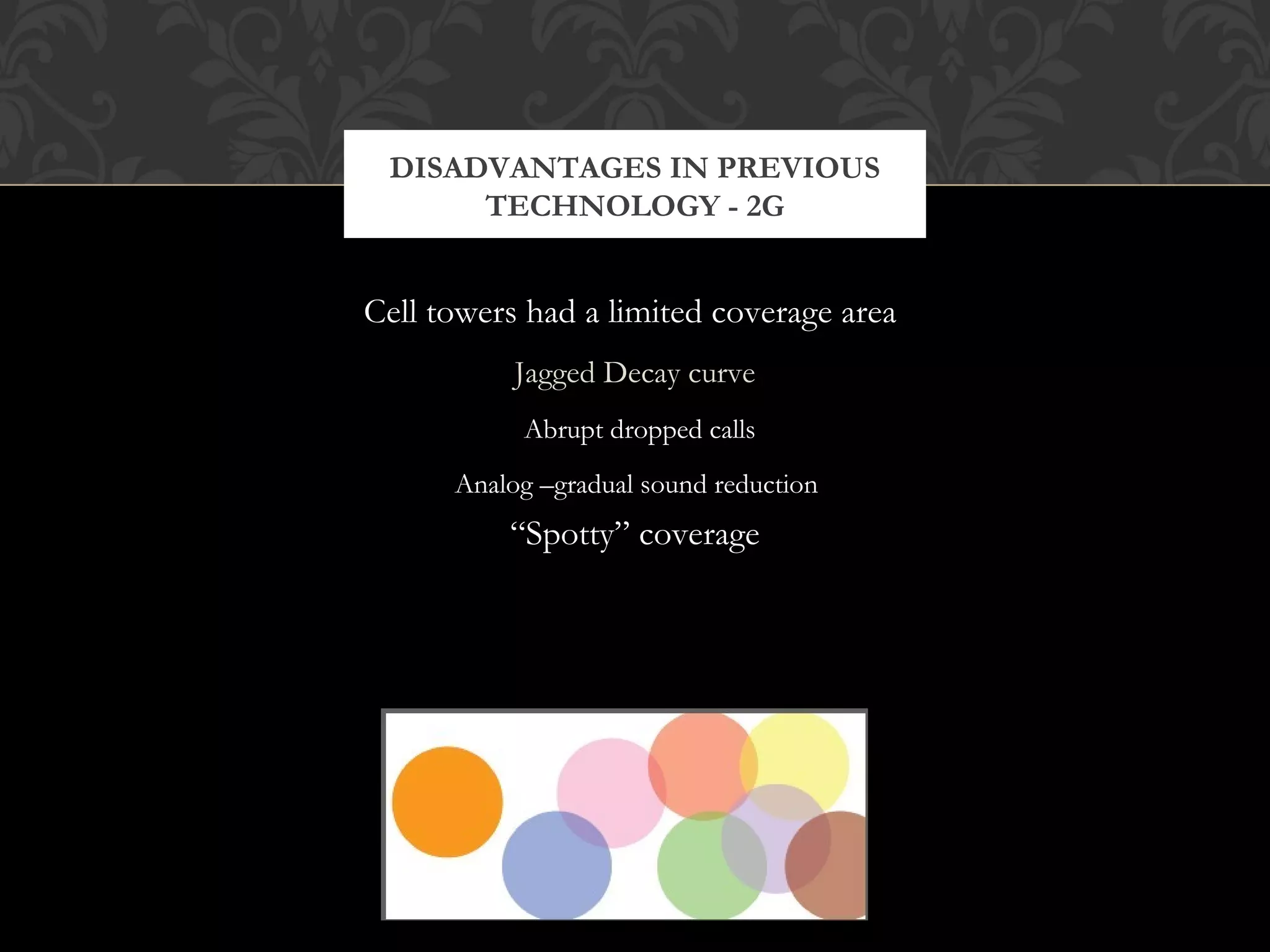
Cell towers had a limited coverage area
Jagged Decay curve
Abrupt dropped calls
Analog –gradual sound reduction
“Spotty” coverage
DISADVANTAGES IN PREVIOUS
TECHNOLOGY - 2G
Large capacity and broadband capabilities
Allows the transmission of 384kbps for mobile systems
and up to 2Mbps
Increased spectrum efficiency –5Mhz
A greater number of users that can be simultaneously supported by
a radio frequency bandwidth
High data rates at lower incremental cost than 2G–Global roaming
3G TECHNOLOGY
CDMA –Code Division Multiple Access
Form of multiplexing
Does not divide up the channel by time or frequency
Encodes data with a special code associated with each channel
PREVIOUS TECHNOLOGY - 3G
CODE DIVISION MULTIPLE
ACCESS
FDMA – Frequency Division Multiple Access
Each phone call is allocated one frequency for the entire duration of the call
TYPES OF
MULTIPLEXING
TDMA - Time Division Multiple Access
Each phone call is allocated a spot in the frequency for a small amount of time, and "takes
turns" being transmitted
TYPES OF MULTIPLEXING
CDMA - Code Division Multiple Access
Each phone call is uniquely encoded and transmitted across the entire spectrum, in a
manner known as spread spectrum transmission
TYPES OF MULTIPLEXING
Even though 3G has successfully been introduced to
mobile users, there are some issues that are debated by 3G
providers and users.
High input fees for the 3G service licenses
Great differences in the licensing terms
3G phones are expensive
REASONS FOR
NEW RESEARCH
FOURTH GENERATION
Fourth Generation Technology
Faster and more reliable
100 Mb/s
Lower cost than previous generations
Multi-standard wireless system
Bluetooth, Wired, Wireless
Ad Hoc Networking
IPv6 Core
OFDM used instead of CDMA
Potentially IEEE standard 802.11n
Most information is proprietary
WHAT IS 4G?
Broadcast layer:
fix access points, (i.e.) cell tower connected by fiber, microwave, or satellite (ISP)
Ad-hoc/hot-spot layer:
wireless LANs (i.e. internet at Starbuck’s)
COMMUNICATIONS
ARCHITECTURE
Personal Layer Gateway:
devices that connect to upper layers; cell phone, fax, voice, data
modem, MP3 players, PDAs
Info-Sensor layer:
environmental sensors
Fiber-optic wire layer:
high speed subterranean labyrinth of fiber optic cables and
repeaters
COMMUNICATIONS
ARCHITECTURE
AD HOC NETWORKS
Spontaneous self organization of
networks of devices
Not necessarily connected to internet
4G will create hybrid wireless networks
using Ad Hoc networks
Form of mesh networking–Very reliable
Experience enhance wireless capabilities that deliver
mobile gaming interaction with less than five seconds
Play online multi player games while traveling at high
speeds or sitting outside
ENHANCE MOBILE
GAMING
4G will provide a wireless alternative for broadband access
I will provide first opportunity for broadband access in remote locations without
an infrastructure to support cable or DSL access.
BROADBAND ACCESS IN REMOTE
LOCATION

4g technology

  • 1.
  • 2.
    4G is notone defined technology or standard, but rather a collection of technologies at creating fully packet-switched networks optimized for data. 4G Networks are projected to provide speed of 100Mbps while moving and 1Gbps while stationary. 4G DEFINITION
  • 3.
    At the endof the 1940’s, the first radio telephone service was introduced, and was designed to users in cars to the public land-line based telephone network. In the 1960’s, a system launched by Bell Systems, called, Improved Mobile Telephone Service (IMTS), brought quite a few improvements such as direct dialing and more bandwidth. The very first analog systems were based upon IMTS and were created in the late 60s and early 70s. 0G (ZERO GENERATION MOBILE SYSTEM)
  • 4.
    1G refers tothe first-generation of wireless telephone technology was developed in 1970’s. 1G had two major improvements: the invention of the microprocessor the digital transform of the control link between the phone and the cell site. Analog signal 1G TECHNOLOGY
  • 5.
    Around 1980’s Better quality& capacity - More people could use there phones at the same time Digital Signals – consist of 0’s & 1’s 2G TECHNOLOGY
  • 6.
    Digital – consistof 0’s and 1’s Digital signal: 1.Low level, 2.High level, 3.Rising edge and 4.Falling edge PREVIOUS TECHNOLOGY - 2G
  • 7.
    Digital data canbe compressed and multiplexed much more effectively than analog voice encodings Multiplexing -multiple analog message signals or digital data streams are combined into one signal For 1 and 2G standards, bandwidth maximum is 9.6 Kbit/sec, (I.E) approximately 6 times slower than an ISDN PREVIOUS TECHNOLOGY - 2G
  • 8.
    Allows for lowerpowered radio signals that require less battery Power–CODEC introduction -program that encodes and decodes digital data stream or signal Translates data from digital to analog and vice versa PREVIOUS TECHNOLOGY - 2G
  • 9.
  • 10.
    The digital voiceencoding allows digital error checking increase sound quality lowers the noise level Going all-digital allowed for the introduction of digital data transfer SMS –“short message service” E-mail ADVANTAGES IN PREVIOUS TECHNOLOGY - 2G
  • 11.
    Cell towers hada limited coverage area Jagged Decay curve Abrupt dropped calls Analog –gradual sound reduction “Spotty” coverage DISADVANTAGES IN PREVIOUS TECHNOLOGY - 2G
  • 12.
    Large capacity andbroadband capabilities Allows the transmission of 384kbps for mobile systems and up to 2Mbps Increased spectrum efficiency –5Mhz A greater number of users that can be simultaneously supported by a radio frequency bandwidth High data rates at lower incremental cost than 2G–Global roaming 3G TECHNOLOGY
  • 13.
    CDMA –Code DivisionMultiple Access Form of multiplexing Does not divide up the channel by time or frequency Encodes data with a special code associated with each channel PREVIOUS TECHNOLOGY - 3G
  • 14.
  • 15.
    FDMA – FrequencyDivision Multiple Access Each phone call is allocated one frequency for the entire duration of the call TYPES OF MULTIPLEXING
  • 16.
    TDMA - TimeDivision Multiple Access Each phone call is allocated a spot in the frequency for a small amount of time, and "takes turns" being transmitted TYPES OF MULTIPLEXING
  • 17.
    CDMA - CodeDivision Multiple Access Each phone call is uniquely encoded and transmitted across the entire spectrum, in a manner known as spread spectrum transmission TYPES OF MULTIPLEXING
  • 18.
    Even though 3Ghas successfully been introduced to mobile users, there are some issues that are debated by 3G providers and users. High input fees for the 3G service licenses Great differences in the licensing terms 3G phones are expensive REASONS FOR NEW RESEARCH
  • 19.
  • 20.
    Fourth Generation Technology Fasterand more reliable 100 Mb/s Lower cost than previous generations Multi-standard wireless system Bluetooth, Wired, Wireless Ad Hoc Networking IPv6 Core OFDM used instead of CDMA Potentially IEEE standard 802.11n Most information is proprietary WHAT IS 4G?
  • 21.
    Broadcast layer: fix accesspoints, (i.e.) cell tower connected by fiber, microwave, or satellite (ISP) Ad-hoc/hot-spot layer: wireless LANs (i.e. internet at Starbuck’s) COMMUNICATIONS ARCHITECTURE
  • 22.
    Personal Layer Gateway: devicesthat connect to upper layers; cell phone, fax, voice, data modem, MP3 players, PDAs Info-Sensor layer: environmental sensors Fiber-optic wire layer: high speed subterranean labyrinth of fiber optic cables and repeaters COMMUNICATIONS ARCHITECTURE
  • 23.
    AD HOC NETWORKS Spontaneousself organization of networks of devices Not necessarily connected to internet 4G will create hybrid wireless networks using Ad Hoc networks Form of mesh networking–Very reliable
  • 24.
    Experience enhance wirelesscapabilities that deliver mobile gaming interaction with less than five seconds Play online multi player games while traveling at high speeds or sitting outside ENHANCE MOBILE GAMING
  • 25.
    4G will providea wireless alternative for broadband access I will provide first opportunity for broadband access in remote locations without an infrastructure to support cable or DSL access. BROADBAND ACCESS IN REMOTE LOCATION