
Presented by:
Ahmed Atef Elnaggar
Supervisor:
Prof. Saad M. Darwish
 Mobile penetration (Global and Local)
 Growth factors of M-commerce
 M-Commerce definition & history
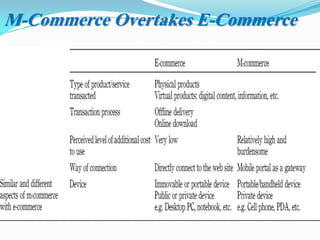
 M-Commerce overtakes E-Commerce
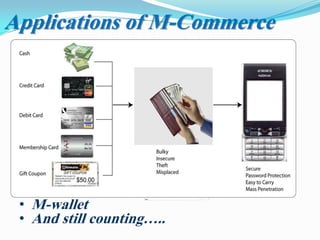
 Applications of M-Commerce
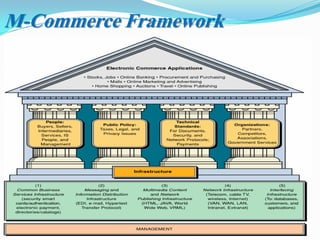
 M-Commerce Framework
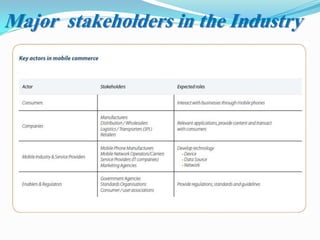
 Major stakeholders in the Industry
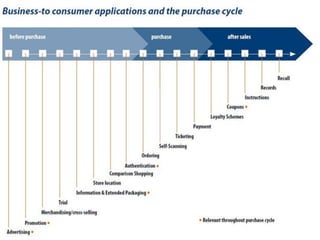
 Purchase cycle B2C
 Opportunities & Limitations
 Recommended sites & References
Overview
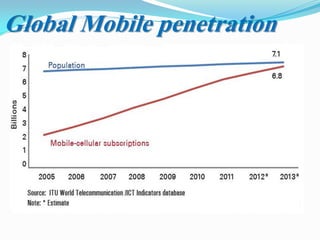
Global Mobile penetration
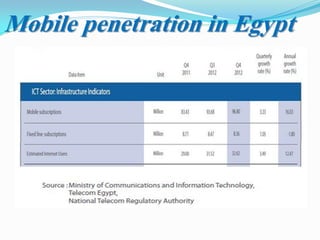
Mobile penetration in Egypt
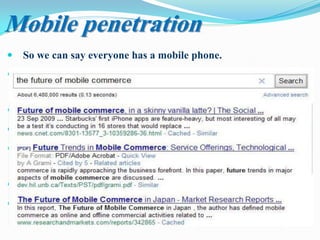
 So we can say everyone has a mobile phone.
 Over the past 10 years mobile phones have changed the way
that we live and work (All in one).
 The mobile phone seems to give us more power.
 People consider mobile phones as extensions of themselves.
 So Market and developing business models should to exploit
the huge profit and the potential revenue of this new market.
 So Mobile commerce has become the latest topic for today.
 While electronic commerce continues to phenomenal growth,
mobile commerce is still in its infancy.
Mobile penetration
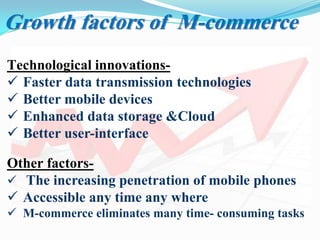
Growth factors of M-commerce
Technological innovations-
 Faster data transmission technologies
 Better mobile devices
 Enhanced data storage &Cloud
 Better user-interface
Other factors-
 The increasing penetration of mobile phones
 Accessible any time any where
 M-commerce eliminates many time- consuming tasks
M-Commerce definition & history
"Mobile Commerce is any transaction, involving the
transfer of ownership or rights to use goods and services,
which is initiated and completed by using mobile (Cell-
phone, PDA, Smart-phone) access to mobile
communication networks over different technologies” .
 Mobile Commerce Services were first delivered in 1997,
when the first two mobile-phone enabled Coca Cola
vending machines were installed in Finland.
 Since the launch of the iPhone, mobile Commerce has
moved away from SMS systems and into actual
applications. (Mobile Commerce is Exploding)
Accessibility ( anytime on-the-go)
 Localization ( anywhere)
Convenience
Easy Connectivity
Personalization ( your personal device)
Innovation :Can create new business
opportunity to reach and attract customers.
Security
M-Commerce Overtakes E-Commerce
• Mobile Money Transfer
• Mobile ATM
• Mobile Ticketing
• Mobile vouchers, coupons ,loyalty cards
• Mobile Banking
• Mobile brokerage
• Auctions
• Mobile Browsing
• Mobile Purchases
• Mobile marketing and advertising
• NFC
• M-wallet
• And still counting…..
Applications of M-Commerce
10
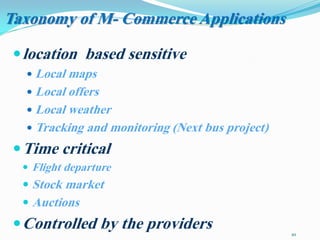
location based sensitive
 Local maps
 Local offers
 Local weather
 Tracking and monitoring (Next bus project)
Time critical
 Flight departure
 Stock market
 Auctions
Controlled by the providers
Taxonomy of M- Commerce Applications
11
M-Commerce Framework
Technology developers
Device Manufacturers
Application Providers
Content Providers
Service providers (Operators)
Users
Major stakeholders in the Industry
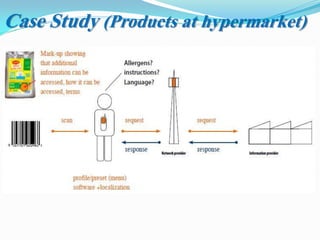
Case Study (Products at hypermarket)
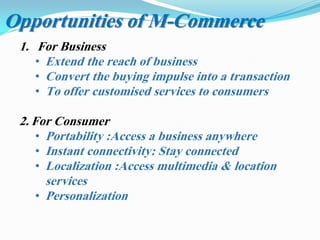
1. For Business
• Extend the reach of business
• Convert the buying impulse into a transaction
• To offer customised services to consumers
2. For Consumer
• Portability :Access a business anywhere
• Instant connectivity: Stay connected
• Localization :Access multimedia & location
services
• Personalization
Opportunities of M-Commerce
• Accessibility expensive
• Unresolved legal issues
• Lack of national and international
governmental regulations
• Lack of mature methodologies to measure
benefits
• Customer resistance
• Competition issues
Limitations of M-Commerce
• Standardization issues : Lack of universal standards
• Smaller Displays : Inconvenient to navigate
• Limited Storage Capacity: Unsuitable to carry large data
• Limited Processing Memory:Programs freeze
• Use of graphics limited
• Limited Battery Capacity
• Insufficient & limited bandwidth
• Security issues
Technical Limitations
• Integration difficulties
• Need for special Web servers
 WAP and SMS limited to small number of characters
and text.
 Potential health hazards
 Fear of radiation
 Unsafe to drive and use wireless phone
 Cell phones may interfere with sensitive medical
devices (pacemakers)
Cont. Technical Limitations
 Challenges
Expectations of users increase
Increased maturity of systems and processes
It’s a new channel to be explored
Many platforms, many technologies, many players
 Threats
“anytime, anywhere” increases transparency
Price comparison (incl. barcode scanning) makes the
market even more transparent, reaching full
transparency (in B2C)
Oligopoly/Cartels might appear
Challenges & Threats
 According to new analysis from Juniper Research,
consumer demand for mobile money transfer services
will see users exceed 500 million globally by 2014,
principally in developing countries.
 Africa ,Middle East ,China and the Indian will be the
leading regions for national mobile money transfer
services in 2014 (Money transfer service by mobile is
launched 4-2013 at Egypt)
 Sophisticated mobile financial services such as loans
and savings accounts can add to the attractiveness of
mobile money services
 Therefore, the future of M- Commerce is very optimistic
Future of M-commerce
 As m-commerce applications and wireless
devices are evolving rapidly, one will take
forward the other one towards empowering
innovation, versatility and power in them.
 Once m-commerce issues and challenges have
been incorporated into the policies of a company,
more benefits could be expected.
 Therefore, in the future, research needs to focus
on two aspect; the influences that determine the
success of m-commerce and the benefits
themselves.
Conclusion
• Trend Predictions in 140 Characters
http://www.slideshare.net/TrendsSpotting/2010-
mobile-influencers-trend-predictions-in-140-
characters-by-trendsspotting
• Mobile Trends 2020
I. http://www.slideshare.net/rudydw/mobile-
trends-2020
II. http://nobelprize.org/physics/laureates/1909/mar
coni- bio.html
Recommended web site
1. Mobile Commerce: opportunities and challenges A GS1
Mobile Com White Paper February 2008 Edition
(www.gs1.org).
2. Chang-tseh Hsieh: University of Southern Mississippi (2007
Volume 7 Issue 1).
3. 2016: The Future Value Chain (Global Commerce Initiative,
Capgemini, Intel, 2006)
4. Breakthroughs in the European Mobile Payment Market
(ATOS Origin, 2007)
5. Buellingen, F., Woerter, M. (2004) “Development
perspectives, firm strategies and applications in mobile
commerce,” Journal of Business Research, December, Vol.
57 Issue 12, pp.1402-1408.
23
References
Mobile commerce 2

Mobile commerce 2

  • 1.
    Presented by: Ahmed AtefElnaggar Supervisor: Prof. Saad M. Darwish
  • 2.
     Mobile penetration(Global and Local)  Growth factors of M-commerce  M-Commerce definition & history  M-Commerce overtakes E-Commerce  Applications of M-Commerce  M-Commerce Framework  Major stakeholders in the Industry  Purchase cycle B2C  Opportunities & Limitations  Recommended sites & References Overview
  • 3.
  • 4.
  • 5.
     So wecan say everyone has a mobile phone.  Over the past 10 years mobile phones have changed the way that we live and work (All in one).  The mobile phone seems to give us more power.  People consider mobile phones as extensions of themselves.  So Market and developing business models should to exploit the huge profit and the potential revenue of this new market.  So Mobile commerce has become the latest topic for today.  While electronic commerce continues to phenomenal growth, mobile commerce is still in its infancy. Mobile penetration
  • 6.
    Growth factors ofM-commerce Technological innovations-  Faster data transmission technologies  Better mobile devices  Enhanced data storage &Cloud  Better user-interface Other factors-  The increasing penetration of mobile phones  Accessible any time any where  M-commerce eliminates many time- consuming tasks
  • 7.
    M-Commerce definition &history "Mobile Commerce is any transaction, involving the transfer of ownership or rights to use goods and services, which is initiated and completed by using mobile (Cell- phone, PDA, Smart-phone) access to mobile communication networks over different technologies” .  Mobile Commerce Services were first delivered in 1997, when the first two mobile-phone enabled Coca Cola vending machines were installed in Finland.  Since the launch of the iPhone, mobile Commerce has moved away from SMS systems and into actual applications. (Mobile Commerce is Exploding)
  • 8.
    Accessibility ( anytimeon-the-go)  Localization ( anywhere) Convenience Easy Connectivity Personalization ( your personal device) Innovation :Can create new business opportunity to reach and attract customers. Security M-Commerce Overtakes E-Commerce
  • 9.
    • Mobile MoneyTransfer • Mobile ATM • Mobile Ticketing • Mobile vouchers, coupons ,loyalty cards • Mobile Banking • Mobile brokerage • Auctions • Mobile Browsing • Mobile Purchases • Mobile marketing and advertising • NFC • M-wallet • And still counting….. Applications of M-Commerce
  • 10.
    10 location based sensitive Local maps  Local offers  Local weather  Tracking and monitoring (Next bus project) Time critical  Flight departure  Stock market  Auctions Controlled by the providers Taxonomy of M- Commerce Applications
  • 11.
  • 12.
    Technology developers Device Manufacturers ApplicationProviders Content Providers Service providers (Operators) Users Major stakeholders in the Industry
  • 13.
    Case Study (Productsat hypermarket)
  • 15.
    1. For Business •Extend the reach of business • Convert the buying impulse into a transaction • To offer customised services to consumers 2. For Consumer • Portability :Access a business anywhere • Instant connectivity: Stay connected • Localization :Access multimedia & location services • Personalization Opportunities of M-Commerce
  • 16.
    • Accessibility expensive •Unresolved legal issues • Lack of national and international governmental regulations • Lack of mature methodologies to measure benefits • Customer resistance • Competition issues Limitations of M-Commerce
  • 17.
    • Standardization issues: Lack of universal standards • Smaller Displays : Inconvenient to navigate • Limited Storage Capacity: Unsuitable to carry large data • Limited Processing Memory:Programs freeze • Use of graphics limited • Limited Battery Capacity • Insufficient & limited bandwidth • Security issues Technical Limitations
  • 18.
    • Integration difficulties •Need for special Web servers  WAP and SMS limited to small number of characters and text.  Potential health hazards  Fear of radiation  Unsafe to drive and use wireless phone  Cell phones may interfere with sensitive medical devices (pacemakers) Cont. Technical Limitations
  • 19.
     Challenges Expectations ofusers increase Increased maturity of systems and processes It’s a new channel to be explored Many platforms, many technologies, many players  Threats “anytime, anywhere” increases transparency Price comparison (incl. barcode scanning) makes the market even more transparent, reaching full transparency (in B2C) Oligopoly/Cartels might appear Challenges & Threats
  • 20.
     According tonew analysis from Juniper Research, consumer demand for mobile money transfer services will see users exceed 500 million globally by 2014, principally in developing countries.  Africa ,Middle East ,China and the Indian will be the leading regions for national mobile money transfer services in 2014 (Money transfer service by mobile is launched 4-2013 at Egypt)  Sophisticated mobile financial services such as loans and savings accounts can add to the attractiveness of mobile money services  Therefore, the future of M- Commerce is very optimistic Future of M-commerce
  • 21.
     As m-commerceapplications and wireless devices are evolving rapidly, one will take forward the other one towards empowering innovation, versatility and power in them.  Once m-commerce issues and challenges have been incorporated into the policies of a company, more benefits could be expected.  Therefore, in the future, research needs to focus on two aspect; the influences that determine the success of m-commerce and the benefits themselves. Conclusion
  • 22.
    • Trend Predictionsin 140 Characters http://www.slideshare.net/TrendsSpotting/2010- mobile-influencers-trend-predictions-in-140- characters-by-trendsspotting • Mobile Trends 2020 I. http://www.slideshare.net/rudydw/mobile- trends-2020 II. http://nobelprize.org/physics/laureates/1909/mar coni- bio.html Recommended web site
  • 23.
    1. Mobile Commerce:opportunities and challenges A GS1 Mobile Com White Paper February 2008 Edition (www.gs1.org). 2. Chang-tseh Hsieh: University of Southern Mississippi (2007 Volume 7 Issue 1). 3. 2016: The Future Value Chain (Global Commerce Initiative, Capgemini, Intel, 2006) 4. Breakthroughs in the European Mobile Payment Market (ATOS Origin, 2007) 5. Buellingen, F., Woerter, M. (2004) “Development perspectives, firm strategies and applications in mobile commerce,” Journal of Business Research, December, Vol. 57 Issue 12, pp.1402-1408. 23 References