CHEMICAL REACTIONS
1
2
Introduction to Chemical Reactions
A chemical change—a chemical reaction—converts
one substance into another.
Chemical reactions involve:
•breaking bonds in the reactants (starting materials)
•forming new bonds in the products
CH4 and O2 CO2 and H2O
3
Introduction to Chemical Reactions
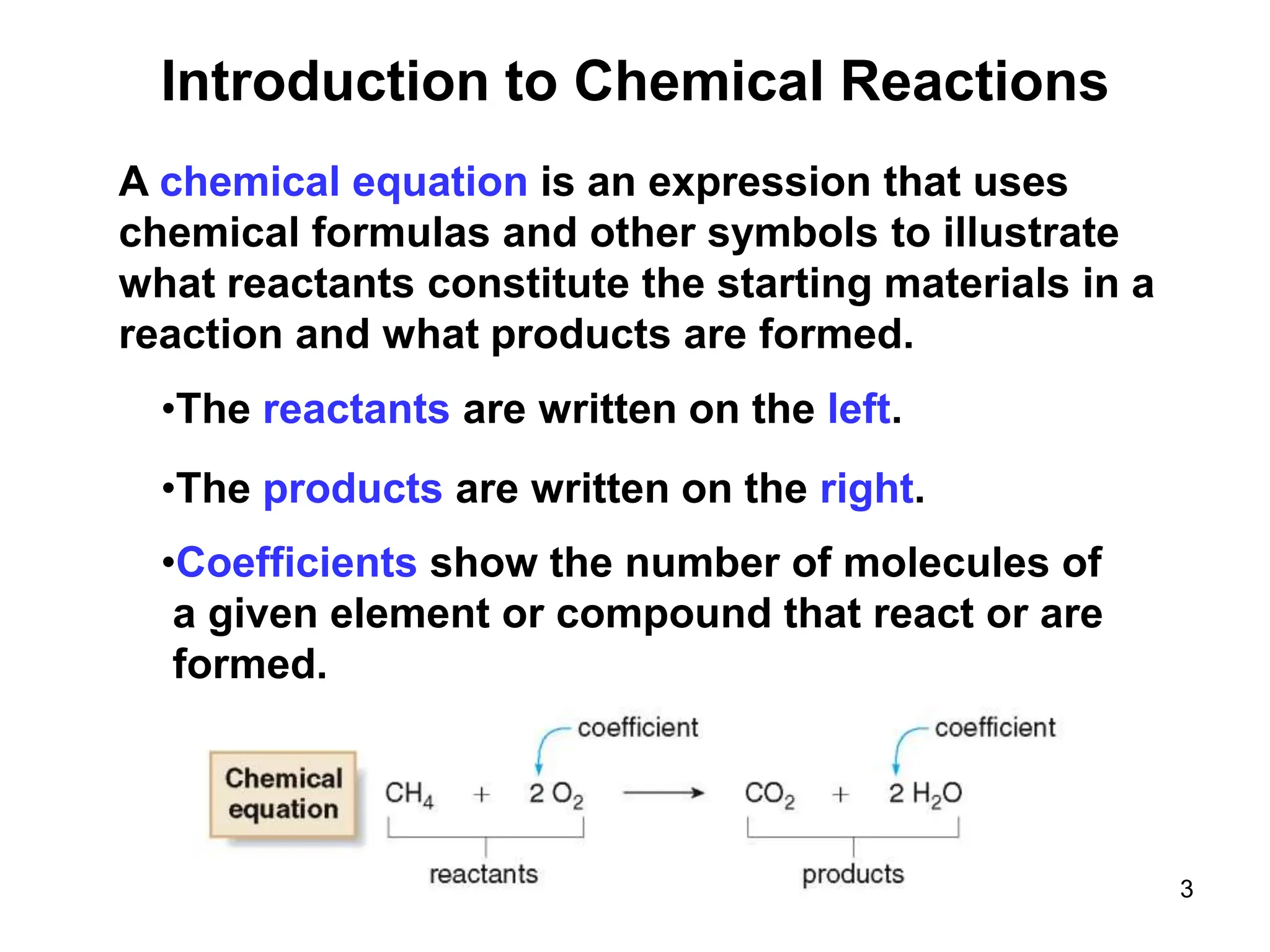
A chemical equation is an expression that uses
chemical formulas and other symbols to illustrate
what reactants constitute the starting materials in a
reaction and what products are formed.
•The reactants are written on the left.
•The products are written on the right.
•Coefficients show the number of molecules of
a given element or compound that react or are
formed.
4
Introduction to Chemical Reactions
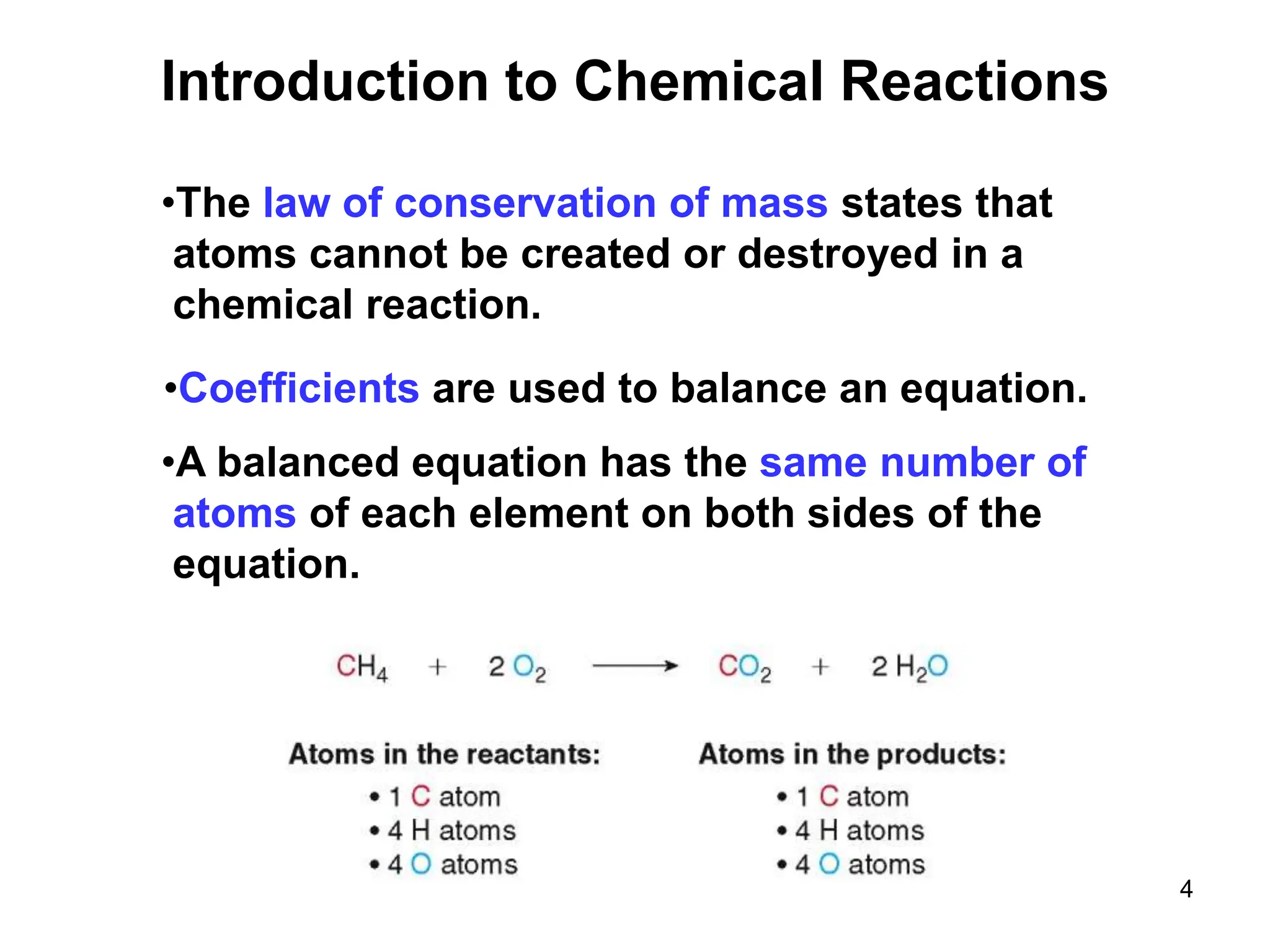
•The law of conservation of mass states that
atoms cannot be created or destroyed in a
chemical reaction.
•Coefficients are used to balance an equation.
•A balanced equation has the same number of
atoms of each element on both sides of the
equation.
5
Introduction to Chemical Reactions
Chemical Reactions
Evidences: (Observable changes)
• Change in color
• Change in temperature
• Evolution of gases or bubble formation
• Precipitation
7
Balancing Chemical Equations
HOW TO Balance a Chemical Equation
Example Write a balanced chemical equation for
the reaction of propane (C3H8) with
oxygen (O2) to form carbon dioxide (CO2)
and water (H2O).
Step [1] Write the equation with the correct formulas.
C3H8 + O2 CO2 + H2O
•The subscripts in a formula can never be changed
to balance an equation, because changing a
subscript changes the identity of a compound.
8
Balancing Chemical Equations
Step [2]
HOW TO Balance a Chemical Equation
Balance the equation with coefficients one
element at a time.
•Balance the C’s first:
•Balance the H’s next:
9
Balancing Chemical Equations
Step [2]
HOW TO Balance a Chemical Equation
Balance the equation with coefficients one
element at a time.
•Finally, balance the O’s:
10
Balancing Chemical Equations
Step [3] Check to make sure that the smallest set
of whole numbers is used.
HOW TO Balance a Chemical Equation
Classes of Reactions
1.Combination or Synthesis
2.Decomposition
3.Single Replacement Reaction
4.Double Replacement
Reaction
Combination or Synthesis
• two or more substances react to form a
single product
A + B  AB
Key: one product
2. Decomposition reactions
• a single compound breaks down into
two or more simpler substances
(elements or compounds)
AB  A + B
Key: one reactant
Decomposition
•often must add energy (heat/electricity) to
make reaction occur
2KClO3(s)  2KCl (s) + 3O2 (g)
3. Single-replacement reactions
• one element replaces another element
in a compound
A + BX  AX + B
Single Displacement
•more active element replaces less active
element
•Refer to activity series of elements
Copper metal reacts with aqueous silver nitrate to
produce silver metal and aqueous copper(II) nitrate.
Copper replaces silver (Activity series)
Cu(s) + AgNO3(aq)  Ag(s) + Cu(NO3)2(aq)
Remember to apply the rules in writing ang
naming, diatomic molecule, crisscross, etc.
Look for the charges in the list of cations and
anions. Ag+1 NO3
-1  AgNO3
Cu+2 NO3
-1  Cu(NO3)2
Cu(s) + 2AgNO3(aq)  2Ag(s) + Cu(NO3)2(aq)
4. Double-replacement reactions
• Exchange of ions between aqueous
solutions of two compounds.
AX + BY  AY + BX
Double Displacement
Aqueous solutions of lead(II) nitrate and
potassium iodide react to form aqueous potassium
nitrate and a precipitate of lead(II) iodide.
Pb(NO3)2(aq) + 2KI(aq)  2KNO3(aq) + PbI2(s)
18
Thread for suturing
wounds is made from
nylon, one of the
countless products
synthesized by the
chemical industry
using chemical
reactions.

46037073323-1-Chemical-Reactions-ppt.ppt

  • 1.
  • 2.
    2 Introduction to ChemicalReactions A chemical change—a chemical reaction—converts one substance into another. Chemical reactions involve: •breaking bonds in the reactants (starting materials) •forming new bonds in the products CH4 and O2 CO2 and H2O
  • 3.
    3 Introduction to ChemicalReactions A chemical equation is an expression that uses chemical formulas and other symbols to illustrate what reactants constitute the starting materials in a reaction and what products are formed. •The reactants are written on the left. •The products are written on the right. •Coefficients show the number of molecules of a given element or compound that react or are formed.
  • 4.
    4 Introduction to ChemicalReactions •The law of conservation of mass states that atoms cannot be created or destroyed in a chemical reaction. •Coefficients are used to balance an equation. •A balanced equation has the same number of atoms of each element on both sides of the equation.
  • 5.
  • 6.
    Chemical Reactions Evidences: (Observablechanges) • Change in color • Change in temperature • Evolution of gases or bubble formation • Precipitation
  • 7.
    7 Balancing Chemical Equations HOWTO Balance a Chemical Equation Example Write a balanced chemical equation for the reaction of propane (C3H8) with oxygen (O2) to form carbon dioxide (CO2) and water (H2O). Step [1] Write the equation with the correct formulas. C3H8 + O2 CO2 + H2O •The subscripts in a formula can never be changed to balance an equation, because changing a subscript changes the identity of a compound.
  • 8.
    8 Balancing Chemical Equations Step[2] HOW TO Balance a Chemical Equation Balance the equation with coefficients one element at a time. •Balance the C’s first: •Balance the H’s next:
  • 9.
    9 Balancing Chemical Equations Step[2] HOW TO Balance a Chemical Equation Balance the equation with coefficients one element at a time. •Finally, balance the O’s:
  • 10.
    10 Balancing Chemical Equations Step[3] Check to make sure that the smallest set of whole numbers is used. HOW TO Balance a Chemical Equation
  • 11.
    Classes of Reactions 1.Combinationor Synthesis 2.Decomposition 3.Single Replacement Reaction 4.Double Replacement Reaction
  • 12.
    Combination or Synthesis •two or more substances react to form a single product A + B  AB Key: one product
  • 13.
    2. Decomposition reactions •a single compound breaks down into two or more simpler substances (elements or compounds) AB  A + B Key: one reactant Decomposition •often must add energy (heat/electricity) to make reaction occur 2KClO3(s)  2KCl (s) + 3O2 (g)
  • 14.
    3. Single-replacement reactions •one element replaces another element in a compound A + BX  AX + B Single Displacement •more active element replaces less active element •Refer to activity series of elements
  • 16.
    Copper metal reactswith aqueous silver nitrate to produce silver metal and aqueous copper(II) nitrate. Copper replaces silver (Activity series) Cu(s) + AgNO3(aq)  Ag(s) + Cu(NO3)2(aq) Remember to apply the rules in writing ang naming, diatomic molecule, crisscross, etc. Look for the charges in the list of cations and anions. Ag+1 NO3 -1  AgNO3 Cu+2 NO3 -1  Cu(NO3)2 Cu(s) + 2AgNO3(aq)  2Ag(s) + Cu(NO3)2(aq)
  • 17.
    4. Double-replacement reactions •Exchange of ions between aqueous solutions of two compounds. AX + BY  AY + BX Double Displacement Aqueous solutions of lead(II) nitrate and potassium iodide react to form aqueous potassium nitrate and a precipitate of lead(II) iodide. Pb(NO3)2(aq) + 2KI(aq)  2KNO3(aq) + PbI2(s)
  • 18.
    18 Thread for suturing woundsis made from nylon, one of the countless products synthesized by the chemical industry using chemical reactions.