Percutaneous absorption
Ms.Wajiha Iffat
Objective:
After the end of this lecture, student will be able
to :
•Describe Structure of skin
•define the percutanous absorption
•Its importance
•Factor affecting percutaneous absorption
•Ways to maximize drug bioavailibility
Percutaneous Absorption
• Skin also known as cuteneous membrane or
integument .
• It means any external membranous covering
or integument of an animal body.
• Skin is the largest organ of the body ,it is thin
at some places (eye lids thickness =0.5mm)
where as thick at other places (sole of foot,
palm of hand thickness=5mm).
• Average thickness of skin is 1-2mm.(0.04-
0.08in).
Percutaneous Absorption
• In adults, the skin covers an area of about 2
square meter and weight 4.5-5kg, about 16%
of total body weight.
Percutaneous Absorption
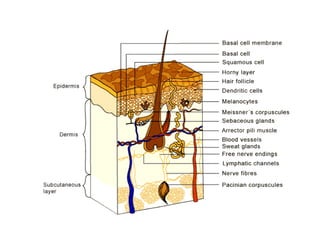
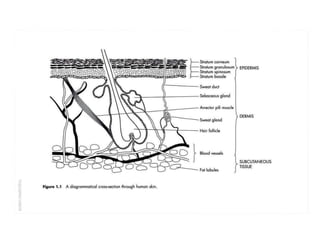
• Skin is made up of two layers,
1.Outer epidermis,
2.Inner dermis.
• 1:-Epidermis
epi =above , dermis=skin
• It is the superficial , thinner portion
composed of keratinized stratified squamous
epithelial tissue.
Percutaneous Absorption
• Epidermis replaces itself . about every two and
half months.
• It has no blood vessel but it is nourished by
diffusion of nutrients from a vascular network of
dermis.
• It is composed of 4 type of cells
1-keratinocytes
2-melanocyets
3-langerhans cell
4-merkel cell.
Percutaneous Absorption
keratinocytes
keratino=horn like, cytes=cell
• 90% of epidermal cells are keratinocytes.
• These are arrange in 4 to 5 layers and are responsible for
production of protien keratin,which is a tough fibrous protein
responsible to protect the skin and underlying tissues from heat,
microbes and chemical.
Melanocytes
Melano=black, cytes=cell
• 8%of epidermal cells are melanocytes.
• They produces a pigment melanin (a yellow red or black brown
pigment) contribute in skin colour and also absoorbs damaging u-v
light
Percutaneous Absorption
Langerhans cells
• They participate in immune responses against
microbes that invade the skin and they are
easily damaged by u-v light.
• Helps other cells of immune system to
recognize an invading microbe and destroy it.
Merkel cell
• Participate in detection of touch sensation.
Percutaneous Absorption
DERMIS :
The sensitive connective tissue layer of the skin located
below the epidermis, containing nerve endings, sweat
and sebaceous glands, and blood, hair follicles,
fibroblast , histocytes and lymph vessels. Also called
corium, cutis, Also called derma.
• Composed of strong connective tissue containing
collagen ( for strength ) and elastin ( for stretch )
• Derma blood vessels not only supply blood to the
dermis and epidermis but also play major role in
temperature regulation.
Percutaneous Absorption
Hypodermis :
• Below the dermis is hypodermis also k/as
subcutaneous layer
• Sub mean under and cutaneous mean skin.
• It is a loose layer of connective tissue which is
anchored to the underlined tissue ( muscle and
bones).
• Most fats cells are present in hypodermis
collectively known as adipose tissues act as
insulator to protect the body from excessive heat
and cold environment
Percutaneous Absorption
Appendages of the skin:
• Hair follicles with hair
• Nails
Glands of skin:
• There are two types of glands
• Sweat glands
• Sebaceous glands
Sebaceous glands :
• They are simple or branched alveolar glands situated in the
dermis of skin
• They secrete an oily secretion c/as sebum active at the time
of adolescense.
Percutaneous Absorption
Percutaneous Absorption:
Percutaneous absorption involves the transfer
of drug from skin surface in to stratum
corneum, under the aegis of a concentration
gradient and its subsequent diffusion through
the dermis and in to microcirculation the skin
behaves as a passive barrier to diffusing
molecules
Percutaneous Absorption
• Percutaneous absorption of a drug generally
results from the direct penetration of the drug
through stratum corneum,10-15µm thick layer
of flat partially desiccated non living tissues.
• SC is composed of 40%protein & 40%water
with a balance being lipid.
• SC acts as a semi permeable membrane &
drug molecules penetrates by passive
diffusion. it is the most rate limiting barrier to
TDDS TRANSPORT.
Percutaneous Absorption
RATIONAL APPROACH TO DRUG DELIVERY TO &
VIA THE SKIN:
• Surface treatment
• Strarum corneum treatment
• Skin appendage treatment
• Viable epidermis & dermis treatment
• Systemic treatment via transdermal
absorption
Percutaneous Absorption
FACTOR AFFECTING PERCUTANOUS
ABSORPTION:
BIOLOGICAL PARAMETERS:
• Skin condition
• Skin age
• Blood flow
• Regional skin sites
• Skin metabolism
Percutaneous Absorption
PHYSICOCHEMICAL PARAMETERS:
• Physicochemical Attraction Of Drug
• Mol Wt Of Drug
• Hydration Of Skin
• Temperature & pH
• Drug Concentrations
• Diffusion coefficient
• Partition coefficient
• Area Of Applications
• Contact Time
Percutaneous Absorption
MAXIMIZING THE BIOAVAILIBILITY OF DRUG TO
SKIN:
• Drug or pro drug selection
• Hydration
• Ultrasounds(phonophoresis)
• Ionophoresis
• elctroporation
• Stratum corneum removal
• Microneedle array
• Chemical penetration enhancers

percutaneous absorption 4355447679450.ppt

  • 1.
    Percutaneous absorption Ms.Wajiha Iffat Objective: Afterthe end of this lecture, student will be able to : •Describe Structure of skin •define the percutanous absorption •Its importance •Factor affecting percutaneous absorption •Ways to maximize drug bioavailibility
  • 2.
    Percutaneous Absorption • Skinalso known as cuteneous membrane or integument . • It means any external membranous covering or integument of an animal body. • Skin is the largest organ of the body ,it is thin at some places (eye lids thickness =0.5mm) where as thick at other places (sole of foot, palm of hand thickness=5mm). • Average thickness of skin is 1-2mm.(0.04- 0.08in).
  • 3.
    Percutaneous Absorption • Inadults, the skin covers an area of about 2 square meter and weight 4.5-5kg, about 16% of total body weight.
  • 6.
    Percutaneous Absorption • Skinis made up of two layers, 1.Outer epidermis, 2.Inner dermis. • 1:-Epidermis epi =above , dermis=skin • It is the superficial , thinner portion composed of keratinized stratified squamous epithelial tissue.
  • 7.
    Percutaneous Absorption • Epidermisreplaces itself . about every two and half months. • It has no blood vessel but it is nourished by diffusion of nutrients from a vascular network of dermis. • It is composed of 4 type of cells 1-keratinocytes 2-melanocyets 3-langerhans cell 4-merkel cell.
  • 8.
    Percutaneous Absorption keratinocytes keratino=horn like,cytes=cell • 90% of epidermal cells are keratinocytes. • These are arrange in 4 to 5 layers and are responsible for production of protien keratin,which is a tough fibrous protein responsible to protect the skin and underlying tissues from heat, microbes and chemical. Melanocytes Melano=black, cytes=cell • 8%of epidermal cells are melanocytes. • They produces a pigment melanin (a yellow red or black brown pigment) contribute in skin colour and also absoorbs damaging u-v light
  • 9.
    Percutaneous Absorption Langerhans cells •They participate in immune responses against microbes that invade the skin and they are easily damaged by u-v light. • Helps other cells of immune system to recognize an invading microbe and destroy it. Merkel cell • Participate in detection of touch sensation.
  • 10.
    Percutaneous Absorption DERMIS : Thesensitive connective tissue layer of the skin located below the epidermis, containing nerve endings, sweat and sebaceous glands, and blood, hair follicles, fibroblast , histocytes and lymph vessels. Also called corium, cutis, Also called derma. • Composed of strong connective tissue containing collagen ( for strength ) and elastin ( for stretch ) • Derma blood vessels not only supply blood to the dermis and epidermis but also play major role in temperature regulation.
  • 11.
    Percutaneous Absorption Hypodermis : •Below the dermis is hypodermis also k/as subcutaneous layer • Sub mean under and cutaneous mean skin. • It is a loose layer of connective tissue which is anchored to the underlined tissue ( muscle and bones). • Most fats cells are present in hypodermis collectively known as adipose tissues act as insulator to protect the body from excessive heat and cold environment
  • 12.
    Percutaneous Absorption Appendages ofthe skin: • Hair follicles with hair • Nails Glands of skin: • There are two types of glands • Sweat glands • Sebaceous glands Sebaceous glands : • They are simple or branched alveolar glands situated in the dermis of skin • They secrete an oily secretion c/as sebum active at the time of adolescense.
  • 13.
    Percutaneous Absorption Percutaneous Absorption: Percutaneousabsorption involves the transfer of drug from skin surface in to stratum corneum, under the aegis of a concentration gradient and its subsequent diffusion through the dermis and in to microcirculation the skin behaves as a passive barrier to diffusing molecules
  • 14.
    Percutaneous Absorption • Percutaneousabsorption of a drug generally results from the direct penetration of the drug through stratum corneum,10-15µm thick layer of flat partially desiccated non living tissues. • SC is composed of 40%protein & 40%water with a balance being lipid. • SC acts as a semi permeable membrane & drug molecules penetrates by passive diffusion. it is the most rate limiting barrier to TDDS TRANSPORT.
  • 15.
    Percutaneous Absorption RATIONAL APPROACHTO DRUG DELIVERY TO & VIA THE SKIN: • Surface treatment • Strarum corneum treatment • Skin appendage treatment • Viable epidermis & dermis treatment • Systemic treatment via transdermal absorption
  • 16.
    Percutaneous Absorption FACTOR AFFECTINGPERCUTANOUS ABSORPTION: BIOLOGICAL PARAMETERS: • Skin condition • Skin age • Blood flow • Regional skin sites • Skin metabolism
  • 17.
    Percutaneous Absorption PHYSICOCHEMICAL PARAMETERS: •Physicochemical Attraction Of Drug • Mol Wt Of Drug • Hydration Of Skin • Temperature & pH • Drug Concentrations • Diffusion coefficient • Partition coefficient • Area Of Applications • Contact Time
  • 18.
    Percutaneous Absorption MAXIMIZING THEBIOAVAILIBILITY OF DRUG TO SKIN: • Drug or pro drug selection • Hydration • Ultrasounds(phonophoresis) • Ionophoresis • elctroporation • Stratum corneum removal • Microneedle array • Chemical penetration enhancers