Balancing Chemical
Equations
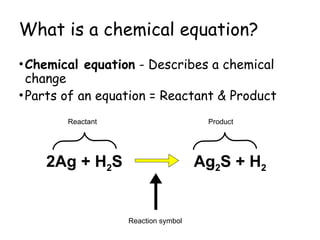
What is a chemical equation?
•Chemical equation - Describes a chemical
change
•Parts of an equation = Reactant & Product
2Ag + H2S Ag2S + H2
Reactant Product
Reaction symbol
Reactants and Products
•Reactant - The chemical(s)/element(s) you
start with before the reaction occurs
Think “Raw” Materials!
•Written on left side of equation…
•Where the “arrow” begins
•Product - The new chemical(s)/elements
formed by the reaction
•Right side of equation…
•Where the “arrow” points
Subscripts and Coefficients
• You should already know this from counting atoms!
• Subscript - shows how many atoms of an element are
in a molecule
• EX: H2
O
• 2 atoms of hydrogen (H)
• 1 atom of oxygen (O)
• Coefficient - shows how many molecules there are of
a particular chemical
• EX: 3 H2
O
• Means there are 3 water molecules.
A Chemical Reaction
•2H2
+ O2
 2H2
O
Law of Conservation of Mass
•You should know THIS, too!
•In a chemical reaction, matter is neither
created nor destroyed
•In other words, the number and type of
atoms going INTO a reaction MUST be
the same as the number and type of
atoms coming OUT
•If an equation obeys the Law of
Conservation, it is balanced.
An Unbalanced Equation
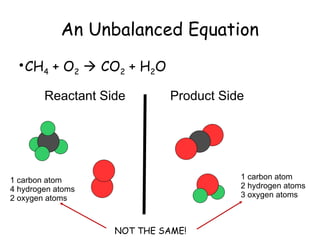
•CH4 + O2  CO2 + H2O
Reactant Side Product Side
1 carbon atom
4 hydrogen atoms
2 oxygen atoms
1 carbon atom
2 hydrogen atoms
3 oxygen atoms
NOT THE SAME!
A Balanced Equation

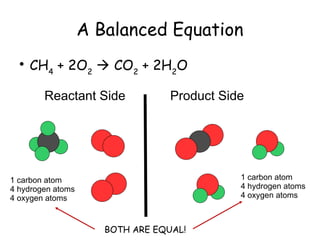
CH4
+ 2O2
 CO2
+ 2H2
O
Reactant Side Product Side
1 carbon atom
4 hydrogen atoms
4 oxygen atoms
1 carbon atom
4 hydrogen atoms
4 oxygen atoms
BOTH ARE EQUAL!
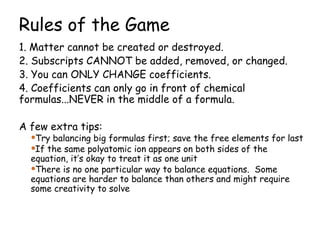
Rules of the Game
1. Matter cannot be created or destroyed.
2. Subscripts CANNOT be added, removed, or changed.
3. You can ONLY CHANGE coefficients.
4. Coefficients can only go in front of chemical
formulas...NEVER in the middle of a formula.
A few extra tips:
Try balancing big formulas first; save the free elements for last
If the same polyatomic ion appears on both sides of the
equation, it’s okay to treat it as one unit
There is no one particular way to balance equations. Some
equations are harder to balance than others and might require
some creativity to solve
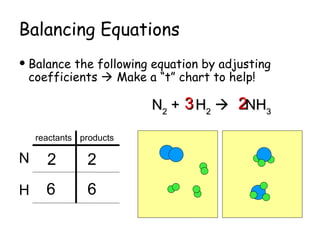
Balancing Equations
 Balance the following equation by adjusting
coefficients  Make a “t” chart to help!
reactants products
N
H
N
N2
2 + H
+ H2
2

 NH
NH3
3
2
2
1
3
2
2
2
6
3
3
6
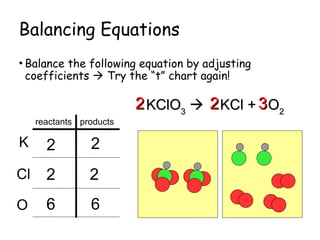
Balancing Equations
• Balance the following equation by adjusting
coefficients  Try the “t” chart again!
KClO
KClO3
3

 KCl + O
KCl + O2
2
reactants products
K
Cl
O
1
1
1
1
3 2
3
3
2
2
2
2
6 6
2
2
2
2
1
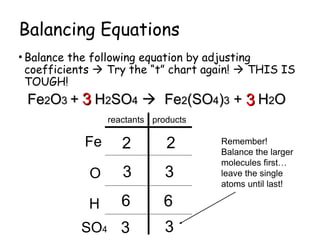
Balancing Equations
• Balance the following equation by adjusting
coefficients  Try the “t” chart again!  THIS IS
TOUGH!
Fe
Fe2
2O
O3
3 + H
+ H2
2SO
SO4
4 
 Fe
Fe2
2(SO
(SO4
4)
)3
3 + H
+ H2
2O
O
reactants products
Fe
O
H
2
3
2
1
2 2
3
3
3
3
3
6 6
3
SO4 3
Remember!
Balance the larger
molecules first…
leave the single
atoms until last!

Balancing chemical equation grade 10 notes

  • 1.
  • 2.
    What is achemical equation? •Chemical equation - Describes a chemical change •Parts of an equation = Reactant & Product 2Ag + H2S Ag2S + H2 Reactant Product Reaction symbol
  • 3.
    Reactants and Products •Reactant- The chemical(s)/element(s) you start with before the reaction occurs Think “Raw” Materials! •Written on left side of equation… •Where the “arrow” begins •Product - The new chemical(s)/elements formed by the reaction •Right side of equation… •Where the “arrow” points
  • 4.
    Subscripts and Coefficients •You should already know this from counting atoms! • Subscript - shows how many atoms of an element are in a molecule • EX: H2 O • 2 atoms of hydrogen (H) • 1 atom of oxygen (O) • Coefficient - shows how many molecules there are of a particular chemical • EX: 3 H2 O • Means there are 3 water molecules.
  • 5.
  • 6.
    Law of Conservationof Mass •You should know THIS, too! •In a chemical reaction, matter is neither created nor destroyed •In other words, the number and type of atoms going INTO a reaction MUST be the same as the number and type of atoms coming OUT •If an equation obeys the Law of Conservation, it is balanced.
  • 7.
    An Unbalanced Equation •CH4+ O2  CO2 + H2O Reactant Side Product Side 1 carbon atom 4 hydrogen atoms 2 oxygen atoms 1 carbon atom 2 hydrogen atoms 3 oxygen atoms NOT THE SAME!
  • 8.
    A Balanced Equation  CH4 +2O2  CO2 + 2H2 O Reactant Side Product Side 1 carbon atom 4 hydrogen atoms 4 oxygen atoms 1 carbon atom 4 hydrogen atoms 4 oxygen atoms BOTH ARE EQUAL!
  • 9.
    Rules of theGame 1. Matter cannot be created or destroyed. 2. Subscripts CANNOT be added, removed, or changed. 3. You can ONLY CHANGE coefficients. 4. Coefficients can only go in front of chemical formulas...NEVER in the middle of a formula. A few extra tips: Try balancing big formulas first; save the free elements for last If the same polyatomic ion appears on both sides of the equation, it’s okay to treat it as one unit There is no one particular way to balance equations. Some equations are harder to balance than others and might require some creativity to solve
  • 10.
    Balancing Equations  Balancethe following equation by adjusting coefficients  Make a “t” chart to help! reactants products N H N N2 2 + H + H2 2   NH NH3 3 2 2 1 3 2 2 2 6 3 3 6
  • 11.
    Balancing Equations • Balancethe following equation by adjusting coefficients  Try the “t” chart again! KClO KClO3 3   KCl + O KCl + O2 2 reactants products K Cl O 1 1 1 1 3 2 3 3 2 2 2 2 6 6 2 2 2 2
  • 12.
    1 Balancing Equations • Balancethe following equation by adjusting coefficients  Try the “t” chart again!  THIS IS TOUGH! Fe Fe2 2O O3 3 + H + H2 2SO SO4 4   Fe Fe2 2(SO (SO4 4) )3 3 + H + H2 2O O reactants products Fe O H 2 3 2 1 2 2 3 3 3 3 3 6 6 3 SO4 3 Remember! Balance the larger molecules first… leave the single atoms until last!