General Principles of Cell Injury
 The cellular response to injurious stimuli depends on:
 the type of injury, its duration, and its severity
 The consequences of cell injury depend on:
 the type and adaptability of the injured cell
 Cellular function is lost far before morphologic changes
of cell
 The “point of no return” at which cell death has
irreversibly occurred is difficult to determine
Possible Biochemical Mechanisms
of Cell Injury
1) ATP depletion.
2) Generation of reactive oxygen free radicals.
3) Loss of ca++ homeostasis.
4) Defect in plasma membrane permeability.
5) Mitochondrial damage.
1-ATP depletion
 ATP is essential for every cellular process :
-Maintanance of cell osmolarity
-Transport processs
-Protein synthesis
Therfore loss of ATP results in rapid shutdown
of most critical homeostatic pathways
2-Free Radical Mediation of Cell Injury
 Definition Of Free Radicals
Extremely unstable, highly reactive chemical species with a single
unpaired electron in an outer orbital
 In cells they attack and degrade nucleic acids, proteins, lipids and
carbohydrates
 They initiate autocalytic reaction, i.e. molecules that react with free
radicals are converted into free readicals
 Examples Of Free Radicals
 Hydroxyl (OH
.
)
 Hydrogen (H
.
)
 Superoxide (O2
.-
)
Free Radical Mediation of Cell Injury
 Free radicals constitutes an important mechanism of cell
injury
 It Contributes To:
 Chemical and radiation injury
 Oxygen and other gaseous toxicity
 Cellular aging
 Microbial killing by phagocytic cells
 Inflammatory damage
 Tumor destruction by macrophages
 Others
3-Increased Cytosolic Calcium:
 Sources
 mitochondria
 endoplasmic reticulum
 external to the cell
 Consequences (activates enzymes)
 ATPase
 decreased ATP
 phospholipase
 decreased phospholipids
 protease
 disruption of membrane and cytoskeletal proteins
 endonuclease
 nuclear chromatin damage
Increased Cytosolic Calcium, source and
consequences
4-Defects in Plasma membrane permeability:
 Causes :
1. Direct damage by toxins (bacterial,
viruses,complement,physical or chemical injury)
2. Damage secondary to ATPase loss or from calcium-
mediated phospholipase activation
 Effects:
Loss of Mb barriers breakdown of the concentration
gradient of metabolites
5-Mitochondrial damage
 Mitochondrial integrity if cruicial for cell
survival
Causes:
Increase Cytosolic calcium, free radicals
Effects:
No ATP generation
Release of cytochrome c into cytoplasm
Mechanisms of Cell Injury
1) ISCHEMIC & HYPOXIC INJURY
 Reversible injury
 Irreversible injury
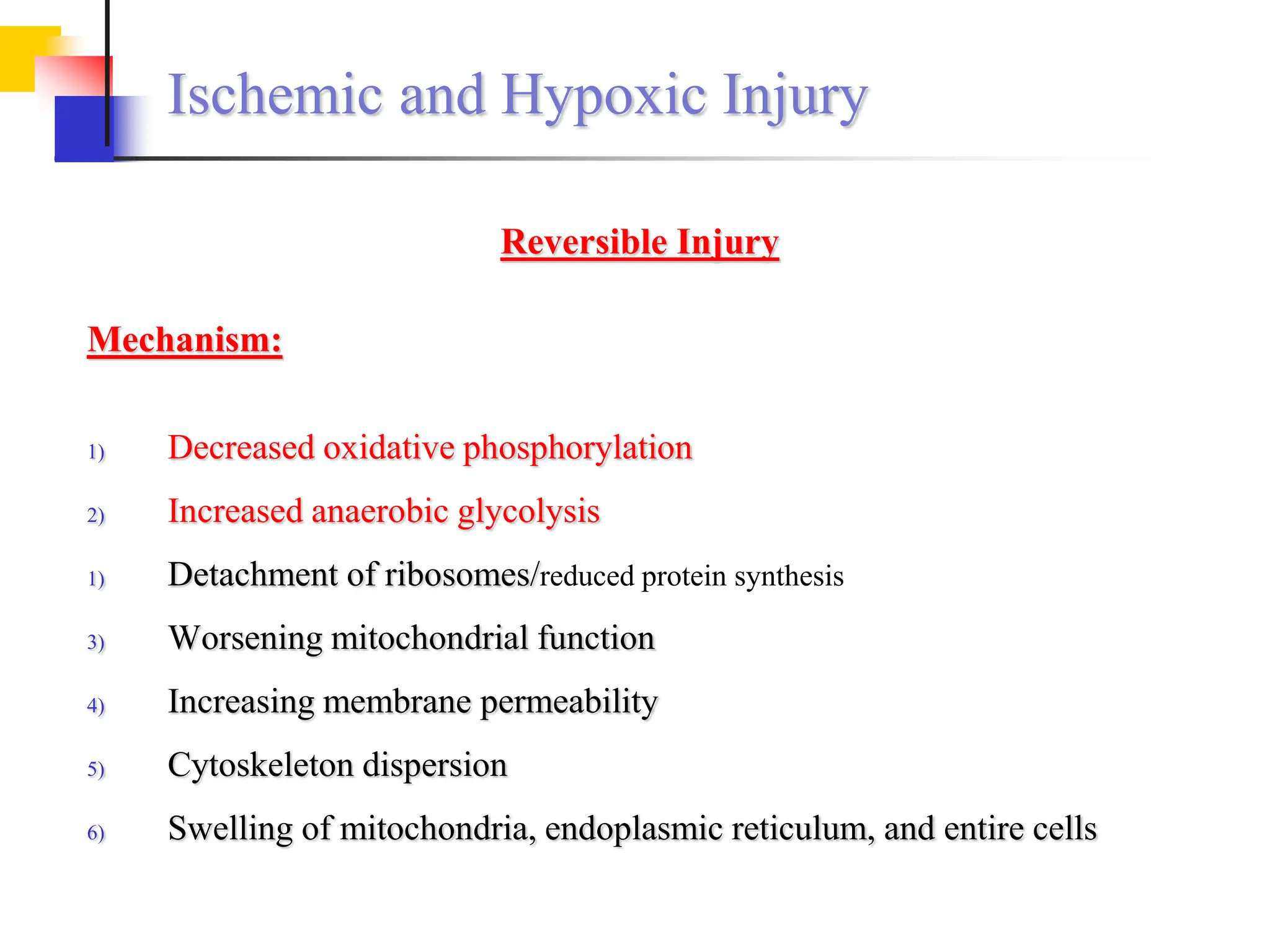
Ischemic and Hypoxic Injury
Reversible Injury
Mechanism:
1) Decreased oxidative phosphorylation
2) Increased anaerobic glycolysis
1) Detachment of ribosomes/reduced protein synthesis
3) Worsening mitochondrial function
4) Increasing membrane permeability
5) Cytoskeleton dispersion
6) Swelling of mitochondria, endoplasmic reticulum, and entire cells

general principle of cell energy12312.ppt

  • 1.
    General Principles ofCell Injury  The cellular response to injurious stimuli depends on:  the type of injury, its duration, and its severity  The consequences of cell injury depend on:  the type and adaptability of the injured cell  Cellular function is lost far before morphologic changes of cell  The “point of no return” at which cell death has irreversibly occurred is difficult to determine
  • 2.
    Possible Biochemical Mechanisms ofCell Injury 1) ATP depletion. 2) Generation of reactive oxygen free radicals. 3) Loss of ca++ homeostasis. 4) Defect in plasma membrane permeability. 5) Mitochondrial damage.
  • 3.
    1-ATP depletion  ATPis essential for every cellular process : -Maintanance of cell osmolarity -Transport processs -Protein synthesis Therfore loss of ATP results in rapid shutdown of most critical homeostatic pathways
  • 4.
    2-Free Radical Mediationof Cell Injury  Definition Of Free Radicals Extremely unstable, highly reactive chemical species with a single unpaired electron in an outer orbital  In cells they attack and degrade nucleic acids, proteins, lipids and carbohydrates  They initiate autocalytic reaction, i.e. molecules that react with free radicals are converted into free readicals  Examples Of Free Radicals  Hydroxyl (OH . )  Hydrogen (H . )  Superoxide (O2 .- )
  • 5.
    Free Radical Mediationof Cell Injury  Free radicals constitutes an important mechanism of cell injury  It Contributes To:  Chemical and radiation injury  Oxygen and other gaseous toxicity  Cellular aging  Microbial killing by phagocytic cells  Inflammatory damage  Tumor destruction by macrophages  Others
  • 6.
    3-Increased Cytosolic Calcium: Sources  mitochondria  endoplasmic reticulum  external to the cell  Consequences (activates enzymes)  ATPase  decreased ATP  phospholipase  decreased phospholipids  protease  disruption of membrane and cytoskeletal proteins  endonuclease  nuclear chromatin damage
  • 7.
    Increased Cytosolic Calcium,source and consequences
  • 8.
    4-Defects in Plasmamembrane permeability:  Causes : 1. Direct damage by toxins (bacterial, viruses,complement,physical or chemical injury) 2. Damage secondary to ATPase loss or from calcium- mediated phospholipase activation  Effects: Loss of Mb barriers breakdown of the concentration gradient of metabolites
  • 9.
    5-Mitochondrial damage  Mitochondrialintegrity if cruicial for cell survival Causes: Increase Cytosolic calcium, free radicals Effects: No ATP generation Release of cytochrome c into cytoplasm
  • 10.
    Mechanisms of CellInjury 1) ISCHEMIC & HYPOXIC INJURY  Reversible injury  Irreversible injury
  • 11.
    Ischemic and HypoxicInjury Reversible Injury Mechanism: 1) Decreased oxidative phosphorylation 2) Increased anaerobic glycolysis 1) Detachment of ribosomes/reduced protein synthesis 3) Worsening mitochondrial function 4) Increasing membrane permeability 5) Cytoskeleton dispersion 6) Swelling of mitochondria, endoplasmic reticulum, and entire cells