



The Basics of Capital Budgeting
12-1
Should we
build this
plant?
 Analysis of potential additions to fixed assets.
 Long-term decisions; involve large expenditures.
 Very important to firm’s future.
12-2
What is capital budgeting?
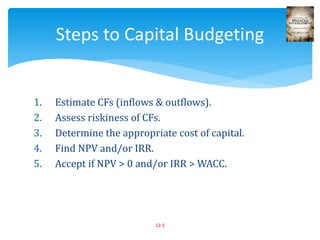
1. Estimate CFs (inflows & outflows).
2. Assess riskiness of CFs.
3. Determine the appropriate cost of capital.
4. Find NPV and/or IRR.
5. Accept if NPV > 0 and/or IRR > WACC.
12-3
Steps to Capital Budgeting
 Independent projects – if the cash flows of one are
unaffected by the acceptance of the other.
 Mutually exclusive projects – if the cash flows of one
can be adversely impacted by the acceptance of the
other.
12-4
What is the difference between independent and
mutually exclusive projects?
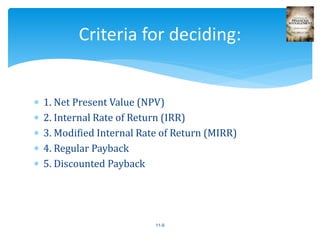
 1. Net Present Value (NPV)
 2. Internal Rate of Return (IRR)
 3. Modified Internal Rate of Return (MIRR)
 4. Regular Payback
 5. Discounted Payback
11-5
Criteria for deciding:
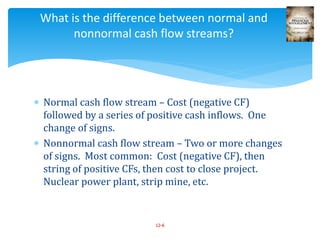
 Normal cash flow stream – Cost (negative CF)
followed by a series of positive cash inflows. One
change of signs.
 Nonnormal cash flow stream – Two or more changes
of signs. Most common: Cost (negative CF), then
string of positive CFs, then cost to close project.
Nuclear power plant, strip mine, etc.
12-6
What is the difference between normal and
nonnormal cash flow streams?
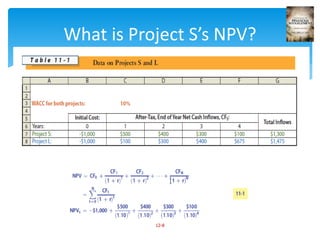
 Sum of the PVs of all cash inflows and outflows of a
project:
12-7
Net Present Value (NPV)
 

N
0t
t
t
)r1(
CF
NPV
12-8
What is Project S’s NPV?
11-9
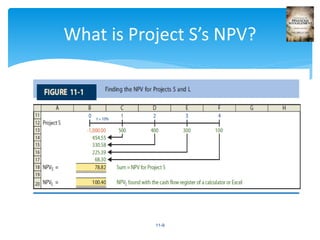
What is Project S’s NPV?
NPV = PV of inflows – Cost
= Net gain in wealth
 Independent projects: If NPV exceeds zero, accept the
project.
 Mutually exclusive projects: Accept the project with
the highest positive NPV.
 If no project has a positive NPV, reject them all.
12-10
Rationale for the NPV Method
 

N
0t
t
t
IRR)(1
CF
0
12-11
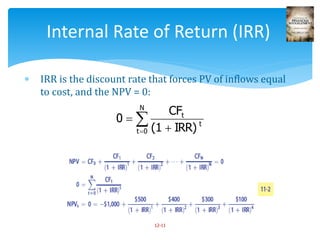
Internal Rate of Return (IRR)
 IRR is the discount rate that forces PV of inflows equal
to cost, and the NPV = 0:
 They are the same thing.
 Think of a bond as a project. The YTM on the bond
would be the IRR of the “bond” project.
12-12
How is a project’s IRR similar to a
bond’s YTM?
 Independent projects: If IRR exceeds the project’s
WACC, accept the project.
 If IRR is less than the project’s WACC, reject it.
 Mutually exclusive projects. Accept the project with
the highest IRR, provided that IRR is greater than
WACC. Reject all projects if the best IRR does not
exceed WACC.
12-13
Rationale for the IRR Method
12-14
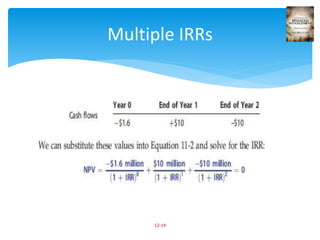
Multiple IRRs
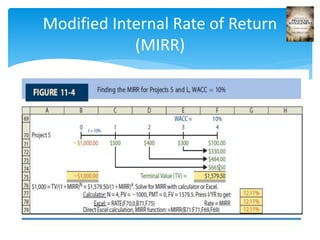
 The discount rate at which the present value
of a project’s cost is equal to the present value
of its terminal value, where the terminal
value is found as the sum of the future values
of the cash inflows, compounded at the firm’s
cost of capital.
11-15
Modified Internal Rate of Return
(MIRR)
11-16
Modified Internal Rate of Return
(MIRR)
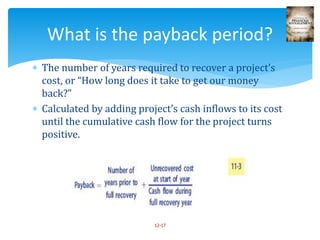
 The number of years required to recover a project’s
cost, or “How long does it take to get our money
back?”
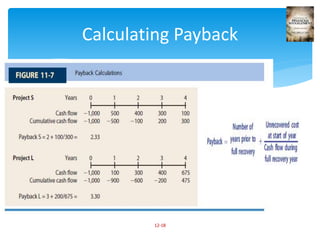
 Calculated by adding project’s cash inflows to its cost
until the cumulative cash flow for the project turns
positive.
12-17
What is the payback period?
12-18
Calculating Payback
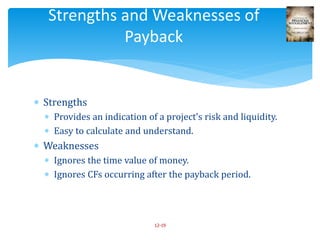
 Strengths
 Provides an indication of a project’s risk and liquidity.
 Easy to calculate and understand.
 Weaknesses
 Ignores the time value of money.
 Ignores CFs occurring after the payback period.
12-19
Strengths and Weaknesses of
Payback
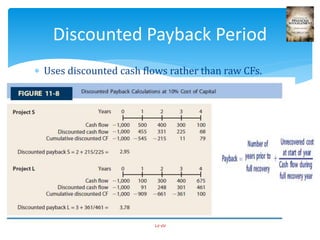
 Uses discounted cash flows rather than raw CFs.
12-20
Discounted Payback Period
11-21
Conclusions
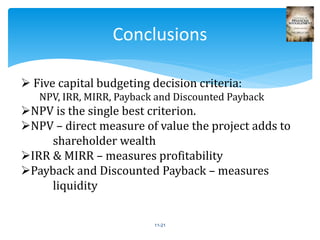
 Five capital budgeting decision criteria:
NPV, IRR, MIRR, Payback and Discounted Payback
NPV is the single best criterion.
NPV – direct measure of value the project adds to
shareholder wealth
IRR & MIRR – measures profitability
Payback and Discounted Payback – measures
liquidity
11-22
END

4 the basic of capital budgeting

  • 1.
    The Basics ofCapital Budgeting 12-1 Should we build this plant?
  • 2.
     Analysis ofpotential additions to fixed assets.  Long-term decisions; involve large expenditures.  Very important to firm’s future. 12-2 What is capital budgeting?
  • 3.
    1. Estimate CFs(inflows & outflows). 2. Assess riskiness of CFs. 3. Determine the appropriate cost of capital. 4. Find NPV and/or IRR. 5. Accept if NPV > 0 and/or IRR > WACC. 12-3 Steps to Capital Budgeting
  • 4.
     Independent projects– if the cash flows of one are unaffected by the acceptance of the other.  Mutually exclusive projects – if the cash flows of one can be adversely impacted by the acceptance of the other. 12-4 What is the difference between independent and mutually exclusive projects?
  • 5.
     1. NetPresent Value (NPV)  2. Internal Rate of Return (IRR)  3. Modified Internal Rate of Return (MIRR)  4. Regular Payback  5. Discounted Payback 11-5 Criteria for deciding:
  • 6.
     Normal cashflow stream – Cost (negative CF) followed by a series of positive cash inflows. One change of signs.  Nonnormal cash flow stream – Two or more changes of signs. Most common: Cost (negative CF), then string of positive CFs, then cost to close project. Nuclear power plant, strip mine, etc. 12-6 What is the difference between normal and nonnormal cash flow streams?
  • 7.
     Sum ofthe PVs of all cash inflows and outflows of a project: 12-7 Net Present Value (NPV)    N 0t t t )r1( CF NPV
  • 8.
  • 9.
  • 10.
    NPV = PVof inflows – Cost = Net gain in wealth  Independent projects: If NPV exceeds zero, accept the project.  Mutually exclusive projects: Accept the project with the highest positive NPV.  If no project has a positive NPV, reject them all. 12-10 Rationale for the NPV Method
  • 11.
       N 0t t t IRR)(1 CF 0 12-11 Internal Rateof Return (IRR)  IRR is the discount rate that forces PV of inflows equal to cost, and the NPV = 0:
  • 12.
     They arethe same thing.  Think of a bond as a project. The YTM on the bond would be the IRR of the “bond” project. 12-12 How is a project’s IRR similar to a bond’s YTM?
  • 13.
     Independent projects:If IRR exceeds the project’s WACC, accept the project.  If IRR is less than the project’s WACC, reject it.  Mutually exclusive projects. Accept the project with the highest IRR, provided that IRR is greater than WACC. Reject all projects if the best IRR does not exceed WACC. 12-13 Rationale for the IRR Method
  • 14.
  • 15.
     The discountrate at which the present value of a project’s cost is equal to the present value of its terminal value, where the terminal value is found as the sum of the future values of the cash inflows, compounded at the firm’s cost of capital. 11-15 Modified Internal Rate of Return (MIRR)
  • 16.
  • 17.
     The numberof years required to recover a project’s cost, or “How long does it take to get our money back?”  Calculated by adding project’s cash inflows to its cost until the cumulative cash flow for the project turns positive. 12-17 What is the payback period?
  • 18.
  • 19.
     Strengths  Providesan indication of a project’s risk and liquidity.  Easy to calculate and understand.  Weaknesses  Ignores the time value of money.  Ignores CFs occurring after the payback period. 12-19 Strengths and Weaknesses of Payback
  • 20.
     Uses discountedcash flows rather than raw CFs. 12-20 Discounted Payback Period
  • 21.
    11-21 Conclusions  Five capitalbudgeting decision criteria: NPV, IRR, MIRR, Payback and Discounted Payback NPV is the single best criterion. NPV – direct measure of value the project adds to shareholder wealth IRR & MIRR – measures profitability Payback and Discounted Payback – measures liquidity
  • 22.