FINANCIAL
PLANNING & FORECASTING
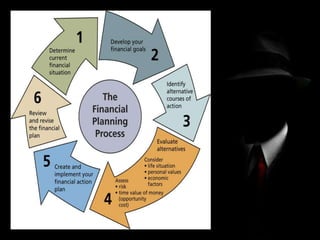
Financial Planning:-
Financial Planning is the process of estimating the capital required and
determining it’s competition. It is the process of framing financial
policies in relation to procurement, investment and administration of
funds of an enterprise.
Objectives of Financial Planning
To Determining capital requirements:-
This depend upon factors
- Cost of current and fixed assets,
- Promotional expenses,
- Range planning.
Capital requirements have to be looked with both aspects:
short- term and long- term requirements.
To Determining capital structure:-
The capital structure is the composition of capital,
This includes decisions of debt- equity ratio- both short-term and
long- term.
To Frame financial policies with regards to cash control, lending,
borrowings, etc.
A finance manager ensures that the scarce financial resources are
maximally utilized in the best possible manner at least cost in order to
get maximum returns on investment.
To Better Decision Making Process
Importance of Financial Planning
Financial Planning is process of framing objectives, policies, procedures, programmes
and budgets regarding the financial activities of a concern. This ensures effective and
adequate financial and investment policies.
The importance can be outlined as-
 Adequate funds have to be ensured.
 Financial Planning helps in ensuring a reasonable balance between outflow and
inflow of funds so that stability is maintained.
 Financial Planning ensures that the suppliers of funds are easily investing in
companies which exercise financial planning.
Financial Planning helps in making growth and expansion programmes
which helps in long-run survival of the company.
 Financial Planning reduces uncertainties with regards to changing market
trends which can be faced easily through enough funds.
 Financial Planning helps in reducing the uncertainties which can be a
hindrance to growth of the company.
 This helps in ensuring stability an d profitability in concern.
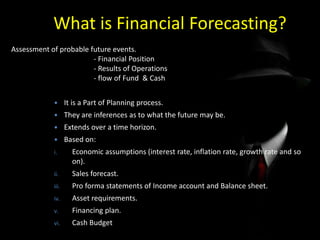
What is Financial Forecasting?
 It is a Part of Planning process.
 They are inferences as to what the future may be.
 Extends over a time horizon.
 Based on:
i. Economic assumptions (interest rate, inflation rate, growth rate and so
on).
ii. Sales forecast.
iii. Pro forma statements of Income account and Balance sheet.
iv. Asset requirements.
v. Financing plan.
vi. Cash Budget
Assessment of probable future events.
- Financial Position
- Results of Operations
- flow of Fund & Cash
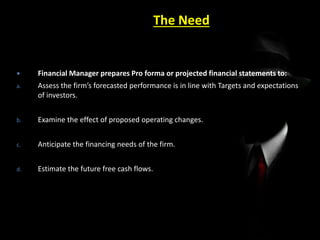
The Need
 Financial Manager prepares Pro forma or projected financial statements to:
a. Assess the firm’s forecasted performance is in line with Targets and expectations
of investors.
b. Examine the effect of proposed operating changes.
c. Anticipate the financing needs of the firm.
d. Estimate the future free cash flows.
Techniques of Financial projections
1. Regression Analysis
2. Pro-forma Financial Statements.
3. Po-forma of Budgets.
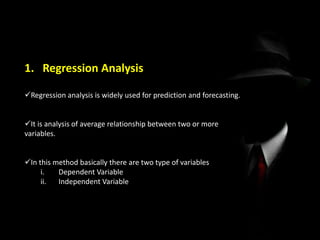
1. Regression Analysis
Regression analysis is widely used for prediction and forecasting.
It is analysis of average relationship between two or more
variables.
In this method basically there are two type of variables
i. Dependent Variable
ii. Independent Variable
2. Pro forma Financial Statements
 A comprehensive look at the likely future financial performance.
 Pro forma Income Statement. (Represents the operational plan for the
whole organization.)
 Pro forma Balance sheet. (Reflects the cumulative impact of anticipated
future decisions).
 Prepared with Hypothetical Financial Figures based on previous business operations.
Pro Forma Income Statements
Percent of Sales Method
 Assumes that future relationship between various elements of cost to sales will be similar
to their historical relationships.
 These cost ratios are generally based on the average of previous two or three years.
 Goods sold may be expressed as a percentage of Sales.
Budgeted Expense Method
 Estimate the expenses of each item on the basis of expected
developments in the future period for which the pro forma P&L a/c is
being prepared.
 Calls for greater effort on the part of Management, since they have to
define the likely happenings.
Combination method
 A combination of both methods work best.
 Items which have stable relationship to sales can be forecasted using the
Percent of sales method.
 For items where the future is likely to be very different from the past,
budgeted expense method can be used.
Functional Budgeting:-
Cash Budgets
Operational Budgets
Sales Budgets
 Budgeting
 Budget
 Long duration Forecasting - for Investment planning
3. Pro Forma of Budgets
Financial Planning and Forecasting

Financial Planning and Forecasting

  • 1.
  • 2.
    Financial Planning:- Financial Planningis the process of estimating the capital required and determining it’s competition. It is the process of framing financial policies in relation to procurement, investment and administration of funds of an enterprise. Objectives of Financial Planning To Determining capital requirements:- This depend upon factors - Cost of current and fixed assets, - Promotional expenses, - Range planning. Capital requirements have to be looked with both aspects: short- term and long- term requirements.
  • 3.
    To Determining capitalstructure:- The capital structure is the composition of capital, This includes decisions of debt- equity ratio- both short-term and long- term. To Frame financial policies with regards to cash control, lending, borrowings, etc. A finance manager ensures that the scarce financial resources are maximally utilized in the best possible manner at least cost in order to get maximum returns on investment. To Better Decision Making Process
  • 4.
    Importance of FinancialPlanning Financial Planning is process of framing objectives, policies, procedures, programmes and budgets regarding the financial activities of a concern. This ensures effective and adequate financial and investment policies. The importance can be outlined as-  Adequate funds have to be ensured.  Financial Planning helps in ensuring a reasonable balance between outflow and inflow of funds so that stability is maintained.  Financial Planning ensures that the suppliers of funds are easily investing in companies which exercise financial planning.
  • 5.
    Financial Planning helpsin making growth and expansion programmes which helps in long-run survival of the company.  Financial Planning reduces uncertainties with regards to changing market trends which can be faced easily through enough funds.  Financial Planning helps in reducing the uncertainties which can be a hindrance to growth of the company.  This helps in ensuring stability an d profitability in concern.
  • 7.
    What is FinancialForecasting?  It is a Part of Planning process.  They are inferences as to what the future may be.  Extends over a time horizon.  Based on: i. Economic assumptions (interest rate, inflation rate, growth rate and so on). ii. Sales forecast. iii. Pro forma statements of Income account and Balance sheet. iv. Asset requirements. v. Financing plan. vi. Cash Budget Assessment of probable future events. - Financial Position - Results of Operations - flow of Fund & Cash
  • 8.
    The Need  FinancialManager prepares Pro forma or projected financial statements to: a. Assess the firm’s forecasted performance is in line with Targets and expectations of investors. b. Examine the effect of proposed operating changes. c. Anticipate the financing needs of the firm. d. Estimate the future free cash flows.
  • 9.
    Techniques of Financialprojections 1. Regression Analysis 2. Pro-forma Financial Statements. 3. Po-forma of Budgets.
  • 10.
    1. Regression Analysis Regressionanalysis is widely used for prediction and forecasting. It is analysis of average relationship between two or more variables. In this method basically there are two type of variables i. Dependent Variable ii. Independent Variable
  • 11.
    2. Pro formaFinancial Statements  A comprehensive look at the likely future financial performance.  Pro forma Income Statement. (Represents the operational plan for the whole organization.)  Pro forma Balance sheet. (Reflects the cumulative impact of anticipated future decisions).  Prepared with Hypothetical Financial Figures based on previous business operations.
  • 12.
    Pro Forma IncomeStatements Percent of Sales Method  Assumes that future relationship between various elements of cost to sales will be similar to their historical relationships.  These cost ratios are generally based on the average of previous two or three years.  Goods sold may be expressed as a percentage of Sales.
  • 13.
    Budgeted Expense Method Estimate the expenses of each item on the basis of expected developments in the future period for which the pro forma P&L a/c is being prepared.  Calls for greater effort on the part of Management, since they have to define the likely happenings.
  • 14.
    Combination method  Acombination of both methods work best.  Items which have stable relationship to sales can be forecasted using the Percent of sales method.  For items where the future is likely to be very different from the past, budgeted expense method can be used.
  • 15.
    Functional Budgeting:- Cash Budgets OperationalBudgets Sales Budgets  Budgeting  Budget  Long duration Forecasting - for Investment planning 3. Pro Forma of Budgets