GROUP 1
 A Model of Legitimacy of Organizational Influence
 How Rights to Privacy Are Interpreted
 Bases for Discrimination at Work
 Using Discipline to Change Behaviors
 Quality of Work Life (QWL)
 Job Enrichment: Pros and Cons
 Mutual Individual-Organization
Responsibilities
 Whistle-Blowing as a Prosocial Behavior
1. Areas of Legitimate
Organizational Influence
2. Rights of Privacy
3. Discipline
 If the organization and an individual define
the boundaries of legitimate influence
differently, then organizational conflict is
likely to develop.
 Legitimate - conforming to the law or to
rules.
 Job Conduct
 Personal Activities off the job
 Off the Job Conduct
Type of Conduct
On-the-job
Off-the-job
Job Related Not Job Related
Job Relatedness
High
Legitimacy
Moderate
Legitimacy
Moderate
Legitimacy
Low
Legitimacy
 primarily related to organizational invasion of
a person’s private life and unauthorized
release of confidential information about a
person in a way that would cause emotional
harm or suffering.
 Lie detectors
 Personality tests
 Location trackers
 Medical examinations
 Treatment of alcoholism
 Monitoring of employee lifestyles
 Treatment of drug abuse
 Surveillance devices
 Computer data banks
 Confidential records
 Genetic screening
 Inquiry into personal relationships
 Relevance
– only necessary, useful information.
 Recency – Obsolete information.
 Notice – No personal data systemis
unknown.
 Fiduciary duty – keeper of the information.
 Confidentiality – secured information.
 Due process
 Protection of the psyche- inner self should
not be invaded.
 Is known to employees and has a compelling job
reason usually is not considered to be an undue
infringement on privacy.
Forms of Surveillance Devices
 Electronic sensor badges – microcomputers in clip-
on ID cards, which emit infrared signals.
 Electronic monitoring - it takes many forms,
including automatic counting of key strokes,
remote observations of the screen s of desktop
computer operators, surreptitious reading of
employee’s electronic mail, and voice recording
systems.
 Cybersurfing – activity done by employees who
use work time and work computers to surf the
Web, looking for wide range of information of
personal interest.
 Cyberloafers/Cyberslackers – called to those
employees who abuses their privileges.
 The Polygraph (Lie detector)
 – is an instrument that was developed to
record those changes and provide evidence of
lying.
 Paper and Pencil Tests
– also known as integrity tests, attempt to get
the respondent to disclose information about
his or her previous or prospective honesty.
 Since alcoholism presents major medical and job
problems, employers need to develop responsible
policies and programs to deal with it without
endangering rights of privacy.
Reasons for Company Programs
 The firm and employee already have a working
relationship on which they can build.
 Any success with the employee will save both
a valuable person for the company and a
valuable citizen for society.
 The job appears to be the best environment
for supporting recovery.
Successful Programs
 treat alcoholism as an illness
 focus on the behavior caused by alcoholism
 provide both medical help and psychological
support for alcoholics
 Abuse of drugs other than alcohol,
particularly if used at work, may cause
severe problems for the individual, the
employer, and other employees.
 Drug Testing
- To employers, the direct
consequences of employee drug abuse
are enormous.
Impairment testing
- A solution to the problems with drug
testing.
- this method usually consists of a brief
motor-skills test performed on a computer
Positive uses of genetic testing
 information include transferring the
susceptible employees to other work areas
where they will not be exposed to the
substances, providing health warnings, and
developing protective measures to shield the
employees from danger.
Negative side of genetic testing
 comes into play when a firm screens present
employees or job applicants on the basis of
genetic predispositions and uses the
information o discriminate against them in an
attempt to minimize the firm’s future health
costs.
Sexual harassment
 When supervisors make employment or promotion
decisions contingent on sexual favors.
 When an employee’s colleagues engage in any
verbal or physical conduct that creates an offensive
working environment.
Acquired immune deficiency syndrome (AIDS)
 is a deadly virus affecting the human
immune system.
 is management action to enforce
organizational standards.
2 Types of Discipline
Preventive discipline
 is action taken to encourage employees to
follow standards and rules so that infractions
do not occur.
Corrective discipline
 is action that follows infraction of a rule;
 it seeks to discourage further infractions so
that future acts will be in compliance with
standards.
 What is quality of work life (QWL) ?
 - refers to the favorableness or
unfavorableness of total job environment for
people.
 A progressive Discipline System
Written reprimand,
with record in
personnel file
Verbal reprimand by
supervisor
One-to three day
suspension from work
Discharge for causeSuspension for one
week or longer
 The modern interest in quality of work life
was stimulated through efforts to change the
scope of people’s jobs in attempting to
motivate them.
o Breadth
o Depth
Job Breadth
 is the number of different task an individual
is directly responsible for.
Job Enlargement
- It is a process where Employees with narrow job
breadth were sometimes given a wider variety of
duties in order to reduce their monotony.
- It provides breadth.
Job Enrichment
- It was developed by Frederick Herzberg on the
basis of his studies indicating that the most
effective way to motivate workers was by focusing
on higher-order needs.
- It provides depth.
Difference between Job Enrichment and Job Enlargement
Higher-
order
Lower-
order
Few Many
Number of tasks
(Focus on breadth)
Job
enrichment
Routine
job
Job
enlargement
Job
Enrichment
and
Enlargement
Accentonneeds
(Focusondepth)
 Applying Job Enrichment
- Viewed in terms of Herzberg’s motivational factors, job
enrichment occurs when the work itself is more challenging,
when achievement is encouraged, when there is opportunity
for growth, and when responsibility, feedback, and recognition
are provided.
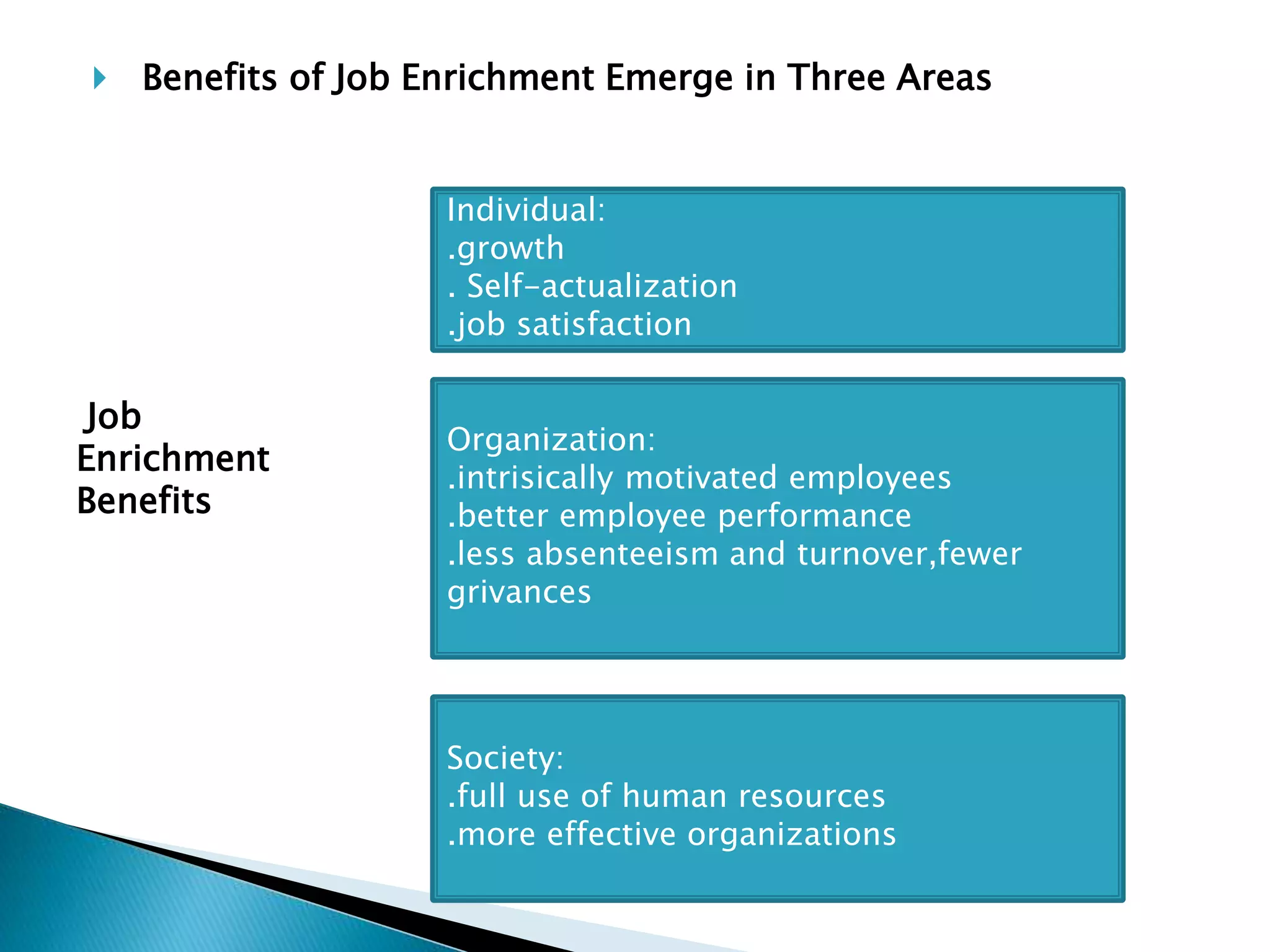
Individual:
.growth
. Self-actualization
.job satisfaction
 Benefits of Job Enrichment Emerge in Three Areas
Organization:
.intrisically motivated employees
.better employee performance
.less absenteeism and turnover,fewer
grivances
Society:
.full use of human resources
.more effective organizations
Job
Enrichment
Benefits
 Core dimensions: A Job
Characteristics Approach
Five Core Dimensions :
 Skill Variety-allows employees to perform
different operations that often require
different skills.
 Task Identity- allows employees perform a
complete piece of work.
 Task Significance-refers to the amount of
impact, as perceived by the worker, that the work
has on other people.
 Autonomy- job characteristic that gives
employees some discretion and control over job-
related decisions and it appears to be
fundamental in building a sense of responsibility
in workers
 .
 Feedback- refers to information that tells
workers how well they are performing.
 Managers can then take action to increase
one or more of the five factors to enrich the
job.
 Jobs that have been enriched increase the
probability of high motivation, provided that
employees
Con’t
o Have adequate job knowledge and skills
o Desire to learn, grow, and develop
o Are satisfied with their work environment
(are not distracted by negative hygiene)
 One explanation for the lack of predicted
changes from enrichment lies in the presence
of social cues, which are often rather subtle
bits of information workers receive from their
social surroundings. These social cues may
come from co-workers , leaders. Other
organizational members, customers and
family.
 Objective task
Characteristic
 Social cues:
 .supporting
 .counteracting
 Perceived task characteristics
 (e.g. skill variety)
 Employee attitudes and
behaviors
 Some workers may not want enriched jobs.
 If they are unable to tolerate increased
responsibility
 Dislike more complex duties
 If their skills are not adaptable etc…….
 Expensive equipment may not be adaptable
 The program may unbalance the production
system
 Supervisor or staff roles may be reduced
 Enriched jobs may increase pay dissatisfaction
 Costs may increase
 Unions may oppose some enrichment efforts
 Organizational Citizenship
 Dues-Paying
 Mutual Trust
Presented by :
GROUP ONE
Ms. Teodosio
Ms. Valeroso
Ms. Valenzuela
Ms. Velasquez
Ms. Vergara
Ms. Vineles
Mr. Zhu
THANK YOU!!!

Issues between organizations and individuals

  • 1.
  • 2.
     A Modelof Legitimacy of Organizational Influence  How Rights to Privacy Are Interpreted  Bases for Discrimination at Work  Using Discipline to Change Behaviors  Quality of Work Life (QWL)  Job Enrichment: Pros and Cons  Mutual Individual-Organization Responsibilities  Whistle-Blowing as a Prosocial Behavior
  • 3.
    1. Areas ofLegitimate Organizational Influence 2. Rights of Privacy 3. Discipline
  • 4.
     If theorganization and an individual define the boundaries of legitimate influence differently, then organizational conflict is likely to develop.
  • 5.
     Legitimate -conforming to the law or to rules.  Job Conduct  Personal Activities off the job  Off the Job Conduct
  • 6.
    Type of Conduct On-the-job Off-the-job JobRelated Not Job Related Job Relatedness High Legitimacy Moderate Legitimacy Moderate Legitimacy Low Legitimacy
  • 7.
     primarily relatedto organizational invasion of a person’s private life and unauthorized release of confidential information about a person in a way that would cause emotional harm or suffering.
  • 8.
     Lie detectors Personality tests  Location trackers  Medical examinations  Treatment of alcoholism  Monitoring of employee lifestyles  Treatment of drug abuse  Surveillance devices  Computer data banks  Confidential records  Genetic screening  Inquiry into personal relationships
  • 9.
     Relevance – onlynecessary, useful information.  Recency – Obsolete information.  Notice – No personal data systemis unknown.  Fiduciary duty – keeper of the information.  Confidentiality – secured information.  Due process  Protection of the psyche- inner self should not be invaded.
  • 10.
     Is knownto employees and has a compelling job reason usually is not considered to be an undue infringement on privacy. Forms of Surveillance Devices  Electronic sensor badges – microcomputers in clip- on ID cards, which emit infrared signals.
  • 11.
     Electronic monitoring- it takes many forms, including automatic counting of key strokes, remote observations of the screen s of desktop computer operators, surreptitious reading of employee’s electronic mail, and voice recording systems.  Cybersurfing – activity done by employees who use work time and work computers to surf the Web, looking for wide range of information of personal interest.  Cyberloafers/Cyberslackers – called to those employees who abuses their privileges.
  • 12.
     The Polygraph(Lie detector)  – is an instrument that was developed to record those changes and provide evidence of lying.  Paper and Pencil Tests – also known as integrity tests, attempt to get the respondent to disclose information about his or her previous or prospective honesty.
  • 14.
     Since alcoholismpresents major medical and job problems, employers need to develop responsible policies and programs to deal with it without endangering rights of privacy.
  • 15.
    Reasons for CompanyPrograms  The firm and employee already have a working relationship on which they can build.  Any success with the employee will save both a valuable person for the company and a valuable citizen for society.
  • 16.
     The jobappears to be the best environment for supporting recovery. Successful Programs  treat alcoholism as an illness  focus on the behavior caused by alcoholism  provide both medical help and psychological support for alcoholics
  • 18.
     Abuse ofdrugs other than alcohol, particularly if used at work, may cause severe problems for the individual, the employer, and other employees.  Drug Testing - To employers, the direct consequences of employee drug abuse are enormous.
  • 19.
    Impairment testing - Asolution to the problems with drug testing. - this method usually consists of a brief motor-skills test performed on a computer
  • 20.
    Positive uses ofgenetic testing  information include transferring the susceptible employees to other work areas where they will not be exposed to the substances, providing health warnings, and developing protective measures to shield the employees from danger.
  • 21.
    Negative side ofgenetic testing  comes into play when a firm screens present employees or job applicants on the basis of genetic predispositions and uses the information o discriminate against them in an attempt to minimize the firm’s future health costs.
  • 22.
    Sexual harassment  Whensupervisors make employment or promotion decisions contingent on sexual favors.  When an employee’s colleagues engage in any verbal or physical conduct that creates an offensive working environment.
  • 24.
    Acquired immune deficiencysyndrome (AIDS)  is a deadly virus affecting the human immune system.
  • 25.
     is managementaction to enforce organizational standards.
  • 26.
    2 Types ofDiscipline Preventive discipline  is action taken to encourage employees to follow standards and rules so that infractions do not occur.
  • 27.
    Corrective discipline  isaction that follows infraction of a rule;  it seeks to discourage further infractions so that future acts will be in compliance with standards.
  • 28.
     What isquality of work life (QWL) ?  - refers to the favorableness or unfavorableness of total job environment for people.
  • 29.
     A progressiveDiscipline System Written reprimand, with record in personnel file Verbal reprimand by supervisor One-to three day suspension from work Discharge for causeSuspension for one week or longer
  • 30.
     The moderninterest in quality of work life was stimulated through efforts to change the scope of people’s jobs in attempting to motivate them.
  • 31.
    o Breadth o Depth JobBreadth  is the number of different task an individual is directly responsible for.
  • 32.
    Job Enlargement - Itis a process where Employees with narrow job breadth were sometimes given a wider variety of duties in order to reduce their monotony. - It provides breadth.
  • 33.
    Job Enrichment - Itwas developed by Frederick Herzberg on the basis of his studies indicating that the most effective way to motivate workers was by focusing on higher-order needs. - It provides depth.
  • 34.
    Difference between JobEnrichment and Job Enlargement Higher- order Lower- order Few Many Number of tasks (Focus on breadth) Job enrichment Routine job Job enlargement Job Enrichment and Enlargement Accentonneeds (Focusondepth)
  • 35.
     Applying JobEnrichment - Viewed in terms of Herzberg’s motivational factors, job enrichment occurs when the work itself is more challenging, when achievement is encouraged, when there is opportunity for growth, and when responsibility, feedback, and recognition are provided.
  • 36.
    Individual: .growth . Self-actualization .job satisfaction Benefits of Job Enrichment Emerge in Three Areas Organization: .intrisically motivated employees .better employee performance .less absenteeism and turnover,fewer grivances Society: .full use of human resources .more effective organizations Job Enrichment Benefits
  • 37.
     Core dimensions:A Job Characteristics Approach Five Core Dimensions :  Skill Variety-allows employees to perform different operations that often require different skills.
  • 38.
     Task Identity-allows employees perform a complete piece of work.  Task Significance-refers to the amount of impact, as perceived by the worker, that the work has on other people.  Autonomy- job characteristic that gives employees some discretion and control over job- related decisions and it appears to be fundamental in building a sense of responsibility in workers  .  Feedback- refers to information that tells workers how well they are performing.
  • 39.
     Managers canthen take action to increase one or more of the five factors to enrich the job.  Jobs that have been enriched increase the probability of high motivation, provided that employees
  • 40.
    Con’t o Have adequatejob knowledge and skills o Desire to learn, grow, and develop o Are satisfied with their work environment (are not distracted by negative hygiene)
  • 41.
     One explanationfor the lack of predicted changes from enrichment lies in the presence of social cues, which are often rather subtle bits of information workers receive from their social surroundings. These social cues may come from co-workers , leaders. Other organizational members, customers and family.
  • 42.
     Objective task Characteristic Social cues:  .supporting  .counteracting  Perceived task characteristics  (e.g. skill variety)  Employee attitudes and behaviors
  • 43.
     Some workersmay not want enriched jobs.  If they are unable to tolerate increased responsibility  Dislike more complex duties  If their skills are not adaptable etc…….
  • 44.
     Expensive equipmentmay not be adaptable  The program may unbalance the production system  Supervisor or staff roles may be reduced  Enriched jobs may increase pay dissatisfaction  Costs may increase  Unions may oppose some enrichment efforts
  • 45.
     Organizational Citizenship Dues-Paying  Mutual Trust
  • 46.
    Presented by : GROUPONE Ms. Teodosio Ms. Valeroso Ms. Valenzuela Ms. Velasquez Ms. Vergara Ms. Vineles Mr. Zhu THANK YOU!!!