13 - 1
Copyright © 2002 Harcourt, Inc. All rights reserved.
Should we
build this
plant?
The Basics of Capital Budgeting:
Evaluating Cash Flows
13 - 2
Copyright © 2002 Harcourt, Inc. All rights reserved.
What is capital budgeting?
Analysis of potential additions to
fixed assets.
Long-term decisions; involve large
expenditures.
Very important to firm’s future.
Investment is made in present times
13 - 3
Copyright © 2002 Harcourt, Inc. All rights reserved.
 Evaluate expenditure decisions
benefit of which may accrue for more
than one year
Irreversible
Effect for longer period
Lot of funds are required
13 - 4
Copyright © 2002 Harcourt, Inc. All rights reserved.
What is the difference between
independent and mutually exclusive
projects?
Projects are:
independent
mutually exclusive
13 - 5
Copyright © 2002 Harcourt, Inc. All rights reserved.
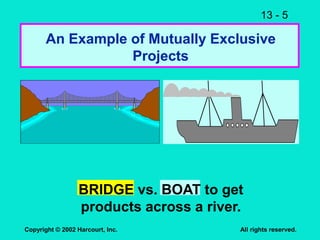
An Example of Mutually Exclusive
Projects
BRIDGE vs. BOAT to get
products across a river.
13 - 6
Copyright © 2002 Harcourt, Inc. All rights reserved.
Normal Cash Flow Project:
Cost (negative CF) followed by a
series of positive cash inflows.
One change of signs.
Nonnormal Cash Flow Project:
Two or more changes of signs.
Most common: Cost (negative
CF), then string of positive CFs,
then again negative CF
.
13 - 7
Copyright © 2002 Harcourt, Inc. All rights reserved.
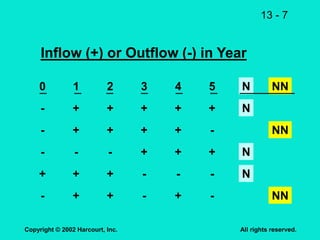
Inflow (+) or Outflow (-) in Year
0 1 2 3 4 5 N NN
- + + + + + N
- + + + + - NN
- - - + + + N
+ + + - - - N
- + + - + - NN
13 - 8
Copyright © 2002 Harcourt, Inc. All rights reserved.
What is the payback period?
The number of years required to
recover a project’s cost,
or how long does it take to get the
business’s money back?
13 - 9
Copyright © 2002 Harcourt, Inc. All rights reserved.
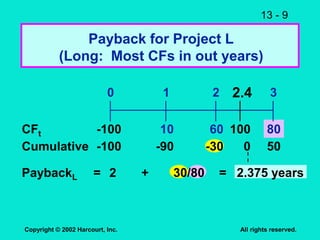
Payback for Project L
(Long: Most CFs in out years)
10 80
60
0 1 2 3
-100
=
CFt
Cumulative -100 -90 -30 50
PaybackL 2 + 30/80 = 2.375 years
0
100
2.4
13 - 10
Copyright © 2002 Harcourt, Inc. All rights reserved.
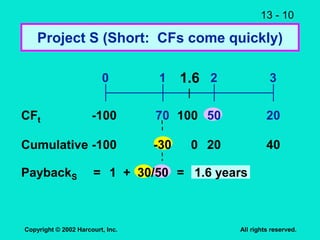
Project S (Short: CFs come quickly)
70 20
50
0 1 2 3
-100
CFt
Cumulative -100 -30 20 40
PaybackS 1 + 30/50 = 1.6 years
100
0
1.6
=
13 - 11
Copyright © 2002 Harcourt, Inc. All rights reserved.
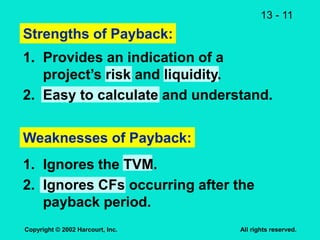
Strengths of Payback:
1. Provides an indication of a
project’s risk and liquidity.
2. Easy to calculate and understand.
Weaknesses of Payback:
1. Ignores the TVM.
2. Ignores CFs occurring after the
payback period.
13 - 12
Copyright © 2002 Harcourt, Inc. All rights reserved.
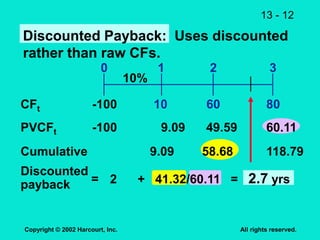
10 80
60
0 1 2 3
CFt
Cumulative 9.09 58.68 118.79
Discounted
payback 2 + 41.32/60.11 = 2.7 yrs
Discounted Payback: Uses discounted
rather than raw CFs.
PVCFt -100
-100
10%
9.09 49.59 60.11
=
13 - 13
Copyright © 2002 Harcourt, Inc. All rights reserved.
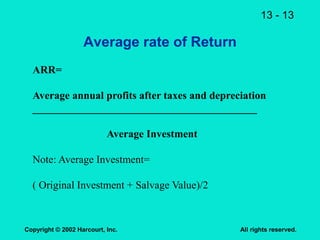
Average rate of Return
ARR=
Average annual profits after taxes and depreciation
__________________________________________
Average Investment
Note: Average Investment=
( Original Investment + Salvage Value)/2
13 - 14
Copyright © 2002 Harcourt, Inc. All rights reserved.
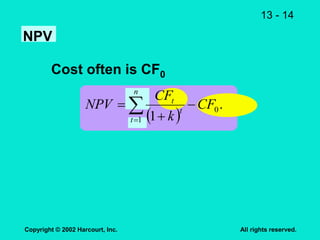
NPV
Cost often is CF0
 
.
1
0
1
CF
k
CF
NPV t
t
n
t


 

13 - 15
Copyright © 2002 Harcourt, Inc. All rights reserved.
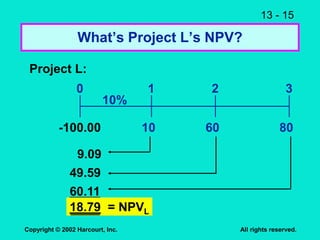
What’s Project L’s NPV?
10 80
60
0 1 2 3
10%
Project L:
-100.00
9.09
49.59
60.11
18.79 = NPVL
13 - 16
Copyright © 2002 Harcourt, Inc. All rights reserved.
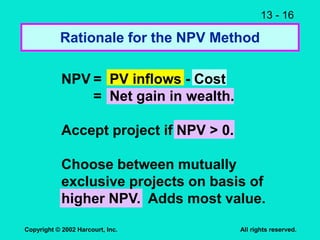
Rationale for the NPV Method
NPV = PV inflows - Cost
= Net gain in wealth.
Accept project if NPV > 0.
Choose between mutually
exclusive projects on basis of
higher NPV. Adds most value.
13 - 17
Copyright © 2002 Harcourt, Inc. All rights reserved.
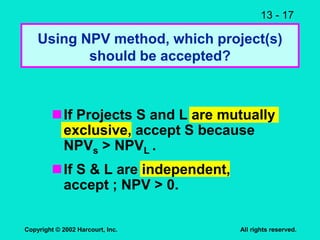
Using NPV method, which project(s)
should be accepted?
If Projects S and L are mutually
exclusive, accept S because
NPVs > NPVL .
If S & L are independent,
accept ; NPV > 0.
13 - 18
Copyright © 2002 Harcourt, Inc. All rights reserved.
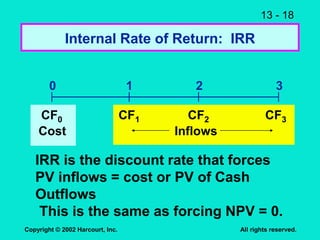
Internal Rate of Return: IRR
0 1 2 3
CF0 CF1 CF2 CF3
Cost Inflows
IRR is the discount rate that forces
PV inflows = cost or PV of Cash
Outflows
This is the same as forcing NPV = 0.
13 - 19
Copyright © 2002 Harcourt, Inc. All rights reserved.
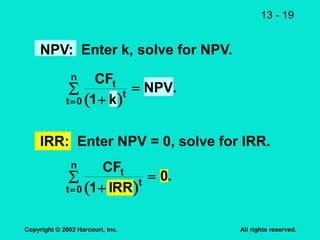
 
t
n
t
t
CF
k
NPV




0 1
.
 
t
n
t
t
CF
IRR




0 1
0.
NPV: Enter k, solve for NPV.
IRR: Enter NPV = 0, solve for IRR.
13 - 20
Copyright © 2002 Harcourt, Inc. All rights reserved.
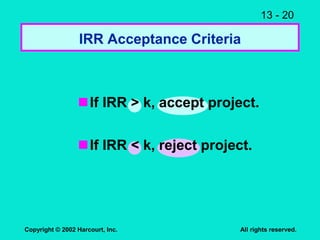
IRR Acceptance Criteria
If IRR > k, accept project.
If IRR < k, reject project.
13 - 21
Copyright © 2002 Harcourt, Inc. All rights reserved.
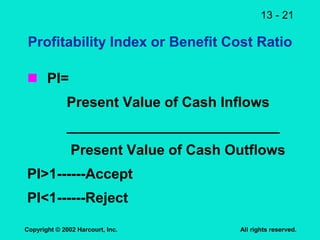
Profitability Index or Benefit Cost Ratio
 PI=
Present Value of Cash Inflows
___________________________
Present Value of Cash Outflows
PI>1------Accept
PI<1------Reject
13 - 22
Copyright © 2002 Harcourt, Inc. All rights reserved.
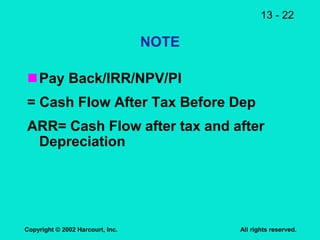
NOTE
Pay Back/IRR/NPV/PI
= Cash Flow After Tax Before Dep
ARR= Cash Flow after tax and after
Depreciation

Additional File-Capital Budgeting 3.ppt

  • 1.
    13 - 1 Copyright© 2002 Harcourt, Inc. All rights reserved. Should we build this plant? The Basics of Capital Budgeting: Evaluating Cash Flows
  • 2.
    13 - 2 Copyright© 2002 Harcourt, Inc. All rights reserved. What is capital budgeting? Analysis of potential additions to fixed assets. Long-term decisions; involve large expenditures. Very important to firm’s future. Investment is made in present times
  • 3.
    13 - 3 Copyright© 2002 Harcourt, Inc. All rights reserved.  Evaluate expenditure decisions benefit of which may accrue for more than one year Irreversible Effect for longer period Lot of funds are required
  • 4.
    13 - 4 Copyright© 2002 Harcourt, Inc. All rights reserved. What is the difference between independent and mutually exclusive projects? Projects are: independent mutually exclusive
  • 5.
    13 - 5 Copyright© 2002 Harcourt, Inc. All rights reserved. An Example of Mutually Exclusive Projects BRIDGE vs. BOAT to get products across a river.
  • 6.
    13 - 6 Copyright© 2002 Harcourt, Inc. All rights reserved. Normal Cash Flow Project: Cost (negative CF) followed by a series of positive cash inflows. One change of signs. Nonnormal Cash Flow Project: Two or more changes of signs. Most common: Cost (negative CF), then string of positive CFs, then again negative CF .
  • 7.
    13 - 7 Copyright© 2002 Harcourt, Inc. All rights reserved. Inflow (+) or Outflow (-) in Year 0 1 2 3 4 5 N NN - + + + + + N - + + + + - NN - - - + + + N + + + - - - N - + + - + - NN
  • 8.
    13 - 8 Copyright© 2002 Harcourt, Inc. All rights reserved. What is the payback period? The number of years required to recover a project’s cost, or how long does it take to get the business’s money back?
  • 9.
    13 - 9 Copyright© 2002 Harcourt, Inc. All rights reserved. Payback for Project L (Long: Most CFs in out years) 10 80 60 0 1 2 3 -100 = CFt Cumulative -100 -90 -30 50 PaybackL 2 + 30/80 = 2.375 years 0 100 2.4
  • 10.
    13 - 10 Copyright© 2002 Harcourt, Inc. All rights reserved. Project S (Short: CFs come quickly) 70 20 50 0 1 2 3 -100 CFt Cumulative -100 -30 20 40 PaybackS 1 + 30/50 = 1.6 years 100 0 1.6 =
  • 11.
    13 - 11 Copyright© 2002 Harcourt, Inc. All rights reserved. Strengths of Payback: 1. Provides an indication of a project’s risk and liquidity. 2. Easy to calculate and understand. Weaknesses of Payback: 1. Ignores the TVM. 2. Ignores CFs occurring after the payback period.
  • 12.
    13 - 12 Copyright© 2002 Harcourt, Inc. All rights reserved. 10 80 60 0 1 2 3 CFt Cumulative 9.09 58.68 118.79 Discounted payback 2 + 41.32/60.11 = 2.7 yrs Discounted Payback: Uses discounted rather than raw CFs. PVCFt -100 -100 10% 9.09 49.59 60.11 =
  • 13.
    13 - 13 Copyright© 2002 Harcourt, Inc. All rights reserved. Average rate of Return ARR= Average annual profits after taxes and depreciation __________________________________________ Average Investment Note: Average Investment= ( Original Investment + Salvage Value)/2
  • 14.
    13 - 14 Copyright© 2002 Harcourt, Inc. All rights reserved. NPV Cost often is CF0   . 1 0 1 CF k CF NPV t t n t     
  • 15.
    13 - 15 Copyright© 2002 Harcourt, Inc. All rights reserved. What’s Project L’s NPV? 10 80 60 0 1 2 3 10% Project L: -100.00 9.09 49.59 60.11 18.79 = NPVL
  • 16.
    13 - 16 Copyright© 2002 Harcourt, Inc. All rights reserved. Rationale for the NPV Method NPV = PV inflows - Cost = Net gain in wealth. Accept project if NPV > 0. Choose between mutually exclusive projects on basis of higher NPV. Adds most value.
  • 17.
    13 - 17 Copyright© 2002 Harcourt, Inc. All rights reserved. Using NPV method, which project(s) should be accepted? If Projects S and L are mutually exclusive, accept S because NPVs > NPVL . If S & L are independent, accept ; NPV > 0.
  • 18.
    13 - 18 Copyright© 2002 Harcourt, Inc. All rights reserved. Internal Rate of Return: IRR 0 1 2 3 CF0 CF1 CF2 CF3 Cost Inflows IRR is the discount rate that forces PV inflows = cost or PV of Cash Outflows This is the same as forcing NPV = 0.
  • 19.
    13 - 19 Copyright© 2002 Harcourt, Inc. All rights reserved.   t n t t CF k NPV     0 1 .   t n t t CF IRR     0 1 0. NPV: Enter k, solve for NPV. IRR: Enter NPV = 0, solve for IRR.
  • 20.
    13 - 20 Copyright© 2002 Harcourt, Inc. All rights reserved. IRR Acceptance Criteria If IRR > k, accept project. If IRR < k, reject project.
  • 21.
    13 - 21 Copyright© 2002 Harcourt, Inc. All rights reserved. Profitability Index or Benefit Cost Ratio  PI= Present Value of Cash Inflows ___________________________ Present Value of Cash Outflows PI>1------Accept PI<1------Reject
  • 22.
    13 - 22 Copyright© 2002 Harcourt, Inc. All rights reserved. NOTE Pay Back/IRR/NPV/PI = Cash Flow After Tax Before Dep ARR= Cash Flow after tax and after Depreciation