Accounting Standards
Presentation on Accounting StandardsTeam 4AS 9 : Revenue Recognition
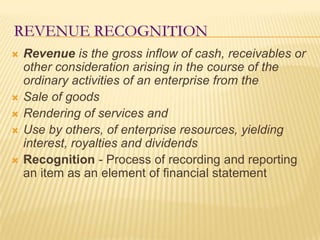
Revenue RecognitionRevenue is the gross inflow of cash, receivables or other consideration arising in the course of the ordinary activities of an enterprise from the Sale of goodsRendering of services andUse by others, of enterprise resources, yielding interest, royalties and dividendsRecognition - Process of recording and reporting an item as an element of financial statement
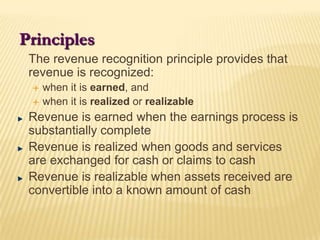
Principles	The revenue recognition principle provides that revenue is recognized:when it is earned, andwhen it is realized or realizableRevenue is earned when the earnings process is substantially completeRevenue is realized when goods and services are exchanged for cash or claims to cashRevenue is realizable when assets received are convertible into a known amount of cash
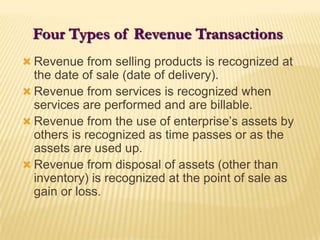
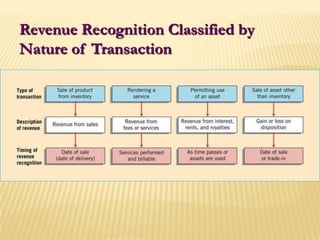
Four Types of Revenue TransactionsRevenue from selling products is recognized at the date of sale (date of delivery).Revenue from services is recognized when services are performed and are billable.Revenue from the use of enterprise’s assets by others is recognized as time passes or as the assets are used up.Revenue from disposal of assets (other than inventory) is recognized at the point of sale as gain or loss.
Revenue Recognition Classified by Nature of Transaction
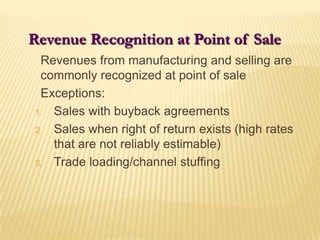
Revenue Recognition at Point of Sale	Revenues from manufacturing and selling are commonly recognized at point of sale	Exceptions:Sales with buyback agreementsSales when right of return exists (high rates that are not reliably estimable)Trade loading/channel stuffing
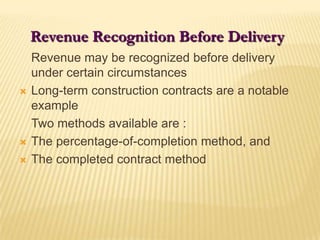
Revenue Recognition Before Delivery	Revenue may be recognized before delivery under certain circumstancesLong-term construction contracts are a notable example	Two methods available are :The percentage-of-completion method, andThe completed contract method
Percentage-of-CompletionMethodCompleted ContractMethod1)  Terms of contract must     be certain, enforceable2) Certainty of performance     by both parties3) Estimates of completion    can be made reliably1) To be used only when      the percentage method is      inapplicable [uncertain]2) For short-term contractsRevenue Recognition Before DeliveryLong-Term ConstructionAccounting Methods
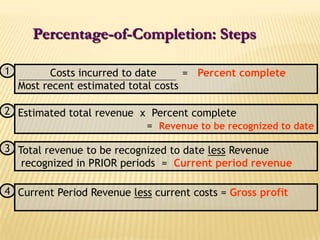
1          Costs incurred to date        =   Percent completeMost recent estimated total costs			2Estimated total revenue  x  Percent complete                                        =  Revenue to be recognized to date3Total revenue to be recognized to date less Revenue  recognized in PRIOR periods  =  Current period revenueCurrent Period Revenue less current costs = Gross profit4Percentage-of-Completion: Steps
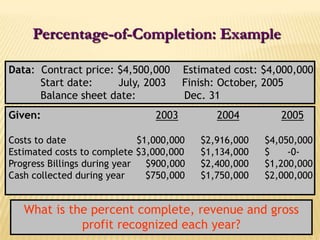
Percentage-of-Completion: ExampleData:  Contract price: $4,500,000    Estimated cost: $4,000,000	Start date:        July, 2003     Finish: October, 2005	Balance sheet date:               Dec. 31Given:	200320042005Costs to date			$1,000,000  	$2,916,000  	$4,050,000Estimated costs to complete $3,000,000  	$1,134,000  	$      -0-Progress Billings during year     $900,000  	$2,400,000  	$1,200,000Cash collected during year	   $750,000	$1,750,000  	$2,000,000What is the percent complete, revenue and gross profit recognized each year?
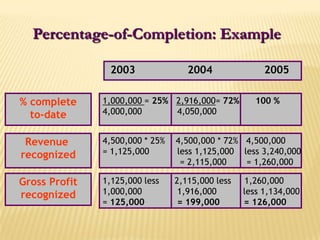
% complete to-date1,000,000 = 25%2,916,000= 72%100 %4,000,000	    4,050,0004,500,000 * 25%    4,500,000 * 72%   4,500,000= 1,125,000	    less 1,125,000    less 3,240,000		     = 2,115,000	      = 1,260,000Revenue recognizedGross Profit recognized1,125,000 less	   2,115,000 less     1,260,0001,000,000 	    1,916,000          less 1,134,000= 125,000	    = 199,000	     = 126,000Percentage-of-Completion: Example 2003	               2004	         2005
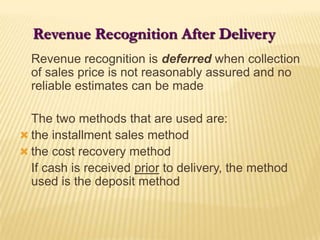
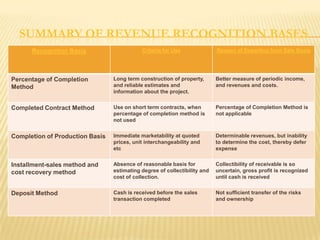
Revenue Recognition After Delivery	Revenue recognition is deferred when collection of sales price is not reasonably assured and no reliable estimates can be made	The two methods that are used are:the installment sales methodthe cost recovery method	If cash is received prior to delivery, the method used is the deposit method
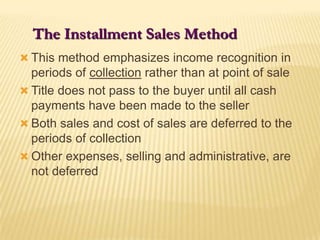
The Installment Sales MethodThis method emphasizes income recognition in periods of collection rather than at point of saleTitle does not pass to the buyer until all cash payments have been made to the sellerBoth sales and cost of sales are deferred to the periods of collectionOther expenses, selling and administrative, are not deferred
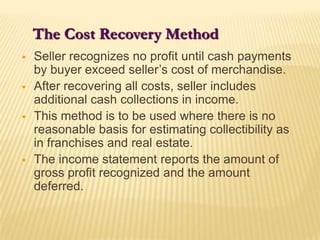
The Cost Recovery MethodSeller recognizes no profit until cash payments by buyer exceed seller’s cost of merchandise.
After recovering all costs, seller includes additional cash collections in income.
This method is to be used where there is no reasonable basis for estimating collectibility as in franchises and real estate.

As 9 Revenue Recognition

  • 1.
  • 2.
    Presentation on AccountingStandardsTeam 4AS 9 : Revenue Recognition
  • 3.
    Revenue RecognitionRevenue isthe gross inflow of cash, receivables or other consideration arising in the course of the ordinary activities of an enterprise from the Sale of goodsRendering of services andUse by others, of enterprise resources, yielding interest, royalties and dividendsRecognition - Process of recording and reporting an item as an element of financial statement
  • 4.
    Principles The revenue recognitionprinciple provides that revenue is recognized:when it is earned, andwhen it is realized or realizableRevenue is earned when the earnings process is substantially completeRevenue is realized when goods and services are exchanged for cash or claims to cashRevenue is realizable when assets received are convertible into a known amount of cash
  • 5.
    Four Types ofRevenue TransactionsRevenue from selling products is recognized at the date of sale (date of delivery).Revenue from services is recognized when services are performed and are billable.Revenue from the use of enterprise’s assets by others is recognized as time passes or as the assets are used up.Revenue from disposal of assets (other than inventory) is recognized at the point of sale as gain or loss.
  • 6.
    Revenue Recognition Classifiedby Nature of Transaction
  • 7.
    Revenue Recognition atPoint of Sale Revenues from manufacturing and selling are commonly recognized at point of sale Exceptions:Sales with buyback agreementsSales when right of return exists (high rates that are not reliably estimable)Trade loading/channel stuffing
  • 8.
    Revenue Recognition BeforeDelivery Revenue may be recognized before delivery under certain circumstancesLong-term construction contracts are a notable example Two methods available are :The percentage-of-completion method, andThe completed contract method
  • 9.
    Percentage-of-CompletionMethodCompleted ContractMethod1) Terms of contract must be certain, enforceable2) Certainty of performance by both parties3) Estimates of completion can be made reliably1) To be used only when the percentage method is inapplicable [uncertain]2) For short-term contractsRevenue Recognition Before DeliveryLong-Term ConstructionAccounting Methods
  • 10.
    1 Costs incurred to date = Percent completeMost recent estimated total costs 2Estimated total revenue x Percent complete = Revenue to be recognized to date3Total revenue to be recognized to date less Revenue recognized in PRIOR periods = Current period revenueCurrent Period Revenue less current costs = Gross profit4Percentage-of-Completion: Steps
  • 11.
    Percentage-of-Completion: ExampleData: Contract price: $4,500,000 Estimated cost: $4,000,000 Start date: July, 2003 Finish: October, 2005 Balance sheet date: Dec. 31Given: 200320042005Costs to date $1,000,000 $2,916,000 $4,050,000Estimated costs to complete $3,000,000 $1,134,000 $ -0-Progress Billings during year $900,000 $2,400,000 $1,200,000Cash collected during year $750,000 $1,750,000 $2,000,000What is the percent complete, revenue and gross profit recognized each year?
  • 12.
    % complete to-date1,000,000= 25%2,916,000= 72%100 %4,000,000 4,050,0004,500,000 * 25% 4,500,000 * 72% 4,500,000= 1,125,000 less 1,125,000 less 3,240,000 = 2,115,000 = 1,260,000Revenue recognizedGross Profit recognized1,125,000 less 2,115,000 less 1,260,0001,000,000 1,916,000 less 1,134,000= 125,000 = 199,000 = 126,000Percentage-of-Completion: Example 2003 2004 2005
  • 13.
    Revenue Recognition AfterDelivery Revenue recognition is deferred when collection of sales price is not reasonably assured and no reliable estimates can be made The two methods that are used are:the installment sales methodthe cost recovery method If cash is received prior to delivery, the method used is the deposit method
  • 14.
    The Installment SalesMethodThis method emphasizes income recognition in periods of collection rather than at point of saleTitle does not pass to the buyer until all cash payments have been made to the sellerBoth sales and cost of sales are deferred to the periods of collectionOther expenses, selling and administrative, are not deferred
  • 15.
    The Cost RecoveryMethodSeller recognizes no profit until cash payments by buyer exceed seller’s cost of merchandise.
  • 16.
    After recovering allcosts, seller includes additional cash collections in income.
  • 17.
    This method isto be used where there is no reasonable basis for estimating collectibility as in franchises and real estate.