Group 5 Proudly Presents
Objectives:
TO UNDERSTAND
 The role of stress in Employee Health
 Extreme Forms of Stress Reactions
 Causes and Symptoms of Stress
 Organizational Effects of Stress
 Actions that may prevent or reduce Stress
 Different Counseling Functions
 Three Types of Counseling and their usefulness
What Stress Is??
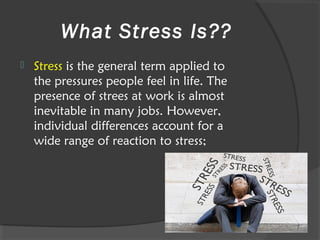
 Stress is the general term applied to
the pressures people feel in life. The
presence of strees at work is almost
inevitable in many jobs. However,
individual differences account for a
wide range of reaction to stress;
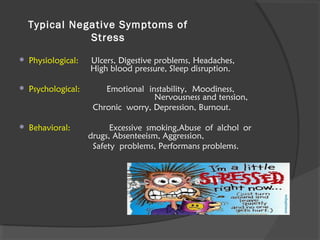
Typical Negative Symptoms of
Stress
 Physiological: Ulcers, Digestive problems, Headaches,
High blood pressure, Sleep disruption.
 Psychological: Emotional instability, Moodiness,
Nervousness and tension,
Chronic worry, Depression, Burnout.
 Behavioral: Excessive smoking,Abuse of alchol or
drugs, Absenteeism, Aggression,
Safety problems, Performans problems.
Extreme Products of
Stress
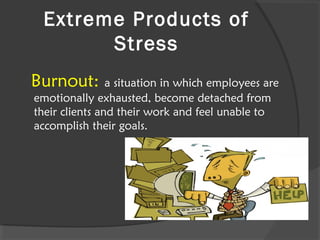
Burnout: a situation in which employees are
emotionally exhausted, become detached from
their clients and their work and feel unable to
accomplish their goals.
Extreme Products of
Stress
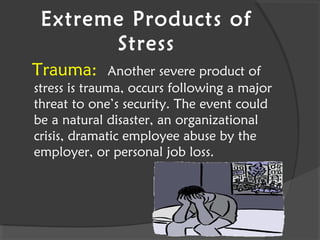
Trauma: Another severe product of
stress is trauma, occurs following a major
threat to one’s security. The event could
be a natural disaster, an organizational
crisis, dramatic employee abuse by the
employer, or personal job loss.
3 types of Trauma
Workplace Trauma – it can arise from harassment at work,
wrongful termination, discrimination or an employees perceived
incapacity to meet evolving performance expectation.
Lay off survivor Sickness – feelings of uncertainty, anger, guilt
and distrust.
Workplace Violence – harmful physical action against co-
workers, managers or company’s property include unprovoked
fights, destruction of property or use of weapons to harm others.
Causes of Stress
Stressors. Conditions that tend to cause stress, combine
to pressure an employee in a variety of ways until stress
develops.
Two Types of Stressors
Organizational Stressors - related on the job
Non-work Stressors – not related on the job
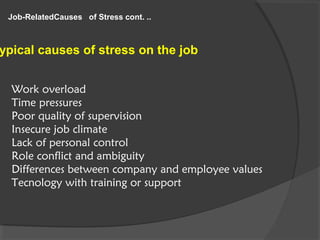
Work overload
Time pressures
Poor quality of supervision
Insecure job climate
Lack of personal control
Role conflict and ambiguity
Differences between company and employee values
Tecnology with training or support
Job-RelatedCauses of Stress cont. ..
ypical causes of stress on the job
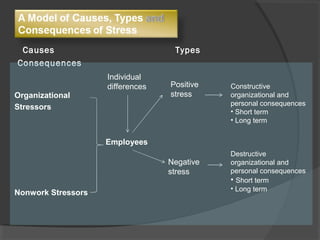
Causes Types
Consequences
Organizational
Stressors
Nonwork Stressors
Employees
Individual
differences Positive
stress
Negative
stress
Constructive
organizational and
personal consequences
• Short term
• Long term
Destructive
organizational and
personal consequences
• Short term
• Long term
Job-RelatedCauses of Stress cont. ..
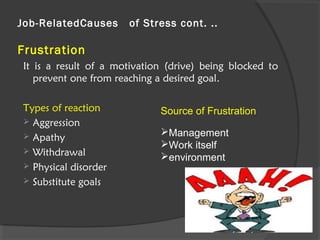
Frustration
It is a result of a motivation (drive) being blocked to
prevent one from reaching a desired goal.
Types of reaction
 Aggression
 Apathy
 Withdrawal
 Physical disorder
 Substitute goals
Source of Frustration
Management
Work itself
environment
Frustration and Management
Practice
Supportive Managerial Role
 where management attempts to
motivate employees strongly, it also
should be prepared to remove barriers and
help prepare the way for employees to
reach their goal.
Stress and Job Performance
Stress can be either helpful or harmful to job
performance, depending on its level.
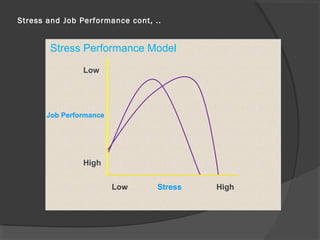
Constructive Stress – is a healthy stimulus that
encourages employees to respond to challenges.
Destructive Stress – performance begins to decline
at some point because excess stress interfere with
performance
Stress and Job Performance cont, ..
Stress Performance Model
StressLow High
Job Performance
Low
High
Stress Vulnerability
Two Major Factors
Stress Threshold Perceived Control
Worker vulnerability to
stress is a function of both
internal (organizational)
and external (non work)
stressors.
 The second internal factor
affecting employee stress
is the amount of perceived
control they have over their
work and working
conditions
Type A and Type B People
Type A People Type B People
 aggresive and
competitive
 set high standarts
 impatient with
themselves and others
 thrive under constant
time pressures
 More relaxed and
easygoing
 can easily accept
situations rather than
fight them competitively.
 Highly productive
workers
Approaches to Stress Management
 Three approaches: prevent, escape, cope
To eliminate or reduce stressors for employees
management should seek to
 Empower employees through participation
 Redesign jobs to be more fulfilling
 Implement organization development programs
 Improve managerial communication skills
Common Personal Strategies for
Managing Stress
 Resist working long hours or accepting overtime
 Volunteer for flextime or other alternative work
schedules
 Maintain a healthy diet and eat regularly
 Avoid procrastination
 Set reasonable goals for yourself
 Develop a simple method of organizing things and
adhere to it
Approaches to Stress Management
cont. ..
Approaches to Stress Management cont. ..
 Social support : is the network of helpful activities,
interactions and relationships that provides an employee
with the satisfaction of important needs.
 Relaxation : Some employees have turned to various
means of mental relaxation to adjust to the stresses in their
lives.
 Personal Wellness : encourage changes in lifestyle, such
as breathing regulation, muscle relaxation, positive imagery,
nutrition management and exercise, enabling employees to
use more of their full potential
Types of support
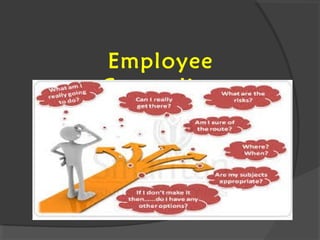
Employee
Counseling
Employee Counseling
 is the discussion with an employee of a problem that
usually has emotional content in order to help the
employee cope with it better seeks to improve employee
mental health and well-being.
 An exchange of ideas and feelings between two people,
nominally a counselor and a counselee. So it is an act of
communication.
What Counseling is?
Counseling may be performed by both
professionals and nonprofessionals.
Counseling usually is confidential so that
employees will feel free to talk openly about
their problems. It also involves both job and
personal problems, since both types of problems
may affect an employee’s performance on the
job.
Employee Counseling
What counseling can do ?
The general objectives of counseling are :
To help employees grow in self confidence
Understanding self control
Ability to work effectively
Encourage employee growth and self direction
Need for Counseling
Most problems that require counseling
have some emotional content. Emotions
are a normal part of life. Nature gave
people their emotions and these feeling
make people human. On the other hand,
emotions can get out of control and cause
workers to do things that are harmful to
their own best interests and those of the
firm..
The managers counseling role
 Counseling functions usually can be performed
successfully by skilled managers
 Managers are important counselors because
they are the ones in day to day interaction
with employees
 Performing all six counseling functions
 Managers should not close their eyes to the
emotional problems of employees and refuse
to discuss them
Functions of
Counseling
1. Advise : Telling a person what you think should be done;
coaching
2. Reassurance : Giving people courage and confidence
that they are capable of facing problems
3. Communication : Providing information and
understanding
4. Release of Emotional Tension : Helping a person feel
more free of frustrations and stress
5. Clarified thinking : Encouraging more coherent, rational
and mature thought
6. Reorientation : Encouraging an internal change in
goals, values and mental models
Types of Counseling
Directive Counseling Nondirective Counseling
 is the process of listening
to an employee’s problem,
deciding with the
employee what should be
done and then telling and
motivating the employee
to do it.
 It is the process of skillfully
encouraging a counselee to
explain troublesome
problems, understand them
and determine appropriate
solutions. It focuses on the
counselee rather than on the
counselor as judge and
adviser; thus it is client-
centered.
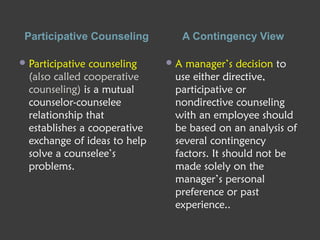
Participative Counseling A Contingency View
Participative counseling
(also called cooperative
counseling) is a mutual
counselor-counselee
relationship that
establishes a cooperative
exchange of ideas to help
solve a counselee’s
problems.
A manager’s decision to
use either directive,
participative or
nondirective counseling
with an employee should
be based on an analysis of
several contingency
factors. It should not be
made solely on the
manager’s personal
preference or past
experience..
Presented by :
Cañete, Rodrigo Jr. Loynay
Castro, Ciela Santos
Corpuz, Shiela Marie M.
Cuevas, Kriszandra Mylen Santos
Dacayo, Mary Grace Masi
Dalimit Jr., Juliano Santillan
De Veyra, Jan Edward Beljot
THE END
THANK YOU FOR LISTENING!

Ready to present

  • 1.
  • 3.
    Objectives: TO UNDERSTAND  Therole of stress in Employee Health  Extreme Forms of Stress Reactions  Causes and Symptoms of Stress  Organizational Effects of Stress  Actions that may prevent or reduce Stress  Different Counseling Functions  Three Types of Counseling and their usefulness
  • 4.
    What Stress Is?? Stress is the general term applied to the pressures people feel in life. The presence of strees at work is almost inevitable in many jobs. However, individual differences account for a wide range of reaction to stress;
  • 5.
    Typical Negative Symptomsof Stress  Physiological: Ulcers, Digestive problems, Headaches, High blood pressure, Sleep disruption.  Psychological: Emotional instability, Moodiness, Nervousness and tension, Chronic worry, Depression, Burnout.  Behavioral: Excessive smoking,Abuse of alchol or drugs, Absenteeism, Aggression, Safety problems, Performans problems.
  • 6.
    Extreme Products of Stress Burnout:a situation in which employees are emotionally exhausted, become detached from their clients and their work and feel unable to accomplish their goals.
  • 7.
    Extreme Products of Stress Trauma:Another severe product of stress is trauma, occurs following a major threat to one’s security. The event could be a natural disaster, an organizational crisis, dramatic employee abuse by the employer, or personal job loss.
  • 8.
    3 types ofTrauma Workplace Trauma – it can arise from harassment at work, wrongful termination, discrimination or an employees perceived incapacity to meet evolving performance expectation. Lay off survivor Sickness – feelings of uncertainty, anger, guilt and distrust. Workplace Violence – harmful physical action against co- workers, managers or company’s property include unprovoked fights, destruction of property or use of weapons to harm others.
  • 9.
    Causes of Stress Stressors.Conditions that tend to cause stress, combine to pressure an employee in a variety of ways until stress develops. Two Types of Stressors Organizational Stressors - related on the job Non-work Stressors – not related on the job
  • 10.
    Work overload Time pressures Poorquality of supervision Insecure job climate Lack of personal control Role conflict and ambiguity Differences between company and employee values Tecnology with training or support Job-RelatedCauses of Stress cont. .. ypical causes of stress on the job
  • 11.
    Causes Types Consequences Organizational Stressors Nonwork Stressors Employees Individual differencesPositive stress Negative stress Constructive organizational and personal consequences • Short term • Long term Destructive organizational and personal consequences • Short term • Long term
  • 12.
    Job-RelatedCauses of Stresscont. .. Frustration It is a result of a motivation (drive) being blocked to prevent one from reaching a desired goal. Types of reaction  Aggression  Apathy  Withdrawal  Physical disorder  Substitute goals Source of Frustration Management Work itself environment
  • 13.
    Frustration and Management Practice SupportiveManagerial Role  where management attempts to motivate employees strongly, it also should be prepared to remove barriers and help prepare the way for employees to reach their goal.
  • 14.
    Stress and JobPerformance Stress can be either helpful or harmful to job performance, depending on its level. Constructive Stress – is a healthy stimulus that encourages employees to respond to challenges. Destructive Stress – performance begins to decline at some point because excess stress interfere with performance
  • 15.
    Stress and JobPerformance cont, .. Stress Performance Model StressLow High Job Performance Low High
  • 16.
    Stress Vulnerability Two MajorFactors Stress Threshold Perceived Control Worker vulnerability to stress is a function of both internal (organizational) and external (non work) stressors.  The second internal factor affecting employee stress is the amount of perceived control they have over their work and working conditions
  • 17.
    Type A andType B People Type A People Type B People  aggresive and competitive  set high standarts  impatient with themselves and others  thrive under constant time pressures  More relaxed and easygoing  can easily accept situations rather than fight them competitively.  Highly productive workers
  • 18.
    Approaches to StressManagement  Three approaches: prevent, escape, cope To eliminate or reduce stressors for employees management should seek to  Empower employees through participation  Redesign jobs to be more fulfilling  Implement organization development programs  Improve managerial communication skills
  • 19.
    Common Personal Strategiesfor Managing Stress  Resist working long hours or accepting overtime  Volunteer for flextime or other alternative work schedules  Maintain a healthy diet and eat regularly  Avoid procrastination  Set reasonable goals for yourself  Develop a simple method of organizing things and adhere to it Approaches to Stress Management cont. ..
  • 20.
    Approaches to StressManagement cont. ..  Social support : is the network of helpful activities, interactions and relationships that provides an employee with the satisfaction of important needs.  Relaxation : Some employees have turned to various means of mental relaxation to adjust to the stresses in their lives.  Personal Wellness : encourage changes in lifestyle, such as breathing regulation, muscle relaxation, positive imagery, nutrition management and exercise, enabling employees to use more of their full potential Types of support
  • 21.
  • 22.
    Employee Counseling  isthe discussion with an employee of a problem that usually has emotional content in order to help the employee cope with it better seeks to improve employee mental health and well-being.  An exchange of ideas and feelings between two people, nominally a counselor and a counselee. So it is an act of communication. What Counseling is?
  • 23.
    Counseling may beperformed by both professionals and nonprofessionals. Counseling usually is confidential so that employees will feel free to talk openly about their problems. It also involves both job and personal problems, since both types of problems may affect an employee’s performance on the job. Employee Counseling
  • 24.
    What counseling cando ? The general objectives of counseling are : To help employees grow in self confidence Understanding self control Ability to work effectively Encourage employee growth and self direction
  • 25.
    Need for Counseling Mostproblems that require counseling have some emotional content. Emotions are a normal part of life. Nature gave people their emotions and these feeling make people human. On the other hand, emotions can get out of control and cause workers to do things that are harmful to their own best interests and those of the firm..
  • 26.
    The managers counselingrole  Counseling functions usually can be performed successfully by skilled managers  Managers are important counselors because they are the ones in day to day interaction with employees  Performing all six counseling functions  Managers should not close their eyes to the emotional problems of employees and refuse to discuss them
  • 27.
    Functions of Counseling 1. Advise: Telling a person what you think should be done; coaching 2. Reassurance : Giving people courage and confidence that they are capable of facing problems 3. Communication : Providing information and understanding 4. Release of Emotional Tension : Helping a person feel more free of frustrations and stress 5. Clarified thinking : Encouraging more coherent, rational and mature thought 6. Reorientation : Encouraging an internal change in goals, values and mental models
  • 28.
    Types of Counseling DirectiveCounseling Nondirective Counseling  is the process of listening to an employee’s problem, deciding with the employee what should be done and then telling and motivating the employee to do it.  It is the process of skillfully encouraging a counselee to explain troublesome problems, understand them and determine appropriate solutions. It focuses on the counselee rather than on the counselor as judge and adviser; thus it is client- centered.
  • 29.
    Participative Counseling AContingency View Participative counseling (also called cooperative counseling) is a mutual counselor-counselee relationship that establishes a cooperative exchange of ideas to help solve a counselee’s problems. A manager’s decision to use either directive, participative or nondirective counseling with an employee should be based on an analysis of several contingency factors. It should not be made solely on the manager’s personal preference or past experience..
  • 30.
    Presented by : Cañete,Rodrigo Jr. Loynay Castro, Ciela Santos Corpuz, Shiela Marie M. Cuevas, Kriszandra Mylen Santos Dacayo, Mary Grace Masi Dalimit Jr., Juliano Santillan De Veyra, Jan Edward Beljot THE END THANK YOU FOR LISTENING!