1
ICT-based Creativity and
Innovation
--oo--oo--
4. Innovation Lifecycle
M.Missikoff
Institute of Sciences and Technologies of Cognition
ISTC-CNR, Rome
(michele.missikoff@cnr.it)
Institute of Cognitive
Sciences and Technologies
ToC
• Enterprise Innovation Lifecycle
• Innovation Triggers
• Innovation unfolding
• From Process to Waves
– Creativity
– Feasibility
– Prototyping
– Engineering
• and the final transfert to production
2
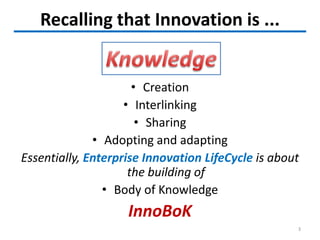
Recalling that Innovation is ...
• Creation
• Interlinking
• Sharing
• Adopting and adapting
Essentially, Enterprise Innovation LifeCycle is about
the building of
• Body of Knowledge
InnoBoK
3
Enterprise Innovation Lifecycle
• Innovation process is an oxymoron
• A process is a repeatable, codified partially
ordered sequence of activities
• Each innovation endeavour is different
• But we need guidance, best practices, caveats,
lessons learned to carefully consider
• Therefore ...
Welcome to EILC!
4
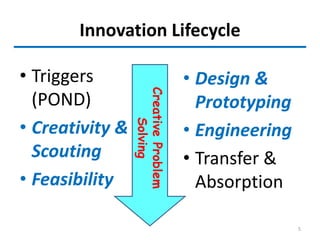
Innovation Lifecycle
• Triggers
(POND)
• Creativity &
Scouting
• Feasibility
• Design &
Prototyping
• Engineering
• Transfer &
Absorption
CreativeProblem
Solving
5
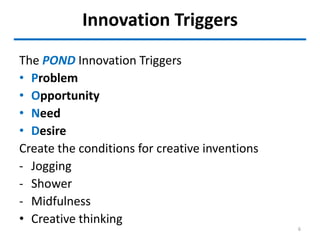
Innovation Triggers
The POND Innovation Triggers
• Problem
• Opportunity
• Need
• Desire
Create the conditions for creative inventions
- Jogging
- Shower
- Midfulness
• Creative thinking
6
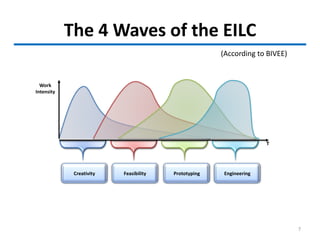
The 4 Waves of the EILC
7
Work
Intensity
T
Creativity Feasibility Prototyping Engineering
(According to BIVEE)
1. Creativity & Immagination
“Presumably, the process of creativity, whatever it is,
is essentially the same in all its branches and varieties,
so that the evolution of a new art form, a new gadget,
a new scientific principle, all involve common factors.”
(Isaac Asimov, On Creativity, MIT Tech Rep 1959.
Reprint by MIT Technology Review, Oct 2014)
8
Creativity
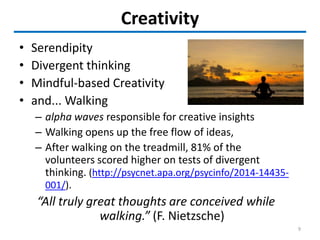
• Serendipity
• Divergent thinking
• Mindful-based Creativity
• and... Walking
– alpha waves responsible for creative insights
– Walking opens up the free flow of ideas,
– After walking on the treadmill, 81% of the
volunteers scored higher on tests of divergent
thinking. (http://psycnet.apa.org/psycinfo/2014-14435-
001/).
“All truly great thoughts are conceived while
walking.” (F. Nietzsche)
9
Where Creativity comes from?
• Connective approach to creativity. New
knowledge stemming from new connections
• This is why you need first “to know” (the
importance of Innovation Knowledge
Repository)
“creativity does not spring from the null, it
emerges establishing new connections among
elements that exist.”
(Henri Poincaré)
10
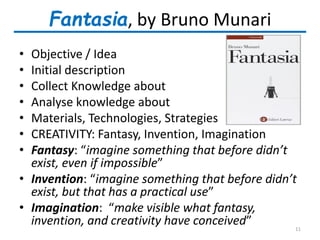
Fantasia, by Bruno Munari
• Objective / Idea
• Initial description
• Collect Knowledge about
• Analyse knowledge about
• Materials, Technologies, Strategies
• CREATIVITY: Fantasy, Invention, Imagination
• Fantasy: “imagine something that before didn’t
exist, even if impossible”
• Invention: “imagine something that before didn’t
exist, but that has a practical use”
• Imagination: “make visible what fantasy,
invention, and creativity have conceived” 11
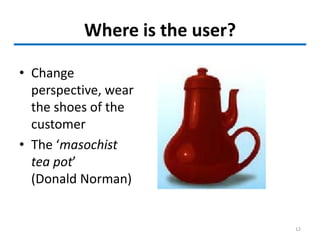
Where is the user?
• Change
perspective, wear
the shoes of the
customer
• The ‘masochist
tea pot’
(Donald Norman)
12
Idea Management Tool
13
Preliminarily define the Objective
• Solicit ideas, create Surveys, Questions
• Receive Surveys and Questions responses
• Review, filter and ‘scrub’ submitted ideas
• Create a short list of candidate ideas, plus
deferred and discarded ideas, with motivations
• Clearly define selection criteria and rank ideas
accordingly
Scouting
• Is my idea really innovative?
• What are similar ideas? Previous projects
addressing similar issues?
• What are previous successes and failures?
• What are the key challenges (and traps) we are
going to face?
Open Innovation Observatory (OIO)
Outcome of the Creativity Wave

InnoBoK Part 1: Idea Specification & First
Assessment
14
2. Feasibility
Activity of multi-disciplinary teams
• Technical feasibility
– How risky is the implementation? Is the needed technology available,
stable?
• Financial feasibility
– Do we have the finacial resources? Or, how difficult will be to attract
venture capital? Break-even point?
• Market feasibility
– What is the value proposition? Is the market ready for this? How strong
are the competitors? Can we differentiate?
• Competencies feasibility
– Do we have the required expertise? Can we evolve the
internal skills? Or, what kind of partnerships we need?
15
Feasibility Objectives
• Organised in 4 different reports, according to the 4
perspectives
– Technical feasibility Report
– Financial feasibility Report
– Market feasibility Report
– Competencies feasibility Report
• This is a baseline to provide input to managers and
obtain needed resources
• They can be produced by using your preferred
method (e.g., including SWOT)
• You can add more reports or integrate the
content, e.g., with extended risk analysis and mgt
InnoBoK Part 2: Feasibility Studies
16
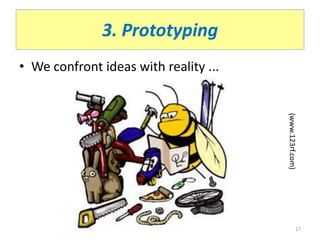
3. Prototyping
• We confront ideas with reality ...
(www.123rf.com)
17
Prototyping Objectives
• This is a very crucial activity: show that your
idea is actually actualy (properly) working
• Innovators may approach it as they prefer
• Firstly: creative design, then tentative
implementation
• Then need to test, measure, assess, change,
retry, ....
• But ... eventually a running solution needs to
be fully completed
InnoBoK Part 3: Prototype (and Tech Rep) 18
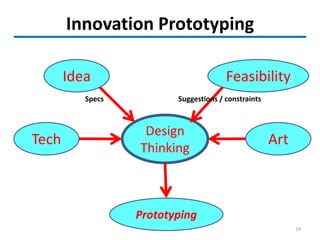
Innovation Prototyping
Design
Thinking
Idea
ArtTech
Prototyping
Feasibility
Suggestions / constraintsSpecs
19
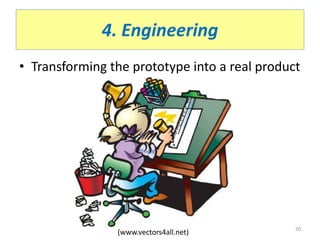
4. Engineering
• Transforming the prototype into a real product
20
(www.vectors4all.net)
Engineering Objectives
• Revisit the prototype in a business perspective
– Costs
– Usability
– Value proposition for endusers
– ...
• Identify suppliers, partners
• Conceive production plans
InnoBoK Part 4: Production Strategies & Plans
21
Transfer
• Knowledge transfer to production ...
22
(www.clipartreview.com)
Absorption (1)
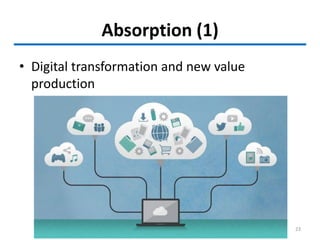
• Digital transformation and new value
production
23
Absorption (2)
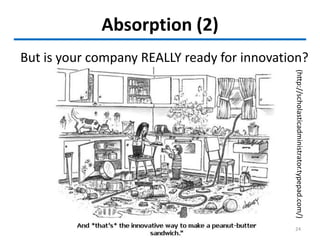
But is your company REALLY ready for innovation?
24
(http://scholasticadministrator.typepad.com/)
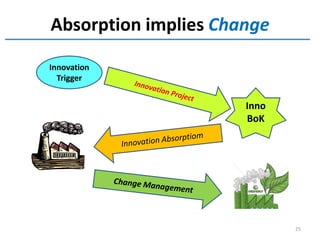
Absorption implies Change
25
Innovation
Trigger
Inno
BoK
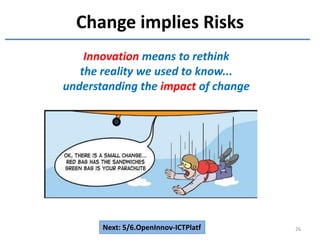
Change implies Risks
26
Innovation means to rethink
the reality we used to know...
understanding the impact of change
Next: 5/6.OpenInnov-ICTPlatf

4. open innov lifecycle

  • 1.
    1 ICT-based Creativity and Innovation --oo--oo-- 4.Innovation Lifecycle M.Missikoff Institute of Sciences and Technologies of Cognition ISTC-CNR, Rome (michele.missikoff@cnr.it) Institute of Cognitive Sciences and Technologies
  • 2.
    ToC • Enterprise InnovationLifecycle • Innovation Triggers • Innovation unfolding • From Process to Waves – Creativity – Feasibility – Prototyping – Engineering • and the final transfert to production 2
  • 3.
    Recalling that Innovationis ... • Creation • Interlinking • Sharing • Adopting and adapting Essentially, Enterprise Innovation LifeCycle is about the building of • Body of Knowledge InnoBoK 3
  • 4.
    Enterprise Innovation Lifecycle •Innovation process is an oxymoron • A process is a repeatable, codified partially ordered sequence of activities • Each innovation endeavour is different • But we need guidance, best practices, caveats, lessons learned to carefully consider • Therefore ... Welcome to EILC! 4
  • 5.
    Innovation Lifecycle • Triggers (POND) •Creativity & Scouting • Feasibility • Design & Prototyping • Engineering • Transfer & Absorption CreativeProblem Solving 5
  • 6.
    Innovation Triggers The PONDInnovation Triggers • Problem • Opportunity • Need • Desire Create the conditions for creative inventions - Jogging - Shower - Midfulness • Creative thinking 6
  • 7.
    The 4 Wavesof the EILC 7 Work Intensity T Creativity Feasibility Prototyping Engineering (According to BIVEE)
  • 8.
    1. Creativity &Immagination “Presumably, the process of creativity, whatever it is, is essentially the same in all its branches and varieties, so that the evolution of a new art form, a new gadget, a new scientific principle, all involve common factors.” (Isaac Asimov, On Creativity, MIT Tech Rep 1959. Reprint by MIT Technology Review, Oct 2014) 8
  • 9.
    Creativity • Serendipity • Divergentthinking • Mindful-based Creativity • and... Walking – alpha waves responsible for creative insights – Walking opens up the free flow of ideas, – After walking on the treadmill, 81% of the volunteers scored higher on tests of divergent thinking. (http://psycnet.apa.org/psycinfo/2014-14435- 001/). “All truly great thoughts are conceived while walking.” (F. Nietzsche) 9
  • 10.
    Where Creativity comesfrom? • Connective approach to creativity. New knowledge stemming from new connections • This is why you need first “to know” (the importance of Innovation Knowledge Repository) “creativity does not spring from the null, it emerges establishing new connections among elements that exist.” (Henri Poincaré) 10
  • 11.
    Fantasia, by BrunoMunari • Objective / Idea • Initial description • Collect Knowledge about • Analyse knowledge about • Materials, Technologies, Strategies • CREATIVITY: Fantasy, Invention, Imagination • Fantasy: “imagine something that before didn’t exist, even if impossible” • Invention: “imagine something that before didn’t exist, but that has a practical use” • Imagination: “make visible what fantasy, invention, and creativity have conceived” 11
  • 12.
    Where is theuser? • Change perspective, wear the shoes of the customer • The ‘masochist tea pot’ (Donald Norman) 12
  • 13.
    Idea Management Tool 13 Preliminarilydefine the Objective • Solicit ideas, create Surveys, Questions • Receive Surveys and Questions responses • Review, filter and ‘scrub’ submitted ideas • Create a short list of candidate ideas, plus deferred and discarded ideas, with motivations • Clearly define selection criteria and rank ideas accordingly
  • 14.
    Scouting • Is myidea really innovative? • What are similar ideas? Previous projects addressing similar issues? • What are previous successes and failures? • What are the key challenges (and traps) we are going to face? Open Innovation Observatory (OIO) Outcome of the Creativity Wave  InnoBoK Part 1: Idea Specification & First Assessment 14
  • 15.
    2. Feasibility Activity ofmulti-disciplinary teams • Technical feasibility – How risky is the implementation? Is the needed technology available, stable? • Financial feasibility – Do we have the finacial resources? Or, how difficult will be to attract venture capital? Break-even point? • Market feasibility – What is the value proposition? Is the market ready for this? How strong are the competitors? Can we differentiate? • Competencies feasibility – Do we have the required expertise? Can we evolve the internal skills? Or, what kind of partnerships we need? 15
  • 16.
    Feasibility Objectives • Organisedin 4 different reports, according to the 4 perspectives – Technical feasibility Report – Financial feasibility Report – Market feasibility Report – Competencies feasibility Report • This is a baseline to provide input to managers and obtain needed resources • They can be produced by using your preferred method (e.g., including SWOT) • You can add more reports or integrate the content, e.g., with extended risk analysis and mgt InnoBoK Part 2: Feasibility Studies 16
  • 17.
    3. Prototyping • Weconfront ideas with reality ... (www.123rf.com) 17
  • 18.
    Prototyping Objectives • Thisis a very crucial activity: show that your idea is actually actualy (properly) working • Innovators may approach it as they prefer • Firstly: creative design, then tentative implementation • Then need to test, measure, assess, change, retry, .... • But ... eventually a running solution needs to be fully completed InnoBoK Part 3: Prototype (and Tech Rep) 18
  • 19.
  • 20.
    4. Engineering • Transformingthe prototype into a real product 20 (www.vectors4all.net)
  • 21.
    Engineering Objectives • Revisitthe prototype in a business perspective – Costs – Usability – Value proposition for endusers – ... • Identify suppliers, partners • Conceive production plans InnoBoK Part 4: Production Strategies & Plans 21
  • 22.
    Transfer • Knowledge transferto production ... 22 (www.clipartreview.com)
  • 23.
    Absorption (1) • Digitaltransformation and new value production 23
  • 24.
    Absorption (2) But isyour company REALLY ready for innovation? 24 (http://scholasticadministrator.typepad.com/)
  • 25.
  • 26.
    Change implies Risks 26 Innovationmeans to rethink the reality we used to know... understanding the impact of change Next: 5/6.OpenInnov-ICTPlatf