


Open Innovation:
The First Decade
Joel West
KGI - The Keck Graduate Institute
Claremont, California
Strategizing Open Innovation
University of Bath
19 September 2013
Plan
• What is open innovation?
• Three modes of open innovation
- Inbound
- Outbound
- Coupled
• What’s next?
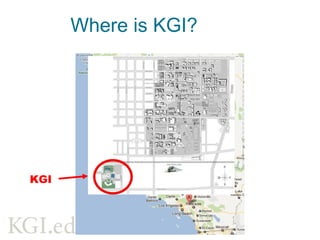
• Keck Graduate Institute of Applied Life
Sciences
• Mission: “dedicated to education and research aimed
at translating into practice, for the benefit of society,
the power and potential of the life sciences.”
• Founded in 1997
• Funded by grant from Keck Foundation
• Youngest of 7 Claremont Colleges
• Mixture of science and business faculty
• About 200 graduate students
What is KGI?
Open Innovation
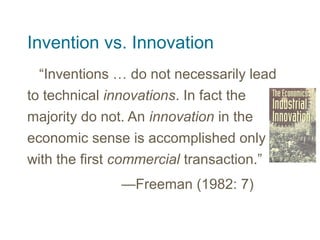
Invention vs. Innovation
“Inventions … do not necessarily lead
to technical innovations. In fact the
majority do not. An innovation in the
economic sense is accomplished only
with the first commercial transaction.”
—Freeman (1982: 7)
Latent value of an innovation
“The inherent value of a technology
remains latent until it is commercialized in
some way.
“A business model unlocks that latent
value, mediating between technical and
economic domains.”
– Chesbrough & Rosenbloom (2002)
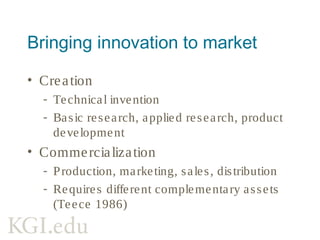
Bringing innovation to market
• Creation
- Technical invention
- Basic research, applied research, product
development
• Commercialization
- Production, marketing, sales, distribution
- Requires different complementary assets
(Teece 1986)
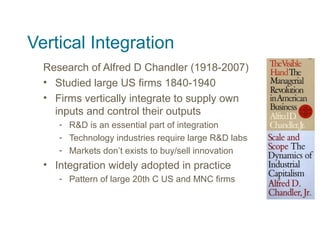
Research of Alfred D Chandler (1918-2007)
• Studied large US firms 1840-1940
• Firms vertically integrate to supply own
inputs and control their outputs
- R&D is an essential part of integration
- Technology industries require large R&D labs
- Markets don’t exists to buy/sell innovation
• Integration widely adopted in practice
- Pattern of large 20th C US and MNC firms
Vertical Integration
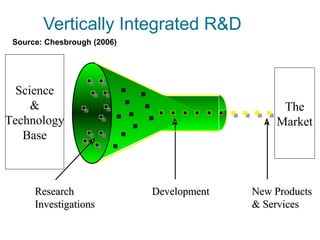
ResearchResearch
InvestigationsInvestigations
DevelopmentDevelopment New ProductsNew Products
& Services& Services
The
Market
Science
&
Technology
Base
Source: Chesbrough (2006)
Vertically Integrated R&D
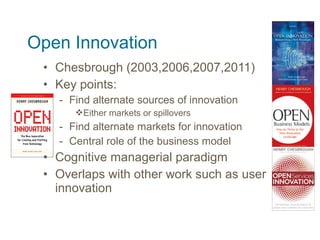
Open Innovation
• Chesbrough (2003,2006,2007,2011)
• Key points:
- Find alternate sources of innovation
Either markets or spillovers
- Find alternate markets for innovation
- Central role of the business model
• Cognitive managerial paradigm
• Overlaps with other work such as user
innovation
What is “open innovation”?
“Open innovation is the use of purposive
inflows and outflows of knowledge to accelerate
internal innovation, and expand the markets for
external use of innovation, respectively.”
Henry Chesbrough, O pe n Inno vatio n:
Re se arching a Ne w Paradig m (2006)
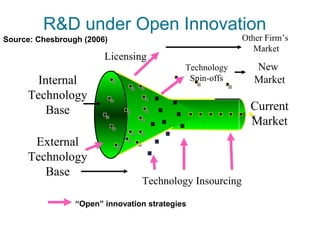
Source: Chesbrough (2006)
Current
Market
Internal
Technology
Base
Technology Insourcing
New
Market
Technology
Spin-offs
External
Technology
Base
Other Firm’s
Market
Licensing
“Open” innovation strategies
R&D under Open Innovation
What’s new?
• Many antecedent/overlapping areas
- Technology sourcing, IP markets,
university licensing, alliances, supplier
innovation, user innovation
• New ideas include
- Role of the business model
- Agnostic to internal/external paths
- Rise of innovation intermediaries
Cf. Chesbrough (2006)
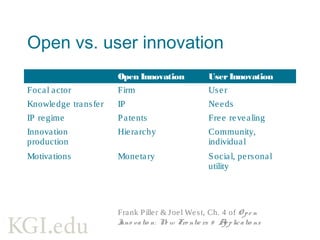
Open vs. user innovation
Open Innovation UserInnovation
Focal actor Firm User
Knowledge transfer IP Needs
IP regime Patents Free revealing
Innovation
production
Hierarchy Community,
individual
Motivations Monetary Social, personal
utility
Frank Piller & Joel West, Ch. 2 of O pe n
Inno vatio n: Ne w Fro ntie rs & Applicatio ns
Three open innovation processes
1. Inbound (or “outside-in”)
2. Outbound (or “inside-out”)
3. Coupled combines these two
Cf. Chesbrough (2003, 2006), Gassmann & Enkel
(2004), Enkel et al (2009), West & Gallagher (2006)
Inbound Open Innovation
Review of inbound OI
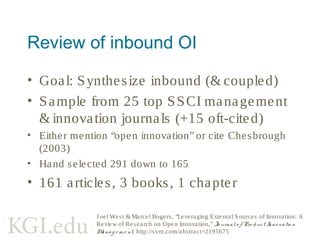
• Goal: Synthesize inbound (& coupled)
• Sample from 25 top SSCI management
& innovation journals (+15 oft-cited)
• Either mention “open innovation” or cite Chesbrough
(2003)
• Hand selected 291 down to 165
• 161 articles, 3 books, 1 chapter
Joel West & Marcel Bogers, “Leveraging External Sources of Innovation: A
Review of Research on Open Innovation,” Jo urnalo f Pro duct Inno vatio n
Manag e m e nt, http://ssrn.com/abstract=2195675
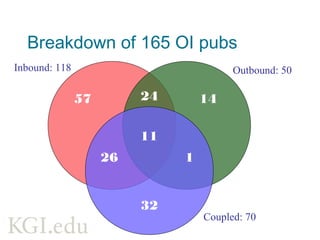
Breakdown of 165 OI pubs
Inbound: 118 Outbound: 50
Coupled: 70
57 14
11
24
26 1
32
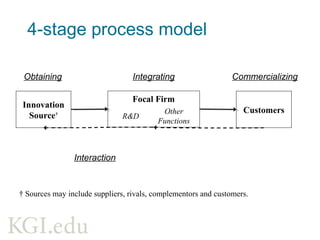
4-stage process model
Innovation
Source†
Customers
CommercializingObtaining Integrating
Interaction
Focal Firm
R&D
Other
Functions
† Sources may include suppliers, rivals, complementors and customers.
1. Obtaining Innovations
• Best covered of the phases
- Searching, enabling, filtering
- Sourcing particularly well covered
• Most popular area: sources of innovation
• Often about external knowledge and not
external innovations
• Not much about asset specificity of potential
innovations
2. Integrating Innovations
• Considers org capabilities and culture
- Absorptive capacity over-researched
- NIH is mentioned, not well measured
- Implicit assumptions
• Integration seems to be a black box
- Are new competencies needed?
- Does utilizing external innovations help or
hurt internal R&D competencies?
3. Commercializing Innovations
• Lots of value creation
- Sometimes measured using NPD metrics
- Less research on value capture
• Assumes external innovations
commercialized same as internal ones
- How do firms differ in external innovation
commercialization capabilities?
4. Reverse Paths
Beyond the linear model, this includes
• Feedback mechanisms
- Information flow upstream
• Reciprocal measures
- Ongoing interactions
- Includes co-creation, communities
Research relatively scarce
Other gaps and opportunities
• Is everything an “innovation”?
- Patent, copyright, knowledge
• Where is the business model?
- Not a lot of value capture
• Where are the success metrics?
Outbound Open Innovation
What is outbound OI?
• Firms should find best/highest use of their IP
- Not all IP aligns to the firm’s business model
• Avoids Type II (false negative) error
• Can include licensing to rivals, spinoffs
- In parallel or instead of internal use
Inspired by Chesbrough study of Xerox PARC
spinoffs (Chesbrough & Rosenbloom, 2002)
Key challenges of outbound OI
• Identifying underused IP
• Simultaneous internal/external
commercialization
• Functioning IP markets
• Appropriability fears
• Drag due to excess appropriability
Outbound OI research getting scarcer
Chesbrough (2003, 2006b), Fabrizio (2006), Enkel
et al (2009), Dahlander & Gann (2010)
Coupled Open Innovation
Coupled open innovation
• “Coupled” is different from inbound and
outbound
• Two modes of coupled interaction
- Bi-directional (Gassmann & Enkel, 2004)
Combines inbound & outbound
Applies to firm-to-firm R&D collaborations
- Interactive collaboration (Piller & West, 2014)
Joint production outside the firm
Different from either inbound or outbound
Coupled open innovation
Examples of coupled open innovation:
•Open source (West & Gallagher, 2006)
•Communities (West & Sims, 2013)
•R&D consortia (Muller-Seitz & Sydow, 2013)̈
More abstraction is needed
What’s Next?
Recent trends in OI research
• Greater precision of constructs
• Better measurement
- Inspired by Laursen & Salter (2006)
• Better understanding of performance
• Services, not just products
- Chesbrough 2011 book
• Nonprofit actors and motivations
- West & Gallagher (2006), Dahlander & Gann (2010),
Chesbrough & Di Minin (2014)
2014: new OI publications
• Re se arch Po licy special issue
- Chesbrough, Salter, Vanhaverbeke & West,
guest editors
- Ashish Aurora, lead editor
- Ca. 10 articles (5 so far)
• O pe n Inno vatio n: Ne w Fro ntie rs &
Applicatio ns (Oxford)
- Chesbrough, Vanhaverbeke & West, eds.
- 15 chapters
Thank you!
blog.OpenInnovation.net

Open Innovation: The First Decade

  • 1.
    Open Innovation: The FirstDecade Joel West KGI - The Keck Graduate Institute Claremont, California Strategizing Open Innovation University of Bath 19 September 2013
  • 2.
    Plan • What isopen innovation? • Three modes of open innovation - Inbound - Outbound - Coupled • What’s next?
  • 3.
    • Keck GraduateInstitute of Applied Life Sciences • Mission: “dedicated to education and research aimed at translating into practice, for the benefit of society, the power and potential of the life sciences.” • Founded in 1997 • Funded by grant from Keck Foundation • Youngest of 7 Claremont Colleges • Mixture of science and business faculty • About 200 graduate students What is KGI?
  • 4.
  • 5.
    Invention vs. Innovation “Inventions… do not necessarily lead to technical innovations. In fact the majority do not. An innovation in the economic sense is accomplished only with the first commercial transaction.” —Freeman (1982: 7)
  • 6.
    Latent value ofan innovation “The inherent value of a technology remains latent until it is commercialized in some way. “A business model unlocks that latent value, mediating between technical and economic domains.” – Chesbrough & Rosenbloom (2002)
  • 7.
    Bringing innovation tomarket • Creation - Technical invention - Basic research, applied research, product development • Commercialization - Production, marketing, sales, distribution - Requires different complementary assets (Teece 1986)
  • 8.
    Research of AlfredD Chandler (1918-2007) • Studied large US firms 1840-1940 • Firms vertically integrate to supply own inputs and control their outputs - R&D is an essential part of integration - Technology industries require large R&D labs - Markets don’t exists to buy/sell innovation • Integration widely adopted in practice - Pattern of large 20th C US and MNC firms Vertical Integration
  • 9.
    ResearchResearch InvestigationsInvestigations DevelopmentDevelopment New ProductsNewProducts & Services& Services The Market Science & Technology Base Source: Chesbrough (2006) Vertically Integrated R&D
  • 10.
    Open Innovation • Chesbrough(2003,2006,2007,2011) • Key points: - Find alternate sources of innovation Either markets or spillovers - Find alternate markets for innovation - Central role of the business model • Cognitive managerial paradigm • Overlaps with other work such as user innovation
  • 11.
    What is “openinnovation”? “Open innovation is the use of purposive inflows and outflows of knowledge to accelerate internal innovation, and expand the markets for external use of innovation, respectively.” Henry Chesbrough, O pe n Inno vatio n: Re se arching a Ne w Paradig m (2006)
  • 12.
    Source: Chesbrough (2006) Current Market Internal Technology Base TechnologyInsourcing New Market Technology Spin-offs External Technology Base Other Firm’s Market Licensing “Open” innovation strategies R&D under Open Innovation
  • 13.
    What’s new? • Manyantecedent/overlapping areas - Technology sourcing, IP markets, university licensing, alliances, supplier innovation, user innovation • New ideas include - Role of the business model - Agnostic to internal/external paths - Rise of innovation intermediaries Cf. Chesbrough (2006)
  • 14.
    Open vs. userinnovation Open Innovation UserInnovation Focal actor Firm User Knowledge transfer IP Needs IP regime Patents Free revealing Innovation production Hierarchy Community, individual Motivations Monetary Social, personal utility Frank Piller & Joel West, Ch. 2 of O pe n Inno vatio n: Ne w Fro ntie rs & Applicatio ns
  • 15.
    Three open innovationprocesses 1. Inbound (or “outside-in”) 2. Outbound (or “inside-out”) 3. Coupled combines these two Cf. Chesbrough (2003, 2006), Gassmann & Enkel (2004), Enkel et al (2009), West & Gallagher (2006)
  • 16.
  • 17.
    Review of inboundOI • Goal: Synthesize inbound (& coupled) • Sample from 25 top SSCI management & innovation journals (+15 oft-cited) • Either mention “open innovation” or cite Chesbrough (2003) • Hand selected 291 down to 165 • 161 articles, 3 books, 1 chapter Joel West & Marcel Bogers, “Leveraging External Sources of Innovation: A Review of Research on Open Innovation,” Jo urnalo f Pro duct Inno vatio n Manag e m e nt, http://ssrn.com/abstract=2195675
  • 18.
    Breakdown of 165OI pubs Inbound: 118 Outbound: 50 Coupled: 70 57 14 11 24 26 1 32
  • 19.
    4-stage process model Innovation Source† Customers CommercializingObtainingIntegrating Interaction Focal Firm R&D Other Functions † Sources may include suppliers, rivals, complementors and customers.
  • 20.
    1. Obtaining Innovations •Best covered of the phases - Searching, enabling, filtering - Sourcing particularly well covered • Most popular area: sources of innovation • Often about external knowledge and not external innovations • Not much about asset specificity of potential innovations
  • 21.
    2. Integrating Innovations •Considers org capabilities and culture - Absorptive capacity over-researched - NIH is mentioned, not well measured - Implicit assumptions • Integration seems to be a black box - Are new competencies needed? - Does utilizing external innovations help or hurt internal R&D competencies?
  • 22.
    3. Commercializing Innovations •Lots of value creation - Sometimes measured using NPD metrics - Less research on value capture • Assumes external innovations commercialized same as internal ones - How do firms differ in external innovation commercialization capabilities?
  • 23.
    4. Reverse Paths Beyondthe linear model, this includes • Feedback mechanisms - Information flow upstream • Reciprocal measures - Ongoing interactions - Includes co-creation, communities Research relatively scarce
  • 24.
    Other gaps andopportunities • Is everything an “innovation”? - Patent, copyright, knowledge • Where is the business model? - Not a lot of value capture • Where are the success metrics?
  • 25.
  • 26.
    What is outboundOI? • Firms should find best/highest use of their IP - Not all IP aligns to the firm’s business model • Avoids Type II (false negative) error • Can include licensing to rivals, spinoffs - In parallel or instead of internal use Inspired by Chesbrough study of Xerox PARC spinoffs (Chesbrough & Rosenbloom, 2002)
  • 27.
    Key challenges ofoutbound OI • Identifying underused IP • Simultaneous internal/external commercialization • Functioning IP markets • Appropriability fears • Drag due to excess appropriability Outbound OI research getting scarcer Chesbrough (2003, 2006b), Fabrizio (2006), Enkel et al (2009), Dahlander & Gann (2010)
  • 28.
  • 29.
    Coupled open innovation •“Coupled” is different from inbound and outbound • Two modes of coupled interaction - Bi-directional (Gassmann & Enkel, 2004) Combines inbound & outbound Applies to firm-to-firm R&D collaborations - Interactive collaboration (Piller & West, 2014) Joint production outside the firm Different from either inbound or outbound
  • 30.
    Coupled open innovation Examplesof coupled open innovation: •Open source (West & Gallagher, 2006) •Communities (West & Sims, 2013) •R&D consortia (Muller-Seitz & Sydow, 2013)̈ More abstraction is needed
  • 31.
  • 32.
    Recent trends inOI research • Greater precision of constructs • Better measurement - Inspired by Laursen & Salter (2006) • Better understanding of performance • Services, not just products - Chesbrough 2011 book • Nonprofit actors and motivations - West & Gallagher (2006), Dahlander & Gann (2010), Chesbrough & Di Minin (2014)
  • 33.
    2014: new OIpublications • Re se arch Po licy special issue - Chesbrough, Salter, Vanhaverbeke & West, guest editors - Ashish Aurora, lead editor - Ca. 10 articles (5 so far) • O pe n Inno vatio n: Ne w Fro ntie rs & Applicatio ns (Oxford) - Chesbrough, Vanhaverbeke & West, eds. - 15 chapters
  • 34.

Editor's Notes

  • #2 Thank you
  • #10 Also, the other counterpoint is the vertically integrated model, where in order to do anything, you have to do everything.
  • #13 The open innovation model emphasizes flexibility in a firm ’ s innovation strategy: The best source of innovation may be outside the firm (arrows going in) The best market for an innovation may be outside the firm (arrows going out) The importance of flexibility. Span firm boundaries. Can bring in technology at any point in the product development process. Major goal: if firm is fighting false positives (extra cautious), you will get lots of false negatives (Chesbrough 2006). Make sure you find a way to monetize or otherwise find a path to market for these false negatives.
  • #16 A lot of people when they think about open innovation they only think about the inbound mode; most of the research is about inbound
  • #18 15 highly cited, with 100+ Google Scholar cites. 3 books and 1 chapter by Chesbrough
  • #20 4-phase model
  • #21 1. Searching (where): Sourcing, Brokerage , Limits, University research, User innovation 2. Enabling process/mechanisms (how): Contests, Intermediaries , Toolkits, PlatformsCrowdsourcing 3. Filtering (which): Gatekeepers , Technology scouts, Technology brokering 4. Acquiring: Incentives to share, Contracting, Nature of the innovation
  • #22 Absorptive capacity: 80/280 articles
  • #25 Definitions of innovation from Schumpeter, Ed Roberts, Chris Freeman
  • #28 Chesbrough and Rivette & Klein ’s Rembrandts in the Attic, IP licensing is going up; Issue of what, why and how: descriptive, causal and normative. At least 6 OI-related papers on technology sourcing have been retracted: SMJ, Org Science, Research Policy, Strategic Organization, Industrial and Corporate Change. Google Open Innovation retraction to read all about it.
  • #34 Late 2013, more likely in 2014