Creativity & Innovation
Presenters
Waqar Iqbal
Saleem Saifullah
Abdul Latif
Shafeequllah
Creativity
• Creativity is the ability to
generate innovative ideas and
manifest them from thought
into reality. The process
involves original thinking and
then producing.
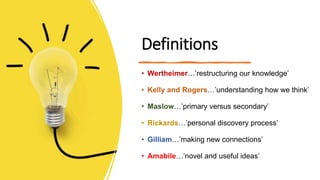
Definitions
• Wertheimer…’restructuring our knowledge’
• Kelly and Rogers…’understanding how we think’
• Maslow…’primary versus secondary’
• Rickards…’personal discovery process’
• Gilliam…’making new connections’
• Amabile…’novel and useful ideas’
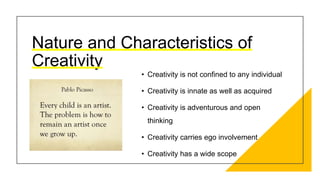
Nature and Characteristics of
Creativity
• Creativity is not confined to any individual
• Creativity is innate as well as acquired
• Creativity is adventurous and open
thinking
• Creativity carries ego involvement
• Creativity has a wide scope
Characteristics of
creative people
• Creative people are energetic, but focused
• Creative people are smart, but also naive
• Creative people are playful, yet disciplined
• Creative people are realistic dreamers
• Creative people are extroverted AND introverted
• Creative people are proud, yet modest
• Creative people are not weighed down by rigid gender roles.
• Creative people are conservative, yet rebellious.
• Creative people are passionate, but objective about their
work.
• Creative people are sensitive and open to experience, but
happy and joyful
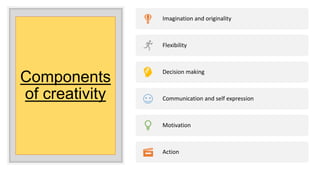
Components
of creativity
Imagination and originality
Flexibility
Decision making
Communication and self expression
Motivation
Action
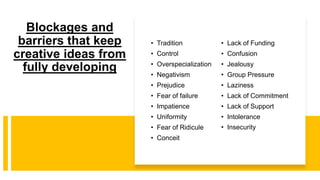
Blockages and
barriers that keep
creative ideas from
fully developing
• Tradition
• Control
• Overspecialization
• Negativism
• Prejudice
• Fear of failure
• Impatience
• Uniformity
• Fear of Ridicule
• Conceit
• Lack of Funding
• Confusion
• Jealousy
• Group Pressure
• Laziness
• Lack of Commitment
• Lack of Support
• Intolerance
• Insecurity
Creative
Thinking
Techniques
Creative
Thinking
Techniques
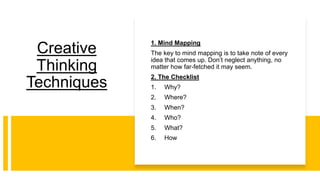
1. Mind Mapping
The key to mind mapping is to take note of every
idea that comes up. Don’t neglect anything, no
matter how far-fetched it may seem.
2. The Checklist
1. Why?
2. Where?
3. When?
4. Who?
5. What?
6. How
3. Six Thinking Hats
• White Hat – Facts,
• Red Hat – Emotions,
• Black Hat – Judgement,
• Yellow Hat – Logic,
• Green Hat – Creativity,
• Blue Hat -- Caution,
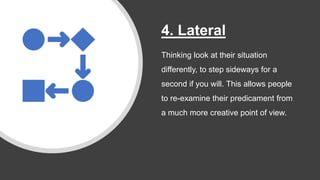
4. Lateral
Thinking look at their situation
differently, to step sideways for a
second if you will. This allows people
to re-examine their predicament from
a much more creative point of view.
5. Random Word Generation
Simply pick two random words and try
and tie your content to it in the most
imaginative way possible.
6. Picture Association
• If you’re truly stuck for ideas,
perform an image search on your
topic of choice, pick a random
photo. Work backwards from the
picture, developing a story around
how the photo was taken.
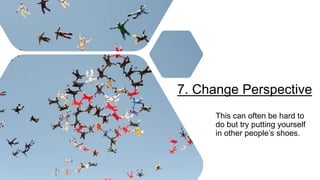
7. Change Perspective
This can often be hard to
do but try putting yourself
in other people’s shoes.
8. Get Up and Go Out
People underestimate the value
of being bored. If you work
around screens all day, if can
often prove both relaxing and
rewarding to just get up and walk
about for a bit. Let your mind
wander instead of focusing on a
task so hard it hurts
Innovation
Innovation
• Innovation as executing new ideas to create
value. Innovation is the commercialization
of creativity.” “Innovation is the creation,
development and implementation of a new
product, process or service, with the aim of
improving efficiency, effectiveness or
competitive advantage.”
• The process of translating an idea or
invention into a good or service that creates
value or for which customers will pay. ... In
business, innovation often results when
ideas are applied by the company in order to
further satisfy the needs and expectations of
the customers.
What makes something
innovative?
A product or an idea
becomes innovative when it stands out
from the rest and truly makes the
customers' lives easier.
A successful change that can convert
knowledge and ideas into benefit – in the
form of new or improved products /
services is capable of being innovative.
What makes
something
innovative?
• Innovation is not just about brand new
products. There are many places where you
can be innovative and often the context helps
define innovation.
• The six focus areas for innovation are:
• Product --- what we produce and sell
• Service --- exceeding customer
expectations
• Process --- continuous improvement of how
we do things
• Management --- business strategies, systems
and structures
• Open --- working beyond boundaries and
collaborating globally
• Value --- creating unique value that
eliminates the cost to compete
INVENTION VS. INNOVATION:
THE DIFFERENCE
• In its purest sense, invention can be defined as
the creation of a product or introduction of a
process for the first time.
• Innovation, on the other hand, occurs if
someone improves on or makes a significant
contribution to an existing product, process or
service.
• Consider the microprocessor. Someone
invented the microprocessor. But by itself, the
microprocessor was nothing more than another
piece on the circuit board. It’s what was done
with that piece — the hundreds of thousands of
products, processes and services that evolved
from the invention of the microprocessor —
that required innovation.
Types of Invention
Incremental Innovation
• Incremental Innovation is the most
common form of innovation. It utilizes
your existing technology and increases
value to the customer (features, design
changes, etc.) within your existing
market. Almost all companies engage in
incremental innovation in one form or
another.
Disruptive Innovation
Disruptive innovation, also known as stealth
innovation, involves applying new technology or
processes to your company’s current market.
It is stealthy in nature since newer tech will often be
inferior to existing market technology. This newer
technology is often more expensive, has fewer
features, is harder to use, and is not as aesthetically
pleasing.
It is only after a few iterations that the newer tech
surpasses the old and disrupts all existing
companies. By then, it might be too late for the
established companies to quickly compete with the
newer technology.
Architectural Innovation
Architectural innovation is simply taking
the lessons, skills and overall technology
and applying them within a different
market.
This innovation is amazing at increasing
new customers as long as the new market
is receptive.
Most of the time, the risk involved in
architectural innovation is low due to the
reliance and reintroduction of proven
technology.
Though most of the time it requires
tweaking to match the requirements of the
new market.
Radical
innovation
Radical innovation is what we think of
mostly when considering innovation. It
gives birth to new industries (or swallows
existing ones) and involves creating
revolutionary technology. The airplane, for
example, was not the first mode of
transportation, but it is revolutionary as it
allowed commercialized air travel to develop
and prosper.

Creativity and innovation

  • 1.
    Creativity & Innovation Presenters WaqarIqbal Saleem Saifullah Abdul Latif Shafeequllah
  • 2.
    Creativity • Creativity isthe ability to generate innovative ideas and manifest them from thought into reality. The process involves original thinking and then producing.
  • 3.
    Definitions • Wertheimer…’restructuring ourknowledge’ • Kelly and Rogers…’understanding how we think’ • Maslow…’primary versus secondary’ • Rickards…’personal discovery process’ • Gilliam…’making new connections’ • Amabile…’novel and useful ideas’
  • 4.
    Nature and Characteristicsof Creativity • Creativity is not confined to any individual • Creativity is innate as well as acquired • Creativity is adventurous and open thinking • Creativity carries ego involvement • Creativity has a wide scope
  • 5.
    Characteristics of creative people •Creative people are energetic, but focused • Creative people are smart, but also naive • Creative people are playful, yet disciplined • Creative people are realistic dreamers • Creative people are extroverted AND introverted • Creative people are proud, yet modest • Creative people are not weighed down by rigid gender roles. • Creative people are conservative, yet rebellious. • Creative people are passionate, but objective about their work. • Creative people are sensitive and open to experience, but happy and joyful
  • 6.
    Components of creativity Imagination andoriginality Flexibility Decision making Communication and self expression Motivation Action
  • 7.
    Blockages and barriers thatkeep creative ideas from fully developing • Tradition • Control • Overspecialization • Negativism • Prejudice • Fear of failure • Impatience • Uniformity • Fear of Ridicule • Conceit • Lack of Funding • Confusion • Jealousy • Group Pressure • Laziness • Lack of Commitment • Lack of Support • Intolerance • Insecurity
  • 8.
  • 9.
    Creative Thinking Techniques 1. Mind Mapping Thekey to mind mapping is to take note of every idea that comes up. Don’t neglect anything, no matter how far-fetched it may seem. 2. The Checklist 1. Why? 2. Where? 3. When? 4. Who? 5. What? 6. How
  • 10.
    3. Six ThinkingHats • White Hat – Facts, • Red Hat – Emotions, • Black Hat – Judgement, • Yellow Hat – Logic, • Green Hat – Creativity, • Blue Hat -- Caution,
  • 11.
    4. Lateral Thinking lookat their situation differently, to step sideways for a second if you will. This allows people to re-examine their predicament from a much more creative point of view.
  • 12.
    5. Random WordGeneration Simply pick two random words and try and tie your content to it in the most imaginative way possible.
  • 13.
    6. Picture Association •If you’re truly stuck for ideas, perform an image search on your topic of choice, pick a random photo. Work backwards from the picture, developing a story around how the photo was taken.
  • 14.
    7. Change Perspective Thiscan often be hard to do but try putting yourself in other people’s shoes.
  • 15.
    8. Get Upand Go Out People underestimate the value of being bored. If you work around screens all day, if can often prove both relaxing and rewarding to just get up and walk about for a bit. Let your mind wander instead of focusing on a task so hard it hurts
  • 16.
  • 17.
    Innovation • Innovation asexecuting new ideas to create value. Innovation is the commercialization of creativity.” “Innovation is the creation, development and implementation of a new product, process or service, with the aim of improving efficiency, effectiveness or competitive advantage.” • The process of translating an idea or invention into a good or service that creates value or for which customers will pay. ... In business, innovation often results when ideas are applied by the company in order to further satisfy the needs and expectations of the customers.
  • 18.
    What makes something innovative? Aproduct or an idea becomes innovative when it stands out from the rest and truly makes the customers' lives easier. A successful change that can convert knowledge and ideas into benefit – in the form of new or improved products / services is capable of being innovative.
  • 19.
    What makes something innovative? • Innovationis not just about brand new products. There are many places where you can be innovative and often the context helps define innovation. • The six focus areas for innovation are: • Product --- what we produce and sell • Service --- exceeding customer expectations • Process --- continuous improvement of how we do things • Management --- business strategies, systems and structures • Open --- working beyond boundaries and collaborating globally • Value --- creating unique value that eliminates the cost to compete
  • 20.
    INVENTION VS. INNOVATION: THEDIFFERENCE • In its purest sense, invention can be defined as the creation of a product or introduction of a process for the first time. • Innovation, on the other hand, occurs if someone improves on or makes a significant contribution to an existing product, process or service. • Consider the microprocessor. Someone invented the microprocessor. But by itself, the microprocessor was nothing more than another piece on the circuit board. It’s what was done with that piece — the hundreds of thousands of products, processes and services that evolved from the invention of the microprocessor — that required innovation.
  • 21.
  • 22.
    Incremental Innovation • IncrementalInnovation is the most common form of innovation. It utilizes your existing technology and increases value to the customer (features, design changes, etc.) within your existing market. Almost all companies engage in incremental innovation in one form or another.
  • 23.
    Disruptive Innovation Disruptive innovation,also known as stealth innovation, involves applying new technology or processes to your company’s current market. It is stealthy in nature since newer tech will often be inferior to existing market technology. This newer technology is often more expensive, has fewer features, is harder to use, and is not as aesthetically pleasing. It is only after a few iterations that the newer tech surpasses the old and disrupts all existing companies. By then, it might be too late for the established companies to quickly compete with the newer technology.
  • 24.
    Architectural Innovation Architectural innovationis simply taking the lessons, skills and overall technology and applying them within a different market. This innovation is amazing at increasing new customers as long as the new market is receptive. Most of the time, the risk involved in architectural innovation is low due to the reliance and reintroduction of proven technology. Though most of the time it requires tweaking to match the requirements of the new market.
  • 25.
    Radical innovation Radical innovation iswhat we think of mostly when considering innovation. It gives birth to new industries (or swallows existing ones) and involves creating revolutionary technology. The airplane, for example, was not the first mode of transportation, but it is revolutionary as it allowed commercialized air travel to develop and prosper.