Open Innovation: An
Introduction and Overview
Marcel Bogers
Seminar: “Open innovation - managing
innovation across organizational boundaries”
Chalmers University of Technology
May 19, 2015
@bogers
Why important?
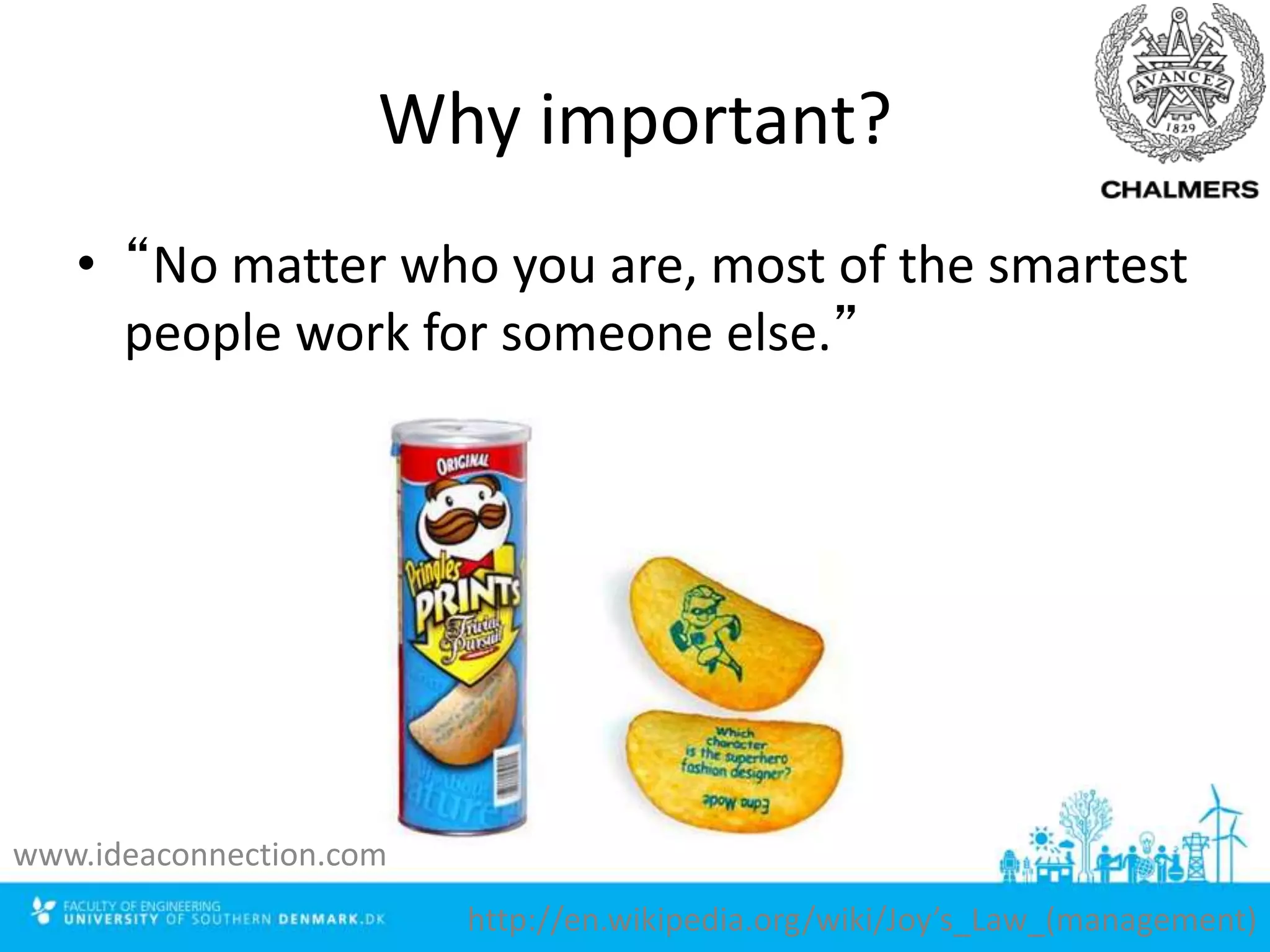
• “No matter who you are, most of the smartest
people work for someone else.”
http://en.wikipedia.org/wiki/Joy’s_Law_(management)
www.ideaconnection.com
Where do we come from?
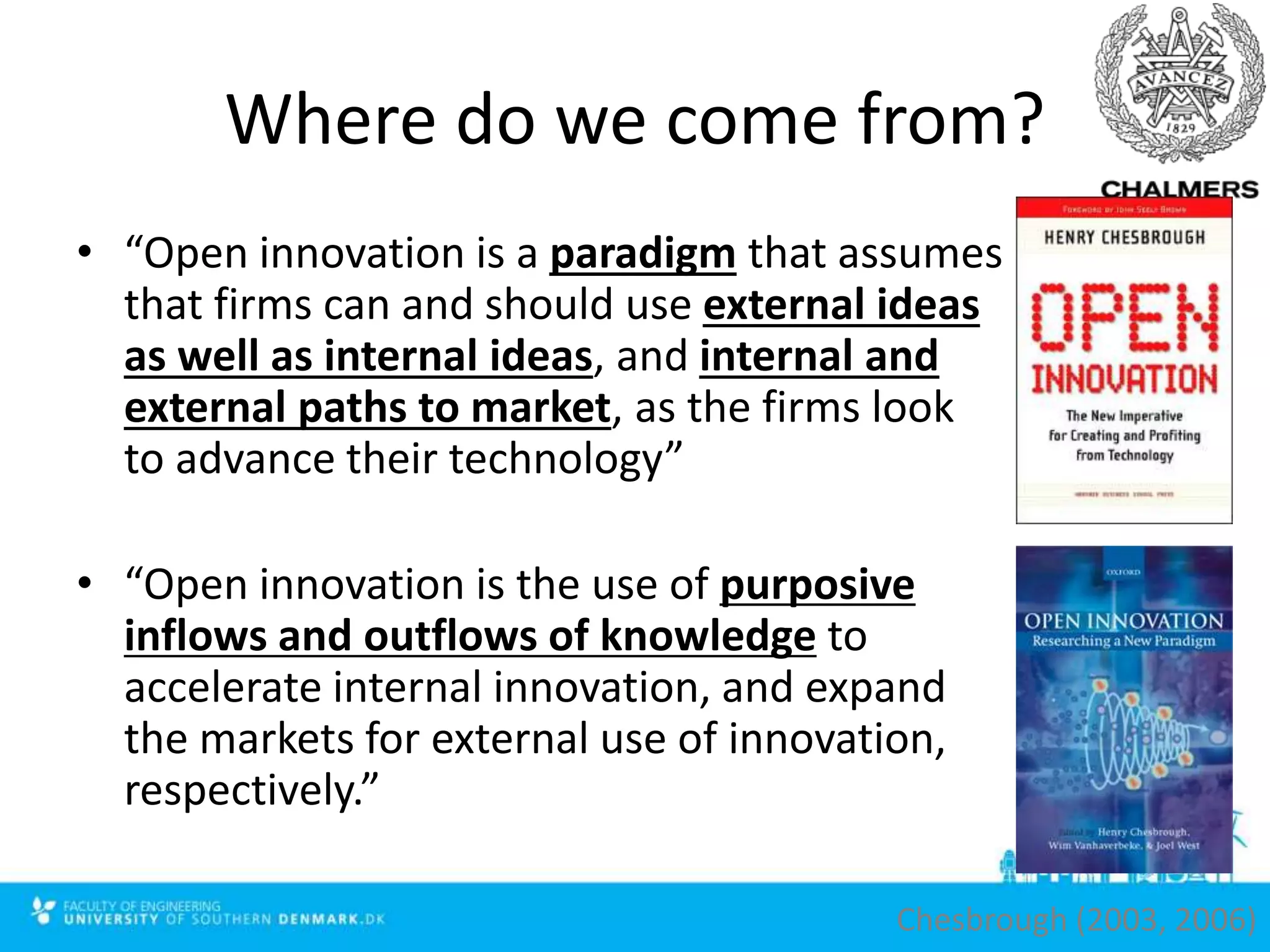
• “Open innovation is a paradigm that assumes
that firms can and should use external ideas
as well as internal ideas, and internal and
external paths to market, as the firms look
to advance their technology”
• “Open innovation is the use of purposive
inflows and outflows of knowledge to
accelerate internal innovation, and expand
the markets for external use of innovation,
respectively.”
Chesbrough (2003, 2006)
Where are we?
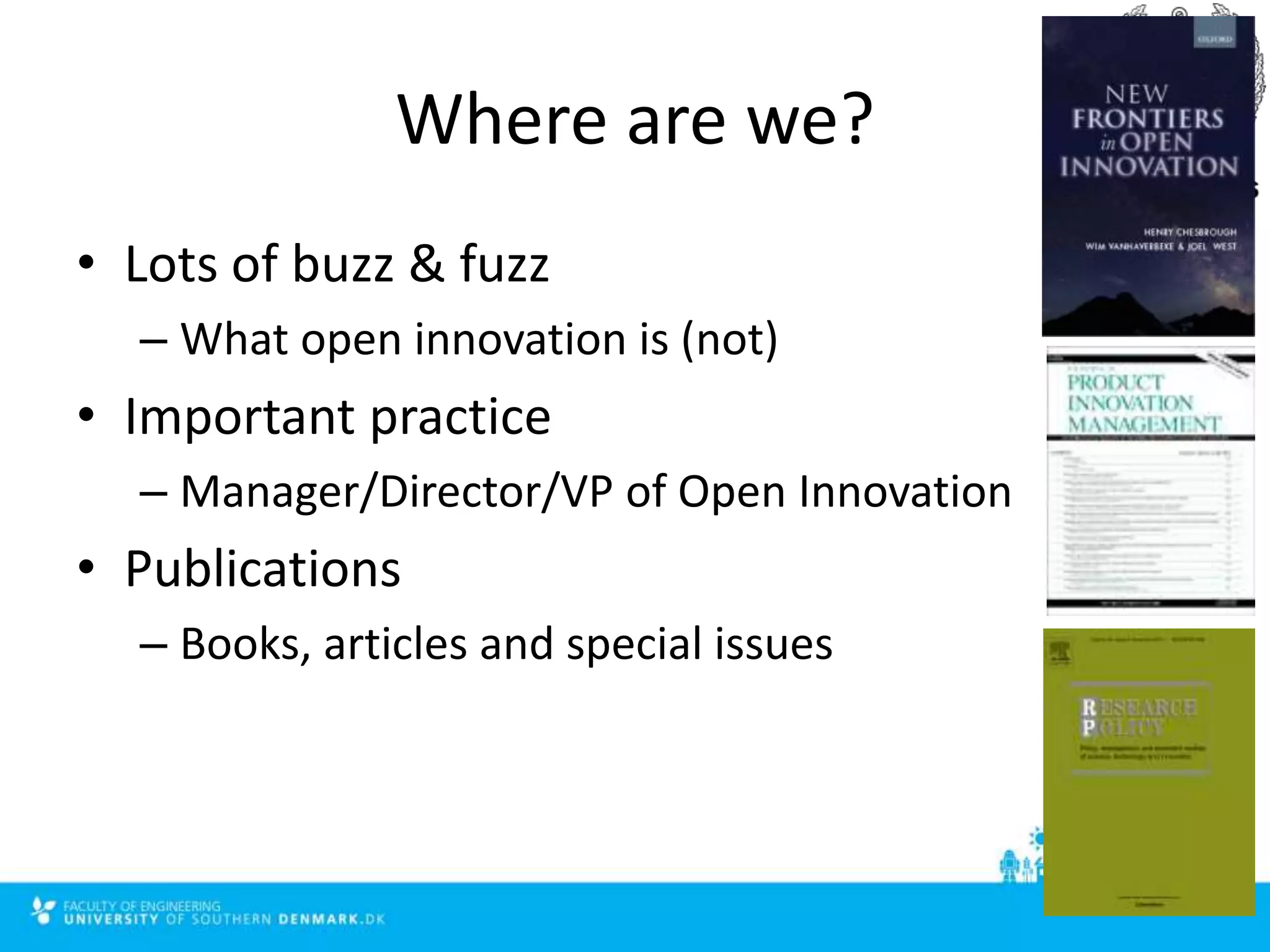
• Lots of buzz & fuzz
– What open innovation is (not)
• Important practice
– Manager/Director/VP of Open Innovation
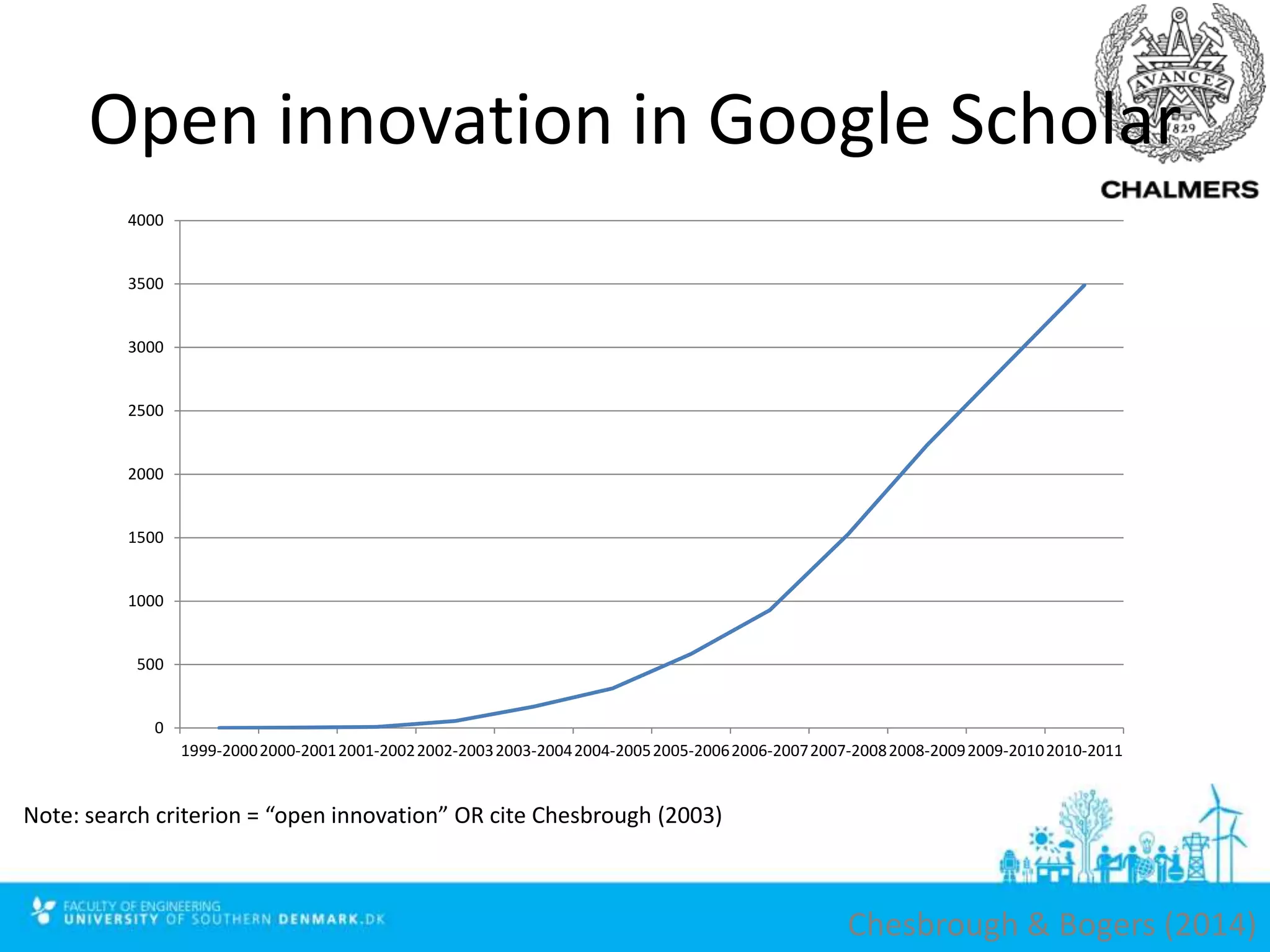
• Publications
– Books, articles and special issues
0
500
1000
1500
2000
2500
3000
3500
4000
1999-20002000-20012001-20022002-20032003-20042004-20052005-20062006-20072007-20082008-20092009-20102010-2011
Note: search criterion = “open innovation” OR cite Chesbrough (2003)
Open innovation in Google Scholar
Chesbrough & Bogers (2014)
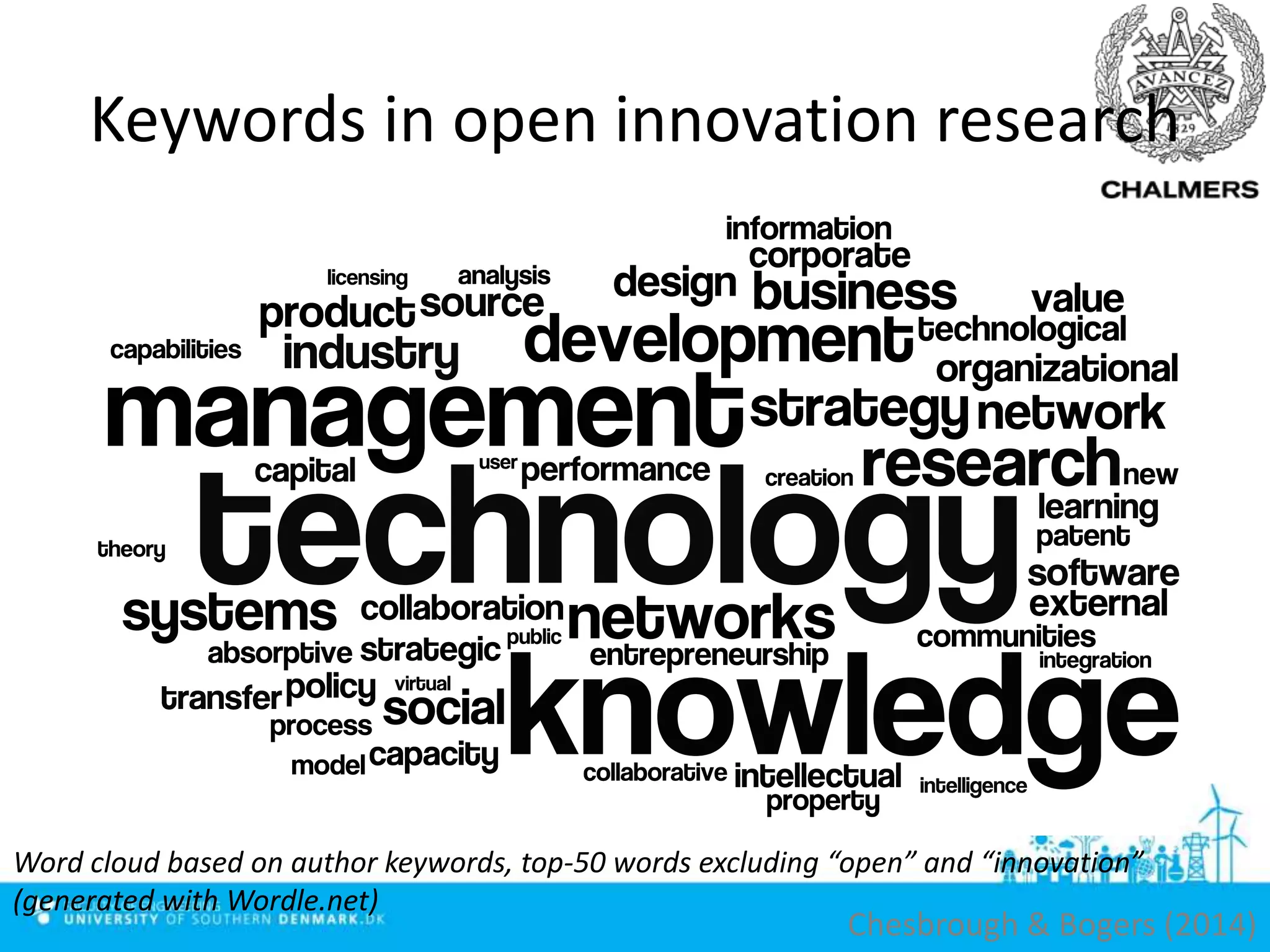
Keywords in open innovation research
Word cloud based on author keywords, top-50 words excluding “open” and “innovation”
(generated with Wordle.net)
Chesbrough & Bogers (2014)
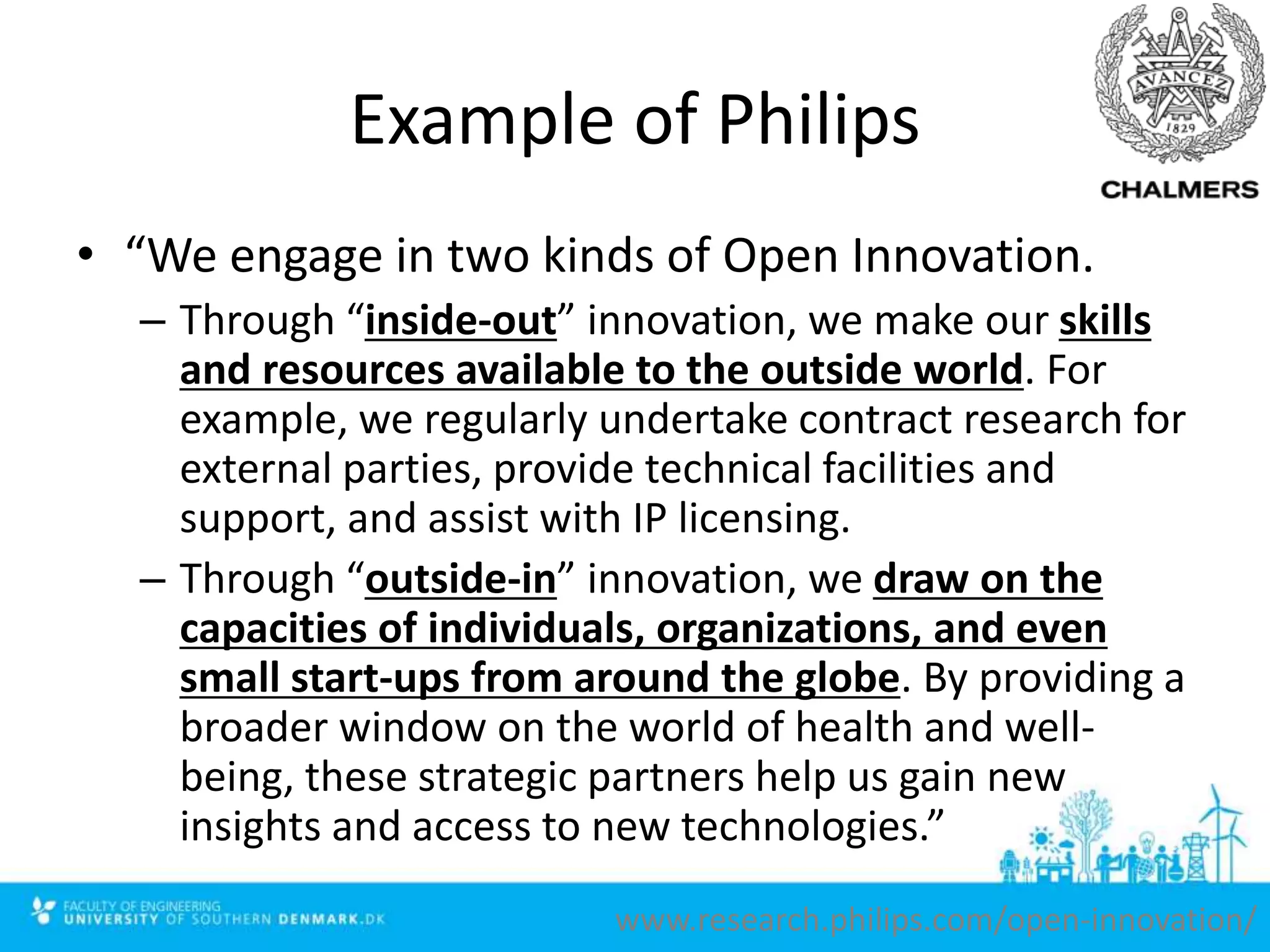
Example of Philips
• “We engage in two kinds of Open Innovation.
– Through “inside-out” innovation, we make our skills
and resources available to the outside world. For
example, we regularly undertake contract research for
external parties, provide technical facilities and
support, and assist with IP licensing.
– Through “outside-in” innovation, we draw on the
capacities of individuals, organizations, and even
small start-ups from around the globe. By providing a
broader window on the world of health and well-
being, these strategic partners help us gain new
insights and access to new technologies.”
www.research.philips.com/open-innovation/
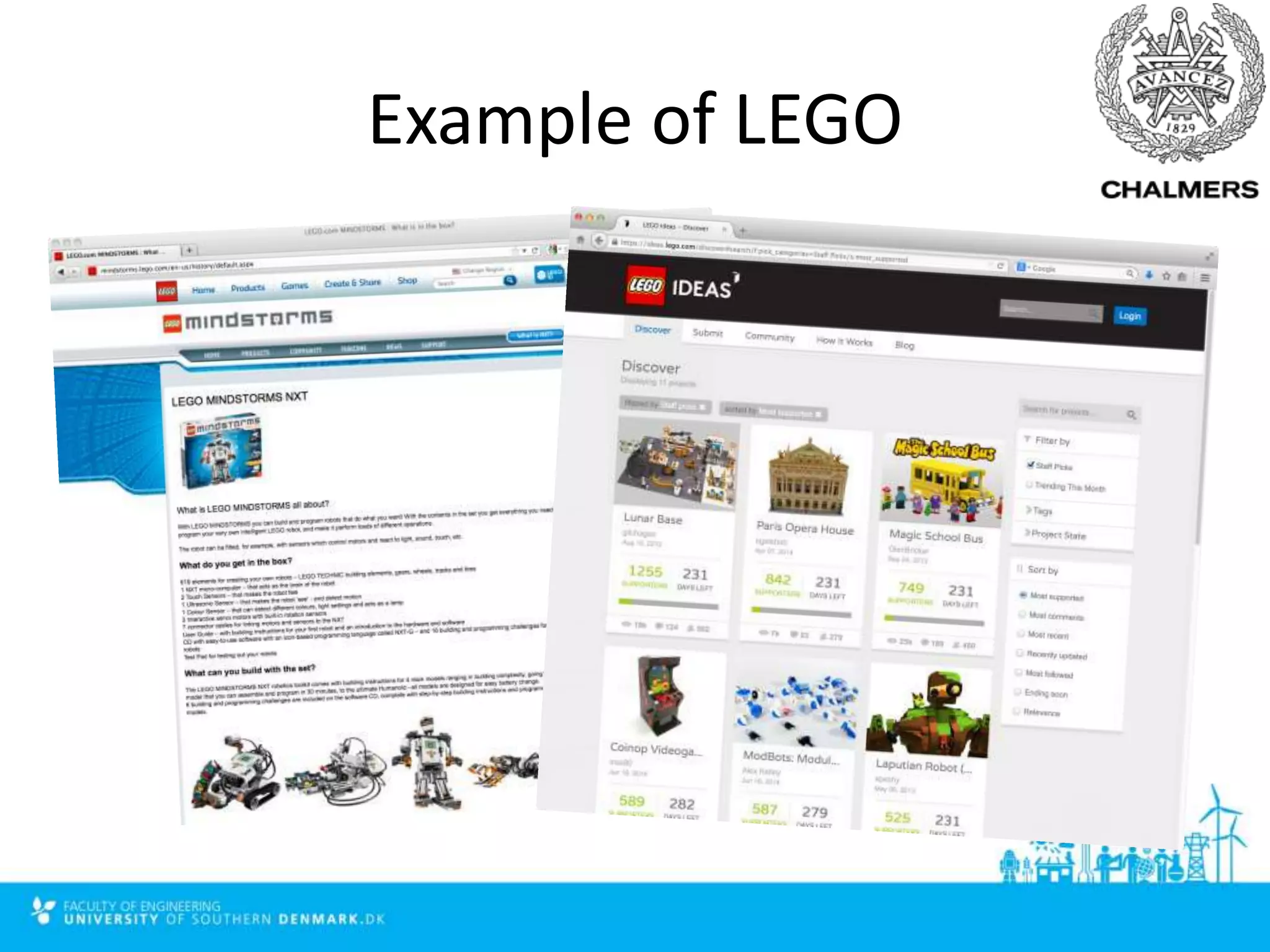
Example of LEGO
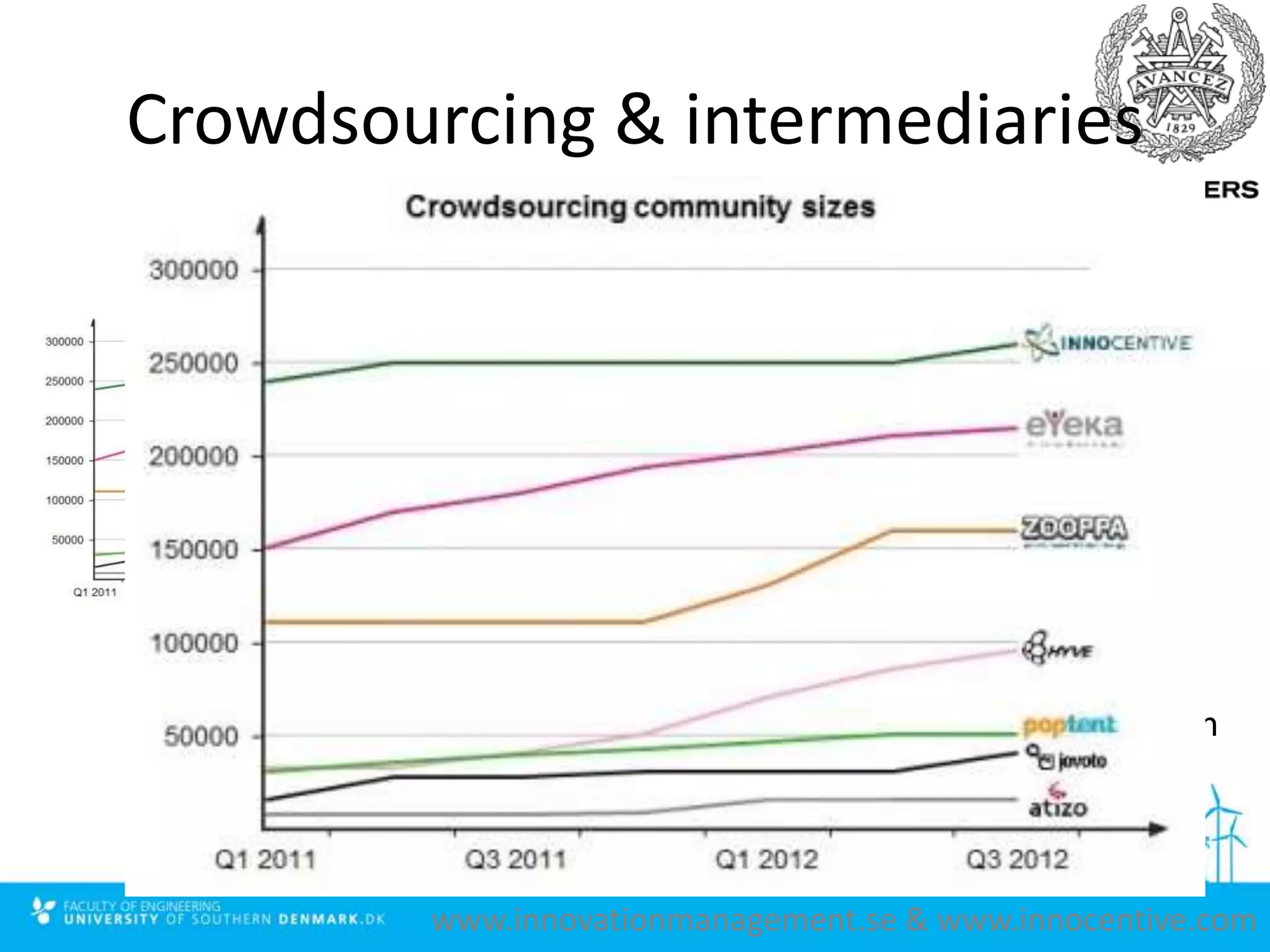
Crowdsourcing & intermediaries
InnoCentive
www.innovationmanagement.se & www.innocentive.com
• 355,000+ Solvers
• Nearly 200 countries
• 13+ million Solver Reach
• External Challenges: 2,000+
• Project Rooms Opened: 500,000+
• Total Solution Submissions: 40,000+
• Awards Given: 1,500+
• Total Award Dollars Posted: $40+ million
• Range of awards: $5,000 to $1+ million
• Premium Challenge Success Rate: 85%
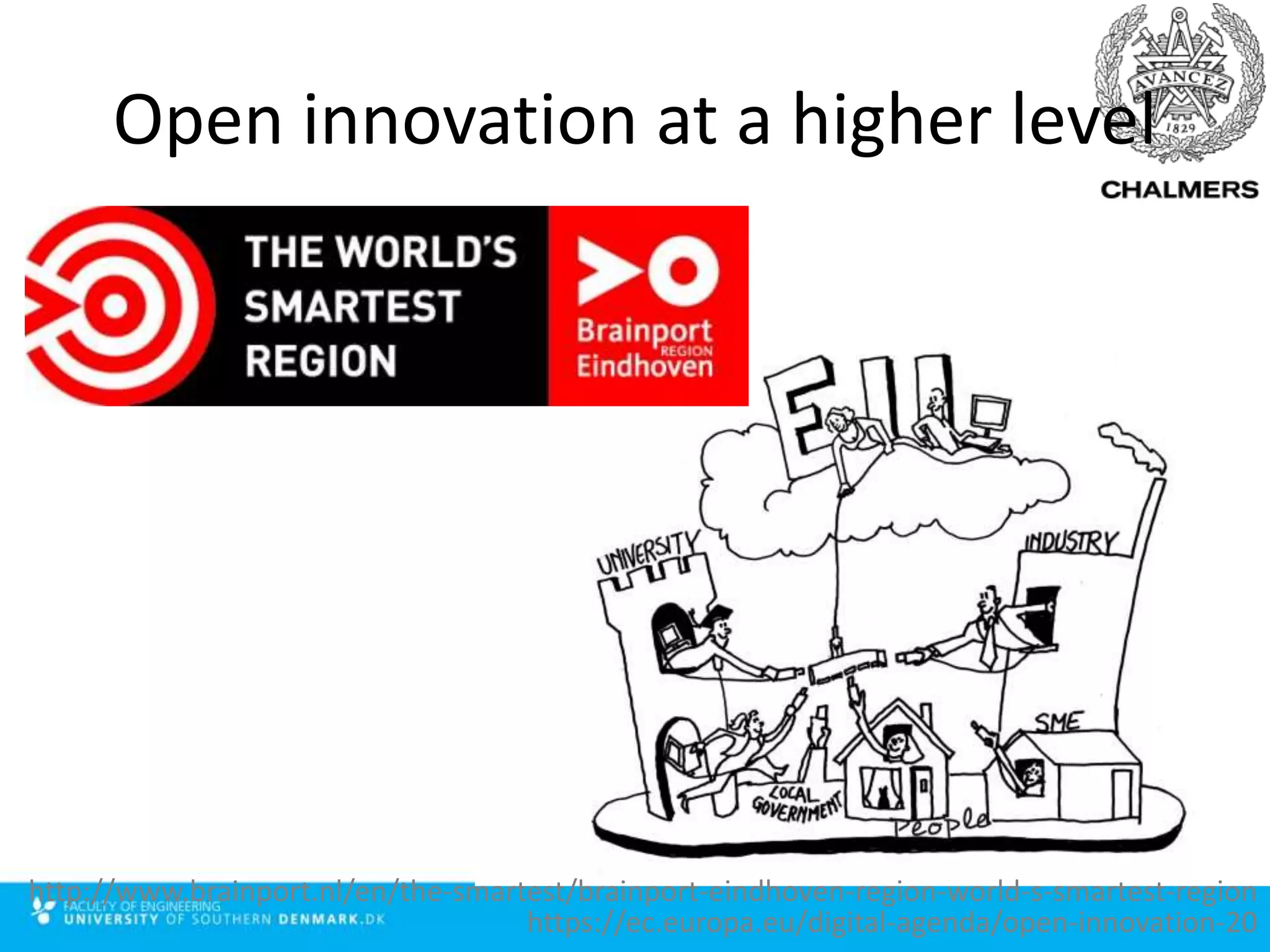
Open innovation at a higher level
http://www.brainport.nl/en/the-smartest/brainport-eindhoven-region-world-s-smartest-region
https://ec.europa.eu/digital-agenda/open-innovation-20
Defining open innovation
• “A distributed innovation process based on
purposively managed knowledge flows across
organizational boundaries, using pecuniary
and non-pecuniary mechanisms in line with
the organization’s business model.”
Chesbrough & Bogers (2014)
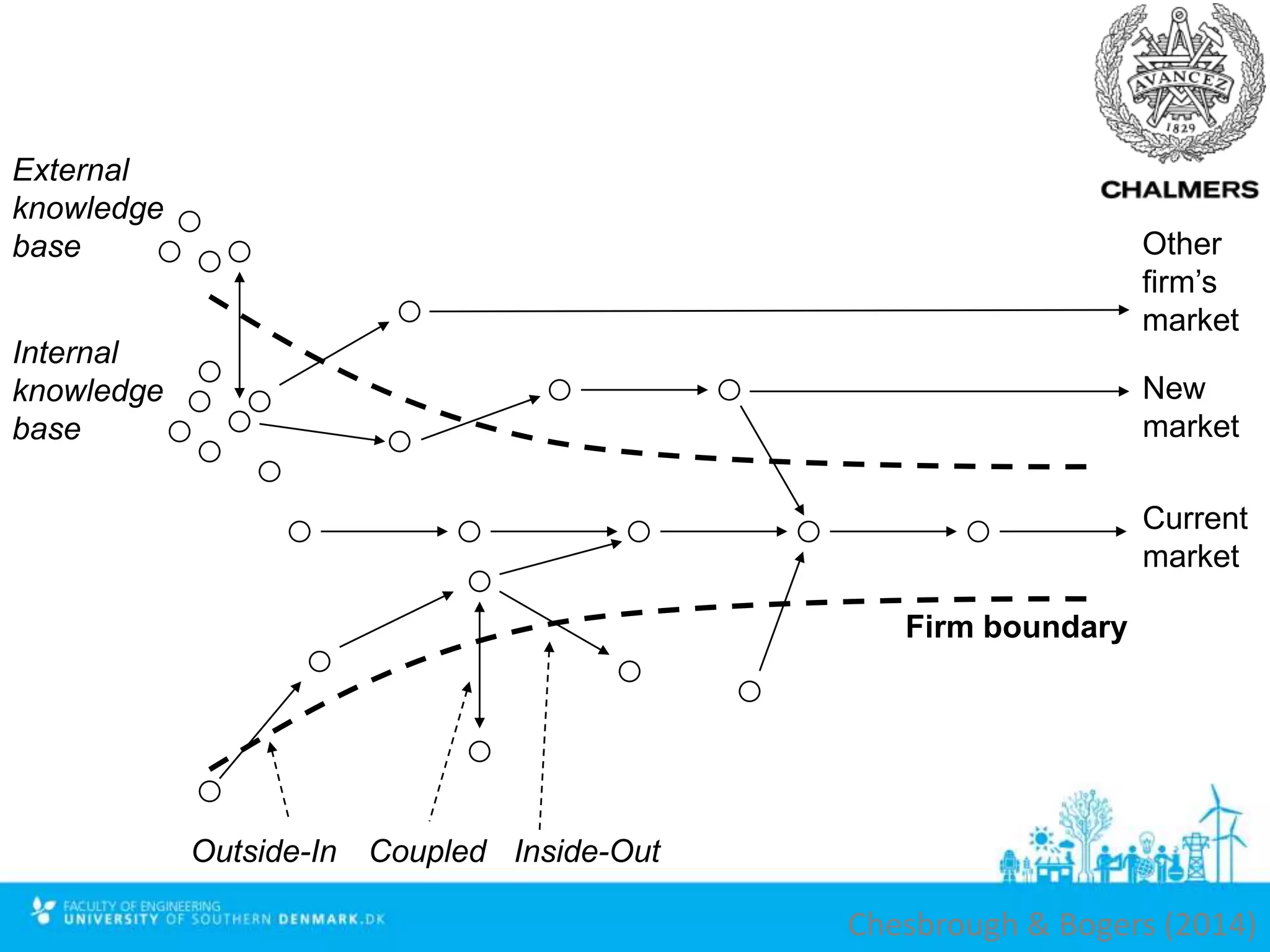
External
knowledge
base
Current
market
New
market
Other
firm’s
market
Outside-In Inside-OutCoupled
Internal
knowledge
base
Firm boundary
Chesbrough & Bogers (2014)
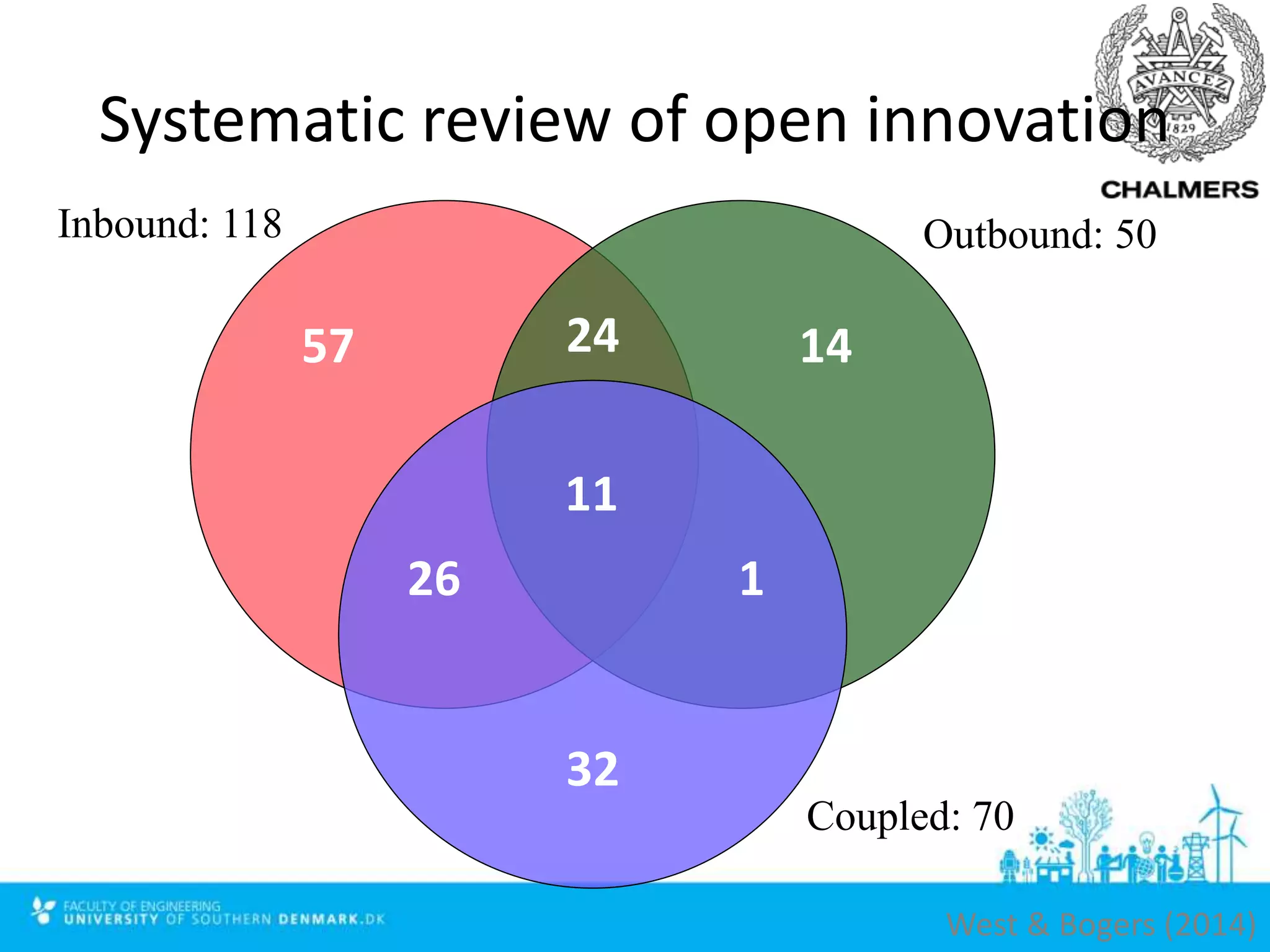
Systematic review of open innovation
Inbound: 118 Outbound: 50
Coupled: 70
57 14
11
24
26 1
32
West & Bogers (2014)
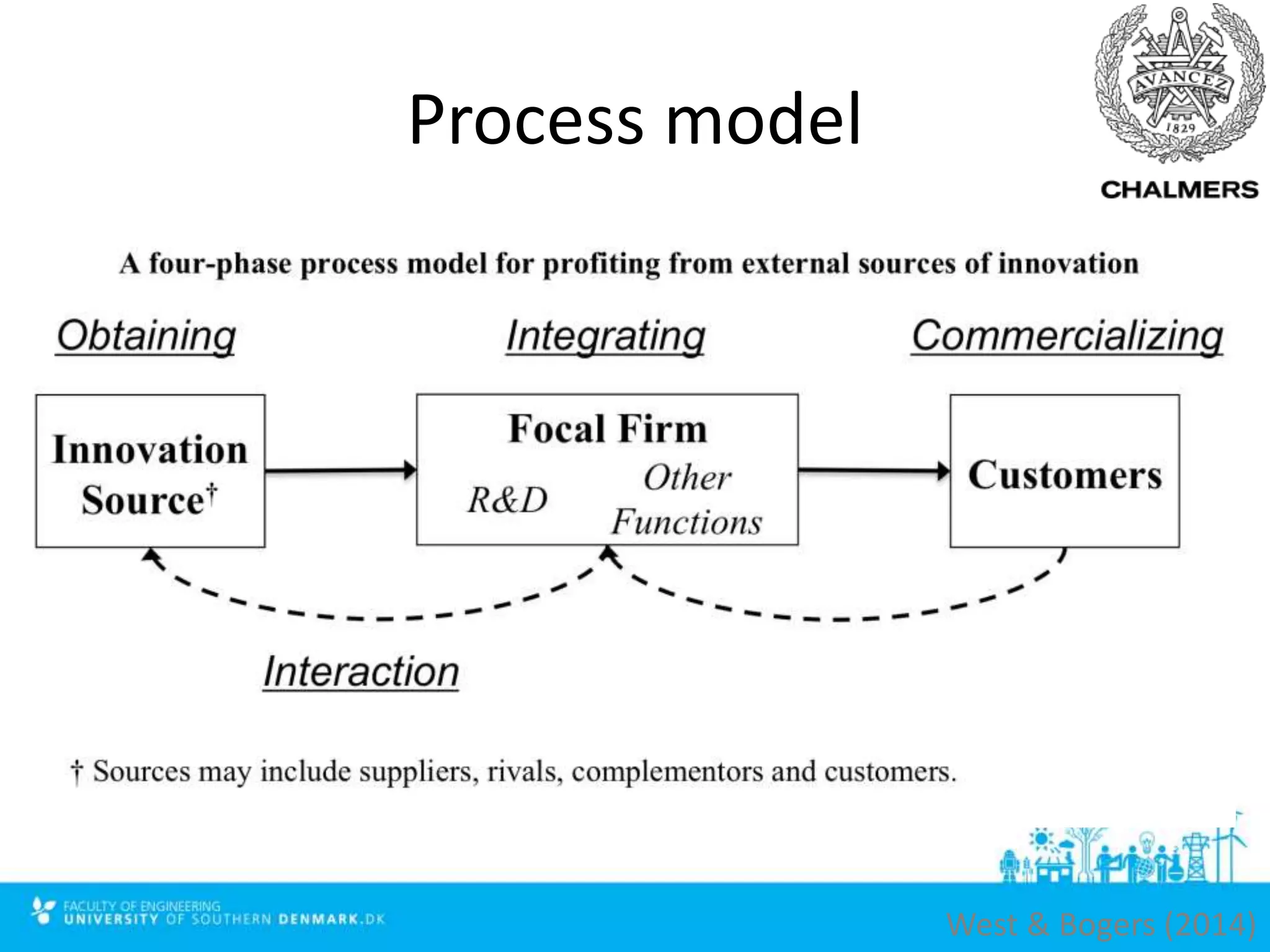
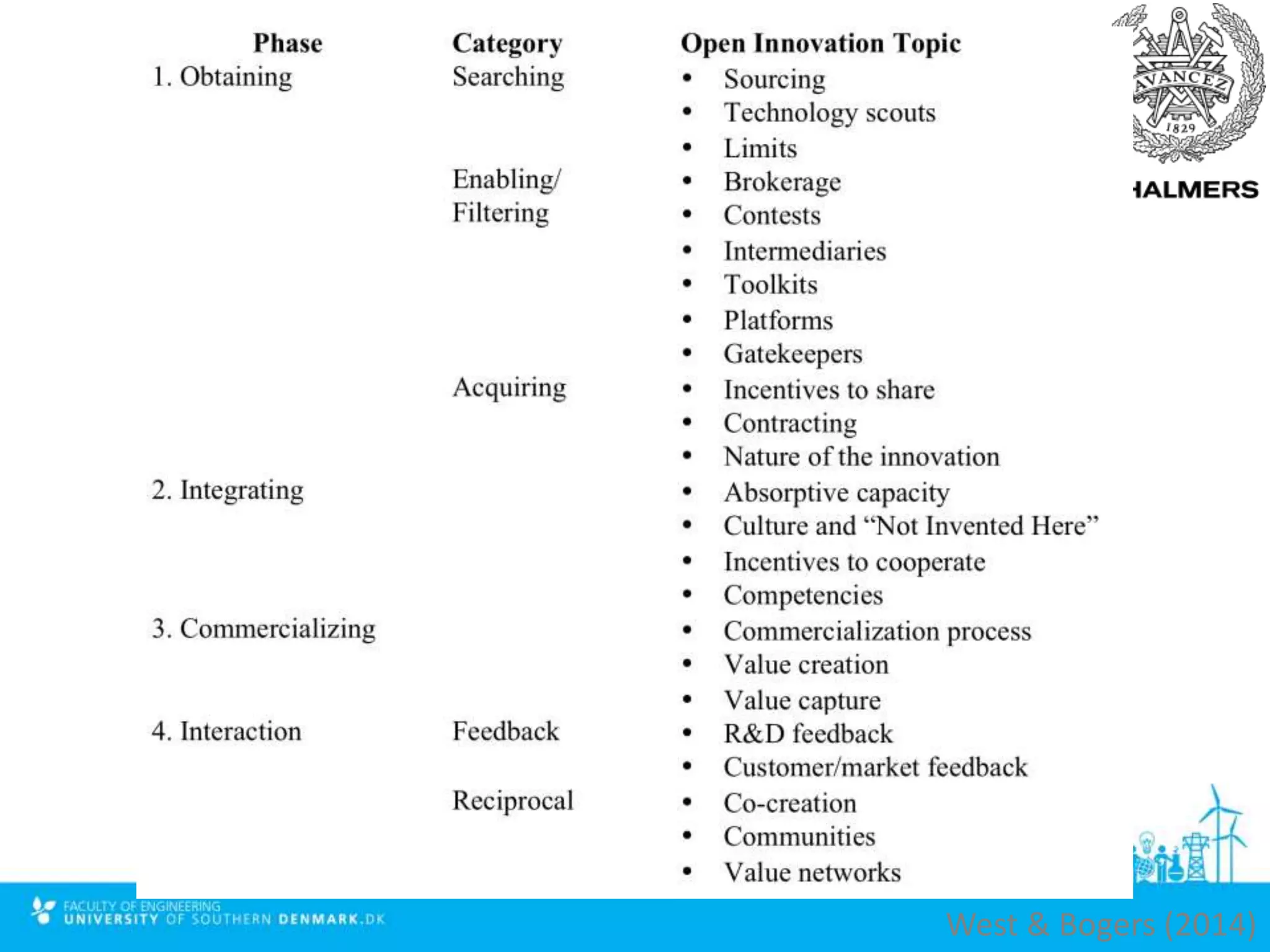
Process model
West & Bogers (2014)
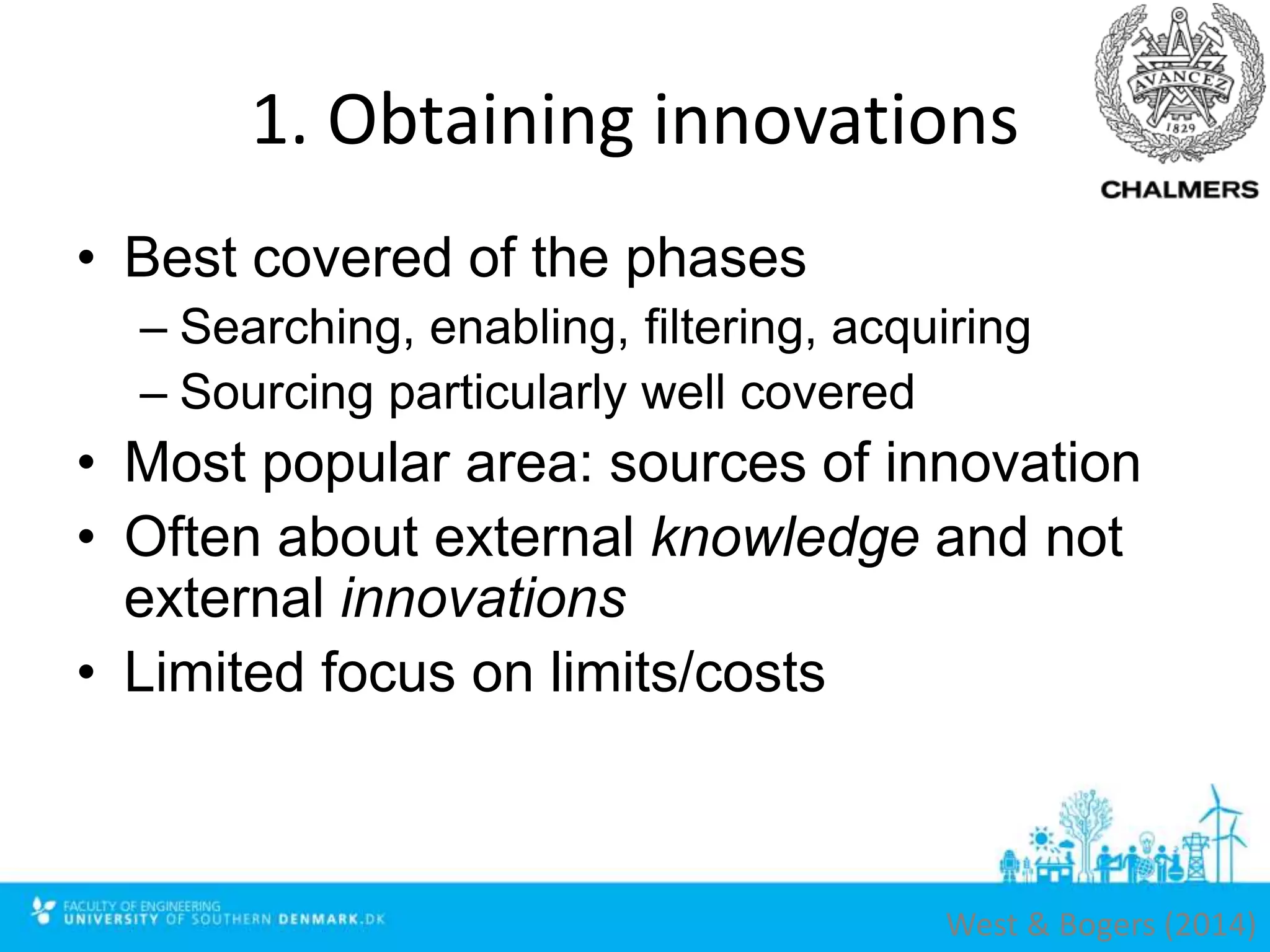
1. Obtaining innovations
• Best covered of the phases
– Searching, enabling, filtering, acquiring
– Sourcing particularly well covered
• Most popular area: sources of innovation
• Often about external knowledge and not
external innovations
• Limited focus on limits/costs
West & Bogers (2014)
2. Integrating innovations
• Considers organizational capabilities and
culture
– Absorptive capacity
• Over-researched, ill-measured?
– NIH is mentioned, not well measured
– Implicit assumptions
• Integration seems to be a black box
– Are new competencies needed?
• Limited discussion of open innovation as
substitute for R&D
West & Bogers (2014)
3. Commercializing innovations
• Lots of value creation
– Often measured using NPD metrics
– Not as much value capture
• Cf. business model
• Assumes similar commercialization
process for external and internal
innovations
– How do firms differ in external innovation
commercialization capabilities?
West & Bogers (2014)
4. Interaction mechanisms
• Beyond the linear model
– Reverse paths
– Feedback mechanisms
• Information flow upstream
– Reciprocal processes
• Ongoing interactions
• Includes co-creation, networks, communities
• Research relatively scarce
West & Bogers (2014)
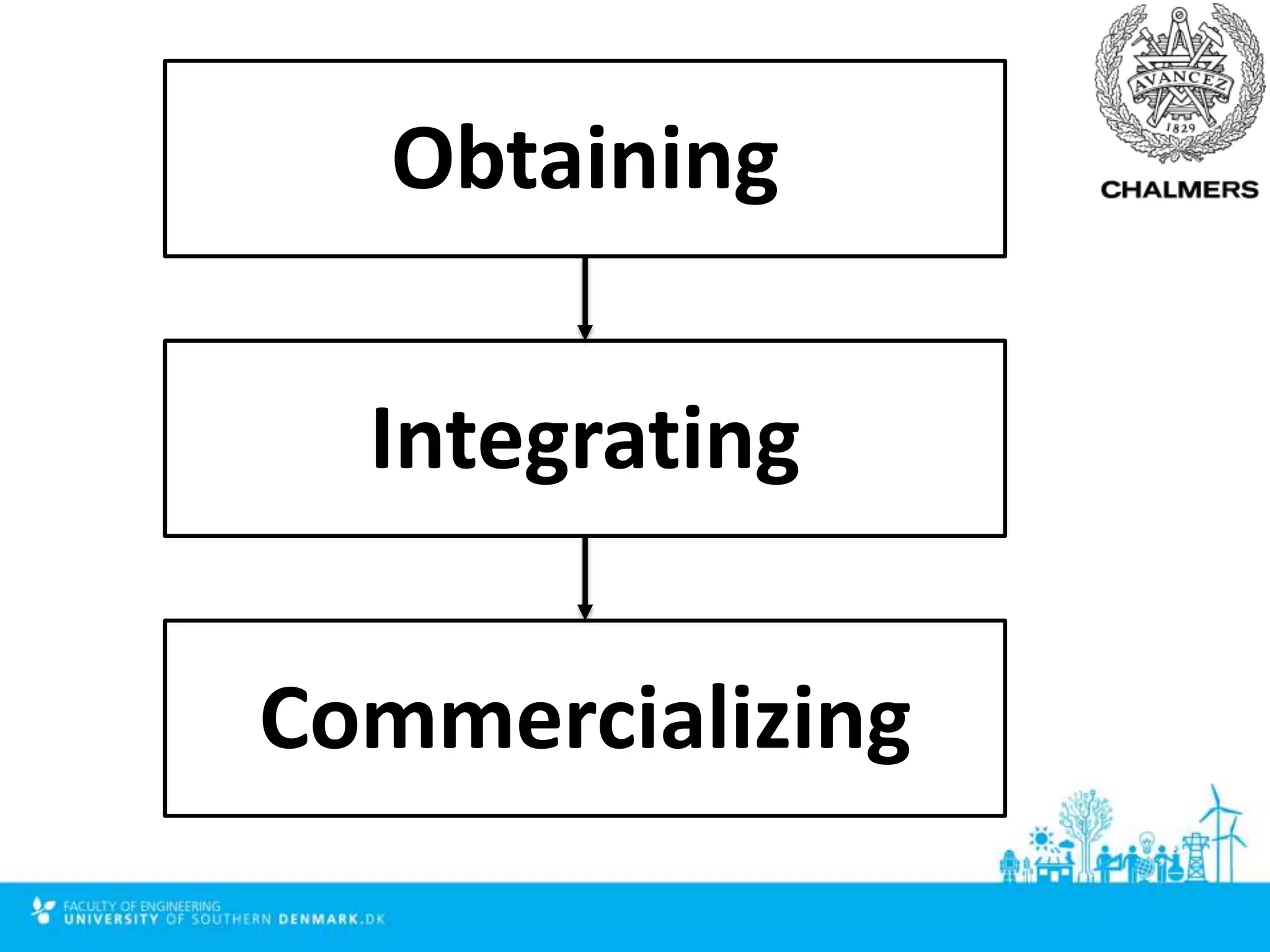
Obtaining
Integrating
Commercializing
Gaps and opportunities (1)
• Use of business model
– Particularly value capture
– Measure strategic objectives/success
• Examining the entire process
– More on back end of process
– Consider process end to end
West & Bogers (2014)
Gaps and opportunities (2)
• Clarity of innovation construct(s)
– Antecedents, processes & outcomes
– “Innovation” not same as antecedents
• Move beyond linear model
– Cf. “outbound” & “coupled”
• Limits and moderators
– Decreasing returns, costs & risks (failures?)
– Interaction effects
– Within-firm processes/effects/decisions
West & Bogers (2014)
Thank you for your attention!
Marcel Bogers
www.marcelbogers.com
@bogers
Reference List
• Chesbrough, H. 2003. Open Innovation: The New Imperative for
Creating and Profiting from Technology. Boston, MA: Harvard
Business School Press.
• Chesbrough, H. 2006. Open innovation: A new paradigm for
understanding industrial innovation. In H. Chesbrough, W.
Vanhaverbeke, & J. West (Eds.), Open Innovation: Researching a
New Paradigm: 1-12. Oxford: Oxford University Press.
• Chesbrough, H., & Bogers, M. 2014. Explicating open innovation:
Clarifying an emerging paradigm for understanding industrial
innovation. In H. Chesbrough, W. Vanhaverbeke, & J. West (Eds.),
New Frontiers in Open Innovation: 3-28. Oxford: Oxford University
Press.
• West, J., & Bogers, M. 2014. Leveraging external sources of
innovation: A review of research on open innovation. Journal of
Product Innovation Management, 37(2): 814-831.
• West, J., Salter, A., Vanhaverbeke, W., & Chesbrough, H. 2014. Open
innovation: The next decade. Research Policy, 43(5): 805-811.

Open Innovation: An Introduction and Overview (Chalmers)

  • 1.
    Open Innovation: An Introductionand Overview Marcel Bogers Seminar: “Open innovation - managing innovation across organizational boundaries” Chalmers University of Technology May 19, 2015 @bogers
  • 2.
    Why important? • “Nomatter who you are, most of the smartest people work for someone else.” http://en.wikipedia.org/wiki/Joy’s_Law_(management) www.ideaconnection.com
  • 3.
    Where do wecome from? • “Open innovation is a paradigm that assumes that firms can and should use external ideas as well as internal ideas, and internal and external paths to market, as the firms look to advance their technology” • “Open innovation is the use of purposive inflows and outflows of knowledge to accelerate internal innovation, and expand the markets for external use of innovation, respectively.” Chesbrough (2003, 2006)
  • 4.
    Where are we? •Lots of buzz & fuzz – What open innovation is (not) • Important practice – Manager/Director/VP of Open Innovation • Publications – Books, articles and special issues
  • 5.
  • 6.
    Keywords in openinnovation research Word cloud based on author keywords, top-50 words excluding “open” and “innovation” (generated with Wordle.net) Chesbrough & Bogers (2014)
  • 7.
    Example of Philips •“We engage in two kinds of Open Innovation. – Through “inside-out” innovation, we make our skills and resources available to the outside world. For example, we regularly undertake contract research for external parties, provide technical facilities and support, and assist with IP licensing. – Through “outside-in” innovation, we draw on the capacities of individuals, organizations, and even small start-ups from around the globe. By providing a broader window on the world of health and well- being, these strategic partners help us gain new insights and access to new technologies.” www.research.philips.com/open-innovation/
  • 8.
  • 9.
    Crowdsourcing & intermediaries InnoCentive www.innovationmanagement.se& www.innocentive.com • 355,000+ Solvers • Nearly 200 countries • 13+ million Solver Reach • External Challenges: 2,000+ • Project Rooms Opened: 500,000+ • Total Solution Submissions: 40,000+ • Awards Given: 1,500+ • Total Award Dollars Posted: $40+ million • Range of awards: $5,000 to $1+ million • Premium Challenge Success Rate: 85%
  • 10.
    Open innovation ata higher level http://www.brainport.nl/en/the-smartest/brainport-eindhoven-region-world-s-smartest-region https://ec.europa.eu/digital-agenda/open-innovation-20
  • 11.
    Defining open innovation •“A distributed innovation process based on purposively managed knowledge flows across organizational boundaries, using pecuniary and non-pecuniary mechanisms in line with the organization’s business model.” Chesbrough & Bogers (2014)
  • 12.
  • 13.
    Systematic review ofopen innovation Inbound: 118 Outbound: 50 Coupled: 70 57 14 11 24 26 1 32 West & Bogers (2014)
  • 14.
    Process model West &Bogers (2014)
  • 15.
  • 16.
    1. Obtaining innovations •Best covered of the phases – Searching, enabling, filtering, acquiring – Sourcing particularly well covered • Most popular area: sources of innovation • Often about external knowledge and not external innovations • Limited focus on limits/costs West & Bogers (2014)
  • 17.
    2. Integrating innovations •Considers organizational capabilities and culture – Absorptive capacity • Over-researched, ill-measured? – NIH is mentioned, not well measured – Implicit assumptions • Integration seems to be a black box – Are new competencies needed? • Limited discussion of open innovation as substitute for R&D West & Bogers (2014)
  • 18.
    3. Commercializing innovations •Lots of value creation – Often measured using NPD metrics – Not as much value capture • Cf. business model • Assumes similar commercialization process for external and internal innovations – How do firms differ in external innovation commercialization capabilities? West & Bogers (2014)
  • 19.
    4. Interaction mechanisms •Beyond the linear model – Reverse paths – Feedback mechanisms • Information flow upstream – Reciprocal processes • Ongoing interactions • Includes co-creation, networks, communities • Research relatively scarce West & Bogers (2014)
  • 20.
  • 21.
    Gaps and opportunities(1) • Use of business model – Particularly value capture – Measure strategic objectives/success • Examining the entire process – More on back end of process – Consider process end to end West & Bogers (2014)
  • 22.
    Gaps and opportunities(2) • Clarity of innovation construct(s) – Antecedents, processes & outcomes – “Innovation” not same as antecedents • Move beyond linear model – Cf. “outbound” & “coupled” • Limits and moderators – Decreasing returns, costs & risks (failures?) – Interaction effects – Within-firm processes/effects/decisions West & Bogers (2014)
  • 23.
    Thank you foryour attention! Marcel Bogers www.marcelbogers.com @bogers
  • 24.
    Reference List • Chesbrough,H. 2003. Open Innovation: The New Imperative for Creating and Profiting from Technology. Boston, MA: Harvard Business School Press. • Chesbrough, H. 2006. Open innovation: A new paradigm for understanding industrial innovation. In H. Chesbrough, W. Vanhaverbeke, & J. West (Eds.), Open Innovation: Researching a New Paradigm: 1-12. Oxford: Oxford University Press. • Chesbrough, H., & Bogers, M. 2014. Explicating open innovation: Clarifying an emerging paradigm for understanding industrial innovation. In H. Chesbrough, W. Vanhaverbeke, & J. West (Eds.), New Frontiers in Open Innovation: 3-28. Oxford: Oxford University Press. • West, J., & Bogers, M. 2014. Leveraging external sources of innovation: A review of research on open innovation. Journal of Product Innovation Management, 37(2): 814-831. • West, J., Salter, A., Vanhaverbeke, W., & Chesbrough, H. 2014. Open innovation: The next decade. Research Policy, 43(5): 805-811.