Collaborative Ontology
Engineering and Management
May 20-24, 2013
The Sheraton San Diego Hotel &
Marina
San Diego, California, USA
The 2013 International Conference on
Collaboration Technologies and Systems
(CTS 2013)
Michele Missikoff
Polytechnic University of Marche and LEKS-CNR, Italy
Content
• What is an ontology? Why we need them?
• The Semantic Web and Social Semantic
Networks
• On the nature of (computational) knowledge
• Conceptual modeling: principles
• From perception to representation
• Ontology Engineering
• The social dimension of Ontology Building
And ...
• Some practical exercises
2CTS 2013, San Diego
The Speaker
Michele Missikoff
• Scientific Advisor at Univ Polytechnic of
Marche (Ancona), for the European BIVEE1
Project
• Coordinator of Lab for Enterprise Knowledge
and Systems, Italian National Research Council
• European Task Force Leader of FInES - Future
Internet Enterprise Systems Research
Roadmap
• Professor of Enterprise Information Systems at
International University of Rome
3CTS 2013, San Diego
(1Business Innovation in Virtual Enteprise Environments)
4
What is an ontology? What is the
Semantic Web? Why we need
them?
Ontology Introduction
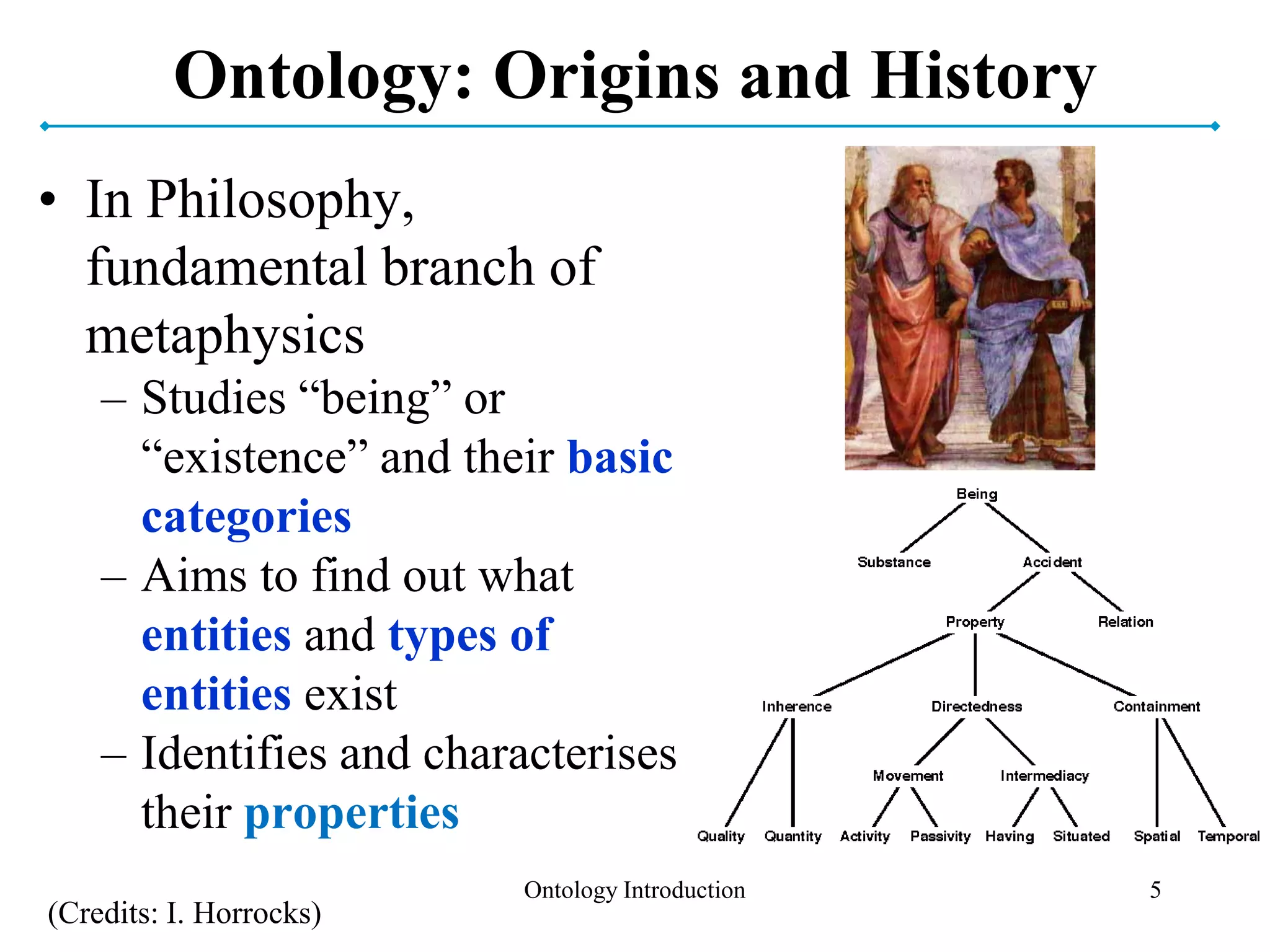
Ontology: Origins and History
Ontology Introduction 5
• In Philosophy,
fundamental branch of
metaphysics
– Studies “being” or
“existence” and their basic
categories
– Aims to find out what
entities and types of
entities exist
– Identifies and characterises
their properties
(Credits: I. Horrocks)
Ontology Introduction 6
What is a Computational Ontology?
From Philosophy to practical use of an Ontology
– It is about what exists, and is relevant for our
purposes, in our domain of interest;
– Needs the consensus of a group which is
representative of the community of interest
– Aims at reaching a shared view of the domain of
interest
– Allows for reduction or elimination of
terminological and conceptual confusion
An ontology is an evolving repository of relevant
concepts, continuously incorporating new meanings
from the interaction with the environment
Ontology Introduction 7
An Ontology is …
“… a theory about the nature of beings” (Philosophical view)
“… a formal, explicit specification of a shared
conceptualisation.” (AI view – T.R. Gruber)*
– ‘Formal' refers to the fact that the ontology should be
machine understandable.
– 'Explicit' means that the type of concepts used and the
constraints on their use are explicitly and fully defined.
– 'Shared' reflects the notion that ontology captures
consensual knowledge, that is, it is not restricted to some
individual, but accepted by a group / community.
– A 'conceptualisation' refers to an abstract model of some
phenomena in the world, it identifies the relevant concepts
related to that phenomena.
• In formal terms: Ont = (Conc, Rel, Axioms, Inst)
Ontology Introduction 8
An Ontology is … (con’d)
"An ontology defines the common terms and
concepts (meaning) used to describe and
represent an area of knowledge. An ontology can
range in expressivity from a Taxonomy
(knowledge with minimal hierarchy or a
parent/child structure), to a Thesaurus (words
and synonyms), to a Conceptual Model (with
more complex knowledge), to a Logical Theory
(with very rich, complex, consistent and
meaningful knowledge)." [www.omg.org]
Ontology Introduction 9
Conceptual models and ontologies
They have common roots, but ...
Conceptual Model
• Traditionally conceived for inter-human communication
• Typically in diagrammatic form (e.g., UML, BPMN)
• Semi-formal representation
– Formal syntax, but intuitive semantics
• Used with a precise goal (e.g., IS engineering)
Computational Ontologies
• Conceived to be ‘fully’ processed by a computer
• Linear (textual) form (supports equivalent diagrammatic
forms)
• Typically represented with a formal language (e.g., RDF(S),
OWL, CG, F-Logic, ...)
• Used to represent an application domain, not a specific system
Ontology Introduction 10
Ontologies as Social Artefacts
• An Ontology is a socio-cultural phenomenon, but we
want to describe the concepts in a formal and
unambiguous way, processable by a computer
An ontology contains:
– a set of concepts (e.g., entities, attributes, processes) seen as
relevant in a given domain
– the definitions and inter-relationships among these concepts
– set of Axioms (e.g., constraints) and, in case, instances
• To be used by computers, ontologies must
– have precise definitions, with a formal semantics (Tarski)
– evolve according to an evolving reality and adapt to current
needs and usage of both human users and computers
– be supported by an Ontology Management System
Ontology Introduction 11
Why Ontologies?
Ontology Introduction 12
First Motivations
When starting a cooperation (to work together
or in interacting in social settings), people
and organizations may have different:
– viewpoints
– assumptions
– needs
about the same domain, due to different
contexts, goals, backgrounds and cultures
13
motivations (cont’d)
Furthermore, the frequent use of different:
– jargon
– terminology
sometimes diverging or overlapping, generate confusion.
Even worse,
– concepts
may be mismatched or ill-defined (e.g., delivery_date).
Goal
allow people, organizations, computer applications, smart
objects to effectively cooperate, despite the mentioned
differences
• All computers today can communicate, but it does not imply
that they cooperate (due to different services & data
organization)
• People and organizations do communicate and cooperate, but
with low automatic support (and several misunderstandings)
Ontology Introduction 14
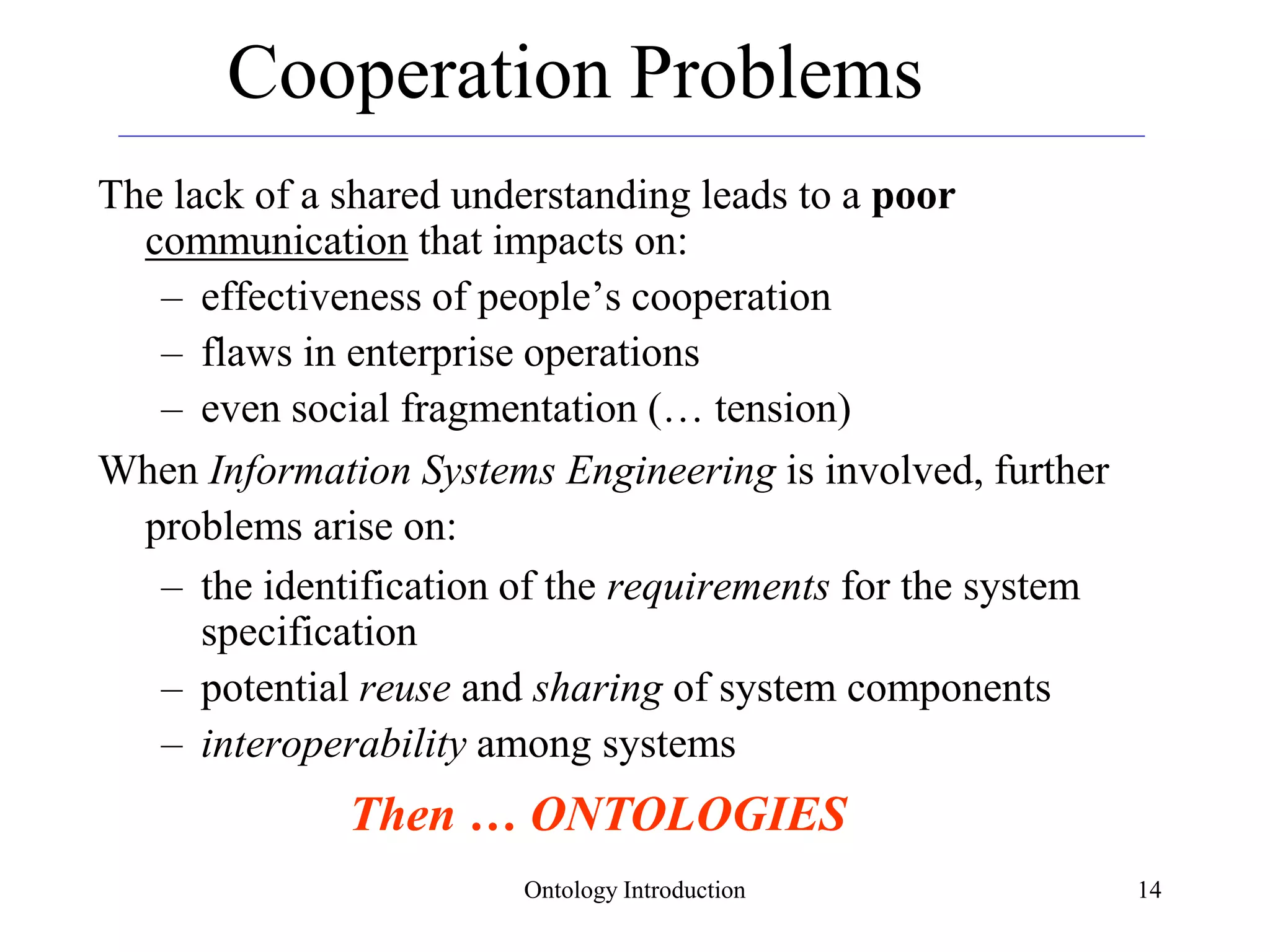
Cooperation Problems
The lack of a shared understanding leads to a poor
communication that impacts on:
– effectiveness of people’s cooperation
– flaws in enterprise operations
– even social fragmentation (… tension)
When Information Systems Engineering is involved, further
problems arise on:
– the identification of the requirements for the system
specification
– potential reuse and sharing of system components
– interoperability among systems
Then … ONTOLOGIES
Ontology Introduction 15
Benefits of Reference Ontologies
• Business Opportunity analysis
• Partnering
• Interoperability
• Semantic Knowledge Management
• Business / IT Alignment
• Social / Shared vision
By means of
• A collaboration practice for a shared context
understanding
• Ontology management – Building an EO
• Semantic Annotation
• Interoperability among legacy systems
• Sem Search: exact / approximate
• Similarity reasoning
Ontology Introduction 16
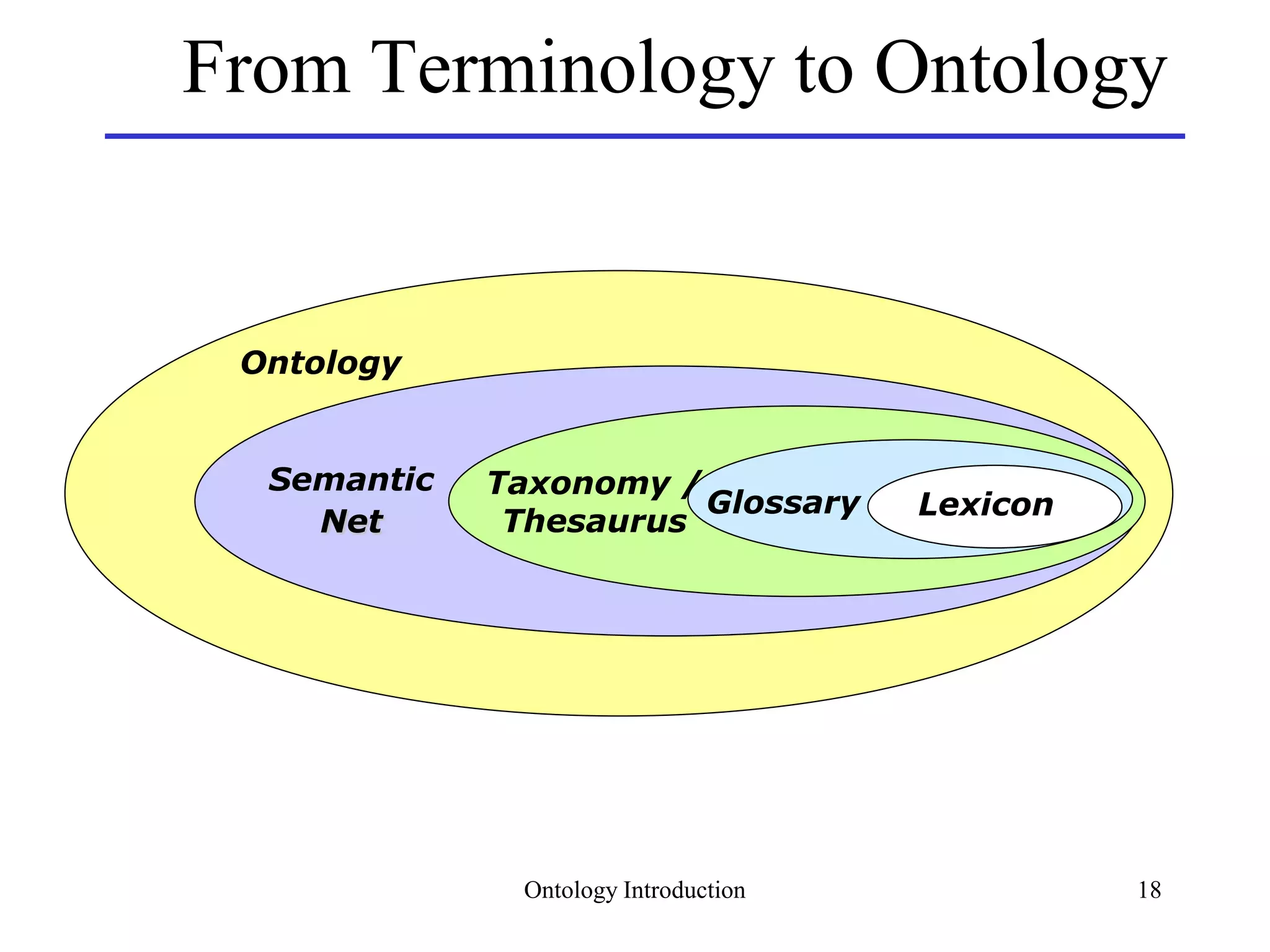
From Terminlogy to Ontology
A First Glimpse on Ontology
Engineering
Ontology Introduction 17
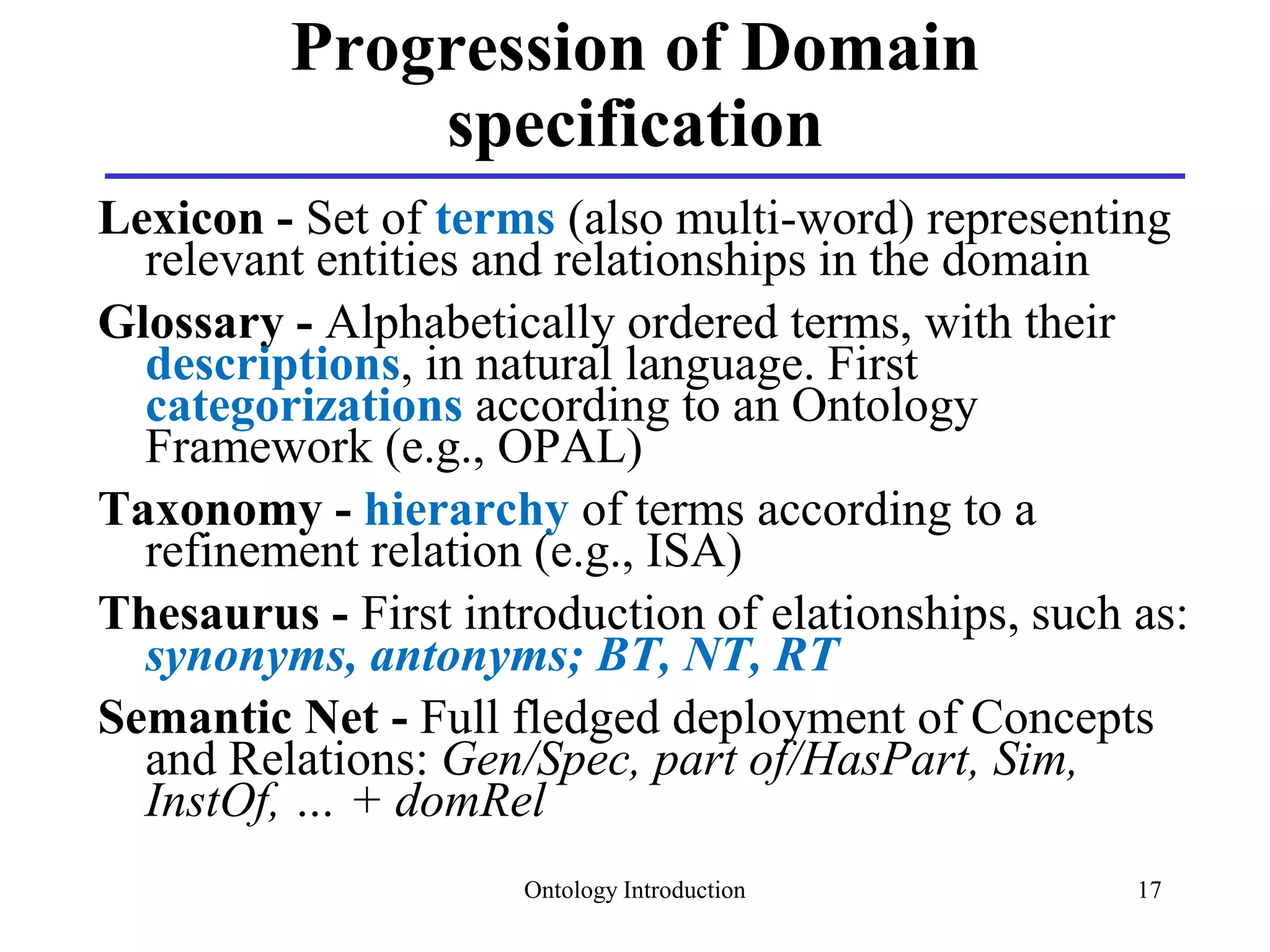
Progression of Domain
specification
Lexicon - Set of terms (also multi-word) representing
relevant entities and relationships in the domain
Glossary - Alphabetically ordered terms, with their
descriptions, in natural language. First
categorizations according to an Ontology
Framework (e.g., OPAL)
Taxonomy - hierarchy of terms according to a
refinement relation (e.g., ISA)
Thesaurus - First introduction of elationships, such as:
synonyms, antonyms; BT, NT, RT
Semantic Net - Full fledged deployment of Concepts
and Relations: Gen/Spec, part of/HasPart, Sim,
InstOf, … + domRel
Ontology Introduction 18
From Terminology to Ontology
Ontology
Lexicon
Semantic
Net
Taxonomy /
Thesaurus
Glossary
The Societal Dimension of
Ontologies
Ontology Introduction 19
20
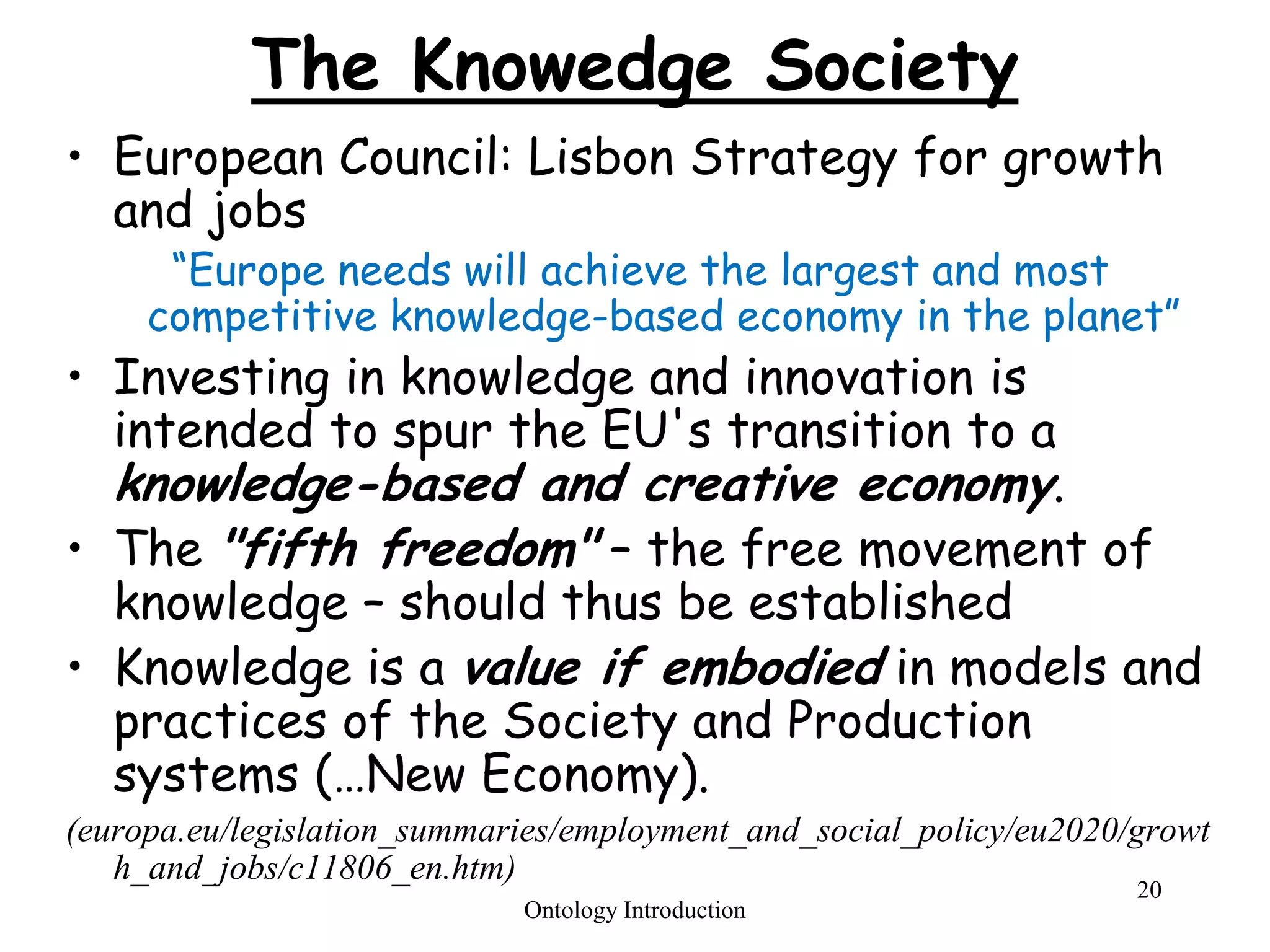
The Knowedge Society
• European Council: Lisbon Strategy for growth
and jobs
“Europe needs will achieve the largest and most
competitive knowledge-based economy in the planet”
• Investing in knowledge and innovation is
intended to spur the EU's transition to a
knowledge-based and creative economy.
• The "fifth freedom" – the free movement of
knowledge – should thus be established
• Knowledge is a value if embodied in models and
practices of the Society and Production
systems (…New Economy).
(europa.eu/legislation_summaries/employment_and_social_policy/eu2020/growt
h_and_jobs/c11806_en.htm)
Ontology Introduction
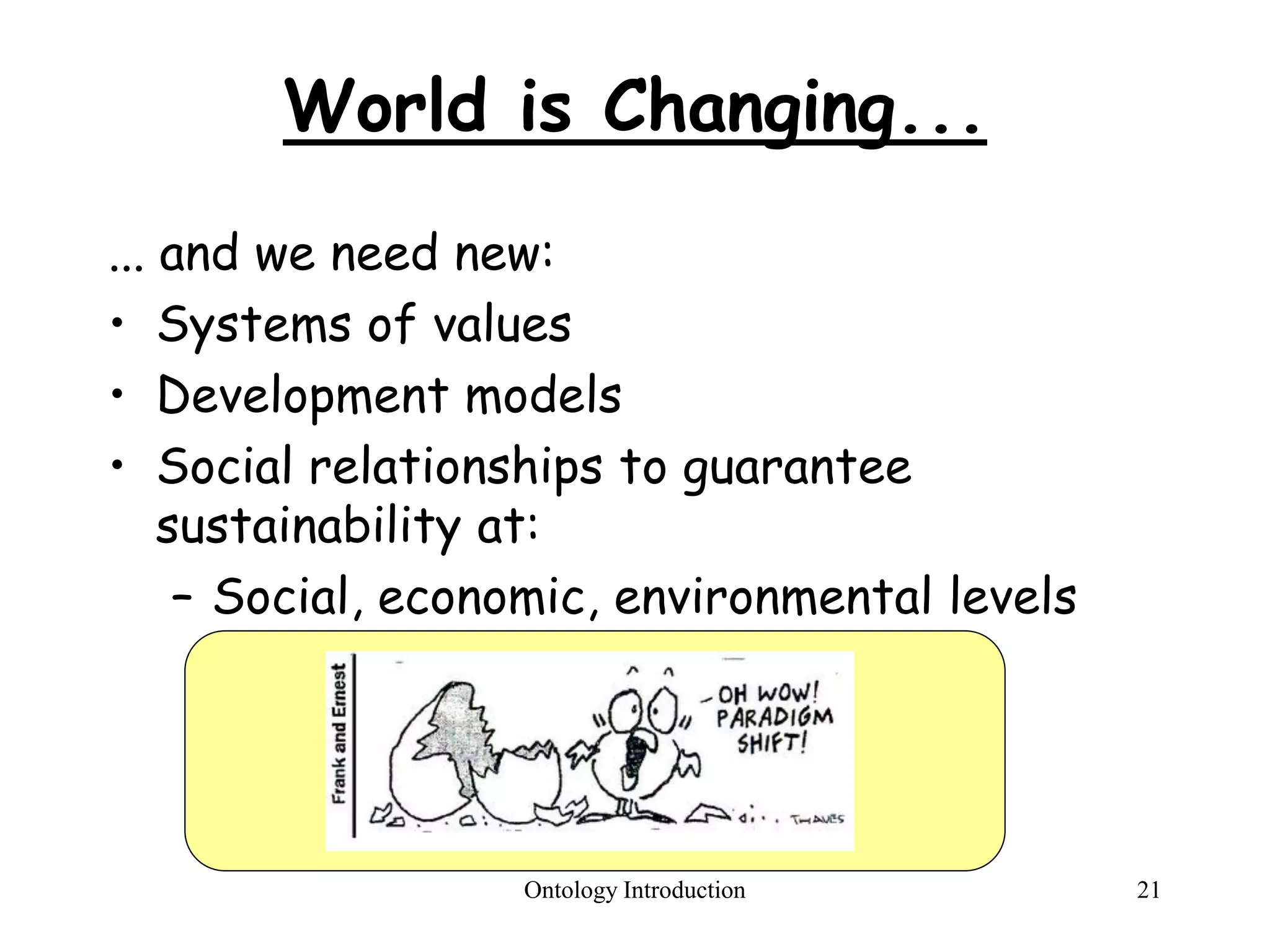
World is Changing...
... and we need new:
• Systems of values
• Development models
• Social relationships to guarantee
sustainability at:
– Social, economic, environmental levels
Ontology Introduction 21
22
The Advent of the Semantic Web
The collaborative, shared dimension of
Knowledge: The Semantic Web
“The Semantic Web is an extension of the
current Web in which information is given
well-defined meaning, better enabling
computers and people [and Smart Objects] to
work in cooperation.”
(Tim Berners-Lee, James Hendler and Ora Lassila, The
Semantic Web, Scientific American, May 2001)
Ontology Introduction
23
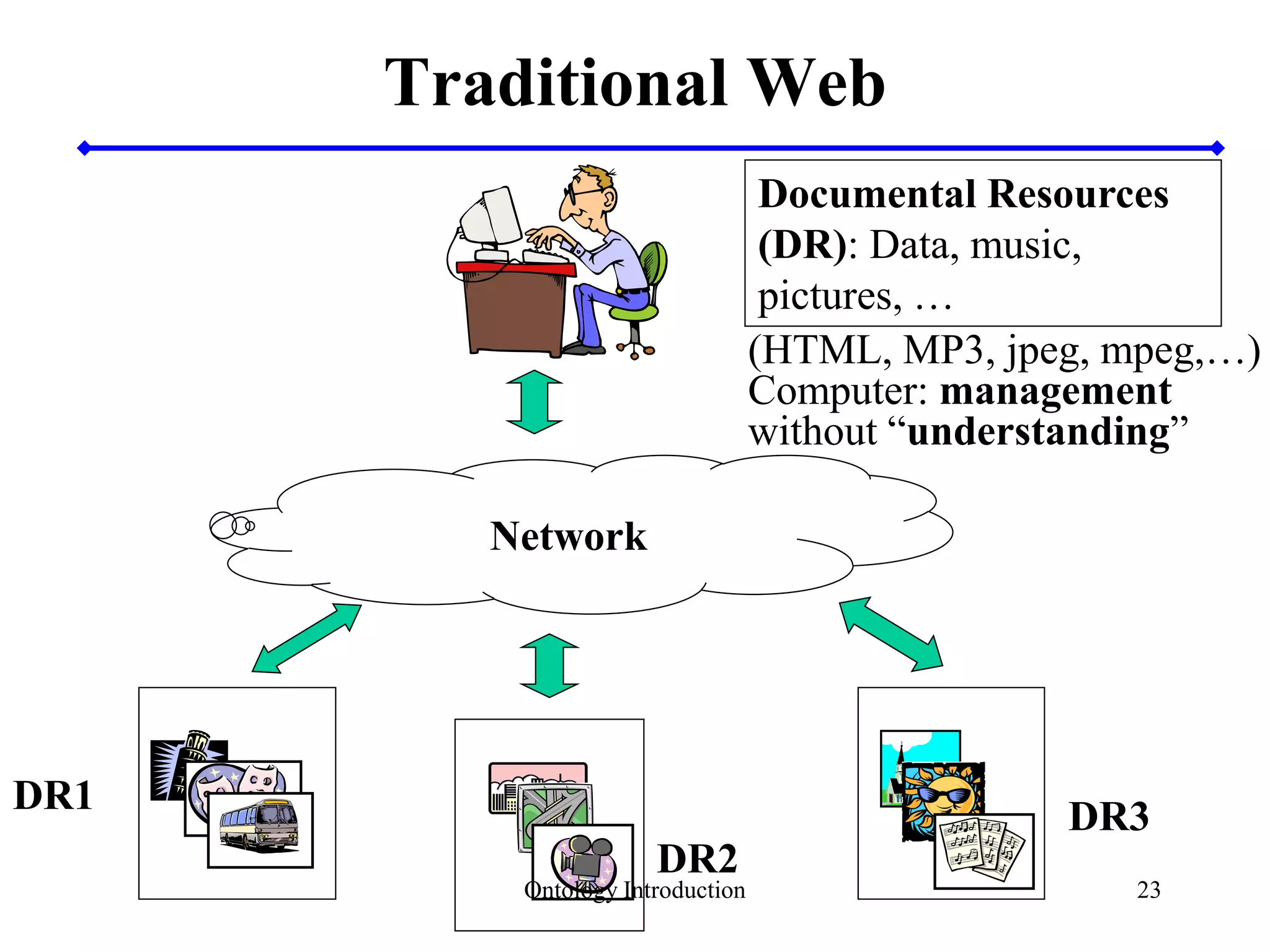
Traditional Web
DR1
DR2
DR3
Network
Documental Resources
(DR): Data, music,
pictures, …
(HTML, MP3, jpeg, mpeg,…)
Computer: management
without “understanding”
Ontology Introduction
24
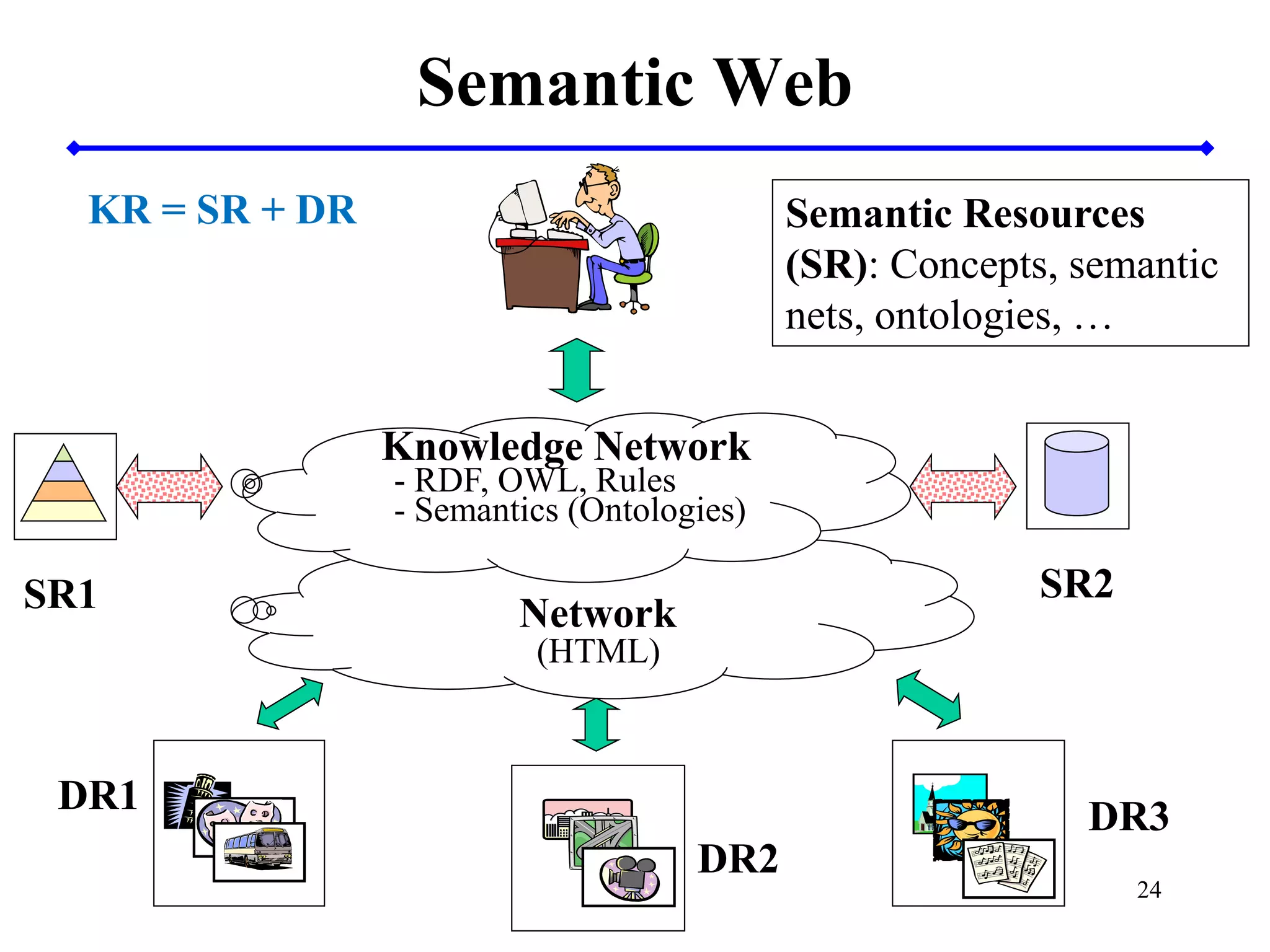
Semantic Web
DR2
DR3
Network
(HTML)
Knowledge Network
- RDF, OWL, Rules
- Semantics (Ontologies)
SR1 SR2
Semantic Resources
(SR): Concepts, semantic
nets, ontologies, …
DR1
KR = SR + DR
25
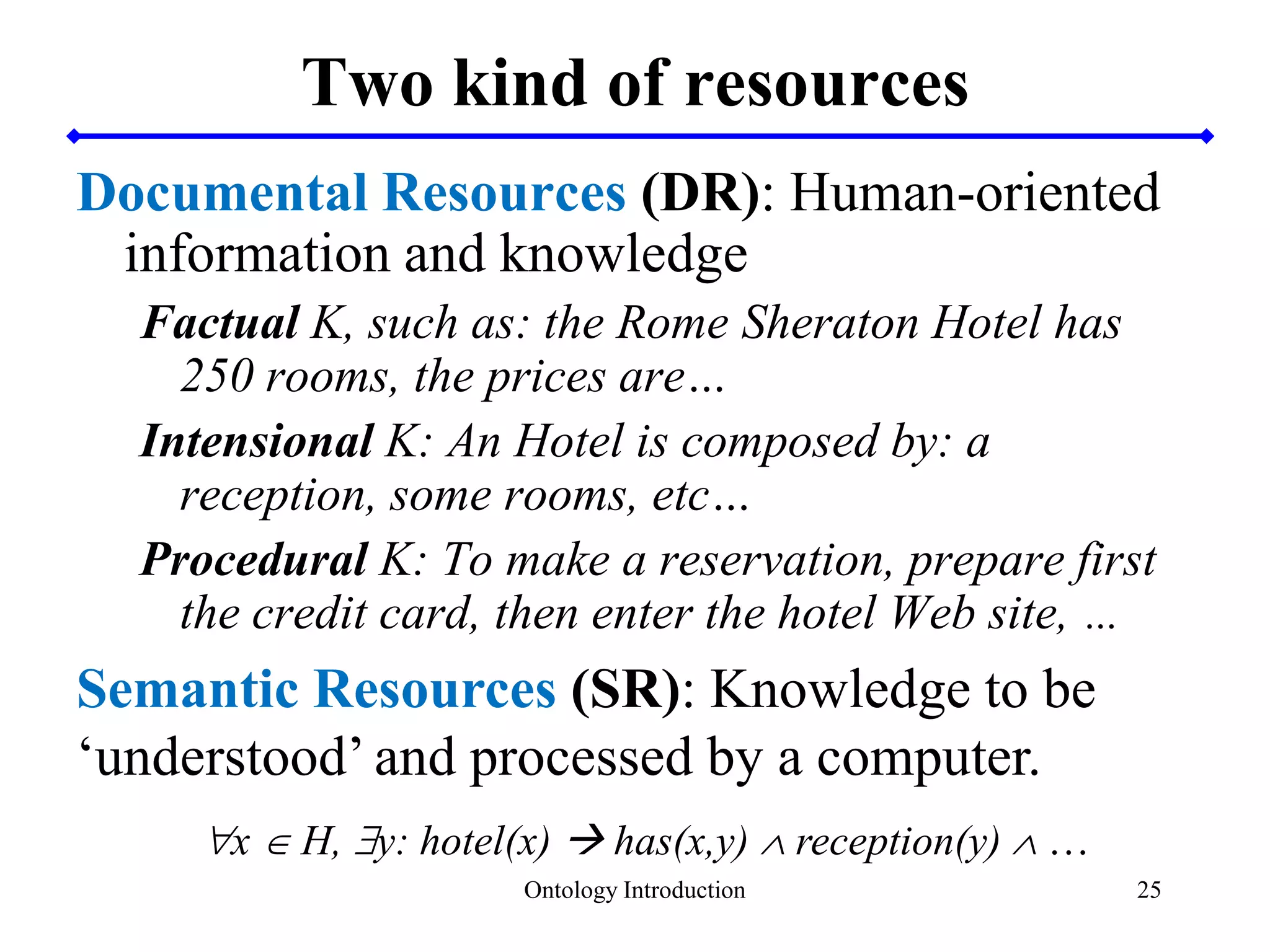
Two kind of resources
Documental Resources (DR): Human-oriented
information and knowledge
Factual K, such as: the Rome Sheraton Hotel has
250 rooms, the prices are…
Intensional K: An Hotel is composed by: a
reception, some rooms, etc…
Procedural K: To make a reservation, prepare first
the credit card, then enter the hotel Web site, …
Semantic Resources (SR): Knowledge to be
‘understood’ and processed by a computer.
x  H, y: hotel(x)  has(x,y)  reception(y)  …
Ontology Introduction
26
Human-readable vs Computer-
readable
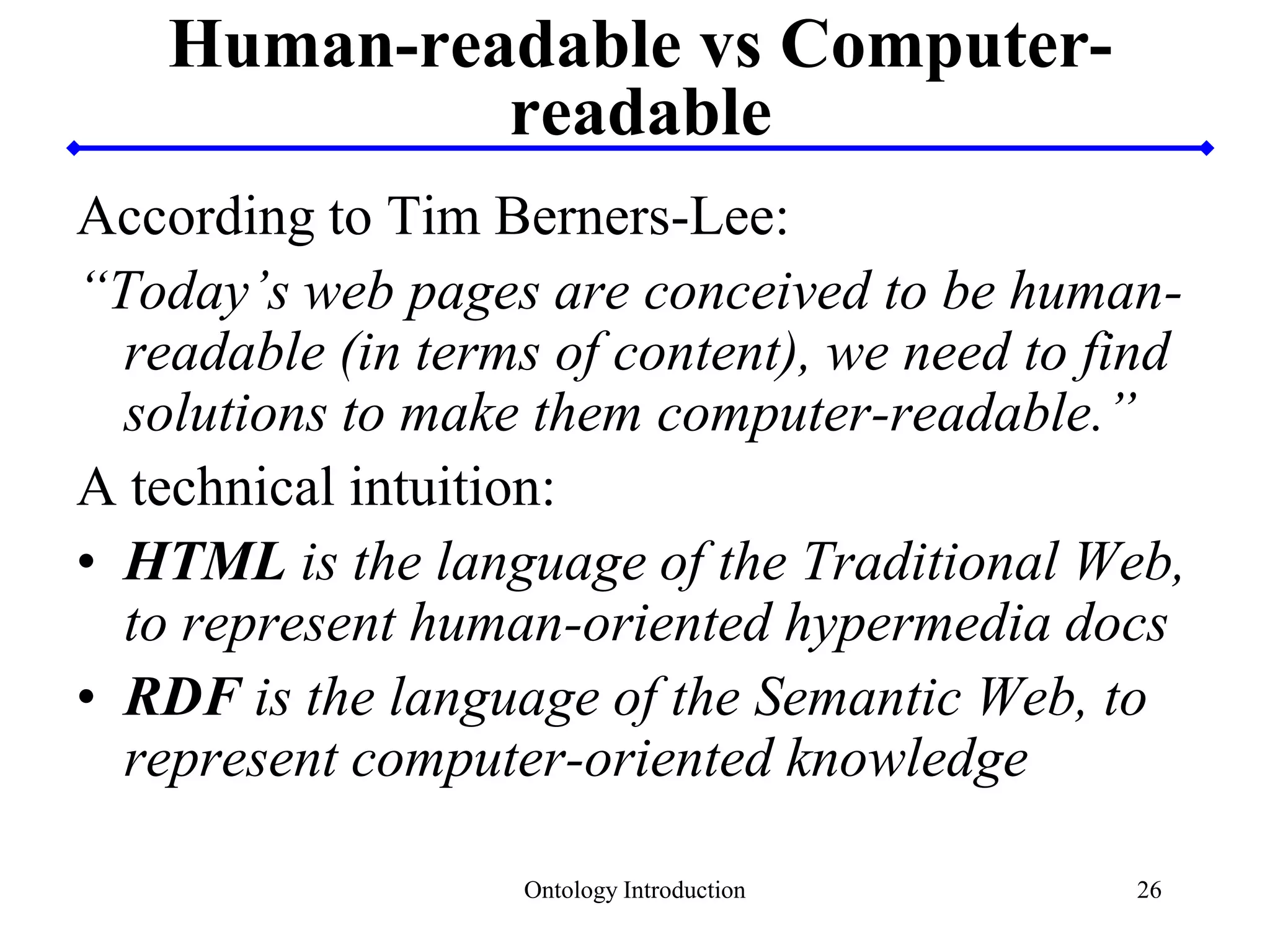
According to Tim Berners-Lee:
“Today’s web pages are conceived to be human-
readable (in terms of content), we need to find
solutions to make them computer-readable.”
A technical intuition:
• HTML is the language of the Traditional Web,
to represent human-oriented hypermedia docs
• RDF is the language of the Semantic Web, to
represent computer-oriented knowledge
Ontology Introduction
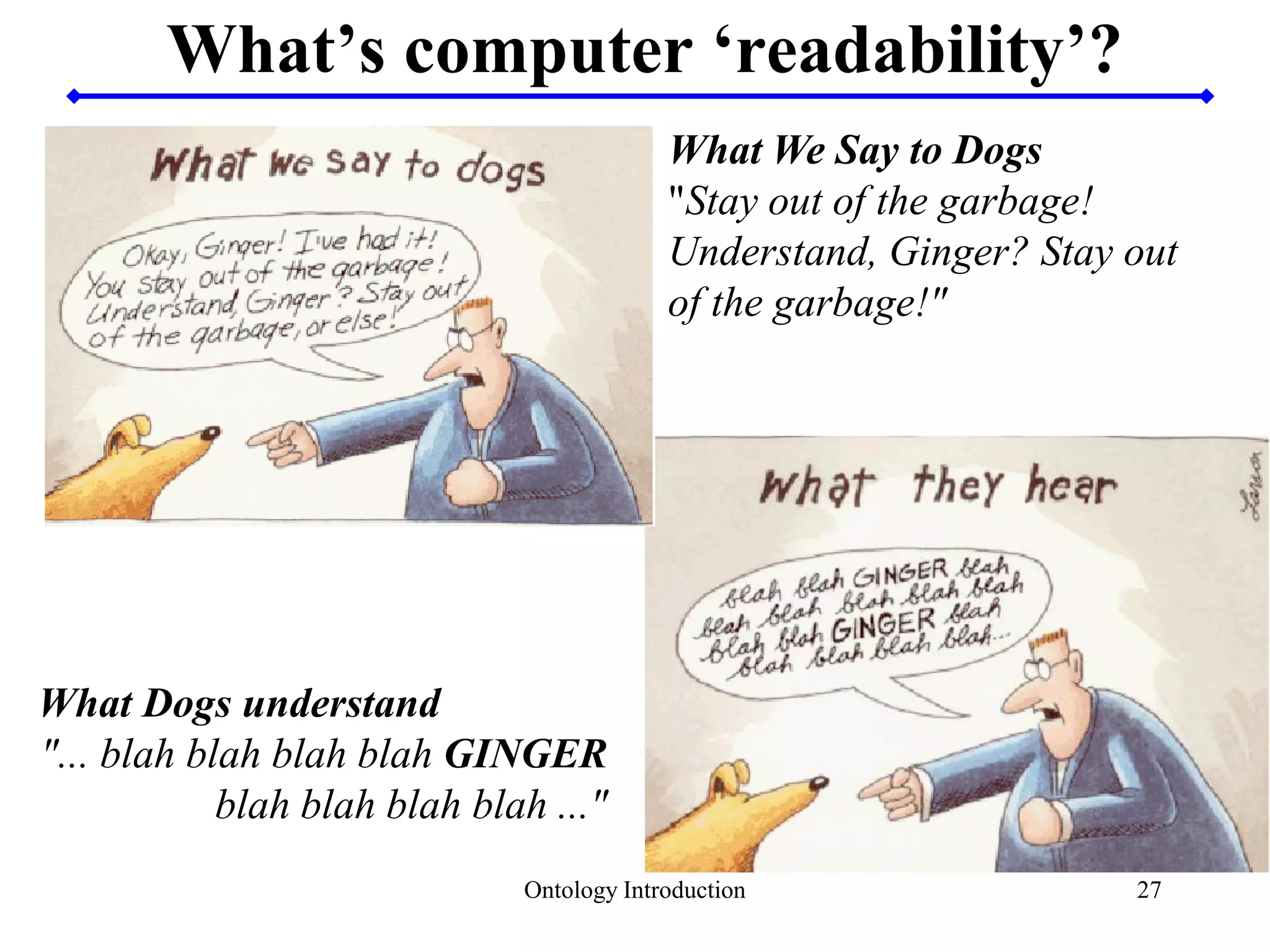
What’s computer ‘readability’?
Ontology Introduction 27
What We Say to Dogs
"Stay out of the garbage!
Understand, Ginger? Stay out
of the garbage!"
What Dogs understand
"... blah blah blah blah GINGER
blah blah blah blah ..."
28
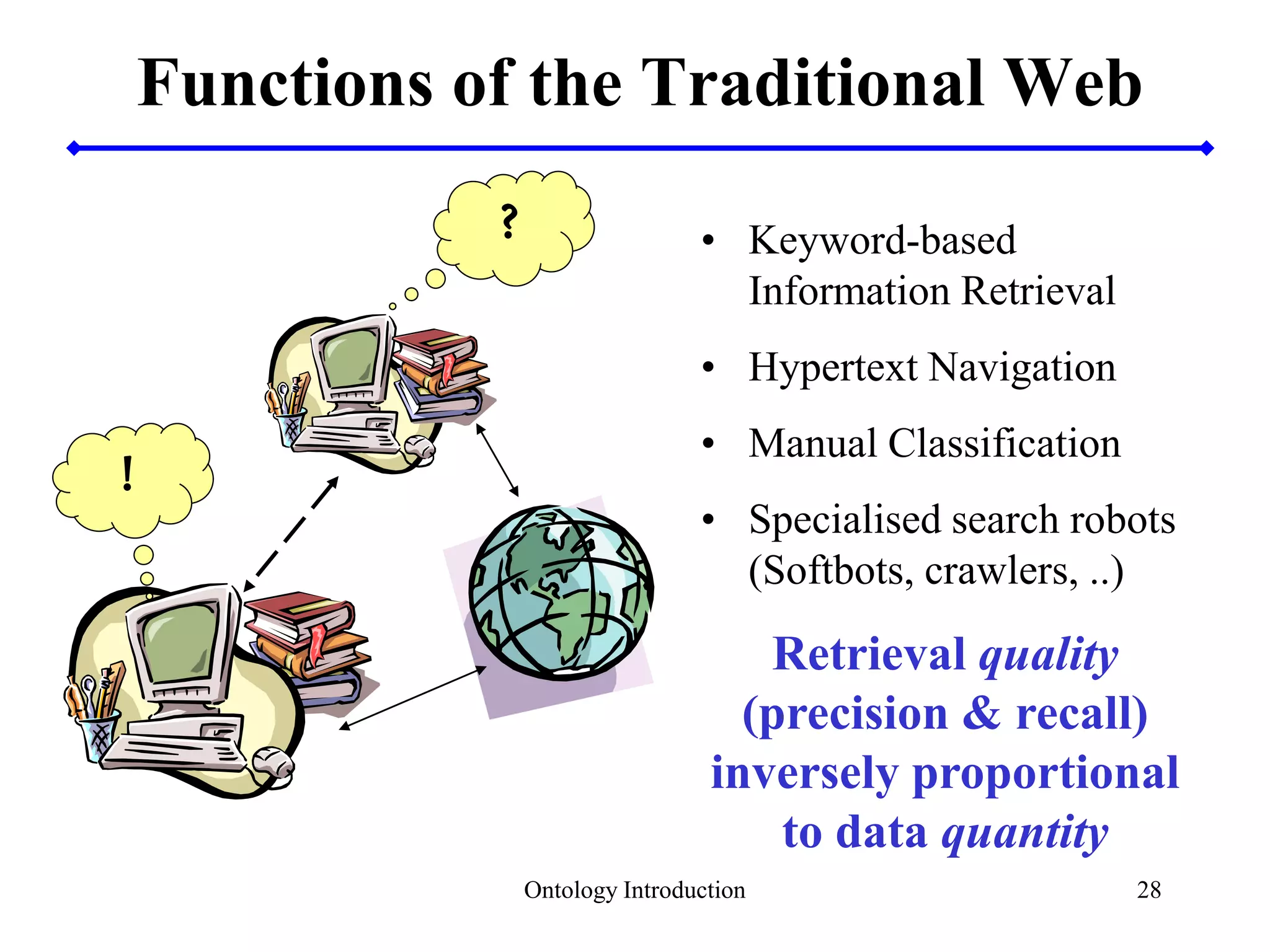
Functions of the Traditional Web
• Keyword-based
Information Retrieval
• Hypertext Navigation
• Manual Classification
• Specialised search robots
(Softbots, crawlers, ..)
!
?
Retrieval quality
(precision & recall)
inversely proportional
to data quantity
Ontology Introduction
29
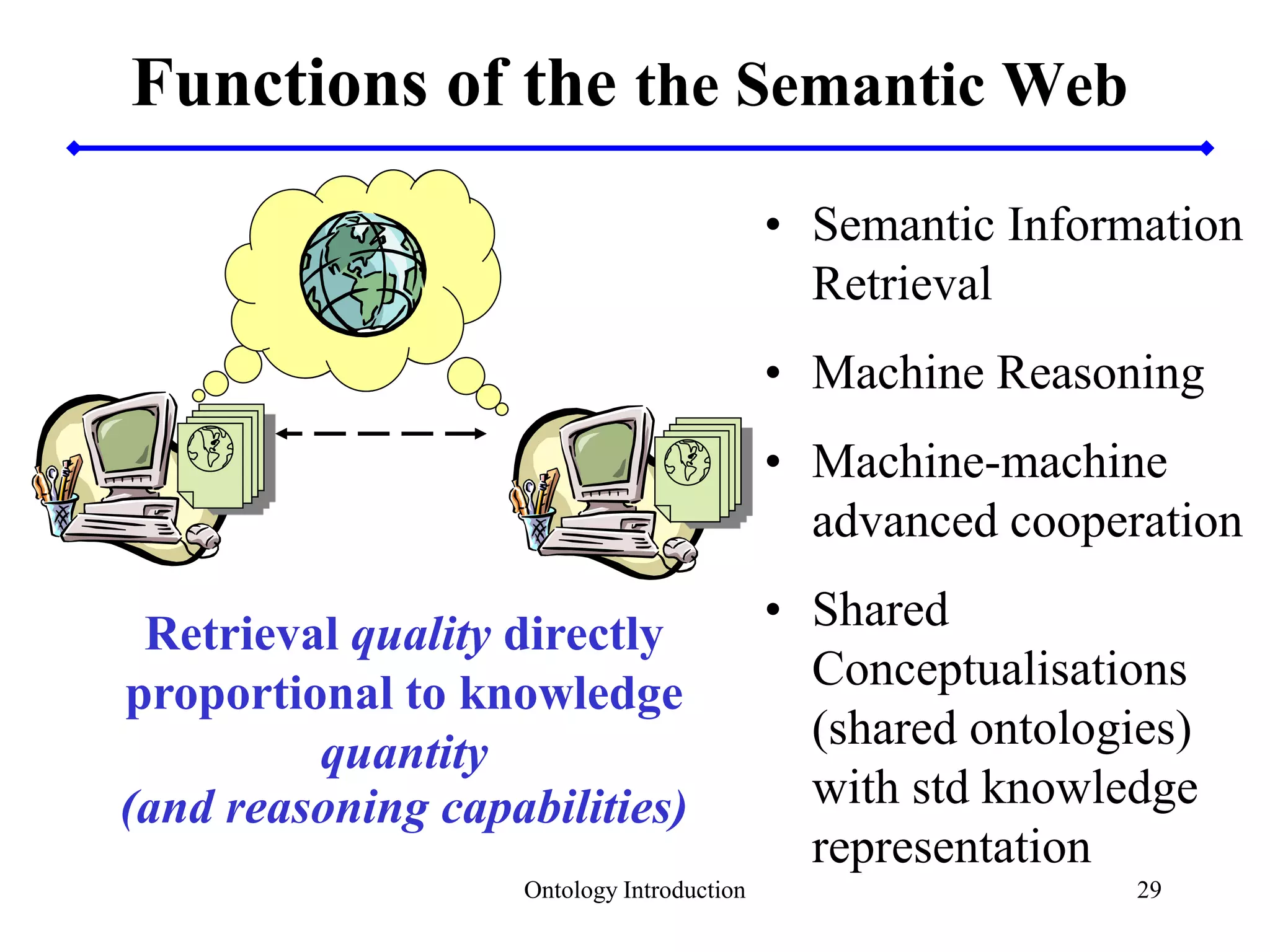
Functions of the the Semantic Web
• Semantic Information
Retrieval
• Machine Reasoning
• Machine-machine
advanced cooperation
• Shared
Conceptualisations
(shared ontologies)
with std knowledge
representation
Retrieval quality directly
proportional to knowledge
quantity
(and reasoning capabilities)
Ontology Introduction
30
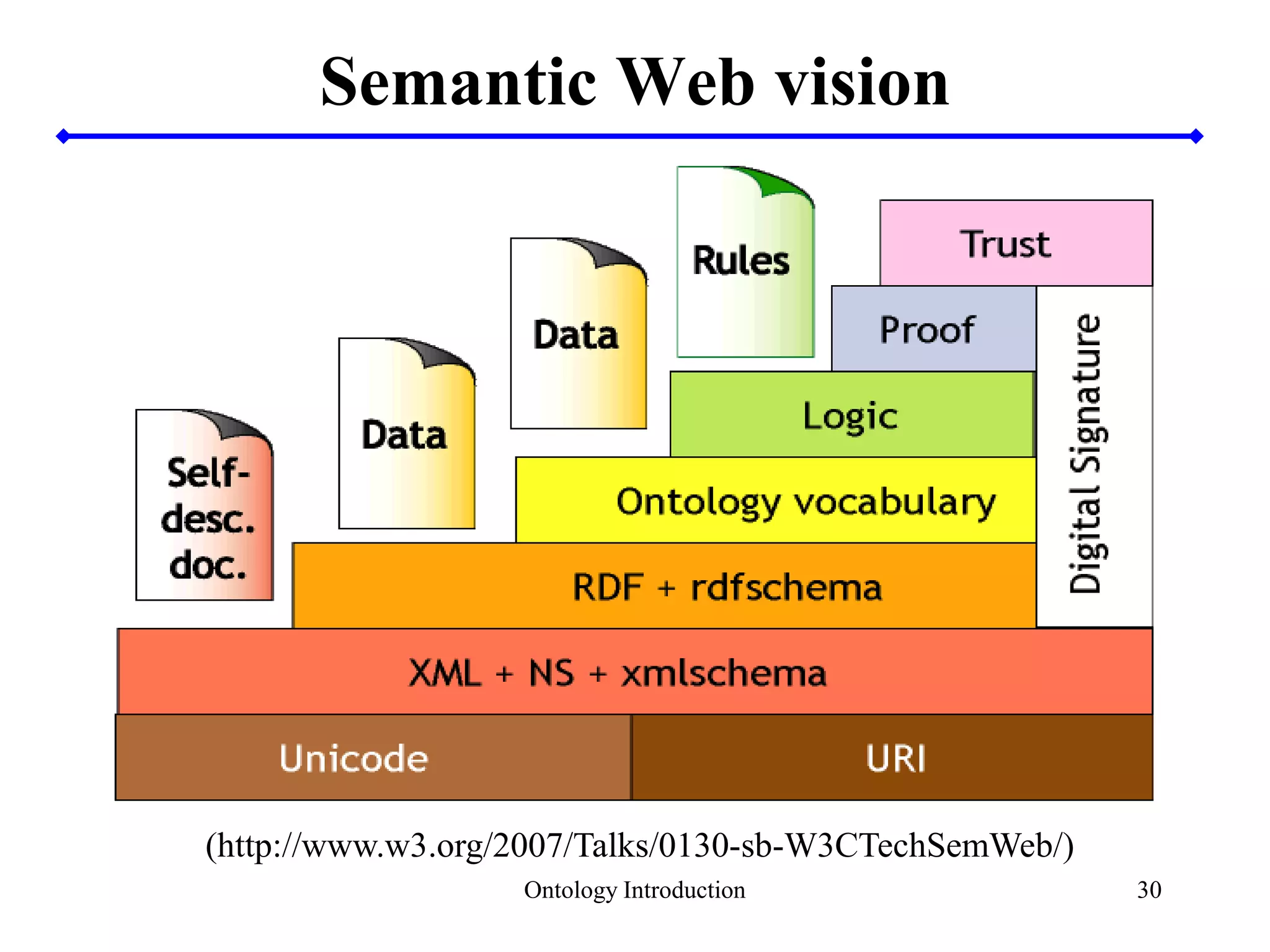
Semantic Web vision
(http://www.w3.org/2007/Talks/0130-sb-W3CTechSemWeb/)
Ontology Introduction
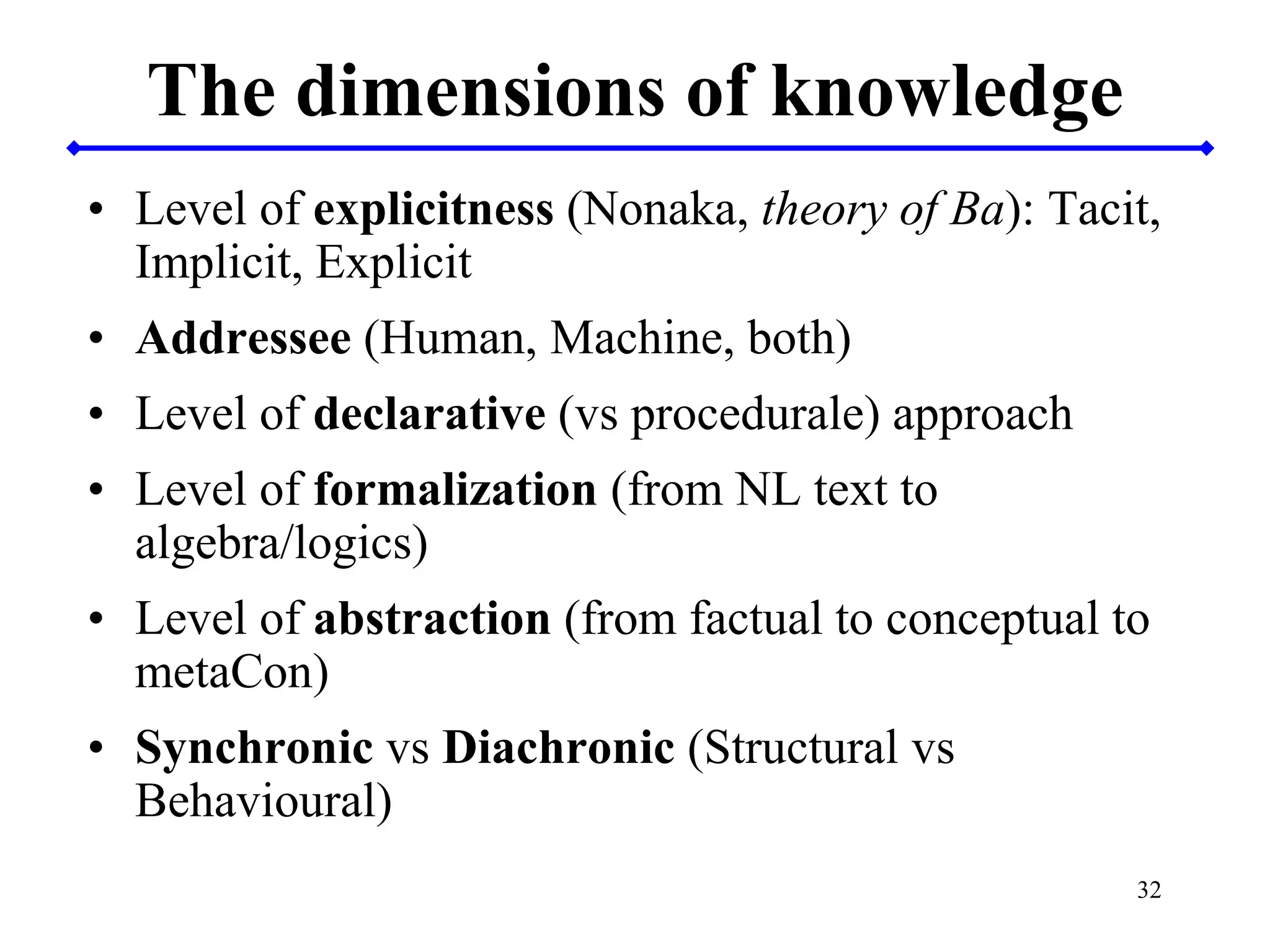
But... What is Knowledge?
31
32
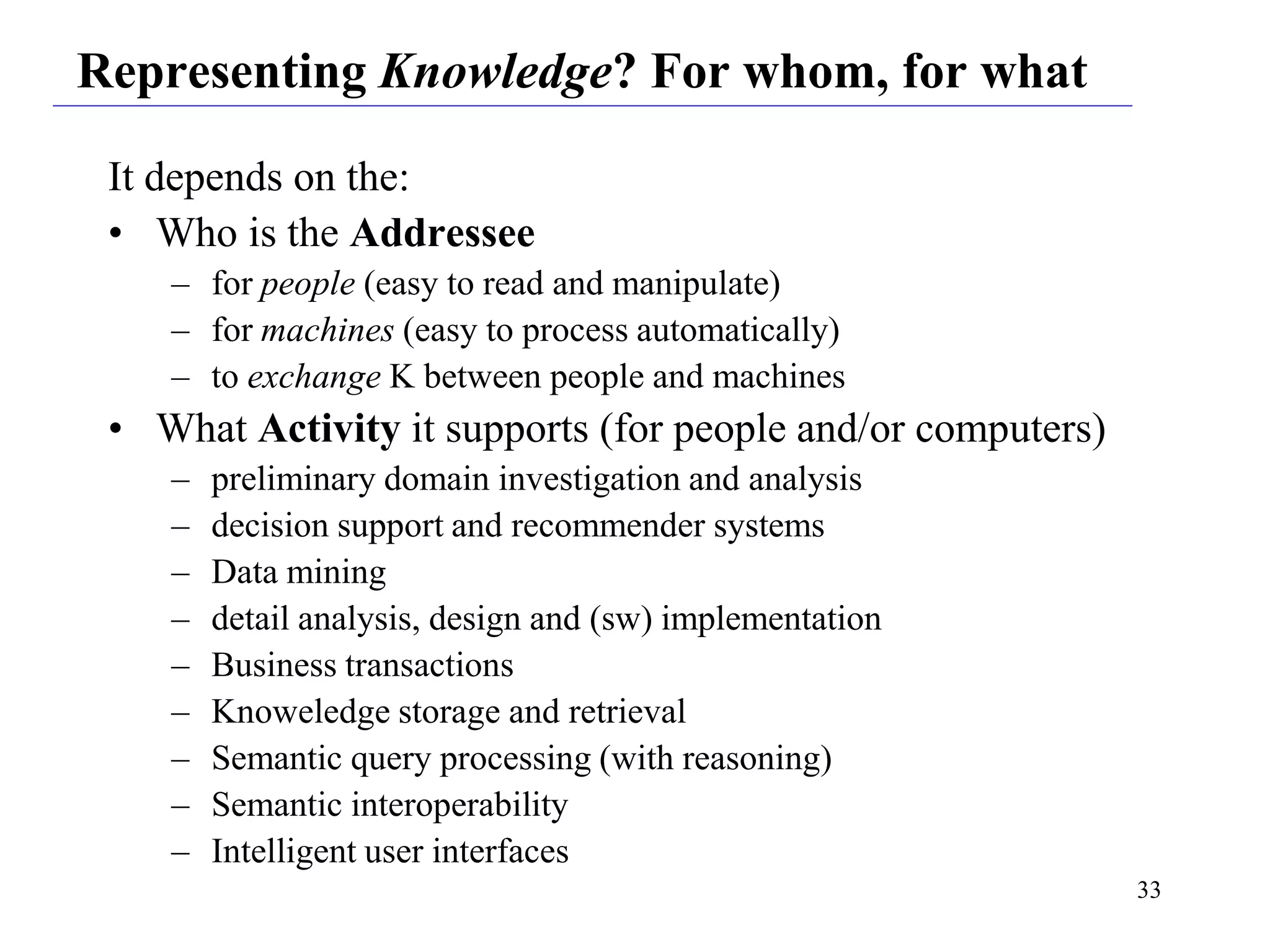
The dimensions of knowledge
• Level of explicitness (Nonaka, theory of Ba): Tacit,
Implicit, Explicit
• Addressee (Human, Machine, both)
• Level of declarative (vs procedurale) approach
• Level of formalization (from NL text to
algebra/logics)
• Level of abstraction (from factual to conceptual to
metaCon)
• Synchronic vs Diachronic (Structural vs
Behavioural)
33
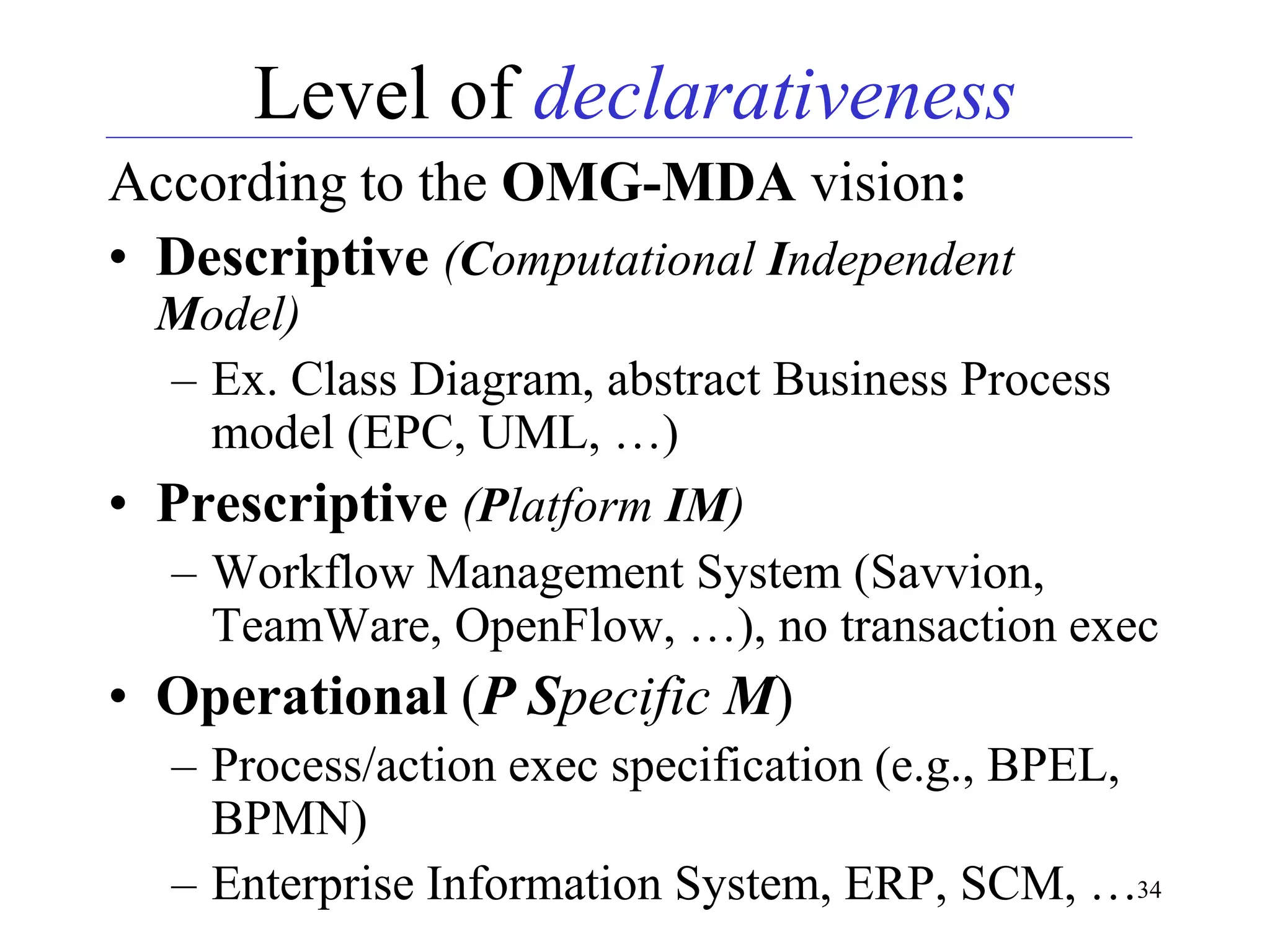
Representing Knowledge? For whom, for what
It depends on the:
• Who is the Addressee
– for people (easy to read and manipulate)
– for machines (easy to process automatically)
– to exchange K between people and machines
• What Activity it supports (for people and/or computers)
– preliminary domain investigation and analysis
– decision support and recommender systems
– Data mining
– detail analysis, design and (sw) implementation
– Business transactions
– Knoweledge storage and retrieval
– Semantic query processing (with reasoning)
– Semantic interoperability
– Intelligent user interfaces
34
Level of declarativeness
According to the OMG-MDA vision:
• Descriptive (Computational Independent
Model)
– Ex. Class Diagram, abstract Business Process
model (EPC, UML, …)
• Prescriptive (Platform IM)
– Workflow Management System (Savvion,
TeamWare, OpenFlow, …), no transaction exec
• Operational (P Specific M)
– Process/action exec specification (e.g., BPEL,
BPMN)
– Enterprise Information System, ERP, SCM, …
35
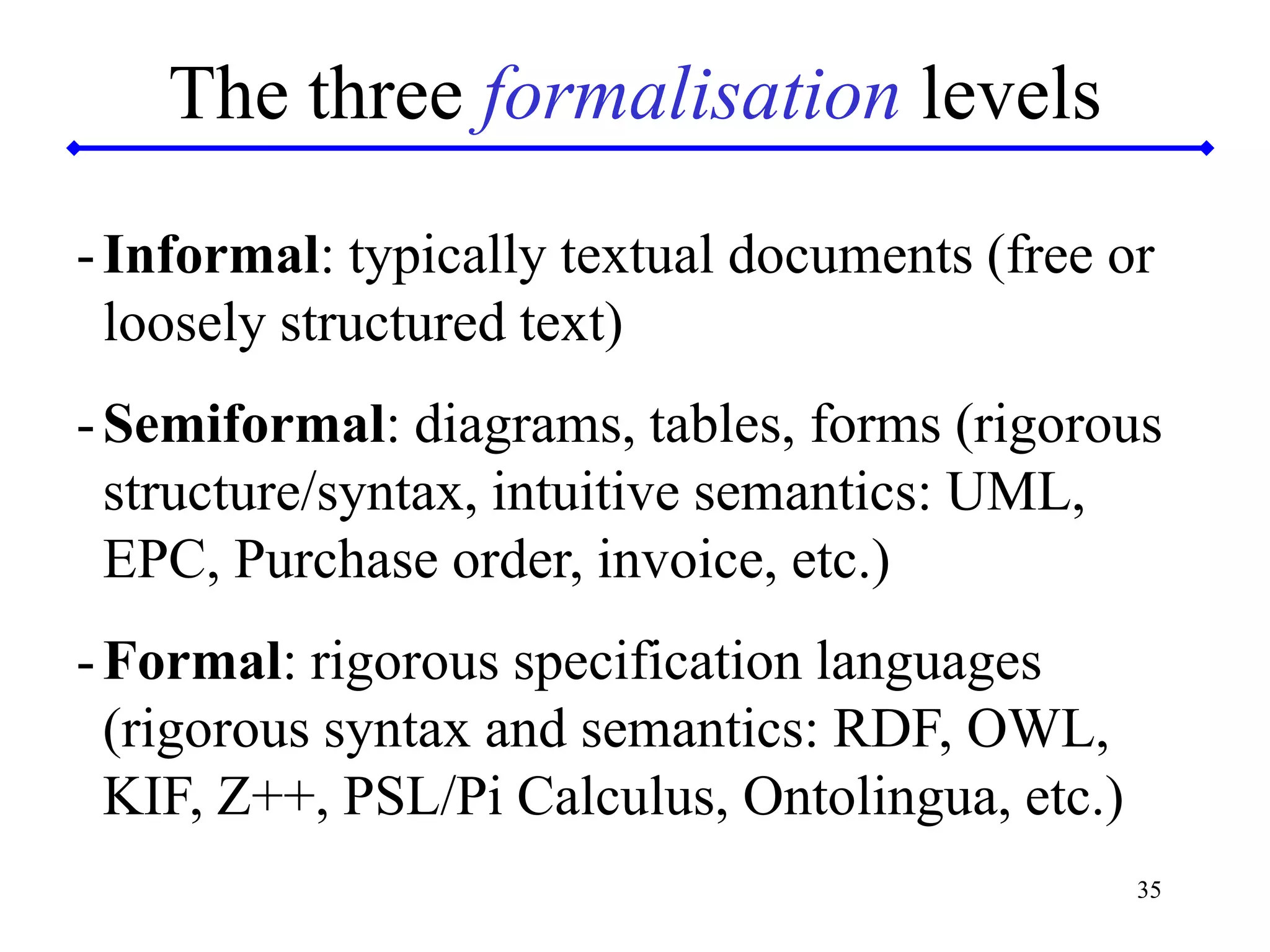
The three formalisation levels
-Informal: typically textual documents (free or
loosely structured text)
-Semiformal: diagrams, tables, forms (rigorous
structure/syntax, intuitive semantics: UML,
EPC, Purchase order, invoice, etc.)
-Formal: rigorous specification languages
(rigorous syntax and semantics: RDF, OWL,
KIF, Z++, PSL/Pi Calculus, Ontolingua, etc.)
36
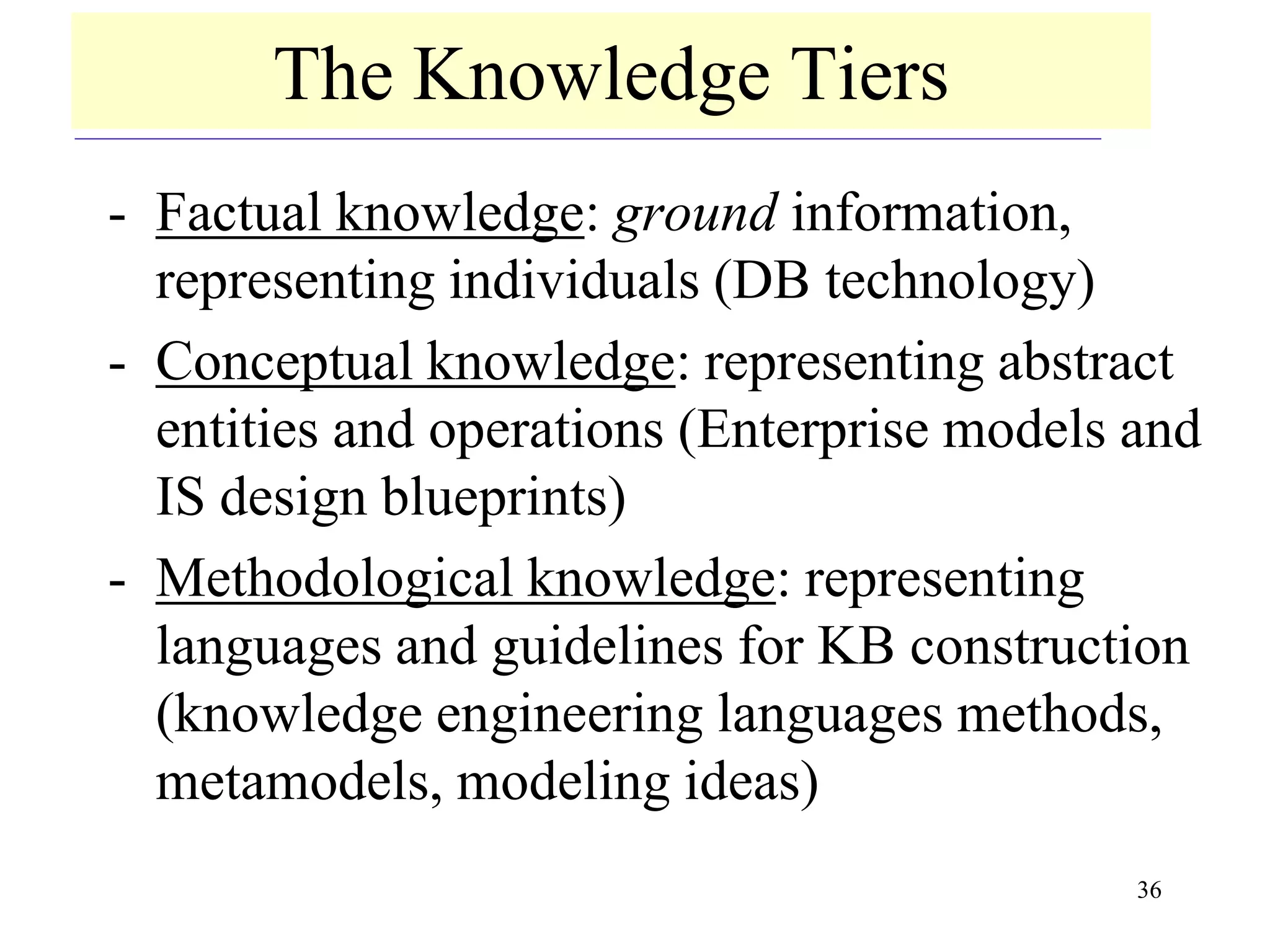
The Knowledge Tiers
- Factual knowledge: ground information,
representing individuals (DB technology)
- Conceptual knowledge: representing abstract
entities and operations (Enterprise models and
IS design blueprints)
- Methodological knowledge: representing
languages and guidelines for KB construction
(knowledge engineering languages methods,
metamodels, modeling ideas)
37
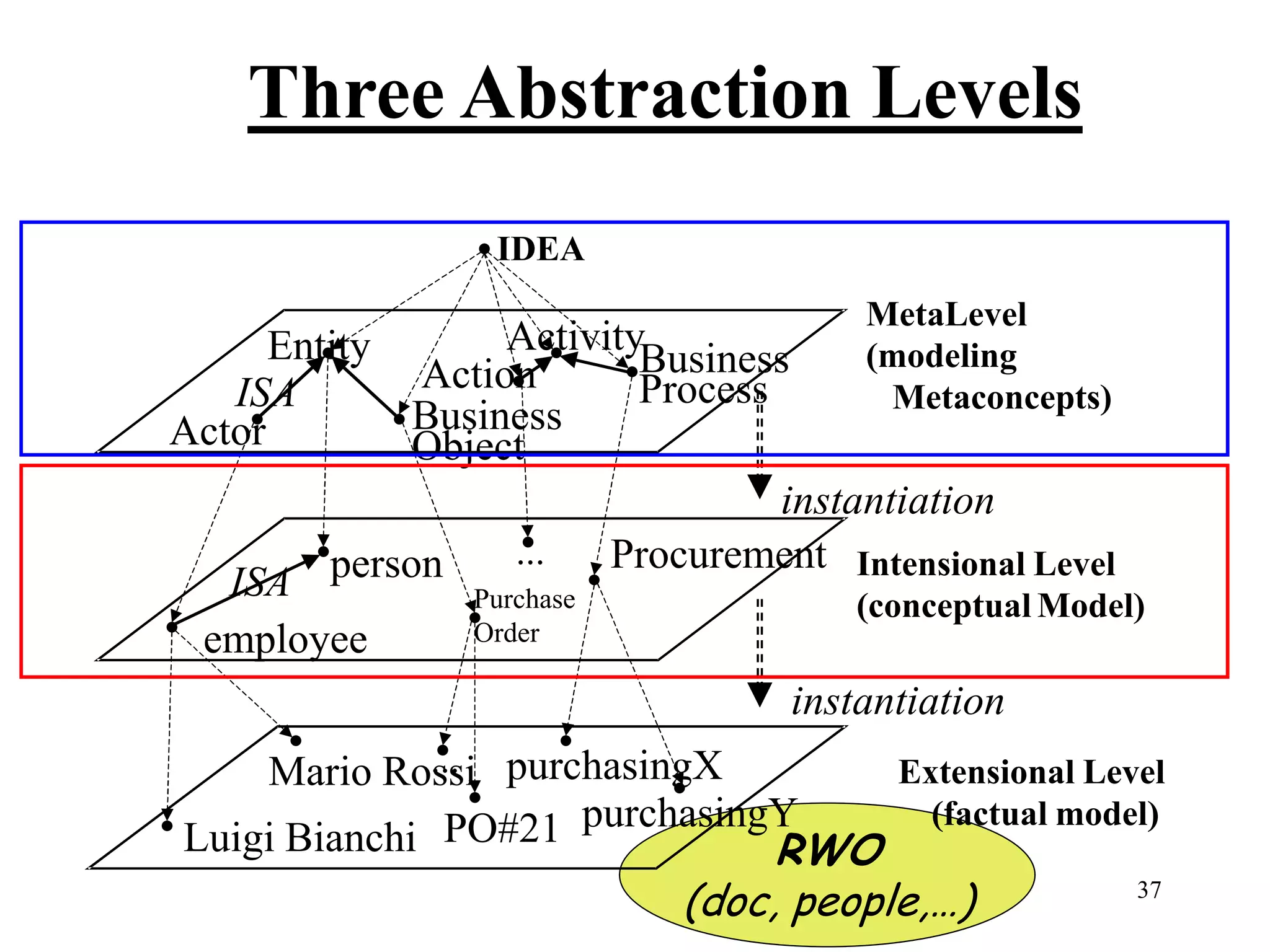
RWO
(doc, people,…)
Entity
Actor Business
Object
Business
ProcessISA
person
employee
ISA Purchase
Order
Procurement
Luigi Bianchi
Mario Rossi
PO#21
purchasingX
Intensional Level
(conceptual Model)
Extensional Level
(factual model)
MetaLevel
(modeling
Metaconcepts)
...
Activity
Action
purchasingY
...
IDEA
instantiation
instantiation
Three Abstraction Levels
38
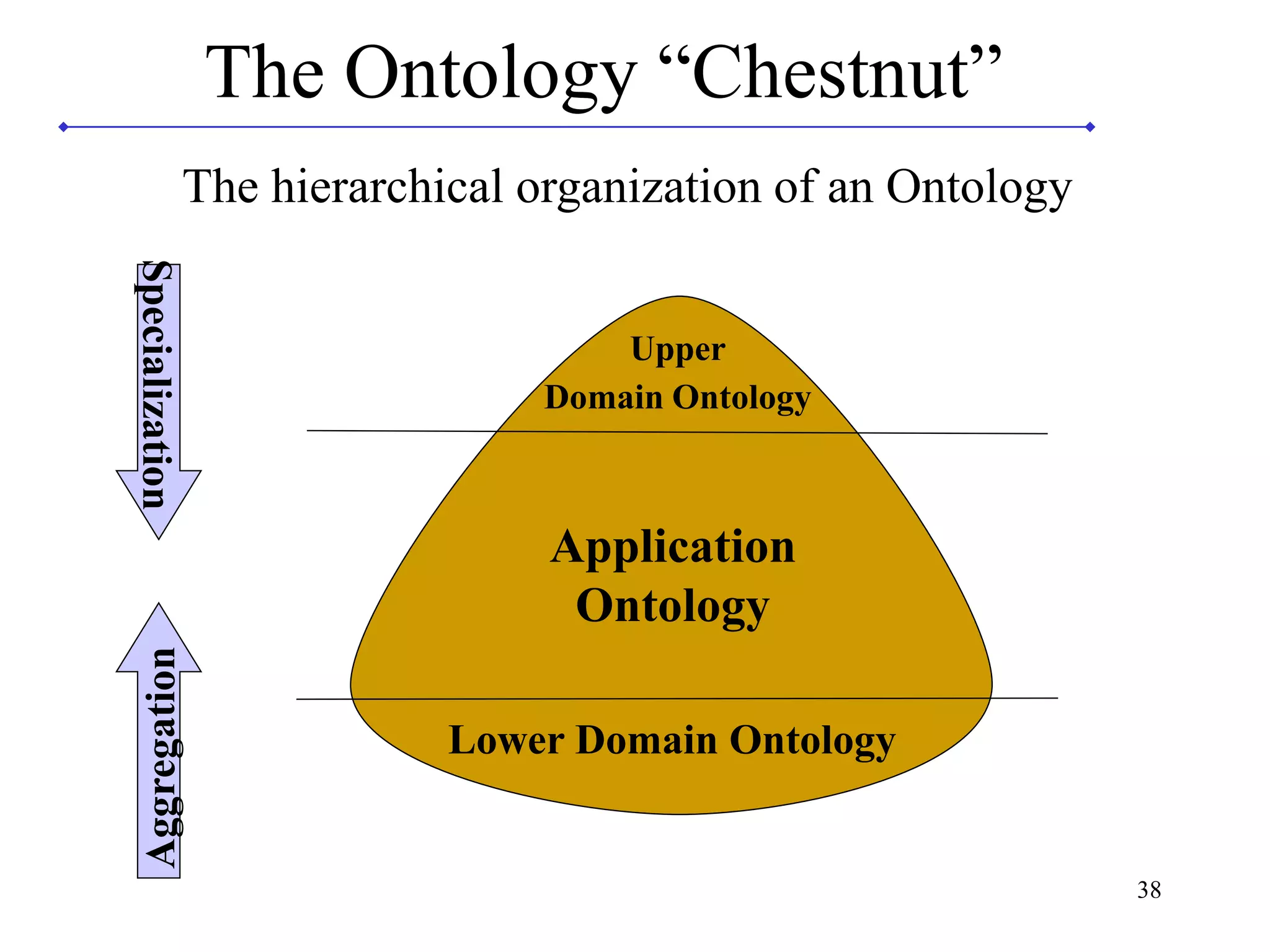
The Ontology “Chestnut”
Upper
Domain Ontology
Application
Ontology
Lower Domain Ontology
Specialization
Aggregation
The hierarchical organization of an Ontology
Collaborative Dimension in
Ontology Engineering
Ontology Introduction 39
Social Ontology Building
and Evolution (SOBE)
SOBE supports the building of shared
ontologies through:
• Automatic knowledge extraction
– Analysis of textual documents by using NLP
techniques
• Social participation
– Voting and discussing (forum) for validating
and enriching extracted knowledge
Ontology Introduction 40
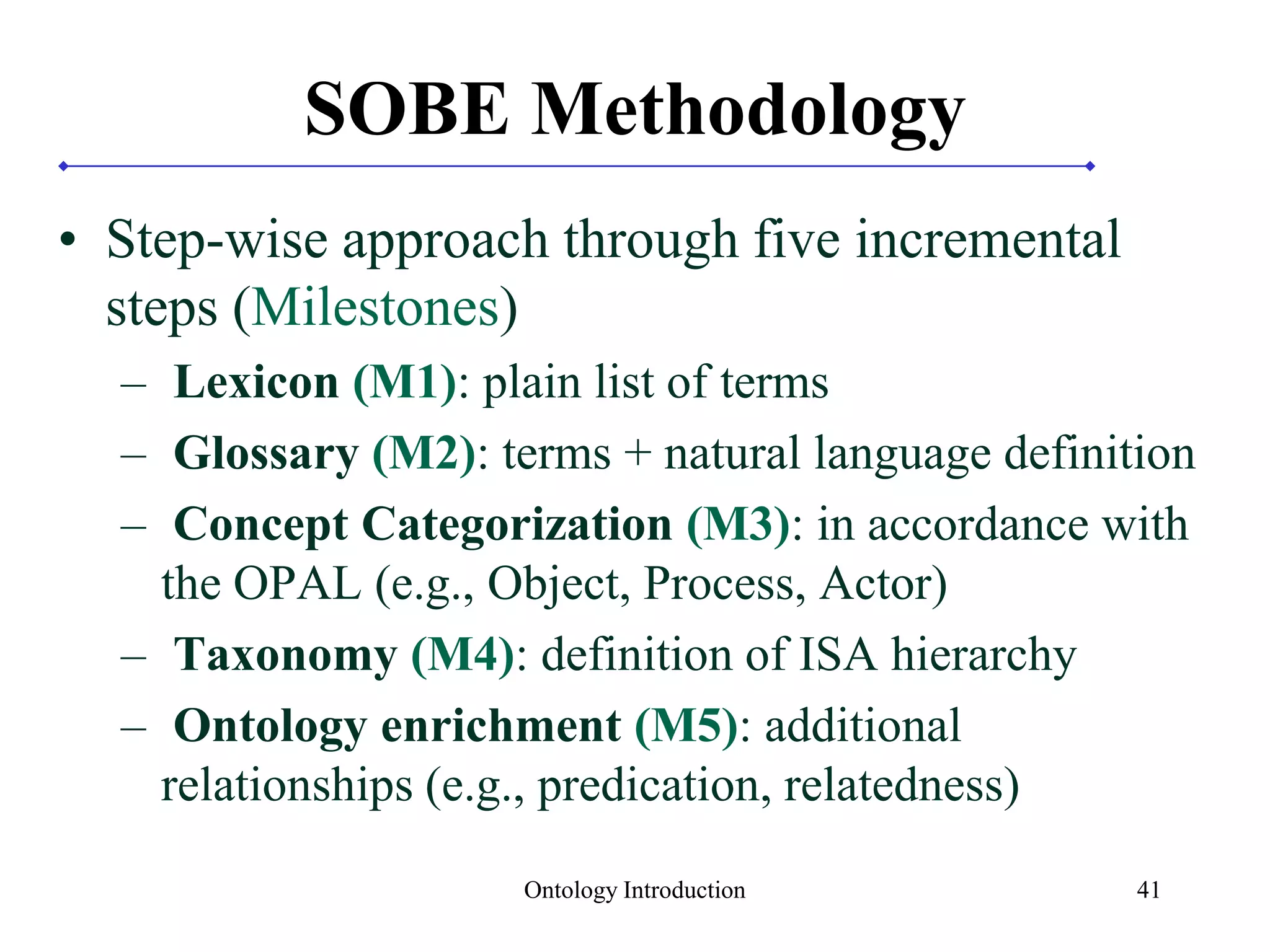
SOBE Methodology
• Step-wise approach through five incremental
steps (Milestones)
– Lexicon (M1): plain list of terms
– Glossary (M2): terms + natural language definition
– Concept Categorization (M3): in accordance with
the OPAL (e.g., Object, Process, Actor)
– Taxonomy (M4): definition of ISA hierarchy
– Ontology enrichment (M5): additional
relationships (e.g., predication, relatedness)
Ontology Introduction 41
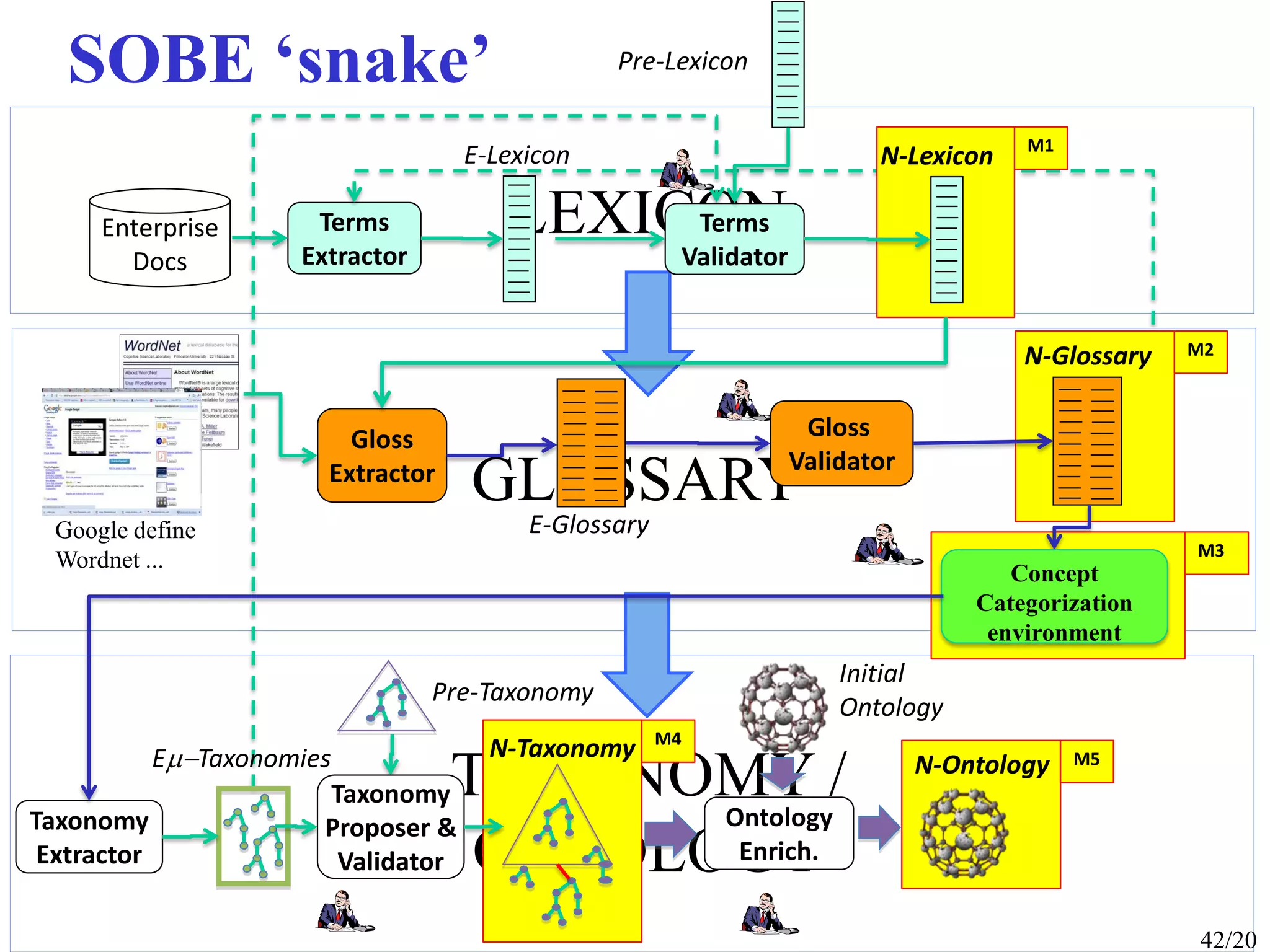
SOBE ‘snake’
Ontology Introduction 42
GLOSSARY
LEXICON
TAXONOMY /
ONTOLOGY
Enterprise
Docs
Terms
Extractor
E-Lexicon
Terms
Validator
N-Lexicon
Pre-Lexicon
M1
Gloss
Validator
N-Glossary M2
Concept
Categorization
environment
M3
N-Ontology
Ontology
Enrich.
Initial
Ontology
M5
Taxonomy
Extractor
Em-Taxonomies
Taxonomy
Proposer &
Validator
Pre-Taxonomy
M4
N-Taxonomy
E-Glossary
Gloss
Extractor
Google define
Wordnet ...
42/20
Collaborative Dimension
Driven by Web 2.0 and social communities
philosophy
• Voting: accept/discard results of the
automatic extraction (lexicon and glossary)
• Proposing: new terms and definitions to be
validated by participants
• Discussing: for reaching an agreement on
glossary definitions (dedicated forums)
Ontology Introduction 43
44
Conclusions
• Semantic Web applications will involve humans (H),
smart objects and devices (O), mainly improving:
– O2O communication and cooperation, when devices interact
to support human activities and goals achievments
– H2O and H2H (tech-enhanced), with digital technology that
will progressively disappear, allowing ‘natural’ interactions
• Semantic Web needs Ontologies to interpret meanings of
(digital) resources
• Ontologies effectiveness depends on representation
languages, reasoning, and collaborative consensus
reaching
Ontology Introduction

M1. sem web & ontology introd

  • 1.
    Collaborative Ontology Engineering andManagement May 20-24, 2013 The Sheraton San Diego Hotel & Marina San Diego, California, USA The 2013 International Conference on Collaboration Technologies and Systems (CTS 2013) Michele Missikoff Polytechnic University of Marche and LEKS-CNR, Italy
  • 2.
    Content • What isan ontology? Why we need them? • The Semantic Web and Social Semantic Networks • On the nature of (computational) knowledge • Conceptual modeling: principles • From perception to representation • Ontology Engineering • The social dimension of Ontology Building And ... • Some practical exercises 2CTS 2013, San Diego
  • 3.
    The Speaker Michele Missikoff •Scientific Advisor at Univ Polytechnic of Marche (Ancona), for the European BIVEE1 Project • Coordinator of Lab for Enterprise Knowledge and Systems, Italian National Research Council • European Task Force Leader of FInES - Future Internet Enterprise Systems Research Roadmap • Professor of Enterprise Information Systems at International University of Rome 3CTS 2013, San Diego (1Business Innovation in Virtual Enteprise Environments)
  • 4.
    4 What is anontology? What is the Semantic Web? Why we need them? Ontology Introduction
  • 5.
    Ontology: Origins andHistory Ontology Introduction 5 • In Philosophy, fundamental branch of metaphysics – Studies “being” or “existence” and their basic categories – Aims to find out what entities and types of entities exist – Identifies and characterises their properties (Credits: I. Horrocks)
  • 6.
    Ontology Introduction 6 Whatis a Computational Ontology? From Philosophy to practical use of an Ontology – It is about what exists, and is relevant for our purposes, in our domain of interest; – Needs the consensus of a group which is representative of the community of interest – Aims at reaching a shared view of the domain of interest – Allows for reduction or elimination of terminological and conceptual confusion An ontology is an evolving repository of relevant concepts, continuously incorporating new meanings from the interaction with the environment
  • 7.
    Ontology Introduction 7 AnOntology is … “… a theory about the nature of beings” (Philosophical view) “… a formal, explicit specification of a shared conceptualisation.” (AI view – T.R. Gruber)* – ‘Formal' refers to the fact that the ontology should be machine understandable. – 'Explicit' means that the type of concepts used and the constraints on their use are explicitly and fully defined. – 'Shared' reflects the notion that ontology captures consensual knowledge, that is, it is not restricted to some individual, but accepted by a group / community. – A 'conceptualisation' refers to an abstract model of some phenomena in the world, it identifies the relevant concepts related to that phenomena. • In formal terms: Ont = (Conc, Rel, Axioms, Inst)
  • 8.
    Ontology Introduction 8 AnOntology is … (con’d) "An ontology defines the common terms and concepts (meaning) used to describe and represent an area of knowledge. An ontology can range in expressivity from a Taxonomy (knowledge with minimal hierarchy or a parent/child structure), to a Thesaurus (words and synonyms), to a Conceptual Model (with more complex knowledge), to a Logical Theory (with very rich, complex, consistent and meaningful knowledge)." [www.omg.org]
  • 9.
    Ontology Introduction 9 Conceptualmodels and ontologies They have common roots, but ... Conceptual Model • Traditionally conceived for inter-human communication • Typically in diagrammatic form (e.g., UML, BPMN) • Semi-formal representation – Formal syntax, but intuitive semantics • Used with a precise goal (e.g., IS engineering) Computational Ontologies • Conceived to be ‘fully’ processed by a computer • Linear (textual) form (supports equivalent diagrammatic forms) • Typically represented with a formal language (e.g., RDF(S), OWL, CG, F-Logic, ...) • Used to represent an application domain, not a specific system
  • 10.
    Ontology Introduction 10 Ontologiesas Social Artefacts • An Ontology is a socio-cultural phenomenon, but we want to describe the concepts in a formal and unambiguous way, processable by a computer An ontology contains: – a set of concepts (e.g., entities, attributes, processes) seen as relevant in a given domain – the definitions and inter-relationships among these concepts – set of Axioms (e.g., constraints) and, in case, instances • To be used by computers, ontologies must – have precise definitions, with a formal semantics (Tarski) – evolve according to an evolving reality and adapt to current needs and usage of both human users and computers – be supported by an Ontology Management System
  • 11.
  • 12.
    Ontology Introduction 12 FirstMotivations When starting a cooperation (to work together or in interacting in social settings), people and organizations may have different: – viewpoints – assumptions – needs about the same domain, due to different contexts, goals, backgrounds and cultures
  • 13.
    13 motivations (cont’d) Furthermore, thefrequent use of different: – jargon – terminology sometimes diverging or overlapping, generate confusion. Even worse, – concepts may be mismatched or ill-defined (e.g., delivery_date). Goal allow people, organizations, computer applications, smart objects to effectively cooperate, despite the mentioned differences • All computers today can communicate, but it does not imply that they cooperate (due to different services & data organization) • People and organizations do communicate and cooperate, but with low automatic support (and several misunderstandings)
  • 14.
    Ontology Introduction 14 CooperationProblems The lack of a shared understanding leads to a poor communication that impacts on: – effectiveness of people’s cooperation – flaws in enterprise operations – even social fragmentation (… tension) When Information Systems Engineering is involved, further problems arise on: – the identification of the requirements for the system specification – potential reuse and sharing of system components – interoperability among systems Then … ONTOLOGIES
  • 15.
    Ontology Introduction 15 Benefitsof Reference Ontologies • Business Opportunity analysis • Partnering • Interoperability • Semantic Knowledge Management • Business / IT Alignment • Social / Shared vision By means of • A collaboration practice for a shared context understanding • Ontology management – Building an EO • Semantic Annotation • Interoperability among legacy systems • Sem Search: exact / approximate • Similarity reasoning
  • 16.
    Ontology Introduction 16 FromTerminlogy to Ontology A First Glimpse on Ontology Engineering
  • 17.
    Ontology Introduction 17 Progressionof Domain specification Lexicon - Set of terms (also multi-word) representing relevant entities and relationships in the domain Glossary - Alphabetically ordered terms, with their descriptions, in natural language. First categorizations according to an Ontology Framework (e.g., OPAL) Taxonomy - hierarchy of terms according to a refinement relation (e.g., ISA) Thesaurus - First introduction of elationships, such as: synonyms, antonyms; BT, NT, RT Semantic Net - Full fledged deployment of Concepts and Relations: Gen/Spec, part of/HasPart, Sim, InstOf, … + domRel
  • 18.
    Ontology Introduction 18 FromTerminology to Ontology Ontology Lexicon Semantic Net Taxonomy / Thesaurus Glossary
  • 19.
    The Societal Dimensionof Ontologies Ontology Introduction 19
  • 20.
    20 The Knowedge Society •European Council: Lisbon Strategy for growth and jobs “Europe needs will achieve the largest and most competitive knowledge-based economy in the planet” • Investing in knowledge and innovation is intended to spur the EU's transition to a knowledge-based and creative economy. • The "fifth freedom" – the free movement of knowledge – should thus be established • Knowledge is a value if embodied in models and practices of the Society and Production systems (…New Economy). (europa.eu/legislation_summaries/employment_and_social_policy/eu2020/growt h_and_jobs/c11806_en.htm) Ontology Introduction
  • 21.
    World is Changing... ...and we need new: • Systems of values • Development models • Social relationships to guarantee sustainability at: – Social, economic, environmental levels Ontology Introduction 21
  • 22.
    22 The Advent ofthe Semantic Web The collaborative, shared dimension of Knowledge: The Semantic Web “The Semantic Web is an extension of the current Web in which information is given well-defined meaning, better enabling computers and people [and Smart Objects] to work in cooperation.” (Tim Berners-Lee, James Hendler and Ora Lassila, The Semantic Web, Scientific American, May 2001) Ontology Introduction
  • 23.
    23 Traditional Web DR1 DR2 DR3 Network Documental Resources (DR):Data, music, pictures, … (HTML, MP3, jpeg, mpeg,…) Computer: management without “understanding” Ontology Introduction
  • 24.
    24 Semantic Web DR2 DR3 Network (HTML) Knowledge Network -RDF, OWL, Rules - Semantics (Ontologies) SR1 SR2 Semantic Resources (SR): Concepts, semantic nets, ontologies, … DR1 KR = SR + DR
  • 25.
    25 Two kind ofresources Documental Resources (DR): Human-oriented information and knowledge Factual K, such as: the Rome Sheraton Hotel has 250 rooms, the prices are… Intensional K: An Hotel is composed by: a reception, some rooms, etc… Procedural K: To make a reservation, prepare first the credit card, then enter the hotel Web site, … Semantic Resources (SR): Knowledge to be ‘understood’ and processed by a computer. x  H, y: hotel(x)  has(x,y)  reception(y)  … Ontology Introduction
  • 26.
    26 Human-readable vs Computer- readable Accordingto Tim Berners-Lee: “Today’s web pages are conceived to be human- readable (in terms of content), we need to find solutions to make them computer-readable.” A technical intuition: • HTML is the language of the Traditional Web, to represent human-oriented hypermedia docs • RDF is the language of the Semantic Web, to represent computer-oriented knowledge Ontology Introduction
  • 27.
    What’s computer ‘readability’? OntologyIntroduction 27 What We Say to Dogs "Stay out of the garbage! Understand, Ginger? Stay out of the garbage!" What Dogs understand "... blah blah blah blah GINGER blah blah blah blah ..."
  • 28.
    28 Functions of theTraditional Web • Keyword-based Information Retrieval • Hypertext Navigation • Manual Classification • Specialised search robots (Softbots, crawlers, ..) ! ? Retrieval quality (precision & recall) inversely proportional to data quantity Ontology Introduction
  • 29.
    29 Functions of thethe Semantic Web • Semantic Information Retrieval • Machine Reasoning • Machine-machine advanced cooperation • Shared Conceptualisations (shared ontologies) with std knowledge representation Retrieval quality directly proportional to knowledge quantity (and reasoning capabilities) Ontology Introduction
  • 30.
  • 31.
    But... What isKnowledge? 31
  • 32.
    32 The dimensions ofknowledge • Level of explicitness (Nonaka, theory of Ba): Tacit, Implicit, Explicit • Addressee (Human, Machine, both) • Level of declarative (vs procedurale) approach • Level of formalization (from NL text to algebra/logics) • Level of abstraction (from factual to conceptual to metaCon) • Synchronic vs Diachronic (Structural vs Behavioural)
  • 33.
    33 Representing Knowledge? Forwhom, for what It depends on the: • Who is the Addressee – for people (easy to read and manipulate) – for machines (easy to process automatically) – to exchange K between people and machines • What Activity it supports (for people and/or computers) – preliminary domain investigation and analysis – decision support and recommender systems – Data mining – detail analysis, design and (sw) implementation – Business transactions – Knoweledge storage and retrieval – Semantic query processing (with reasoning) – Semantic interoperability – Intelligent user interfaces
  • 34.
    34 Level of declarativeness Accordingto the OMG-MDA vision: • Descriptive (Computational Independent Model) – Ex. Class Diagram, abstract Business Process model (EPC, UML, …) • Prescriptive (Platform IM) – Workflow Management System (Savvion, TeamWare, OpenFlow, …), no transaction exec • Operational (P Specific M) – Process/action exec specification (e.g., BPEL, BPMN) – Enterprise Information System, ERP, SCM, …
  • 35.
    35 The three formalisationlevels -Informal: typically textual documents (free or loosely structured text) -Semiformal: diagrams, tables, forms (rigorous structure/syntax, intuitive semantics: UML, EPC, Purchase order, invoice, etc.) -Formal: rigorous specification languages (rigorous syntax and semantics: RDF, OWL, KIF, Z++, PSL/Pi Calculus, Ontolingua, etc.)
  • 36.
    36 The Knowledge Tiers -Factual knowledge: ground information, representing individuals (DB technology) - Conceptual knowledge: representing abstract entities and operations (Enterprise models and IS design blueprints) - Methodological knowledge: representing languages and guidelines for KB construction (knowledge engineering languages methods, metamodels, modeling ideas)
  • 37.
    37 RWO (doc, people,…) Entity Actor Business Object Business ProcessISA person employee ISAPurchase Order Procurement Luigi Bianchi Mario Rossi PO#21 purchasingX Intensional Level (conceptual Model) Extensional Level (factual model) MetaLevel (modeling Metaconcepts) ... Activity Action purchasingY ... IDEA instantiation instantiation Three Abstraction Levels
  • 38.
    38 The Ontology “Chestnut” Upper DomainOntology Application Ontology Lower Domain Ontology Specialization Aggregation The hierarchical organization of an Ontology
  • 39.
    Collaborative Dimension in OntologyEngineering Ontology Introduction 39
  • 40.
    Social Ontology Building andEvolution (SOBE) SOBE supports the building of shared ontologies through: • Automatic knowledge extraction – Analysis of textual documents by using NLP techniques • Social participation – Voting and discussing (forum) for validating and enriching extracted knowledge Ontology Introduction 40
  • 41.
    SOBE Methodology • Step-wiseapproach through five incremental steps (Milestones) – Lexicon (M1): plain list of terms – Glossary (M2): terms + natural language definition – Concept Categorization (M3): in accordance with the OPAL (e.g., Object, Process, Actor) – Taxonomy (M4): definition of ISA hierarchy – Ontology enrichment (M5): additional relationships (e.g., predication, relatedness) Ontology Introduction 41
  • 42.
    SOBE ‘snake’ Ontology Introduction42 GLOSSARY LEXICON TAXONOMY / ONTOLOGY Enterprise Docs Terms Extractor E-Lexicon Terms Validator N-Lexicon Pre-Lexicon M1 Gloss Validator N-Glossary M2 Concept Categorization environment M3 N-Ontology Ontology Enrich. Initial Ontology M5 Taxonomy Extractor Em-Taxonomies Taxonomy Proposer & Validator Pre-Taxonomy M4 N-Taxonomy E-Glossary Gloss Extractor Google define Wordnet ... 42/20
  • 43.
    Collaborative Dimension Driven byWeb 2.0 and social communities philosophy • Voting: accept/discard results of the automatic extraction (lexicon and glossary) • Proposing: new terms and definitions to be validated by participants • Discussing: for reaching an agreement on glossary definitions (dedicated forums) Ontology Introduction 43
  • 44.
    44 Conclusions • Semantic Webapplications will involve humans (H), smart objects and devices (O), mainly improving: – O2O communication and cooperation, when devices interact to support human activities and goals achievments – H2O and H2H (tech-enhanced), with digital technology that will progressively disappear, allowing ‘natural’ interactions • Semantic Web needs Ontologies to interpret meanings of (digital) resources • Ontologies effectiveness depends on representation languages, reasoning, and collaborative consensus reaching Ontology Introduction