London, City University, 19 June 2012


Methods and Tools for Enterprise Innovation in
the Networked Economy: a Knowledge-centric
                Approach.


                 Michele Missikoff
                  LEKS, CNR-IASI
     Polytechnic University of Marche, Ancona
                                                  1
Creditis
• Large part of the content of this talk has been
  elaborated within the European Project BIVEE:
  Business Innovation in Virtual Enterprise
  Environments.
• BIVEE is a 3 years project (ends Aug 2014) with 4.3
  M€ budget and 10 partners :
 Engineering (It)                     UnivPM (It)
 BIBA (De)                            TAL (UK)
 BOC (At)                             SRDC (Tr)
 ATOS (Es)                            AIDIMA (Es)
 CNR (It)                             Loccioni - GI (It)
         Proceedings: http://ceur-ws.org/Vol-864/
Innovation in the Context
Current Scenario – The world, and Western
  economies in particular, are traversing a
  critical phase that requires to enter an era of
  deep changes
The changes will take place along three main
  dimensions:
• The technology dimension
• The socio-economic dimension
• The political dimension (... but I’ll skip this ;-)
                                                        3
Technology dimension
Among the key technological innovations of the
  last period, we may cite:
• Cloud Computing,
• Service Oriented Architectures (SOA) and
  SaaS (Software as a Service),
• Internet of Things and Smart Objects,
• Semantic Web, ontologies, and Linked Data
• Social Media, entering in the enterprise world
                                                   4
Socio-economic dimension
• Western countries cannot continue to grow at the rate
  of the previous decades
• The current development model has reached an end
• Continuous growth of production and consumption
  (and waste disposal) is unbearable
• New value systems are emerging (ref. Stiglitz, Sen,
  Fitoussi report; S.Latouche and the ‘graceful
  degrowth’)
• Towards a development model where the quality of
  life is loosely connected to the possession of goods
• Innovation need to be re-considered in light of the
  above concerns                                       5
Vision
• To overcome the crisis, EU enterprises need a deep
  change
• Introducing continuous improvement and innovation
  to remain competitive in the globalised economy
• Sustainable Innovation rather than expansive
  innovation
• Focusing on Enterprise Software
   – Vital infrastructure for businesses and socio-
     economic systems, but …
   – ‘hindering factor’, wrt the speed and flexibility
     required by markets and business innovation
• We need to put Knowledge in the center, to guarantee
• Continuous alignment of Business needs and
  Enterprise Software Applications in ever changing
  enterprises
1. What is Business Innovation?
Business Innovation is a designed, managed
  transformation of some aspects of the enterprise
  (or the society, the city, etc.) aimed at a
  substantial improvement of:
• the quality of delivery products (goods, services)
  and the customer satisfaction,
• production processes and workers satisfaction
• cost reduction and/or revenue raise
• In a sustainable way (respectful of working
  conditions, social context, environment, ...)
                                                   7
Business Innovation: Where?
• Products (goods / services)
• Production / Admin processes
• HR competencies, skills, capabilities
• Organization models, with new delegation patterns
• Enterprise information organization and flow
• Markets and marketing styles
• Customer relationships
• Suppliers and partners strategies and management
• Technology adoption, deployment, renewal strategies and
  practice
• Financial and control styles, methods, and tools
• Quality of working life and ambient
• Relationships with the territories, the people, the
  environment, local cultures
                                                            8
Business Innovation: How?
Scope
Business Innovation: Goods, Services, Processes with ICT
Approaches
push-mode and technology driven, when generated on
    the supply side;
pull-mode and demand driven, when requested by the
    market/demand side;
co-creation, when all the stakeholders cooperate
    together to generate product or process innovation.
Endogenous, when ideas come from within the
    Ecosystems
Exogenous, when ideas come from the rest of the World
Enabling Business Innovation
• Create the right environment, working conditions
• Grassroots innovation (beyond Toyotism ...)
• Open innovation (but controlled), with systematic and
  ad-hoc relationships with
   – universities , research centres, partners, suppliers and
     customers
• Facilitate info / knowledge / ideas circulation within
  and outside the enterprise
• Culture of cooperation (rewarding system)
• Scouting
   – Technology
   – Market
   – Excellence centres
• Observatories on opportunities, problems, threats, ...        10
On the Nature of Business Innovation
• Innovation ... Is it a process?
• What is its relationship with Knowledge
   Management?
• What is its relationship with Change
   Management?
In essence, it is a Transformation, but in a rather
   fuzzy context:
• Fuzzy starting point (we never fully know the
   reality)
• Fuzzy ending point (is there an end ...?)
• Uncertainty on how to get there ...
                                                      11
The Nature of Business Innovation
• Whatever you innovate, firstly you change your
  behaviours
• Knowledge Management is not sufficient
• You need Knowledge at Work (pargmetics)
                           KW
• Knowledge capable of modifying your working
  style, your environment, your culture, ...
   – HR continuous training, formal and ‘on the job’
• In the Enterprise, KW will modify your
  organization, BP, Info Flow, ... the Value Production
  Space
                                                       12
Innovation           New Knowledge
Knowledge about
• enterprise and its organization
• competencies, skills, and capabilities
• problems and improvement opportunities
• products and services
• Knowledge about the production processes,
  methods
• Technologies, systems, and resources
• Markets, clients, partners and competitors
                                               13
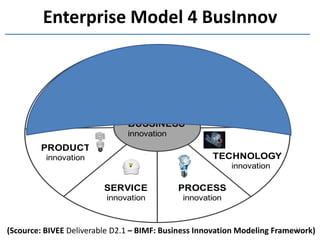
Enterprise Model 4 BusInnov

                               STRATEGY
                                 innovation

          MARKETING
                                                 ORGANIZATIONAL
             innovation
                                                           innovation
                               BUSSINESS
                               innovation
        PRODUCT
          innovation                                 TECHNOLOGY
                                                             innovation

                          SERVICE             PROCESS
                          innovation          innovation


(Scource: BIVEE Deliverable D2.1 – BIMF: Business Innovation Modeling Framework)
                                                                           14
Innovating Innovation

• Towards Open Innovation
• A systematic approach to Innovation,
  nurturing creativity and ideas generation
• Innovation as intangible goods
• ‘Manufacturing’ approach to Innovation
• The need of new production/organization
  models
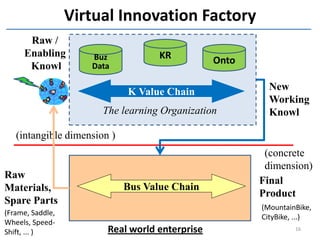
• Virtual Innovation Factory (VIF), operating in
  the Innovation space
                                                   15
Virtual Innovation Factory
      Raw /
     Enabling        Buz            KR          Onto
      Knowl          Data

                             K Value Chain               New
                                                         Working
                       The learning Organization         Knowl

   (intangible dimension )
                                                        (concrete
                                                        dimension)
Raw
                                                       Final
Materials,                   Bus Value Chain
                                                       Product
Spare Parts
                                                       (MountainBike,
(Frame, Saddle,
                                                       CityBike, ...)
Wheels, Speed-
Shift, ... )            Real world enterprise                   16
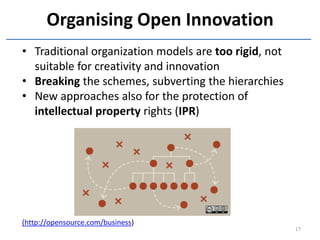
Organising Open Innovation
• Traditional organization models are too rigid, not
  suitable for creativity and innovation
• Breaking the schemes, subverting the hierarchies
• New approaches also for the protection of
  intellectual property rights (IPR)


(http://opensource.com/business)
                                                       17
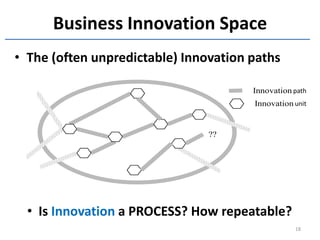
Business Innovation Space
• The (often unpredictable) Innovation paths

                                       Innovation path
                                           link
                                        Innovation unit
                                          Unit

                                ??


  • Is Innovation a PROCESS? How repeatable?
                                                   18
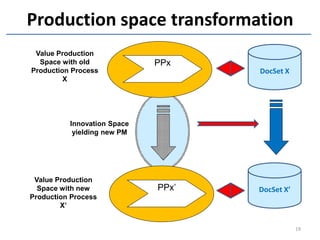
Production space transformation
 Value Production
  Space with old             PPx
Production Process                  DocSet X
         X


          Innovation Space
           yielding new PM


 Value Production
  Space with new             PPx’   DocSet X’
Production Process
        X’


                                                19
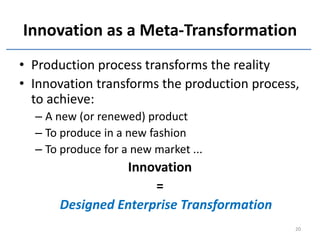
Innovation as a Meta-Transformation
• Production process transforms the reality
• Innovation transforms the production process,
  to achieve:
  – A new (or renewed) product
  – To produce in a new fashion
  – To produce for a new market ...
                Innovation
                     =
      Designed Enterprise Transformation
                                              20
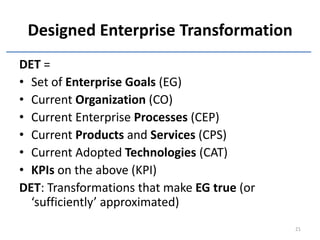
Designed Enterprise Transformation
DET =
• Set of Enterprise Goals (EG)
• Current Organization (CO)
• Current Enterprise Processes (CEP)
• Current Products and Services (CPS)
• Current Adopted Technologies (CAT)
• KPIs on the above (KPI)
DET: Transformations that make EG true (or
  ‘sufficiently’ approximated)
                                             21
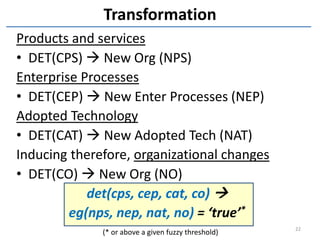
Transformation
Products and services
• DET(CPS)  New Org (NPS)
Enterprise Processes
• DET(CEP)  New Enter Processes (NEP)
Adopted Technology
• DET(CAT)  New Adopted Tech (NAT)
Inducing therefore, organizational changes
• DET(CO)  New Org (NO)
            det(cps, cep, cat, co) 
         eg(nps, nep, nat, no) = ‘true’*
                                                     22
              (* or above a given fuzzy threshold)
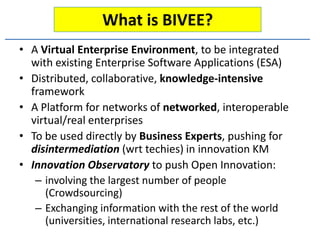
What is BIVEE?
• A Virtual Enterprise Environment, to be integrated
  with existing Enterprise Software Applications (ESA)
• Distributed, collaborative, knowledge-intensive
  framework
• A Platform for networks of networked, interoperable
  virtual/real enterprises
• To be used directly by Business Experts, pushing for
  disintermediation (wrt techies) in innovation KM
• Innovation Observatory to push Open Innovation:
   – involving the largest number of people
     (Crowdsourcing)
   – Exchanging information with the rest of the world
     (universities, international research labs, etc.)
Document-centric approach
• Towards a full digital enterprise, all relevant
  information is digital (see UDE: Unified Digital
  Enterprise, FInES Research Roadmap)
• Everything is documented, by people for people
• What is not documented does not exist ... !!!
• The enterprise knowledge is captured by a wealth
  of document collections (Pre-KB)
• Documents need to be semantically enriched
• Partitioning the Knowledge Space according to
  – document categories
  – Knowledge categories (ontologies)
                                                 24
Enterprise Doc Categories
• Business Doc: describe the business transactions
  (invoice, Req for Quotation, Order, ...)
• Actors & Roles Doc: describe the competencies, skills,
  and capabilities, useful invalue production (Yellow Pg)
• Domain Doc: capture the industry sector (Catalogues,
  BoM, ...)
• Process Doc: describe the production process (plan,
  build, manange, ...)
• Performance Doc: describe the indicators and the
  measuring methods, to keep performance under control
  (measurmenet methods, KPIs, ...)
• Report Doc: all the base studies and reportes necessary
  for value production / innovation (technical reports,
  Feasibility studines, market analysis, ...)             25
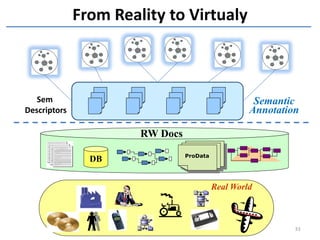
Semantic Doc Management
• Semantic Descriptors of Docs are the missing
  ring between humans and computers
• Docs give account of entities, phenomena and
  manifestations that make sense for humans
  (tech experts, business people, customers and
  suppliers, etc.)
• We need to make such knowledge fully
  available to computers ...
                       
             Let’s go semantics
                                              26
Enterprise Ontologies
• Enterprise Ontologies will reflect the
  knowledge originated within the Enterprise,
  gathered in the Enterprise Docs
• Enterprise Doc are generally complex
  structure whose semantics cannot be
  captured by a single ontology
• There will be primary ontologies and
  complementary ones

                                                27
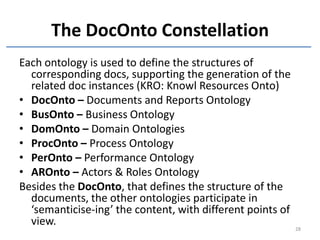
The DocOnto Constellation
Each ontology is used to define the structures of
  corresponding docs, supporting the generation of the
  related doc instances (KRO: Knowl Resources Onto)
• DocOnto – Documents and Reports Ontology
• BusOnto – Business Ontology
• DomOnto – Domain Ontologies
• ProcOnto – Process Ontology
• PerOnto – Performance Ontology
• AROnto – Actors & Roles Ontology
Besides the DocOnto, that defines the structure of the
  documents, the other ontologies participate in
  ‘semanticise-ing’ the content, with different points of
  view.
                                                            28
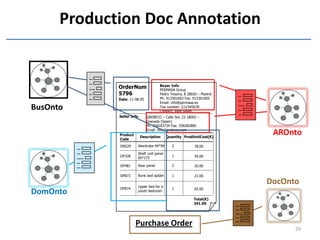
Production Doc Annotation


                                     Buyer Info
             OrderNum                PERMASA Group
             5796                    Pedro Texeira, 8 28020 – Madrid
             Date: 11-08-05          Ph. 913301003 Fax. 913301005
                                     Email: info@permasa.es
BusOnto                              Tax number: G12345678
                                     Contact: John Smith
             Seller Info      GREBECO – Calle Sol, 23 18003 –
                              Granada (Spain)
                              Ph. 958203734 Fax. 558282885
                              Email: info@grebeco.com
             Product
                           Description    Quantity ProdUnitCost(€)
                                                                        AROnto
             Code
             ON229     Wardrobe 49*99        2            78.00

                       Sheft unit panel
             OP328                           1            59.00
                       60*175

             OP481     Rear panel            2            20.00

             OP873     Bunk bed ladder       1            21.00

                       Upper bed for a
                                                                       DocOnto
             OP874                           1            65.00
DomOnto                youth bedroom

                                                         Total(€)
                                                         341.00


                       Purchase Order
                                                                             29
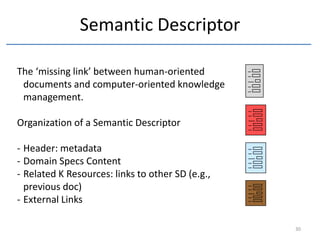
Semantic Descriptor

The ‘missing link’ between human-oriented
 documents and computer-oriented knowledge
 management.

Organization of a Semantic Descriptor

- Header: metadata
- Domain Specs Content
- Related K Resources: links to other SD (e.g.,
  previous doc)
- External Links

                                                  30
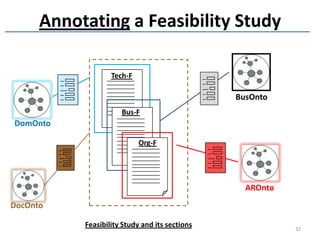
Innovation Doc: Feasibility Study
Is the Innovative Idea (of, e.g., a new product) viable?
• Technical feasibility
   – Design outline: structure, functions, expected
     effectiveness
   – Material costs, Production costs
   – Enabling technology
• Business feasibility
   – Potential market penetration, Production volumes
   – Competitors and Market leaders
   – Value proposition, business model, and SWOT, profitability
• Organizational feasibility
   – Competencies and Capabilities
   – Partnership and Suppliers
   – Resources estimation: time and financial viability       31
Annotating a Feasibility Study

                   Tech-F

                                                BusOnto
                      Bus-F
DomOnto

                            Org-F


                                                  AROnto
DocOnto

           Feasibility Study and its sections              32
From Reality to Virtualy


   Sem                                               Semantic
Descriptors                                         Annotation

                       RW Docs
                                 ProData
                DB


                                           Real World


                                                             33
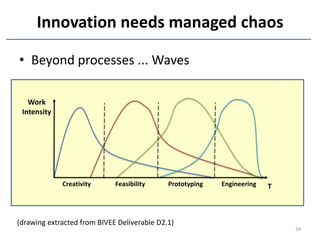
Innovation needs managed chaos

• Beyond processes ... Waves

   Work
 Intensity


             Creativity      Feasibility     Prototyping   Engineering   T


(drawing extracted from BIVEE Deliverable D2.1)
                                                                             34
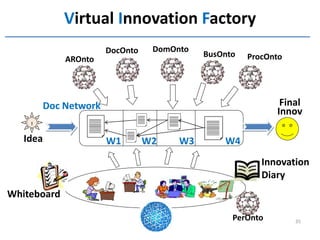
Virtual Innovation Factory
                      DocOnto    DomOnto
                                           BusOnto   ProcOnto
             AROnto


        Doc Network                                         Final
                                                           Innov
    !


   Idea               W1        W2    W3       W4
                                                        Innovation
                                                        Diary
Whiteboard

                                                 PerOnto        35
A platform for open Innovation
 Social Semantic Knowledge Managemet Platform
Social – open to all (up to IPR)
Semantic – a rigorous bases for:
Knowledge – any form of enterprise knowledge:
  documents, minutes, reports, videos, image, ...
Management – advanced services to allow managers
  and innovators to keep under control the evolution
  of the venture
 Current experimentation: Semantic MediaWiki Plus

                                                 36
Conclusions
• The main ideas on a new approach for
  Innovation have been presented
• Future innovation needs to be addressed as a
  Knowledge Management venture
• But traditional KM is not suited for the purpose
• We need to revisiting the existing KM solutions
• Ontologies and Semantic Wikis are promising
  tools, together with social media and
  cooperation tools (in Open Innovation)
• But human intelligence and creativity remains
  the key pillar
                                                     37
Thank you for your attention


    Wake up ... Questions?     38

120619 cul knowledge based bus inno v03

  • 1.
    London, City University,19 June 2012 Methods and Tools for Enterprise Innovation in the Networked Economy: a Knowledge-centric Approach. Michele Missikoff LEKS, CNR-IASI Polytechnic University of Marche, Ancona 1
  • 2.
    Creditis • Large partof the content of this talk has been elaborated within the European Project BIVEE: Business Innovation in Virtual Enterprise Environments. • BIVEE is a 3 years project (ends Aug 2014) with 4.3 M€ budget and 10 partners : Engineering (It) UnivPM (It) BIBA (De) TAL (UK) BOC (At) SRDC (Tr) ATOS (Es) AIDIMA (Es) CNR (It) Loccioni - GI (It) Proceedings: http://ceur-ws.org/Vol-864/
  • 3.
    Innovation in theContext Current Scenario – The world, and Western economies in particular, are traversing a critical phase that requires to enter an era of deep changes The changes will take place along three main dimensions: • The technology dimension • The socio-economic dimension • The political dimension (... but I’ll skip this ;-) 3
  • 4.
    Technology dimension Among thekey technological innovations of the last period, we may cite: • Cloud Computing, • Service Oriented Architectures (SOA) and SaaS (Software as a Service), • Internet of Things and Smart Objects, • Semantic Web, ontologies, and Linked Data • Social Media, entering in the enterprise world 4
  • 5.
    Socio-economic dimension • Westerncountries cannot continue to grow at the rate of the previous decades • The current development model has reached an end • Continuous growth of production and consumption (and waste disposal) is unbearable • New value systems are emerging (ref. Stiglitz, Sen, Fitoussi report; S.Latouche and the ‘graceful degrowth’) • Towards a development model where the quality of life is loosely connected to the possession of goods • Innovation need to be re-considered in light of the above concerns 5
  • 6.
    Vision • To overcomethe crisis, EU enterprises need a deep change • Introducing continuous improvement and innovation to remain competitive in the globalised economy • Sustainable Innovation rather than expansive innovation • Focusing on Enterprise Software – Vital infrastructure for businesses and socio- economic systems, but … – ‘hindering factor’, wrt the speed and flexibility required by markets and business innovation • We need to put Knowledge in the center, to guarantee • Continuous alignment of Business needs and Enterprise Software Applications in ever changing enterprises
  • 7.
    1. What isBusiness Innovation? Business Innovation is a designed, managed transformation of some aspects of the enterprise (or the society, the city, etc.) aimed at a substantial improvement of: • the quality of delivery products (goods, services) and the customer satisfaction, • production processes and workers satisfaction • cost reduction and/or revenue raise • In a sustainable way (respectful of working conditions, social context, environment, ...) 7
  • 8.
    Business Innovation: Where? •Products (goods / services) • Production / Admin processes • HR competencies, skills, capabilities • Organization models, with new delegation patterns • Enterprise information organization and flow • Markets and marketing styles • Customer relationships • Suppliers and partners strategies and management • Technology adoption, deployment, renewal strategies and practice • Financial and control styles, methods, and tools • Quality of working life and ambient • Relationships with the territories, the people, the environment, local cultures 8
  • 9.
    Business Innovation: How? Scope BusinessInnovation: Goods, Services, Processes with ICT Approaches push-mode and technology driven, when generated on the supply side; pull-mode and demand driven, when requested by the market/demand side; co-creation, when all the stakeholders cooperate together to generate product or process innovation. Endogenous, when ideas come from within the Ecosystems Exogenous, when ideas come from the rest of the World
  • 10.
    Enabling Business Innovation •Create the right environment, working conditions • Grassroots innovation (beyond Toyotism ...) • Open innovation (but controlled), with systematic and ad-hoc relationships with – universities , research centres, partners, suppliers and customers • Facilitate info / knowledge / ideas circulation within and outside the enterprise • Culture of cooperation (rewarding system) • Scouting – Technology – Market – Excellence centres • Observatories on opportunities, problems, threats, ... 10
  • 11.
    On the Natureof Business Innovation • Innovation ... Is it a process? • What is its relationship with Knowledge Management? • What is its relationship with Change Management? In essence, it is a Transformation, but in a rather fuzzy context: • Fuzzy starting point (we never fully know the reality) • Fuzzy ending point (is there an end ...?) • Uncertainty on how to get there ... 11
  • 12.
    The Nature ofBusiness Innovation • Whatever you innovate, firstly you change your behaviours • Knowledge Management is not sufficient • You need Knowledge at Work (pargmetics) KW • Knowledge capable of modifying your working style, your environment, your culture, ... – HR continuous training, formal and ‘on the job’ • In the Enterprise, KW will modify your organization, BP, Info Flow, ... the Value Production Space 12
  • 13.
    Innovation New Knowledge Knowledge about • enterprise and its organization • competencies, skills, and capabilities • problems and improvement opportunities • products and services • Knowledge about the production processes, methods • Technologies, systems, and resources • Markets, clients, partners and competitors 13
  • 14.
    Enterprise Model 4BusInnov STRATEGY innovation MARKETING ORGANIZATIONAL innovation innovation BUSSINESS innovation PRODUCT innovation TECHNOLOGY innovation SERVICE PROCESS innovation innovation (Scource: BIVEE Deliverable D2.1 – BIMF: Business Innovation Modeling Framework) 14
  • 15.
    Innovating Innovation • TowardsOpen Innovation • A systematic approach to Innovation, nurturing creativity and ideas generation • Innovation as intangible goods • ‘Manufacturing’ approach to Innovation • The need of new production/organization models • Virtual Innovation Factory (VIF), operating in the Innovation space 15
  • 16.
    Virtual Innovation Factory Raw / Enabling Buz KR Onto Knowl Data K Value Chain New Working The learning Organization Knowl (intangible dimension ) (concrete dimension) Raw Final Materials, Bus Value Chain Product Spare Parts (MountainBike, (Frame, Saddle, CityBike, ...) Wheels, Speed- Shift, ... ) Real world enterprise 16
  • 17.
    Organising Open Innovation •Traditional organization models are too rigid, not suitable for creativity and innovation • Breaking the schemes, subverting the hierarchies • New approaches also for the protection of intellectual property rights (IPR) (http://opensource.com/business) 17
  • 18.
    Business Innovation Space •The (often unpredictable) Innovation paths Innovation path link Innovation unit Unit ?? • Is Innovation a PROCESS? How repeatable? 18
  • 19.
    Production space transformation Value Production Space with old PPx Production Process DocSet X X Innovation Space yielding new PM Value Production Space with new PPx’ DocSet X’ Production Process X’ 19
  • 20.
    Innovation as aMeta-Transformation • Production process transforms the reality • Innovation transforms the production process, to achieve: – A new (or renewed) product – To produce in a new fashion – To produce for a new market ... Innovation = Designed Enterprise Transformation 20
  • 21.
    Designed Enterprise Transformation DET= • Set of Enterprise Goals (EG) • Current Organization (CO) • Current Enterprise Processes (CEP) • Current Products and Services (CPS) • Current Adopted Technologies (CAT) • KPIs on the above (KPI) DET: Transformations that make EG true (or ‘sufficiently’ approximated) 21
  • 22.
    Transformation Products and services •DET(CPS)  New Org (NPS) Enterprise Processes • DET(CEP)  New Enter Processes (NEP) Adopted Technology • DET(CAT)  New Adopted Tech (NAT) Inducing therefore, organizational changes • DET(CO)  New Org (NO) det(cps, cep, cat, co)  eg(nps, nep, nat, no) = ‘true’* 22 (* or above a given fuzzy threshold)
  • 23.
    What is BIVEE? •A Virtual Enterprise Environment, to be integrated with existing Enterprise Software Applications (ESA) • Distributed, collaborative, knowledge-intensive framework • A Platform for networks of networked, interoperable virtual/real enterprises • To be used directly by Business Experts, pushing for disintermediation (wrt techies) in innovation KM • Innovation Observatory to push Open Innovation: – involving the largest number of people (Crowdsourcing) – Exchanging information with the rest of the world (universities, international research labs, etc.)
  • 24.
    Document-centric approach • Towardsa full digital enterprise, all relevant information is digital (see UDE: Unified Digital Enterprise, FInES Research Roadmap) • Everything is documented, by people for people • What is not documented does not exist ... !!! • The enterprise knowledge is captured by a wealth of document collections (Pre-KB) • Documents need to be semantically enriched • Partitioning the Knowledge Space according to – document categories – Knowledge categories (ontologies) 24
  • 25.
    Enterprise Doc Categories •Business Doc: describe the business transactions (invoice, Req for Quotation, Order, ...) • Actors & Roles Doc: describe the competencies, skills, and capabilities, useful invalue production (Yellow Pg) • Domain Doc: capture the industry sector (Catalogues, BoM, ...) • Process Doc: describe the production process (plan, build, manange, ...) • Performance Doc: describe the indicators and the measuring methods, to keep performance under control (measurmenet methods, KPIs, ...) • Report Doc: all the base studies and reportes necessary for value production / innovation (technical reports, Feasibility studines, market analysis, ...) 25
  • 26.
    Semantic Doc Management •Semantic Descriptors of Docs are the missing ring between humans and computers • Docs give account of entities, phenomena and manifestations that make sense for humans (tech experts, business people, customers and suppliers, etc.) • We need to make such knowledge fully available to computers ...  Let’s go semantics 26
  • 27.
    Enterprise Ontologies • EnterpriseOntologies will reflect the knowledge originated within the Enterprise, gathered in the Enterprise Docs • Enterprise Doc are generally complex structure whose semantics cannot be captured by a single ontology • There will be primary ontologies and complementary ones 27
  • 28.
    The DocOnto Constellation Eachontology is used to define the structures of corresponding docs, supporting the generation of the related doc instances (KRO: Knowl Resources Onto) • DocOnto – Documents and Reports Ontology • BusOnto – Business Ontology • DomOnto – Domain Ontologies • ProcOnto – Process Ontology • PerOnto – Performance Ontology • AROnto – Actors & Roles Ontology Besides the DocOnto, that defines the structure of the documents, the other ontologies participate in ‘semanticise-ing’ the content, with different points of view. 28
  • 29.
    Production Doc Annotation Buyer Info OrderNum PERMASA Group 5796 Pedro Texeira, 8 28020 – Madrid Date: 11-08-05 Ph. 913301003 Fax. 913301005 Email: info@permasa.es BusOnto Tax number: G12345678 Contact: John Smith Seller Info GREBECO – Calle Sol, 23 18003 – Granada (Spain) Ph. 958203734 Fax. 558282885 Email: info@grebeco.com Product Description Quantity ProdUnitCost(€) AROnto Code ON229 Wardrobe 49*99 2 78.00 Sheft unit panel OP328 1 59.00 60*175 OP481 Rear panel 2 20.00 OP873 Bunk bed ladder 1 21.00 Upper bed for a DocOnto OP874 1 65.00 DomOnto youth bedroom Total(€) 341.00 Purchase Order 29
  • 30.
    Semantic Descriptor The ‘missinglink’ between human-oriented documents and computer-oriented knowledge management. Organization of a Semantic Descriptor - Header: metadata - Domain Specs Content - Related K Resources: links to other SD (e.g., previous doc) - External Links 30
  • 31.
    Innovation Doc: FeasibilityStudy Is the Innovative Idea (of, e.g., a new product) viable? • Technical feasibility – Design outline: structure, functions, expected effectiveness – Material costs, Production costs – Enabling technology • Business feasibility – Potential market penetration, Production volumes – Competitors and Market leaders – Value proposition, business model, and SWOT, profitability • Organizational feasibility – Competencies and Capabilities – Partnership and Suppliers – Resources estimation: time and financial viability 31
  • 32.
    Annotating a FeasibilityStudy Tech-F BusOnto Bus-F DomOnto Org-F AROnto DocOnto Feasibility Study and its sections 32
  • 33.
    From Reality toVirtualy Sem Semantic Descriptors Annotation RW Docs ProData DB Real World 33
  • 34.
    Innovation needs managedchaos • Beyond processes ... Waves Work Intensity Creativity Feasibility Prototyping Engineering T (drawing extracted from BIVEE Deliverable D2.1) 34
  • 35.
    Virtual Innovation Factory DocOnto DomOnto BusOnto ProcOnto AROnto Doc Network Final Innov ! Idea W1 W2 W3 W4 Innovation Diary Whiteboard PerOnto 35
  • 36.
    A platform foropen Innovation Social Semantic Knowledge Managemet Platform Social – open to all (up to IPR) Semantic – a rigorous bases for: Knowledge – any form of enterprise knowledge: documents, minutes, reports, videos, image, ... Management – advanced services to allow managers and innovators to keep under control the evolution of the venture Current experimentation: Semantic MediaWiki Plus 36
  • 37.
    Conclusions • The mainideas on a new approach for Innovation have been presented • Future innovation needs to be addressed as a Knowledge Management venture • But traditional KM is not suited for the purpose • We need to revisiting the existing KM solutions • Ontologies and Semantic Wikis are promising tools, together with social media and cooperation tools (in Open Innovation) • But human intelligence and creativity remains the key pillar 37
  • 38.
    Thank you foryour attention Wake up ... Questions? 38